“You may go; as you have believed let it be done for you.”

The centurion said in reply, “Lord, I am not worthy to have you enter under my roof; only say the word and my servant will be healed” (Mt 8:8).

After Jesus finishes his Sermon on the Mount, he comes down from the mountain. In the opening of chapter eight, we see two hearts open to God, a leper (who is not included in today’s reading but you can see his encounter with Jesus by reading Mt. 8:1-4.) and a centurion. The centurion may or may not have been a Roman but he certainly was a Gentile. He, a member of an occupying army, was aware of the animosity many Jews felt toward him. Yet he, like the leper, approached Jesus.

Jesus saw in the leper, not revulsion, and in the centurion, not an enemy, but first and foremost, human beings in need, two persons with faith and belief. Reading on we see that Jesus also heals the mother-in-law of Peter and many who are possessed. Jesus reached out to them with a simple touch of his hand, with his healing words and in so doing brought to each of them the healing they sought. Jesus shows us that the kingdom of his Father is open to all who have faith and believe.

Jesus said to the centurion, “You may go; as you have believed let it be done for you” (Mt. 8:13). Do we have the same belief as the leper, the centurion, and Peter’s mother-in-law? Each of them believed in Jesus and experienced healing.

We are all wounded by sin and also in need of experiencing physical, psychological, and/or spiritual healing.  Jesus is just waiting for us to ask, and to open our hearts and minds to him, so that we too may be healed and transformed by his forgiveness, love, and mercy. We, like the centurion and Peter, can approach Jesus on behalf of others who are also in need of healing. Let us resist the temptation to judge anyone as unworthy to receive the grace, love, and mercy of Jesus but be willing to see others in need and bring Jesus to them.

As God brings people into our lives, let us receive them as Jesus did: as fellow human beings, first and foremost, created in his image and likeness. May we be healed from any revulsion, prejudice, or temptation to define others with labels and instead be willing to allow Jesus to reach out through us to share his healing word or extend his healing touch to one another. Let us believe in Jesus, be healed and help to heal others!


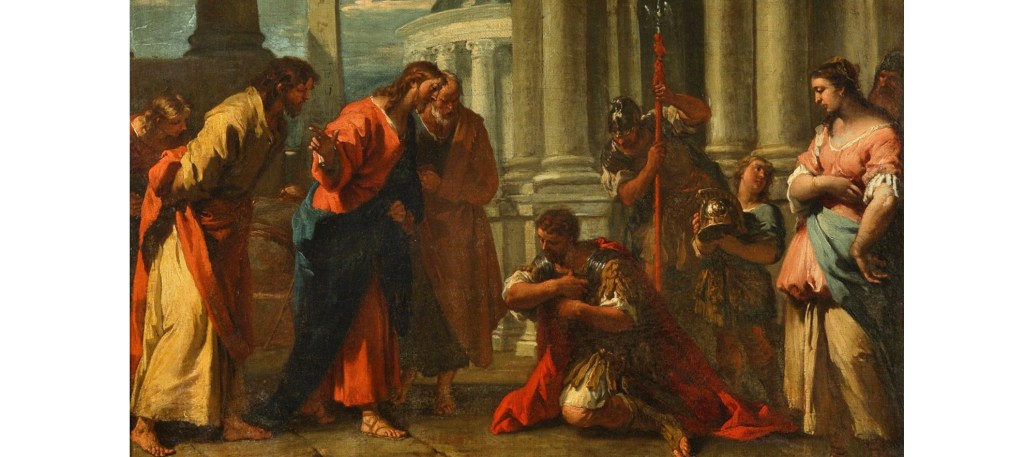
Painting: Sebastiano Ricci, “Christ and Centurion”, 16th century, Italy

Link for the Mass readings for Saturday, June 28, 2025

Jesus is willing to save the one.

“What man among you having a hundred sheep and losing one of them would not leave the ninety-nine in the desert and go after the lost one until he finds it” (Lk 15:4)?

At first hearing, how many of those present hearing the parable, or us today reading it, would answer yes? To most of us it would not make sense to leave the ninety-nine to go and search for the one that was lost.

What this parable represents is the love that God has for each and everyone of us. He knows us better than we know ourselves. God loves us with an everlasting love and is continually reaching out to us because he is the foundation and source of who we are. He wills our good and wants the best for us, even when we may not see the truth. This parable also represents a microcosm of the public ministry of Jesus.

Jesus met people one on one, person to person. He encountered the blind, the lame, the leper, the Syrophoenician woman, the woman at the well, the woman accused of adultery, the daughter of Jairus, the widow’s son, and Lazarus. Jesus not only healed these people and so many others who were considered to be on the outside looking in, he restored their dignity as human beings. Jesus loved each of them as a unique person.

In crafting this parable of the good shepherd seeking the lost sheep, Jesus may be echoing, Isaiah. He prophesied that because the leadership of his time was not bringing back the stray nor seeking out the lost, God would “appoint one shepherd over them, to pasture them” (See Ezekiel 34:23). Jesus sought out and continues to seek out the lost, no matter how far we have strayed, or messed up, Jesus loves comes for us.

He opens his arms and invites us into his loving embrace so that we may feel and experience the beating of his Sacred Heart. As we enter into that sacred rhythm, all our anxiety, fears, and pain begin to fade away and we begin to heal. We begin to experience our dignity as we experience being loved for who we are, not defined by our worst sins nor by what we do.

We just need to be willing to be found and allow him to lift us up on his shoulders and carry us back into the fold. As we do so and as we continue to experience his love, we will come to believe and say, as did St Paul,“Who can separate us from the love of Christ? Trial, or distress, or persecution, or hunger, or nakedness, or danger, or the sword?… Yet in all this we are more than conquerors because of him who has loved us” (cf. Romans 8:35-37).

Once we slow down enough to place our head on the chest of and experience the beating of the Sacred Heart of Jesus, renew in the rhythm of it, we will experience his peace and rest. We too are to love with the same radical love of the Shepherd who left the ninety-nine to rescue the one, who just happens to be us if we are willing to be rescued.

—————————————————–

Photo: Stain glass window at Cathedral of Our Lady of the Angels, Los Angeles, CA

Link for the Mass readings for Friday, June 27, 2025, Solemnity of the Sacred Heart of Jesus

Let us build our spiritual homes on the love of the Father, the Son, and the Holy Spirit.

“Everyone who listens to these words of mine and acts on them will be like a wise man who built his house on rock” (Mt 7:24).

Jesus speaks to us: in the Gospels, in the silence of our hearts, through our conscience, through the words of others, in our daily activities, and through creation which has been loved into existence through collaboration with his Father and the Holy Spirit.

We can be unaware of the words he speaks, we can hear his words but not listen, hear his words but ignore, listen but not act upon them, or we can do with his words as Jesus encourages us to do. We can listen to his words and put them into action. We can experience the gentle nudge of the Holy Spirit and follow his lead. When we follow the urgings of Jesus and the Holy Spirit, no matter how small of a nudge it is, that step in alignment with the Father’s love will make all the difference. For each affirmation and putting into action their guidance helps us to experience the love of God our Father.

Jesus became one with us so that we can share in the love of his Father. Not one with us, so that we can know about him. Not one with us, so that we can say that we prophesy, cast out demons, do mighty works, cite Bible chapter and verse to show our knowledge or justify our behavior in his name. One with us so that we can share in the very life of God the Father as he and the Spirit does. 

Jesus meets us on our level and when we are willing to follow his lead, he will lead us up to the heights of participating in his divine life. Jesus has been doing just that in his Sermon on the Mount which we have been reflecting upon these past few weeks. If you are just coming in today or need a refresher, this gathering of teachings began in chapter five of Matthew and takes us up to today with chapter seven. Jesus presented us with the Beatitudes, that we are called to be salt and light, he built on the law and the prophets by giving us the six antitheses (“You have heard it said, but I say to you…” statements), he taught us to pray the Our Father, that we are to depend and place our trust in God and not the things of this world, we are to refrain from judging others, we are not to cast our pearls before swine, we are to do to others as we would have them do to us, we are to seek to enter through the narrow gate, and to be aware of false prophets.

The teachings of Jesus in chapters five, six, and seven of Matthew, his Sermon on the Mount, put into practice will help us to build the foundation of our spiritual houses on solid rock. The same rock that Peter built his foundation on, the Christ the Son of the Living God. May we go back through chapters five, six, and seven of Matthew and see which teaching Jesus is leading us to ponder, meditate upon, put into action, and place our next foundational stone of discipleship.

If that is a bit much, we can start with St. Irenaeus who learned from St. Polycarp, who learned from the beloved Apostle John who learned from Jesus. St. Irenaeus taught that Jesus became one with us so that we can become one with him. Jesus entered our humanity so that we can participate in his divinity. Jesus invites us to be in relationship with him, to know him, so that we can know his Father and experience the love of the Holy Spirit that he wants to share with us. The goal is that we can be one as Jesus and the Father is one.

Jesus loves us as we are, and for who we are, right now at this very moment. Jesus loves us more than we can ever imagine. Jesus loves us so much, he invites us to repent and turn away from anyone and anything that may be leading us away from God. He invites us to turn back and walk in the direction of the Father’s arms that are wide open to embrace us. When we experience God’s loving embrace, may we rest there, savor, and abide in his love. Filled up with his love to overflowing, we have a wonderful gift to share.


Photo: The Sanctuary of Madonna della Corona in the province of Verona, Italy. Photo accessed from Italiabsolutely

Link for the Mass readings for Thursday, June 26, 2025

Want to know Jesus? Spend some time daily with him in the Gospels.

“Beware of false prophets, who come to you in sheep’s clothing, but underneath are ravenous wolves. By their fruits you will know them” (Mt 7:15-16).

So as not to be taken in by false prophets within in our Church and society, and most importantly, so as not to be wolves in sheep’s clothing ourselves, we need to know the Shepherd. We need to know, as St Irenaeus (whose feast we celebrate on Saturday the 28th) described: Jesus, “who did, through His transcendent love, become what we are, that He might bring us to be even what He is Himself” (p. 526 Against Heresies, Book V, Introduction). Jesus Christ, the second person of the Trinity, who entered into and embraced our fallen and wounded condition to become fully human while remaining fully divine, came to shine a light in our lives.

Jesus came to reveal those sinful acts which estrange us from God and one another. Jesus came to show us the value of our unique dignity as human beings, the wonder of God’s creation that we are, and empower us so we may restore our likeness to God and deepen our relationship with God and one another. In allowing Jesus to come close to us and getting to know him, he through his love and light, will reveal to us those road blocks that prevent us from following his way.

How can we know Jesus today since we are removed from the time of the Apostles?

One practice is to follow the encouragement of Pope Francis who invited us to read and prayerfully reflect upon the Gospels each day and Pope Leo XIV who in his first audience on May 21 said that, “every word of the Gospel is like a seed that is thrown on the ground of our life.” Especially, during this Season of Ordinary Time we may receive these “seeds”, the teachings of Jesus, through the daily Mass readings. Reading them on our own is a powerful daily practice that allows us to come to not just know about Jesus and his teachings but to know him.

This does not happen by just reading the words on the page with the sole intent to finish it and move on to something else, so as to complete one more task. Instead we are invited to read slowly, meditatively, and prayerfully. We can read a section as in today’s Gospel about knowing true disciples from false prophets. Reading through a section three to four times or more until we feel a movement within from the Holy Spirit guiding us to ponder a particular verse or word is helpful.

We then stay there with Jesus by mediating on a word or phrase from the Gospel that peaks our attention. We may receive an insight, an intuition, a confirmation, a sense of excitement, a challenge, or a question. We can also be confused, perplexed, or frustrated. We can also place ourselves in the scene as if we are watching a movie and allow through our imagination our senses to come alive and pay attention to what arises.

Another gift of encountering Jesus in the Gospels, that some may not recognize as a gift, is that we will naturally be drawn to examine our conscience as we read and ponder the life and teachings of Jesus. We don’t have to read long to experience how challenging Jesus’ teachings are. In pondering today’s account about a bad tree bearing bad fruit, some of our own bad fruit may come to light: selfishness, greed, judgment, gluttony, lust, pride, indifference, sloth, envy, wrath, or others.

This in not an invitation to experience shame. This is Jesus’ invitation to identify, repent, and confess and to turn to God to receive his forgiveness, mercy, and love so that we can be transformed. Jesus’ call to repentance is an invitation to prune those branches within us that bear such fruits. The discipline of repentance and confession that leads to pruning will provide more energy and nourishment for those good branches we have so they may flourish with the fruits of love, joy, peace, patience, kindness, chastity, goodness, generosity and self-control.

It is important to sit with what we experience from a meditative and prayerful reading of the Gospels. The Holy Spirit will reveal insights and experiences of consolation and joy. It is just as important to be willing to wrestle with passages that challenge us, that we do not understand, or disagree with. Each experience provides us with the opportunity to ponder and discern what God seeks to reveal to us.

Through a daily commitment of reading, meditating upon, praying with, and allowing the Gospels to come alive in our hearts, minds, and souls, we be drawn to deeper moments of quiet contemplation, and we will encounter and grow in our relationship with Jesus, Mary, and the apostles. That which we have received in each prayerful time of reading, we can then carry with us throughout the day to call upon and experience rest with him as needed.

I have been drawn to remain with and pray with the same verse for the past week during my holy hour:  Jesus, “went up on the mountain by himself to pray. When it was evening he was there alone” (Matthew 14:23). I have been seeking to put God first in my life more and more, and letting go of any attachments and disordered affections that may be leading me astray. What a gift Jesus has given me to step away for an hour each day to go up on the mountain and pray with him.

As we experience the Gospels with a pondering and prayerful approach, we will grow in our relationship with Jesus and know his voice. With his guidance we will better identify those apparent goods, temptations, and false prophets who seek to lead us astray. In trusting in, being obedient to, and putting into practice Jesus’ teachings, we will better know the truth of who we are and who God calls us to be. As we grow in our relationship with Jesus we will not lead others astray but help them to encounter Jesus so that they too may experience his love, mercy, forgiveness, and rest for their souls.


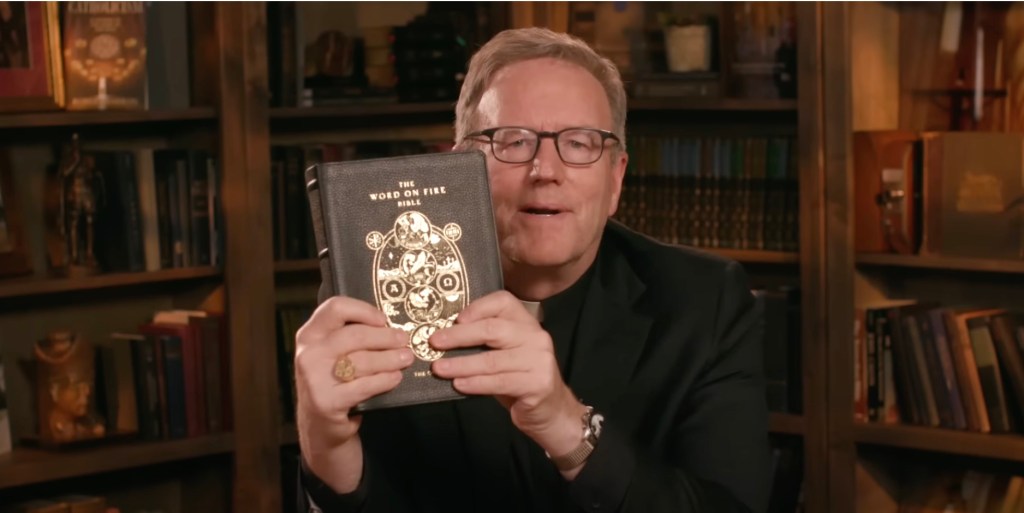
Photo: Bishop Barron link captured from YouTube introducing the Word on Fire Bible, Volume I: The Gospels. I have found the Word on Fire Bible a great resource for reading, prayer, and study. Also, great for those who are just beginning or are looking to return to reading and praying with the Bible.

Link for the Mass readings for Wednesday, June 25, 2025
“He must increase; I must decrease.” John 3:30

“No. He will be called John” (Lk 1:60).

With these simple words, three inter-related points arise. First, Elizabeth is beginning to shift the momentum of original sin. Eve was tempted by the serpent to eat of the fruit that God had told her and Adam not to eat of, yet she did. Adam did not support her nor step in protect Eve during her dialogue but remained silent in the face of temptation Eve was experiencing. Both of them slipped into sin by disobeying the will of God and grasping for what God would have given to them if they were willing to receive their fulfillment of participating in his divinity.

At the time of the birth of Elizabeth’s son, there was even more cause for celebration, for Elizabeth had not born a child and was past child-bearing years. The eighth day had come in which following the Abrahamic law the boy was to be circumcised and named. Her relatives and neighbors gathered around with great excitement and there appeared to be a unanimous decision to name the boy after his father. Elizabeth did not, like Eve, cave to the pressure and temptation surrounding her. Unlike Adam who lost his voice at the time he needed to speak up, Zechariah found his voice, and had Elizabeth’s back. Both Elizabeth and Zechariah knew what God wanted them to do and were faithful to follow through.

Elizabeth and Zechariah were faithful to God even while facing the familial and social pressure placed on them. Some today may be removed by such familial pressure when naming a child, but for this time, Elizabeth, despite the pressure, held her ground and stood firm that the boy would be named John. Ignoring her, the people deferred to Zechariah, the boy’s father, thinking he would have more sense, but he, ignoring supported Elizabeth. The point here is not so much the name, but the following God’s will in the face of pressure to do the opposite.

This brings us to the third point and that is the maturation in moving from identity to integrity. Culture and traditions are not sacred, but God is. Elizabeth and Zechariah faced a lot of familial and social pressure to conform, yet they chose to be true to God, to be true to themselves, and they chose integrity over their identity.

The very simple account of Elizabeth and Zechariah naming their child John in opposition to the pressure offers for us a way to counteract the rising tide of polarization and conflicts that we face in our own country today. Identity provides safety, support, and security. It fuels one of our deepest pangs of hunger to belong, to be a part of something bigger than ourselves. We can find our identity in family, friendships, our religious traditions, culture, political affiliations, common interests, clubs, activities, hobbies, and sports. Our identity in these cultural norms, provides us with security and stability, which is good, but doing so can also be a trap.

We want to belong so much, the drive is so strong, that we may feel the pressure to make decisions, act in certain ways, and support others who go against who we are just so that we can belong. We may have known what God wants from us in a particular situation, heard the whispers of his voice in our conscience, yet were pulled by the louder voices of the group. We are sometimes so ingrained by our identity that we can be strangled and suffocated by it.

In today’s Gospel account, Elizabeth and Zechariah were true to the will of God and won over those placing pressure on them by their family and neighbors. More often though, being a person of integrity does not go so well. Their own son who would grow up to be John the Baptist, would lose his life by speaking truth to power.

John would also show his integrity when he said, “He must increase; I must decrease” (cf. John 3:30). John was talking about Jesus who embodied the moral courage that we all need today. Though more than just a model of a life well-lived, more than just a word on the page, Jesus is the Word of God embodied. Jesus is present to us now, to guide and lead us, to empower us with the same love that he embodies, such that when we invite him into our lives, we too can be transformed to live a life of truth, moral courage, and integrity.

Allowing ourselves, like John the Baptist did, to become less so that Jesus can be more in our lives, aligns ourselves with being disciples of Jesus. We are not to be first but God is. We come to this awareness through the process of repentance and being willing to read, pray, and meditate with Jesus’ teachings and put them into practice. As we prioritize our days by setting up those non-negotiable practices that help our relationship with Jesus to grow, we will begin to better resist internal temptations as well as the external temptations from the enemy and others and grow in the courage to live out our faith in real time in our daily interactions.

————————————————————————–

Photo: Painting by Mattia Pretti of John the Baptist preaching of the coming of Jesus, the Lamb of God who takes away the sins of the world.

Link for the Mass readings for Tuesday, June 24, 2025

When there appears to be no way, trust in Jesus the Way.

Luke records how Jesus had been teaching and healing a large crowd of five thousand men. As the day was drawing to a close, the Twelve approached him and said, “Dismiss the crowd so that they can go to the surrounding villages and farms and find lodging and provisions; for we are in a deserted place here” (Lk 9:12). The disciples appear to show concern for the many gathered. Yet the response of Jesus may reveal otherwise.

When Jesus tells them to, “Give them some food yourselves” (Lk 9:13), the disciples are stymied, for all that they had, five loaves and two fish, would barely be just enough to feed themselves. The disciples first sought to send the people away, then could see nothing but the limited resources they had, they saw lack.

What follows is the miracle of the multiplication of the loaves and the fish such that everyone present had enough to eat. “They all ate and were satisfied. And when the leftover fragments were picked up, they filled twelve wicker baskets” (Lk 9:17). This miraculous account is recorded in all four Gospels. Time and again, throughout the Gospel accounts, Jesus is  able to provide a way where there appeared to be no way.

It is interesting as well that the word the disciples used, deserted, for we are in a deserted place, is erēmos in Greek. The immediate allusion is to the Hebrews who Moses had freed from Egypt. They too were in the deserted place, the wilderness. They also say their lack and constantly grumbled to Moses that they didn’t have enough and yet, God consistently provided for them bread from Heaven, the manna. Each day they did have enough to eat.

Erēmos can also be translated as lonely, a lonely place. One thing that is common among all of humanity is that we all experience loneliness. This is partly true because we separate ourselves from the deepest desire and hunger of our soul, our hunger to be loved by God. When we allow anyone or anything to be placed before our relationship with God, we will always experience a lack because only our relationship with God will truly satisfy us. Even the best of relationships, the best of things are finite, and will not last. In establishing and developing our relationship with God, all our other relationships and appetites can be properly ordered.

The next time, we feel like we can’t, we want to give up, we feel alone or are experiencing desolation, let us turn to our loving God and Father who will provide for our needs. He provides for us at every Mass the opportunity to experience his Son, the true miracle of bread and wine becoming the Body and Blood of Jesus the Christ. We can be nourished weekly, even daily, by the “source and summit of the whole Christine life” (Lumen Gentium) so that we can have the strength to persevere, that we can persevere, we know that we really and truly are never alone, and our desolation can be transformed into consolation by experiencing the love of the Holy Spirit.

Let us not buy into the lie of lack. Where his disciples saw lack, Jesus saw a way provided for by trusting in his Father and he multiplied the five loaves so the 5,000 all had their fill. We are finite human beings living in a finite world, yet we are not alone. Jesus, fully human and fully divine, continues to still be with us, present to us, just as he was with his disciples. As with them, when we trust in Jesus, all things are possible. When there appears to be no way, Jesus is the way. “When we give ourselves to Him, we receive a hundredfold in return. Yes, open wide the doors to Christ – and you will find true life” (Pope Benedict XVI in his inaugural homily, Sattler). Trust in Jesus today!


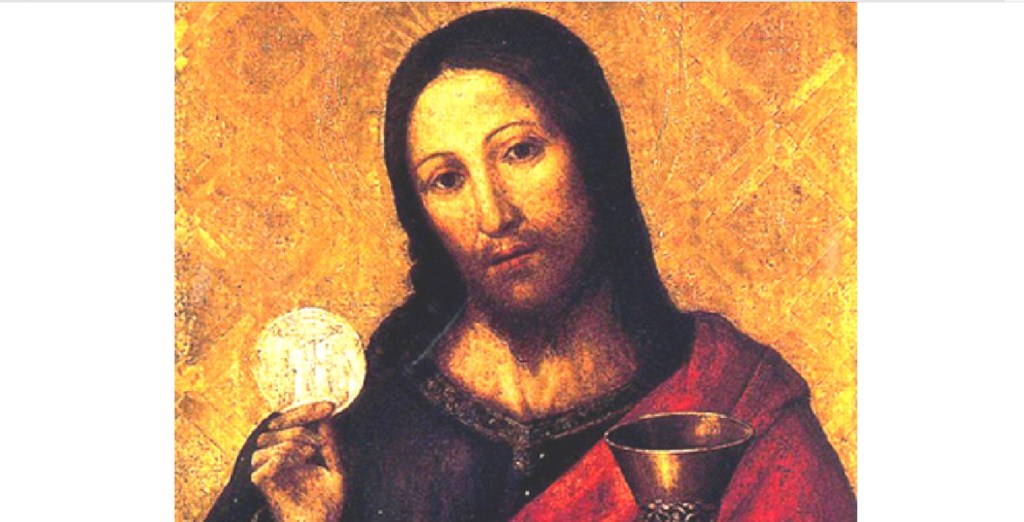
Photo: “Christ with the Host” by Paolo da San Leocadio

Link for the Mass readings for Sunday, June 22, 2025

Putting God first will help us to experience his love and peace.

In today’s Gospel from Matthew, Jesus draws a direct correlation between our level of worry and our faith. Having faith is a common theme throughout Jesus’ teaching. How many times have we read or heard, “O you of little faith” (Mt 6:30). Faith is defined in the Catechism of the Catholic Church as, “man’s response to God, who reveals himself and gives himself to man, at the same time bringing man a superabundant light as he searches for the ultimate meaning of his life” (CCC, 26.) Jesus came to reveal his Father to us, to show us that he cares for, loves, and wants to provide for us in our need.

When we are feeling anxious or worried, we are most likely not placing our trust or putting God first in our lives. We may be dwelling on the past, rehashing something we did or did not do, what someone did or did not do, fixating on whether or not we made the right decision, or we could be anxious about the future. Our minds plague us often with the worst-case scenarios of what might be or what could happen. We also may react to another’s actions or words, not fully understanding the context or source of the hurt or struggle they may be going through that caused those words or actions. When we seek security first in anything other than God, remain hyper-focused and absorbed on our own reaction(s), and/or stay stuck in our emotions, we become tossed about like a tumble weed and our insides can experience a perpetual churning.

When we focus on what we do not have instead of being grateful for what we do, we will also experience unrest. We exercise little faith or trust in God when we allow ourselves to be hyper preoccupied with anyone or anything apart from and other than God. Jesus is helping us to see that, “No one can serve two masters” (Mt 6:24). Either we place ourselves, someone, or something first, or we place God first. Jesus’ command is to put God first in our lives and to trust in him above all and everyone else.

Anxiety, worry, and fear can be debilitating and paralyzing and can lead toward a downward spiral, a curving in upon ourselves, that leads to an unsettled mental state. From this posture we can become impatient, reactive, and more fearful. Too many of us buy into the enemy’s lies to isolate ourselves, to keep ourselves busy, distracted, and perpetually tired. Even when we seek to find some rest and to wind-down and renew, we may reach for activities that do not bring us the rest we seek but instead continue to keep us in a perpetual state of unrest. Mindless channel surfing, lost hours on social media, or binging on YouTube clips, will not bring rest to our souls. These practices do the opposite; they keep us in a constant state of busy and overstimulation fueled by dopamine hits that contribute to a growing cycle of chronic stress.

One of the reasons we may be drawn to these technological avenues is to escape the anxieties and stresses we experience. They can distract and divert us for the moment, we can enjoy instant gratification, and we may feel satisfied for the moment. It comes at the cost though of further separating us from God and each other. At our core, we are deeply hungering to be loved and to love. “The desire for God is written in the human heart, because man is created by God and for God; God never ceases to draw man to himself. Only in God will he find the truth and happiness he never stops searching for” (CCC, 27).

Jesus’ life, words, and actions provide a starting point for shifting the momentum of the cycle of enslavement to our unbridled anxieties, attachments, and emotions. The way out of this inner downward spiral is to, “seek first the Kingdom of God and his righteousness, and all these things will be given you besides” (Mt 6:33). God truly knows what we seek and need in the depths of our souls. At the foundation is deepening our relationship with him. When we spend time consistently reading the Bible, praying and meditating, walking in creation, seeking the things of heaven instead of this world and bringing our anxieties, fears, and sources of stress to God, we will experience moments of peace and renewal. We can come to a place of rest where we can breathe again and we can begin to heal.

Intentionally setting aside key anchor times to be with God each day is one way to put God first in our lives. As we offer vocal prayers to God our Father, share with him our needs, our thanks, our hopes and anxieties, we will find rest in knowing that God hears our prayers and will guide us. As we spend time meditating on God’s word, we are nourished, transformed, and recognize we are not alone in our struggles as we engage with the lives of our ancestors in faith. And as we become more consistent with vocal and meditative ways of praying, we can then engage in the deeper gift of contemplative prayer in which we can just be silent with God and rest in his presence. We can be like St. John who rested his head on the sacred heart of Jesus.

Let not our hearts be troubled, let us not be afraid, but have faith and trust in Jesus, his Father, and the love of the Holy Spirit, and put God first in this moment and often with each drawing of our breath throughout the day.

———————————————————-

Photo: Making some time for a silent holy hour, looking at Jesus as he looks at me.

Link for the Mass readings for Saturday, June 21, 2025

We will experience more peace, even in the face of death, when we follow Jesus and put his teachings into practice.

Jesus said to his disciples: “Do not store up for yourselves treasures on earth, where moth and decay destroy, and thieves break in and steal. But store up treasures in heaven, where neither moth nor decay destroys, nor thieves break in and steal. For where your treasure is, there also will your heart be” (Mt 6:19-21). Jesus helped his disciples then and is helping us today to be aware of the reality of our world. All that exists is finite and material. Each thing, each being, has a beginning and an end. We need to resist the temptation to be attached to anything, even to our family and friends, because in this life and this side of heaven, nothing and no one lasts forever.

Adopting an attitude of non-attachment to material things can be freeing as long as we do not embrace the opposite extreme of placing no value in created things, thinking that we can destroy and abuse the environment, exploit each other, because neither will not last. We can also be tempted to see all things not spiritual as corrupt and bad, even our material reality as human beings, such that our soul is imprisoned until we die. This extreme will not bring us happiness, joy, or fulfillment either.

Living a life directed by Jesus’ teachings will help us to embrace a more balanced life of recognizing that much of what is material and finite is good, as well as very good, and yet each has a time and a season. We have the opportunity and invitation to be participants in God’s eternal plan of salvation, and we can embrace and enjoy the wonders and gifts of his creation when we don’t hold onto the things of this world too tightly.

We need to resist grasping for and clutching anything material and finite. We will then be freer to embrace and follow the steady movement of the Holy Spirit, which is ever fresh and new. The Holy Spirit invites us to deepen and grow in our relationship with our loving God and Father and one another. Refusing to fill the deepest core of our being with the things of this world will help us to be less distracted and more open to God working in our lives.

When we embrace the reality that our time here on this earth is limited, we will be less apt to take it for granted, and instead realize how precious life is, show greater appreciation, be more present, understanding, kinder, supportive, and patient with one another. We will be freer to let the petty things go and embrace the love that Jesus offers us, so we that will have more love to share with one another through thick and thin.

I don’t mind repeating what helped me and JoAnn in her final months was the gift of knowing that her time was short. We appreciated each moment we had together. What also helped was that even before the news, we had already begun the journey years before of deepening our relationship with Jesus and so each year grew closer to each other. A lot of the material things of this world became less important.

Dealing with death is never easy. Trusting that Jesus opened up heaven for us in the humanity he assumed and that he conquered death in his resurrection, helps. Instead of denying or keeping death at a distance, we will be better off by facing the reality of death. Doing so helps us to define who and what is truly important in this life and helps us to “store up treasures in heaven where neither moth nor decay destroys, nor thieves break in and steal” (Mt 6:20).

———————————————————————–

Photo: Together with less than three months left. Appreciate every moment!

Link for the Mass readings for Friday, June 20, 2025

“One vocal prayer… well said, is better than many recited thoughtlessly or hurriedly.”

Prayer is not so much about bending God’s will to our will, but it is about being willing to be transformed and conformed to God’s will. Surrendering ourselves to God in prayer helps us to realize that life is not all about us and we can begin the shift away from placing our sole focus on ourselves as the center of the universe. The world actually does not revolve around us. Accepting these truths is freeing. As we shift the focus away from ourselves alone and accept the invitation to grow in our relationship with the One who is the creator and sustainer of all that exists, we experience the peace and rest in our souls that we all seek.

Jesus guides his disciples on this point when he teaches them how to pray. Jesus said to his disciples: “In praying, do not babble like the pagans, who think that they will be heard because of their many words. Do not be like them. Your Father knows what you need before you ask him” (Mt 6:7-8). The babbling Jesus is referring about is how some of the pagan cultures of the time believed that if they performed the proper incantations, said the proper words, they could bend the gods to their will.

A great example of this is to read the account of Elijah in 1 Kings 20-40. Elijah while on Mount Carmel faced off against 450 of the prophets of Baal. He challenged them to call down fire from Baal to consume the sacrifice they laid out. They spent hours chanting and calling out to their god, dancing and even slashing at their flesh and there was no response. Elijah was heard with a simple petition and God responded by sending his fire to consume the entire sacrifice.

Jesus is teaching us not just that God is all powerful but that he is personal. Our Father knows what we need before we even ask. He really knows what is the deepest yearnings of our hearts even when we often don’t because we are distracted, diverted, and anxious about many things. Our minds and heart are tempted and misled by so much noise and glitter, when all we need is to slow down, breathe slowly and rest with the Lord and sit at his feet. Then we can get in touch with what we are truly experiencing and share with God what we feel honestly, whether that be deep pain, sorrow, or grief, contrition for sin, imploring for guidance, or expressing thanksgiving for his love and presence. Formulaic expressions and the mere volume of words mean very little compared to a few words said with clear intent, focus, and in a mindful and heart filled way.

Jesus helps us to understand that the form prayer takes or the actual words used do not so much matter as understanding why we pray. We pray to deepen and develop our relationship with the Trinitarian communion of God the Father, God the Son, and God the Holy Spirit. The very desire to pray is a prayer in itself because we are hearing the invitation of God to be one with him. The first step is to acknowledge this invitation and then to turn our hearts and minds to God. Fr. Thomas Dubay, in his book, Fire Within, paraphrases St. Teresa of Avila, the 16th-century doctor of the Church, in saying that “one vocal prayer, even so little as one petition of the Our Father, if well said, is better than many recited thoughtlessly or hurriedly” (Dubay 1989, 76).

Reciting the Our Father, or Lord’s Prayer, that Jesus shared with his disciples in today’s Gospel of Matthew, can be a struggle, because the biggest challenge to a life of prayer is taming, what some Buddhists call, the “monkey mind”. Our thoughts can be actively engaged, random, distracting, and even anxiety inducing within one minute. To overcome the challenge of an unsettled mind we can return to St. Teresa again. When we begin to pray, St. Teresa of Avila suggests that we begin “with self-examination and the sign of the Cross” (Dubay 1989, 77).

In this way, we can bring to awareness some issues, struggles, temptations, and sins that we have been dealing with. We can settle into them, instead of run away from or deny them and seek God’s help to be healed and reconciled. In making the sign of the Cross, and taking one slow deep inhalation and exhalation for each Person of the Trinity, we bring our self, as we are, into the presence of the Trinity and invite him to dwell within us. We receive and experience the love, acceptance, and mercy of God and recognize that we are loved as we are and that we are not alone because we belong and are a part of this infinite community of love. In this simple gesture, we are also uniting our body, mind, and soul with the One who will lead us in our prayer.

The next step is to imagine that Jesus is with us to guide and lead us in our prayer. “Imagine that this Lord Himself is at your side and see how lovingly and how humbly he is teaching you” (Dubay 1989, 77). By mindfully engaging with our breath and our body, we slow down and allow ourselves to become more still.

Finally, we can imagine Jesus teaching us the Our Father as if for the first time, as he did his disciples. Going slowly, one word, one verse at a time, allow Jesus to not only share his words with us, but pause and add our own words. By doing so, we begin to discipline the focus of our mind and can enter into a dialogue with God and receive the blessing of his mercy and love. “Focusing on the indwelling presence, says Teresa, is for wandering minds ‘one of the best ways of concentrating the mind’ in prayer” (Dubay 1989, 77).

—————————————————————–

Painting: “St Thérèse” by François Gerard in 1827

Dubay, S.M., Thomas. Fire Within: St. Teresa of Avila, St. John of the Cross, and the Gospel on Prayer. San Francisco: Ignatius, 1989.

Link for the Mass readings for Thursday, June 19. 2025

We give alms, pray, and fast to grow in our relationship with God and one another.

The teachings of the Beatitudes as well as the six antitheses are powerful lessons that can transform our lives when we put them into action. As we continue to hear or read Jesus’ Sermon on the Mount today, Jesus presents not only common practices of living a devout life of faith. As before, Jesus raised the standard practice of these three pillars to a higher level. The key point he is making though has again to do with our end goal. Jesus continued to show his disciples how to be “perfect just as [our] heavenly Father is perfect” (Mt 5:48). The perfection to be attained is oneness with God. Jesus disciple’s then and we today are to strive to become holy, to be saints, for the purpose of deepening our bond and relationship with God and each other.

Our being perfected in Jesus is a process whereby we become less and Jesus becomes more. What decreases is our focus on self, especially the ego-self, our sense of self-centeredness. Jesus provides for us three ways in which we can practice drawing closer into communion with God and one another. We are to give alms, pray, and fast. We may remember that these practices are the three pillars of Lent that we put extra emphasis on during that penitential season.

When we give alms, pray, and fast, our intent must be properly ordered. If we give alms with the intention to “win the praise of others” (Mt 6:2), pray in a public display “so that others may see” us (Mt 6:5), and in our fasting “look gloomy” and “neglect [our] appearance, so [we] may appear to others to be fasting” (Mt 6:16), then we are seeking to do so in such a way that the focal point is on us. We think to ourselves, how holy and pious we are. In fact, if we act in this way, how hypocritical we are because, in each of these actions, we are not seeking to improve our relationship with God, build up his kingdom, or give glory to God but to build up our own pride and ego by seeking affirmation and adulation for ourselves.

Jesus calls us to give and serve out of love for others, so that others may be healed, have their basic needs met, become empowered, and strengthened in their relationship with God. We seek Jesus in prayer not to conform his will to ours, but to surrender to his will and allow the purifying fire of the Holy Spirit to purge us from the dross of our accumulated sin, selfishness, and that which we are attached. In our time of prayer and examination of conscience, Jesus will reveal to us those apparent goods and disordered affections that lead us astray. From these areas we can fast from, turn back to God, and in doing so, we will find rest for our souls.

In our prayer today, let us ask Jesus to reveal to us one way that we are putting ourselves before God, one habitual vice that keeps us bound, and/or something that we are attached to that we can fast from. What is one way we can reach out and give ourselves to someone else? Prayer, fasting, and almsgiving are not only for Lent. Following Jesus’ guidance in each of these three practices will help us to grow closer to God and recognize the needs of others. We become the hands and feet of Jesus when we are willing to allow him to lead us to serve others with the love of the Holy Spirit.

—————————————————–

“Do you wish your prayer to fly toward God? Make for it two wings: fasting and almsgiving.” St. Augustine Painting by Fra Angelico, “The Conversion of St. Augustine”

Link for the Mass readings for Wednesday, June 18, 2025