discipleship


We can meet the challenges of discipleship when we make the time daily to know Jesus.
Jesus said to the crowd: “They will seize and persecute you, they will hand you over to the synagogues and to prisons, and they will have you led before kings and governors because of my name” (Lk 21:12).
Each of the predictions above; being seized, persecuted, handed over, and led before the rulers happened to Jesus’ disciples as was recorded by Luke in his second volume, the Acts of the Apostles. Jesus did not nor does he hide or paint a rosy picture of discipleship. He consistently shared and modeled in his own life how demanding it would be to follow him, the will of his Father, the demands of discipleship, as well as the reality of having to endure persecutions. This continues to be true today. In fact, the number of Christian martyrs in the twentieth century rose to a higher level than at any other time in history combined.
Since the first days of Jesus’ public ministry, there have been those who have said yes to the invitation to be his disciple and this has continued generation after generation up to an including today. Each of us has to make our own commitment to Christ. It is a personal invitation and a personal response. Though the demands, the sacrifices, and the expectations are high, Jesus is present with us through the journey. St. Paul equated discipleship with running a race: “Every athlete exercises discipline in every way. They do it to win a perishable crown, but we an imperishable one” (I Cor 9:25).
Any athlete, musician, artist, or person engaged in any serious endeavor, must discipline themselves to accomplish their goal of freedom for mastery, for excellence. A lack of concerted discipline will not lead to the fluency and the freedom for the sought after goal. The same is true with discipleship. Someone who only does something for an hour a week is not going to be proficient at that task.
The discipline required that Jesus presents in today’s Gospel of Luke is to remain firm in authentically living out our faith even in the face of pushback, persecution, and hostility. This pressure may not just come from those who would seek us harm, but from family, friends, and/or peers. This is where the issue of putting God first comes to bear. We are not to be belligerent, get in someone’s face, or shut down dialogue about what we believe but meet others with love, mercy, and respect. Nor ought we back down from what we believe.
It is important to share, listen, respect and allow another the opportunity to do the same. From a place of mutual respect and honoring each other within and without of our own faith traditions, as well as those having none, we grow. People are free to decide as they wish. Sometimes people will react emotionally, rudely, crudely, or even violently. Yet that is not an excuse nor does it provide the green light for us to respond in kind. If we do, then we will often feed into and justify another person’s preconceived notions.
Archbishop Fulton Sheen said: “There are not one hundred people in the United States who hate the Catholic Church, but there are millions who hate what they wrongly perceive the Catholic Church to be.” As disciples of Jesus Christ, it is important that we know our faith, explain what we believe, live authentically, clarify as needed through respectful dialogue, and above all to be icons of hope and love. We need not be afraid. The Holy Spirit will give us the words to speak as well as the ears to hear. The gift of respectful dialogue will result in the deepening of our relationship with the one who has made us for himself and one another. For where there is the truth, there is God who is Truth.
Photo: Making friends with silence, helps us to listen better to God and one another. We will also then know better when and what God wants us to speak.

We need not fear to invest our gift because Jesus is with us.
In today’s Gospel, we have available to us the parallel to The Parable of the Talents from Matthew 25:14-30, which is The Parable of the Ten Gold Coins from Luke 19:11-28. There are a few differences. A key opening point is that in Matthew’s account, we do not know why or where the master goes after he entrusted three of his servants with talents; five, two, and one respectively. In Luke’s account the man is a noble and he “went off to a distant country to obtain the kingship for himself and then to return” (Lk 19:12). He called ten servants to invest a gold coin he gave to each of them. The theme that is similar in both accounts is that when the man returns, two of the servants invested well and brought about a greater return on their investment, and one hid what he was given out of fear of his lord.
Another added feature in Luke’s account was the fellow citizens of the nobleman that did not want him to be king and openly opposed him. The nobleman after attaining his kingship and returning successfully, dealt harshly, to say the least, with those who opposed him, having them slain. Those listening to Jesus tell the parable would understand this predicted outcome, as it was not uncommon in the ancient Near East for a ruler to slay those who opposed his rise to power.
The most immediate parallel and contemporary example was the current tetrarch, Archelaus, who was placed into power in Judea and was reigning at the time of Jesus. He was a cruel tyrant. The Jewish historian, Josephus, who during the time of the Jewish Wars was captured and later became a Roman citizen wrote that there were “fifty ambassadors were sent from Judea to Rome to request that Archelaus not become king, because he had already killed three thousand Jews in quelling an uprising” (Gadenz, 320).
Just as the wicked tyrant is rejected, the innocent Messiah will also be rejected in Jerusalem, and will give his life. Jesus again appears to be presenting the contrast between the fallen nature of humanity with the coming of the new kingdom under his reign. His apostles are not to be like the corrupt leadership of the age, but they are to go out to all the nations to proclaim the good news of the kingdom.
The readings this week also continue to present eschatological talk, references to the second coming of Jesus, and final judgment because we are in the final two weeks of the liturgical year. Jesus’ reference to going away and coming back, could be a reference to his death, resurrection, ascension, and the waiting until his second coming in which there will be a judgment by God. Jesus makes clear that we are not the judge and jury, though many appropriate this role for themselves. We are only accountable for the talent or gold coin we have been entrusted with.
God has called us each uniquely by name and given us a gift that he wants us to put into action to help build up his kingdom. We need to resist burying this gift or hiding it away. The most important thing we can do each day is to pray, and deepen our relationship with God and each other. The enemy will tempt us with doubts, fears, and anxieties which we are to renounce and instead trust in Jesus, seek his strength, and guidance.
We are invited each day to begin with prayer. In the beginning, the length of time is not as important as consistently spending time with God intentionally. We show up, breathe, allow ourselves to be still, allow the restlessness of our mind to quiet, and we listen. This may take some time or days, but when we continue to return to these daily anchors and trust that God has a purpose for us, we will hear his guidance, and then we are to follow his lead.
The encouraging words of St. John Paul II are helpful: “Remember that you are never alone. Christ is with you on your journey every day of your lives!” – St. John Paul II
We are called by Jesus to be contemplatives in action. We are not to follow the lead of mediocrity and fear. With humility and patience, let us trust in the guidance of the Holy Spirit who will light our path to maturing and actualizing our unique call and as we serve God and one another we will bear good fruit.
Painting: “The Lord of the Parables” by Jorge Cocco, Altus Fine Art
Gadenz, Pablo T. The Gospel of Luke. Grand Rapids, MI: Baker Academic, 2018.

“The fruit of love is service.”
He shouted, “Jesus, Son of David, have pity on me!” The people walking in front rebuked him, telling him to be silent, but he kept calling out all the more, “Son of David, have pity on me” (Lk 18:38-39)!
The difference between the blind man who shouted to Jesus and the people walking in front of Jesus was that the man knew he was blind. Those preventing access to Jesus were not aware of their spiritual blindness. Luke does not say why the people were preventing access to Jesus, just as Jesus in his parable of the Good Samaritan did not say why the priest or the Levite did not help the man dying on the road to Jericho.
Why would the people prevent the man from having access to Jesus? Especially since he was asking for pity or mercy. One practical reason could be time. They were on the way to Jericho, their mind was set to get there, and stay on the schedule they would. Another could be that the man was a beggar. He was not seen to have dignity and worth, so they attempted to quiet him so he could go back to being invisible. The Jericho road was a dangerous road, maybe this was just a setup, a way to lure Jesus into an ambush.
Ultimately, we do not know why they attempted to prevent the man access. The more important question is how often do we prevent others from accessing Jesus? We do not have the time, they are other, we may not see their dignity and worth as human beings, and/or we are afraid, so we keep others at arm’s length. Could it be we are just indifferent to the suffering of others?
Jesus responded differently to the call of the beggar in today’s Gospel account. He stopped and had the blind man brought to him. He made the time, saw him as a fellow brother with dignity and worth, and he took the risk to reach out to someone in need, and healed him. As Pope Francis has said, “[Jesus] understands human sufferings, he has shown the face of God’s mercy, and he has bent down to heal body and soul. This is Jesus. This is his heart” (Francis 2014, opening page).
This is to be our response as well. Even if we do not understand the suffering of another, Jesus does. We are invited to stop, to be aware, to enter the chaos of another, and trust that Jesus will be present through us to provide mercy. Are we willing to resist indifference and fear and instead see each person we encounter, not as other, but as a fellow human being? We do this best by making the time and being present. Are we willing to ask Jesus to heal our blindness that we may be willing to see the dignity and worth of each person that we meet so that those we encounter see in us the face of God’s mercy? We will be more apt to do so the more we spend time being still, breathing, resting, receiving, and abiding in God’s love.
Photo: “The fruit of silence is prayer, the fruit of prayer is faith, the fruit of faith is love, the fruit of love is service, the fruit of service is peace” – St. Mother Teresa. When we put into practice the words of Mother who put into practice the way of Jesus, we will also have the eyes to see and serve Jesus in those around us.

What or who do we place our trust in?
“Before all this happens, however, they will seize and persecute you, they will hand you over…” (Lk 21:12).
The followers of Jesus have faced and continue to face persecution from the moment of Jesus’ Passion and death by crucifixion, continuing on with his Apostles, and the disciples in each generation thereafter up to and including the present day. There are estimates that there have been more Christian martyrs in the last century than in the whole history of the Church. Persecution was also true for the prophets before the time of Jesus. By entering Jerusalem, Jesus knew that his own persecution and death was imminent.
With today’s readings, we receive the last words from Luke for Sundays. Next week will be the last week in Ordinary Time as we celebrate the Solemnity of Christ the King and the following Sunday, we will begin Advent. So, as we end the liturgical year, our readings reflect not only the time of tribulation but also the end of time and the second coming of Jesus.
Why tribulation and this animosity to those who spoke for God before the time of, during the life of Jesus, and continuing on after with his followers? One reason is that to live by the will of God challenges not only those attempting to do so, it challenges those they interact with. Followers of Jesus who authentically practice the teachings of Jesus become a mirror. The disciples of Jesus have accepted where and how they fall short of the glory of God and welcome the opportunity to be freed from their ego and sin. Others may not be ready and are challenged by the idea of doing so.
The more entrenched into our ego and self-centered view we are, the greater the threat the Gospel is. The more we want to determine our own path and rationalize for ourselves our own truth, to define our own morality, and determine who is with us or against us, the more we distance ourselves from and set ourselves apart from the guidance of God. A clash has and continues to arise.
Jesus seized on the opportunity to present this reality when some of his disciples expressed their wonder with the Temple, and in its time, it truly was a wonder. Yet, Jesus said, “All that you see here – the days will come when there will not be left a stone upon another stone that will not be thrown down” (Luke 21:6). In his discourse, Jesus echoed the Prophet Jeremiah who said in his own time, “Do not put your trust in these deceptive words, ‘The temple of the Lord! The temple of the Lord! the temple of the Lord” (Jeremiah 7:4).
Jeremiah was calling his people to repent from their wicked and disobedient ways (cf. Jeremiah 7:1-15). They chose not to repent and in 587 the Babylonians destroyed the temple that the people placed their trust in. They missed the point that Jeremiah consistently sought to make. What was most important was their faithfulness to God, and that he alone would protect them. Living their lives any way they wanted and apart from God and believing that the temple would protect them was idolatry. Solomon’s Temple fell and as Jesus, stood from the Mount of Olive looking at the second temple that was rebuilt and was still being completed, offered the same judgment. Might and arms would not overthrow the Roman occupiers. It would only happen by trusting in God, allowing him to fight for them, that they would overcome times of persecution to come.
After Jesus’ death a movement of Zealots mounted a military strike against the Roman occupiers and for four years Rome would lay siege against Jerusalem. In 70 AD, Jesus words would be fulfilled. The Romans crushed the rebellion, killing up to a million Jews and destroyed the temple not leaving a “stone upon a stone.” All that was left and what remains to this day are the remnants of the western retaining wall securing the temple mount, better known as the wailing wall.
What do Jesus’ words mean for us today as we come to the end of another liturgical year? Who and what are we placing our trust in? There is nothing and no one in the physical world that will save us nor will be our stronghold other than God. We do not know the time or the hour of the final judgment to come, but for each of us, our time on this earth is limited. This thought, well pondered, is not morbid, but can be joyous, because in contemplating our end, we will be less tempted to take the time we do have for granted.
It is important to reflect upon how we have lived our lives daily and how we want to live each day going forward. Do we live only for ourselves and our own pursuits, or do we seek to align our wills with the will of God? Most of us fall somewhere in the middle. Do we feel pressured to compartmentalize and/or privatize our faith or are we willing to stand up for what we believe, not in a belligerent and in your face manner, but with calm assurance and steadfast?
In reading the lives of the saints and reflecting on how they dedicated their lives, even those willing to die as Jesus did, we will see that all were authentic and courageous witnesses. They lived their lives dedicated to the way, the truth, and the life of Jesus with each thought, word, and action. They were not born saints but each encountered Jesus, and at some point decided to follow his lead, and became who he called them to be. We each have a unique role to play in God’s plan and we begin one breath, one prayer, and one act at a time.
—————————————————-
Photo: Jesus was willing to give his life for us, are we willing to live for him?

Forgiveness helps us to walk the path that leads to our healing.
“If your brother sins, rebuke him; and if he repents, forgive him. And if he wrongs you seven times in one day and returns to you seven times saying, ‘I am sorry,’ you should forgive him” (Lk 17:3-4).
Forgiveness is one of the foundational principles of our faith tradition as Christians. If we question or struggle with the degree of forgiveness we engage in, we are in good company with Peter. Thinking he was being generous, Peter asked Jesus how many times should he forgive, seven times? Jesus responded, “I say to you, not seven times but seventy-seven times” (cf. Mt 18:21-22).
Luke records the exchange of the disciples asking Jesus to teach them to pray. He taught them the Our Father or Lord’s Prayer. While reciting this prayer often each day or multiple times each day, we say, “Give us this day our daily bread, and forgive us our trespasses as we forgive those who trespass against us” or “forgive us our debts as we forgive our debtors” (Mt 6:11-12).
One of the barometers of being a faithful disciple of Jesus is that we are people who practice the sacred art of forgiveness. To forgive does not mean in any way that we condone or justify the offense or even necessarily forget about it. We are to hold people accountable, as Jesus said, we are to “rebuke them” in the hope that they will repent and come to a greater appreciation and respect of our dignity and the dignity of others. When they do repent, we are to then forgive them.
Holding on to grudges, seeking revenge, being unwilling to forgive, can be incapacitating, debilitating, and can lead to a premature as well as eternal death. What can be of help is if we can choose to be more mindful of our thoughts and actions. At the moment we experience discomfort from what someone says or does, instead of giving in to the temptation to react or to let our mind run with the offense, it is very helpful to take some deep breaths, relax our shoulders, and/or loosen our grip. As the negative thoughts attempt to rise again, don’t fight or feed the thoughts, just return to being aware of our breath and ask Jesus to help us be more understanding and forgiving. This will also help our body to discharge the stress and experience God’s peace.
We may struggle with being forgiving because we may not have sought or received much forgiveness ourselves. Advent is coming. It is a season to prepare to celebrate the coming of Jesus into our lives. This season provides a wonderful opportunity to prepare and participate in the Sacrament of Reconciliation. Forgiveness is a healing gift of God’s grace. Once we have felt the healing balm of forgiveness, we might be more willing to forgive others.
A good practice to engage in is to go to a place of quiet and ask God to help you to forgive someone or a few people. Even if your prayer begins, “God, I cannot forgive, I hurt too much, but help me to let go, please help me to forgive, (insert name).” Return each day until you can bring yourself to say, “I forgive, (insert name).” Visualize yourself saying that you forgive the person face to face and imagine a healing between each of you. If the opportunity presents itself you may want to say that you forgive the person directly, send an email, or write a letter – even if you do not press send or mail it.
With the intent to forgive and asking for the help of Jesus, who has forgiven us, even if in the beginning we are unwilling, with time, reconciliation is possible. Depending on the hurt that has been inflicted, you may not reach out to the other person as it may be healthier to stay apart. Forgiveness will help you to heal and not allow the person who has hurt you to continue to do so. Forgiveness is an act of love, for to love is to will the good of the other. In our willingness to forgive, there is freedom. Let us remember: “Forgive and you will be forgiven”.
——————————————————————–
Photo: Our willingness to love will help us to walk the path of forgiveness.

Our lives will be much better when we realize we are temples of the Holy Spirit.
When I was still teaching, I would ask my students if Jesus ever sinned. Inevitably, someone referenced the account from today’s Gospel. In these verses, we read how Jesus, “made a whip out of cords and drove them all out of the temple area” (Jn 2:15). Jesus is not sinning here, rather, he is acting in line with prophetic tradition. Jesus is making a bold spectacle to drive home the point that the temple is not a “marketplace” or a “den of thieves” but it is to be a place of worship and right praise to his Father.
We can see prophetic echoes from Zechariah 14:21 where he prophesied that there would be a time when there would no longer be “merchants in the house of the LORD of hosts” and Jeremiah 7:11 where Jeremiah asked, “Has this house which bears my name become in your eyes a den of thieves? I have seen it for myself!” Jesus not only places himself in the line of prophets and professes their words from God, he acts like them in make such bold statements. There is a difference though.
Greater still than the temple, is the people of God. Further down in the text, when those present ask for a sign to justify this act, Jesus said: “Destroy this temple and in three days I will raise it up” (Jn 2:19). John makes the point clear that Jesus was pointing to his body as the temple of God and referring to his Resurrection to come. Jesus is the new temple and he is establishing a new covenant.
The temple, the house of God, believed to be the corporal presence, the very seat of God among his people, Israel, was destroyed in 70 AD by the Romans. This left a tremendous spiritual, political, and social vacuum. Two groups that were intimately tied to the sacrificial cult of the temple, the Sadducees and the Essenes, very soon after the destruction, ceased to exist as a sect within Judaism. The Pharisees, who already were moving to a practice of home worship that mirrored the worship in the temple, would survive and be the ancestral root of different expressions of Judaism today. Another sect would also arise as the followers of the new way of Jesus which became the Church, “God’s building” and “the temple of God”.
After Jesus’ death and resurrection, his rising after the third day, Jesus becomes the first born of the new creation. Those who are baptized do not just gather in a church, they are the Church, the temple of God.
Each one of us has a unique part to play in the Church. We are called to bear witness and practice, in our own unique way, our faith in our everyday experiences. We may be the only church someone ever enters and the only Bible someone ever reads. This call to put our faith into action is not an invitation to be overwhelmed by nor an excuse to assume a posture of elitism. We are no better than anyone else.
Pope Leo recently said to students participating in the Jubilee of the World of Education: “How wonderful it would be if one day your generation were remembered as the ‘generation plus,’ remembered for the extra drive you brought to the Church and the world.” May we all hear these words, seek and follow Jesus, the Way, the Truth, and the Life, and allow his truth and his love to shape and transform our lives. When we are willing to encounter and walk together, we learn and grow from one another. We are also less apt to keep other at a distance and become more willing to draw close.
We need to resist all that contributes in any way to the dehumanization, division, hate, and violence by rooting ourselves in Jesus, the living Temple. In doing so, we will become aware that we ourselves are temples of the Holy Spirit. In spending consistent time in silence, prayer, meditation, study, worship, and service, we not only purify our temple, we better know God and his will, become conformed to and empowered by the love of Christ to be instruments of peace, contemplatives in action, and advocates for healing and reconciliation in a wounded and weary church, politics, country, and world.
Photo: God speaks to us in many ways when we give ourselves time to be still, breathe, and look up.

We are to love Jesus more than anyone or anything.
This is a scene that I enjoy imagining and praying with. Jesus striding along with a gathering of people walking, talking, and moving about, and then he just stops and turns. Those closest to Jesus pull up to a stop, others continue right past, while at the same time others bump into and trip over those who had stopped before them. The subtle hum of random conversation then slowly comes to a halt, a stillness ripples through the crowd, and then there is silence. The dust begins to settle. Those closest to Jesus have their eyes locked on his, while those further back are craning their necks, moving left and right to get a better look, while still others are cupping their ears to catch the sound of Jesus’ voice.
These crowds most likely consisted of some disciples, while the greater majority were those on the periphery gathering because of curiosity, intrigue, maybe even wonder, as well as hope. Jesus then speaks, “If anyone comes to me without hating his father and mother, wife or children, brothers and sisters, and even his own life,…” and then, “Whoever does not carry his own cross and come after me…” and then he finishes with “In the same way, everyone of you who does not renounce all his possessions cannot be my disciple” (cf. Lk 14:25-33).
Those who may be hearing these words second hand, as they were further away from the point of direct hearing, may not believe that the message was transmitted to them correctly. These words cut to the quick, just as surely as when Jesus shared about eating his flesh and drinking his blood, and when he told another follower, who wanted to bury his father to let the dead bury their dead. Luke does not say, but I am sure that many of those gathered around him were just as shocked and began to walk away.
The familial bond for ancient peoples was strong. Though the invitation of salvation that Jesus offers is for all to be saved, he is not going to dumb down or sugar coat his message just to get numbers. Jesus presents, time and again, that the way to live a life of wholeness, to restore that which has been lost, is to put God first. God must be the primary focus, the primary relationship, for nothing else can have priority of place before him. When we do so, everyone and everything will fall into their proper order and place.
Do we want to be an onlooker, just someone looking at Jesus from a distance, or a disciple? An onlooker does not have to make a commitment, a disciple does. The cost of that commitment is to let go of anything and anyone that we have put before God and will distract and divert us from the very flow of his life force that fuels our existence. If we are willing to walk the path of discipleship, we must be willing to surrender our will to God, place him first in our lives, take up our cross, and be transformed by his love.
Jesus is the interpretive key that opens our understanding. All that which is material and finite in our lives find meaning in relation to him. Only when we are able to detach from the things of this world will we then truly be free. St. Francis embodied this in a radical way. One of his foundational prayers, which he sometimes would pray for hours was, “My God and my all!” And that is the life he lived and which Jesus invites us to live.
Photo: Jesus showed his love for us in holding nothing back, giving all he had, himself, of the cross. We are called to love just as radically, a little more today than yesterday, a little more tomorrow than today.
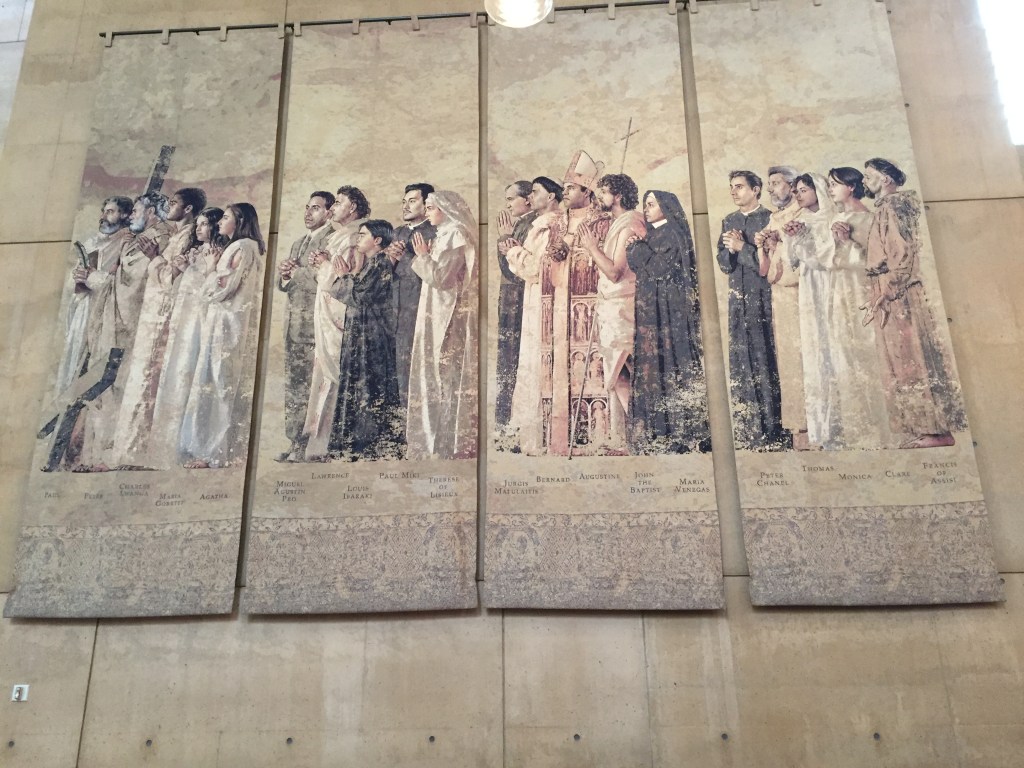
May the saints help us to arise from our slumber.
“Blessed are they who mourn, for they will be comforted” (Mt 5:4).
Mourning here can certainly mean the grief one experiences at the death of a loved one. It can also mean mourning for the evil and unfaithfulness in the world. Another word for blessed is happy. How are we to feel blessed, or happy in reference to the death of those close to our hearts? Blessed or happy for the injustice, violence, warfare that plagues our word? From a theological sense, one interpretation can be that Jesus spoke from the perspective of the eschatological event, his second coming at the end of time and that we can rely on the hope that Jesus died for us all and we will rise with him on the last day. We will be not only freed from the atrocities of this life, but also freed from death.
This is our hope and this is true, but also Jesus may also have been speaking about our day to day experiences as well. Jesus said, as is recorded in Mark 1:15, “This is the time of fulfillment. The kingdom of God is at hand.” Jesus, is the kingdom at hand, just an outstretched arm away. Those of us who mourn and suffering will be blessed, will find comfort when we resist running away, or denying the agony and pain that threatens to overwhelm us and instead allow ourselves to experience the grief and the suffering of our loss and our fallen world. It is in the very embracing of our pain and suffering that we encounter Jesus waiting for us there with his arms wide open.
When we turn to Jesus, and with him face the sorrow, grieve and mourn for those who have died, as well as for the injustice, violence, and sin of our world, he will help us to release the unbearable weight we have been carrying. Jesus, who suffered the agony, loss, pain, and hurt in his passion and death on the cross, understands what we are feeling. His presence and closeness will be the strength we need to guide us through the many ups and downs, fits and starts, of our emotional roller coaster and also be able to offer help.
Today, we celebrate the gift of the Communion of Saints on this All Saints Day. The saints understood and lived the message and truth of the Gospel that Jesus has risen. They dedicated their lives to the call that Jesus extended to them and have gone before us to the true land of promise, our heavenly home, and from there they cheer us on, encourage, and intercede for us. They remind us that we will be blessed when we resist being attached to the things of this world and instead follow the will of God.
Jesus suffered and persevered the agonizing pain of the cross, then experienced, and conquered death. He lights the way and leads us back to the Father. We need not fear the fallen world nor death because through our life in Jesus, neither has any power over us. St Paul of the Cross, taught: “The world lives unmindful of the sufferings of Jesus which are the miracle of miracles of the love of God. We must arouse the world from its slumber.” When we turn to God with everything, we will experience God’s comfort, peace, and healing to rise from our slumber, and reflect the light of Christ to help others to rise from their slumbers.
Photo: Tapestry of saints hanging in the Cathedral of Our Lady of the Angeles, Los Angeles, CA.

We enter the narrow gate by growing in love.
He answered them, “Strive to enter through the narrow gate, for many, I tell you, will attempt to enter but will not be strong enough” (Lk 13:24).
Jesus offered this answer to the person who asked him, “Lord, will only a few be saved?” Jesus’ parables about it being easier for a camel to pass through the eye of a needle than for a rich man to enter heaven (cf Mt 19:24) and the rich man and Lazarus (Lk 16:19-31) also reveal to us that what we say and do in our lives regarding the welfare of others matter. Are we building walls or bridges regarding our relationship with God and one another, are we including or excluding?
There are many distractions, diversions, and temptations that pull at us. When we give in to them, we can strain or even break our relationships. Jesus said many will not be strong enough, and on our own he is right. St Paul also realized this, for he wrote, “I do not do the good I want, but I do the evil that I do not want” (Romans 7:19). How many of us could say the same?
Relationships are not easy in the best of circumstances, this is true on the human level as well as the spiritual. St Teresa of Avila, the 16th-century Spanish saint and doctor of the Church, shared openly and honestly with Jesus once after being thrown from a carriage into a mud puddle, “If you treat your friends so poorly, it is no wonder that you have so few!” I relate to the honesty of this quote. My maternal grandparents had the same kind of open, unfiltered relationship with each other. To an outsider looking in, they would have missed the depth of love they had developed for one another for over sixty years and which continued to grow into their last days.
Authentic relationships demand that we go through the narrow gate of love. Love is more than mere sentiments, emotions, or feelings. We must grow in our willingness to sacrifice, be committed, understanding and forgiving, to be present, patient, willing to risk being vulnerable, honest, respect boundaries, and share who we truly are with one another, free of any pretense or masks. On our own, we are not strong enough to persevere, often our insecurities seek to keep us unbalanced, but with God, we will remain faithful and grounded.
Regarding marriage, my grandmother told me to take the time we needed to get to know each other, but once we knew, not to wait too long. We didn’t. JoAnn and I were married six months after we started dating. Each of us brought our own baggage, wounds, and made plenty of mistakes, into our relationship, yet each year was better than the one before because we remained committed to God and to each other. We became more patient and understanding, we empowered and were there for each other. Each of the crossroads that arose over our twenty-three years, we chose the narrow gate. We loved Jesus and each other and that made all the difference.
Jesus is the relationship we need to develop first and foremost. That means other people and things will not be able to remain. This is good news, because that which will not remain is not for our good. Growing in our relationship with Jesus takes time and commitment, and doing so will help us to properly order our other relationships as well as all aspects of our lives. Our Father is our foundation and strength and the Holy Spirit is our guide. God continually invites us with his tender chords of love to draw closer into relationship with him and so to better grow closer in relationship with one another.
Photo: Because our relationship and commitment with Jesus grew, so did our relationship and commitment with one other.

