easter

Resist the thief and hired hand, trust only the Good Shepherd and follow his voice.
“I am the good shepherd, and I know mine and mine know me” (John 10:14).
Jesus, distinguished himself as the Good Shepherd who cared for his sheep instead of “thieves and robbers” who sought to harm the sheep. Nor is Jesus simply a “hired man” who has no personal investment in the flock and will abandon the flock at the mere sighting of a wolf. In referencing, “thieves and robbers and hired men” Jesus continued his calling out those Pharisees from chapter nine. Those who did not listen to his voice and those who were not leading God’s sheep with care.
The imagery of the shepherds is an echo back to past abuses such as in the time of Ezekiel who spoke out against those leaders who had “been pasturing themselves”, and who failed to “strengthen the weak nor heal the sick nor bind up the injured”. Thus the sheep of God’s flock, “were scattered for lack of a shepherd, and became food for all the wild beasts. They were scattered and wandered over all the mountains and high hills; over the entire surface of the earth my sheep were scattered. No one looked after them or searched for them” (Ezekiel 34:2-10).
God, the eternal Shepherd, spoke through Ezekiel and said: “I will take my sheep out of their hand and put a stop to their shepherding my flock, so that these shepherds will no longer pasture them” (Ezekiel 34:10). Jesus is the fulfillment of Ezekiel’s prophecy. Jesus is the Son who God his Father sent to do just that. Jesus has come to gather the lost sheep and bring them to green pastures, and lead them with his voice to eternal life.
Even today, we have experienced so much abuse of power and corruption, self-seeking and self-aggrandizement, that we are weary and have lost faith in our leaders and institutions. Yet, all is not lost. Jesus is still among his flock and calling his sheep to himself. Let us not be deaf to the call of the Good Shepherd because of the “robbers and thieves” and “hired men” that have abused or abandoned the sheep.
Let us listen only for the voice of the Good Shepherd. We learn to know and identify his voice when we make the time to be still and listen. When we resist the temptation to run away or react out of fear. When we resist impulsive responses or seek immediate gratification, and are instead patient and trust in the voice of the Good Shepherd who has our best interest and intentions in mind and will care for us. Jesus will not harm us, because he loves us.
We may have been wounded or hurt when we have gone astray or even when we thought we were safe in the sheep pen. We can trust Jesus when he seeks to come close. Unlike the hired hand who will bolt at the first sign of trouble, Jesus is willing to stand with us and give his life for us. When wounded, his healing may initially provide an increase in pain and suffering for a time, as healing often does before we get better, but as we remain close to him, his healing balm will prevail. We will experience forgiveness, healing, renewal, and wholeness.
Jesus loves us, knows us, and calls each one of us by name. Mary Magdalene, in her grief, didn’t recognize Jesus when she met him after his resurrection, but when he called her by name she recognized his voice. May we, like Mary, remain still long enough, no matter the cause of our suffering, so that we can allow the Good Shepherd to come close and listen for his voice amidst the cacophony of so many other voices, robbers, and hired hands. Being patient and only moving with the Good Shepherd when he calls our name. Each time we follow his lead, we will grow in greater intimacy and unity with him.
Photo: Allowing ourselves to be quiet and still helps us to distinguish between the voices that seek to distract, divert, and tempt us away from the voice of Jesus who seeks to lead us to experience his love and peace.
Link for the Mass readings for Monday, April 27, 2026
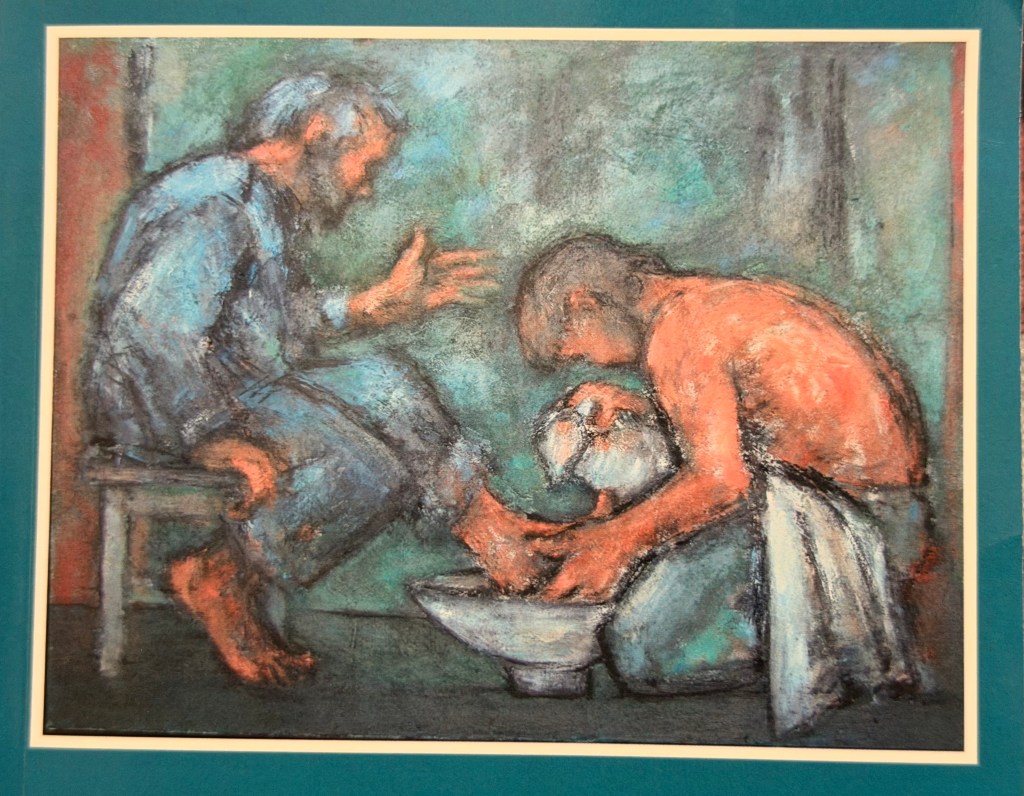
May we allow ourselves to rest and be cared for by Jesus our shepherd.
I am not sure how many people reading this reflection are shepherds, live on a farm, or raise sheep. Many of us are most likely removed from the daily life and commitment of a shepherd. With such ignorance as our starting point, we can fall prey to a false romanticism of the life of a shepherd as a reaction to the fast pace and hustle and bustle of modern urban and suburban life. The commitment and demands of shepherds during Jesus’ time were demanding and all-consuming, with little acknowledgment or recognition. In fact, many shepherds were looked down upon, and groveling at the bottom of the social class of ancient Palestine. Yet Jesus compared himself to being a shepherd.
Just scratching the surface of the social context of shepherds could help to shed light on John’s Gospel today where Jesus paints an image of himself as a shepherd who when he calls his sheep they hear and recognize his voice so they follow him. the sheep hear his voice, “the shepherd calls his own sheep by name” (Jn 10:3).
Jesus is not just a shepherd, but the good shepherd. Good shepherds lived among their sheep, watched over them, cared for them, helped to birth and raise them, as well as was willing to protect them with his life from predators and thieves. Though we may not be fond of being compared to sheep, Jesus does the same for us. He watches, cares for, protects, nourishes us with his own Body and Blood, and has given his life for us. Jesus calls us by name. Imagine that. Really, ponder all the billions of human beings that have, exist now, and will ever exist, and Jesus knows each one of us by name. Are we willing to listen and come to him.
We can get in trouble when we stray from his protective care and wander away. Yet, just as a sheep baas and bleats, so the Good Shepherd is always close to hear when we call. Each one of us is precious and important to him. We just need to remember that truth and reach out to him daily and more importantly stay close to him. Yet, no matter how far we may find ourselves astray, he will come to us and will carry us back home on his shoulders.
I invite you to spend some quiet time with Jesus, the Good Shepherd, today. With the humility and simplicity of a lamb, allow yourself to rest your head on his lap, surrender to him all your cares, doubts, anxieties, and fears. Allow your self to feel the comforting weight of his hand and so be healed by confessing any sins that are weighing you down. Let him impart some healing balm on past hurts left unforgiven, and let him bind up any recent wounds. At some point in your contemplation, also let soak in the ultimate gift this shepherd gave: his life for each one of us that we might have life in him. A life not merely to exist or survive, but a life of joy, fulfillment, and wholeness.
————————————————-
Photo: Some quiet time resting with my Lord and my Shepherd.
Link for the Mass readings for Sunday, April 26, 2026
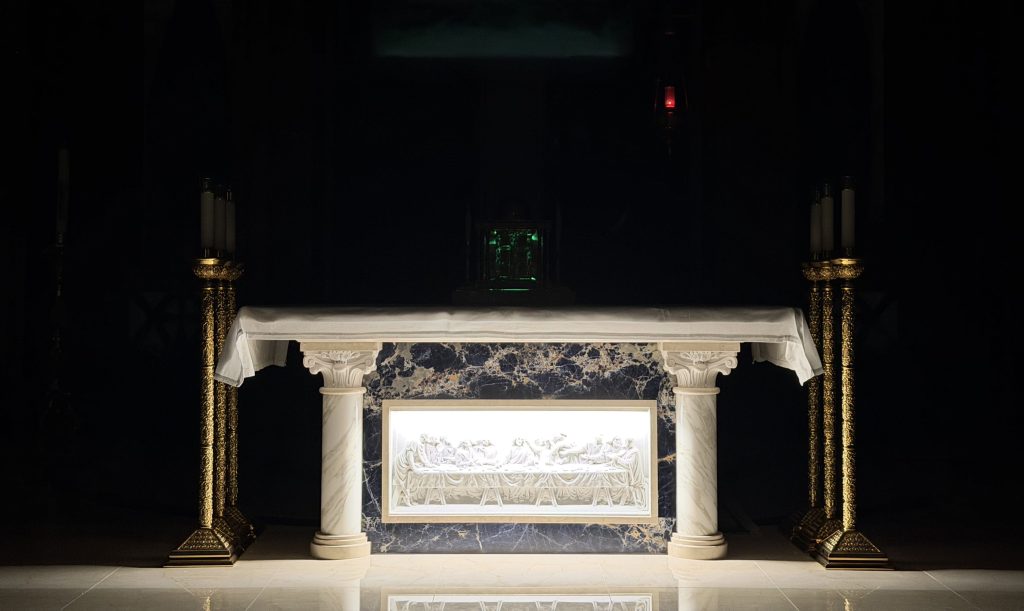
Having beheld and received Jesus, may we go forth to serve him in one another.
Jesus appeared to the Eleven and said to them: “Go into the whole world and proclaim the Gospel to every creature” (Mk 16:15). Jesus is once again claiming who he is: Kyrios – Lord. The word, gospel, comes from the Greek word, euangelion, meaning good news, but the one who proclaimed “good news” during the time of Jesus was the emperor. Caesar would send his emissaries to announce such good news as a great victory or his birthday. What Mark conveys in the very first line and here at the ending of his Gospel, is that Jesus is Lord! Not Kaiser Kyrios, Caesar is Lord, but Jesus Kyrios, Jesus is Lord!!!
We receive Jesus our Lord in an intimate way in the Eucharist. We receive his Body and Blood. We are loved and transformed by him each time we receive him by consuming him as we have been reviewing these past few days with Jesus’ Bread of Life discourse. When we are dismissed from Mass, one of the dismissal lines is, “Go and announce the Gospel of the Lord.” This is to echo the command of Jesus for all of us to proclaim the Gospel in our everyday experiences and encounters.
We proclaim the Gospel first and foremost by believing that Jesus is the Christ, the Son of God, our Savior and Lord. He has risen! He has risen indeed! He is the firstborn of the new creation. This is something to get excited about, something to fill us with joy. We are not to be a Grumpy Gus People, but an Alleluia People!!! Once we remind ourselves what we believe, who we believe in, who we are, and whose we belong to, then we are better prepared to engage with others.
The most powerful witness we can offer is when we seek opportunities to act, speak about and engage others with respect, caring, and joy. When we catch the eye of another offer a smile. We can also say hello, a nod of our head, or offer a wave, fist bump, high five, or a hug. We also need to be aware of other’s boundaries and respect their space at the same time. If someone is not open, we need to respect their posture, and meet them where they are.
Reaching out to others to acknowledge their dignity and value is the simplest, yet most profound way to spread the Gospel, which really means to share the love of Jesus by willing their good. We are to accept and accompany others as Jesus does with the purpose of building relationships. We are more inviting when we are willing to be patient, gracious, and willing to listen and hear in our interactions with each person we meet and in doing so we may begin to understand each other a little better.
Remember God gave us two ears and one mouth for a reason because it is better to listen first and speak second. As we encounter others, we are to also remember the common courtesy of saying please, thank you, and I forgive you, whether in a store, restaurant, bank, convenience store, on the sidewalk, in traffic, or online. It is just as important to engage in a similar fashion with those of our family, friends, and those closest to us.
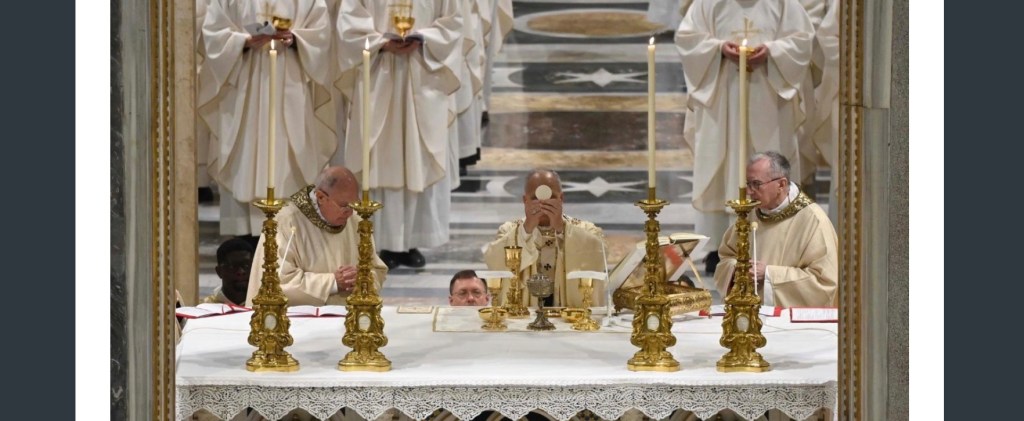
Especially now, with our country and the world on edge and more anxious than ever, believing in Jesus, embracing his love, and putting into practice small actions with great love we can make a difference. As Pope Leo said in his homily on Holy Thursday: “Christ offers us the example of self-giving, service and love. We need his example to learn how to love, not because we are incapable of it, but precisely to teach ourselves and one another what true love is. Learning to act like Jesus — the living sign that God has placed within the history of the world — is the work of a lifetime.”
Photo: Pope Leo XIV celebrating Mass Holy Thursday Evening (@Vatican Media)
Link for the Mass readings for Saturday, April 25, 2026
“The source and summit of the Christian life.”
All that Jesus has been building up to is now coming to a climax. Any silent shock of disbelief or quiet murmuring has now escalated. The Jews quarreled among themselves, saying, “How can this man give us his Flesh to eat” (Jn 6:52)? Jesus hears the growing concern and disbelief. If he was speaking in a figurative or symbolic way, this would be the moment to clarify his point.
Jesus does speak, but he does not walk back or qualify his comments. Jesus doubles down: “Amen, amen, I say to you, unless you eat the Flesh of the Son of Man and drink his Blood, you do not have life within you” (Jn 6:53). Jesus does not only repeat that his disciples are to eat his Flesh but he also insists that they are to drink his Blood. Drinking or even eating meat with the blood of an animal was inconceivable for devout Jews. Also, the Greek used here in John’s Gospel for eat is trogein, which is used to describe how an animal eats, by gnawing and tearing at the flesh. The imagery that Jesus is using here is more graphic than the customary use of phagein, which would be used for chewing, as a human would chew their food.
Jesus continues to make his point that whoever does eat his Flesh and drink his Blood, will not only remain in him, but also Jesus will remain in them, and they will have eternal life. A wonderful end goal, but would any be able to make the leap of faith to get there? In tomorrow’s Gospel reading we will be able to see the response to Jesus’ claims.
Almost two thousand years later, we continue to have the opportunity to celebrate daily the person of Jesus in our midst. This happens through participating in “the source and summit of the Christian life” (Catechism of the Catholic Church, 1324), the Mass. Our hearts have the opportunity to be set on fire, as Cleopas and his companion, as we hear the word proclaimed during the Liturgy of the Word, and then Jesus is made known to us in the breaking of the bread in the Liturgy of the Eucharist. We are invited to experience an intimate encounter with the Son of God, as we consume him, Body, Soul, and Divinity.
That we eat the Flesh and Blood of Jesus may sound just as bizarre as it did to Jesus’ followers. The term we have for this miraculous transformation of bread and wine is transubstantiation. What happens at the calling down of the Holy Spirit and the words of institution which are invoked by the priest is that the substance, the reality, of the bread and wine is transfigured into the Body and Blood of Jesus, while the accidental form, or appearance, remains the same. So we consume Jesus’ unbloody, acceptable sacrifice. We consume his glorified body that has transcended the three dimensional realm as we know it.
Jesus is giving all of who he is corporally, holding nothing back of himself so that we receive all of him – Body and Blood, Soul and Divinity. The miracle does not stop there because in the receiving of Jesus’ fullness in the appearance of bread and wine, we also become divinized through our participation in his life as he permeates our whole being. We receive eternal life! This takes the saying, we are what we eat, to a whole new level.
This gift we get to then share. We are dismissed at the end of the Mass to go, like Mary, to bear Jesus Christ, to love others as Jesus loved us. In seeing and receiving Jesus in the Eucharist, we better see him in each other and are then inspired to serve one another. For what we do to the least of our brothers and sisters, we do to Jesus (cf. Mt 25:40). Jesus is risen, he has risen indeed. We are not alone. Jesus remains with us now and for all ages, most intimately in the Eucharist! We are alive and given eternal life, because the Bread of Life lives within and among us! Amen. Alleluia!
——————————————————–
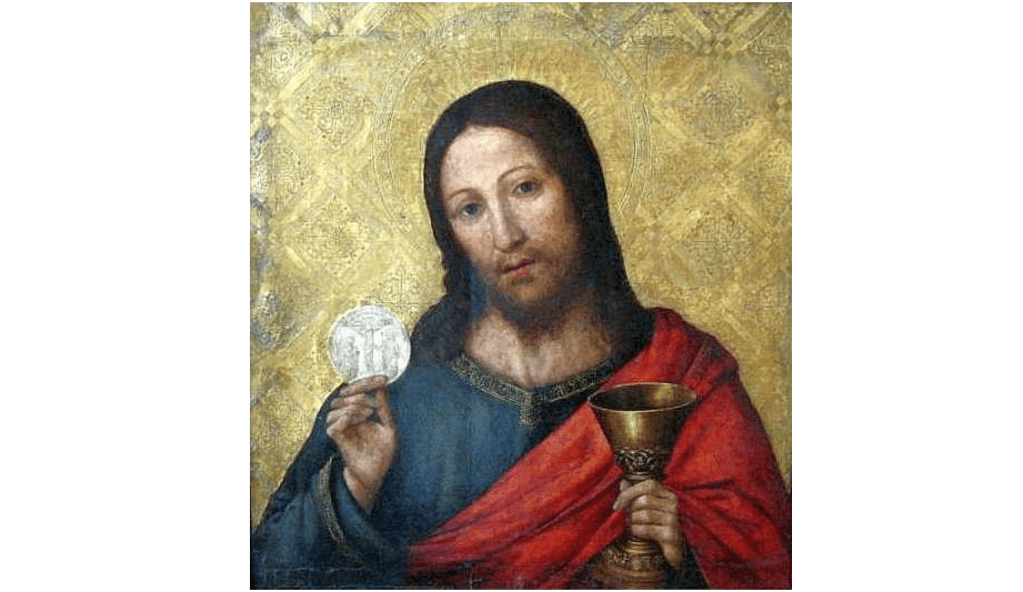
Painting: “Christ with the Host”, by Paolo de San Leocadio
Link for the Mass readings for Friday, April 24, 2026
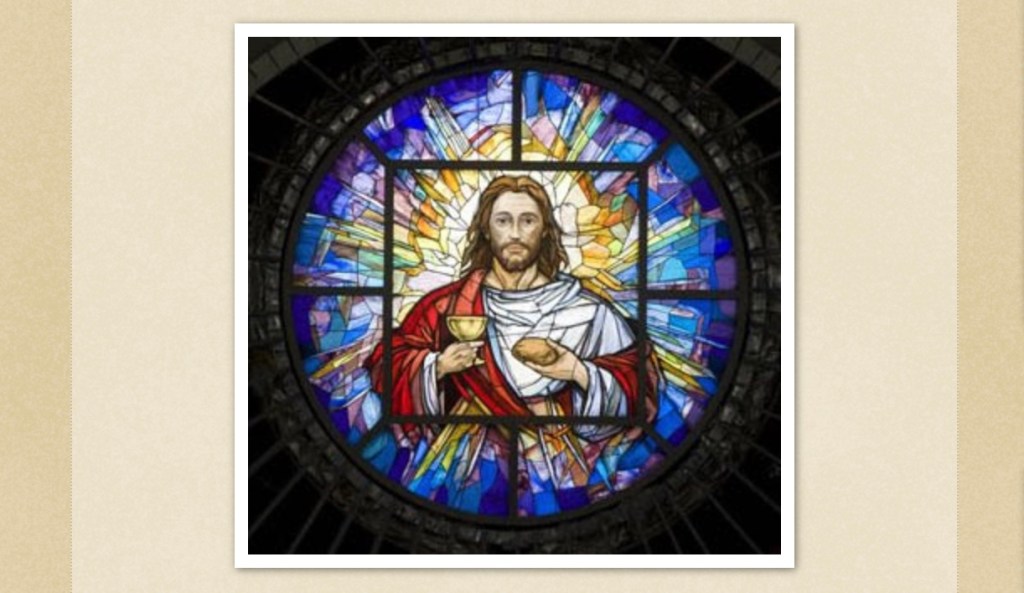
“the bread that I will give is my flesh for the life of the world”
Those in the crowd who Jesus is speaking are those who experienced his multiplication of the loaves and fish. Step by systematic and deliberate step, Jesus is setting the stage for today’s insertion into his presentation.
Jesus begins slowly, but with each successive addition, he is not willing to be tamed. He came, the One from above, the One who has seen and has been sent by the Father, is fully divine, as well as fully human, to speak the truth to those who have come. He has responded to the people’s request regarding how they were to “accomplish the works of God” (see John 6:28-29) and his response is that they are to believe in him, he who had been sent by God. They were to “work for food that endures for eternal life, which the Son of Man will give” (John 6:27). Jesus with the multiplication of the loaves and fish provided for those who were hungry in the moment. He provided physical nourishment. He is now moving from satisfying physical needs, to how he will provide food that will endure for eternal life. Jesus shared that he is this food, the bread from heaven, that will give life to the world.
What Jesus shared thus far and what he shares in today’s Gospel message has been given to him to say from his Father and is for everyone who is willing to accept his invitation: “I am the living bread that came down from heaven; whoever eats this bread will live forever; and the bread that I will give is my flesh for the life of the world” (John 6:51). We have an advantage, that those listening to Jesus, did not have. We just experienced Lent and we can certainly draw a line to how Jesus certainly does give his very life, his flesh, that is sacrificed and hung on the cross. Jesus died and experienced utter God forsakenness by giving his very life for the life the world.
But for those in the crowd who only the day before sought to unanimously make him their Messiah by popular acclamation are, with each word expressed by Jesus, growing a bit more uncomfortable. This discourse is moving away from what might have initially appeared to be a figurative discussion to a more dramatic and concrete presentation with horrific implications. After an initial gasp or two, some murmuring started to circulate, maybe centering around such questions as:
“Did Jesus really just say he would give us his flesh?”
“Jesus is equating himself with the bread from heaven, and the bread he is offering is his flesh?”
“Is Jesus saying what I think he is saying?”
Yes! Jesus stated clearly that he is the Bread of Life, and this Bread is his very Flesh. Beyond and before time, the Father has given all that he is, holding nothing back, emptying himself into the Son. The Son has received all that the Father is and returns himself, giving all that he is, holding nothing back, to the Father. This eternal giving and receiving, this eternal communion of Love shared between the Father and the Son is the Holy Spirit. Jesus is offering his listeners and continues to offer us today participation in this perichoresis, this divine dance of infinite communion. Jesus offers all that he is to be consumed.
Just as Jesus gave all of himself on the cross, he gives all of himself, holding nothing back in his glorified Body present in the Eucharist. We are invited not only to receive all that Jesus is, we are also invited to give ourselves away in return. As we receive, we become who we eat. We are transformed by the love of Jesus’ presence in our being as we consume him so that we to, as Jesus did, give of ourselves to serve others.
—————————————-
Photo of the Rose Window from the Co-Cathedral of the Sacred Heart, Archdiocese of Galveston-Houston.
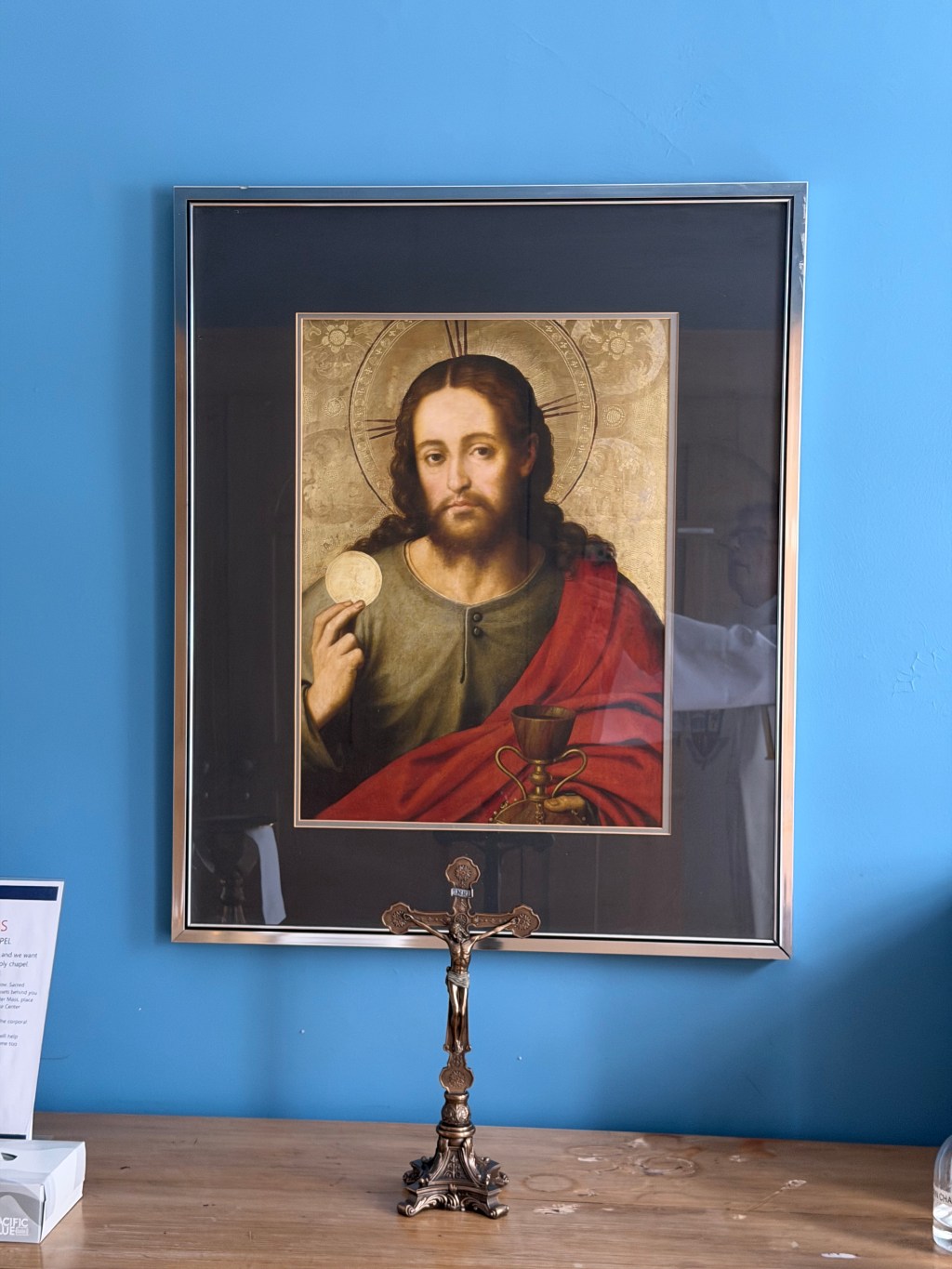
“I am the bread of life; whoever comes to me will never hunger… will never thirst”
Yesterday and today’s Gospel readings from John are laying the groundwork for Jesus’ Bread of Life discourse. In yesterday’s account, Jesus shared with the people who gathered about him, the people who had already received the miraculous multiplication of bread, that they were not to “work for food that perishes but for the food that endures for eternal life” and Jesus also shared that they were to “believe in the one [God] sent” (see Jn 6:27-29).
In today’s account, Jesus asserted that he was even greater than Moses. The people, who believed that Moses gave them bread from heaven, asked Jesus for a similar sign, to prove he was who he said he was. Jesus reminded them first and foremost that his Father, not Moses, had given them the bread from heaven, and also as he often did, met their request but built upon it: “My Father gives you the true bread from heaven. For the bread of God is that which comes down from heaven and gives life to the world” (Jn 6:32-33).
Certainly, this offer is appealing, and so the people not only want some of this bread also, they want an endless supply. Jesus welcomes the opportunity to offer them what they desire, in the very depths of their souls but unaware: “I am the bread of life; whoever comes to me will never hunger, and whoever believes in me will never thirst” (Jn 6:35).
Jesus encouraged his listeners to pursue the food that “endures for eternal life” to believe in the one his Father sent, then he shared how his Father gave them the true bread from heaven, “for the bread of God is that which comes down from heaven and gives life to the world.” Jesus is the one his listeners are to build their relationship with, for he is the very presence of God in their midst. Jesus is the promise of eternal life. Jesus is the one sent by his Father to give life to the world. Jesus became one with us in our humanity so that we can become one with him in his divinity. Jesus is the bread of life!
We are a living craving, hunger, and desire to be one with God and each other, and this is true for the atheist and the believer alike. That which God has created, he has created good, but the material and finite will not fulfill us. We, in short order, experience the limitations of the finite and seek something more. This is how we are wired, because ultimately, our deepest hunger, craving, and desire, is that which we seek to fulfill us, that which is eternal. The only One to satisfy our eternal hunger is the bread of life, Jesus the Christ, the Son of the living God.
Do we believe this to be true? Do we believe that Jesus is the bread of life, that he is the source and sustenance, the very foundation of our being and existence?
If we have been caught up: in the business of life, in mere existence or survival mode of the day-to-day, or stuck in our sin, addiction, wounds, or disillusionment, or if we feel like we are just running on empty. If we have just taken this reality for granted, then let us seek to, “believe in the one who God sent”, commit or recommit our selves, our very life, to the one who is our source and sustainer, Jesus, the Bread of Life. When we encounter Jesus in his glorified body, present in the consecrated host, we encounter our Savior, the bread of everlasting life who will satisfy our deepest hunger and thirst.
——————————————————————-
Photo: Print of the painting: “Christ the Saviour” by Vicente Juan Masip hanging in the sacristy in the chapel of St. Mary of the Lake.
Link for the Mass readings for Tuesday, April 20, 2026
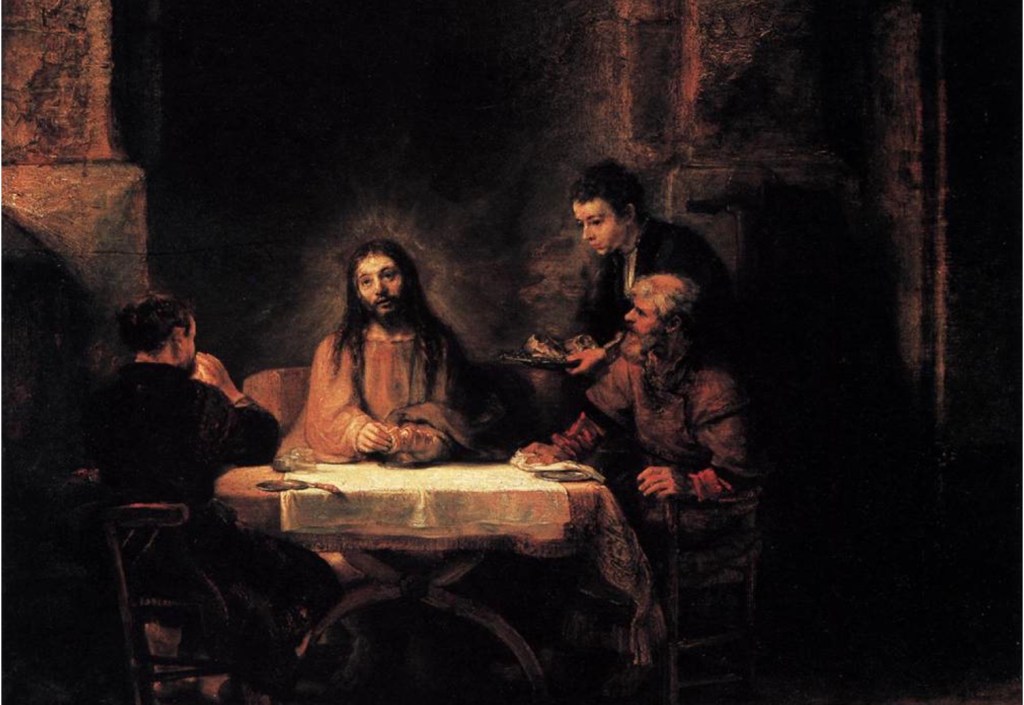
Jesus did not give up on Thomas or Cleopas. He will not give up on us.
We return again to the reading of the Road to Emmaus pericope that we heard less than two weeks ago. This rich record is certainly worth many readings because there is within its telling so much contained in its depths that one, two, or three readings is nowhere near sufficient.
Jesus comes upon Cleopas and another disciple heading away from Jerusalem feeling devastated because not only had their teacher been brutally crucified but their hopes of him truly being the Messiah were also dashed. The interesting points that come up when they begin to talk to Jesus are that “some women…had indeed seen a vision of angels who announced that he was alive.” They also announced to Jesus: “Then some of those with us went to the tomb and found things just as the women had described, but him they did not see.”
Cleopas and the other disciple were certainly close enough to the inner circle of the Apostles to know Mary Magdalene and the Eleven to be in hiding with them after the crucifixion. This also meant that they knew Jesus pretty well. They had to have heard on more than one occasion either from Jesus himself or the other Apostles that Jesus would rise again on the third day.
Why then did they leave after hearing the tomb was empty? Wouldn’t they want to find out if what Jesus said about his Resurrection was actually true? Jesus had told them to wait for him in Jerusalem, not Emmaus. Cleopas and the other are heading the wrong way! Last week we read about how Thomas was away when Jesus reappears to the Apostles. Could he have gone his own way and leave like Cleopas and the other disciple did?
There were those like Mary, Peter, and John who stayed in Jerusalem, while at the same time we know about Thomas, Cleopas, and another disciple who had left, even after hearing about the empty tomb. Jesus was clear in what he taught about his coming back on the third day, just as he was when he told his followers that they would eat his flesh and drink his blood. People left then as well.
How many times have we given up or given in just when what we had been waiting for or working for would have been fulfilled? We may never know. Fortunately, for Cleopas and the other disciple that we read about this week and Thomas last week, Jesus was willing to reach out to them a second time. They heard his words about the Resurrection but they did not grasp or comprehend the full meaning of what Jesus meant.
The same is often true of us. Jesus invites us to follow him as he did the others, as he does with all of humanity, yet we often do not understand or fully appreciate the fullness of what Jesus is offering. Until we are able to relate to and value the deeper meaning and worth of what it means to truly develop a relationship with Jesus, to know, be loved by and love him, and be a follower of his, we will not be willing to invest our time and commitment. The Good News is that Jesus did not give up on Thomas or Cleopas nor will he give up on us. One day we too will also be able to exclaim with joy, “The Lord has truly been raised,” and our life we never be the same.
Painting: The Supper at Emmaus by Rembrandt 1648
Link for the Mass readings for Sunday, April 19, 2026

Engaging both our physical and spiritual natures helps us to embrace wonder!
The feeding of the five thousand that we encounter in today’s Gospel from John is reported in each of the four Gospels. This point is relevant because biblical scholars look to the multiple attestation theory as one means as to whether an account in the Gospel record is more or less plausible. Having the same account present in each of the four is strong evidence in support for that event happening.
From a different perspective, there are those that embrace a scientism that they will not believe in anything that can not be measured, experimented upon, or proven within the realm of the five senses. For those ascribing to this strict interpretation, religion and accounts of miracles are often dismissed as superstition, that if something indeed did happen, there is a scientific explanation to dismiss the miraculous. Even some believers may discount the record of the feeding of the five thousand as more of a symbolic representation of the generosity and service encouraged by Jesus such that everyone gave their small share and there was enough for all, not that he actually was able to multiply the bread and fish.
These perspectives of downplaying the miracle of multiplication seek to reduce or limit Jesus to just his humanity, but he is so much more. Jesus is human, fully human, yes, even more so after his resurrection, but he is also fully divine. Coming to understand the wonder of the unity of the divinity and humanity of Jesus can help us better understand the reality of our world and the whole of the cosmos.
One of the core aspects of who we are as human beings is that we are people of wonder. The physical sciences are tools that we have in our toolbox that we can access to help us to understand our physical realm, while at the same time we also have spiritual tools that help us to receive insights from both physical and spiritual realities. The physical sciences actually emerge precisely because of our spiritual pursuit to understand the wonders of God’s creation. In accessing both faith and reason, we come to have a broader picture, more pieces of the puzzle in which to put together and better experience our world.
When we limit or explain away the miracles of Jesus we rob ourselves of a more accurate picture of reality. One concrete example of this is when our third president, Thomas Jefferson, took a sharp object and painstakingly cut out verses from the Bible and pasted them to blank pages. He did so in columns of Latin and Greek on one side of the paper and French and English on the other. This eighty-four-page tome is commonly called the Jefferson Bible, but the president titled it: The Life and Morals of Jesus of Nazareth. This text offers a human portrayal of Jesus that dismisses anything divine.
If we remove ourselves from the divine such that we experience, explore, and think from the perspective of the finite material realm solely, we will miss a deeper expression of who we are as human beings and much of the joy and gift of life. It stands to reason then why we would find it hard to believe in miracles, the mystical, and the spiritual. The miracles are not a self-aggrandizing move on Jesus’ part, but a move of love and empathy. Jesus is moved, time and again, to reach out in love, to care for and support those who are in need. They are also a foretaste of heaven. Jesus entered into our human condition, fully divine to become fully human. In doing so, he opened up heaven for us.
We need to resist the temptation to write off too quickly the miracles of Jesus. May we also not dismiss the gift and value of the sciences. By approaching our world with a both/and approach, we will get a better understanding of and appreciation for not only the gift and wonder of creation but also who we are as human beings. God has imparted within us the ability to access and develop both our faith and reason, to think critically, and to pray and meditate more deeply.
Jesus as the firstborn of the new creation embodies the reality of the fullness of who we are called by God and in the depths of our souls, aspire to be, human and divine. Jesus is still present to us today, knocking on the doors of our hearts, minds, and souls. If we only follow the moral and social teachings of Jesus, as did Thomas Jefferson, we will experience some benefit but we will limit ourselves by cutting out the very life force that sustains those virtues we hope to aspire to and we will not understand the ground and foundation of those morals and social teachings in the first place.
We will access more of the fullness of all that God the Father offers us when we open the door to his Son this Easter Season and invite the Holy Spirit in. Let us continue our journey, to read and pray together the Gospels of Matthew, Mark, Luke, and John. May we resist rejecting outright what we do not understand or comprehend, and instead be willing to ponder the wonders that God seeks to unfold for us, the gift of God’s grace building on nature, the reality of God-incidences all around us, and embrace the eternal foundation and ground of our being which is the Trinitarian Love of God. In this way, we will then come to know and love God, so we can serve him and one another better,
Photo: A moment to be grateful for the wonder of God’s creation.
Link for the Mass readings for Friday, April 17, 2026

When we encounter Jesus for ourselves, we too will have some good news to share!
Today’s reading from the Gospel of Mark, 16:9-16, is commonly called, “The Longer Ending.” Most ancient manuscripts of Mark end at 16:8. Whether this Gospel ended there or the original ending was lost is not definitively known. Many biblical scholars also recognize in these verses a different writing style, so attribute this longer ending to a different author. This ending recounts that Mary Magdalene and two disciples, presumably the same on the road to Emmaus as recorded in Luke, met the risen Jesus. When both Mary and the this pair share their experiences with the eleven, they are not believed, and then, “later, as the eleven were at table, he [Jesus] appeared to them and rebuked them for their unbelief and hardness of heart”
How many times had Jesus rebuked the Pharisees for being hard of heart? Now he is saying the same to the eleven for not believing the accounts of Mary and the two disciples. We do not have a reason for their unbelief and maybe that is well and good because that gives us the opportunity to ponder for ourselves when has someone brought us a message from Jesus and we responded to them with hard hearts and were unbelieving? Are there certain people we would not believe no matter what good news they had to share with us? Have we brought the good news of our encounter with Jesus and it was met with coldness or even disdain?
Mary a woman and a woman that has had seven demons exorcized from her would not have been considered a credible witness in the ancient near East. And yet, Jesus chose her to appear to first and to bring the message of his resurrection to the Apostles. And that such an “unreliable” source, Mary’s witness, has been retained in all four gospels has something to also say – Mary encountered Jesus, believed, and shared what she saw and experienced and although initially not believe, her testimony was preserved.
Jesus does not belabor the point. His conviction helped them to see that as his followers their hearts needed to be open to him working through others, as he told John when someone was casting out demons in Jesus’ name, “whoever is not against us is for us” (cf. Mk 9:40). He was also preparing them for those who would believe their testimonies.
Christianity is not a secret sect, it is a universal call and proclamation to be shared with all. We are celebrating in this Easter Octave, as we continue to do so each year, the fullness of the Paschal Mystery. Not only did the Son of God became incarnate and live the fullness of a human existence, he suffered, died, conquered death, and rose again, for all of humanity and creation.
This was no mere resuscitation like Lazarus who would die again. Jesus conquered death and became the firstborn of the new creation and he invites us to participate in his reign. He invites us to share in his divinity. The resurrection is the Good News he wanted his eleven to proclaim when he said to them, “Go into the whole world and proclaim the gospel to every creature” (Mk 16:15).
Do we believe the apostolic claim that was first shared by Mary Magdalene, the Apostle to the Apostles, and has been passed on generation after generation? Will we, like those who have gone before us, receive, abide in, and share the love of God? Jesus is calling us to do so not for a select few in our pew, but for all in our realm of influence. We are to build relationships by bringing the light, joy, and love of Jesus to each individual that we meet, person to person. Let us also be open to God working through others and receive his message from them as well! Alleluia!!!Alleluia!!!
———————————————————————
Photo: Elizabeth Tabish, playing Mary Magdalene in the series The Chosen.

