“Quiet! Be still!”

One element on display in this recounting of the calming of the storm at sea is the humanity of Jesus. He has finally succumbed to the exhaustion from being pulled and touched, challenged and accused, the constant interaction through his service of teaching, healing, forgiving, and exorcising, that he not only fell asleep on the boat but was in such a deep sleep that he was as if dead, even through the height of the storm tossed the boat. Also, we see his divinity expressed quite well when his disciples wake him and he calmed the storm immediately with just his words: “Quiet! Be Still” (Mk 4:39)!

The disciples have grasped his uniqueness and have accepted him as their rabbi, their teacher, but they are still having trouble comprehending that he is also the Son of God. The disciples will continue to experience his miracles, but it will not be until after the resurrection and ascension, that their faith will find the maturity to participate in the fullness of the ministry Jesus was grooming them for. Their spiritual maturity opened them up and helped them to be better disposed to accept the Holy Spirit who came upon them at Pentecost. Now through all they had been through, they were tried and true.

Storms arise in our lives, sometimes just as unannounced and as quickly as the squall in today’s Gospel. A health issue, an injury, an economic shift, a relational conflict, the effects of a mistake in judgment or a sinful choice… All can arise at a moment’s notice. We, like the disciples, can sometimes only hold on so as not to be tossed into the sea, or bail out water so we don’t sink. Sooner rather than later though we may just want to turn to Jesus to seek his aid. A helpful point to keep in mind that I received from one of our past retreat directors, Fr. RB is: “Sometimes the Lord calms the storm, and sometimes the Lord lets the storm rage on and calms his child.”

I have taken great comfort in those words as well as the words of Pope Francis who said often, especially during the height of the pandemic in April of 2020, that Jesus cares. No matter the severity of the storm, we can trust that Jesus does care and that he is just as present with us as he was with his disciples in the boat. Even if we brought the storm upon ourselves, Jesus will not abandon us.

Having experienced a storm or two with Jesus then, we are better able to guide others through their own. We can embody the words of Jesus, “Quiet, be still” (Though not share them with the person we are attempting to provide comfort for!), when we are willing to remain during another’s storms, let another know we care with a hug of support, an active listening ear, a heart open with understanding, and our ongoing and enduring presence.

We can trust that Jesus will calm whatever tempest rages exteriorly or within our minds, or have faith that he will guide us through.


After the Storm: Sea of Galilee – photo by Mark Fuller

Link for the Mass readings for Tuesday, July 1, 2025

Trust in Jesus and cross with him to the other side.

In today’s Gospel, a scribe approached Jesus. Often, when a scribe is mentioned in the Gospels, one can expect a conflict. This time though, it appears that this scribe has not come to challenge Jesus, but has a sincere interest in following him and becoming one of his disciples because he said, “Teacher, I will follow you wherever you go” (Mt 8:19). Just as Jesus responded to the rich man who sought what he must do to enter the kingdom of God, so he noticed something in this man that may have been missing. Maybe his request was a bit naive about the cost of following Jesus, about the true cost of discipleship with him. Jesus challenged the scribe, “Foxes have dens and birds of the sky have nests, but the Son of Man has nowhere to rest his head” (Mt 8:20).

The life of the scribe was generally very sedentary and stable. They, more than likely, would have sought urban areas where they could have access to more opportunities to practice their writing craft such as the recording of the collection of taxes, the recording of royal decisions and decrees, secretarial roles in government, as well as seek opportunities to be legal scholars of the Torah. Some scribes could rise to high levels influencing kings or sitting on the Sanhedrin, the Jewish high council in the capital city of Jerusalem.

The public ministry of Jesus was that of an itinerant preacher. For the remainder of his life he would not be staying in one place for long. If the scribe truly wanted to follow Jesus he would need to give up his present lifestyle and be willing to go on the road.

Jesus also challenged all those in the “crowd… to cross to the other side” (Mt 8:18). This other side would be Gentile territory. Those who were just following Jesus out of curiosity, would not go any further. There is no response from them or the scribe to Jesus’ invitation. This is well and good because it gives us the opportunity to answer the question for ourselves. How would we respond? Where do we place our security? Do we place our security in our job, home, trade, vocation, or career choice? Those pursuing college degrees, are you being led by Jesus or the pursuit of power, pleasure, wealth, and/or honor?

Jesus even upped the challenge to the one who wanted to go and bury his father. Jesus said without hesitation, “Follow me, and let the dead bury the dead” (Mt. 8:22). Jesus “summons his followers to be set apart in a radical way to serve God’s kingdom” (Mitch and Sri, 130). Even our family cannot be first before God. Our lives will be more balanced and fulfilling when we let go of our white-knuckled grip of those material realities that we cling to for security and safety.

St. Mother Teresa sought to be a pencil in God’s hand. To be free enough to hear the invitation and call of Jesus and to follow wherever he leads. When we follow Jesus with that same kind of faith, we need not be afraid. He will give us just enough light to follow two steps ahead. When we take each step, he will then give us a little more light. Step by step, as we trust Jesus and walk with him, he will give us the strength and guidance to accomplish what his Father would have us do. Let us begin to “cross to the other side” (Mt. 8:18) by persevering in meditation and prayer, drawing strength from the love of the Holy Spirit, and trusting in the guidance of Jesus.


Photo: A quiet moment as an afternoon storm builds up.

Mitch, Curtis, and Sri, Edward. The Gospel of Matthew. Grand Rapids, MI: Baker Academic, 2010.

Link for the Mass readings for Monday, June 30, 2025

Peter and Paul each conformed their lives to Jesus the Christ the Son of the living God.

Jesus said to his Apostles, “But who do you say that I am” (Mt 16:15)?

Have we answered the same question that Jesus posed to his apostles for ourselves? Too often we move from this to that, one situation to another, putting out fires and moving from one crisis to another, distracted and diverted, or we are just seeking to make it through another day.

To be a Christian is not a call to stop living our lives, but it is an invitation to live our lives in, with, and for Jesus. We have been described as a People of the Book, along with Jews and Muslims. This is true, yet, even more so, we are a people of encounter; we encounter the Living Word, the Son of God, Jesus the Christ.

Peter and Paul encountered Jesus in their lives and were changed forever. We can encounter the same Jesus when we slow down enough to pray and meditate with the Word proclaimed in the Liturgy of the Mass or read in personal prayer.

As a very simple example: except for the first Office of the day, in praying the Liturgy of the Hours, the opening prayer is, “God come to my assistance, Lord make haste to help me.” I continue to embrace the depth of these words and resist the temptation to mindlessly state them and not really take in what I am saying. Also, how many times do we make the Sign of the Cross without being attentive to the profound act we have just engaged ourselves in?

Through invoking a prayer of asking for God’s assistance and making the sacramental gesture of the Sign of the Cross, we are acknowledging that the Creator of all that exists is a part of our lives. While at the same time, as St. Augustine taught, closer to us than we are to ourselves. We may lean on both prayers when tempted, stressed, or anxious. Each one is an affirmation of a commitment to resist giving in to a mindset of minimalism and self-centeredness. All things are possible when we intentionally choose to align ourselves with Jesus, participate in the communion of the Holy Trinity, and welcome the invitation to love others as God loves us.

Peter and Paul both answered the question that Jesus posed. Peter said, “You are the Christ, the Son of the living God” (Mt 16:16), and Paul “proclaimed Jesus in the synagogues, that he is the Son of God” (Acts 9:20)! They were willing to give their lives totally to Jesus and his mission. They allowed themselves to be steadily be conformed to the life of Jesus, holding nothing back even in their willingness to be martyred in Rome.

I invite you to read today’s Gospel account from Matthew a few times. Imagine being present in the scene, and then as Jesus approaches and asks, “Who do you say that I am?” Take a moment to think, pray, and then answer. How we answer this question makes a difference. The next question to entertain is, are we willing to follow Jesus?

Saints Peter and Paul, pray for us!


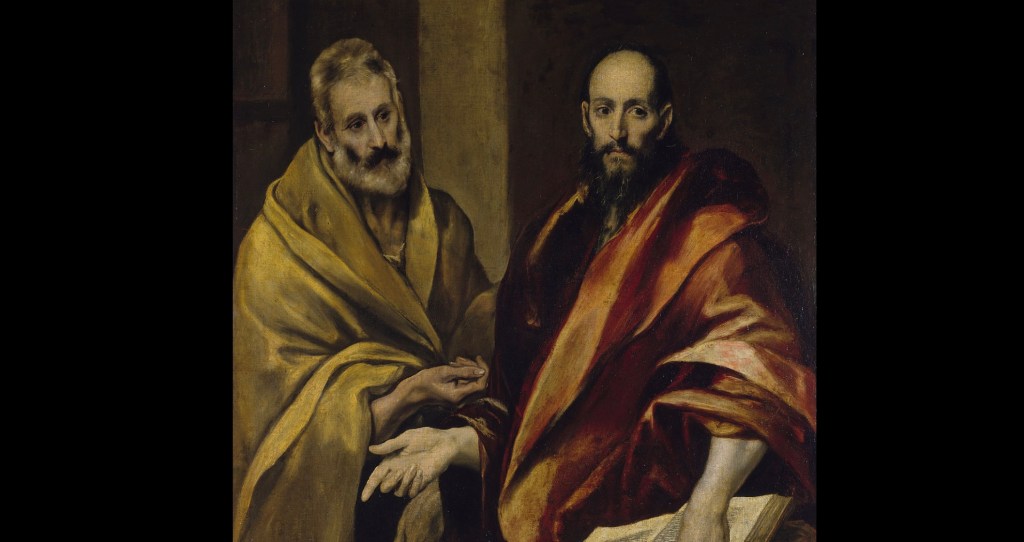
Painting of Saints Peter and Paul by El Greco, 16th Century

Link for the Mass of the Day readings for Sunday, June 28, 2025

“You may go; as you have believed let it be done for you.”

The centurion said in reply, “Lord, I am not worthy to have you enter under my roof; only say the word and my servant will be healed” (Mt 8:8).

After Jesus finishes his Sermon on the Mount, he comes down from the mountain. In the opening of chapter eight, we see two hearts open to God, a leper (who is not included in today’s reading but you can see his encounter with Jesus by reading Mt. 8:1-4.) and a centurion. The centurion may or may not have been a Roman but he certainly was a Gentile. He, a member of an occupying army, was aware of the animosity many Jews felt toward him. Yet he, like the leper, approached Jesus.

Jesus saw in the leper, not revulsion, and in the centurion, not an enemy, but first and foremost, human beings in need, two persons with faith and belief. Reading on we see that Jesus also heals the mother-in-law of Peter and many who are possessed. Jesus reached out to them with a simple touch of his hand, with his healing words and in so doing brought to each of them the healing they sought. Jesus shows us that the kingdom of his Father is open to all who have faith and believe.

Jesus said to the centurion, “You may go; as you have believed let it be done for you” (Mt. 8:13). Do we have the same belief as the leper, the centurion, and Peter’s mother-in-law? Each of them believed in Jesus and experienced healing.

We are all wounded by sin and also in need of experiencing physical, psychological, and/or spiritual healing.  Jesus is just waiting for us to ask, and to open our hearts and minds to him, so that we too may be healed and transformed by his forgiveness, love, and mercy. We, like the centurion and Peter, can approach Jesus on behalf of others who are also in need of healing. Let us resist the temptation to judge anyone as unworthy to receive the grace, love, and mercy of Jesus but be willing to see others in need and bring Jesus to them.

As God brings people into our lives, let us receive them as Jesus did: as fellow human beings, first and foremost, created in his image and likeness. May we be healed from any revulsion, prejudice, or temptation to define others with labels and instead be willing to allow Jesus to reach out through us to share his healing word or extend his healing touch to one another. Let us believe in Jesus, be healed and help to heal others!


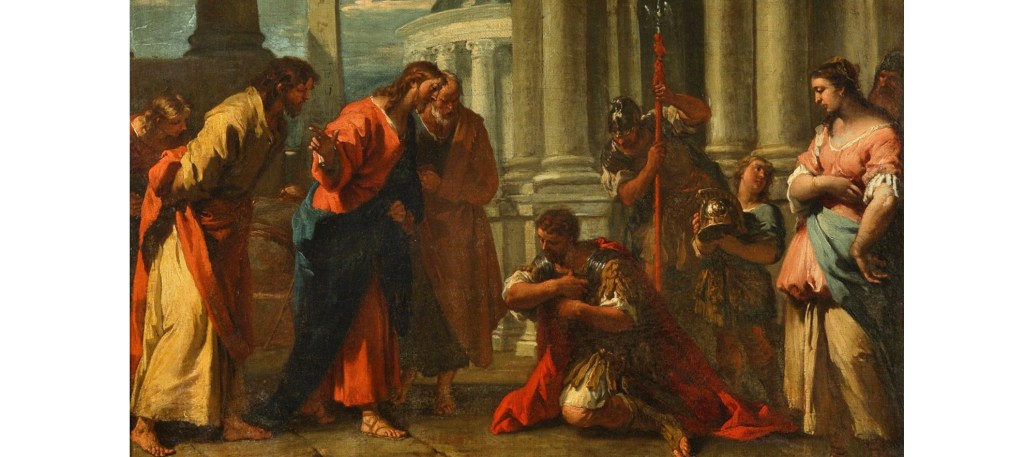
Painting: Sebastiano Ricci, “Christ and Centurion”, 16th century, Italy

Link for the Mass readings for Saturday, June 28, 2025

Jesus is willing to save the one.

“What man among you having a hundred sheep and losing one of them would not leave the ninety-nine in the desert and go after the lost one until he finds it” (Lk 15:4)?

At first hearing, how many of those present hearing the parable, or us today reading it, would answer yes? To most of us it would not make sense to leave the ninety-nine to go and search for the one that was lost.

What this parable represents is the love that God has for each and everyone of us. He knows us better than we know ourselves. God loves us with an everlasting love and is continually reaching out to us because he is the foundation and source of who we are. He wills our good and wants the best for us, even when we may not see the truth. This parable also represents a microcosm of the public ministry of Jesus.

Jesus met people one on one, person to person. He encountered the blind, the lame, the leper, the Syrophoenician woman, the woman at the well, the woman accused of adultery, the daughter of Jairus, the widow’s son, and Lazarus. Jesus not only healed these people and so many others who were considered to be on the outside looking in, he restored their dignity as human beings. Jesus loved each of them as a unique person.

In crafting this parable of the good shepherd seeking the lost sheep, Jesus may be echoing, Isaiah. He prophesied that because the leadership of his time was not bringing back the stray nor seeking out the lost, God would “appoint one shepherd over them, to pasture them” (See Ezekiel 34:23). Jesus sought out and continues to seek out the lost, no matter how far we have strayed, or messed up, Jesus loves comes for us.

He opens his arms and invites us into his loving embrace so that we may feel and experience the beating of his Sacred Heart. As we enter into that sacred rhythm, all our anxiety, fears, and pain begin to fade away and we begin to heal. We begin to experience our dignity as we experience being loved for who we are, not defined by our worst sins nor by what we do.

We just need to be willing to be found and allow him to lift us up on his shoulders and carry us back into the fold. As we do so and as we continue to experience his love, we will come to believe and say, as did St Paul,“Who can separate us from the love of Christ? Trial, or distress, or persecution, or hunger, or nakedness, or danger, or the sword?… Yet in all this we are more than conquerors because of him who has loved us” (cf. Romans 8:35-37).

Once we slow down enough to place our head on the chest of and experience the beating of the Sacred Heart of Jesus, renew in the rhythm of it, we will experience his peace and rest. We too are to love with the same radical love of the Shepherd who left the ninety-nine to rescue the one, who just happens to be us if we are willing to be rescued.

—————————————————–

Photo: Stain glass window at Cathedral of Our Lady of the Angels, Los Angeles, CA

Link for the Mass readings for Friday, June 27, 2025, Solemnity of the Sacred Heart of Jesus

Let us build our spiritual homes on the love of the Father, the Son, and the Holy Spirit.

“Everyone who listens to these words of mine and acts on them will be like a wise man who built his house on rock” (Mt 7:24).

Jesus speaks to us: in the Gospels, in the silence of our hearts, through our conscience, through the words of others, in our daily activities, and through creation which has been loved into existence through collaboration with his Father and the Holy Spirit.

We can be unaware of the words he speaks, we can hear his words but not listen, hear his words but ignore, listen but not act upon them, or we can do with his words as Jesus encourages us to do. We can listen to his words and put them into action. We can experience the gentle nudge of the Holy Spirit and follow his lead. When we follow the urgings of Jesus and the Holy Spirit, no matter how small of a nudge it is, that step in alignment with the Father’s love will make all the difference. For each affirmation and putting into action their guidance helps us to experience the love of God our Father.

Jesus became one with us so that we can share in the love of his Father. Not one with us, so that we can know about him. Not one with us, so that we can say that we prophesy, cast out demons, do mighty works, cite Bible chapter and verse to show our knowledge or justify our behavior in his name. One with us so that we can share in the very life of God the Father as he and the Spirit does. 

Jesus meets us on our level and when we are willing to follow his lead, he will lead us up to the heights of participating in his divine life. Jesus has been doing just that in his Sermon on the Mount which we have been reflecting upon these past few weeks. If you are just coming in today or need a refresher, this gathering of teachings began in chapter five of Matthew and takes us up to today with chapter seven. Jesus presented us with the Beatitudes, that we are called to be salt and light, he built on the law and the prophets by giving us the six antitheses (“You have heard it said, but I say to you…” statements), he taught us to pray the Our Father, that we are to depend and place our trust in God and not the things of this world, we are to refrain from judging others, we are not to cast our pearls before swine, we are to do to others as we would have them do to us, we are to seek to enter through the narrow gate, and to be aware of false prophets.

The teachings of Jesus in chapters five, six, and seven of Matthew, his Sermon on the Mount, put into practice will help us to build the foundation of our spiritual houses on solid rock. The same rock that Peter built his foundation on, the Christ the Son of the Living God. May we go back through chapters five, six, and seven of Matthew and see which teaching Jesus is leading us to ponder, meditate upon, put into action, and place our next foundational stone of discipleship.

If that is a bit much, we can start with St. Irenaeus who learned from St. Polycarp, who learned from the beloved Apostle John who learned from Jesus. St. Irenaeus taught that Jesus became one with us so that we can become one with him. Jesus entered our humanity so that we can participate in his divinity. Jesus invites us to be in relationship with him, to know him, so that we can know his Father and experience the love of the Holy Spirit that he wants to share with us. The goal is that we can be one as Jesus and the Father is one.

Jesus loves us as we are, and for who we are, right now at this very moment. Jesus loves us more than we can ever imagine. Jesus loves us so much, he invites us to repent and turn away from anyone and anything that may be leading us away from God. He invites us to turn back and walk in the direction of the Father’s arms that are wide open to embrace us. When we experience God’s loving embrace, may we rest there, savor, and abide in his love. Filled up with his love to overflowing, we have a wonderful gift to share.


Photo: The Sanctuary of Madonna della Corona in the province of Verona, Italy. Photo accessed from Italiabsolutely

Link for the Mass readings for Thursday, June 26, 2025

Want to know Jesus? Spend some time daily with him in the Gospels.

“Beware of false prophets, who come to you in sheep’s clothing, but underneath are ravenous wolves. By their fruits you will know them” (Mt 7:15-16).

So as not to be taken in by false prophets within in our Church and society, and most importantly, so as not to be wolves in sheep’s clothing ourselves, we need to know the Shepherd. We need to know, as St Irenaeus (whose feast we celebrate on Saturday the 28th) described: Jesus, “who did, through His transcendent love, become what we are, that He might bring us to be even what He is Himself” (p. 526 Against Heresies, Book V, Introduction). Jesus Christ, the second person of the Trinity, who entered into and embraced our fallen and wounded condition to become fully human while remaining fully divine, came to shine a light in our lives.

Jesus came to reveal those sinful acts which estrange us from God and one another. Jesus came to show us the value of our unique dignity as human beings, the wonder of God’s creation that we are, and empower us so we may restore our likeness to God and deepen our relationship with God and one another. In allowing Jesus to come close to us and getting to know him, he through his love and light, will reveal to us those road blocks that prevent us from following his way.

How can we know Jesus today since we are removed from the time of the Apostles?

One practice is to follow the encouragement of Pope Francis who invited us to read and prayerfully reflect upon the Gospels each day and Pope Leo XIV who in his first audience on May 21 said that, “every word of the Gospel is like a seed that is thrown on the ground of our life.” Especially, during this Season of Ordinary Time we may receive these “seeds”, the teachings of Jesus, through the daily Mass readings. Reading them on our own is a powerful daily practice that allows us to come to not just know about Jesus and his teachings but to know him.

This does not happen by just reading the words on the page with the sole intent to finish it and move on to something else, so as to complete one more task. Instead we are invited to read slowly, meditatively, and prayerfully. We can read a section as in today’s Gospel about knowing true disciples from false prophets. Reading through a section three to four times or more until we feel a movement within from the Holy Spirit guiding us to ponder a particular verse or word is helpful.

We then stay there with Jesus by mediating on a word or phrase from the Gospel that peaks our attention. We may receive an insight, an intuition, a confirmation, a sense of excitement, a challenge, or a question. We can also be confused, perplexed, or frustrated. We can also place ourselves in the scene as if we are watching a movie and allow through our imagination our senses to come alive and pay attention to what arises.

Another gift of encountering Jesus in the Gospels, that some may not recognize as a gift, is that we will naturally be drawn to examine our conscience as we read and ponder the life and teachings of Jesus. We don’t have to read long to experience how challenging Jesus’ teachings are. In pondering today’s account about a bad tree bearing bad fruit, some of our own bad fruit may come to light: selfishness, greed, judgment, gluttony, lust, pride, indifference, sloth, envy, wrath, or others.

This in not an invitation to experience shame. This is Jesus’ invitation to identify, repent, and confess and to turn to God to receive his forgiveness, mercy, and love so that we can be transformed. Jesus’ call to repentance is an invitation to prune those branches within us that bear such fruits. The discipline of repentance and confession that leads to pruning will provide more energy and nourishment for those good branches we have so they may flourish with the fruits of love, joy, peace, patience, kindness, chastity, goodness, generosity and self-control.

It is important to sit with what we experience from a meditative and prayerful reading of the Gospels. The Holy Spirit will reveal insights and experiences of consolation and joy. It is just as important to be willing to wrestle with passages that challenge us, that we do not understand, or disagree with. Each experience provides us with the opportunity to ponder and discern what God seeks to reveal to us.

Through a daily commitment of reading, meditating upon, praying with, and allowing the Gospels to come alive in our hearts, minds, and souls, we be drawn to deeper moments of quiet contemplation, and we will encounter and grow in our relationship with Jesus, Mary, and the apostles. That which we have received in each prayerful time of reading, we can then carry with us throughout the day to call upon and experience rest with him as needed.

I have been drawn to remain with and pray with the same verse for the past week during my holy hour:  Jesus, “went up on the mountain by himself to pray. When it was evening he was there alone” (Matthew 14:23). I have been seeking to put God first in my life more and more, and letting go of any attachments and disordered affections that may be leading me astray. What a gift Jesus has given me to step away for an hour each day to go up on the mountain and pray with him.

As we experience the Gospels with a pondering and prayerful approach, we will grow in our relationship with Jesus and know his voice. With his guidance we will better identify those apparent goods, temptations, and false prophets who seek to lead us astray. In trusting in, being obedient to, and putting into practice Jesus’ teachings, we will better know the truth of who we are and who God calls us to be. As we grow in our relationship with Jesus we will not lead others astray but help them to encounter Jesus so that they too may experience his love, mercy, forgiveness, and rest for their souls.


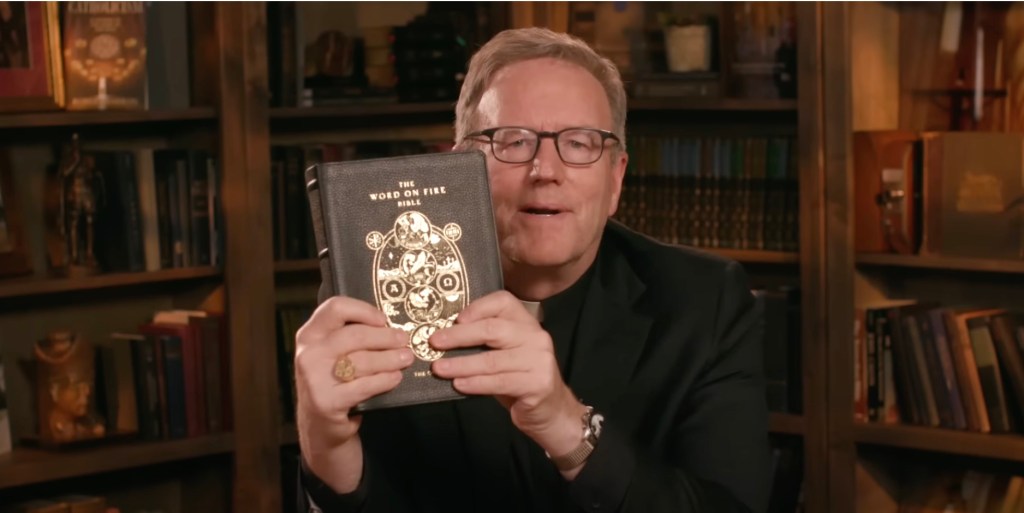
Photo: Bishop Barron link captured from YouTube introducing the Word on Fire Bible, Volume I: The Gospels. I have found the Word on Fire Bible a great resource for reading, prayer, and study. Also, great for those who are just beginning or are looking to return to reading and praying with the Bible.

Link for the Mass readings for Wednesday, June 25, 2025

“He must increase; I must decrease.” John 3:30

“No. He will be called John” (Lk 1:60).

With these simple words, three inter-related points arise. First, Elizabeth is beginning to shift the momentum of original sin. Eve was tempted by the serpent to eat of the fruit that God had told her and Adam not to eat of, yet she did. Adam did not support her nor step in protect Eve during her dialogue but remained silent in the face of temptation Eve was experiencing. Both of them slipped into sin by disobeying the will of God and grasping for what God would have given to them if they were willing to receive their fulfillment of participating in his divinity.

At the time of the birth of Elizabeth’s son, there was even more cause for celebration, for Elizabeth had not born a child and was past child-bearing years. The eighth day had come in which following the Abrahamic law the boy was to be circumcised and named. Her relatives and neighbors gathered around with great excitement and there appeared to be a unanimous decision to name the boy after his father. Elizabeth did not, like Eve, cave to the pressure and temptation surrounding her. Unlike Adam who lost his voice at the time he needed to speak up, Zechariah found his voice, and had Elizabeth’s back. Both Elizabeth and Zechariah knew what God wanted them to do and were faithful to follow through.

Elizabeth and Zechariah were faithful to God even while facing the familial and social pressure placed on them. Some today may be removed by such familial pressure when naming a child, but for this time, Elizabeth, despite the pressure, held her ground and stood firm that the boy would be named John. Ignoring her, the people deferred to Zechariah, the boy’s father, thinking he would have more sense, but he, ignoring supported Elizabeth. The point here is not so much the name, but the following God’s will in the face of pressure to do the opposite.

This brings us to the third point and that is the maturation in moving from identity to integrity. Culture and traditions are not sacred, but God is. Elizabeth and Zechariah faced a lot of familial and social pressure to conform, yet they chose to be true to God, to be true to themselves, and they chose integrity over their identity.

The very simple account of Elizabeth and Zechariah naming their child John in opposition to the pressure offers for us a way to counteract the rising tide of polarization and conflicts that we face in our own country today. Identity provides safety, support, and security. It fuels one of our deepest pangs of hunger to belong, to be a part of something bigger than ourselves. We can find our identity in family, friendships, our religious traditions, culture, political affiliations, common interests, clubs, activities, hobbies, and sports. Our identity in these cultural norms, provides us with security and stability, which is good, but doing so can also be a trap.

We want to belong so much, the drive is so strong, that we may feel the pressure to make decisions, act in certain ways, and support others who go against who we are just so that we can belong. We may have known what God wants from us in a particular situation, heard the whispers of his voice in our conscience, yet were pulled by the louder voices of the group. We are sometimes so ingrained by our identity that we can be strangled and suffocated by it.

In today’s Gospel account, Elizabeth and Zechariah were true to the will of God and won over those placing pressure on them by their family and neighbors. More often though, being a person of integrity does not go so well. Their own son who would grow up to be John the Baptist, would lose his life by speaking truth to power.

John would also show his integrity when he said, “He must increase; I must decrease” (cf. John 3:30). John was talking about Jesus who embodied the moral courage that we all need today. Though more than just a model of a life well-lived, more than just a word on the page, Jesus is the Word of God embodied. Jesus is present to us now, to guide and lead us, to empower us with the same love that he embodies, such that when we invite him into our lives, we too can be transformed to live a life of truth, moral courage, and integrity.

Allowing ourselves, like John the Baptist did, to become less so that Jesus can be more in our lives, aligns ourselves with being disciples of Jesus. We are not to be first but God is. We come to this awareness through the process of repentance and being willing to read, pray, and meditate with Jesus’ teachings and put them into practice. As we prioritize our days by setting up those non-negotiable practices that help our relationship with Jesus to grow, we will begin to better resist internal temptations as well as the external temptations from the enemy and others and grow in the courage to live out our faith in real time in our daily interactions.

————————————————————————–

Photo: Painting by Mattia Pretti of John the Baptist preaching of the coming of Jesus, the Lamb of God who takes away the sins of the world.

Link for the Mass readings for Tuesday, June 24, 2025

“Remove the wooden beam from your eye first”!

For many of us, judging one another is almost as automatic as breathing. As we encounter someone we have instant internal judgments. We judge looks, clothes, actions, inactions, homes, cars, and material items. We judge our family, spouses, friends, colleagues, classmates, leaders, enemies, celebrities, as well as those we consider different as well as those we determine to keep at arm’s length. Much of what gets our attention is what Jesus is addressing in today’s Gospel, negative judgments.

Jesus said to his disciples: “How can you say to your brother, ‘Let me remove that splinter from your eye,’ while the wooden beam is in your eye? You hypocrite, remove the wooden beam from your eye first; then you will see clearly to remove the splinter from your brother’s eye” (Mt 7:4-5).

There are positive judgments that bring about effective change for the good. In a court case, our hope is that the judge is learned in the law and guides the lawyers and jury in ways of sound judgment such that justice with mercy is served. For us to do likewise in our everyday interactions with one another, Jesus shares that we need to remove the wooden beam from our eye first before we are able to remove the splinter in another’s.

Through this hyperbolic image of someone attempting to remove a splinter in someone else’s eye all the while the wooden beam protruding out of his own eye prevents him from coming close enough to actually be of any help! To remove the beam from our own eye, Jesus is inviting us to change our hearts and minds such that we are no longer hardened by negative and condemning judgments toward others based on our own unbridled biases and prejudices. May they soften such that they are open to the mercy and love of Jesus. This does not mean that we accept any and all behaviors, actions, and inactions from ourselves and others. Jesus did not do so.

He is willing to enter our chaos, to embrace any and all of us who will receive the invitation of his healing embrace. Next, through his love, Jesus walks with us, convicts us, and shines his light to reveal to us our slavery of sin. Then he calls us to repent, to turn away from our sinful ways and turn instead toward that which is True, Good, and Beautiful.

As we acknowledge and turn away from our sin, we participate more in the life of Jesus. We are then healed from our own limitations, weaknesses, self-centered perceptions, denial and suppression of our anxieties and wounds that so often fueled our biases and prejudices. As we experience God’s forgiveness and love, we begin to heal, and that beam becomes smaller, and we are able to see others as God sees them, as human beings endowed with dignity because we have been created in the image and likeness of God.

Repentance, forgiveness, and growing in love helps us to collaborate and participate in Jesus’ work of redemption and how we can participate in taking the log out of our own eyes. We can then better assist others in  removing their splinters. When we are willing to admit to our own shortcomings, weaknesses, and failures, and are open to healing, learning, and growing from those experiences, we are then in a better position to meet others in their own chaos, to journey side by side, help others to repent, heal, and to be transformed into who God is calling us to be.

Let us commit to allowing Jesus to help us to remove our beams of judgment so that we can be more understanding, merciful, and forgiving. We will be blessed in doing so, for Jesus also taught that as we judge, so will God judge us. As we repent and are forgiven, so may we forgive and show mercy. In receiving forgiveness and forgiving, in repenting from sin and judgmentalism, our souls will find rest and we will experience God’s peace.


Photo: Icon of 1546 by Theophanes the Cretan, Monastery of Stavronikita Mount Athos.

Link for the Mass for Monday, June 23, 2025

When there appears to be no way, trust in Jesus the Way.

Luke records how Jesus had been teaching and healing a large crowd of five thousand men. As the day was drawing to a close, the Twelve approached him and said, “Dismiss the crowd so that they can go to the surrounding villages and farms and find lodging and provisions; for we are in a deserted place here” (Lk 9:12). The disciples appear to show concern for the many gathered. Yet the response of Jesus may reveal otherwise.

When Jesus tells them to, “Give them some food yourselves” (Lk 9:13), the disciples are stymied, for all that they had, five loaves and two fish, would barely be just enough to feed themselves. The disciples first sought to send the people away, then could see nothing but the limited resources they had, they saw lack.

What follows is the miracle of the multiplication of the loaves and the fish such that everyone present had enough to eat. “They all ate and were satisfied. And when the leftover fragments were picked up, they filled twelve wicker baskets” (Lk 9:17). This miraculous account is recorded in all four Gospels. Time and again, throughout the Gospel accounts, Jesus is  able to provide a way where there appeared to be no way.

It is interesting as well that the word the disciples used, deserted, for we are in a deserted place, is erēmos in Greek. The immediate allusion is to the Hebrews who Moses had freed from Egypt. They too were in the deserted place, the wilderness. They also say their lack and constantly grumbled to Moses that they didn’t have enough and yet, God consistently provided for them bread from Heaven, the manna. Each day they did have enough to eat.

Erēmos can also be translated as lonely, a lonely place. One thing that is common among all of humanity is that we all experience loneliness. This is partly true because we separate ourselves from the deepest desire and hunger of our soul, our hunger to be loved by God. When we allow anyone or anything to be placed before our relationship with God, we will always experience a lack because only our relationship with God will truly satisfy us. Even the best of relationships, the best of things are finite, and will not last. In establishing and developing our relationship with God, all our other relationships and appetites can be properly ordered.

The next time, we feel like we can’t, we want to give up, we feel alone or are experiencing desolation, let us turn to our loving God and Father who will provide for our needs. He provides for us at every Mass the opportunity to experience his Son, the true miracle of bread and wine becoming the Body and Blood of Jesus the Christ. We can be nourished weekly, even daily, by the “source and summit of the whole Christine life” (Lumen Gentium) so that we can have the strength to persevere, that we can persevere, we know that we really and truly are never alone, and our desolation can be transformed into consolation by experiencing the love of the Holy Spirit.

Let us not buy into the lie of lack. Where his disciples saw lack, Jesus saw a way provided for by trusting in his Father and he multiplied the five loaves so the 5,000 all had their fill. We are finite human beings living in a finite world, yet we are not alone. Jesus, fully human and fully divine, continues to still be with us, present to us, just as he was with his disciples. As with them, when we trust in Jesus, all things are possible. When there appears to be no way, Jesus is the way. “When we give ourselves to Him, we receive a hundredfold in return. Yes, open wide the doors to Christ – and you will find true life” (Pope Benedict XVI in his inaugural homily, Sattler). Trust in Jesus today!


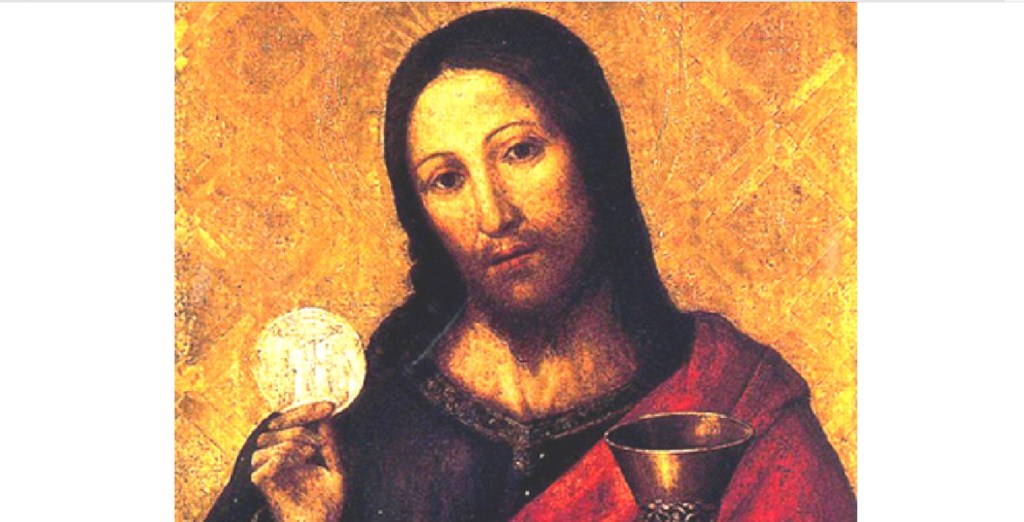
Photo: “Christ with the Host” by Paolo da San Leocadio

Link for the Mass readings for Sunday, June 22, 2025