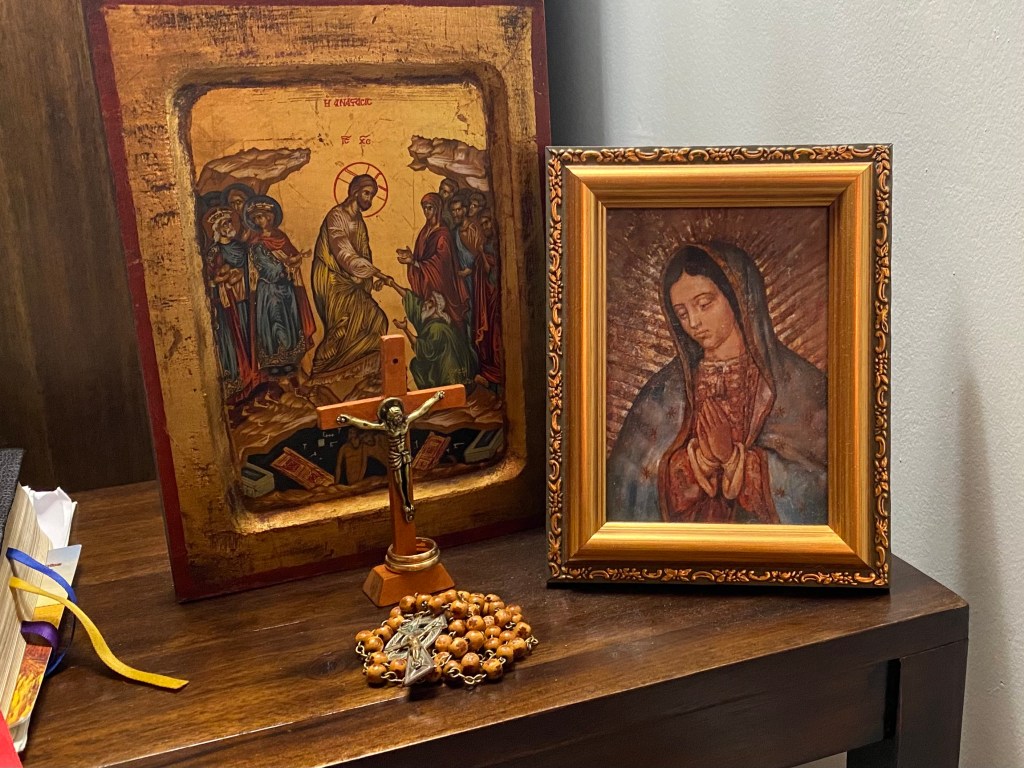
forgiveness
May we confess and not allow the sun to set on our sins.
In each of our readings for this Sunday, even the psalm, there is conflict. The reconciliation for this conflict is to accept and understand that God is God, and we are not. We are to place all our trust in him, follow his precepts and teachings and we will be in a much better place. Better because we will come to realize that the interpretive key to experience healing for ourselves and guidance through our conflicts, is to accept the invitation of our loving God and Father to be in relationship with him.
We have been created by an outpouring of God’s love, to receive his love, and to love God, our neighbors, and ourselves as he loves us. When we anchor ourselves in this truth, in putting God first, trusting in him and seeking to deepen our relationship with him, our lives will be more properly ordered and we will realize that not only are we not alone when we experience conflicts but we will have a firm foundation in God for guidance. When we have recognized that we have turned away from God through our sin, may we have the humility to seek forgiveness.
In our first reading then when Joshua complains to Moses because he hears about how Eldad and Medad are prophesying apart from the seventy who had come to receive the spirit God sought to bestow on them, Moses pointed out to Joshua that God can bestow the spirit on whomever he wills and, “Would that the LORD might bestow his spirit on them all” (Numbers 11:29)!
This same theme arises in the Gospel when John also complained to Jesus that someone, not one of the apostles, was driving out demons in Jesus’ name. Jesus tells him not to prevent him from doing so, “For whoever is not against us is for us” (Mark 9:40).
Both Moses and Jesus recognize and acknowledge that the power of God is at work among his people, and that this not to be prevented or inhibited in any way. That people are receiving the spirit of God and acting upon God’s guidance is what we are all to do! To give the spirit and love and for all to receive is what God wants for all of us!!! The love we have received is not for us alone, but for us to share.
James points this out clearly in his letter and reveals the danger of wealth when we cling to it and refuse to share. Wealth given by God is a gift and a gift given not for us alone. We are to be good stewards of what we have received and provide freely for those in need. We are not to grasp for wealth on our own terms apart from God’s guidance nor exploit or use others for our own gain.
One of most egregious of sins is withholding wages from workers that are due their pay; the cries of which “have reached the ears of the Lord of hosts” (James 1:4). Withholding wages of day laborers during the time of James could have devastating effects. It could mean the laborer or his family would not eat, he could not make a payment of debt and could be imprisoned, as well as other complications that posed a risk for those living day to day with no social net or means of support.
In the Gospel, Jesus shows vividly and graphically the seriousness of sin. Without mincing words, Jesus showed clearly that sin was not to be taken lightly and doing so has catastrophic effects not only in this life but for all eternity. This was especially true for those who lead others into sin. “Whoever causes one of these little ones who believe in me to sin, it would be better for him if a great millstone were put around his neck and he were thrown into the sea” (Mark 9:42).
This great millstone or donkey stone was massive. Some biblical scholars state that this stone could have weighed up to a thousand pounds. The donkey was hooked up to the stone, which was in the form of a massive wheel and then led by the donkey in a circle to pulverize wheat and other grains that was placed in a stone trough so to make flour. It is not hard to then imagine what would happen to someone who had this stone attached to his neck and thrown into the sea!
Jesus continued with more imagery by saying that it would be better to cut off a hand or a foot, and to pluck out an eye if any of these members would lead to sin. Jesus used such graphic language to show how destructive sin is in our lives, for each of us as individuals, as well as for families and communities. Sin has horrific consequences because it damages or ruptures our relationship with God and each other. The ultimate devastation would be an eternal life of separation from God.
Better to die a horrific death, than to die in a state of unrepentant mortal sin. Better to die maimed than clinging to a sin that would separate us from God for all eternity. Jesus is not wishing horrific deaths, physical dismemberments, or eternal damnation on anyone. He came not to condemn but to save humanity. His first public statement as he began his public ministry recorded back in Mark 1:15 is: “This is the time of fulfillment. The kingdom of heaven is at hand. Repent and believe in the Gospel.”
Jesus came to wake us up, to lead us away from our selfishness, our self-centeredness, and sin, to heal us from our fears and deepest wounds, and to guide us home to the very source of our being, the infinite spring of our sustenance and nourishment, the core of our deepest desire, which is to remember who and whose we are. To call us to repent, to turn back to God, and believe in the gospel, the good news, that we are God’s beloved daughters and sons. And yet, through a free act of our will, we can reject the love of our Father and choose to separate ourselves from the love that God wants to bestow upon us in this life and for all eternity.
We can also choose to make the psalmist’s words our own: “Cleanse me of my hidden faults” (Psalm 19:12). When we hide in the darkness and cling to our sin, we are listening to the father of lies who seeks division and our death. God will forgive us from anything. God never tires of forgiving us. We tire of asking. Let us come confidently into the light, into the confessional, and ask Jesus to reveal to us our sins. When we have the humility to be contrite, confess, and atone for our sins, we will know and experience Jesus’ mercy, forgiveness and love, and be reconciled to our God and one another now, in this life, and for all eternity.
Photo: Rosary walk, Riomar Beach, Vero Beach, FL.
Humility, contrition, and confession are the pillars for forgiveness, love, and peace.
Logistically, to our modern minds, the setting of this verse may appear confusing. How could this “sinful” woman be standing behind Jesus such that her tears would fall on his feet? When we think of someone sitting and eating, we imagine them doing so by sitting in a chair. Thus, the feet would be toward the front of the person.
During the time period Jesus lived, the customary practice when eating was not to sit at all but to recline. Thus, the woman was standing behind the feet of Jesus as he reclined, and her tears fell on his feet. She then knelt down, dried his feet with her hair, and then anointed Jesus’ feet with the ointment she brought for him.
She did not rationalize, deny, ignore, or come grudgingly nor wait for Jesus to call her out, she came not asking for healing but with true contrition for her sins. Being in the presence of Jesus, when we are open to his love and experience his compassion, we are pierced to the heart with our own sorrow for the hurt we have caused others through our sinful actions.
Those quick to point the finger at other’s sins, like Simon who judged this woman, are less apt to be aware of the depth of their own sin and thus “the one to whom little is forgiven, loves little” (Lk 7:47). We are not forgiven less because God is not willing to forgive but because God will not go against our free will. If we are unaware or unwilling to bring our sins forward in a contrite manner, we are cutting ourselves off from the healing forgiveness God wants so much to share with us. But if we, like the woman in today’s Gospel account, are willing to bear our soul with humility and sorrow we will not only be forgiven but experience a deeper outpouring of God’s love. The one who confesses truthfully, fully, and contritely is forgiven more and thus will love more.
We are offered the same gift of grace and forgiveness as she received. What if instead of hiding from, being in denial of, rationalizing, or justifying our sins, we acknowledged them and sought the healing forgiveness of Jesus as she did? In opening our hearts and minds to the forgiving and purifying love of the Holy Spirit there is pain, as there is in any healing, but there is also freedom. When we trust Jesus as she did with our deepest and darkest sins, we too can be forgiven, healed, and freed of the shackles that bind us and experience his love.
Don’t believe the lies of the enemy. God loves us more than our worst mistakes and sins. When we trust him, are contrite, confess, and willing to atone for our sins, the truth will set us free, and we will experience God’s love more fully and his peace more deeply.
Photo: Good to be still, quiet, breathe, and examine our lives from time to time.
Link for the Mass readings for Thursday, September 19, 2024
Let us believe, in Jesus who opens up heaven for us.
Jesus continues his conversation with Nicodemus in today’s Gospel from John. In the opening verse, Jesus outlines why he came into the world: “God so loved the world that he gave his only-begotten Son, so that everyone who believes in him might not perish but might have eternal life” (Jn 3:16). God has created us out of love and shepherds us out of love. God loves what he has created, and in his order and timing, he sent his Son to enter humanity to become one with us, to heal us and invite us to come out of the shadows and dark recesses of turning in upon ourselves, from living in fear and sin, and to walk with him in relationship.
To love we need to risk being rejected. Jesus entered humanity as we all did, in the utter vulnerability of the womb. His very life was at risk from the moment of conception. Mary, a young woman, betrothed to Joseph, in a time and culture in which a woman found to be with child and not from her husband, could be stoned to death. Mary could have made a different choice, Joseph could have made a different choice, but both chose to follow the will of God. They resisted the temptation to close in upon themselves and make an isolated decision based on their own needs, anxieties, and fears. While all of creation held its collective breath, Mary and Joseph trusted God, they chose the light, they chose to protect life.
“Whoever believes in him will not be condemned, but whoever does not believe has already been condemned, because he has not believed in the name of the only-begotten Son of God” (Jn 3:18). Jesus did not come to condemn, he came to redeem, to save, to love us into eternity. For love to be real, it must be truly free. Free to the full extent that it can be rejected. Otherwise, what is experienced by the other is coercion, conditions, manipulation, pressure, but not love. The Son of God entered the womb of Mary risking rejection by her, Joseph, and/or their extended family.
Those who, like Mary and Joseph, believe in Jesus will come to have eternal life, and those who do not have already been condemned, not by God but by themselves. This is true because instead of accepting the invitation of the Source of life they are turning away. Those rejecting God have been invited to receive his love also, but for reasons they may or may not be aware of, say no. We who follow Jesus are to be his presence of love among those we encounter, even those who shy away or reject him. We may be the only Bible someone ever reads.
Satan tempts and condemns us when we fall. God does not. “God so loved the world that he gave his only-begotten Son, so that everyone who believes in him might not perish but might have eternal life” (Jn 3:16). We, even in our brokenness, imperfections, and sin, are loved by Jesus. Don’t listen to the father of lies who would say anything different. Jesus has not come to condemn but to invite us to receive his love, healing, and forgiveness. Only if we are unwilling to seek his forgiveness, we are not sorry, and/or we are not willing to change, will we not be forgiven, because we give nothing to Jesus to forgive.
There is nothing Jesus will not forgive us for, nothing, that is why he instituted the sacrament of Reconciliation. When we seek his forgiveness, are sorry for our sins, confess to the priest, seek to change with Jesus’ help and do penance, we will be absolved and forgiven.
We are free to reject or accept the offer of Jesus’ love. As Pope Francis wrote: “We are called to be holy by living our lives with love and by bearing witness in everything we do, wherever we find ourselves.” As we are forgiven, receive, and experience the love of Jesus, may we seek to love those we encounter as Jesus has loved us. If there are any that we might not include in everyone, may we be willing to allow Jesus to love them through us until we can.
Photo: Looking up to the things of heaven as I began my Rosary walk – St. Vincent De Paul Regional Seminary, Boynton Beach, FL.
Link for article on Gaudete et Exultate (“Rejoice and Be Glad”)
Link for the Mass readings for Wednesday, April 10, 2024
Which path will we follow? Judas’s or Peter’s?
The Gospel reading for today from John is painful on two fronts. First, Jesus said to Judas, “What you are going to do, do quickly” (Jn 13:27). Did their eyes meet at that moment, was there an unspoken appeal from Jesus to Judas, or had that already been settled in Jesus’ full surrender in the Garden of Gethsemane? Judas aligned himself with Satan and set his course, and removed himself from Jesus and his companions and it was night.
The second front appears at the end of today’s reading. Despite Peter’s apparent full endorsement of Jesus and promise to even lay his life down for him, Jesus predicted that “the cock will not crow until” Peter will deny him “three times” (Jn 13:38). The momentum of utter betrayal builds. Judas will agree to turn Jesus over for thirty pieces of silver. He will betray the Son of God, yet in so doing, Judas will play his part in salvation history.
Judas will set in motion Jesus’ arrest that will culminate in his crucifixion. Peter will come to deny Jesus three times as Jesus predicted. I cannot think of any experience worse than the pain of betrayal. And yet, if we read these passages closely, they ought to convict us to the heart. How have we betrayed Jesus? This is an important question to ask, and what is even more important is that we not only answer it honestly but seek forgiveness and resist the temptation of isolating ourselves in our sin and pride when we come to admit where we fall short.
Judas separated himself, cut himself off from Jesus and his companions. He came to realize his sin, though he did not seek forgiveness, but isolated himself further and in his despair took his life. Peter, also regretted his sin, his cowardice, he wept when he heard the cock crow, but he also trusted, and later affirmed his love for Jesus three times, atoning for his three denials and was forgiven.
This Holy Week we can choose to walk the path of Judas or Peter. With each humble step, may we come to see how our spirits are often willing but our bodies are weak, that we have been wounded by others and acted in kind. We have also fallen short of who God has called us to be in what we have done and what we have failed to do.
Awareness of our unworthiness is a good thing. We must resist isolating and beating ourselves up though. The confessional is not a place of condemnation but a place of healing. With each confession, we don’t go back to the beginning and start all over, the grace of each confession builds on the past one, and strengthens us to resist temptations going forward.
Jesus has not come for those who are worthy, he has not come to call the righteous, but he has come to call us sinners to repentance (cf. Luke 5:32), and this is good news! Jesus will receive us when we are humble enough to admit our sins and willing to be forgiven and so healed. In this way, we can learn from Peter. Even if we have betrayed Jesus and each other, Jesus is willing to forgive us too so that we will become wounded healers as well!
——————————————————————-
Painting: I have experienced many blessings these past two years, one being walking down this ramp each evening for a Rosary walk! St. Vincent de Paul Regional Seminary, Boynton Beach, FL.
Link for the Mass reading for Tuesday, March 26, 2024
Cast the first stone or confess?
“Let the one among you who is without sin be the first to throw a stone at her” (Jn 8:7).
As these words came forth from the mouth of Jesus, there must have been a deafening stillness. A mob had gathered around a woman seeking to stone her for being caught in the act of adultery. Had this woman actually been caught in the “very act”? Were there those that were scheming so scrupulously that they would spy on her at that moment, or like our first reading from the Book of Daniel was this a false accusation because the woman refused the advancement of someone who wanted to commit adultery with her, and she refused? Either way, Jesus helped to restore the dignity of this woman by showing the common shortcoming of our fallen humanity.
Today’s Gospel account from John helps us to come to terms with the reality that we are all unified in the reality that we all fall short of the glory of God that we were originally created for. Fortunately, there was no one present who thought himself so self-righteous that he had not committed any sin. All left and only Jesus and the woman remained. It was only then that he spoke to her.
Jesus’ goal for each person he encounters is that we come to terms with our own sin, repent, and believe in the Gospel. Yet, he does so not by condemning us but by showing us how we are off the mark and bestowing his mercy and love upon us. In this way, he guides us to the path that will lead to what is truly good, not the false allures of apparent goods that may glitter in the moment, but then fade.
Jesus does not define us by our worst mistakes, but he does not want us to remain in our sin either. By doing so, we are separating ourselves from a more real and intimate relationship with God and one another. Jesus reveals to us those choices, behaviors, habits, prejudices, and vices that separate us from him and each other.
Lent is an intense season when we make the time to become more aware of that which divides and in humility admit to and confess these behaviors so that through the love and mercy of God and in collaboration with him, we can be transformed.
Jesus does not forgive us so that we will then call out another’s sins publicly to condemn them. If we truly care about saving another, we are to do so as Jesus did and has guided. We are to meet them one on one, convict and correct with tender chords of love that they may be more able to see their sin and willing to confess. We are better able to do so when we have the humility to see our own sins, be contrite, and go to Jesus through the priest, confess them, and receive absolution, healing, and forgiveness.
May we examine our conscience, call to mind those areas in which we have fallen short of the glory of God in our lives, where we have sinned, and with humility share them with Jesus. In this way, we with the woman caught in adultery may also hear his words, “Neither do I condemn you. Go, and from now on do not sin anymore” (Jn 8:11).
—————————————
Photo: From the stone moat around St. Vincent de Paul Chapel, St. Vincent de Paul Regional Seminary, Boynton Beach, FL.
Link for the Mass readings for Monday, March 18, 2024
Turn from darkness and prefer instead the light that has come into the world.
“That the light came into the world, but people preferred darkness to light” (Jn 3:19). What is the preference of darkness over light? We have all said with St. Paul, “For I do not do what I want, but I do what I hate.” (Romans 7:25)? Now we are not always in this state of choosing darkness over light and choosing to do what we don’t want to do instead of what we want to, but we are probably guilty of entertaining both more than we are willing to admit. Why? I don’t have a definitive answer, but I can share a few ideas.
We are certainly influenced by the condition of Original Sin, that time in our ancient ancestral past where the choice to choose self over God happened and has been perpetuated generation after generation up to an including today. We can choose our self over God because that is an influence of our fallen world and have learned to live our lives that way. We create habitual patterns of behavior and then we go on automatic pilot, continuing to make the same decisions repeatedly. We also make decisions that appear to be but are not for our highest hope and good, because many of us have been wounded and we are doing the best we can to cope and survive.
Our Baptism takes care of Original Sin, but we still have concupiscence, which is our tendency to be drawn into sinful actions. We are still susceptible to temptation. What helps is recognizing that there is a God who loves us, so much so, that he sent his only Son to be one with us so we can be one with him. What helps is making more of a conscious choice to recognize and come out of the shadows, out of the darkness of our defense mechanisms, our denial, our past hurts, anxieties and fears. We need to say yes to Jesus who never sinned because for each and every temptation he received, even in Gethsemane, Jesus had one and the same answer: “Not my will but yours be done” (cf. Lk 22:42).
When we choose to surrender our life to God, by aligning our will with God’s, and by participating in the life of Jesus, we can receive and experience the love of the Holy Spirit working in our own lives. In so doing, we will find healing and forgiveness. This is not a one-time event. This is a progressive, spiritual journey that continues throughout the whole of our lives, and into eternity with God. When we notice we are beginning to slip, this awareness is good. We need to resist beating ourselves up, admit where we are, apologize as necessary, seek forgiveness, and return to loving God, ourselves, and one another.
Holy Spirit, please guide us today so that we can better resist the temptations that go before us, unlearn our negative behaviors, and create new habits to replace those that have kept us bound and shackled to our self-centered, indifferent, and unhealthy postures. Help us to identify and renounce the shadow sides of ourselves, seek to confess and allow your love to heal us, and to place our trust in the Light of Jesus, the warmth of his love, and receive the gift of his forgiveness and mercy.
Photo: St. Francis preferred and chose to follow the light of Christ. Outside our chapel, St. Vincent de Paul Regional Seminary, Boynton Beach, FL.
Having the humility to confess our sins frees and heals us.
It is much easier to find fault in others, and in some cases, the act of doing so has become entertainment in private as well as publicly, and especially with social media. Gossip has a seductive allure and can be consuming. Judging others is also a way to justify and or project our own inappropriate behavior onto others. We may even place ourselves in a false sense of exalted pride. Have we ever, not just stated, but thought or prayed something along the same lines as the Pharisee in today’s Gospel? “O God, I thank you that I am not like the rest of humanity — greedy, dishonest, adulterous — or even like this tax collector. I fast twice a week, and I pay tithes on my whole income” (Lk 18:11-12).
To pray any part of this prayer stunts the growth in our spiritual life because we are focused on ourselves instead of emptying ourselves before God. Anytime we rationalize, cover over, or deny our sinful behavior we create and support habits of selfishness. Left unchecked, we can become enslaved to them. Lent is a time for healing, purification, and transformation. To be able to heal from sinful attitudes and actions that have become habits, we first must be able to acknowledge and identify them.
Over time, reading more and more lives of the saints, I have come to understand that their recognition and confession of their sinfulness was not just pious platitudes, but true expressions that they were growing closer in their relationship with Jesus. A simple example can help express where they are coming from.
When we drive our car while it is dark we don’t give much thought to the cleanliness of our windshield because we can see fine. Yet as the headlights from an oncoming car illuminate our windshield, the smudges, dirt streaks, and bug residue come into focus. This can be evident in our spiritual life as well. The more we remain in our own darkness of denial, we feel we are fine, all is right with the world. The closer we grow in our relationship with Jesus, the more his light shines in our darkness, and he reveals to us our sin.
Jesus invites us to resist the prayer of the Pharisee who justifies himself as he prays comparing himself to someone else, instead of acknowledging his own sinful actions and he instead emphasizes that we are to follow the honest humility of the tax collector, who did “not even raise his eyes to heaven but beat his breast and prayed, ‘O God, be merciful to me a sinner’”(Lk 18:13).
Now, Jesus is not saying this is the only way we pray. We have the opportunity to worship and praise the Lord joyfully, we can seek his help in praying for others through intercessory prayer or for ourselves in petitionary prayer, we can also sit in quiet meditation during adoration or out among God’s wonder of creation. Each prayer has its time and place and each type of experience of prayer helps us to grow and deepen our relationship with Jesus and each other.
True humility is brought about by our willingness to see who we are from God’s eyes and to focus on him instead of ourselves. If we want to set a standard to live up to and if we are to compare ourselves to anyone, let it be Jesus. A daily examination of conscience is a healthy practice and discipline. We just need to be willing to invite Jesus to shine his light of love into our present places of darkness. What we see then we can confess. Admitting to and experiencing the sorrow for the hurt we have caused from our sins is healing. In our willingness to confess, promise to sin no more, and do penance, we will receive his love, mercy, and forgiveness.
One prayer I have found helpful over the last few years is the Jesus Prayer. It is very simple. Sit in a comfortable space, take a few deep breaths and exhalations, then as you take the next breath in recite, “Lord Jesus Christ, Son of the living God,” and then as you breathe out say, “Have mercy on me a sinner.” You are breathing in the light of Christ and you are breathing out the darkness of your sin.
Traditional prayer ropes exist from the Eastern Orthodox tradition for this practice. They are made of wool, usually black, and have ten decades of ten beads. The bottom can also have a fringe representing the mercy of God wiping away our tears of sorrow. You can also use your Rosary. If you have neither a prayer rope or a Rosary, you have your fingers. Start with a set of ten Jesus Prayer recitations each day and pray by prayer come closer into communion with God.
—————————————————————————————
Photo: Rosary walk and looking up, just past sunset. God is good! St. Vincent de Paul Regional Seminary, Boynton Beach, FL.
Link for the Mass readings for Saturday, March 9, 2024
Forgiveness is possible. We just need to be willing to ask Jesus to help us.
Forgiveness is a wonderful gift of grace and mercy. If we asked many people if they would like to receive forgiveness most would say yes. The number would most likely be less if we were to ask them how many would be willing to forgive others. If we were asked to forgive someone seven times, that number would shrink significantly, and if we were invited to forgive someone seventy-seven times, is there any among us who would say yes, any among us willing to consider doing so?
Why is forgiveness so hard for most of us? I do say most because there are those who have an openness to being forgiving. One reason could be that we have few role models. I would imagine those that are more forgiving have not only experienced positive role models but have received forgiveness themselves.
How often do we seek forgiveness from others when we have done something wrong, inappropriate, or made a mistake? We often seek to explain first, make excuses, justify, or ignore our behavior altogether. When we resist being humble, confronting our offenses, and do not seek reconciliation, we do not experience the healing balm of forgiveness. We are then less likely to be willing to offer forgiveness and more likely to hold a grudge or to seek revenge.
Yet, even if we receive the gifts of mercy and forgiveness, as the servant did in today’s parable (Mt 18:21-35), we may still choose to be unforgiving toward others. We may resist forgiveness because we have already created patterns of distancing ourselves, making someone else as other, somehow justifying the hurt and pain we feel. We think that by holding a grudge or offering another the cold shoulder, we are giving them just what they deserve.
Unfortunately, patterns of not seeking forgiveness, not willing to forgive others, allowing ourselves to bear grudges, to distance ourselves, or project negative feelings on others to cover up our own inadequacies, not only perpetuate a climate of isolation and divisiveness, but continues to multiply mistrust and further distance. When allowed to left unchecked leads to violence in too many forms.
Even in a case when someone has truly wronged us in some way, Jesus is guiding us to forgive, to make an attempt to understand why someone might act in such a way, and to shift the momentum away from the perpetual cycle of hurt and to seek to bring about healing and reconciliation.
Jesus is clear that if we are not willing to forgive, we will not be forgiven. This is true because when we are unwilling to forgive, we cut ourselves off from the love of God. We choose the hurt and pain inflicted upon us over the healing balm that God offers. The Sacrament of Reconciliation is a gift of healing, and a pattern of regular confession helps us to receive the healing and forgiveness of our loving God and Father. As we develop a regular practice of examining our conscience, experiencing contrition – true sorrow for our sins, confess, and are willing to complete our acts of penance, we are absolved and forgiven from our sins, and we will experience healing.
Forgiveness does not mean we condone another’s inappropriate actions. It means we choose to no longer participate in the cycle of hurt. Even when we feel forgiveness is impossible, are we willing? That is all Jesus requires. We forgive in the beginning when we are willing to ask Jesus to forgive through us until we can learn to forgive ourselves, like Doha Sabah Abdallah.
Doha lost her son during the bombing of her city in 2014. Doha shared her story with Pope Francis while he visited Iraq back in 2021. She said: “By imitating him [Jesus] in our sufferings, we testify that love is stronger than everything,”
Pope Francis shared how touched he was by Doha’s story of forgiveness. On his plane trip back home, Pope Francis said, “I forgive. This is a word we have lost. We know how to insult big time. We know how to condemn in a big way… But to forgive, to forgive one’s enemies. This is the pure Gospel. This hit me in Qaraqosh.”
Let us take up the mantle that Jesus holds out to us today and this Lent, seek forgiveness, be healed, and willing to forgive.
————————————————————————-
Photo: Statue of St. Vincent de Paul our patron saint. St. Vincent de Paul Regional Seminary, Boynton Beach, FL
“Be merciful, just as your Father is merciful.”
My wife, JoAnn, asked me on a couple of occasions what were the favorite clothes of mine that she wore that I would like her to pack for our trip. I said the ones that you feel most comfortable in. She also shared with me what clothes she liked on me, including a pair of black, skinny jeans.
The reason we were having this conversation was because we were moving to Los Angeles. JoAnn had been diagnosed with Stage IV Pancreatic Cancer and we were moving to LA, for her final months this side of heaven.
With all packed, JoAnn flew ahead to Los Angeles with Jack. I would follow two weeks later after I finished out the school year. When I arrived and we were unpacking, JoAnn said, “You didn’t pack your black, skinny jeans.” The look on her face pierced my heart. We didn’t talk about it again.
About four months later and a few days after JoAnn died. The image of the look on her face came back to me again, and with some time to think, I realized that JoAnn was focusing on the clothes because these would be our last weeks together and why not dress in clothes that we both liked on each other. I was devastated that I missed it. The feeling also brought up times throughout our marriage where I did not make the time to listen to JoAnn, where I was impatient, and even treated her with contempt.
In that moment I experienced a deep sense of contrition at how I must have hurt JoAnn in those times. I cried as I walked to the cathedral in downtown LA which was about a half mile away. I got myself together and then fell apart again as I confessed to the priest. When I finished, he said that JoAnn forgave me, and that God forgave me.
Mercy, in Hebrew – Chesed – tender compassion.
God’s mercy, his tender compassion, is what I felt in that moment.
This is what Jesus is calling us to receive and be in our Gospel today. We are to be merciful, just as our Father is merciful with us.
Lent is a time to experience the mercy, forgiveness, and love of God. We do so when we are willing to be humble enough to allow Jesus to show us our sin, where we have fallen short of loving him, ourselves, and one another as he has created us to be. When we see our sin, Jesus does not condemn, berate, or demean us. If we experience any of that, know it is the devil seeking to isolate and separate us from the mercy, forgiveness, and love God wants to embrace us with.
All God asks of us is to be ourselves, to be who he has created us to be and that is his beloved daughter or son. All the other things we think we need to be, we can let go of. We can let go of all the anxiety, stress, and confusion about who we think we ought to be and just breathe deeply, receive, rest, and abide in the love our Father wants to share with us. When we live from this experience of God’s love, we will be in a better place. And when we mess up, we just need to be contrite, confess, be forgiven, do penance, and begin again.
As I shared my experience above, I encourage you to think of a time when you have experienced God’s mercy, chesed – his tender compassion. Rest in that moment and return to it again and again today and this week. When we return to and experience these anchor moments of God’s mercy for us, we will remember who and whose we are, and we will better be able to share God’s mercy, forgiveness, and love with others.
Photo: Treasure each moment you have with those you hold close to your heart. Even in the best of circumstances, time goes too quickly and the unexpected can happen. Let those you love, know you love them, with your thoughts, words, faces, and actions.