Jesus is offering to us his heart, are we willing to receive it?

We can observe two movements of Jesus going out to serve others in today’s Gospel. The first is evident in the beginning verse: “When Jesus saw the vast crowd, his heart was moved with pity for them, for they were like sheep without a shepherd; and he began to teach them many things” (Mk 6:34). Jesus was moved with pity or compassion and he also witnessed, beyond their immediate physical hunger their deeper, spiritual ache. hey were not even aware of the depth of their hunger.

They just had spent time with Jesus, experienced and had heard of the many other accounts of him preaching with authority, his healings, and exorcisms. They wondered if he could be the Messiah, the one who had been promised, present now in their midst. Yet, for the vast number of them, if not all gathered, they sought the kind of leader, that Jesus was not. He was not to be a mighty military leader, he would not train his followers in guerilla warfare, and Jesus would not conquer the Roman occupation with might.

After his teaching, the time grew late and he and his disciples were aware of the hunger of the crowd. The disciples only saw the five loaves and two fish that were present, barely if enough to feed the Twelve, let alone the vast multitude. Their first instinct was to send them on their way such that they could fend for themselves. Jesus, who knew the Father, knew there were no limitations to his providential care. Jesus: Then, taking the five loaves and the two fish and looking up to heaven, he said the blessing, broke the loaves and gave them to [his] disciples to set before the people; he also divided the two fish among them all (Mk 6:41).

Jesus shepherded and provided nourishment for five thousand men, so if that number was not including women and children, the number could have been easily doubled, and all ate and were satisfied (Mk 6:42). Jesus was aware of their deepest needs and provided for them. Jesus knew their spiritual hunger as well as their physical hunger, better than those who came to listen to him. This deeper desire, in time, he would provide as well.

Are we so different today? We think we know what we need, but how many times are they really apparent or disordered goods or substitutes for what we truly hunger for deep down? We continually strive to be autonomous, self-sufficient, able to control and govern our own affairs. We witness this when the disciples wanted to send off the people to get their own food, and they would deal with the meager amount they had. Yet, this is counter to who we have been created to be.

Jesus showed his disciples time and again the way of God was not self-sufficiency, but self-surrender. They were and we are to place our complete reliance on God. The deepest hunger we all have is to be loved by God. Can we allow ourselves to be loved? Will we remain still long enough to experience his love? Do we believe in some form of lie that says we are unlovable? If so, renounce it and replace it with the words of John: “In this is love: not that we have loved God, but that he loved us and sent his Son as expiation for our sins” (1 John 4:10).

To experience this love, we are invited to spend time with Jesus regularly just as we would to help nourish any human relationship. With only a small amount of bread and fish, Jesus was able to give enough to the multitude so that all were satisfied. So too, the amount of time we spend is not as important as that we spend time with him each day. The little bit of intentional time we give to Jesus, he will receive and share his love with us. Jesus requires nothing from us. When we are willing to offer him our poverty, recognize our need for, and acknowledge that we depend on him, we allow our heart to beat with the rhythm of his sacred heart.


Photo: Statue of the Sacred Heart of Jesus, grounds of USML, Mundelein, IL.

Link for the Mass readings for Tuesday, January 6, 2025

Theotokos! – We are invited to ponder.

Mary offers us a wonderful gift through the words of Luke as we begin the new year together. “Mary kept all these things, reflecting on them in her heart” (Lk 2:19). Gabriel shares with Mary that she will conceive a child through the power of the Holy Spirit. Her relative Elizabeth, past childbearing years, is six months pregnant when Mary and Elizabeth meet. In their encounter, John leaps in the womb of Elizabeth. The shepherds convey the message they received from the angels that Mary’s baby is the long-awaited Messiah. Simeon and Anna offer prophetic confirmation that Jesus is the Messiah.

These are the events we have been hearing or reading about again during Advent and this Christmas Octave. May we, like Mary, also ponder them, not to just read or listen and move on. The Church at her best has followed the model of Mary’s reflection, pondering, and meditating upon what these words mean and has come to call this day the Solemnity of the Blessed Virgin Mary, the Mother of God. This title says more about Jesus than it does about Mary. This is the teaching that the Church Fathers confirmed during the council of Ephesus in 431 AD:

Mary is the Mother of God, in Greek – Theotokos – the God-bearer.

From the pondering of Paul we receive his words, “God sent forth his Son, born of a woman” (Galatians 4:4). Paul did not say, born of man and woman but of a woman. The second Person of the Trinity was sent by his Father through the overshadowing of the Holy Spirit and was conceived in the womb of Mary. Jesus is the Son of God in his divinity and the son of Mary in his humanity. He remained fully divine as the second Person of the Trinity and the Holy Trinity was not diminished in any way as he developed as a human being in the womb and was born of Mary. This truth and reality is the Mystery of the hypostatic union: Jesus is one divine person subsisting in two natures the human and divine.

Theological insights such as Mary being the Mother of God and the hypostatic union of Jesus, are easily missed or worse dismissed if we conform ourselves to the present age of instant gratification, instant access, surfing, swiping, absorbing sound bites from social media platforms and amassing information overload. These technological avenues along with the growing influence of AI can be one more distraction, diversion, and temptation that can lead to horrific outcomes or if we slow down, discern well and allow ourselves to think critically and prudently, we can experience some benefits.

If we still read books, do we do so with pencil and highlighter in hand, take notes and go back to those points underlined, highlighted, and/or annotated and ponder the insights we have received, and then put them into practice? Or do we just have a moment of pause and say hmm, interesting, and then move on to the next page, paragraph, and book, seeking more?

Let us begin the first day of the new year by taking a few deep breaths, allow ourselves to stop before getting back on the roller coaster of chaos and chronic stress, and allow ourselves to follow Mary’s guidance, and ponder. We can reflect on a word, a phrase, or a short statement that we write down and return to it often. The phrase could be as simple as a paraphrase from today’s reading: Mary pondered these things in her heart.

We can ponder a mystery of Scripture that touched us at some point in our lives and see what the deeper relevance to our lives God has invited us to experience when he moved our hearts and minds to carry this memory. We can go to today’s reading, read it again a few times and allow the Holy Spirit to overshadow us so that Jesus made be revealed present and comfortable awaiting our waking to his presence.

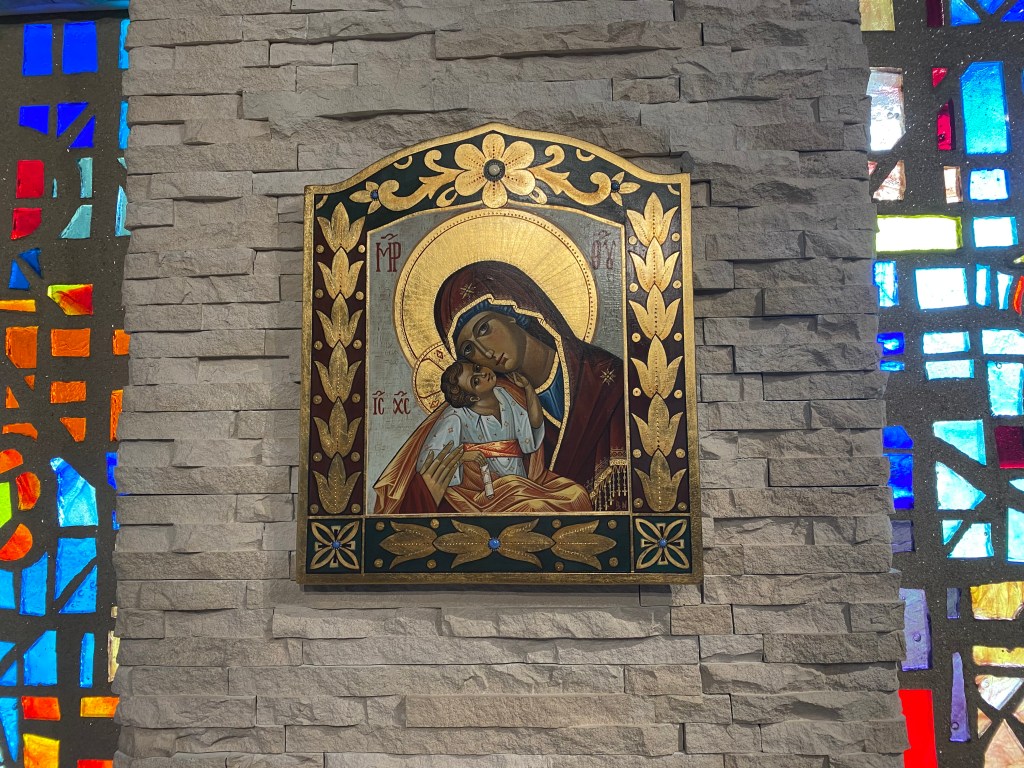
This reality can be deepened by meditating on one word such as: Theotokos, expressing the truth that Mary is the God-bearer, the Mother of God, and what that means to us. How can we be Theotokos? We can meditate on a picture like the one I posted with this reflection, one you may have on the wall or a precious moment on your phone or a dusty untouched photo album.

If we seek to live a life of joy, fulfillment, and meaning in 2026, we would do well to follow Mary. Following her lead would entail pondering more, slowing down, and reflecting on life, on what is important, what has value, where we are putting our time, energy, and effort, and recognizing where we do not follow God and where we do welcome God into our lives. We can reflect upon where we resist and where we follow his will.

Reflecting upon our lives helps us to move away from the automatic pilot of survival mode and experience more intention and agency. Otherwise, we may allow ourselves to float along through another year indecisively or stagnantly with indifference or cynicism, merely reacting to situations that arise, or just plodding along in survival mode or merely bored and listless. Being still can be scary because as we do so, our fears, our past hurts, and our loneliness can come to the surface.

If so, that is a gift. We are human and in experiencing our emotions, we can heal. When we experience them with Jesus whose celebration of his incarnation we have been experiencing, then there is a path lit by the light of his love that reveals a way where in the past we thought there was no way, no hope. In an intentional act of slowing down and even coming to a complete stop, the Holy Spirit can overshadow us in these very real emotions with his love, so we can begin to heal and transform beyond merely existing and set a healthier course of being more alive and grateful for the gift of our lives.

Hand in hand with Jesus and Mary, we can face and embrace our fears, and heal from our wounds. Surrendering and conforming our lives more to the life and love of Jesus, we will realize that we are not alone, and so can build more authentic and intimate relationships. We can act more decisively and with greater clarity, and experience more fully what we are here for, to bring a little more tenderness, mercy, understanding, forgiveness, and love to the many others around us who are also wounded.

May 2026 be a wonderful new year of healing, joy, and fulfillment, as we, like Mary, come to experience God’s presence in the silence of our hearts, his love that he seeks to embrace us with, so that we may become a people of faith, hope, and love in contemplation and action. Mary Mother of God, pray for us.

Here is a blessing to receive and ponder for us all for today and each day of this year. May “the LORD bless you and keep you! The LORD let his face shine upon you, and be gracious to you! The LORD look upon you kindly and give you peace!” (See Numbers 6:24-26)

————————————————————————————

Photo: My favorite icon of Jesus and Mary, St. Mary’s Chapel, St Vincent DePaul Regional Seminary, Boynton Beach, where I was blessed to spend many hours reading, pondering, mediating, praying, and healing.

Link for the Mass readings for January 1, 2026

May God’s word enkindle a flame in our hearts and transform us.

Jesus said to his disciples: “I have come to set the earth on fire, and how I wish it were already blazing” (Lk 12:49)!
What has been burned does not remain the same. What fire touches, it transforms. Jesus wants us to be consumed so as to be transformed by the fire of the Holy Spirit. Encountering Jesus affects a change in us. When we are open to allow the Holy Spirit to breathe on the embers in the depths of our souls they are fanned like tinder and ignite. We continue to fuel the fire by getting in touch with what God has called us to do in our place and in our time.
We are not to be a Christian in name alone but in thought, word, and deed. Pope Francis, in his exhortation The Joy of the Gospel, wrote: “THE JOY OF THE GOSPEL fills the hearts and lives of all who encounter Jesus. Those who accept this offer of salvation are set free from sin, sorrow, inner emptiness, and loneliness” (Francis 2013, 9). Joy is a gift, a holy flame, that is given to us by the Holy Spirit, it wells up within, and rises up and out to be shared with others. It is different than pleasure which has its source in the stimulation of the senses being aroused but fades once the external stimulus has ended.
Happiness is also external and fleeting. It lasts longer than pleasure in that the memory of the experience will linger on but it too will also fade away. Joy wells up from within, as it is imparted to us by God and can be present even when the external experiences are stressful or chaotic. I experienced this when I was still teaching 5th and 6th Grade Religion and acting as the dean of students at Rosarian Academy. At the same time, I was also immersed in family and parish life, as well as my studies and formation activities for the permanent diaconate.
One particular morning I woke up exhausted. When the alarm went off my first response was to skip my morning prayer and hit the snooze button to get an extra twenty minutes before rising. Instead, I literally crawled to my small chapel area, lit the candles, and opened my breviary. When I read the words in Psalm 42: “Hope in God; I will praise him still, my savior and my God”, something ignited within. I felt an energy well up within me that I cannot to this day describe. I felt an inexpressible joy. Not only did the experience carry me into the day but lasted throughout the whole week.
God is the foundation of our lives and seeks to transform us with the fire of his love, and even when we are at our lowest, such that in our soul there are only smoldering embers, we need to resist the temptations of indifference and complacency and remember to turn to Jesus. Instead of brooding over what we don’t have, we will encounter him when we are thankful for that which he has given to us and for those he has placed in our lives. We will experience him in his Word, in prayer and worship, and in serving one another. We need to keep showing up, even if sometimes we have to crawl to get there, and allow God to fan the embers within our soul to set us ablaze.
This flame St. Paul experienced and shared in today’s first reading from his letter to the Church in Ephesus and he invites us to experience this gift of grace as well. May we, “know the love of Christ that surpasses knowledge, so that [we] may be filled with all the fullness of God” (Ephesians 3:19). To know the love of Jesus is more than knowing about him. We don’t read and study the Bible as we study a history text, but to experience the love of the Holy Spirit bringing alive the word into our hearts. In meditating, pondering, and praying with Sacred Scripture, we experience, breathe, rest, and receive his love and so become filled with the fullness of God.
Nothing else in this world can satisfy us as much as experiencing and being transformed by the love of God! When we seek God first, we resist the temptation of being attached to finite things. When we trust Jesus and align our will with his, we know him and experience his love for us and then our relationships and possessions are properly ordered. Knowing his love we can then experience fullness of his Father, we will no longer seek substitutes to place before God. We will experience fulfillment and better enjoy our relationships and those goods in our lives that God has blessed us with.

Photo: Rosary walk at sunset on Veteran’s Memorial Island, Vero Beach. Great way to ponder and mediate upon the mysteries of Jesus and his life.
Pope Francis. Evangelii Gaudium: The Joy of the Gospel. Frederick, MD: The Word Among Us Press, 2013.
Link for the Mass readings for Thursday, October 24, 2024

Jesus will lead us to our fulfillment, if we are willing to listen and follow.

“At the sight of the crowds, his heart was moved with pity for them because they were troubled and abandoned, like sheep without a shepherd” (Mt 9:36).

There is much that pulls at us for our time and attention. Jesus witnessed the anxieties, struggles, pain, and feelings of being lost regarding those in his midst. Are we so different today? Jesus knows the Father, he knows the joy and fulfillment of what being in a full relationship with him entails. Jesus saw then and sees in us now how lost can become, how easily distracted and diverted can be, he knows how many things we put before our relationship with God, and he “is moved with pity.”

Jesus’ heart goes out to us, he yearns to be one with us, he loves us, but in that very act of love, he risks. He loves us so much, that he is willing to let us choose ourselves, others, or a myriad of other pursuits over him. Jesus invites us to the joyful experience of developing a relationship with him so we can come to know his Father, while at the same time he does not impose himself on us. We are given the whole world to choose from or we can choose him. Who do we put first? Is God a priority in our life? If we find that God is at best an after-thought, or at worst a no thought, instead of getting to know God better, what is it that we are choosing over him?

Jesus invites us, but too often we miss, ignore, or do not follow through on his invitation. Too often we choose other pleasures, distractions, diversions, temptations, and/or apparent goods. With time and experience, we may come to see the emptiness of the lure of these worldly promises, as well as begin to recognize that our attachments and disordered affections often lead to many of our troubles, trials, stresses, and anxieties. We are often led astray because we are seeking address our underlying experiences of unfulfillment, abandonment, and/or loneliness. There is only one source, one person, that will ultimately fulfill our innermost longing; God our Father.

I am not advocating for a rejection of the material world. All that God has created is good. We are human beings and a part of God’s glorious creation. Nor do I believe that we are souls trapped in this body waiting to be released upon our death. As human beings, we are a unique unity of body and soul. The key to our fulfillment, finding meaning and belonging is choosing to put God first. In establishing a firmer relationship with God, we can better discern that which we need to let go of, and/or how to reorder that which God wants to remain. Once we establish God as our firm foundation, even the challenges and trials that arise with not disturb our peace.

This might be the moment to be still and evaluate where we are in our lives and to ponder who we belong to. Jesus offers to lead us, just as he has led his disciples through the ages. Those of every age have experienced trials and tribulations and found the promises of this world fleeting. What made the difference for the saints was that they said yes to the call of the Shepherd and then followed him. Are we willing to slow down, to breathe, and listen to the Shepherd’s invitation today? Are we willing to follow his lead?


Photo: Rosary walk Sunday evening, Veteran’s Memorial Island Sanctuary, Vero Beach.

Link for the Mass readings for Tuesday, July 9, 2024