Blessed is the one who hears and ponders the word of God and puts it into practice.

Curtis Mitch and Edward Sri, in their commentary on Matthew, offer three key insights into how to understand the beatitudes. Contextually, Jesus does not make up the genre of beatitudes himself. The Greek, makarios, can be interpreted to mean happy and “denotes blessedness or happiness not in the sense of an emotional state but in terms of being in a fortunate situation… In the Jewish tradition, beatitudes either commended those who take a certain path of life or promised future consolation to those in affliction” (Mitch and Sri, 88). 

The Hebrew Scriptures provide examples that Joseph and Mary would have read or shared from memory to Jesus, and he would have prayed with himself. “Forty-five beatitudes are found in the Old Testament, most in the Psalms and Wisdom literature, where they commend a certain quality, condition or situation. For example, the blessed are those who delight in God’s law (Ps 1-2), who take refuge in the law (Ps 2:12)… and trust in him (Ps 84:12).” (Mitch and Sri, 89).

Who is blessed to Jesus? Not even his own mother because she is his mother, but blessed is the one who hears and ponders the word of God and puts it into practice (cf. Luke 11:28). Jesus presents to his followers a path of how they are going to live a particular way of life. He is setting a road map that will guide them through the trials and tribulations that will come in doing so, and even when challenges arise, Jesus promises that his Father will provide consolation. Those who put the beatitudes into practice and live as his disciples will experience happiness and fulfillment. 

Mitch and Sri also show that “Jesus’ beatitudes represent a reversal of values, turning the world’s standards for happiness upside down” (Mitch and Sri, 88). Mature disciples of Jesus will come to experience consolation no matter the external storms that arise. Even in times of desolation, they will remain persistent and on course, so to come out on the other side stronger for having trusted that Jesus is with them even when they did not feel his presence. 

Jesus does not commend those who wage war as blessed, but instead: “Blessed are the peacemakers, for they will be called the children of God” (Mt. 5:9). Jesus does not promote the lives of the rich and famous, but instead: “Blessed are the poor in spirit, for theirs is the kingdom of heaven” (Mt. 5:3). Jesus does not affirm those who thirst for power, pleasure, wealth, and fame, but instead: “Blessed are they who hunger and thirst for righteousness, for they will be satisfied” (Mt. 5:6).

These are just a few of the eight beatitudes Jesus presented. A good practice is to review each of the eight beatitudes that Jesus presents in the beginning of his Sermon on the Mount. Which one(s) strike a nerve. Stop there and meditate with Jesus leading us. Where is he helping us to see a way where we can release an attachment so to better follow more faithfully?

Jesus invited his disciples to sit at his feet as the “new Moses”. He came up the mountain like Moses who came up to receive the law. Jesus did not come to receive the law, he came to “teach it” (Mitch and Sri, 87). As he begins his Sermon on the Mount with the Beatitudes, the other wonderful thing we will realize about the beatitudes is that he was not just sharing head knowledge but practical ways to inherit the kingdom of Heaven, to grow in intimacy with his Father and share in the love of the Holy Spirit. All practices that he himself lived through and through.

The Beatitudes, like the Ten Commandments, are boundaries that define us as the children and inheritors of God’s will and blessing. They help us to uncover that which seeks to lead us astray, to isolation, and to our death, and instead identify how to stay focused on that which leads us to eternal life. The most important thing we can do every day is to pray, and the enemy knows that, so he will seek with all his means to distract, divert, and dissuade us from doing so or to keep our prayer and practices merely at the functional level. 

Jesus offers us his love that we might trust him to allow his light to shine in our hearts and minds and the places we would rather no one would see. Even those places that we may feel unlovable, because even there, Jesus will love us when we let him in. He seeks to reveal our sin and failures, not to condemn and shame us, but to help us to see what is enslaving and isolating us and that which keeps us from greater intimacy with his Father. The light and love of Jesus help us to see what our lives are like without God and what they are like with him.

As our consciences become better formed through following Jesus’ teaching, such as the Beatitudes, as we allow him access to our wounds and sins, as we are loved by Jesus even there, we will be purified by the loving fire of the Holy Spirit, and we will then be blessed with a clean heart and see God. See our Loving God and Father who has made us to be happy, fulfilled, and at rest; a rest that we will find when we breathe, receive, rest, and abide in Him.


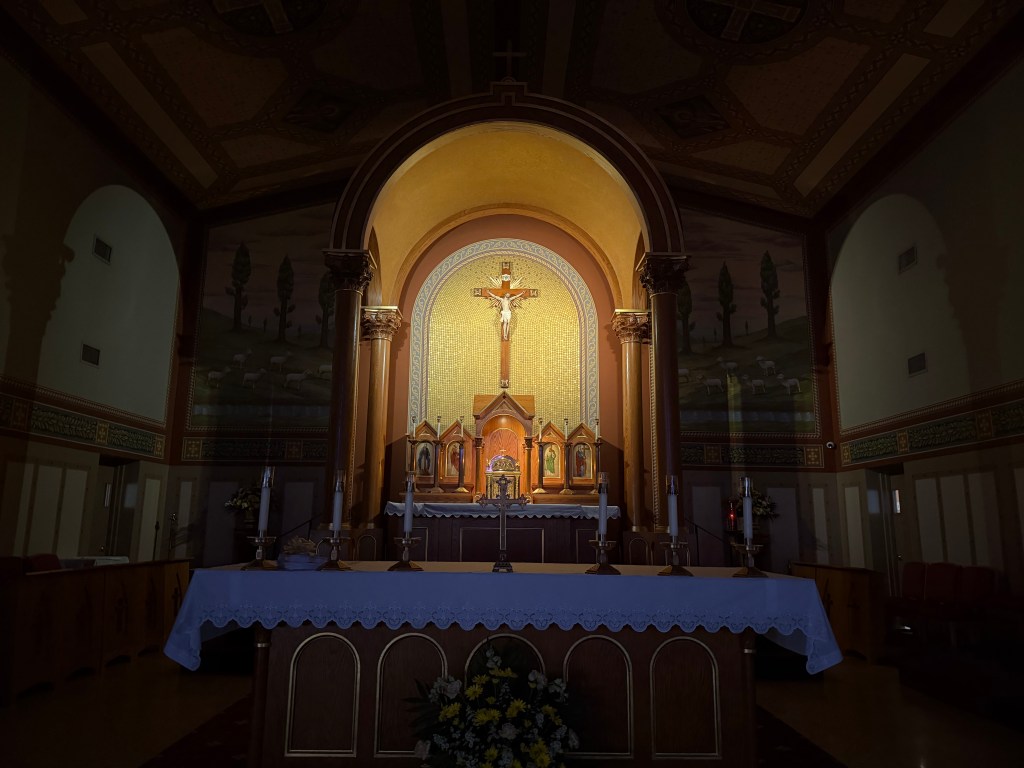
Photo: Quiet time praying Evening Prayer after the Saturday Vigil Mass at St Helen Catholic Church in Vero Beach.

Mitch, Curtis. The Gospel of Matthew. Grand Rapids, MI: Baker Academic, 2010.
Link for the Mass readings for Monday, June 8, 2026

Theotokos! – We are invited to ponder.

Mary offers us a wonderful gift through the words of Luke as we begin the new year together. “Mary kept all these things, reflecting on them in her heart” (Lk 2:19). Gabriel shares with Mary that she will conceive a child through the power of the Holy Spirit. Her relative Elizabeth, past childbearing years, is six months pregnant when Mary and Elizabeth meet. In their encounter, John leaps in the womb of Elizabeth. The shepherds convey the message they received from the angels that Mary’s baby is the long-awaited Messiah. Simeon and Anna offer prophetic confirmation that Jesus is the Messiah.

These are the events we have been hearing or reading about again during Advent and this Christmas Octave. May we, like Mary, also ponder them, not to just read or listen and move on. The Church at her best has followed the model of Mary’s reflection, pondering, and meditating upon what these words mean and has come to call this day the Solemnity of the Blessed Virgin Mary, the Mother of God. This title says more about Jesus than it does about Mary. This is the teaching that the Church Fathers confirmed during the council of Ephesus in 431 AD:

Mary is the Mother of God, in Greek – Theotokos – the God-bearer.

From the pondering of Paul we receive his words, “God sent forth his Son, born of a woman” (Galatians 4:4). Paul did not say, born of man and woman but of a woman. The second Person of the Trinity was sent by his Father through the overshadowing of the Holy Spirit and was conceived in the womb of Mary. Jesus is the Son of God in his divinity and the son of Mary in his humanity. He remained fully divine as the second Person of the Trinity and the Holy Trinity was not diminished in any way as he developed as a human being in the womb and was born of Mary. This truth and reality is the Mystery of the hypostatic union: Jesus is one divine person subsisting in two natures the human and divine.

Theological insights such as Mary being the Mother of God and the hypostatic union of Jesus, are easily missed or worse dismissed if we conform ourselves to the present age of instant gratification, instant access, surfing, swiping, absorbing sound bites from social media platforms and amassing information overload. These technological avenues along with the growing influence of AI can be one more distraction, diversion, and temptation that can lead to horrific outcomes or if we slow down, discern well and allow ourselves to think critically and prudently, we can experience some benefits.

If we still read books, do we do so with pencil and highlighter in hand, take notes and go back to those points underlined, highlighted, and/or annotated and ponder the insights we have received, and then put them into practice? Or do we just have a moment of pause and say hmm, interesting, and then move on to the next page, paragraph, and book, seeking more?

Let us begin the first day of the new year by taking a few deep breaths, allow ourselves to stop before getting back on the roller coaster of chaos and chronic stress, and allow ourselves to follow Mary’s guidance, and ponder. We can reflect on a word, a phrase, or a short statement that we write down and return to it often. The phrase could be as simple as a paraphrase from today’s reading: Mary pondered these things in her heart.

We can ponder a mystery of Scripture that touched us at some point in our lives and see what the deeper relevance to our lives God has invited us to experience when he moved our hearts and minds to carry this memory. We can go to today’s reading, read it again a few times and allow the Holy Spirit to overshadow us so that Jesus made be revealed present and comfortable awaiting our waking to his presence.

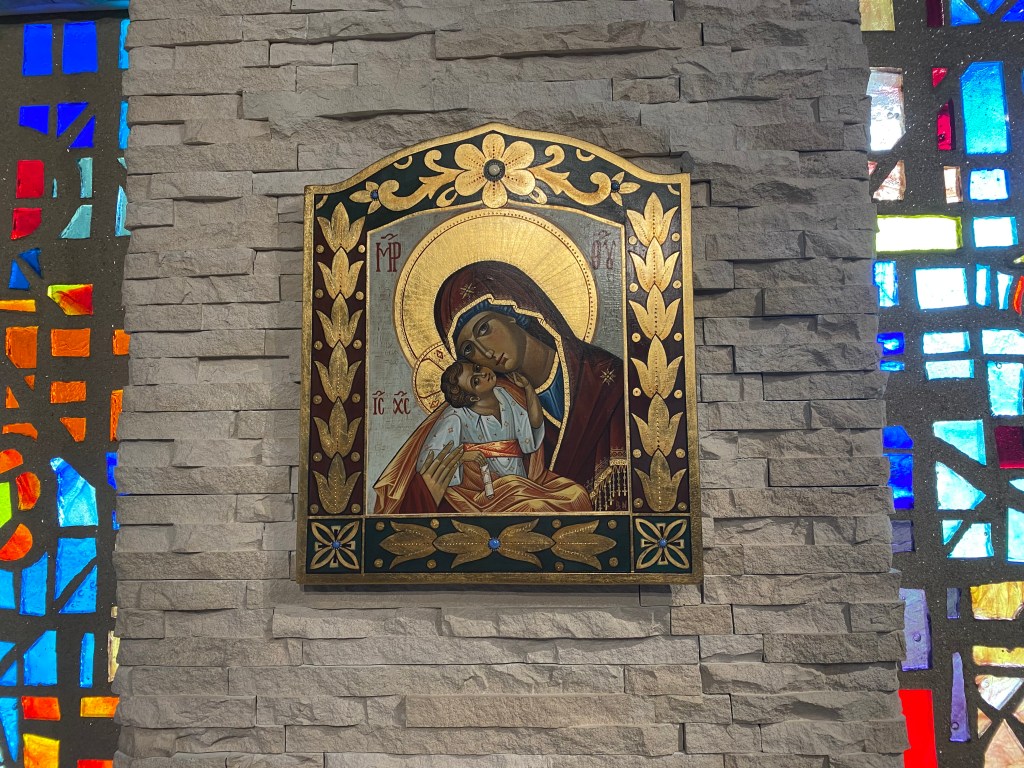
This reality can be deepened by meditating on one word such as: Theotokos, expressing the truth that Mary is the God-bearer, the Mother of God, and what that means to us. How can we be Theotokos? We can meditate on a picture like the one I posted with this reflection, one you may have on the wall or a precious moment on your phone or a dusty untouched photo album.

If we seek to live a life of joy, fulfillment, and meaning in 2026, we would do well to follow Mary. Following her lead would entail pondering more, slowing down, and reflecting on life, on what is important, what has value, where we are putting our time, energy, and effort, and recognizing where we do not follow God and where we do welcome God into our lives. We can reflect upon where we resist and where we follow his will.

Reflecting upon our lives helps us to move away from the automatic pilot of survival mode and experience more intention and agency. Otherwise, we may allow ourselves to float along through another year indecisively or stagnantly with indifference or cynicism, merely reacting to situations that arise, or just plodding along in survival mode or merely bored and listless. Being still can be scary because as we do so, our fears, our past hurts, and our loneliness can come to the surface.

If so, that is a gift. We are human and in experiencing our emotions, we can heal. When we experience them with Jesus whose celebration of his incarnation we have been experiencing, then there is a path lit by the light of his love that reveals a way where in the past we thought there was no way, no hope. In an intentional act of slowing down and even coming to a complete stop, the Holy Spirit can overshadow us in these very real emotions with his love, so we can begin to heal and transform beyond merely existing and set a healthier course of being more alive and grateful for the gift of our lives.

Hand in hand with Jesus and Mary, we can face and embrace our fears, and heal from our wounds. Surrendering and conforming our lives more to the life and love of Jesus, we will realize that we are not alone, and so can build more authentic and intimate relationships. We can act more decisively and with greater clarity, and experience more fully what we are here for, to bring a little more tenderness, mercy, understanding, forgiveness, and love to the many others around us who are also wounded.

May 2026 be a wonderful new year of healing, joy, and fulfillment, as we, like Mary, come to experience God’s presence in the silence of our hearts, his love that he seeks to embrace us with, so that we may become a people of faith, hope, and love in contemplation and action. Mary Mother of God, pray for us.

Here is a blessing to receive and ponder for us all for today and each day of this year. May “the LORD bless you and keep you! The LORD let his face shine upon you, and be gracious to you! The LORD look upon you kindly and give you peace!” (See Numbers 6:24-26)

————————————————————————————

Photo: My favorite icon of Jesus and Mary, St. Mary’s Chapel, St Vincent DePaul Regional Seminary, Boynton Beach, where I was blessed to spend many hours reading, pondering, mediating, praying, and healing.

Link for the Mass readings for January 1, 2026