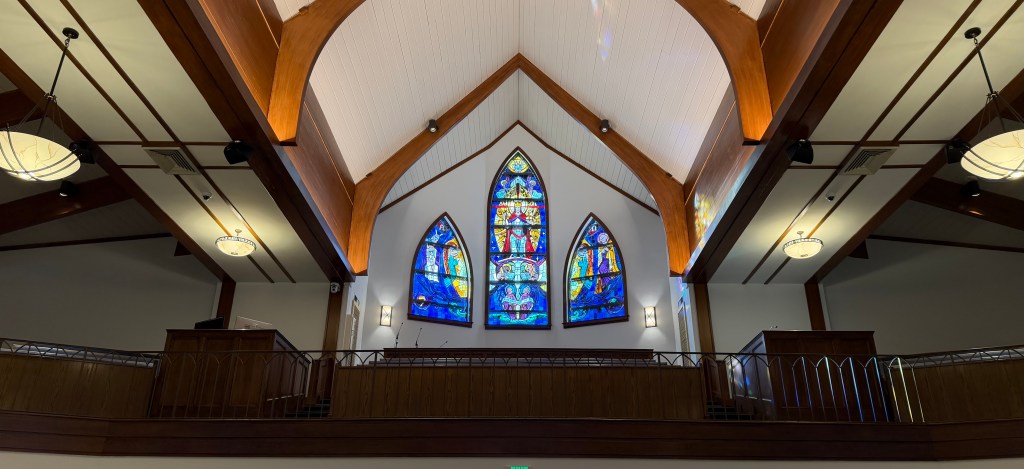
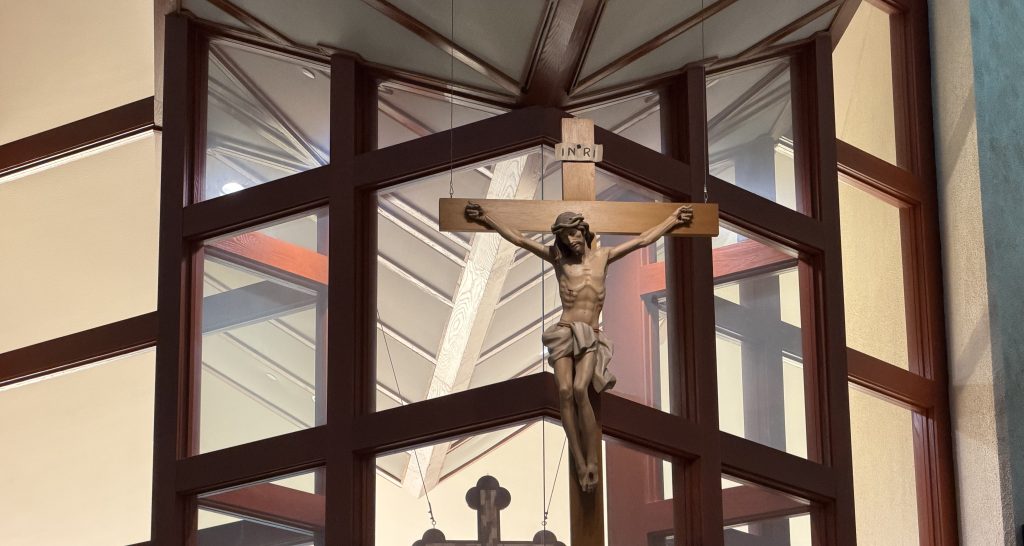
Slowing down will help us to be one as Jesus and his Father are one.

“Holy Father, keep them in your name that you have given me, so that they may be one just as we are one” (Jn 17:11).

Jesus is well aware of the temptations of the world, recognizes that the disciples will need the protection of his intercession, that they will remain faithful only if they remain in his love and in relationship with him. The unity that the Father and Son share is an eternal and infinite communion. Jesus, as the Son of God, continued to be one with his Father, while fully experiencing his humanity. As a human being, Jesus faced the same temptations present in this world that we face. The difference is that with each choice that he made, as a human being with a free human will, he chose to be faithful to his Father at each and every opportunity, and so his unity of his humanity remained intact and deepened.

Jesus sought the same unity that he shares with his Father for his disciples and he seeks the same for us today. His hope is that we may be one as he and the Father are one. Yet, he is not going to pull us out of the world for that to happen. “I do not ask that you take them out of the world but that you keep them from the Evil One” (Jn 17:15). The disciples then and us today, are to do as Jesus did. We are to welcome the invitation to be in a relationship  with God, come to know his will, and share it with those we encounter in our realm of influence. We are not to be transformed by the world, but we are to allow God to transform us by the renewal of our minds and hearts. As we do so, we can also bring Jesus’ light into the darkness as God works through us one person at a time.

Following the will of God is not easy. Many distractions, diversions, and temptations pull at us and attempt to draw us away from being faithful and true to God, ourselves, and who God calls us to be. Many times these distractions not only appear to be, but are good. The challenge is not whether we are good or evil, we are being good or doing good, but are we doing God’s will, are we doing what God is calling us to do?

Being able to stop, be still, quiet our mind, and just breathe for a sustained period of time can help us to learn to recollect. Often when we attempt to spend time in prayer, we finish at the moment we are really just getting ready to begin and wonder why nothing is happening! Making time to recollect grants us the opportunity to transition from the busy to making friends with silence.

We can deepen our relationship with Jesus and his Father when we slow down our pace, become still within, because we are better able to hear his voice. We are also in a better place to receive the gifts that the Holy Spirit seeks to impart, his guidance to discern his direction, as well as the courage to follow his will. If any fear or anxiety arises, we just need to remind ourselves to trust that God will provide the means and support we need, for we are not meant to do what he calls us to do on our own.

St. Mother Teresa taught that, “in the silence of the heart, God speaks.” We are better able to recognize God’s voice and the people he places in our lives to help us when we embrace consistent moments of stillness. We are better able to identify the temptations and pitfalls along path when we go slower. We grow in discipline, persistence, and dedication when we allow ourselves to be nourished by God’s love and encouragement. When we are willing to change, to be transformed, to grow, and take the risk to trust in Jesus, we, like the disciples, will experience the love and oneness Jesus and his Father seek to share with us.

————————————————————————–

Photo: Meditating on the Glorious Mysteries (back in April before the newest renovations).

Link for the Mass for Wednesday, June 4, 2025

May we experience the love of God, so we can know him and each other better.

“Now this is eternal life, that they should know you, the only true God, and the one whom you sent, Jesus Christ” (Jn 17:3).

This is our goal, to know God. Eternal life, or heaven, is not only experienced when we die. Through experiencing the life of Jesus we can have a foretaste of heaven now. We can experience this as the joy that rises up from within, that is not merely pleasure, which is a response from the stimulation of our senses and which dissipates once the experience ends. Nor is joy even happiness which comes from the lasting memories of these pleasurable experiences. The experience of joy is not based on external situations and sensations, joy comes from an encounter with the living God who is present to us, closer to us than we are to ourselves.

We often first experience this joy, this closeness to God when we experience love exchanged between ourselves and another. Even a love that begins in infatuation is a drawing out of ourselves toward another. The hope is that this love matures and develops into a friendship.

This maturation happens when we spend time getting to know each other’s interests, goals, and dreams. We experience another as a person, and with time and continued trust, we begin to risk and allow our masks to be taken off. Inevitably, when relationships begin to mature, they will go through times of miscommunication, misunderstanding, and conflict. The relationship will come to a crossroads, but this does not mean that the relationship will come to an end. If the relationship devolves into abuse, dehumanization, and self-gratification alone, the relationship will end. But if there is a willingness to forgive, to work together, to meet each other with humility and seek mutual understanding, relationships will grow stronger and deeper. This is the fertile soil where love grows.

Our first experience of developing relationships is in our families. None of us are perfect, so none of us have had a perfect family life. Familial relationships develop in a similar fashion as listed above. We all go through ups and downs. The more that we can be present to one another, support one another, communicate and love one another, the more likely our familial relationships and friendships will also mature and grow.

Many of us hope to attain a place within where we can accept and love ourselves and develop mature relationships with a core group of family and friends. Most of us could be quite happy with that. Even as Jesus invites and guides us to reach this point of development, he continues to press us to strive to love beyond family, friends, and tribe. All of us are ultimately called to an unconditional love that sees in others a brother and sister seeking to be better stewards of God’s creation. This is not some utopian philosophy. Love happens through one concrete encounter, one person at a time. As we love God and one another, we lift all of humanity and creation up.

This will not happen through our own will power or discipline alone. Placing self over God and others, isolates and disconnects us from the True, the Good, and the Beautiful. God is not some transcendent, impersonal force, nor is God an omnipotent, tyrannical overlord. The God of Jesus Christ is a God of love, for “God is love, and whoever remains in love remains in God and God in him” (1 John 4:16). Jesus invites us into a relationship with him and his Father to experience the love of the Holy Sprit. When we assent to this invitation, we come to know and experience a foretaste of heaven on earth.

Jesus, please help us to experience the love of God by coming to know you, and in truly knowing you come to better know each other. May we see each other as God our Father sees us, as a unique gift that has never been nor ever will be again. Help us resist reacting to the rough edges and exterior projections of our inner wounds and instead guide us to be more compassionate and understanding, and willing to see the truth and fullness of the potential of each person. Help us to allow God to love others through us today, one person and one encounter at a time.

———————————————————

Photo: “The Father does not love us any less than he loves his only-begotten Son. In other words, with an infinite love” – Pope Leo from his Sunday, June 1, 2025 homily. (credit fromDaniel Ibáñez/CNA/ EWTN accessed from ncregister.com).

Link for the Mass readings for Tuesday, June 3, 2025

We are never alone, the Father is always with us.

The disciples are beginning to have a better understanding that Jesus is who he says he is, that “he came from God.” Jesus does not rest on or savor this insight and affirmation, but shares with them how, they still do not fully comprehend. He lets them know how each will leave him alone in his most desperate hour. They will do just that. Those he takes with him into the Garden of Gethsemane will fall asleep. When Jesus asks them to watch and pray with him, to be a support for him as he receives the crushing will of the Father that leads him to the cross, they fall asleep multiple times. When the guards come to arrest Jesus, led by Judas, the disciples would flee. Peter will then betray him three times.

What is interesting is that just as Jesus shares with them, that even though they, his most intimate followers, his closest friends would betray him, he says: “I am not alone, because the Father is with me. I have told you this so that you might have peace in me. In the world you will have trouble, but take courage, I have conquered the world.” 

These words are words of comfort and hope. Comfort and hope for his disciples then as well as for us today! No matter if we betray or are betrayed ourselves, we let others down or are let down, we see and experience the devastating effects of our fallen world and fallen human nature, from without and within; no matter what conflict, challenges, or tribulations rise up before us, we do not need to succumb to cynicism, hopelessness, and despair.

What is important is that we resist the temptation to curve in upon ourselves and drink from the poison of shame. In doing so, we cut ourselves off from the very source of our life and being. Having the humility to acknowledge where and when we have caused harm in any form requires embracing a healthy sense of guilt which is good. Then, instead of beating ourselves up, we are to seek forgiveness and reconciliation as well as be understanding and willing to forgive.

We also need to remember that in those times when we feel misunderstood, betrayed, or are facing the unbearable in life, we are not alone! Jesus, who experienced the same. reveals to us the way to his Father because Jesus is the Way! Seeking affirmation from the culture or the world is not the way. Our priority instead is build our relationship with Jesus, who will lead us to the Father so to experience the Love of the Holy Spirit!

Jesus is the light that shines in the darkness, and he will not be overcome by it, for he has conquered death, and has overcome the world. We are an Alleluia people because through our participation in the life of Jesus the Christ we will overcome as well when we trust in and experience the love of the Father. As an Alleluia people, we are to resist being shaped by the culture and the world, and are to instead evangelize it by authentically living out the Gospel and will of our Father as Jesus did; by sharing the light, joy, peace, and love of Christ we have received in each our interactions with one another.


Photo: The more we slow down and breathe, receive, rest, and abide in the love of God, we will know no matter what we are experiencing, we are not alone.

Link for the Mass readings for Monday, June 2, 2025

Jesus ascended up but not away! He is now closer to us than we are to ourselves.

For many of us, when we hear about the Ascension of Jesus we can be just as confused as the disciples who as recorded in the Book of Acts were standing around, looking at the sky. Also, depending on where we live, will depend on when we celebrate this solemnity. If you live in the ecclesiastical Provinces of Boston, Hartford, New York, Newark, Omaha, and Philadelphia you already celebrated Ascension Thursday on its traditional day, this past Thursday. For the rest of the country, as we do here in Florida, it is a holy day of obligation celebrated today, on Sunday. The reason for Ascension Thursday is that the Ascension of Jesus took place 40 days since the Resurrection and 10 days before Pentecost.

The Ascension is just as significant as is Jesus’ suffering and death that we remember during Lent and his Resurrection that we have been recalling during this Easter Season. Regarding what the Ascension of Jesus is, sometimes, we can understand a term better by saying what it is not. The Ascension was not an event where Jesus went up, up, and away in a beautiful balloon, or Superman zipping away to destroy an asteroid hurtling toward the earth.

The Ascension is the culminating event of the Paschal Mystery of Jesus Christ. Jesus who as the Son of God became a human being like us in the Incarnation, lived among us, experienced the joys and sufferings of life like all of us in all things but sin. Yet, Jesus took our sins upon himself on the cross. Jesus died, entered into the utter godforsakeness of death and conquered death. He rose again through the power of the Love of the Holy Spirit, not as a ghost or a spirit, but still fully God and fully man, yet his body was transfigured. In his glorified body, Jesus became the first born of the new creation.

For forty days after his Resurrection, Jesus spent time with his disciples. “Forty days (or the number forty in general) always symbolizes a time of transition, a time of purification and a time of preparation for a new stage” (Pitre). This is evident in the Noah flood account. God cleansed the world from sin and established a new covenant with Noah and his family setting the stage for a new beginning. Moses spent 40 forty days meditating with the Lord to give the people new commandments and a new covenant charting a new course for those that God had freed them from slavery in Egypt. Jesus himself spent 40 days in the desert, a transition time after his baptism and before beginning his public ministry, preparation to face the devil, and resist his temptations.

Jesus also spent forty days with his disciples after his Resurrection, to prepare them, to help them to understand the truth of the kind of Messiah he was. Not a political and military leader, but the suffering servant of Isaiah. The Son of God was sent by his Father to defeat Satan, undo his strongholds, and free us from our slavery to sin by giving his life and conquering death. He commissioned his apostles to go out to do as he had done, to cast out demons, to heal, to preach with authority, to preach repentance, and to forgive sins. They were to be martyrs, witnesses by their life, teaching to the Jews first but as well to all nations, and even giving their lives as Jesus had done to promote the faith Jesus passed on to them.

Then at the appointed time, just as Jesus descended from his Father in heaven, he would return. This time though he would ascend fully divine as well as fully human. Jesus led his followers “out as far as Bethany, raised his hands, and blessed them. As he blessed them he parted from them and was taken up to heaven” (Luke 24:50-51).

This was no simple goodbye gesture. Jesus revealed in this action his role as high priest. He blessed his followers as the high priest, Aaron, blessed the people after he had made the sacrificial offerings for their sins (cf. Leviticus 9:22). With this blessing offered, Jesus “parted from them and was taken up to heaven” (Luke 24:51). As Bishop Robert Barron explains: “The Ascension is the translation of this earthly reality into a heavenly reality.”

Jesus is no longer limited by the time and space of our present three dimensional realm. He transcends our recognized dimension and now exists at a higher pitch of existence. Just as Jesus passed through the locked door to bestow peace on his disciples, Jesus ascended to offer himself to his Father in the heavenly Temple. As we heard in the letter to the Hebrews: “Christ did not enter into a sanctuary made by hands, a copy of the true one, but heaven itself, that he might now appear before God on our behalf” (Hebrews 9:24).

Jesus gave himself as an offering for our sins and did so once for all and for all time. This is why Jesus is present to us at every Mass on Thursday or Sunday or any time that the Mass is celebrated anywhere in the world. Jesus is present to us where two or more are gathered in his name and he is present when we proclaim, read and pray with the words of the Bible. Jesus is present to all of us everywhere because we are united as one in his abiding love!

Through the event of the Ascension, Jesus brings something of our humanity to heaven and at Pentecost, which we will celebrate next week, he sent something of heaven to us in the descent of the Holy Spirit. And who is the Holy Spirit, but the Love that is breathed, that is shared between the Father and the Son.

What the Ascension means for us is that we are no longer separated from the reality of heaven. St Irenaeus wrote that, “Jesus opened up heaven for us in the humanity he assumed.” Our relationship with God our Father is made possible again because of the Ascension of Jesus. The biblical images foretell this great event, as the sky was torn open at the baptism of Jesus (Mark 1:10), as the veil was torn in two outside the Holy of Holies (Matthew 27:51) in the temple at the moment of his crucifixion, and as Jesus ascended in the fullness of his glorified body, with our humanity, to return to the right hand of the Father.

Heaven and earth have been wedded. We become part of the Church, the bride of Christ through our Baptism, we are nourished in receiving the Eucharist, and empowered in Confirmation. Through our baptism we are grafted, conformed to, and become an organic part of the Mystical Body of Christ. We are transformed, divinized, participate in the life of God through our participation in the life of Jesus. We are made holy, our image to God is restored. Jesus blesses through the priest at the end of every Mass and sends us as he did his apostles and the saints of each successive generation “to go into the whole world and proclaim the gospel to every creature” (Mark 16:15).

Having heard this Good News of the Ascension, let us not, as the two angels said about the disciples, just “stand around looking at the sky” (Acts 1:11) but go forth and share the love of his very being that we receive in the Eucharist and invite all to participate on earth what is celebrated in heaven, the love of the communion between the Father, and the Son, and the Holy Spirit. Amen! Alleluia!!!


Photo: View as I walked out of the sanctuary of St. Mark the Evangelist after celebrating my first public Mass in Spanish for the vigil of the Ascension.

Brant Pitre’s commentary on the Ascension

The Mass readings for the Sunday readings of the Ascension, June 1, 2025

The Holy Spirit will help us to continually embrace wonder and experience truth.

Benjamin Franklin is quoted as saying, “Wise men don’t need advice. Fools won’t take it.” Most of us may fall somewhere in the middle. Hopefully, we are less foolish and moving more along to path of gaining wisdom. Jesus continues his best efforts in today’s Gospel to offer guidance and assurance to his disciples that the Holy Spirit will continue to be their guide after his departure. “I have much more to tell you, but you cannot bear it now. But when he comes, the Spirit of truth, he will guide you to all truth” (Jn 16:12-13a).

Surely, Jesus could see the dimming lamps in the eyes of his disciples. As discussed yesterday, comprehending the death of the Messiah, his Resurrection, and return to the Father was a bit much to digest. Also, there was only so much that they could grasp with their finite intellect. Until they experienced the infused contemplative insights given to them by the Holy Spirit, there was only so much the apostles were going to be able to digest of what Jesus was sharing with them about the inner life of the Trinity, the divine communion of love between he Father, and the Son, and the Holy Spirit.

Yet, Jesus, though, still needed to share what his Father gave him to share, and the disciples were to take in what they could. Jesus’ death and Ascension were not to put an end to their learning, deepening of their understanding, or further developing their relationship with Jesus and his Father. The Holy Spirit would continue what Jesus started, and would to lead them to all truth, the fullness of the foundational relationship that is the source of all that exists, the Holy Trinity.

Anyone involved in teaching anyone anything or learning something for one self will know, that just telling someone something does not mean that learning has happened. There is a process of introduction, integration, practice, review, mistakes, corrections, and adjustments until some proficiency is achieved. With the disciples, this is the same. Jesus did not just present things once and move on to the next order of business. That is why John declared at the end of his Gospel that: “There are also many other things that Jesus did, but if these were to be described individually, I do not think the whole world would contain the books that would be written” (Jn 21:25).

I am sure a part of what John was talking about here were the lessons, corrections, and guidance Jesus offered. Just as Joseph modeled for and guided Jesus in his trade in carpentry, so Jesus learned from him through observation, practice, mistakes, adjustments, and corrections. Jesus guided his disciples in the same way, as a mentor with his apprentices. He was now assuring them that even though he would be leaving them, the guidance and leading would continue with the support of the Holy Spirit.

The lessons about the immanence of God, God within himself as a Trinitarian communion, that Jesus taught were not as concrete as sawing, hammering, and planing wooden beams though. God is not a being, not even a supreme being, meaning that he transcends our ability to comprehend the fullness of his reality. We will never fully comprehend God or exhaust the richness and the depth of our relationship with God. What the apostles and the saints to follow and we can still experience today is God’s grace building on his nature. When we read, pray, and meditate with these sacred texts, the Holy Spirit will communicate with us and grant us insights beyond any intellectual endeavor.

On the human level, we are guilty of malpractice in our relationships when we assume that we know everything there is to know about someone else. The gift of the person, the human being, is that we are ever-developing and growing in the mystery and wonder of who we are and who we are called to be. We can always surprise each other. If this is true for us in our relationships with each other, it is much more so in our relationship with God. Once we get to one level of understanding, we plateau for a time, but that is not the end of the journey, that is only a time to savor, to ponder, and contemplate until we are ready to go ever deeper into the truth that the Holy Spirit will reveal to us.

Our tradition teaches us that the fullness of God has been revealed in Jesus Christ, which is true, yet to comprehend that revelation will take a lifetime and continue on into eternity just to scratch the surface. St Thomas Aquinas (1225-1274), a Dominican Friar, who is considered the Angelic Doctor of the Church, was one of the top theological influences during the Scholastic Period, yet close to the end of his life he had a deep and intimate encounter with God in which he came to realize that all of his intellectual achievement, all that he had written, mattered no more than a pile of straw compared to that which God had revealed to him in a single moment of infused contemplation.

Arguably one of the wisest persons of his time, and some would say one of the most brilliant minds ever, was also one who was steeped in daily prayer and continued to be open to the majestic wonder of the glory of God. May we too continue to embrace the gift of wonder, the gift of learning, and never settle, rest and savor yes, but continue to learn and grow, to seek and hunger for the Good, the True, and the Beautiful, to continually have our hearts and minds open to allow the Holy Spirit to guide us “to all truth”!


Photo: A momentary pause during my Rosary walk to observe the interplay between some mangrove stems and barnacles. Many invitations to experience God’s wonder when we get out and about!

Link for the Mass readings for Wednesday, May 28, 2025

As we participate in the life of Jesus we experience the love of the Holy Spirit.

What is common to all of us is that we experience some expression of loneliness to varying degrees consciously, or mostly unconsciously. We are social beings, we want to belong, to be part of, and this is why we are communal. We may do, say, or turn a blind eye to behaviors that go against our conscience just to be accepted, acknowledged, and/or noticed. This behavior further feeds our loneliness, because though we may be “accepted”, we become more alienated from our true self. We are not be accepted for who we are but who we portray ourselves to be.

At the core of our being, what we all seek is to be loved, and to love in return. We strive from the moment of our conception not only to exist but to actualize the fullness of who God is calling us to be. Through our time of gestation, we are not potential human beings, we are human beings actualizing out potential. A difference between me typing this now and when I was in my mother’s womb is that before and after my birth, I was smaller and more vulnerable.

We as human beings are a living, craving hunger and desire to be in communion with God and one another from the moment of our conception until our natural death and continuing on into eternity. This is true to the believer and the atheist alike. Until we embrace this deepest of needs and desires, we will be restless, anxious, and unfulfilled. We can feel isolated and alone, even in the midst of a hundred people or daily likes on social media. As St. Augustine shared in the introduction to his autobiography, “You have made us for yourself, O Lord, and our hearts are restless until they rest in thee.”

God has made us for himself and constantly invites us to be in a relationship with him and with each other because he is the foundation and source of our being. Sin is the turning away from that invitation, a curving, or caving in upon oneself away from God and others. It is also the unwillingness to bother or care, to reach out toward another in need. For what we do to the least of our brothers and sisters, we do to Jesus. We are not just to be pro-birth though, we as Catholics are to be pro-life, and we are invited to promote a consistent ethic of life.

Jesus became human in his Incarnation. He too, as we did, developed in the womb of Mary to show the importance of the dignity of the person and that our dignity is grounded in our relationship with God our Father, meaning we are all brothers and sisters. We are his beloved daughters and sons, just by who we are not by what we do. Jesus was not a plan B, but he was always the primary plan. In the fullness of time, when God so willed, he sent his Son to become one with us in our humanity so that we can become one with him in his divinity. Jesus is the face, hands, and body of God. He came that we might see and experience God. Jesus experienced all we experience except for sin because he never in any thought, word, or deed rejected or said no to his Father. His whole life was a, “Yes” to the will of God. Jesus is the bridge, the way to love and be loved, authentically.

In today’s Gospel, Jesus continues his farewell discourse. He prepares his disciples for the reality that he will be returning to the Father, and yet at the same time, he will not leave us alone. He will be with us for all ages. This is so because as the Son of God made man, in his Ascension, he returned to the Father not just in his divinity as the Son, but also in his humanity. God created all of humanity and his creation as interconnected, and because of that, we all experience this transcendent act of the Ascension when Jesus returned to the Father in his glorified, human body.

Jesus shared with his disciples: “When the Advocate comes whom I will send you from the Father, the Spirit of truth who proceeds from the Father, he will testify to me. And you also testify, because you have been with me from the beginning” (Jn 15:26-27). Jesus is talking about the Holy Spirit, the third person of the Trinity, the infinite Love experienced and shared between the Father and the Son. We become sharers in this divine love and communion of the Holy Trinity through our participation in the life of Jesus.

As we experience the love of the Holy Spirit and develop a relationship with him we begin to feel alive, we begin to heal and to feel whole, because we have experienced the love we have been made for. We have experienced being loved for who we are and as we are. We no longer have to say, do, or accept those actions that we don’t agree with that go against our conscience, to belong. St. John Henry Cardinal Newman has stated that our conscience is the “Aboriginal Vicar of Christ”. Jesus dwells within us, to guide and lead us, to help us to develop a well formed conscience. He encourages us to also say, “Yes” to his Father as he has and continues to do.

We share in the trinitarian love when we grow our relationship and participate in the life of Jesus. This great gift of grace will continue to grow as we testify to this love and share it with others. The greatest gift of God, his love that he gives us, expands as we give his love away. The more we give, the more we will receive. That does not mean fixing others or their problems. We are called to be present, to accompany, and journey with others, meeting them as Jesus met others and meets us, as and where we are. We are to laugh with, to cry along, to encourage, empower, and support, but above all to be present, to allow the love of the Holy Spirit to happen through us.

Jesus has not left us as orphans. His return to the Father through his Ascension has given us a greater and more intimate access to the Holy Spirit. By trusting in his love, we free ourselves from the tendrils of fear and anxiety. We are not alone when we say, “Yes”, to God’s will and develop our relationship with him. As we do so, we continue to actualize the fullness of our potential, become truer to ourselves, and who we are created to be. We experience that peace that surpasses all understanding and develop relationships with others based on authenticity and integrity, regardless of external pressures and experiences. We are loved and we love in return, which is what we all seek, which is who we are called to be.

——————————————————————————–

Photo credit: Some quiet time and prayer during priest convocation May 7.

Link for the Mass readings for Monday, May 26, 2025

We can experience Jesus’ peace even in our greatest challenges.

“Peace I leave with you; my peace I give to you. Not as the world gives do I give it to you” (Jn 14:27). The peace that Jesus is talking about, the peace that he gives us is a peace the surpasses all understanding, because it does not come from this world but from the love of the Trinity. This peace Jesus can give because he has received this peace from the relationship that he has with his Father. “It is a supernatural peace that arises from a total love for the Father” (Martin and Wright, 252).

God is an infinite communion of Love. There are three Persons, yet one God, because of their infinite nature. There is a complete, perfect, and infinite giving and receiving between the Father and the Son and the love that is shared between them who is the Holy Spirit. We experience this peace because of Jesus, in his becoming one with us in our humanity, we become one with him in his divinity. Because of our union with Jesus, we too then share in the love of the Holy Spirit and experience also the peace of the Holy Spirit. This peace is not just an absence of stress, anxiety, violence, and war, but a receiving, resting, abiding, and sharing in his trinitarian communion of love. Jesus seeks to share the love and peace he has received from his Father with each of us.

Jesus does not promise with the bestowal of his peace a life of perfection and peace. We still live in a wounded, dark, and fallen world and there will be challenges, trials, tribulations, and tragedy, yet through all matter of what we encounter, we can tap into the infinite well spring of the love of the Holy Spirit. He is present and accompanies us in the midst of any and every situation we invite him into. There may be chaos all around, but as we turn to Jesus and trust in him, we will experience his peace.

Today, would have been JoAnn and my 29th anniversary. I can still remember the day we received the news of JoAnn’s diagnosis of pancreatic cancer during the Wednesday of Holy Week. From that moment, our life entered a non-stop whirlwind and flurry of activity. There was so much we had to prepare and plan for even beyond dealing with the diagnosis. Despite everything, there was a peace that was consistently present for both of us. Jesus sustained us through every step leading up to her death, the time of grieving and mourning that followed, and learning how to live again without her.

Nothing this side of heaven is permanent. At best, all God has created is good, but finite. The one constant we can place our hope and trust in is Jesus’ love and support for each one of us. This is why we are an alleluia people because even death does not have the final say, Jesus does. The veil between heaven and earth is so thin at Mass because Jesus is present with us in his word proclaimed, in his Body and Blood, in each of us who gather on earth as the angels and saints gather in heaven. Jesus seeks to enter our lives and to share with us his love and peace in every situation, are we willing to open the door and let him in?


Photo: Thanks for 23 blessed years and for your help and intercession these past five and a half years. Happy 29th my heart and my love!

Martin, Francis and Wright IV, William M. The Gospel of John. Grand Rapids, MI: Baker Academic, 2015.

Link for the Mass readings for Sunday, May 25, 2025

May we pray that we will be more willing to help “one another to walk in love and truth.”

When Jesus said to his disciples: “If the world hates you, realize that it hated me first”, Jesus was not proposing an-us-verses them mentality, for he had just spoken to them about loving others as he loves them. Falling into an-us-verses mentality for those suffering from persecution is an understandable posture. It is just not the stance that Jesus proposes for us to take. We are to love our enemies, we are to love those who hate us and persecute us. Impossible? On our own will power alone, yes, for apart from Jesus we can do nothing, but with him all things are possible, even loving our enemies, haters, and persecutors.

Jesus is making it plain to his disciples that they need to be prepared, that they will face the same that he did. They will be persecuted, mocked, imprisoned, and many will give their lives just as Jesus did. The gospel message is a challenge. We are challenged to have a change of mind and heart and not to think in the ways of the fallen world. Our minds are instead to be transformed by and conformed to the love of Jesus the Christ. This means that our focus must shift away from being self first and foremost to putting God first. God is to have the primary place in our lives.

We know we are putting God first instead of our fallen nature when we react less and love more. Reactions are based in fear, defensive, and slipping into an-us-verses them mentality. “They”: are responsible for the state I am in, are taking my jobs, are not allowing me to worship or speak in the way I want to, it is all their fault, they made me do it. These are all reactive thoughts that lead to uglier statements and actions. Jesus invites us to assume the disposition resisting the temptation of reaction and instead choosing intentional action grounded in God’s love for us and making our decisions from God’s guidance and not our reactions.

The way we can be more intentional and less reactive is to spend more time making friends with silence, being more still to pray and meditate with God’s word in the Bible and also in his word of creation. Much of our reaction comes from our harried pace, keeping us from being in touch with our deep-seated wounds, fears, and prejudices. We run from the mirror Jesus holds up to us. It is important to stop and pray regularly. When we do and we are willing to face the sin in our hearts, we can identify them and let them go. We can bring our struggles, pain, and areas in need of healing to Jesus for healing. A way to begin to turn away is by taking some deep breaths and ask Jesus to shine the light of his love in our hearts so that we can see what lies hidden in those dark corners. Then we can identify those sins, renounce, let it go, be forgiven of them, and set free.

Embracing the humility to confess our sins and to die to our sinful ways helps in our healing. We are not only forgiven, Jesus gives us the grace to grow in our relationship with him and each other and we are strengthened to resist temptations. We become more patient, understanding, and truer to who Jesus calls us to be, which is people who love. We will each other’s good by treating each other as brothers and sisters. We are better able to accept that we are all imperfect, make mistakes, experience loneliness, and just want to belong, and be loved.

Pope Leo encouraged us in his Regina Caeli address on May 11 to, “ask our Heavenly Father to assist us in living in service to one another, each according to his or her state of life, shepherds after his own heart, (cf. Jer 3:15) capable of helping one another to walk in love and truth.”

Jesus and Pope Leo show us the way to the Father is to ask him for help. Let us ask God, our Heavenly Father to help us to live more consciously and pray to renew and conform our lives to the Jesus who gave his life that we might be free from the grip of our own sins, prejudices, and darkness. May we allow the love of the Holy Spirit to guide and flow through us, so as to dissolve attitudes of hate and division, and instead soften our hearts that they would be more open to dialogue and healing.

May we no longer turn away from the temptation of revenge and fueling contempt, hate, and dehumanization, and instead choose to pause, breathe, receive, rest, and abide often in Jesus’ love for us. Empowered and embodied by his love, obeying God’s will and his commandments, we will be empowered to resist the easy and impulsive reaction so as to not retaliate in kind, but instead choose to intentionally respond in ways that are understanding, compassionate, and loving. In this way, we can heal and help others to heal and to “walk in truth and love.”

———————————————————————————-

Photo: Pope Leo offering his first Regina Caeli address on May 11, 2025. Vatican News photo credit.

Link for Regina Caeli Pope Leo

Link for the Mass readings for Saturday, May 24, 2025

“Love one another as I love you.”

Jesus said to his disciples: “This is my commandment: love one another as I love you” (Jn 15:12). This verse is foundational to our faith as we seek to live as disciples of Jesus. Love is what Jesus lived, modeled, taught, and commanded, but even more so, love is who, as the second person of the Trinity Jesus is. Jesus is love because: “God is love” (I John 4:8). By becoming human, as one of us, and embracing the Paschal Mystery: his suffering, crucifixion, death, Resurrection, and Ascension into Heaven, the Son of God opened up the reality for us that we can also participate in the very same love he shares with his Father.

We are capable of loving others because Jesus has loved us first. How did he love us? Jesus gave his life for you and me, each and every person, for those who believe in him and those who don’t, he gave his life for the good and the bad alike. Jesus was willing to suffer the scourging, agony of his carrying the cross, crucifixion, and death. He was not just going through the motions, his divine Person was not somehow hovering over his body. Jesus felt the rejection, the betrayal, the physical torment of the nails, because, “No one has greater love than this, to lay down one’s life for one’s friends” (Jn 15:13).

Some of us may have heard this verse so many times that we do not fully appreciate the impact of it. The gift of the liturgical seasons is that the readings of Scripture are offered again and again so we can experience their telling again and again. We just need to slow down and ponder the significance of this reading, breathe in the reality of this passage, so that it becomes the living Word of God, not just a dead letter. As we do so, we will be less apt to take our lives for granted, the life we have been given at such great cost. In coming to realize the gift that Jesus gave for us, and meditating on that reality, hopefully, we can see others in our lives who we may have taken for granted. Those who have loved us, have been there for us, have been there when maybe when no one else has been.

What is our response to the love of Jesus that we have been blessed with? Jesus answers: “This I command you: love one another” (Jn 15:17). Jesus ends today’s Gospel as recorded by John where he began at the beginning, he invites us to love. Jesus loves us more than our worst mistakes or our most grievous of sins; he loves us more than we can ever hope or imagine. This is important to not only hear but to allow the reality of this grace to fill us to overflowing, such that we seek to love others as well in the same fashion.

In embracing the love of Jesus, his invitation of friendship, and with a heart full of gratitude, maybe just maybe, we too will love others a little more today than we did yesterday, and a little more tomorrow than today. Love is not a willingness to love each other only when everything is going well. Love is being willing to do so one conflict at a time, one interruption at a time, one inconvenience at a time, one heartbreak, and even one betrayal at a time. We are able to truly love when we are willing to see each other as Jesus sees us, as friends: as human beings endowed with dignity. When we are willing to do so, we are ready to love, one encounter, one moment, one person at a time.


Photo: A quiet moment to breathe, receive, rest, and abide in God’s love.

Link for the Mass readings for Friday, May 23, 2025

We love well when we are willing to dialogue well.

“This is my commandment: love one another as I love you” (Jn 15:12).

God created us from the abundance and outpouring of his trinitarian love to be loved, and to love him in return. The love that Jesus is talking about is unconditional and not just relegated to those closest to us, although, hopefully, in our families and friendships is where we first experienced being loved and learned to love in return.

The love that Jesus commands that we are to participate in as his followers, is a going out from, a giving of ourselves to, and a willingness to sacrifice for one another. We are not to seek in return, but are to empty and give ourselves away. The return we get is from experiencing the infinite wellspring and source of the Holy Spirit that rises up within us. The more we hold back, the less we receive, the more we give, the more we experience. We are to resist withdrawing our love and assuming a selfish posture that leads to us becoming more like a stagnant pool. Instead, we are to remain open so as to allow the living stream of God’s infinite love to flow through us.

The love Jesus commands cannot be done on the fly. Love is accepting the interruption and choosing to be present. Love means stopping, setting aside our agendas, and accompanying another. Love is also not coercion and manipulation, it is accepting another as they are and where they are. Love is sharing the journey of life together. St Thomas Aquinas has written it best: Love is to will the good of the other as other. This is more than mere emotion, feeling, or sentiment but actually wanting the best for someone else and rejoicing in their becoming fully alive. Nor does this mean that we become doormats or enablers of dysfunctional or abusive behavior. We hold people accountable – for to love is also to be clear about respecting our’s and another’s dignity.

This practice of love is also not exclusive but universal. Yes, we are to love those in our family, community, place of worship, tribe, political party, and nation, while at the same time we must be willing to go out from our comfort zones and protected bubbles to risk opening ourselves up to those who we feel are different, those who do not see the world as we see it, and even those we consider our enemies. This does not mean we have to agree or even like someone else. Jesus commands us to love, to respect the dignity of the person as our starting point. This is the love he offers us and calls us to do the same.

A dialogue grounded in love is a wonderful way to grow in relationship. Speaking and listening with a heart and mind open to the love of God is also a good way to participate in the divine communion of love that is shared between the Father, and the Son, and the Holy Spirit. Authentic communication happens when we state clearly our beliefs, our thoughts, and dreams, and also allow others to do the same. Even though we may differ in our points of view, we can still grow together in love for one another.

When we talk at and over one another, demean, belittle, and/or are condescending, we dehumanize each other. Pope Leo has invited us to be “a Church that builds bridges and encourages dialogue, a Church ever open to welcoming”.  We welcome and build such bridges of such dialogue when we are willing to resist staying at a distance and are more willing to come close, to love, and respect one another. From that starting point we are better able to encounter the person and free ourselves from prejudicial caricatures and labels that hopefully will dissolve through our interaction and respectfully engaging with one another.

Instead of keeping each other at arm’s length, when we are willing to love as Jesus loves us, we will better be able to listen with patience and understanding. We will learn to embrace and grow from one another. From a place of mutual, loving dialogue, we can recognize and remember again who we are, beloved daughters and sons of God our Father, friends, brothers and sisters together on this journey we call life.

—————————————————————-

Photo: Making some time to be in quiet conversation with Jesus, to receive his love and love him in return. Giving ourselves time to experience loving dialogue with Jesus helps us to better enter into loving dialogue with each other.

Pope Leo XIV quote from his May 8 Ubi et Orbi message

Link for the Mass readings for Thursday, May 22, 2025