We are invited to be agents of calm and peace.

Some of the context for today’s reading of the Gospel is found in John’s account of the multiplication of the loaves which closes with this verse: “Since Jesus knew that they were going to come and carry him off to make him king, he withdrew again to the mountain alone” (Jn 6:15). Both Jesus and the people knew the Torah. In Deuteronomy 18:15-18, Moses shared that he was not the seal or end of prophetic tradition, he, like John the Baptist, pointed to one that would be greater than he.

As the five-thousand ate they talked among themselves, many may have then recalled how God fed the Hebrews in the desert, manna, bread from heaven. The miraculous multiplication mingled with the manna remembrance, comingled with the already growing messianic hope, could make a good case for why the people began to believe that Jesus was the “Prophet, the one who is to come into the world” (Jn 6:14), and then they rose to make him their king.

Recognizing their motivation and lack of understanding of the fullness of the kingship he would indeed assume, Jesus withdrew back higher up the mountain upon which he saw the people coming to him in the first place. The people presumably camped where they had eaten since evening drew near. Separation occurred between Jesus and the people because they moved to make him into something he was not. He refused, as he did during his fast in the desert, to give in to the temptation of power, pride, and honor.

The disciples were also separated from Jesus. They set out on the sea and headed toward Capernaum and would be reunited as they experienced a storm that arose on the sea of Galilee. Already full of anxiety as they were being tossed about by the waves, their fear grew as Jesus came closer to their boat, walking on the water. He calmed them as he said, “It is I. Do not be afraid” (Jn 6: 20).

Those present at the multiplication of the loaves and fish, the disciples, nor us today totally comprehend all of who Jesus is, for he embodies the fullness of humanity and divinity. Nor is he ours to tame. Jesus comes to us, is present to us, loves, and is willing to walk with us through all our trials and tribulations, as well as our joys and exhilarations. Though, what he will not do is be untrue to himself or to who he calls us to be. If we want to be fulfilled in this life, we need to let go of making Jesus in our image and likeness. Instead, with humility, we are invited to be conformed to his will, which, deep down is what we want too. We need to decrease, so that he may increase. We need to die in him, so that he may live in us.

In our willingness to surrender to the will of Jesus, we are able to keep our eyes focused on him. This does not mean our life will be perfect. There will continue to be challenges and conflict. The closer we come to Jesus the clearer we will see the truth and the absence of it within us and without. Conflicts with others will still arise. The difference is that when we experience the closeness of Jesus, while storms may rage on the outside, we will be calm on the inside. We will no longer feel the need react when our buttons are pressed, but can see another person with a wider lens, more  understanding, and love, and discern better how to engage or remain still.

We will grow stronger in our faith and trust in Jesus, and be more able to help others along the way to do the same, when we are willing to follow the guidance of Jesus and collaborate with him. In this free act of our will, we are aligning ourselves with the infinite power and ground of our being. In our participation with Jesus, we have access to his power working in and through us, we become agents of stillness and calm for ourselves and others, even while experiencing the storms of our everyday lives: “Be not afraid!” Trust in Jesus! When we do so, we will experience his peace.

——————————————————————

Photo: Spending some time winding down each day helps too! St. Vincent De Paul Regional Seminary, Boynton Beach, FL.

Link for the Mass readings for Saturday, April 12, 2024

Each day is an opportunity to experience the miracles and wonders of God.

The feeding of the five thousand that we encounter in today’s Gospel from John is reported in each of the four Gospels. The only other incident that is recorded in all four is the Resurrection accounts. This point is relevant because biblical scholars look to the multiple attestation theory as one means as to whether an account in the Gospel record is more or less plausible. Having the same account present in each of the four is strong evidence in support for that event happening.

From a different perspective, there are those that embrace scientism meaning that they will not believe in anything that cannot be measured, experimented upon, or proven within the realm of the five senses. For those ascribing to this strict interpretation, religion and accounts of miracles are often dismissed as superstition, that if something indeed did happen, there is a scientific explanation to dismiss the miraculous. Even some believers may discount the record of the feeding of the five thousand as more of a symbolic representation of the generosity and service encouraged by Jesus such that everyone gave their small share and there was enough for all, not that he was able to multiply the bread and fish.

These perspectives of downplaying the miracle of multiplication seek to reduce or limit Jesus to just his humanity, but he is so much more. Jesus is human, fully human, yes, but he is also fully divine. Coming to understand the wonder of the unity of the divinity and humanity of Jesus can help us better understand the reality of our world and cosmos. One of the core aspects of who we are as human beings is that we are people of wonder. The physical sciences are tools that we have in our toolbox that we can access to help us to understand our physical realm, while at the same time we also have spiritual tools that aid us in understanding both physical and spiritual realities. The physical sciences actually emerge precisely because of our spiritual pursuit to understand the wonders of God’s creation. In accessing both faith and reason, we come to have a broader picture, more pieces of the puzzle in which to put together and better experience our world.

When we limit or explain away the miracles of Jesus, we rob ourselves of a more accurate picture of the reality of creation. One concrete example of this is when our third president, Thomas Jefferson, took a sharp object and painstakingly cut out verses from the Bible and pasted them to blank pages. He did so in columns of Latin and Greek on one side of the paper and French and English on the other. This eighty-four-page tome is commonly called the Jefferson Bible, but the president titled it: The Life and Morals of Jesus of Nazareth. This text offers a human portrayal of Jesus that dismisses anything divine.

If we remove ourselves from the divine, and 99.9% of our life, experience, interests, and thought is spent in the finite material realm, we will miss a deeper expression of who we are as human beings and disconnect ourselves from much of the joy and gift of life. It stands to reason then why we would find it hard to believe in miracles, the mystical, the spiritual. In the miracles is not a self-aggrandizing move on Jesus’ part, but a move of love and empathy. Jesus is moved, time and again, to reach out in love, to care for and support those who are in need. Even more, the miracles are pointing to our final destination which is beyond the limits of this finite reality! As we read in today’s account of the feeding of the five thousand, Jesus is showing what living life to the full is all about: being in communion with God and one another.

We need to resist the temptation to write off too quickly the miracles of Jesus presented in the Gospels and still happening today. May we also not dismiss the gift and value of the sciences. By approaching our world with a both/and approach, we will get a better understanding of and appreciation for not only the gift and wonder of creation but also who we are as human beings. God has imparted within us the ability to access and develop both our faith and reason, to think critically, and to pray and meditate deeply.

Jesus, as the firstborn of the new creation, embodies the reality of the fullness of who God in the depths of our souls has created us to be, human and divine. Jesus is still present to us today, knocking on the doors of our hearts, minds, and souls. If we only follow the moral and social teachings of Jesus, as did Thomas Jefferson, we will experience some benefit, but we will limit ourselves because we will be cutting out the very life force that sustains those virtues we hope to aspire to. We will access the fullness of all that God the Father offers us when we open the door to his Son this Easter Season, let the Holy Spirit in, and offer the little we have and watch how much he can multiply our simple gifts.

Let us continue to journey together, to read and pray together the Gospels of Matthew, Mark, Luke, and John. May we resist rejecting outright what we do not understand or comprehend, and instead be willing to ponder the wonders of miracles, the gifts of God’s grace that builds on our nature, the reality of God-incidences all around us, and embrace the eternal foundation and ground of our being which is the Trinitarian Love of God.


Photo: Morning prayer back on retreat at Our Lady of Florida Spiritual Center, North Palm Beach, FL.

Link to the Mass readings for Friday, April 12, 2024

Are we willing to decrease so that Jesus may increase in our lives?

John the Baptist shared that he must decrease, and Jesus must increase. He had the humility and foresight that he was preparing the way for the Lord and he himself was not him. These words of John came in the last verse before today’s Gospel verses begin. There is no clear indication who then is continuing the verses read in today’s Gospel. Were they the continuing words of John the Baptist, Jesus himself, or the author of John.

The author is not as important as the words that describe Jesus as the one who “comes from above” and the one who “comes from heaven is above all”; this one “testifies to what he has seen and heard” and he is sent by God to speak “the words of God”; he is also generous in that he “does not ration the gift of the Spirit”; and the Son is loved by the Father and God “has given everything over to him”.

Each of these phrases point to the truth that Jesus is the Son of God who has come from above, he has come to reveal the truth about the Father, and is able to do so because he has seen and has an infinite relationship with him. He preaches the Gospel, the Good News, that God loves us, that he seeks and has always sought, to be in communion with us, his created beings and help us to grow in our communion with the Father as well. Jesus has come to reveal the Love of the Father and that his love is unlimited.

The proclamation that Jesus is the Messiah, is not just revealed in the Gospel of John, but each of the three other Gospels, Matthew, Mark, and Luke, as well as the epistles. Jesus, as the Son of God, is also the key to unlocking the Hebrew Scriptures, and we can see how the Torah, the Prophets, and the Writings all point to Jesus as well. Jesus shared this outline of salvation history with Cleopas and the other disciple on the road to Emmaus, such that their hearts were burning within them while Jesus spoke and opened the scriptures to them (cf. Lk 24:32).

John the Baptist gets it and that is why he is willing to pass on the baton of his ministry. Jesus is the Son of the Living God, and John offers the model for us to follow when he shared with his disciples: “He must increase; I must decrease” (Jn 3:30).

I invite you to spend some time in quiet reflection today by pondering the phrases that arise from John’s Gospel regarding the truth of who Jesus is. Pick one that calls to you and carry it with you through the day.

“The one who comes from above is above all.”
“The one who comes from heaven is above all.”
“He testifies to what he has seen and heard.”

“For the one whom God sent speaks the words of God.”
“He does not ration his gift of the Spirit.”
“The Father loves the Son and has given everything over to him.”

Do we “accept his testimony” and “certify that God is trustworthy”? If we “accept his testimony”, are we willing to decrease, such that he will increase his influence in our lives. Do we believe that Jesus is the Christ, the Son of the Living God?


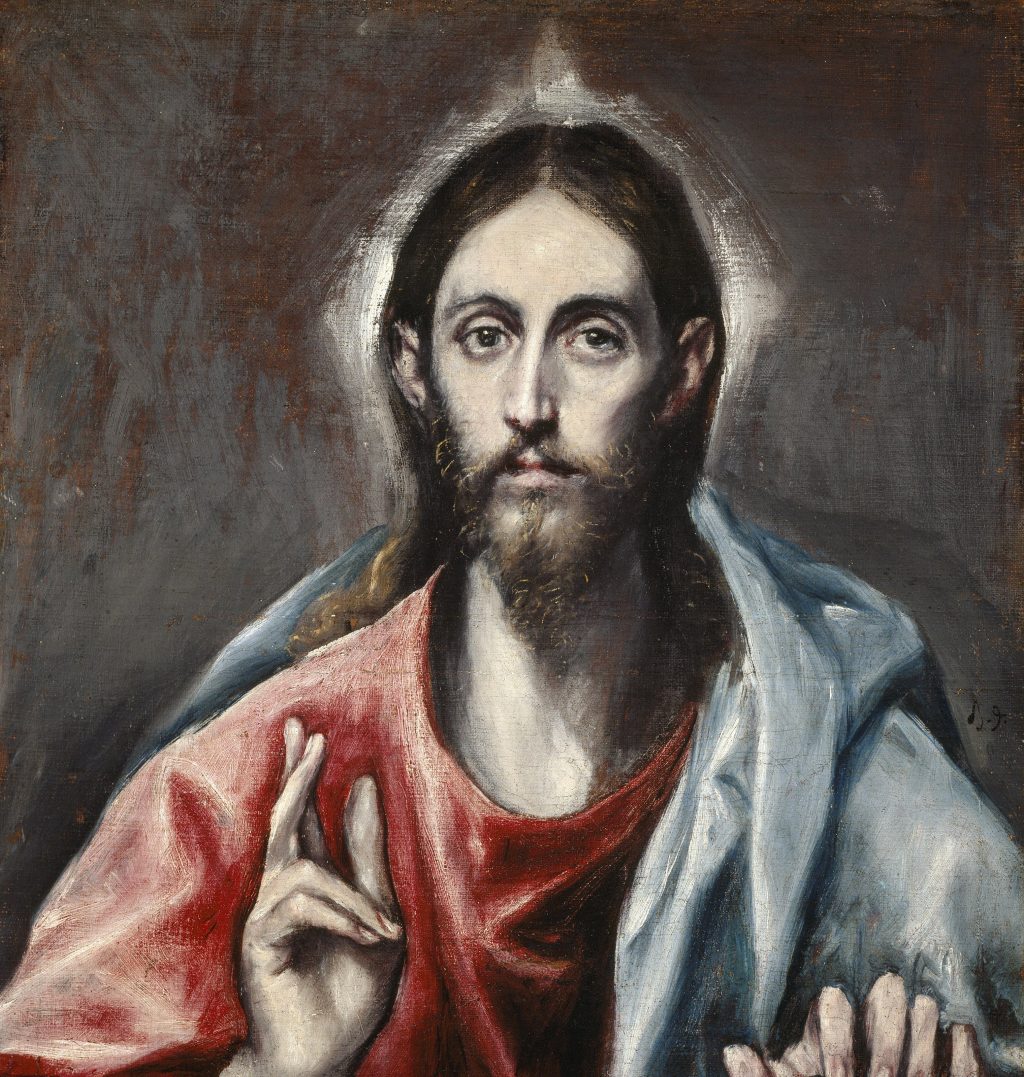
Painting: Christ Blessing (‘The Savior of the World’), by El Greco, 1600

Link for the Mass readings for Thursday, April 11, 2024

Let us believe, in Jesus who opens up heaven for us.

Jesus continues his conversation with Nicodemus in today’s Gospel from John. In the opening verse, Jesus outlines why he came into the world: “God so loved the world that he gave his only-begotten Son, so that everyone who believes in him might not perish but might have eternal life” (Jn 3:16). God has created us out of love and shepherds us out of love. God loves what he has created, and in his order and timing, he sent his Son to enter humanity to become one with us, to heal us and invite us to come out of the shadows and dark recesses of turning in upon ourselves, from living in fear and sin, and to walk with him in relationship.

To love we need to risk being rejected. Jesus entered humanity as we all did, in the utter vulnerability of the womb. His very life was at risk from the moment of conception. Mary, a young woman, betrothed to Joseph, in a time and culture in which a woman found to be with child and not from her husband, could be stoned to death. Mary could have made a different choice, Joseph could have made a different choice, but both chose to follow the will of God. They resisted the temptation to close in upon themselves and make an isolated decision based on their own needs, anxieties, and fears. While all of creation held its collective breath, Mary and Joseph trusted God, they chose the light, they chose to protect life.

“Whoever believes in him will not be condemned, but whoever does not believe has already been condemned, because he has not believed in the name of the only-begotten Son of God” (Jn 3:18). Jesus did not come to condemn, he came to redeem, to save, to love us into eternity. For love to be real, it must be truly free. Free to the full extent that it can be rejected. Otherwise, what is experienced by the other is coercion, conditions, manipulation, pressure, but not love. The Son of God entered the womb of Mary risking rejection by her, Joseph, and/or their extended family.

Those who, like Mary and Joseph, believe in Jesus will come to have eternal life, and those who do not have already been condemned, not by God but by themselves. This is true because instead of accepting the invitation of the Source of life they are turning away. Those rejecting God have been invited to receive his love also, but for reasons they may or may not be aware of, say no. We who follow Jesus are to be his presence of love among those we encounter, even those who shy away or reject him. We may be the only Bible someone ever reads.

Satan tempts and condemns us when we fall. God does not. “God so loved the world that he gave his only-begotten Son, so that everyone who believes in him might not perish but might have eternal life” (Jn 3:16). We, even in our brokenness, imperfections, and sin, are loved by Jesus. Don’t listen to the father of lies who would say anything different. Jesus has not come to condemn but to invite us to receive his love, healing, and forgiveness. Only if we are unwilling to seek his forgiveness, we are not sorry, and/or we are not willing to change, will we not be forgiven, because we give nothing to Jesus to forgive.

There is nothing Jesus will not forgive us for, nothing, that is why he instituted the sacrament of Reconciliation. When we seek his forgiveness, are sorry for our sins, confess to the priest, seek to change with Jesus’ help and do penance, we will be absolved and forgiven.

We are free to reject or accept the offer of Jesus’ love. As Pope Francis wrote: “We are called to be holy by living our lives with love and by bearing witness in everything we do, wherever we find ourselves.” As we are forgiven, receive, and experience the love of Jesus, may we seek to love those we encounter as Jesus has loved us. If there are any that we might not include in everyone, may we be willing to allow Jesus to love them through us until we can.


Photo: Looking up to the things of heaven as I began my Rosary walk – St. Vincent De Paul Regional Seminary, Boynton Beach, FL.

Link for article on Gaudete et Exultate (“Rejoice and Be Glad”)

Link for the Mass readings for Wednesday, April 10, 2024

Jesus has risen! Let us share his love, light, and joy!!!

Today’s reading from the Gospel of Mark, 16:9-16, is commonly called, “The Longer Ending.” Most ancient manuscripts of Mark end at 16:8. Whether this Gospel ended there, or the original ending was lost is not definitively known. Many biblical scholars also recognize in these verses a different writing style, so attribute this longer ending to a different author. This ending recounts that Mary Magdalene and two disciples, presumably the same on the road to Emmaus, met the risen Jesus. When both Mary and the two disciples share their experiences with the eleven, they are not believed, and “later, as the eleven were at table, he [Jesus] appeared to them and rebuked them for their unbelief and hardness of heart”

How many times had Jesus rebuked the Pharisees for being hard of heart? Now he is saying the same to the eleven for not believing the accounts of Mary and the two disciples. We do not have a reason for their unbelief and maybe that is well and good because that gives us the opportunity to ponder for ourselves those times when someone has brought us a message from Jesus and we responded to them with hard hearts and were unbelieving. Are there certain people we would not believe no matter what good news they had to share with us? Maybe someone is bringing us a message from a different or no faith tradition…

Jesus does not belabor the point. His rebuke helped them to see that as his followers their hearts needed to be open to him working through others, as he told John when someone was casting out demons in Jesus’ name, “whoever is not against us is for us” (cf. Mk 9:40).

Christianity is not a secret sect, it is a universal call and proclamation to share the love of God with everyone. The source of this love that we celebrate this Easter Octave is the Paschal Mystery, that the Son of God became incarnate, entered into our human condition, lived, suffered, and died, conquered death, and rose again, for all of humanity and creation.

This was no mere resuscitation. Jesus conquered death and became the firstborn of the new creation and invites us to participate in his reign of the kingdom of heaven which is at hand. This is the Good News he wanted his eleven to proclaim when he said to them, “Go into the whole world and proclaim the gospel to every creature” (Mk 16:15).

Jesus is calling us to do the same, as brothers and sisters, working in solidarity, not for a select few in our pew, but for all in our realm of influence. We are to build relationships by bringing the light, joy, and love of Jesus to each individual that we meet, person to person. Let us also be open to allow God to work through others and receive his message from them as well! Alleluia!!!

———————————————————————

Photo: One of my last classes at Cardinal Newman HS in May of ’22 before leaving to enter seminary. Hopefully, I was able to share with them the love of Jesus and that they are spreading his light, love, and joy!

Link for the Mass readings for Saturday, April 6, 2024

God reaches out to us in so many ways, to let us know that he cares and we are not alone.

Just as Jesus came among Cleopas and the other disciple on their journey toward Emmaus, Jesus does so again as the pair was recounting their encounter with the risen Jesus. What Jesus does differently in this interaction is that he clarifies that he is not a ghost, “Look at my hands and my feet, that it is I myself. Touch me and see, because a ghost does not have flesh and bones as you can see I have” (Lk 24:39). He then asked for something to eat. They gave him fish and he ate, something a ghost or spirit would not do. He talked with his disciples as he had done during their time together before his crucifixion.

We have heard about the resurrection of Jesus, maybe for years, but it is important not to get complacent with the amazing miracle that this is, who Jesus was, and continues to be: a hypostatic union, meaning that Jesus is one divine person, subsisting in two natures, the human and divine.

The humanity of Jesus through his resurrection was fully actualized and transcended the limitations of the three-dimensional realm that he had experienced in his humanity before his death and resurrection. This is how he could disappear after making himself known in the breaking of the bread and how he will come through a locked door to interact with his disciples.

The relevance of the bodily resurrection of Jesus for us is that he, in dying and conquering death, is now the reality of who we will one day be. We will be fully actualized as God has created us to be. The good news is that we do not have to wait to go to heaven for this process to begin! The path of becoming redeemed and whole begins in this life, now, as we accept Jesus as our Lord, Savior, and Redeemer. Jesus in his encounter with his disciples from today’s reading from Luke continues the message he began at the beginning of his ministry, which is one of repentance and forgiveness.

When we were baptized, we were born again as an integral part of the new creation given to us by the death and resurrection of Jesus. Through this grace, our humanity has been redeemed. Each day we are to live in humility, calling to mind our sins and repenting daily. As we do so, Jesus will forgive us, and as we receive his mercy and forgiveness, we will not only be more and more conformed to him, we are also to offer the same to others. Jesus suffered and died for each and every one of us, and he also seeks to live through us. Jesus is the foundation and source of our life and salvation. Jesus has come to show us that we are not in competition with God, but that his Father, our Father, seeks to be in solidarity with us.

There have been times when I have felt pretty wiped out physically, working second shift full time while student teaching in my last year of college; the balance of family life, teaching full time, and five years studying for the permanent deaconate; taking care of JoAnn in her final months; recovering from pneumonia; and over these past two years studying for the priesthood. Through each of these episodes and the regular day in and day out in between each of these more intense moments, I have found peace and renewal, and even more importantly, a deepening of my intimacy in my relationship with Jesus. This has grown as I have been more consistent in the daily anchor practices of praying with the liturgy of the hours and the daily Mass readings, participating in Mass, meditation and contemplation during my holy hour, the Rosary, and Chaplet of Divine Mercy.

Most recently, in the days before taking my Cura Animarum, our final, oral exams, I headed out for my Rosary walk and saw a unique rainbow to the west (the picture of which I posted a few weeks ago), then the next day during my holy hour I was drawn to Jeremiah 1:7-9 in which God was encouraging me to have no fear and that he would place his words in my mouth, and then the day before the exam as I was genuflecting before Jesus present in the tabernacle, I surrendered all of myself to him and felt this overwhelming sense of closeness. Jesus was affirming not only that I would pass my oral exams, which I did, thank God, I felt he was affirming again my vocational path to the priesthood.

Since my late teens, God has revealed himself in these small ways. No mere coincidences have they been but God-incidences. These are moments where God says hello and lets us know that he walks with us and that we are not alone. Even in the midst of our trials and tribulations, when weary and worn, we can experience joy! God is reaching out to us in so many ways, all the time. We just need to take a moment, take a breath, and look up, listen, and be willing to feel. The more we do so, not only in our trials but in every situation, the more we will experience God-incidents – Alleluia!!!

——————————————————-

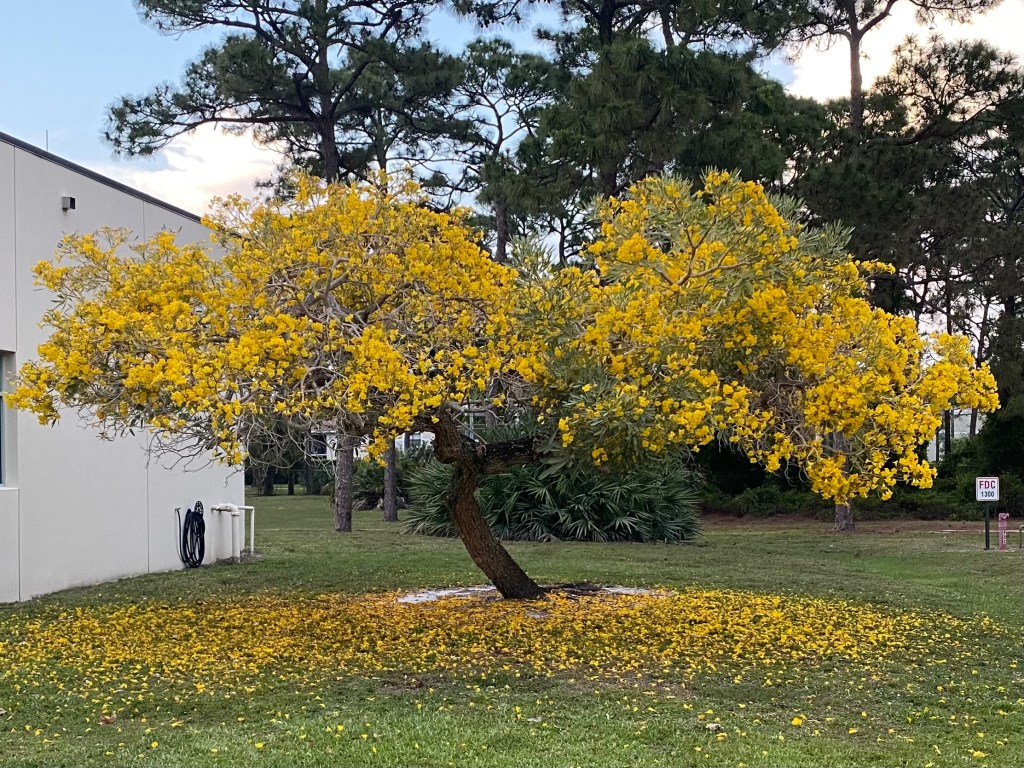
Photo: While praying the glorious mysteries, came upon this glorious bloom! – St. Vincent de Paul Regional Seminary, Boynton Beach, FL.

Link for the Mass reading for Thursday, April 4, 2024

“Were not our hearts burning within us while he spoke to us?”

Our Gospel reading for today begins with a feeling of despair. The hope of Jesus being the Messiah, the promised one who came to redeem and deliver his people Israel died a brutal death. Even though Jesus sought to prepare his followers for this reality, they could not conceive or believe that the promised Messiah could die.

Cleopas and his companion are in mourning as they walk along the road to Emmaus. They have left Jerusalem and are commiserating among themselves about their dashed hopes. They were so sure that Jesus was who he said he was, now what were they to do? Jesus met them where they were and wove his way into the conversation and their journey.

When the time for them to part arrived, Jesus motioned to them that he was continuing on. The pair of disciples urged him, “Stay with us, for it is nearly evening and the day is almost over” (Lk 24:29). Jesus did just that and he revealed himself to them “in the breaking of the bread”(Lk 24:35).

The account of the road to Emmaus has significant relevance for our own spiritual journeys. How many times have we had an inaccurate understanding of Jesus in such a way that we felt let down? Have we domesticated Jesus, or limited who he is, seeing only one aspect of his totality, attempted to shape or conform him into our image and likeness? Have we prayed for something and then that petition or intention was not fulfilled in the way we had hoped? Have we sought Jesus and felt that he wasn’t there for us in our time of struggle or during those times that we felt that we needed guidance?

We need to remember that Jesus meets us where we are, accepts us as we are, walks with us even when we are walking in the wrong direction. While at the same time, he reveals to us the truth. We then need to decide to continue on the path leading away from the love of God or to turn back and into his open arms waiting for our return.

Following the truth that Jesus sets out before us means that we will be stretched beyond our comfort zones, urged to let go of our safety nets and training wheels, called to repent from our sinful ways by resisting the temptation to curve in upon and isolate ourselves. Instead we need to be willing to risk, to be loved, and to love in return. Through our relationship with him, Jesus invites us to nothing less than experiencing the transfiguring flames of Trinitarian Love.

Spending time reading and meditating upon the wonderful, daily readings from the Acts of the Apostles and the Gospels available to us right now will set our hearts aflame as happened with Cleopas and his companion. As this pair returned to the community of Jerusalem, may we gather each Lord’s Day, to hear his word proclaimed and to experience him revealed in the breaking of the bread.

As we put into practice what we hear and receive, we too then will begin to: see Jesus more active in the midst of our everyday activities, recognize him in our daily events and even in interruptions, be more inspired to share the sacrificial love we have received from Jesus with those around us, and come to realize that Jesus is more present and closer to us than we are to ourselves. We just need to invite him to walk with us on our journeys, even and especially when we are heading the wrong way!!!

————————————————————-

Photo: While praying with the mysteries of the Rosary, not only my heart, but the sky was burning!

Link for the Mass reading for Wednesday, April 3, 2024

We experience the miracle of the Resurrection at each Mass!

As we continue through our Easter readings we are given glimpses of encounters with the risen Jesus. This is good news for us, as the risen Jesus of the Gospels is the same Jesus who we can encounter each day.

In today’s Gospel, Mary does not return with Peter and John after having observed the empty tomb. Mary stayed by the side of the tomb and wept. She then peered into the tomb and witnessed two angels. As she turned back, she saw who she believed to be the gardener. She questioned him as to the whereabouts of Jesus. Mary sought a rational reason for where the dead body had gone. When the man did not immediately answer, she must have turned away again, because Jesus said to her, “Mary” (Jn 20:16)!

Upon hearing her name, Mary Magdalene recognized Jesus.

Peter and John left the empty tomb. We do not know why. Maybe they wanted to confirm to the other disciples that Mary was correct about the empty tomb? Mary could have gone back also, but something impelled her to stay. It could have been the sorrow that brought her to tears, it could have been her dedication and faithfulness to Jesus to find him, to anoint him as she had come to do that first early Easter morning, it could have been that she did not know what to do next, or that there was a sense beyond her understanding that compelled her to stay. Whatever the reason shortly thereafter, Jesus came to her. She recognized him not at first, but when he called her by name. When she called him “Rabbouni”, Jesus asked her to, “Stop holding on to me”.

What was Mary holding on to? Though mistaking him for the gardener at first, she came to recognize that he had indeed come back to life. But in calling Jesus Rabbouni, teacher or master, Mary was going back to the relationship she had with him before. Jesus was transfigured, he was different than he was before. Jesus actualized the perfection of his humanity, while still retaining the fullness of his divinity. Though his mission would not be complete until he returned back to the Father with his Ascension.

In the accounts of the Resurrection of Jesus, there was not only a newness to his appearance, but his relationship with his followers were also transformed. He was not coming back to avenge those who betrayed him. Jesus charged Mary to return and convey the message he gave her to his “brothers”. Jesus is revealing to Mary the intimacy of relationship with him that she personally experienced when Jesus called her by name. And this was only a foretaste of the greater intimacy to come at his Ascension, when he would return to the Father and unleash the power of their divine communion of love through the power of the Holy Spirit that would be experienced by his brothers and sisters at Pentecost.

We are heirs to the same promise that Mary Magdalene, the Apostle to the Apostles, shared with the Twelve. Jesus has become the firstborn of the new creation and through our baptism in the name of the Father, and of the Son and of the Holy Spirit, we are offered the invitation to participate in his death and resurrection as well and share in the same intimacy of Jesus’ life and love that he shares with his Father.

The miracle of the Resurrection is revealed at each Mass when Jesus, Body and Blood, is represented again. Around the altar we gather as his brothers and sisters to be configured to his Body, and as we consume him, we are not only being nourished by the Bread of Life, we are being perfected, divinized by the trinitarian love, and being transformed into the image and likeness of the Father that we have been created to be. This is why Easter is such a cause for joy and celebration!!! This is why, like Mary who was sent by Jesus, at the end of Mass we to are sent forth to, “Go and announce the Good News of the Resurrection” in our everyday lives! Alleluia!!!

———————–

Photo: Beginning of Easter morning Mass where I was blessed to assist Fr. Nick and his parishioners at St. Clare Catholic Church, North Palm Beach, FL.

Link for the Mass readings for Tuesday, April 2, 2024

Holy Week invitation, unplug for a bit and be still with God.

In yesterday’s reading, Caiaphas and the Sanhedrin plot to bring about the death of Jesus. The results of their planning will be on full display today in the Gospel account of Mark. Though long, these verses are well worth the time and effort to read (cf. Mark 11:1-10, 14:1-15:47).

The scene from the Passion account that I would like to reflect upon is Jesus in the Garden of Gethsemane (Mk 14:32-42). Jesus invited Peter, James, and John, the same three apostles that witnessed the raising of Jairus’ daughter and the Transfiguration of Jesus on Mt. Tabor to be with him again, this time in his hour of dire need. As Jesus entered the garden, he expressed to them that he felt “sorrowful even unto death”, reflecting the full weight of what was about to take place. Jesus asked the closest of his inner circle to watch and pray while he went off at a distance. Through Mark’s account we are given a glimpse of Jesus’ humanity and divinity.

The most primal of our human instincts is the preservation of our life. Jesus, faced with his imminent death, acknowledged this primal urge by requesting, “Abba, Father, all things are possible to you. Take this cup away from me”. The agony is palpable. Jesus has done all that the Father has asked of him, he has preached, taught, healed, exorcised demons, followed his Father’s will, and now finds himself on death’s door. He can probably sense Judas and the Temple guards drawing close. He will be turned over to those who have turned their back on his Father. All appeared to be hopeless.

Yet, Jesus was not done, he continued, “but not what I will but what you will.” These are not words of despair. In Jesus’ surrender of his human will to the Father, he surrenders in hope. The same hope that we see in Psalms 42 and 43: “Hope in God, I will praise him still, my savior and my God.” Even faced with his imminent and brutal death, Jesus accepted the will of his Father, his Abba. He trusted that there would be a greater good to transpire through his death, through the giving of his life.

With those words, Jesus surrendered his human will to that of his divine will. With each and every yes to his Father’s will through his life, his human nature was more and more conformed to his divine nature. In this account, we see that Jesus is one divine person, the Son of God, while at the same time having two natures and two wills, the human and divine.

As Jesus arose, he came to Peter, James, and John and found them asleep. He said to Peter, “Simon, are you asleep? Could you not keep watch for one hour? Watch and pray that you may not undergo the test. The spirit is willing but the flesh is weak.” Jesus returned to prayer and returned two more times to find his three closest disciples asleep each time. Jesus was ready to face the cross even if they were not. As with the apostles, Jesus commands us to watch and pray this Holy Week. How will we do?

Often, this Lent we may have felt the desire to pray, but the business of life has worn us down – “the spirit is willing but the flesh is weak.” In the evenings, we just want to be numb and zone out. Sometimes this is necessary to recharge. What we choose to do during our winding down time though may not be renewing or restful, but even more draining. Scrolling through social media, surfing through TV channels can lead to 20 – 30 minutes to a couple of hours. Passive activities like these can also affect our attentiveness and bleed into the decisions we make each day and can create a rhythm and pattern of tiredness and fatigue that continues and is perpetuated. We may find ourselves creating a cycle that we have less energy to exercise, to pray, and to take care of our basic needs.

We are invited this next week to follow Jesus. He who certainly did not want to die, was willing to let go of his life to follow his Father’s will. He also did so for each of us. May we be willing to take the same approach. With each choice we make this Holy Week, may we take a moment to breathe and say, “Not my will but yours, Father.” And then wait a moment for a response. Maybe we can fast a little more this Holy Week, from food and diversions that we know are not healthy. When we feel the pangs of hunger and diversions calling and tempting, let us pray for someone we know is in need. Instead of an automatic reaching for the remote or the phone, find a quiet spot and be still, breathe, and review the day in quiet and call to mind what and who we are grateful for. Read a few verses from one of the gospels and see what God might be saying to us. Then ask Jesus how best you might spend the rest of your evening.

Sometimes, just taking five minutes to unplug, stop, breathe and be sit still or to go for a quiet walk with Jesus can be renewing and life changing. We can feel better about ourselves, closer to God, and better able to be present for others.

————————————————

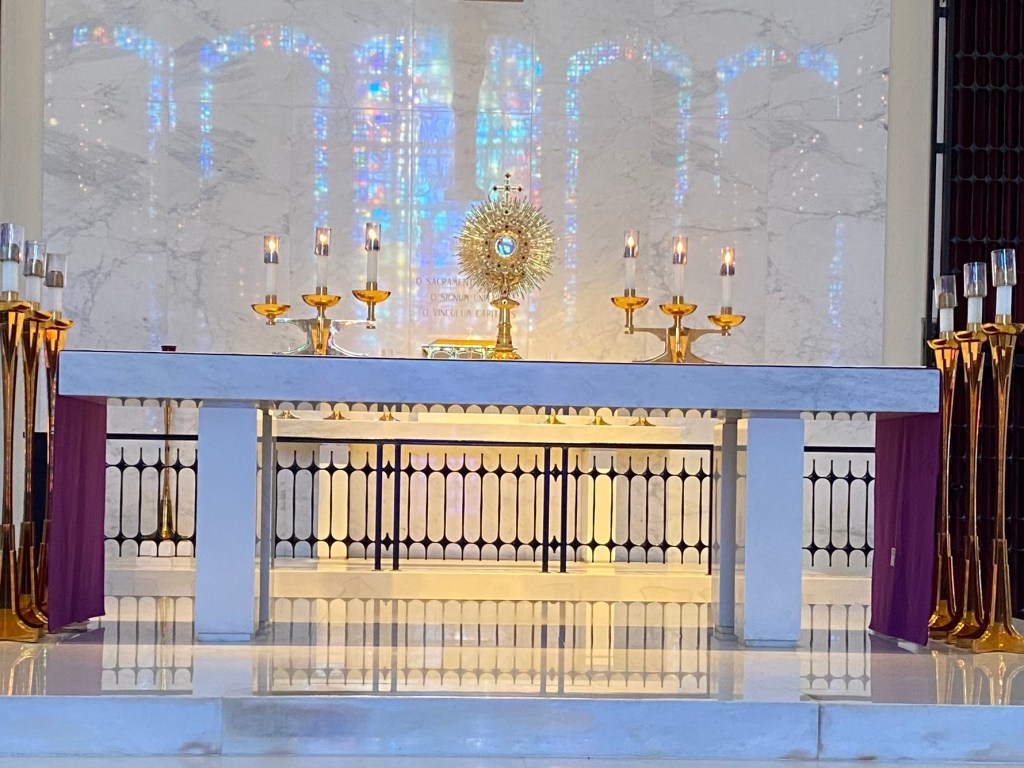
Photo: Some quiet time during our 40 Hours of Devotion to the Most Blessed Sacrament last week, SVDP chapel, SVDP Regional Seminary, Boynton Beach, FL.

Link for the Mass reading for Sunday, March 24, 2024

Jesus, blasphemer or human and divine?

Two groups of Jews emerged in today’s Gospel account. There were those about to stone Jesus for blasphemy and those who began to believe. The first group did not recognize the good works that Jesus did as coming from God, nor his reasoning that “even if you do not believe me, believe the works, so that you may realize and understand that the Father is in me and I am in the Father” (Jn 10:38). They listened to the claim that Jesus was making but they refused to accept the fulfillment of the assertion: Jesus did the works of his Father because he was then and still is today the Son of God.

The more that Jesus sought to help them to understand that he was who he says he is, the more they dug in their heels. They left the stones on the ground but then moved to have him arrested. Jesus evaded their grasp and moved on to the region across the Jordan where John first baptized. John did not preach in the Temple precincts either, even though he was the son of a priest. John followed the lead of God to prepare the way for Jesus and his eternal priesthood. The Temple had not been the seat of God for some time. Jesus would become the new and living Temple.

Jesus returned to the place of his baptism, where he joined in solidarity with sinful humanity. This visible image of consecration revealed what happened silently in his conception and birth: the Son of God took on flesh and paraphrasing St. Irenaeus, became man to open up heaven for us in the humanity he assumed. As people came to John in the Jordanian wilderness, so too, people came to Jesus. Not all rejected his message. Many came to him and said, “John performed no sign, but everything John said about this man was true.” And many there began to believe in him (Jn 10:41-42).

The question that arises for us as our steps take us closer to Palm Sunday and Holy Week is, will we label Jesus as a blasphemer or accept that Jesus is the Son of God? Today’s scriptural account does not reveal indifference as an option. There is no room for Jesus being only human; a good teacher, a wise man, or a revolutionary radical.

We either accept Jesus is fully human and fully divine or we don’t. If he isn’t who he claimed to be: God, then Christianity is just another philosophical, theological pursuit and in the words of St. Paul, our faith is in vain. Yet, when we accept that Jesus is the Christ, the Son of the Living God, then our lives are to be aligned with his. Our thoughts, words, actions, and even our faces need to reflect that truth. This does not mean we, or our lives are going to be perfect. We and our lives aren’t, but as we surrender our lives to Jesus, repent when we fall, seek his guidance, and invite him to be at the core and center of our lives, we will be perfected, slowly and surely by his love.

A good way to begin each day is affirming this fact by stating with an attitude of prayer, “Jesus I believe in you, you are my God and my all, and I need you.” Ask him what works of the Father he would have us offer in his name this day. In what ways can we be of help and support to another? May we have the openness of mind and heart to hear his words and the courage to act upon his guidance, so to be the precious, living stones we are, reflecting the light from our source, Jesus the Christ, the Son of the Living God.

————————————————————————-

Photo: As the moon reflects the light from the sun, so are we to reflect the light of Jesus.

Link for the Mass readings for Thursday, March 22, 2024