We pray, love, and serve because we are loved by the One who is Love.

“[W]hen you hold a banquet, invite the poor, the crippled, the lame, the blind; blessed indeed will you be because of their inability to repay you” (Lk 14:13-14).

Jesus means what he says here, though I am not sure many of us are ready to live this Gospel out. If we are going to get to the point where we can, we must understand the deeper point that he is making. The words of Jesus above give us an example of what it means to love unconditionally. We are to resist the temptation of doing anything with the primary purpose of receiving thanks or praise. We are to instead reach out to those in need because they are in need seeking nothing in return. We embrace our dignity as human beings when we recognize the inherent dignity of another and serve them without hesitation, without holding anything back.

This is the root of what we mean when we say that we are believers in the God of Jesus Christ. God is a divine community of persons, Father, Son, and Holy Spirit. The Father gives all that he is to the Son perfectly, infinitely, holding nothing back. The Son receives all that he has been given perfectly, infinitely and returns, in like fashion, what he has received back to the Father, holding nothing back. The infinite love shared between the Father and the Son is the Holy Spirit.

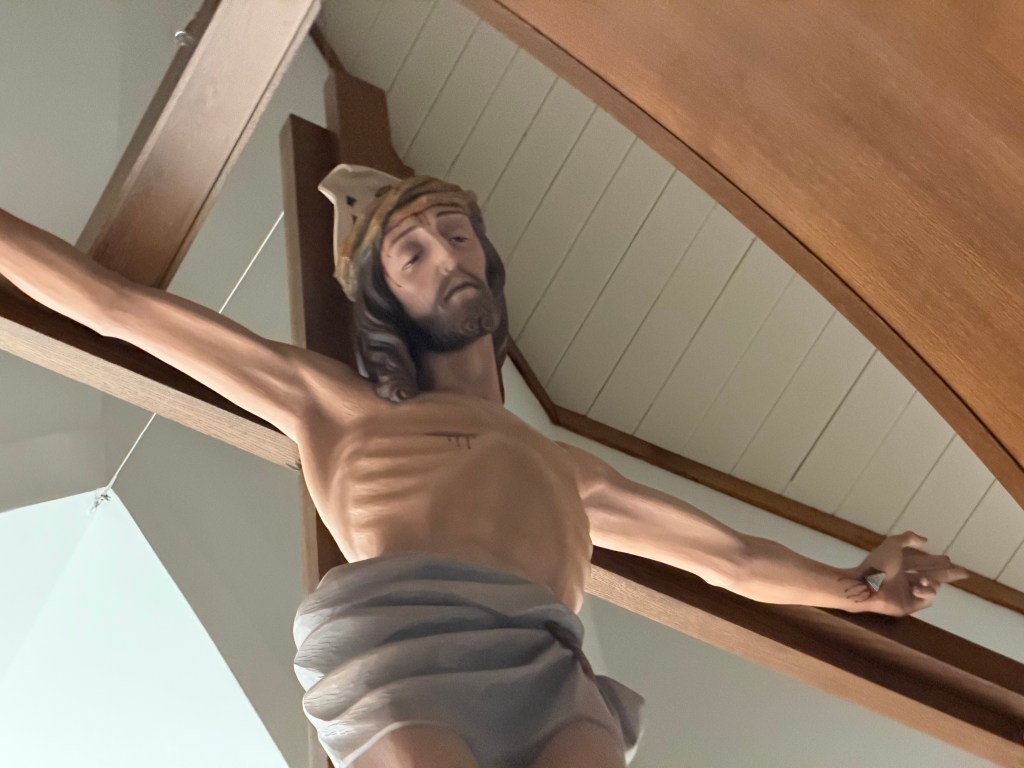
The Son of God became incarnate, one with us in our humanity, and he also gave all of himself to us on the cross, holding nothing back. He conquered death, rose from the dead, ascended to the Father so that we now can participate in that same divine love given and received between Father, Son, and Holy Spirit. We do not give of our time, talent, and treasure, so that we will receive more of each. We give, we love, we will the good of each other, because we have been loved into existence and are continually loved more than we can ever imagine by God. We are to receive his love and love in return because that is who he created us to be.

The very fact that we exist, that we have life, is a gift, yet we are not meant to merely exist. Jesus teaches us that the height of our humanity is to allow him to love us and through us, love others unconditionally. When we look into the eye of each and every person we meet, we are to see a brother, sister, mother, father. With each smile, each embrace, each listening ear, each act of invitation to walk not ahead, not behind, but with another, and by simply being present, we reaffirm to each other that we have dignity. This is true because each and every one of us has been created in the image of God, who is Love.

——————————————————–

Photo: St. Martin de Porres lived out this gospel literally. From the Dominican monastery in Lima, Peru, he fed several hundred people a day, provided healing, financial support, and began a school for street children. St. Martin, pray for us that we also may be people of prayer and service.

Link for the Mass readings for Monday, November 3, 2025

The antidote for our hypocrisy is to accept our poverty.

The Lord said to him, “Although you cleanse the outside of the cup and the dish, inside you are filled with plunder and evil. You fools” (Lk 11:39).

Jesus’ harshest critiques were for acts of hypocrisy. He did so to show, in no uncertain terms, how dangerous this was, especially for religious leaders. These men were entrusted with the care of God’s people. They may have observed the proper rituals, spoke, and dressed to match the part but this all meant nothing if their hearts were hardened such that they were closed to the love and will of God. This situation was more perilous when they themselves became obstacles and stumbling blocks to those who sought God. Jesus indicting them as fools meant that they were bereft of the wisdom of God they projected to have.

In the depths of our very being, we seek and yearn for the transcendent, the infinite. We are spiritual seekers. We seek God while at the same time we experience suffering, injustice, and hypocrisy at the hands of the very ones who are our leaders in both the religious and political sphere. This is why Jesus convicted those who abused their positions because he knew the significant damage that they could inflict.

No one is perfect, our leaders nor ourselves. We all fall short of the glory of God, even those of us who seek and aspire to live by the Gospel. If we put anyone up on a pedestal, they, sooner or later, are going to fall, and the higher up they go, the greater the fall. God is to hold priority of place. We are to seek God first. God is to be our foundation, the light shining on the hill, our guide, and source.

One way we can sidestep the trap of hubris is by resisting the urge to project all is well and good, that we are fine when we are not. None of us are super men or women. If we think we can go it alone, on our own power and persistence, we will fall sooner or later. A hyper sense of self-reliance means we seek God and each other less for help and support.

When we turn to Jesus to reveal our weakness and our sin, we can experience his transformative and healing power in our lives. To be vulnerable, to allow Jesus to shine his light into our inner darkness takes courage, but when we open all of our lives to him, we will identify and be able to release our own “plunder and evil”. The Holy Spirit can also help us to trust one another with our weaknesses, faults, and shortcomings.

We are healthier and stronger when we accept our own spiritual poverty, where we need help, and reach out to ask for assistance. We are better when we entrust ourselves to Jesus and a core group of people we trust, firmly ground ourselves in the love of God and one another. We grow stronger when we support the unique gifts of each other while at the same time hold each other accountable. Isolated and in the darkness, our sin festers and grows. When brought into the light, sin starves and withers away.

Jesus challenges us to resist projecting an image of perfection when all is not well on the inside. When willing to reveal our weaknesses, sins, suffering, and pain, we can receive help, heal, and let go of carrying the weight of seeking an internal perfectionism. Healed and transformed from being the center of the universe, which we never were or never can be, we can let go of having to project an image of perfection. We can instead be free to be ourselves as God calls us to be and radiate his love as we receive his love. Instead of driving people to the nearest exit, we can begin to welcome people back home to be forgiven, healed, loved, and transformed.


Photo: Not a cloud in the sky. Would that we can say, no sin on our soul! We can get closer by seeking the cleansing healing from sin when we are willing to confess regularly and often.

Link for the Mass readings for Tuesday, October 14, 2025

Are we willing to be a pencil in God’s hand?

So should it be with you. When you have done all you have been commanded, say, ‘We are unprofitable servants; we have done what we were obliged to do’” (Lk  17:10).

This ending verse from today’s Gospel account from Luke flies in the face of the ideals of fame and honor that many in our culture believe we ought to be striving for. After all, everyone wants their fifteen minutes of fame, don’t they?

The point Jesus is making with his disciples is one of perspective. We need to constantly remember that God is the Creator and we are his created beings, God is God and we are not. Our life is completely dependent on him and whether we like the analogy or the reality that we are servants, that is not only how we were created, but what will, in the end, bring us the most meaning and fulfillment in our lives is serving God without hesitation.

This is no dictatorial or tyrannical power play by God through his crown prince Jesus. Jesus himself consistently served his Father and would do so in the fullness of giving himself on the Cross. This is best summarized by Paul in his Letter to the Philippians, when he echoes one of the most ancient Christian hymns: “Though he was in the form of God, Jesus did not deem equality with God something to be grasped. Rather he emptied himself and took the form of a slave, being born in the likeness of men.”

Jesus, the divine Son of God, entered into our human condition because he was serving the will of his Father. We are to do the same. God is the director of his epic drama and each of us has a part to play. Our faith grows as we empty ourselves from our own grasping nature of seeking control, of being in charge, and seeking to be the director of our own life.

One of the reasons many of us have trouble with this type of imagery and language is because we consistently see so much abuse of power for selfish gain. This is not God’s goal. God does not need us, he is fully self-sufficient without our worship or service. It is we who need him and through the opening of our mind and heart to his direction, by acting on every word that comes from him, we do not become diminished, we actually expand and become more!

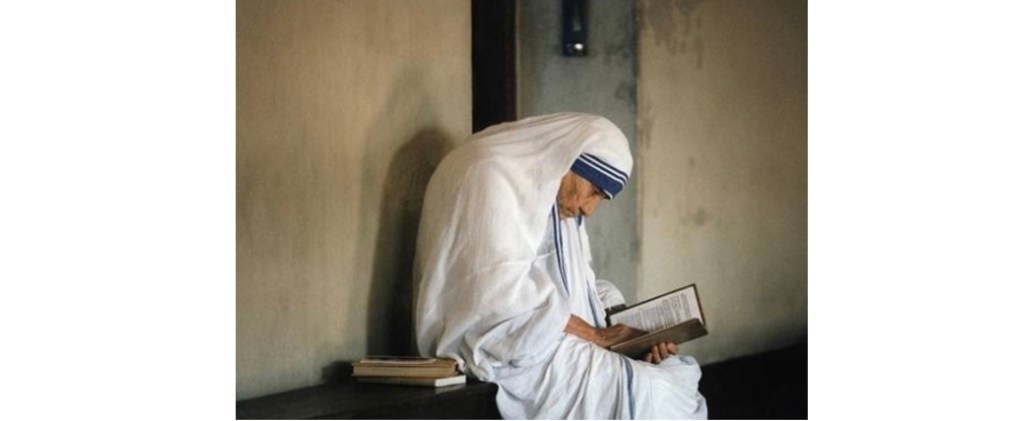
We truly become ourselves, we are fully alive, and we will experience more peace, when we resist living in the past or anticipating the worst case scenarios about the future. A wonderful image that St. Mother Teresa used often that I find helpful is being a pencil in God’s hand. When we have faith in and trust God, we can rest in his loving guidance and act as he directs. This is the beating heart of our faith, to place ourselves in a posture to hear the will of God, and act upon it in our willingness to serve him without hesitation. In doing so, we lose our life, and in so doing we find joy because we become fully alive.

—————————————————

Photo: St. Mother Teresa could be a pencil in God’s hand because she gave herself to him in prayer and service daily.

Link for the Mass readings for Sunday, October 5, 2025

Praying helps us to grow in our relationship with God, as well as in humility and love.

“Rather, when you hold a banquet, invite the poor, the crippled, the lame, the blind; blessed indeed will you be because of their inability to repay you. For you will be repaid at the resurrection of the righteous” (Lk 14:13-14).

At the end of this parable, Jesus is expressing a deeper definition of love that we in our culture may not be accustomed. When we hear someone talking about love, most likely we think of an emotion, a feeling, sentiment, or a state of mind. As I have written often, I follow St Thomas Aquinas in his definition of love as the willing the good of other as other. This definition of love is unconditional. There are no restrictions placed on another for a return of the good given. In fact, as we read Jesus’ words, no return is to be expected.

This is what Jesus means by inviting the poor, the crippled, the lame, and the blind. These are people of his time who had nothing to give to someone who has the means of offering a banquet. They could even come, because of their ostracized status without the proper etiquette to even express the most minimal of thank you for the invitation and the meal, and instead to complain about the food, the decor, and even be insulting to the host. Yet, they would be served with humility and grace anyway, because the point is to give without expectation of reciprocity.

Some may say this is impossible, that nobody gives without expecting something in return. Everybody’s got an angle, even if we do something for a compliment. Jesus would probably agree with this claim, for on our own we may not conceive of giving without looking to get something back in return, let alone make such an offer. Jesus has countered this claim in a different context, but it applies here just as well: “For human beings this is impossible, but for God all things are possible” (Mt 19:26).

To be able to love then, to will the good of the other without condition, we need to first be willing to receive the love of God that he offers. We are only capable of love because first and foremost, we have been loved ourselves. If we spend no time with God, no time in his word, prayer, worship, acts of service, or most importantly his silence, we set ourselves apart from the love of God, and separate ourselves from him, the very source of our being. Our very existence, in fact, the reality of all creation, is the result of the outpouring of the love of God.

To receive the love of God, it helps when we respond to the invitation of the Holy Spirit to pray each day. Our very desire to pray, seeking the existence of God, the urge to move out from our self to reach out to the need of another, is the first response we might experience to his invitation even if we may not even be fully be aware. Another important movement to make time for prayer is to resist the many distractions, diversions, and temptations that keep us from praying and make time for God and God alone.

Humility is a key virtue that helps us to resist seeing ourselves as first and foremost. God is God and we are his children. As we enter into relationship with him and receive his love, it is important to resist keeping his love for ourselves. Yes, share with those closest to us, but also with those who will not give back. We need not fear that there will be a finite end to our giving, for with God there is an inexhaustible supply and a joy for its own sake which comes up from within our soul from our loving Father who is the source.

Having received God’s caritas, charity, we are to give until it hurts, as St. Mother Teresa taught. Jesus is not teaching us to build up fame and fortune here in this life, but to build up treasure in heaven where we will receive our eternal reward. If we don’t follow through on the movement of love dwelling up and share, if we only seek a return or equal exchange for the love given, we will often be let down and disillusioned. When the Holy Spirit nudges us to reach out in concrete situations, we are to follow without hesitation and seek nothing in return.


Photo: Divine Jesus Prayer Canvas from ArtisianCanvasPrint

Link for the Mass readings for Sunday, August 31, 2025

We are to “turn and become like children.”

“Amen, I say to you, unless you turn and become like children, you will not enter the Kingdom of heaven. Whoever becomes humble like this child is the greatest in the Kingdom of heaven. And whoever receives one child such as this in my name receives me (Mt 18:3-5).

The above response Jesus gave was to the disciple’s question regarding, “Who is the greatest in the Kingdom of heaven.” Jesus offered an unexpected response, as children had no esteem, honor, let alone greatness in the cultural realm of his time. Jesus was also not pointing out so much the innocence of children, but emphasizing that children were completely dependent on others for their very survival.

If we are to embark or stay on the journey that will lead us to the Kingdom of heaven, we need to do the same. Jesus is inviting us to give up our control, our apparent, self-sufficiency, and surrender all we are to God and place our dependence on him alone. We are to depend on God as would an infant or young child depends on his or her parents.

Very young children also have not developed a defensive filter and they say what is on their mind, often with precise insights! How often do we do the opposite by automatically responding in a defensive manner, thinking about how we will be received or fearing an ulterior motive from the question? Jesus has taught us that our yes is to be yes, and our no is to be no, and anything more is from the evil one (cf. Mt 5:37). As his disciples, Jesus calls us to be humble, to admit to our sins, our mistakes, to confess, correct, learn from them, and so mature in the spiritual life.

We grow in humility when we depend on God and place our trust in him. Doing so, we will experience the truth and see through our own rationalizations for accepting apparent goods instead of that which is truly good. Having turned away from the false promises and turned toward the truth, we will mature and begin to discern between what St. Ignatius of Loyola calls the competition of goods – choosing between those things that are indeed good, but accepting only those that align with God’s will for our unique station in life.

Trusting in God for everything and depending completely on him will also make our lives much simpler because we will no longer be chasing after that which is really not helpful or healthy. We will also come to accept that what we have, is a gift from God. From this place of gratitude, we will experience more peace and more rest, or as St. Jane de Chantal’s offers: “How blessed is the person who, in tranquility of heart, lovingly maintains the sacred sense of God’s presence! For this person’s union with divine Goodness will continue growing perpetually, though imperceptibly, and will fill her whole spirit with its infinite sweetness…”


Photo: When we allow ourselves to be childlike we can also embrace wonder again!

Link for the readings of the Mass for Tuesday, August 12, 2025

Some guidance from Jesus, St. John, and St. André Bessette, for the new year.

The beloved disciple John shares with us today a wonderful compass to guide us into the new year. From his first letter he writes that God’s “commandment is this: we should believe in the name of his Son, Jesus Christ, and love one another just as he commanded us” (I John 3:23).

Before we can believe in God’s Son, we need to trust him. For many if not all of us at some point in our lives who have experienced being hurt, betrayed, or wounded in any way, trust can be hard. 

That is why the Son of God was willing to be sent by his Father. He wanted to become one with us so that he could not only experience all the pain and suffering of our humanity but that he could take that upon himself, even death, so he could conquer them and heal, restore, and show us the way back to the Father, through our suffering and pain and into healing.

We can trust Jesus. Jesus not only has our best interest in mind, but he knows the plan of his Father for our lives and he can lead us to experience his love and our vocation as we trust him by taking one step at a time. He gives us enough light to see two steps ahead and when we take those steps, he will give us enough light to see the next two.

We can trust Jesus, but each thought or invitation we hear in our mind is not necessarily from Jesus. Some may appear good and true, but are only apparently so. For as John continues: “Beloved, do not trust every spirit but test the spirits to see whether they belong to God” (I John 4:1).

The devil and his demons tempt, entice, divert, and distract us, with the ultimate goal to lead us away from the love of God, the source of our true fulfillment. They seek to plant seeds of so doubt, so we believe that God does not have our best interest in mind. And once those seeds of doubt begin to sprout he seeks to isolate us from our Father by fertilizing those doubts with distrust in our minds and hearts. And when we sin, the devil condemns and shames us, and leads us to believe that we cannot be forgiven and that no one will accept us for what we have done or for who we are.

God never tempts us, he invites us and challenges us to move beyond our sins and our fears. He gently coaxes us to come out of the darkness of our self-centered, protective cocoon, and into the gentle light of his love. He does so patiently, sometimes with a firmness of a good parent, but gently. We hear his voice mostly in the quiet and stillness of our heart. When we do make a mistake, he does not condemn us, he convicts us to learn, to renounce our mistake. When we sin and turn back to him, he forgives and embraces us. We then begin again strengthened by his grace and greater clarity. 

God loves us more than we can ever imagine no matter what we have or have not done, he loves us more than we can ever mess up, and he loves us even in the act of our sin. He has shown this love most profoundly in sending his Son so we can see his face and experience his love, forgiveness, and mercy. We can experience that he loves us as we are right now, right where we are in our weakness and imperfection. 

The key to walk free from the “fowler’s snare” (see Psalm 91:3-4) is to heed the words that Jesus began his public ministry with: “Repent, for the Kingdom of heaven is at hand” (Matthew 4:17). God does not seek to punish us. Neither does he want us to stay in our sin and separation from him. God’s love calls us to more. Feeling guilty and shame is a false humility that keeps us separated from God because our focus remains on ourselves.

God imparts within us a sense of guilt, so that we experience our separation from him. Being in touch with this experience, helps us to choose true humility which leads us to trust in the love of God and believe in his mercy. When we sincerely and contritely confess our sins, do penance, and with his help seek to sin no more, Jesus will forgive, free, save, and restore us to our right relationship with God. 

When we are willing to allow the gentle light of Jesus to shine in our darkness, Jesus helps us to see what our life is like without God and with God. He helps us to be able to see the difference between the apparent goods and the true good so that we can make a clearer decision. Will we choose darkness, separation, and death or light, reconciliation, and life?

St. André Bessette, whose feast day it is today, could have fallen for the devil’s tactics. He who was sickly since he was an infant, lived in poverty as a child, and who then lost his parents when he was only twelve, and struggled with illness for all of his ninety-one years, could have been bitter towards God. André chose instead to trust in God and how he could make this statement: “Do not seek to have your trials removed. Ask rather for the grace to bear them well.”

Living a devout life of faith as a youth, his pastor encouraged him to apply to religious life and he sought at twenty-five to enter the Congregation of the Holy Cross. His poor health continued to plague him and at the end of his novitiate year, he was not asked to continue. André continued to trust in his Lord and his long standing ally St. Joseph. His novice master and bishop saw the light of Christ in this young man and petitioned that he be given an extension and he was eventually admitted into the order and served as a brother. His birth name was Alfred. Upon his profession he took the name of André who was the pastor who had mentored and recommended the pursuit of his vocation.

André was assigned the position of porter, the door keeper, because of his lack of education and frail health. A role that many would not look on with any esteem, André welcomed with open arms. Seeing in this position the opportunity to greet Jesus at the door with each knock and person he met. Looking back at his life he would say, “When I entered the Congregation, they showed me the door. And I stayed there for forty years.”

During his time of service, through the intercession of St. Joseph and his unwavering trust in Jesus despite much opposition and his continued frail health, thousands experienced being heard, loved, and healed. Through St. André, they experienced a foretaste of heaven.

St. André is a model for us on how we can in this new year “believe in the name of his Son, Jesus Christ, and love one another just as he commanded us…”, trust only in the Spirit of God without hesitation, and when we do fall, “Repent, for the Kingdom of heaven is at hand.”

God loves us so much and wants to share his life with us so that we can share in his relationship. Are we willing to resist the lies of the enemy, trust in the love of God, seek his guidance in all circumstances, discern and let go of anything that is not of God? When we do so, we will heal, be forgiven, and be set free to love and love in return. This journey begins and continues by trusting in God the Father’s Son whom he sent.  


Photo: St. André Bessette, pray for us!

Link for the Mass readings for Monday, January 6, 2024

“Whoever humbles himself like this child is the greatest in the Kingdom of heaven.” – Jesus

“Whoever humbles himself like this child is the greatest in the Kingdom of heaven. And whoever receives one child such as this in my name receives me” (Mt 18:4-5).

Children during the time of Jesus were seen if at all, to have little worth. They were vulnerable, had little if any status in society. They were often nothings, nobodies, and completely dependent on their parents for survival. Jesus invites a child to come to him, identifying himself with the child, as a response to the disciples’ question as to who would be considered the greatest in the Kingdom of heaven.

Jesus taught his disciples, and us today that we need to be completely dependent on God our Father, just as a small child is totally dependent on his or her parents. What leads us to greatness in the Kingdom of heaven is our turning away from the temptation to curve in upon ourselves, resisting the urge to feed our ego, place ourselves first, and as St Thomas Aquinas taught, resisting the cultural lures and substitutes for God: power, pleasure, honor, and wealth.

We are also to reject the image of the Übermensch, the super man, popularized by Friedrich Nietzsche, the 19th century German philosopher. Nietzsche wrote that God was dead and promoted the idea that humanity needed to create a world that would create new values based on the power of their will alone. Supermen and women striving for complete autonomy and self-sufficiency. Jesus teaches the exact opposite. We need to place our complete dependency and trust in God and rely on him for everything.

Participating in the reign of God is not one of lordship over another. Instead we are to assume the humility to accompany, walk along with, and serve each other along our journey in this life. Jesus embodied this reality. He as the Son of God entered into our human condition. He did not grasp at his divinity but instead surrendered it to his humanity. While remaining fully divine, he became human when through the power of the Holy Spirit was conceived in the womb of Mary, developed through his period of gestation, and was born into our world. As an infant and child, he was completely dependent on Mary, Joseph, and God his Father.

As Jesus continued to grow as a young child, he experienced the fullness of the human condition. He laughed, he cried, he got sick, he was tempted, he felt pain, he experienced heartache and joy. Throughout his life, and especially during his public ministry, he experienced human suffering up close and personal. He understood the suffering of his neighbor and experienced his own human and finite limitations. He loved and wept as we saw in his encounters with Lazarus, Martha, and Mary.

Jesus invites us to relate to God as our Father often in the Gospels, in the best sense of that intimacy of dependence. St Thérèse of Lisieux got this. “Jesus has chosen to show me the only way which leads to the Divine Furnace of love; it is the way of childlike self-surrender, the way of a child who sleeps, afraid of nothing, in its father’s arms.” Accepting Thérèse’s image is an acknowledgment that we are dependent on God and others, that we are not self-sufficient, that we are not capable of living radically independent lives, nor are we supposed to. God created us to be loved and to love, to be in community, to care for, empower, and support one another.

Our guardian angels, whose memorial we celebrate today, are at the ready awaiting our call. When we have the humility to ask for their help, we will realize that we are not alone. When we experience some supernatural support, from God, his angels and saints, we might just be willing to seek help from and support each other. We can offer a shoulder to lean on, a smile, a hug, a voice that speaks for the voiceless, a soul open to pray with and for others, an ear to hear, and we can embody the courage to serve and stand up for the dignity of others.

St Mother Teresa was willing to come close and pick up that first dying man in the street. She did not ask his religion, was not concerned if he was of a different race or nationality, was not afraid to risk illness or injury by attending to him. She knelt down and was present to him in his time of dire need. We are at our best when we follow Jesus, St. Thérèse and St Mother Teresa, the saints, and our guardian angels, place our dependency and complete trust in God’s hands and accompany each other by doing little things with great love.


Photo: To be loved and love in return is why we are here at this time.

Mass readings for Wednesday, October 2, 2024

Humility, contrition, and confession are the pillars for forgiveness, love, and peace.

Logistically, to our modern minds, the setting of this verse may appear confusing. How could this “sinful” woman be standing behind Jesus such that her tears would fall on his feet? When we think of someone sitting and eating, we imagine them doing so by sitting in a chair. Thus, the feet would be toward the front of the person.

During the time period Jesus lived, the customary practice when eating was not to sit at all but to recline. Thus, the woman was standing behind the feet of Jesus as he reclined, and her tears fell on his feet. She then knelt down, dried his feet with her hair, and then anointed Jesus’ feet with the ointment she brought for him.

She did not rationalize, deny, ignore, or come grudgingly nor wait for Jesus to call her out, she came not asking for healing but with true contrition for her sins. Being in the presence of Jesus, when we are open to his love and experience his compassion, we are pierced to the heart with our own sorrow for the hurt we have caused others through our sinful actions.

Those quick to point the finger at other’s sins, like Simon who judged this woman, are less apt to be aware of the depth of their own sin and thus “the one to whom little is forgiven, loves little” (Lk 7:47). We are not forgiven less because God is not willing to forgive but because God will not go against our free will. If we are unaware or unwilling to bring our sins forward in a contrite manner, we are cutting ourselves off from the healing forgiveness God wants so much to share with us. But if we, like the woman in today’s Gospel account, are willing to bear our soul with humility and sorrow we will not only be forgiven but experience a deeper outpouring of God’s love. The one who confesses truthfully, fully, and contritely is forgiven more and thus will love more.

We are offered the same gift of grace and forgiveness as she received. What if instead of hiding from, being in denial of, rationalizing, or justifying our sins, we acknowledged them and sought the healing forgiveness of Jesus as she did? In opening our hearts and minds to the forgiving and purifying love of the Holy Spirit there is pain, as there is in any healing, but there is also freedom. When we trust Jesus as she did with our deepest and darkest sins, we too can be forgiven, healed, and freed of the shackles that bind us and experience his love.

Don’t believe the lies of the enemy. God loves us more than our worst mistakes and sins. When we trust him, are contrite, confess, and willing to atone for our sins, the truth will set us free, and we will experience God’s love more fully and his peace more deeply.


Photo: Good to be still, quiet, breathe, and examine our lives from time to time.

Link for the Mass readings for Thursday, September 19, 2024