In our encounter and deepening of our relationship with Jesus we experience love, peace, and joy!

After the most recent clash with those Pharisees bent now on killing Jesus, he “withdrew toward the sea”, the Sea of Galilee. After his entanglements with the Pharisees, he may have sought refuge or a quieter setting away from the crowds. Yet, the people followed. Mark details in his account that many from all over the region came to Jesus to be healed. Among the crowd, unclean spirits threw those they possessed down before Jesus. This did not slow the gathering of people who pressed in on Jesus, just to touch him. The mass of people grew to a point that it was getting out of control so Jesus “told his disciples to have a boat ready for him because of the crowd, so that they would not crush him” (Mk 3:9).

People wanted to be healed, to be cured, to be exorcised, and brought others to experience the same. Yet they were missing the deeper point of who Jesus is. He was not just a miracle worker, not just someone that brought about physical healing. Healing accounts were heard and known about in the ancient world.  The unclean spirits got it, they recognized Jesus before the people did, “for, whenever unclean spirits saw him they would fall down before him and shout, ‘You are the Son of God'” (Mk 3:11).

They were bound by the authority of Jesus to be renounced. They had to obey him and in calling out who he was they were attempting to control him with no effect. Throughout the Gospel of Mark, we will read about how the crowds, disciples, and even the apostles, all struggle to understand who Jesus is. The people closed in on Jesus seeking to be healed, but missed the deeper hunger within their souls that St Augustine, the fourth-century bishop of Hippo, so eloquently described on the first page of his autobiography: “[Y]ou have made us for yourself, and our hearts are restless until they can find peace in you” (Augustine 1963, 17). Jesus is the Son of God, not just a miracle worker, teacher, or healer, but God Incarnate.

The only way we will be fully satisfied, inspired, fully alive, and be at peace within our own skin, is by developing an ongoing, deepening relationship, and communion with our Father. God is infinite and cannot be exhausted. We as finite beings are left wanting even when we have the best of material things. We always hunger and want for more, because in the depths of our very being, whether we recognize it or not, we want God. The many who came to Jesus for healing, were not aware of the deeper hunger and healing they sought.

The deeper healing that Jesus seeks to offer all of us is to restore us to the fullness of who his Father created us to be. To do that, we must be willing to embrace the truth, the way, and the life that he offers us. Which means that we will need to let go of anything that does not align with his invitation. At the first, we may be taken aback because of our attachments. We need not be afraid. Jesus works slowly. His light shines gently that we might see what is keeping us from growing in our relationship with him and each other.

Jesus conquered death and freed us to abide in an authentic love expressed at a deeper, more intimate level than we can ever imagine. Jesus satisfies our deepest hunger as he invites us to be drawn into his grace-filled embrace so as to be healed, renewed, shaped, and conformed to his heart, mind, and will. When we come to this place of encounter, reconciliation, and intimate relationship, we come to know our mission and in serving through that mission we come to know who and whose we truly are. In that place is our greatest joy and it only gets better the more we receive and share his love!

————————————————————————

Drawing by: First weekend Mass about six months ago. Feel blessed and joy filled to overflowing each day as I continue to build relationships here at my new home of Holy Cross Catholic Church, grow as a disciple of Jesus, and serve as his priest!

St Augustine. The Confessions of St Augustine. Translated by Rex Warner. New York: New American Library, 1963.


Link for the Mass readings for Thursday, January 23, 2025.

Would we choose to remain paralyzed or be healed?

In a time when word of mouth is the way to get news out, the momentum still moved quickly. Jesus has preached with authority and moved people with his words, he has healed people and exorcised unclean spirits. So when it was known that Jesus was in the vicinity, in his present home of Caparnaum, people came. Jesus came not to abolish the law but to fulfill it. That meant that he did not water down the message of God, but raised the standards even higher than they had been before under the leadership and legacy of Moses. Unlike some of the Pharisees though, Jesus did not just add heavy burdens to leave the people to carry on their own, Jesus accompanied those he challenged, he carried the weight of their sin, all the way to Calvary.

If Jesus had a business card to hand out as people gathered around him, it may have had written on it his first words recorded by Mark in his Gospel: “This is the time of fulfillment. The kingdom of God is at hand. Repent, and believe in the gospel” (Mk 1:15). The time of fulfillment is indeed at hand in the presence of the Son of God made flesh. The entrance to that kingdom is measured by a willingness to turn away from sin and turn back to God. Those who are open to the love of God, willing to be shaped and transformed by his love, who are in touch with their hunger and yearning to be one with the Father, recognizing that there is more to life than the false promises, apparent goods, and even the finite goods of this world, are drawn to Jesus.

When Jesus returned to Capernaum after some days, it became known that he was at home. Many gathered together so that there was no longer room for them, not even around the door, and he preached the word to them (Mk 2:1-2).

It is clear that there is a movement afoot in just these first two chapters of Mark. Another key verse from Mark is the very first line of his Gospel: “The beginning of the gospel of Jesus Christ [the Son of God]” (Mk 1:1). This is an amazing line, unless we read the words only, missing its proper contextual background. Those reading or hearing these words in the first and early second century would have grasped Mark’s intent immediately. There are two words in that verse that would have leapt off the pages or the lips of the reader; gospel and Christ.

The geopolitical powerhouse lording over Israel at the time of the life of Jesus was Rome. The house of Caesar was its head. Augustus Caesar was emperor at the time of the birth of Jesus. Tiberius Caesar reigned during most of the adolescence and adult life of Jesus. The term gospel, euangelion in Greek, meant good news. This gospel was spread throughout the Roman empire by messengers especially on two occasions, at the behest of the emperor; on his birthday and after great military victories. Christ, or Christos in Greek, meant the anointed one. The only ones who were anointed were emperors, kings, and priests.

Mark was making a very clear point with this opening verse, the proclamation of the good news: Jesus is the Christ, the anointed one, not Caesar. It is not Kaiser Kyrios, Casaer is Lord, but Iēsous Kyrios, Jesus is Lord! This verse is treasonous in the face of Caesar and a subversive rallying cry for the followers of Jesus then and today. Yet Mark was not calling for a military coup, or a power play, but transformation from within.

In his gospel account, Mark revealed that the first opposition to rise up against Jesus was not by the Roman occupiers. It came from the scribes of his own people. Instead of being amazed that Jesus had forgiven the man’s sins and was about to heal him of his paralysis, they seek to label him as a blasphemer. Imagine what the man felt who was just about to be healed before the interruption? Thanks to his friends, he was able to overcome the obstacles of getting to Peter’s house in the first place and then through the roof when no one would let them pass, and yet, would he get so close only to be denied by the scribes? Before these doubts could take hold, Jesus spoke: “I say to you rise, pick up your mat and go home” (Mark 2:11).

Jesus freed this man from his paralysis. Unfortunately, the scribes remained paralyzed. How about us? Do we believe that Jesus is a blasphemer or Iēsous Kyrios! May we come to see and to believe that Jesus is the Christ, the Son of the living God, our healer, and Lord. He will free us and heal us when we are willing to surrender our ego and allow ourselves to be transformed from the darkness of revenge, hatred, pride, and division, and instead be conformed to his Body, and like the man’s friends, uphold the dignity of our brothers and sisters through our acts of mercy, love, caring, and unity.

________________________________________
Photo: “Truly this man is the Son of God” (Mark 15:39)! Processional cross, sanctuary of St. Vincent de Paul Chapel, SVDP Regional Seminary, Boynton Beach, FL.

Link for the Mass readings for January, 17, 2025

The horizon we gaze upon has an effect on the life we live now.

The term horizon is often defined as where the earth and sky meet. This is actually an apparent horizon or sensible horizon because we see an apparent plane based on our observation point. If we are able to broaden our viewpoint and look beyond the present location we are standing at on the earth, say from the space shuttle, we could then experience a rational or celestial horizon: where the great circle of the celestial sphere whose plane passes through the center of the earth is parallel to the celestial horizon of a given position. Journeying deeper into space we could discuss event horizons, the boundaries marking the limits of black holes.

Before delving any deeper and getting lost in space, let’s return to earth and today’s Gospel where Jesus stated: “Pay attention to what I am telling you. The Son of Man is to be handed over to men” (Lk 9:44). What Jesus offers to us in this statement is the horizon of the cross, the place where heaven and earth meet, where the physical and the spiritual, where the finite and infinite meet.

Many of Jesus’ followers were and are still confounded by the cross. As Paul wrote to the Church at Corinth: “For Jews demand signs and Greeks look for wisdom, but we proclaim Christ crucified, a stumbling block to Jews and foolishness to Gentiles, but to those who are called, Jews and Greeks alike, Christ the power of God and the wisdom of God” (1 Cor 22-23).

Paul echoes what Jesus was talking about – his imminent fate and our ultimate horizon – death. None of us will be able to avoid the final result of our mortality. Jesus taught both through his words and in his death that to be truly free we need to be willing to lose our life to gain it. We have to face and walk through our deepest fears to grow. Our life is not lived until we give it away.

The more willing we are to face the reality of our own death, the less likely we are to take the time we have for granted, and the better we can live our lives here and now. During our final four months together, JoAnn and I experienced God’s grace because we faced the reality that her time was near, we embraced the gift of the time we had together, and through the prayers of so many, we experienced the infinite presence of the love of God in our midst.

There is so much we can experience and enjoy, but if we only limit ourselves to that which we can experience with our physical senses alone and attempt to deny our own mortality, we limit ourselves and distort the sacredness of life. What makes us fully human, alive, and fulfilled is an embrace of both the physical and the spiritual, of both reason and faith, seeking the horizon where the finite and infinite meet, where earth and heaven come together.

This union happens most perfectly in Jesus Christ, who is fully human and fully divine. Jesus helps us to  experience the beauty of God’s creation and our relationships. This happens best when we are willing to enter with him into, instead of resist, the natural rhythm of life and death. We come to appreciate the truth of how fragile our lives really are.

This is not a truth to run from but to embrace. And as we do, we will be less apt to take each other for granted and instead better appreciate one another. We will also be able to slow down and rest more in the moments that God offers in which we can experience foretastes of heaven now. In doing so, we will better prepare ourselves for that time when Jesus will lead us into our own death so that we may rise with him and experience a new and infinite horizon.


Photo: Rosary walk and pause, Riomar Beach, Vero Beach, FL.

Link for the Mass readings for Saturday, September 28, 2024

Focus on God who alone matters now.

“But the seed sown on rich soil is the one who hears the word and understands it, who indeed bears and yields a hundred or sixty or thirtyfold” (Mt 13:23).

God loves us. All of creation and each one of us have been created out of an outpouring of his love. God wants to be in relationship with us and like a good Father wants the best for us. He has sent his Son to be one with us in our humanity so that we can become one with him in his divinity. Time and again, generation after generation, since Adam and Eve, there are those who have rejected the Father’s love, rejected his Son, and the stirrings of the Holy Spirit.

In Jesus explaining the Parable of the Sower to his disciples, he is expressing why people may turn away from the generosity of God’s love. In a modern context we can experience hearing a word that touches our heart in Mass during one of the readings, prayers, homily, or verse from one of the hymns, or while in our own personal time of prayer. We are moved or even challenged. The devil can then threaten to take it away, we can meditate upon it for a time and then move onto other things forgetting this graced moment, we may even bring it back to mind for a time, but not apply it or put what we have learned into practice. Instead of taking firm root, maturing, sprouting and bearing fruit we remain spiritually immature.

Those who have “rich soil” to receive Jesus are those who hear his word, ponder it, return to it often, and put it into practice. The discipline of putting into practice what we have received from Jesus is the key for it taking firm root and transforming our lives. We are so focused too many times on completing and moving on to the next thing that, even when moved, touched, or challenged by his word, we can set the wondrous experience aside to move onto the next task.

I have been inspired and challenged recently by the words of Romano Guardini: “This restless being wants to pray. Can he do it? Only if he steps out of the stream of restlessness and composes himself. This means discarding roaming desires and concentrating on that thing alone which, for the time being, is the only one that matters… to become still; to free oneself of everything which is irrelevant, and to hold oneself at the disposal of God, who alone matters now” (Guardini, 12).

The message imparted by these words is not new, and this is a practice that I have been engaged in for years. Yet, these words engaged me, especially, “hold oneself at the disposal of God, who alone matters now.” They have been like rich compost that has been nourishing my prayer life and daily experiences for the past week. When my mind starts to wander, I bring it back, “God alone matters now.” and then a calming breath follows and I continue.

This is a good practice to begin to prepare rich soil, to return to, and go deeper with! All the invitations, temptations, apparent goods and glitter, pale in comparison to the hunger and desire that we all experience which is for a deeper intimacy with God. No one or nothing else fulfills. When we put all else aside and focus on God alone, he satisfies. Grounded in his infinite love, our relationships improve because we no longer cling out of a fear of losing them. We enjoy the material more because we no longer project onto them what they could never provide. Anxieties and fears lessen because we feel more safe and secure.


Photo: Enjoying a Rosary walk and the oaks of the neighborhood of Vero Beach, FL.

Link for the Mass readings for Friday, July 26, 2024

Guardini, Romano. The Art of Praying: The Principles and Methods of Christian Prayer.Manchester, NH: Sophia Institute Press, 1985.

Jesus does demand a choice.

“Do not think that I have come to bring peace upon the earth. I have come to bring not peace but the sword” (Mt 10:34).

Words to live by from the King of Peace. The reality of this statement is the reality of his mission. Jesus entered the lives of individuals. Some said yes to following him and some said no; some saying yes and no within the same family. The image of the sword represents how sharp and stark this choice could cut. If you do not think that is true, just look at the political polarization in our country right now. The cut between democrat and republican, right and left, bleeds. And we unfortunately all witnessed the worst expression of that with Saturday’s shooting at former President Trump’s rally.

During the time of Jesus and for most within the first generation of believers, there was not a luke-warm choice. You were either for Jesus or against Jesus. Jesus was either very dangerous because he was leading people to believe he was God, he was distorting the teaching of the Jewish faithful and leading people astray, he was just crazy, or he was who he said he was. These choices would have divided families and friends. In today’s teaching, Jesus was not softening the choice. He said, “Whoever receives you receives me, and whoever receives me receives the one who sent me.”

If you believe in God, you will believe in Jesus. And the choice followed then that if one assented to that truth they followed Jesus first before anyone else. Before father, mother, brother, sister, husband or wife. Anything less is not worthy of a disciple. This stance will cause division because each person is free to reject or accept the truth of who Jesus is.

When Jesus said, “I have come to bring not peace but the sword” (Mt 10:34), he meant that we are not to settle for a false peace, a lethargic appeasement to just get along or to water down the Gospel message in the hope that others will receive it. Jesus demanded a choice from those who were to follow him then and in our time today. We are to decide whether or not we believe that Jesus is who he says he is or not. If he is, then we must follow him and put his teachings into practice which is even more of a challenge.

The good news is that Jesus, following the lead of his Father, meets us where we are and gently leads us with his tender chords of love. He is also there to pick us up when we fall, if we are willing to accept his help. We need to realize too that evangelizing does not mean we carry a mallet and bludgeon others with the true, the good, and the beautiful of our faith. We share our faith in the same way we have received it, through love, patience, and compassion. We meet people where they are and walk with them, build authentic relationships, and help them to know Jesus, develop a relationship with him, and then to slowly seek to understand and to put his teachings into practice together.

In following Jesus and putting into practice the words of the Prophet Isaiah by ceasing to do evil, learning to do good, and making justice our aim (cf. Isaiah 1:15-17), we will cause disruption and face conflict but when we trust in Jesus, respect each other as human beings, really listen to, seek to understand, and are present to one another, we will begin to see that we are beloved children of a loving God, brothers and sisters, fellow human beings, and we might just learn something from one another and maybe begin to move toward the reconciliation and healing our country so desperately needs.


Photo: E Pluribus Unum – Out of many, one – View from my Rosary walk last night at Riverside Park, Vero Beach, FL.

Link for the Mass readings for Monday, July 15, 2024

Just as the sun will rise, we know Jesus will be there for us no matter what.

Jesus continues to present the imagery of the shepherd in today’s Gospel reading from John. He offers the assurance of security and protection that is to be found for those that are in his fold when he says, “No one can take them out of my hand. My Father, who has given them to me, is greater than all, and no one can take them out of the Father’s hand. The Father and I are one” (Jn 10:28-30). How does one enter the fold of the Good Shepherd? All who hear his voice and follow him will be known by him and so be a part of his flock.

Yet, there are those who hear his voice and do not recognize the Shepherd. They do not follow him and so are not known by him, although he seeks them out. They may know about the Shepherd, have heard of him, but do not know him. Their hearts and minds are closed. They do not believe in his miracles, his exorcisms, his teachings, and the question of those opposing him in today’s reading is, “If you are the Messiah, tell us plainly” (Jn 10:24). Jesus did just that by saying that he and the Father are one. The response to the forthright comment of Jesus is that those who are closed to his answer pick up rocks to throw at him (see Jn 10:31).

Jesus offers the gift of relationship with him and his Father, to experience the love shared between them, the Holy Spirit. This offer is without condition. Jesus is open about who he is, who we are, and who we can become in participation with him. Those who say no to his invitation do so for their own reasons; a demand for proof, a listing of the terms and conditions that need to be met first, assurances sought for, and/or excuses offered, diversions, distractions, temptations… Just as Jesus invites us to freely come to him, he will only come so far as we are willing to receive him. He does not conform to us or to our will.  Jesus does not need us, yet he loves us by willing our ultimate good.

Even we who have said yes, only go so far. We hedge our bets, dip our toes into the water, and maybe go in ankle-deep, but not too many of us are willing to relinquish control, let go, and surrender fully all at once. Jesus offers, eternal life, true, but also a life of meaning and fulfillment now. A perfect life? No. There will continue to be challenges, conflicts, mistakes, and misfires as well as Jesus’ voice continuing to call us to follow him to go into deeper waters, to seek freedom and healing from our anxieties, fears, and weaknesses. He urges us to face conflicts, to be disciplined in resisting temptations, and to continue to surrender and trust him.

Through all our experiences, the ups and downs, the only assurance is that we are not alone. No matter what we may face today or tomorrow, just as we know the sun will rise, we can be trust that Jesus will never let us go and no one can take us out of his hand. Each step of the journey we take, we can be confident that Jesus, our Good Shepherd, will be there to guide and protect us.

——————

Photo: Looking up while praying my holy hour during Holy Week at Our Lady of Florida Spiritual Center, North Palm Beach, FL.

Link for the Mass readings for Tuesday, April 23, 2024

Jesus cares.

Jesus is recorded, a few verses before (cf. 7:37-39) today’s Gospel,  speaking about quenching the thirst of those gathered around to listen to him. The thirst he is talking about fulfilling is spiritual thirst, that thirst which we all desire to be refreshed by, that which we have been created to receive; the thirst to belong, to be in communion, to be loved and to love in return. Jesus speaks of coming to those who thirst to be refreshed with: “Rivers of living water [that] will flow from within” (Jn 7:38). Jesus spoke of the day when he would send the Holy Spirit to well up from within the soul of each person who would follow him. All who participate in the life of Jesus would come to experience also the love shared between God the Father and God the Son, who is God the Holy Spirit.

Some who heard Jesus speaking in this way were deeply moved, they believed him to be the Prophet, others believed him to be the Messiah. Yet, there were those who could not see past their own preconceived notions. They heard his teaching, may have even been moved as well but said, “The Messiah will not come from Galilee, will he” (Jn 7:41)? Remember Nathaniel’s first reaction when Philip had told him that they had found the Messiah? Nathaniel asked if anything good could come out of Nazareth (cf. Jn 43-47). Jesus was also rejected by his own hometown crowd most likely because they knew him most of his life and there was nothing special about him. He was a tekton, a carpenter or a day laborer, like Joseph.

Why the region of Galilee, the town of Nazareth itself, would be disparaged is a matter of speculation. The fact was that there were those, unlike Nathaniel, that could not see past their initial prejudices. Even though Jesus spoke and taught with authority, though as the Temple guards who were sent to arrest him said, “Never before has anyone spoken like this man” (Jn 7:46), and even when Nicodemus spoke out rationally, requesting they hear Jesus out and give him the opportunity to make his case, there were those in authority and among the people who could or would not hear Jesus. They closed themselves off to the invitation to receive the gift of the love of God. Their charge was that he was not from Bethlehem, he was not of the line of David, case closed.

It is helpful to come to terms with our ingrained, prejudicial attitudes and our limitations of thought that prevent us from seeing as God sees, otherwise, we will become like a stagnant pool. Like those in today’s Gospel, we can close ourselves off from the invitation of Jesus and his very life that he would like to impart within us. Many times, this happens because we buy into our anxieties and allow them to limit us. We can be paralyzed by them or on the other extreme act out impulsively. Aristotle wrote that virtue is the means between two extremes. In this case, courage is the means between being paralyzed with fear and excessive reckless abandon.

A more reasonable and rational approach is helpful for our spiritual life as well. We can pay more attention to fear and not trust Jesus. We can believe that Jesus has abandoned us or that he doesn’t care, that he does not exist. Or we can follow the lead of Pope Francis who shared in his Ubi et Orbi message at the height of the pandemic in 2020 that Jesus, “more than anyone, cares about us.” Jesus cares.

He his extending his hand out to us right now. We can reject it or grasp it, the choice is ours. Jesus is the source of living water, he is the eye in the midst of any storm, he is the light leading us through the darkness, and he celebrates with us in our victories. When we choose to breathe more and react less, when we are willing to be still and look, when we trust in Jesus and his love for us, we will experience his presence and we will be more likely to recognize and accept his invitation of love. By taking his hand and allowing him to lead us, we will act with more prudence, be more present and mindful, and better prepared to support one another each day going forward.

———————————————————————————-

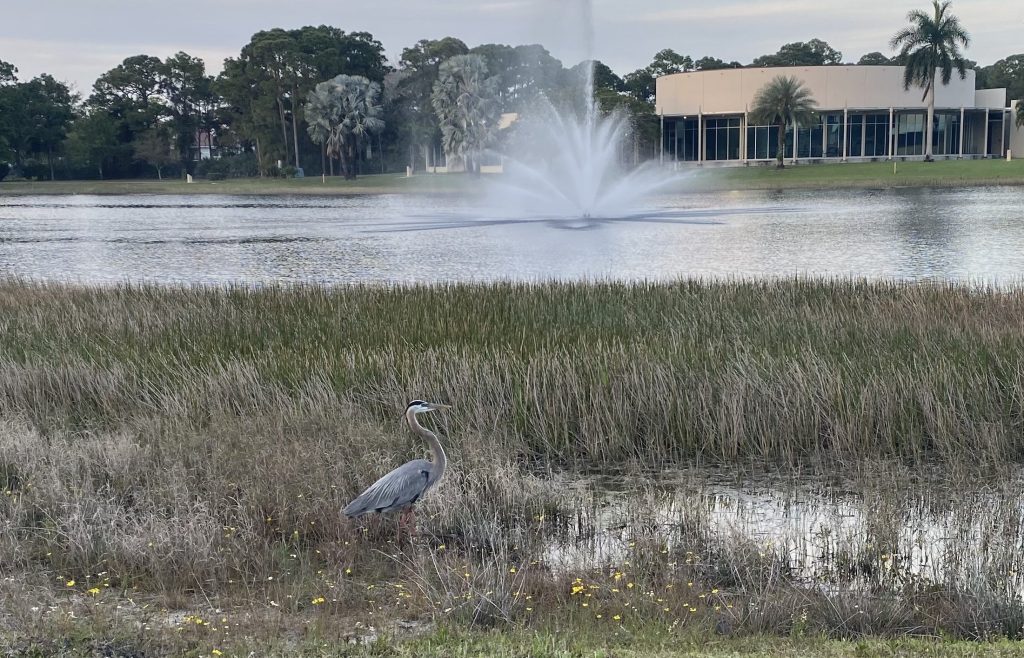
Photo: Great Blue Heron landed next to me as I began my Rosary walk. St. Vincent de Paul Regional Seminary, Boynton Beach, FL.

Link for the Mass readings for Saturday, March 16, 2024

God reveals himself to us when we have the eyes to see and ears to hear.

God heard the cry of his people who were suffering from enslavement in Egypt. God called and sent Moses to free them. Pharoah did not accept the request of Moses to let his people go and instead put more pressure on his slaves to fulfill their daily quota of bricks as before, though now without providing the straw that they needed to accomplish the task (cf. Exodus 5). The Hebrew slaves did not take out their frustrations on their oppressors but on Moses. This pattern of complaint continued time and again, even after their freedom was assured and they wandered in the desert. Even thought they were free, they complained regularly when things got tough, and stated that they would be better off going back to Egypt. Going back to being a slave under Pharaoh instead of placing their trust and dependency upon God.

God the Father sent his Son to free us from our slavery to sin, just as he sent Moses to free the Hebrews enslaved under Pharaoh. How many times do we, like our ancestors, also complain, preferring our life of sin, a life of mere existence, over embracing the gift of a life lived to the full because it is what we know. Even worse there are too often those in positions of spiritual leadership who abuse their power, look out for their own interests, instead of guiding and serving the people entrusted to their care.

Jesus addressed those who were missing the point of his preaching and ministry, “how God has made his will known to the people, the Father who sent me has testified on my behalf. But you have never heard his voice nor seen his form, and you do not have his word remaining in you, because you do not believe in the one whom he has sent” (Jn 5:37-38). God the Father has sent his Son to reveal his will but too many did not and today still do not have eyes to see or ears to hear.

Those who are learned “search the Scriptures, because [they] think [they] have eternal life through them; even they testify on my behalf. But [they] do not want to come to me to have life” (Jn 5:39-40). What is hidden in the Hebrew Scriptures is revealed in the New Testament: the New Covenant made with Jesus and all of creation. The prophecies of old testify that the Messiah will come as a suffering servant, he will unify the nations, cleanse the Temple, and the enemies of God will be placed at his feet. These affirmations are presented and known by those who study the sacred texts, yet they still did not recognize the signs that the Messiah was in the very midst of them.

Even Moses testified of Jesus when he said: “I will raise up for them a prophet like you from among their kindred, and will put my words into the mouth of the prophet; the prophet shall tell them all that I command” (Deuteronomy 18:18). Yet the successors of Moses would not even believe in his writings, so Jesus said how would they believe in his words?

Many of the people of Jesus’ time heard him speak, saw him heal and exorcise demons, and still did not believe. He is not as visibly present as he was, and yet, if we are sincerely seeking God who has and continues to make his presence and will known, we will find him in philosophy, theology, mathematics, the sciences, literature, the arts, sports, relationships, his creation, in our service to each other, as well as in truths of other faith traditions. The fullness of the Father though is revealed in our encounter of him through his Son, “whom he has sent”. Do we have eyes to see, or will we miss God’s invitation because we do not believe in “the one whom he has sent”?

Jesus is also revealed in Scripture, the Old and New Testaments. To understand the New we must understand the Old, for Moses and the prophets testified to his coming and Jesus came not to abolish but to fulfill the Law and the Prophets. Do we leave the Bible on the shelf like any other book? If we do read it, do we do so as if it were a dead letter, or do we read and hear it as it is truly meant to be read and heard, as the living Word of God proclaimed? We are and also more than a people of the book. We are a people of encounter.

The Father makes himself known to us through the presence of his Son and the love of the Holy Spirit. To experience the truth of this reality we need to accept his invitation to enter into and develop a relationship with him. As we reach out to God, we come to realize that he is already present and reaching out to us, especially through his Son. We do not need to run to God, because he is already running to meet us, waiting to hold us in his loving embrace, now and forevermore!

—————————————————

Photo: On the eve of taking our Cura Animarum, our pastoral care board exams, while praying the Rosary, God sent a hug – a slight but distinct rainbow around the sun! St. Vincent de Paul Regional Seminary, Boynton Beach, FL.

Link for the Mass readings for Thursday, March 14, 2024

Are we willing to receive the Kingdom of God which is at hand?

The ten brothers of Joseph are envious of and hated him so much that they plotted to kill him. The Pharisees are planning to do the same with Jesus. Both Joseph and Jesus are beloved sons of their father, both will be sold for silver, and betrayed. Joseph remains faithful to God in his slavery in Egypt and through God’s providence will save the same brothers who betrayed him as well as all of his people from famine such that: what his brothers meant for ill, God would bring about for a greater good.

Jesus, the Son of God, is sent after his Baptism to call the descendants of the same people Joseph saved back to the God of Abraham, Isaac, Jacob, and Joseph. And yet, many of the Pharisees and priests are not about to receive this message or the invitation to repent and believe the Gospel, because most of them do not believe they need to or are not willing to. Joseph was able to save his own father and brothers and his people for a time, but they would eventually die. The offer of the salvation that Jesus presented is an eternal one and yet many of the chief priests and the Pharisees closed their minds and hearts to him, so much so that they were seeking to arrest and kill him. Jesus appealed to them to change by sharing the parable of the Tenants.

At the close of the parable, Jesus said to them, “the Kingdom of God will be taken from you and given to a people that will produce its fruit” (Matthew 21:43). The leaders were the stewards of God’s Kingdom and could inherit and be a part of it, but they would not accept the Son sent by his Father, the landowner, who is God, and it would be taken from them.

Who then is the Kingdom of God to be given to? Those who are willing to repent and believe in the Gospel for the kingdom is present in Jesus. Jesus reaches out his hand to us. Will we refuse or are we willing to place our hand in his and walk with him where he will lead us?

When we take his hand, we will still feel the wound of the nail that pierced him through. Like Thomas, do we realize that we are holding the hand of our Lord and our God? Do we realize that Jesus was willing to give his life for you and me for this very moment in time?

Receive this gift to spend with Jesus. Share with him what is in your heart and on your mind. Breathe and be still and listen to what he would like to share with you. Trust in Jesus and this time together.


Photo: Some quiet time with Jesus this past Sunday, St. Vincent de Paul Regional Seminary, Boynton Beach, FL.

Link for the Mass readings for Friday, March 1, 2024

Let us reflect the love of Christ with our thoughts and our words.

Jesus calls us to be holy, each and every one of us. Our life is to be lived with the end goal being our ascent to heaven, to be in union with our Loving God and Father for all eternity, and to assist others to do the same. Jesus provides for us a concrete example of the heights to which we are called to reach: “You have heard that it was said to your ancestors, You shall not kill; and whoever kills will be liable to judgment. But I say to you, whoever is angry with his brother will be liable to judgment, and whoever says to his brother, Raqa, will be answerable to the Sanhedrin, and whoever says, ‘You fool,’ will be liable to fiery Gehenna” (5:21-22). Jesus is building on the Torah, the Law or the Teachings, by helping us to realize that we can not only kill with weapons but also inflict dehumanizing damage with our words.

To resist this temptation of inflicting mortal wounds, we need to start participating in a deeper examination of conscience which gets to the roots of our own thoughts, words, and actions. If we are not able to discipline our thoughts, what will follow is undisciplined words, and then undisciplined actions, which can lead to entertaining and embracing the deadly sin of wrath. Wrath is unbridled anger that leads someone away from the capacity to think or behave in a rational manner, such that this individual would no longer acknowledge the dignity of the person they would inflict their wrath upon.

Jesus is helping us to see that we can be free of the temptation of wrath if we recognize the danger and destruction of unleashing words as weapons. He offers us the examples of calling someone, Raqa, meaning something along the lines of an air-head or an idiot, and calling someone a fool. These words directed at another have no other cause than to demean, degrade, and belittle. This language, and worse, has no business coming out of the mouths of a disciple of Christ if we are serious about being one of his followers.

I remember a moment in sixth or seventh grade unleashing a derogatory word or two directed at a classmate. Even though they were loosed in jest, I felt a sinking feeling in my gut after hearing myself say them. God gave me a graced moment to feel, contrition, actual sorrow for the negativity and poison I had unleashed with my words. I remember making a commitment to myself not to speak that way toward another person going forward.

We need to be aware that words have the power to wound or to heal. If we are serious about following Jesus, then a wonderful practice this Lent can be to commit to fasting from gossip and from words that belittle, divide, diminish, or dehumanize and replace them with words that empower, unite, uplift and acknowledge the dignity of others. Even when we disagree with another’s point of view, we can do so by still respecting the person and fostering a posture of dialogue.

May we also commit to resisting and not feeing negative or dehumanizing thoughts when they arise. Even when we have defensive musings, resulting from another’s disparaging tone, words, or actions, we need to resist entertaining them. Instead, we can ask for the strength from the Holy Spirit to develop a more mindful disposition that seeks to understand instead of react and to hold each other accountable with respect. We can also give ourselves time regularly to be still and enjoy time outside to let go and unwind. It is important to get enough rest as well. Ultimately we need to consciously choose to love: to will the good of each other as our first step in encountering one another as human beings, as beloved daughters and sons of God.

—————————————————————

Photo: The simple act of looking up can make a difference in our attitude and emotional state. Give it a try and see! Rosary walk, St. Vincent de Paul Regional Seminary, Boynton Beach, FL.

Link for the Mass readings for Friday, February 23, 2024