Jesus leads us from the darkness of our fears into the light of his love.

Jesus said to his Apostles: “No disciple is above his teacher, no slave above his master. It is enough for the disciple that he become like his teacher, for the slave that he become like his master (Mt 10:24-25).

Following the teachings and guidance of Jesus was hard for his apostles and disciples then and it is just as challenging today. To live as authentic disciples, we need to learn from and put his teachings into practice. That means more than reading some of his teachings: love God with your whole heart, mind, and soul and your neighbor as yourself, turn the other cheek, and what you do to the least of my brothers, you did it to me, and acknowledging, that, “That is some good stuff!” Then just moving on to the next thing on the to-do list.

Living as a disciple also happens in a public way, which means public scrutiny. One thing we all have in common as human beings is that we want to belong, to fit in, and to be a part of. We risk rejection and ridicule by following Jesus and living as his disciple because we run up against our own fallen nature and the fallen nature of others. Jesus said he would be sending us as sheep among wolves yesterday and in today’s reading, he announces that we are not to be afraid of those who kill the body. Not exactly the kind of encouragement many of us are looking for.

Yet, Jesus affirms consistently that we are not to be afraid. Jesus leads us to the most important relationship that we will ever develop and that is with his Father. God cares for us, just as Jesus said, as his Father cares for the sparrows, but even more. God knows us by name, and we are his, we belong to him. Our loving God and Father has known us not only before we were born, but before all creation began. Never have we been, are we now, nor will we ever be, alone. As we risk, grow in confidence, and begin to live our life in alignment, in relationship with Jesus and God through the love of the Holy Spirit, we will begin to become unified with him so to feel a joy and a fulfillment that is unmatched.

One of the keys to living the Christian life is understanding that it is more than a philosophy, a set of teachings, or a theology. Being a Christian means allowing ourselves to be known, loved, and to build our relationship with a person. Jesus is that person. Instead of hiding or running we are invited to trust and turn to him. By admitting and giving him our weaknesses and our fears, our anxieties and overthinking, our worries and our sins, we can begin to slowdown, to breathe, and begin to reset our brain’s wiring.

As Isaiah had his mouth purged by the ember placed in his mouth by a seraphim, as Peter recognized in the presence of Jesus that he was a sinful man, we too in the presence of God will see our weaknesses, our failures and our shortcomings. The light of Christ reveals to us our darkness not to condemn us, but to free us. To bring our sin into the light, so it can be purged, that we can be purified, and ultimately deified. Jesus became one with us in our humanity so that we can become one with him in his divinity. It is precisely in turning our weaknesses over to Jesus, and admitting our utter dependence on him, that we become strong.

Acknowledging Jesus is our teacher does not mean that we will gain all the answers to life, but it does mean we will be more aware of his presence during each step of our journey through this life. Take courage, be not afraid, and like Isaiah, the prophets, the Apostles, and Mary let us say, “Yes.” to the will of God and take our next step along the path to our freedom.
————————

Photo: Rosary walk last night in Riverside Park, Vero Beach, FL.

Link for the Mass readings for Saturday, July 13, 2024
Repent, receive Jesus, and bear him to others.

Return to the LORD is the plea of Hosea. In beautiful and loving language the prophet encourages Israel to come home, to leave the idols and their unfaithfulness behind. God, through Hosea, promises to heal, to love, to be “like dew for Israel.” God does not approve of Israel’s unfaithfulness, while at the same time, does not stop loving his children. With gentleness, he seeks to let his grace fall on them like the dewfall, he seeks to wash his children clean, to nourish them and satiate their thirst, to give them strength, and be the source of their life.

Jesus has come to give a visible face to the presence and promise of our God’s loving presence. He healed, cast out demons, consoled, and preached with authority. He too, in the prophetic tradition, called for repentance. Even though God never stops loving us, we cut ourselves off from his love when we choose anything and anyone over him. God must be first and we must spend time with him to grow in our relationship with him. The wonderful gift of our repentance and letting go of our control is that which is not of God is burned away like dross, and what we give to God is purified and made whole.

By trusting in and surrendering our lives to Jesus, we will heal and grow in our relationship with him, and we too like the Apostles will be sent. Jesus calls us to share the Good News of how he has been working in our lives. Not when we become perfect, but right now, even in small ways. As we receive the love of Jesus, we are to share his love with one another. We too, like Hosea, Jesus, and the Apostles will face opposition in sharing his good news. Jesus has assured us that he will send the Holy Spirit to guide us and give us the words to speak.

When we speak the words of God faithfully, that is sufficient. We are not to convince or command, but instruct and invite. As St. Bernadette of Soubirous said when pressured about the validity of her experience with our Mother Mary, “My job is to inform, not convince.” We do well to follow her lead. The Holy Spirit will work through the seeds we have planted. Let us avoid the temptation to impress and instead express the love we have received.

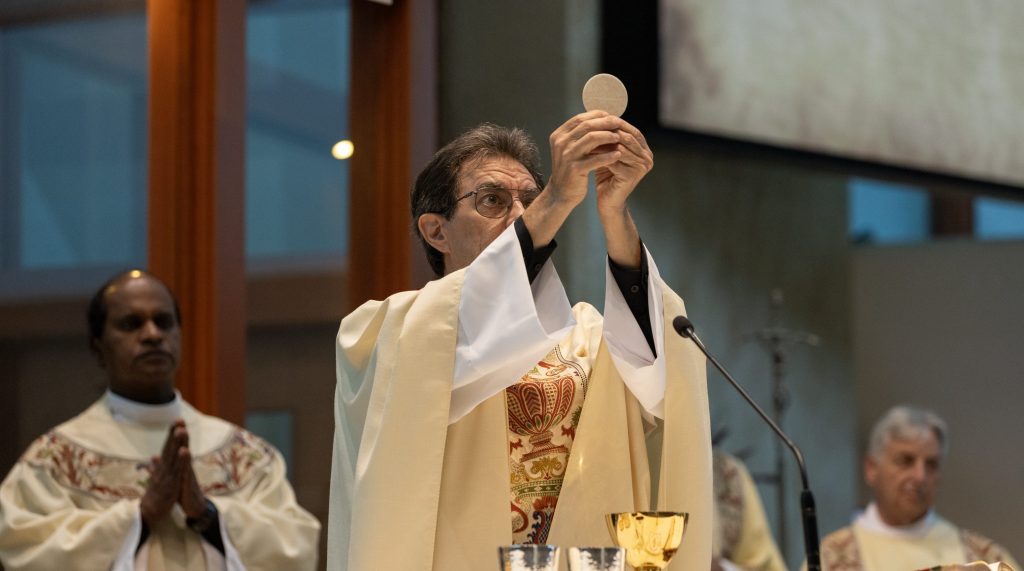
Jesus continually gives himself to us in the Eucharist. When we leave our sins and shortcomings in the confessional and before altar and receive Jesus, his Body and Blood, Soul and Divinity, we receive and become Christ bearers to a weary and worn world in need of repentance and hungering to experience the gentle love and forgiveness of God our Father.


Photo: First Mass of Thanksgiving at St. Peter Catholic Church. So blessed and feeling thankful to be able to share Jesus in the holy sacrifice of the Mass!!!

Link to the Mass readings for Friday, July 12, 2024

As we have received, may we also give.

“Without cost you have received; without cost you are to give” (Mt 10:8).

We cannot buy the grace of God, we do not earn our way into the kingdom of heaven. God’s grace and presence are freely given, without cost and without our effort. As with any gift, the joy and fulfillment come from the willingness to receive and open the gift.

God has given us the gift of his Son. We have the choice to say yes or no to receiving him in our life, each and every moment, each and every day. When we say yes to his offer of relationship, our life will be different. Just as when the wise men from the East went back a different way they came, just as the Apostles lives were transformed, we too will never be the same after our encounter with Jesus. And that, though it may draw up some anxiety, is a good thing. We will hopefully begin to see differently, think differently, and act differently. We like the disciples will be transformed.

Our relationship with Jesus also brings reconciliation, and healing. Yet, this gift that we receive and open is not for our sake alone. We are invited to freely share the love of Jesus we have received with others. The Second Vatican Council renewed this call for evangelization. We are to, as did the Apostles, his disciples, and each following generation, live how he lived, say what he said, and do what he did, yet through our own unique and individual expression. As a bright light that shines through a prism, depending on the unique angle of the cut, a different color will emanate forth. Just so are we to be, reflecting the light of God in our daily experiences with our own unique color.

We say what Jesus said when we use our words not in condemnation but when necessary to convict, and also to empower, affirm, and heal. We do what Jesus did: when we build relationships and engage in respectful encounters and dialogue with one another. This also happens when through our acts of hospitality, mercy, forgiveness, healing, and being present, we attend to the needs of others, especially the most vulnerable.

We are to live as Jesus did. We are to be holy ourselves in every aspect of our conduct, as St. Peter wrote, “for it is written, ‘Be holy because I [am] holy’” (cf. 1 Peter 1:15-16). We begin to grow in holiness when we recognize, repent, choose no longer to be governed by, and seek healing from our own pride, selfish and ego-centered ways of living. We grow in holiness when we say yes to receiving the gift of the purifying fire of the Holy Spirit who will then heal and transform us so that we become aflame with his love. In this way, we will shift our posture from the stiff arm of keeping others at a distance and instead open our arms wide to embrace each other, to love one another as Jesus loves us by giving of ourselves without counting the cost.

Jesus has a unique call for each of us. He is inviting all of us to be open to receive the touch of his embrace, to be loved by him. In our willingness to receive the gift of his love, to be still and experience his unconditional embrace, we will begin to let go of the weight, the stress and the strain. We will begin to heal and see each other with his eyes, to see each other as human beings, created in the image and likeness of his Father. Jesus is calling us to love, to draw close as he has come close with us and accompany one another. Led by and loved by Jesus, each of us are to construct our own unique bridges of encounter and accompaniment helping to restore dignity when and where it has been taken. “Without cost you have received; without cost you are to give” (Mt 10:8).


Photo: As did Mary, may we receive and give God’s love with our arms wide open. Grotto on the grounds of Holy Cross Catholic Church, Vero Beach.

Link for the Mass readings for Thursday, July 11, 2024

“Love one another, as I love you.”

“This is my commandment: love one another as I love you” (Jn 15:12).

God created us to be loved, and to love. The love that Jesus is talking about is unconditional and not just relegated to those closest to us, although, hopefully, in our families and friendships is where we first experienced being loved and learned to love in return.

The love that Jesus commands of us as his followers, is a going out from, a giving of ourselves to one another. We are not to seek in return but are to empty and give ourselves away. The return we get is from experiencing the infinite wellspring and source of the Holy Spirit that rises up within us. The more we hold back, the less we receive, the more we give, the more we experience. We are to resist withdrawing our love and assuming a selfish posture that leads to us becoming more like a stagnant pool. Instead, we are to remain open so that we allow the living stream of God’s infinite love to flow through us.

The love Jesus commands is not selective. Love is accepting the interruption and choosing to be present. Love means stopping, setting aside our agendas, and accompanying another. Love is also not coercion and manipulation, it is accepting another as they are and where they are, inviting them to experience God’s love and healing. Love is sharing the journey of life together. St Thomas Aquinas has written it best: Love is to will the good of the other as other. This is more than mere emotion, feeling, or sentiment but seeking the best for someone else and to rejoice in their becoming fully alive. We are also not a doormat. We hold people accountable – for to love is also to be clear about respecting our and another’s dignity.

This practice of love is also not exclusive but universal. Yes, we are to love those in our family, community, place of worship, tribe, political party, and nation, while at the same time we must be willing to go out from our comfort zones and protected bubbles to risk opening ourselves up to those who we feel are different, those who do not see the world as we see it, and even those we consider our enemies. This does not mean we have to agree or even like someone else, but we are commanded to love, to respect the dignity of the person as our starting point.

A dialogue grounded in love means that we state clearly our beliefs, our thoughts, and dreams, but also allow others to do the same. In this way, though we may differ in our points of view, we can see how we are much more alike than we are different. When we talk at and over one another, demean, belittle, or are condescending, we dehumanize. In an open dialogue, we begin to encounter the person and the prejudicial caricature we carry begins to dissolve. Instead of keeping each other at arm’s length, we can instead learn to embrace and grow from one another. From a place of mutual, loving dialogue, we can recognize and remember again who we are, friends, brothers and sisters, children of God all on this journey we call life.

—————————————————————-

Photo: Jesus’ greatest act of love for each of us, his life that we might have life and have it to the full. Sanctuary of Our Lady of Florida Spiritual Center, North Palm Beach, FL.

Mass readings for Thursday, May 2, 2024

God’s commandments are invitations to grow in love.

Two points jump out of the Gospel of John today: commandments and love. How is each one of these related to living life as a disciple of Jesus? Often, many who hear the word commandments, often react, and are immediately put off. “There goes the Church again telling me what I can and cannot do.” Yet what Jesus is doing showing how the following of his commandments is a true expression of loving him.

Love is another word that evokes reactions. One reason is that, even though the English language has a plethora of words to utilize and choose from, there is only one word for love, and it is interpreted in many ways. In Ancient Greek, there are four words that are used to connote love. There is eros, which has to do with attraction. It is the beginning stage of love because we are drawn out of ourselves as we are attracted to another. The next word for love is philios, which has to do with friendship. This is the love between friends. If our love matures it moves from attraction or infatuation to friendship. The third word is storge or the deeper love shared with family members. The fourth word is agape, which is unconditional love.

When Jesus shares that we are to follow the commandments, he is not demanding that we do so as a tyrant. He is providing the boundaries and parameters for us to grow and mature as people who love, who, in the words of St Thomas Aquinas, will the good of the other as other. As humans, we are social beings. We want to belong, to be accepted, and to be a part of. We seek meaning, purpose, and fulfillment. This is best done through cooperation and collaboration with God and one another, striving for agape, to love unconditionally.

If we operate from a self-centered posture in which we are only turned in upon ourselves, and we only seek to manipulate and get from others, instead of working together and sharing a common vision with others, we will ultimately be empty with the exchange on any level, because we will be left wanting more. This is true because once the immediacy of the stimulation, whether material or sensual, ends, so does the experience of the feeling. Some happiness may linger from the effect, but we will never be filled or satisfied with anything finite. We will continue to seek more and more until the pursuit of instant and constant gratification ensnares us and we are entangled in a web of addiction.

The commandments, grounded in love, are meant to provide boundaries for us, training wheels, and to keep us free from enslavement to sin, while at the same time help us to be persons who move away from being self-centered to maturing as other-centered instead. Discipline in this way is meant to be a means of freedom for excellence such that we can become who God calls us to be and who we truly desire to be. Ultimately, we are to love God as he loves us and love our neighbor as ourselves in our own unique way. God is not in competition with us. He is our biggest fan. As St Irenaeus wrote, the glory of God is the human being fully alive!

Commandments and morality imposed, is a bludgeon. Love and mercy without accountability and justice can be enabling. Jesus provides the blueprint for a balanced both/and approach of invitation and shepherding. May we surrender to his loving guidance and correction, align ourselves with the Holy Spirit, who is the Love expressed and shared between the Father and the Son. May we seek ways to improve our lives, to be more honest with our weaknesses, so Jesus can be our strength, and to seek God when we are tempted to choose him so he can lead us away from the enticement to sin, and seek his forgiveness when we have fallen.

As we journey in this life, we do not do so alone. As we seek to follow Jesus’ lead, as we grow and mature, we do so while in the midst of encountering and forming relationships with others. Conformed by following the commandments, we are to reach out in love to each other as Jesus has done with us. As we form and deepen our relationships, new and old, may we encourage, support, and love one another while at the same time, challenge and hold each other accountable as we strive to be who Jesus invites us to be.
———————————————————–
Photo: The discipline of nightly Rosary walks over these past two years has been a blessing! St. Vincent de Paul Regional Seminary, Boynton Beach, FL.

Link for the Mass readings for Monday, April 29, 2024

We are to be “carriers of God’s love to everyone.”

When Philip asks Jesus to show him the Father, Jesus responds: “Have I been with you for so long a time and you still do not know me, Philip? Whoever has seen me has seen the Father” (Jn 14:9). Even though Philip had lived with Jesus, experienced the authority of his teachings, witnessed his works of healing and exorcism, witnessed to the inclusiveness of his ministry, he, as we, struggled with comprehending what Jesus was talking about regarding the unity between his Father and himself.

One of the reasons is that God is God, and we are not. God is not one being among many, he is not even the Supreme Being, nor is God even in the genus of being. God so transcends our reality and sphere of understanding that any words we say about him are going to be limited. God is Infinite Act, God simply is. We are finite. At the same time, this does not mean that God is an impersonal force. God transcends all of his creation, time, and space, is the source and foundation of all that exists, and yet he is closer to us than we are to ourselves, each and every one of us.

God came closer still when, in the Person of his Son, he came to dwell among us. This is what Jesus meant when he said to Philip that when he saw him, he saw God. Each person, God the Father and God the Son are distinct but because of their infinite essence they are also, as we say in the Nicene Creed each Sunday, consubstantial, they are of one and the same substance.

The Son became one with us while remaining fully divine and in full communion with his Father, so we can become one with him and experience the intimate relationship that they share. We participate in the life of Jesus because he became human, and as human beings, God created each of us as being interconnected with one another. So, what happens to one of us, happens to all of us.

Through our Baptism and participation in the sacraments, we participate and become conformed to the Body of Christ so to encounter Jesus in an ever deeper intimacy and share in the divine Communion between God the Father and God the Son, as well as the Love that is shared between them who is God the Holy Spirit.

The wonderful gift of participating in the relational communion with the Holy Trinity, is not just for us alone as some treasure to sit on, as some secret knowledge to be shared with only a chosen few. This is a universal message to be shared with all. As we grow in our relationship and participation with God, we are to make him known to others. We do so through our participation in the life of Jesus. As Jesus said to Philip, “[W]hoever believes in me will do the works that I do, and will do greater ones than these, because I am going to the Father” (Jn 14:12). Jesus seeks to work, love, and serve through us as the Father did through him.

Each of us is given a particular charism, a ministry of service to build up the kingdom of God. The key is to believe in Jesus and seek his guidance so that he can help us to discern how best we can serve him and build up his Body. Those we call saints were those who came to know that one thing that God called them to do. They then surrendered all to their vocation.

This is not just for clergy or religious, this is for each and every person on this planet. The only requirement is that we are willing to follow Jesus, say yes to the invitation to experience the love of the Holy Spirit he freely offers, and be willing to be sent to allow God to happen in our interactions with one another. As St. Mother Teresa said we are to “become the carriers of God’s love to everyone.”

Let us embrace today the reality that the God of all creation loves each and every one of us more than we can ever imagine. Embrace the unique relationship he calls us to participate in, which is a share in his Trinitarian Communion. Embrace this unique blessing so that we can open our hearts and minds to the service and ministry he calls us to through our participation in the life of Jesus the Christ, the Son of the Living God, through the Love of the Holy Spirit.

———————————————————-

Photo Credit: Photo I took of St Mother Teresa in Massachusetts in the early 90’s. No zoom either, that’s how close I was blessed to be!

Link for the Mass reading for Saturday, April 27, 2024

May the light of Jesus lead us out of our darkness.

“I came into the world as light, so that everyone who believes in me might not remain in darkness” (Jn 12:46).
What might be the darkness that Jesus refers to? It could be anything that turns us within ourselves, turns us away from that which is True, Good, and Beautiful. This can be prejudice, ignorance, cynicism, sin, violence, hatred, war, division, dehumanization, and the list goes on

A major root that keeps us in this darkness is fear. Jesus offers us the light of his Father. He encourages us to leave our self-imposed imprisonment by loving us as we are, more than we can imagine, and more than we can ever mess up. Christianity is not just a set of moral principles, a set of doctrines, a philosophy, or a theology. Christianity is about an encounter with a person, the Son of God, Jesus the Christ.

The light of Jesus leads and invites us to experience that which we have been created and are restless for – an intimate relationship with God the Father and each other. Through the light of his love, Jesus reveals to us those apparent goods, false substitutes, and idols that distract and keep us separated from deepening our relationship with God. We come to know our Father when we are willing to receive the love of the Holy Spirit, to be ourselves free of our masks, and are moved to share that love with each other.

Jesus, please shine your light within and before us so that we may identify and resist any selfish impulse or reaction based on any fears or past hurts. Heal and guide us so that we may instead love you and others as you have loved us. Help us to identify when we are walking away from you, and to resist and renounce that which leads us away from you. Help us to also recognize when we are walking with you and that which leads us closer to you so we may rest, receive, and abide more in your love and presence.

Help us to be aware of, offer to be of help, reach out to others in need, be present and willing to listen, and/or choose to be more understanding, supportive, and encouraging. With each experience may we believe in you more and reflect your light outward so that others may come to see and to believe in you so to come from the darkness and into the light!


Photo: Full moon rising as I was finishing my Rosary walk. St. Vincent de Paul Regional Seminary, Boynton Beach, FL.

Link for the Mass readings for Wednesday, May 24, 2024

Jesus has risen! Let us share his love, light, and joy!!!

Today’s reading from the Gospel of Mark, 16:9-16, is commonly called, “The Longer Ending.” Most ancient manuscripts of Mark end at 16:8. Whether this Gospel ended there, or the original ending was lost is not definitively known. Many biblical scholars also recognize in these verses a different writing style, so attribute this longer ending to a different author. This ending recounts that Mary Magdalene and two disciples, presumably the same on the road to Emmaus, met the risen Jesus. When both Mary and the two disciples share their experiences with the eleven, they are not believed, and “later, as the eleven were at table, he [Jesus] appeared to them and rebuked them for their unbelief and hardness of heart”

How many times had Jesus rebuked the Pharisees for being hard of heart? Now he is saying the same to the eleven for not believing the accounts of Mary and the two disciples. We do not have a reason for their unbelief and maybe that is well and good because that gives us the opportunity to ponder for ourselves those times when someone has brought us a message from Jesus and we responded to them with hard hearts and were unbelieving. Are there certain people we would not believe no matter what good news they had to share with us? Maybe someone is bringing us a message from a different or no faith tradition…

Jesus does not belabor the point. His rebuke helped them to see that as his followers their hearts needed to be open to him working through others, as he told John when someone was casting out demons in Jesus’ name, “whoever is not against us is for us” (cf. Mk 9:40).

Christianity is not a secret sect, it is a universal call and proclamation to share the love of God with everyone. The source of this love that we celebrate this Easter Octave is the Paschal Mystery, that the Son of God became incarnate, entered into our human condition, lived, suffered, and died, conquered death, and rose again, for all of humanity and creation.

This was no mere resuscitation. Jesus conquered death and became the firstborn of the new creation and invites us to participate in his reign of the kingdom of heaven which is at hand. This is the Good News he wanted his eleven to proclaim when he said to them, “Go into the whole world and proclaim the gospel to every creature” (Mk 16:15).

Jesus is calling us to do the same, as brothers and sisters, working in solidarity, not for a select few in our pew, but for all in our realm of influence. We are to build relationships by bringing the light, joy, and love of Jesus to each individual that we meet, person to person. Let us also be open to allow God to work through others and receive his message from them as well! Alleluia!!!

———————————————————————

Photo: One of my last classes at Cardinal Newman HS in May of ’22 before leaving to enter seminary. Hopefully, I was able to share with them the love of Jesus and that they are spreading his light, love, and joy!

Link for the Mass readings for Saturday, April 6, 2024

“Were not our hearts burning within us while he spoke to us?”

Our Gospel reading for today begins with a feeling of despair. The hope of Jesus being the Messiah, the promised one who came to redeem and deliver his people Israel died a brutal death. Even though Jesus sought to prepare his followers for this reality, they could not conceive or believe that the promised Messiah could die.

Cleopas and his companion are in mourning as they walk along the road to Emmaus. They have left Jerusalem and are commiserating among themselves about their dashed hopes. They were so sure that Jesus was who he said he was, now what were they to do? Jesus met them where they were and wove his way into the conversation and their journey.

When the time for them to part arrived, Jesus motioned to them that he was continuing on. The pair of disciples urged him, “Stay with us, for it is nearly evening and the day is almost over” (Lk 24:29). Jesus did just that and he revealed himself to them “in the breaking of the bread”(Lk 24:35).

The account of the road to Emmaus has significant relevance for our own spiritual journeys. How many times have we had an inaccurate understanding of Jesus in such a way that we felt let down? Have we domesticated Jesus, or limited who he is, seeing only one aspect of his totality, attempted to shape or conform him into our image and likeness? Have we prayed for something and then that petition or intention was not fulfilled in the way we had hoped? Have we sought Jesus and felt that he wasn’t there for us in our time of struggle or during those times that we felt that we needed guidance?

We need to remember that Jesus meets us where we are, accepts us as we are, walks with us even when we are walking in the wrong direction. While at the same time, he reveals to us the truth. We then need to decide to continue on the path leading away from the love of God or to turn back and into his open arms waiting for our return.

Following the truth that Jesus sets out before us means that we will be stretched beyond our comfort zones, urged to let go of our safety nets and training wheels, called to repent from our sinful ways by resisting the temptation to curve in upon and isolate ourselves. Instead we need to be willing to risk, to be loved, and to love in return. Through our relationship with him, Jesus invites us to nothing less than experiencing the transfiguring flames of Trinitarian Love.

Spending time reading and meditating upon the wonderful, daily readings from the Acts of the Apostles and the Gospels available to us right now will set our hearts aflame as happened with Cleopas and his companion. As this pair returned to the community of Jerusalem, may we gather each Lord’s Day, to hear his word proclaimed and to experience him revealed in the breaking of the bread.

As we put into practice what we hear and receive, we too then will begin to: see Jesus more active in the midst of our everyday activities, recognize him in our daily events and even in interruptions, be more inspired to share the sacrificial love we have received from Jesus with those around us, and come to realize that Jesus is more present and closer to us than we are to ourselves. We just need to invite him to walk with us on our journeys, even and especially when we are heading the wrong way!!!

————————————————————-

Photo: While praying with the mysteries of the Rosary, not only my heart, but the sky was burning!

Link for the Mass reading for Wednesday, April 3, 2024

Jesus cares.

Jesus is recorded, a few verses before (cf. 7:37-39) today’s Gospel,  speaking about quenching the thirst of those gathered around to listen to him. The thirst he is talking about fulfilling is spiritual thirst, that thirst which we all desire to be refreshed by, that which we have been created to receive; the thirst to belong, to be in communion, to be loved and to love in return. Jesus speaks of coming to those who thirst to be refreshed with: “Rivers of living water [that] will flow from within” (Jn 7:38). Jesus spoke of the day when he would send the Holy Spirit to well up from within the soul of each person who would follow him. All who participate in the life of Jesus would come to experience also the love shared between God the Father and God the Son, who is God the Holy Spirit.

Some who heard Jesus speaking in this way were deeply moved, they believed him to be the Prophet, others believed him to be the Messiah. Yet, there were those who could not see past their own preconceived notions. They heard his teaching, may have even been moved as well but said, “The Messiah will not come from Galilee, will he” (Jn 7:41)? Remember Nathaniel’s first reaction when Philip had told him that they had found the Messiah? Nathaniel asked if anything good could come out of Nazareth (cf. Jn 43-47). Jesus was also rejected by his own hometown crowd most likely because they knew him most of his life and there was nothing special about him. He was a tekton, a carpenter or a day laborer, like Joseph.

Why the region of Galilee, the town of Nazareth itself, would be disparaged is a matter of speculation. The fact was that there were those, unlike Nathaniel, that could not see past their initial prejudices. Even though Jesus spoke and taught with authority, though as the Temple guards who were sent to arrest him said, “Never before has anyone spoken like this man” (Jn 7:46), and even when Nicodemus spoke out rationally, requesting they hear Jesus out and give him the opportunity to make his case, there were those in authority and among the people who could or would not hear Jesus. They closed themselves off to the invitation to receive the gift of the love of God. Their charge was that he was not from Bethlehem, he was not of the line of David, case closed.

It is helpful to come to terms with our ingrained, prejudicial attitudes and our limitations of thought that prevent us from seeing as God sees, otherwise, we will become like a stagnant pool. Like those in today’s Gospel, we can close ourselves off from the invitation of Jesus and his very life that he would like to impart within us. Many times, this happens because we buy into our anxieties and allow them to limit us. We can be paralyzed by them or on the other extreme act out impulsively. Aristotle wrote that virtue is the means between two extremes. In this case, courage is the means between being paralyzed with fear and excessive reckless abandon.

A more reasonable and rational approach is helpful for our spiritual life as well. We can pay more attention to fear and not trust Jesus. We can believe that Jesus has abandoned us or that he doesn’t care, that he does not exist. Or we can follow the lead of Pope Francis who shared in his Ubi et Orbi message at the height of the pandemic in 2020 that Jesus, “more than anyone, cares about us.” Jesus cares.

He his extending his hand out to us right now. We can reject it or grasp it, the choice is ours. Jesus is the source of living water, he is the eye in the midst of any storm, he is the light leading us through the darkness, and he celebrates with us in our victories. When we choose to breathe more and react less, when we are willing to be still and look, when we trust in Jesus and his love for us, we will experience his presence and we will be more likely to recognize and accept his invitation of love. By taking his hand and allowing him to lead us, we will act with more prudence, be more present and mindful, and better prepared to support one another each day going forward.

———————————————————————————-

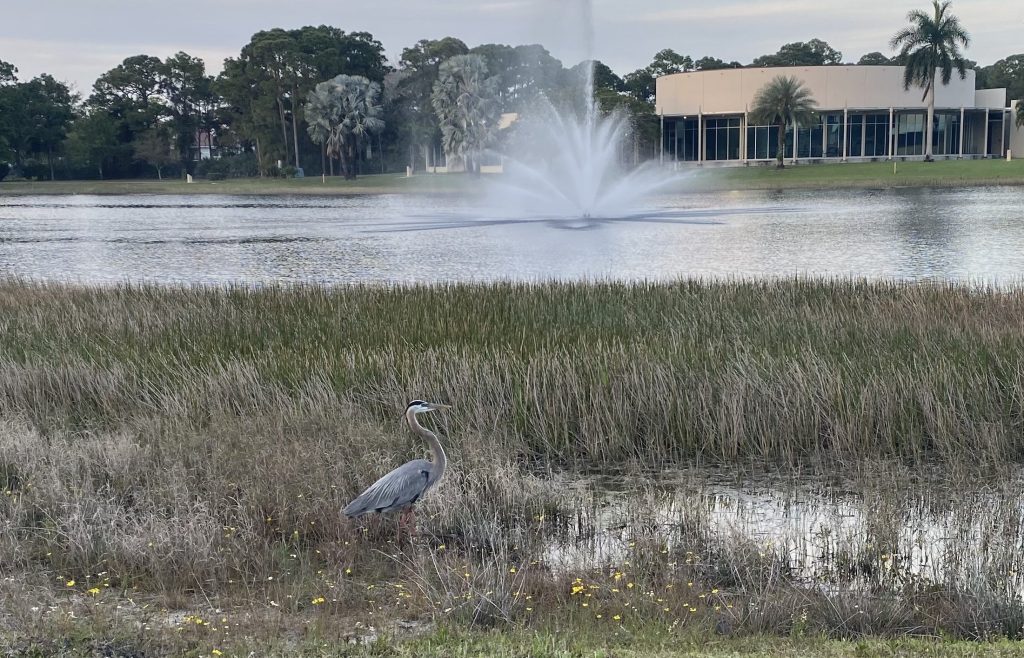
Photo: Great Blue Heron landed next to me as I began my Rosary walk. St. Vincent de Paul Regional Seminary, Boynton Beach, FL.

Link for the Mass readings for Saturday, March 16, 2024