mary
Spending time with Mary and sharing in her memory will help us in healing ourselves and our relationships.
Our gospel today is relatable to anyone hearing or reading it because each of us have experienced family life in all of the different ways family life can be expressed today. At one point or another we have experienced conflict, misunderstanding, and anxiety.
The Bible is good about not covering over the complexities and challenges of life. If the Holy Family can have difficulty, then that can give us comfort if we have gone, or are going through some challenges right now.
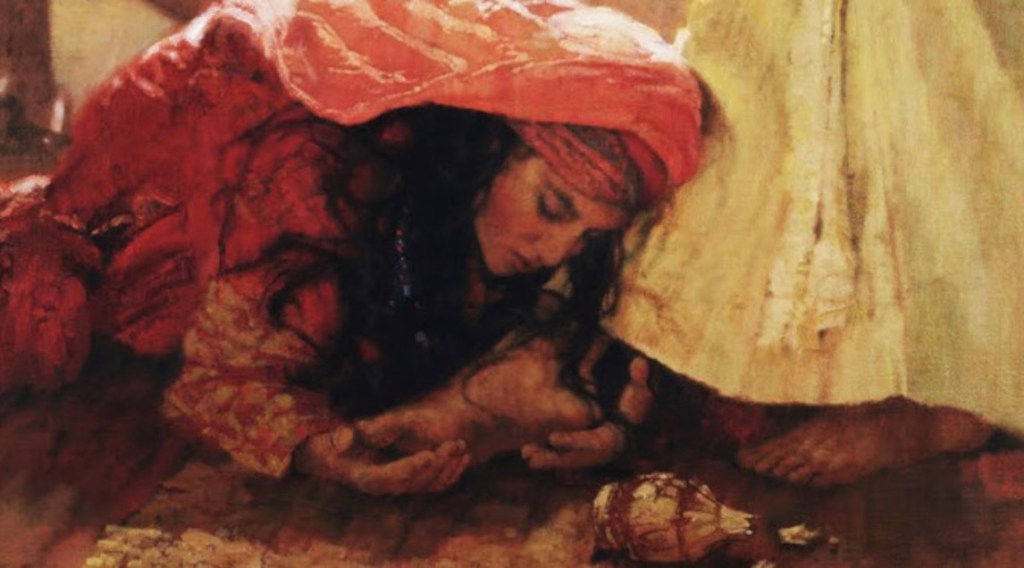
One point that jumps out from the start is that Joseph and Mary are not helicopter parents. After celebrating the Passover, they have left the temple and Jerusalem and are heading back home to Nazareth. Because such a journey was not a safe one, they were traveling in a caravan of extended family, friends, and neighbors. After a day into their trek, they realized that they had not seen Jesus and began a more intense search.
Jesus was nowhere to be found and so they returned to Jerusalem. With each step their concern rose. The ancient near East was not a safe place to travel in nor was it safe to dwell. Children were often kidnapped and sold into slavery. When we don’t understand or are faced with the unknown, we typically conjure up the worst case scenarios and Joseph and Mary were no different. By the time that they found him after their three days of searching, they were filled “with great anxiety.”
Jesus, in typical pre-teen fashion did not seem to appreciate their need for anxiety. He was safe all along among the teachers in the temple. Where else would he be? Neither Joseph nor Mary understood what Jesus was talking about. What happened next is a good response to a lack of understanding.
There was no argument. Jesus was found safe and sound. It was time to go. Jesus was obedient and followed. Joseph was quiet. Mary pondered and “kept all these things in her heart.” We are not given to know the conversation between them on their way back home, but what Luke does share was that, “Jesus advanced in wisdom and age and favor before God and man.”
Jesus did so because he was obedient to “God and man.” And that made a big difference.
Joseph and Mary reacted in the natural way that parents missing their child would react, with concern and anxiety. What they did not allow to happen was to allow their emotions override their reason. Jesus didn’t see anything wrong with what he did because he was following the direction of his Father. He didn’t seem to pick up on the point that he failed to share that little detail with Mary and instead assumed they would know where he was.
This is a powerful affirmation regarding Joseph and Mary’s faith. They were not only faithful to the annual Passover pilgrimage, but they showed their faithfulness to following God’s lead from the beginning of Jesus’ conception. They more than likely passed on their stalwart faith onto Jesus such that he believed that they would know where he was. Yet when he realized this was not true, he obediently followed his parents back to Nazareth.
The three days searching for Jesus would also be a preparation for turning to God and trusting him during another three days in which Jesus remained on a stone slab lying in a tomb. Mary trusted again during her time of anguish of not knowing. Not knowing if or how Jesus would come back from the dead after his brutal death on the cross.
What spending any time in the school of the Holy Family will teach us, is that we are to place our trust in God first. We are to ponder more and react less. This does not mean we will understand God’s will each time, it does not mean that we will be free of suffering or anxiety, nor will we be free of conflict with those we love. Yet, when we resist placing ourselves front and center and instead remain faithful to and seek God’s will in every situation, when we resist reacting and seek to understand, when we are willing to forgive, there will be a better chance of healing and reconciliation sooner.
In times of conflict and misunderstanding, when our intent is to will each other’s good, even when we see things differently and disagree, we will be better off turning to God and trusting in him. We will do better when we are willing to breathe and listen to the one speaking as well as the Holy Spirit that will give us the words to speak or the pause to be silent. Pondering and seeking to understand the will of God as Mary did is a course of action that will bring about better benefits.
One powerful tool of prayer that helps us to be more patient, understanding, and forgiving one another is to spend time quietly meditating and contemplating the mysteries of the Rosary, like this fifth joyful mystery of Mary and Joseph finding Jesus in the temple. For each of us, Mary “continues to relate her personal account of the Gospel. Mary constantly sets before the faithful the ‘mysteries’ of her Son, with the desire that the contemplation of those mysteries will release all their saving power. In the recitation of the Rosary, the Christian community enters into contact with the memories and the contemplative gaze of Mary” (St. John Paul II, The Rosary of the Virgin Mary).
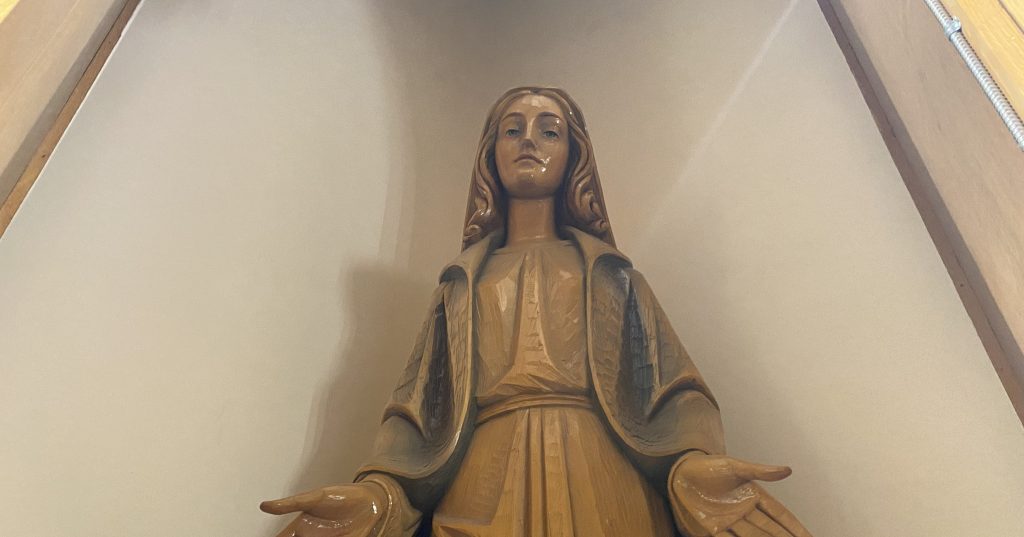
Photo: Our Lady of Grace on the grounds of Joseph and Mary Retreat House, Mundelein, Il, where I was blessed to spend a 30 day silent retreat. Learned much from Mary’s memory!!!
“Blessed are you who believe.”
If you attend Mass daily or pray with the daily Mass readings, you may wonder, “Didn’t I just hear or read this account?” You would be correct, as this was the same Gospel reading as Saturday morning’s daily Mass. The difference comes in with the other readings.
The first reading from Micah may seem a bit obscure and we might be moved to question what does this have to do with getting ready for the coming of Jesus? Bethlehem would be our first clue. Bethlehem is the city of the birth of David. Micah shared that, “from you shall come forth for me one who is to be ruler in Israel; whose origin is from of old, from ancient times” (Micah 5:1). Micah is prophesying that the messiah will be no mere shadow of David, nor a mighty judge like Samson. This one has his origins “from of old”, beyond time. This messiah will be God with us. Both Matthew and Luke pick up on this in their nativity accounts (Matthew 2:1-2 and Luke 2:4-20) that we will read on Christmas.
So what about Ephrathah? Jews from the time of Jacob until those practicing today would pick up the reference to Ephrathah right away as being the burial place of Rachel the mother of Joseph and Benjamin, and beloved wife of Jacob. Though not the birth mother of the twelve sons of Jacob, Rachel was considered the matriarch, the mother of Israel. Jacob’s name, after wrestling with the Lord all night, was changed to Israel.
Echoes of Rachel being the mother of Israel also arose from the prophet Jeremiah when he wrote of her by name as weeping over her the fall of Jerusalem at the hands of the Babylonians. And yet, God sends comforting words through the prophet: “There is hope for your future – oracle of the LORD – your children shall return to your own territory” (Jeremiah 31:15-17).
We can see with the early Church Fathers that David was the premier king of Israel while at the same time he was foreshadowing Jesus the one “from of old” as Micah predicted. Rachel is a foreshadowing of Mary, the mother of Jesus, the mother of the Twelve Apostles, the fulfillment of the gathering in of the lost twelve tribes of Israel and the mother of the Church. She, like Rachel, would also suffer at the death of her children, but also be the intercessor for them through her suffering.
Mary is the new Rachel and also the new Eve because Mary’s obedience unties the knots of Eve’s disobedience. As we learned in the second reading to the Hebrews, God has no pleasure in sacrifice but takes pleasure in those doing his will. God delights not sacrifice but obedience. Mary, before becoming the mother of the Messiah, the mother of God, was obedient with her “yes” at the Annunciation. As Jesus said, the one who does the will of his Father was his mother (cf. Matthew 12:46-50). Who followed the will of the Father better than Mary?
Very soon after her “yes”, and the conception of Jesus in her womb, Mary went in haste to see Elizabeth. Each celebrating the gift of new life in each of their wombs. And how is Mary greeted by her elder cousin? With reverence, which was unheard of. The youth revered the elder family members during Jesus’ time. After hearing the words of Mary’s greeting, experiencing her son leaping in her womb, Elizabeth is moved by the Holy Spirit to proclaim blessing upon Mary: “Blessed are you among women and blessed is the fruit of your womb” (Luke 1:42). Elizabeth does so with great joy, “crying out in a loud voice.”
May Elizabeth and Mary’s joy reach into the depths of our souls. May we be open to believe.
May we believe that Jesus is the Son of God who became man. That Jesus came into the world not just to be a great rabbi and teacher, not just to perform miracles and cast out demons, nor just to be the messiah, that Jesus came not just to live, but that he came to die, to give his life for us, and in so doing become our savior. This birth we are about to celebrate was just a foreshadowing of his impending death.
As Bishop Fulton Sheen wrote, “He was laid in a stranger’s stable at the beginning, and a stranger’s grave at the end… He was wrapped in swaddling bands in His birthplace, He was again laid in swaddling clothes in His tomb… It was not so much that His Birth cast a shadow on His life, and thus led to his death; it was rather that the Cross was there from the beginning, and cast its shadow backward to his birth…” (The Life of Christ).
Jesus, as the fulfillment of the law and the prophets, is inviting us in these final days of Advent to do as he, Mary, and Elizabeth did, to follow the will of his Father. What joy we too will experience when we open ourselves up to the reality of the gift that God has given us, his Son, and so rejoice with Elizabeth and Mary that we too have a part to play in salvation history!
Photo: May these words and picture help you to experience some quiet time to pray and ponder about the connection between the birth and death of Jesus and the life he has called us to live.
Source for Bishop Sheen quote and background information from Dr. Brant Pitre, Mass Readings Explained, The Fourth Sunday of Advent Year C, Christmas and the Cross
Link for the Mass readings for Sunday, December 22, 2024
Mary’s, “yes” brought joy to the world.
Mary said, “Behold, I am the handmaid of the Lord. May it be done to me according to your word.” Then the angel departed from her (Lk 1:38).
Whether this is the first or thousandth time we have read or heard this verse, the more important question for us is how many times have we said to God, “May it be done to me according to your word”? How would it be for us to begin each day with this prayer and then at the end of the day reflect on how well we have heard and answered yes to God’s will?
Mary’s “yes” changed the course of human history. Her willingness to bear the Son of God allowed him to come close. He entered our wounded, human condition to offer us healing, forgiveness, and to lead us home to communion with his Father and each other. Jesus is the gift that keeps giving – and we receive his gift each time we, as did Mary, say “yes” to him. When we do so, we become less, as he becomes more, and the kingdom of God continues to expand.
Along with Mary, the “yes” that we make is not a one-time, “yes,” but we are to affirm a daily, moment by moment “yes”. As St Paul wrote to the Church of Thessalonica, we are to: “Rejoice always. Pray without ceasing” (1 Thessalonians 16-17). We are able to rejoice always and pray without ceasing when we say, “yes,” to God by developing and sustaining our relationship with him such that even when we experience pain, suffering, and struggles, we are not overcome or overwhelmed. When we allow Jesus to be close, we can even feel joy in the midst of them. He does not abandon us to random fate. He is our source, our refuge, and our strength, present to us in all that we experience.
Our prayers of petition for ourselves and intercession for others are another “yes” to God’s will because they are an “admission of one’s own helplessness” (Lohfink 2014, 240). Prayer is a, “no,” to pride. We cannot get through this life on our own, nor are we meant to for apart from God we can do nothing. We are all interconnected and interdependent and God is the foundation and source of our very being, and with God all things are possible.
Our willingness to ask for help and to help others are also practical ways of saying “yes” to God. There is no such thing as a “Lone Ranger Christian”. Even the Lone Ranger had Tonto. Two by two, just as Jesus sent his disciples. Prayer is a “yes” to our acknowledgment that we need Jesus to guide and help us, also to save us from ourselves! Service is a “yes” to the love we have received from him and a willingness to share this love with and receive it from others.
We are to rejoice as we are readying to begin this fourth week of Advent because we draw ever closer to celebrating the birth of Jesus who is Emmanuel, God with us. May we have the grace to experience his love in our time of meditation, prayer and serving one another. This reality was made possible by the handmaid of the Lord.
Photo: May we say with Mary, “May it be done to me according to your word” and rejoice! Accessed from Our Lady Help of Christians Catholic Church.
Lohfink, Gerhard. No Irrelevant Jesus: On Jesus and the Church Today. Collegeville, MN: Liturgical Press, 2014.
Link for the Mass readings for Friday, December 20, 2024
Mary and Joseph, a yes to God and a yes to life.
Joseph heard the news that Mary, his betrothed, was with child. He clearly knew the child was not biologically his. Scripture does not account for the thoughts or emotions of Joseph, but whatever inner turmoil he did have, he came to a decision that would not expose Mary to shame. He was not going to make a public spectacle of Mary, but instead decided to divorce her quietly. Before he made his final decision though, Joseph made an excellent choice regarding the discernment of serious matters. He slept on the idea before acting.
During Joseph’s sleep, the angel of the Lord delivered a message. “Joseph, son of David, do not be afraid to take Mary your wife into your home. For it is through the Holy Spirit that this child has been conceived in her. She will bear a son and you are to name him Jesus, because he will save his people from their sins” (Mt 1:20-21). When Joseph awoke, he did as the angel of the Lord had commanded him and took his wife into his home (Mt 1:24).
From their encounter with God’s messengers, both Mary and Joseph trusted in God’s will, and “that has made all the difference” to quote Robert Frost’s poem, “The Road Not Taken.” Because of Mary and Joseph’s “yes” to God and to family, the Son of God became man and opened up heaven for us in the humanity he assumed.
God often works in the same way when dealing with us. What may appear to be absurd, unimaginable, or downright impossible, is indeed possible when we align our will with God’s will. This is the week of Joy in Advent.
The source of joy does not come from external experiences but from an encounter with and acceptance of God’s invitation. Joy is an experience of communion with the love of God. This has been given to us in greater measure because Jesus became one with us, and so upon his ascension into heaven, we too can experience the loving communion he experiences with his Father. We also experience the love of the Holy Spirit in our encounter with family and friends, this exchange of giving and receiving of ourselves in conversation, shared experiences, and in resolving challenges and conflicts together.
Mary and Joseph both received incredible news, that neither of them fully comprehended. They could have easily responded in a different way. Instead, they trusted in God, they chose family, and because they did, we can rejoice not just during this week but as we heard from the past Sunday from Paul, we are to rejoice always!
Mary and Joseph followed God’s lead and were willing to allow their unborn child, Jesus, to come to full term. Because they were willing to risk public ridicule and worse, Jesus entered into our human condition. There may be a difficult situation we are dealing with, we may feel we are on our own, and that there is no way out, and/or no help on the horizon. God will make a way and reveal it to us through his Son. We may not understand either, but like Mary and Joseph, let us trust in God, one another, and experience that we are not alone.
Jesus, Mary, and Joseph, please intercede on our behalf this Advent Season such that we may better be able to resist the temptation of taking each of our family members for granted, but instead choose to be appreciative and thankful for one another. Help us to react less and breathe deeply more. Help us to be more understanding, patient, and willing to forgive, such that even though we have experienced past hurts, conflicts, disagreements, and different points of view, we may ultimately experience time and again the joy of being there for one another, through thick and thin.
Photo: Stained glass window of the betrothal of Joseph and Mary, from the Church of the Immaculate Conception in Connellsville, PA by Nancy Bauer.
Link for the Mass readings for Wednesday, December 18, 2024
When we turn to and trust in Jesus and Mary we will have the strength to follow God’s will.
Jesus compared “this generation” to children who could not be satisfied. For when the flute was played for them they did not dance, when the dirge was played they did not mourn. There was no pleasing them. Jesus drew the parallel to the present bystanders who acted as fickle as the children. They criticized John as being possessed for practicing fasting and asceticism. They then accused Jesus of being a glutton and a drunkard because his choice of companions for table fellowship.
In today’s Gospel account, Jesus could have been addressing his detractors as well as his disciples. He encouraged his followers to be wary of wallowing in the mud of fickleness. He also wanted them to be sure that they were authentic dispensers of his truth and the will of his Father no matter the reaction of the people, for “wisdom is vindicated by her works” (Mt 11:19). Just as Jesus taught that false prophets would be revealed over time by their fruits (cf. Mt 7:16), so those who were true to his teachings would be vindicated, if not fully in this life, certainly then in the next.
Pope Francis said that “The first thing for a disciple is to be with the Master, to listen to him and learn from him” (Francis 2014, 15). May we pray for open hearts and minds eager and willing to hear the word of Jesus our Master and the courage to act upon his leading in our everyday circumstances. To do so, it is important that we slow down our pace and quiet our minds so that we can even hear his word. We also need to discern the difference between his voice, our own, as well as the many other voices, the enemy, distractions, diversions, and temptations that we hear.
God himself speaks to us in so many ways; directly in the silence of our hearts, through others, spiritual direction, small groups, fellowship, through the Bible, as well as our culture, and influences, as well as through his creation.
More often than not, we may not definitively know if what we discern or hear is coming from God. Yet, remaining paralyzed and doing nothing out of indecision will not help us to move forward. We can find support and confirmation from Scripture and Tradition, others who are wise and practiced in following God, then we can reassess our guidance and then act. If we are wrong, we learn from our mistakes, make adjustments, and begin again. If we are on the mark, this helps us to build our confidence in recognizing God’s voice.
Another important step in discipleship is that we are not to seek to impress, but to express. Adulation and acclaim for ourselves are not what we are about. Our firm intent is to become less so that Christ becomes more. We are also to resist moralizing and condemning others and instead be willing to meet people where they are, convict as needed, as we accompany and break open the word in practical ways so they see the benefits of having God in their lives. The invitation and life of a disciple of Jesus is not an easy one. Will we follow?
We need not be afraid that we cannot fulfill the teachings of Jesus in the gospels because we can’t on our own strength. That is the point. We need Jesus to do so. Just as in learning to walk, our beginning attempts more often than not ended with a thud and us sitting on the floor or ground looking up. Yet, we got up, and with continued practice, we gained strength, balance, made corrections, and so began to gain confidence and the ability to move forward, upright, step by wobbly step. When we seek the support of Mary, and we turn to and trust in Jesus, he will give us the strength to walk on.
Dr. Martin Luther King, Jr. put it more eloquently when he spoke to students at Spelman College in April of 1960. “If you can’t fly then run, if you can’t run then walk, if you can’t walk then crawl, but whatever you do you have to keep moving forward.” So it is in anything we do, but especially in the spiritual life. If we are not moving ahead we are falling behind.
Jesus, please help us to trust in you and accept your invitation to know you and your voice so that we may better know your will. Grant us the courage to follow your will, your plan for our good, and lead us on the path you would like us to go. Inspire us each day to be aware of those you would like us to serve and love. Help us to move forward one more step each day closer to you and being who you call us to be.
—————————————————————————–
Photo: Let us take the hand of Jesus and Mary as we begin each day and walk on.
Francis, Pope. The Church of Mercy: A Vision for the Church. Chicago: Loyola Press, 2014.
Link for the Mass readings for Friday, December 13, 2024
Mary’s Son will forgive us and fill us with joy!
“Mary set out and traveled to the hill country in haste” (Lk 1:39). Why? Because she was filled with joy. She had just experienced an incredible encounter with the angel Gabriel telling her that she was to bear the “holy, Son of God” (Lk 1:35). She also learned that her relative Elizabeth, who had been barren, was six months pregnant. Who better to understand and appreciate what she had gone through than Elizabeth? When we hear good news we want to share it with someone, especially when we believe another will fully appreciate our experience.
Is there a time when you felt overjoyed about something that you felt like you were going to burst and you couldn’t wait to share your experience? A memory may have already started forming in your mind, a smile and glow may already be radiating from your eyes as you re-experience that moment.
One such graced encounter I had was when I was in my early twenties and dealing with a heavy personal issue. I was living in Sharon, Connecticut at the time and had an opportunity to go to the Shrine of Divine Mercy in Stockbridge, Massachusetts to participate in a penance service. I walked up hesitantly to a kind-looking, elderly, polish Marian priest. His name alludes me now, but not his face. He radiated invitation and mercy. After a few stammering words, I let loose and shared what I had been dealing with. When he offered absolution, I felt the burden physically lift, I felt almost like levitating. Then a surge of joy welled up in me that lasted for days.
There is a great gift in sharing a burden with a trusted friend or family member, being heard and supported, and/or receiving absolution from a priest. We need to resist the temptation of turning within ourselves, trusting in the lie that we can handle our conflicts, challenges, and trials all on our own. There is a pearl of great price, God’s healing grace, that is available to us when we share our experiences. In this way, we come to realize concretely that we do not have to go through our pain and suffering alone!
Many of us are struggling with a lot, and sometimes we are not at our best, nor do we make our best decisions. We react instead of act, we get caught in the momentum of behavior that we know is not acceptable, and we continue to slide. The key is not to beat ourselves up and walk around feeling guilty. There are enough people who would be happy to sign up to do that. Instead, we will be better off to choose to practice a healthy sense of guilt, examine our conscience, be mindful, and admit when we have done something inappropriate, sinful, or wrong.
The key to reconciliation is to embrace in humility and admit our sin, be contrite – sorry for what we have done, not upset, defensive or rationalize away our behavior, and to follow the counsel of James and “confess your sins to one another, and pray for one another so that you may be healed” (James 5:16). Having experienced the joy of forgiveness, while still experiencing the grace of our reconciliation, may we be like Mary who is full of grace, and go in haste to share with others the wonderful gift we have received!
Photo: Our Lady of Guadalupe, pray for us!
“The knot of Eve’s disobedience was loosed by the obedience of Mary.”
And coming to her, he said, “Hail full of grace! The Lord is with you” (Luke 1:28).
With these words from the angel Gabriel, we can begin to understand the special and unique gift of grace that God bestowed upon Mary such that we are blessed each year to celebrate this magnificent Solemnity of the Immaculate Conception of the Blessed Virgin Mary. Mary was conceived without sin and she remained not only a virgin all her life, but also sinless and “full of grace” all her life.
The Catechism of the Catholic Church (492), echoes our second reading from St. Paul: “The Father blessed Mary more than any other created person ‘in Christ with every spiritual blessing in the heavenly places’ and chose her ‘in Christ before the foundation of the world, to be holy and blameless before him in love’” (cf. Ephesians 1:3-4).
This special grace was bestowed upon Mary such that she could undo the sin of another who was created sinless: Eve. As we saw in our first reading from Genesis, Adam and Eve were created good, without sin, but both fell by disobeying God and bringing sin, suffering, and death into the world. The Church fathers and doctors saw in Mary, the new Eve. As St. Irenaeus of Lyons, (130-202 A.D.) wrote in his great work, Adversus Haereses, “the knot of Eve’s disobedience was loosed by the obedience of Mary.”
Mary’s, “yes”: “May it be done to me according to your word” (Luke 1:38), and her continued “yes” to God’s will for the rest of her life, kept her full of the grace that God bestowed upon her from the moment of her conception. Adam and Eve fell when their trust in God was shaken by Satan’s temptation. Mary trusted God with Gabriel’s invitation even though she did not understand what was being asked of her. Her question to Gabriel, “How can this be, since I have no relations with a man” (Lk 1:34) was not a demand for proof, but a sincere seeking to understand what was being asked of her.
Mary embodied faith seeking understanding, though while she pondered, as St. Bernard of Clairvaux put it: “Tearful Adam with his sorrowing family begs this of you… Abraham begs it, David begs it… this is what the whole earth waits for, prostrate at your feet… Answer quickly, O Virgin. Reply in haste to the angel, or rather through the angel to the Lord. Answer with a word, receive the Word of God. Speak your own word, conceive the divine Word. Breathe a passing word, embrace the eternal word.”
When Mary said, “Behold, I am the handmaid of the Lord. May it be done to me according to your word” (Lk 1:38), a weary world wounded by the sin of her first parents, exhaled with relief, for the long-awaited savior would now be conceived, born, and come to redeem what had been lost. Mary, in her obedience, loosed the knot of the Sin of Origin committed by Adam and Eve in their disobedience. Mary inmaculatus, Immaculate Mary, was blameless, conceived without sin, for this very moment in time so that of her free will she could say, “yes” and become the new Eve and her Son the new Adam.
Mary, help us to ponder your “yes”, that we may be willing to say “yes” and follow the will of God in all we think, say, and do. Help us to be obedient, to resist a knee jerk reaction to reject outright what we do not understand and choose instead to be open to the possibilities you make available to us that are beyond the realm of our senses and limitations alone. Help us to place our trust in God, Jesus, his Son, and the love of the Holy Spirit in all situations.
——–
Photo: Mary, side altar at the Mission Dolores Cathedral, San Francisco, October 7, 2019.
Quote of St. Bernard of Clairvaux from volume 1, Liturgy of the Hours, p. 345.
Link for the Mass readings for Monday, December 9, 2024
Following the will of God helps us to grow closer to Jesus and each other.
What Jesus proposes is not an either/or statement, but is meant to be a both/and statement. The end goal of our life is to be in communion with God. To attain that goal, we need to not only acknowledge that God exists but also come to know and follow God’s will. As Jesus said, “For whoever does the will of my heavenly Father is my brother, and sister, and mother.” (Mt 12:50). The challenge is that there is so much that pulls at us for our attention, so much that reaches out to divert us. People, activities, material pursuits are all vying for first place for our minds, hearts, and souls.
Then there are the challenges, demands, joy and wonders of family life. We often read, hear, and experience ourselves, how much the family is being challenged in our modern age from without and within. Many of us strive to put family first in our lives. That ought to and needs to be a priority as healthy relationships require commitment, love, sacrifice, and persistence. What Jesus offers then seems to be counter-intuitive to that reality.
Jesus is interrupted while he is teaching, and told that his mother and brothers were there wanting to see him. We would think he would say, “Great! Bring them right in, I have a place reserved for them here, front and center!” Yet, I am sure that his comment, “Who is my mother? Who are my brothers” (Mt 12:49), raised a few eyebrows and hackles.
Jesus was not choosing his disciples over his family, he was clarifying that the primacy of place of God his Father is to be first and foremost. “For whoever does the will of my heavenly Father is my brother, and sister, and mother” (Mt 12:50). Families come in many different shapes and sizes, one size indeed does not fit all. Building our relationship with our heavenly Father is the foundation toward striving toward healthier relationships.
As our ego and self-centeredness become less of a focus, we slowly come to realized we are not the center of the universe. This is no overnight or easy process, but as we surrender a little more each day to the truth that God is our Father and Jesus is our Lord, we will begin to experience the love of the Holy Spirit a little more. As the relationship of God becomes foremost in our life, we will begin to change. We will become more patient, understanding, less reactive, and more present to one another.
As we continue to mature in our spiritual life, we will also begin to experience the fruit of the Holy Spirit: love, joy, peace, patience, kindness, goodness, gentleness, and self-control (cf. Galatians 5:22-23). In sharing what we have received, we will be more available to others and better able to foster deeper relationships with our own family members, while at the same time experience a larger extended family, with those beyond blood. Let us surrender ourselves and all of our relationships to and entrust them into Jesus’ care.
Who was the closest relationship Jesus had? Mary. Not because she gave birth to him, but because who better than Mary followed the will of his Father? If life with some family members is a little bumpy right now or you just want to deepen your familial bonds, begin your day with Mary and say often, “May it be done to me according to your word” (Lk 1:38) and let God happen.
Photo: Mary and John followed Jesus all the way to the Cross. While on canonical retreat last December at Bethany Center, Lutz, FL.
Link for the Mass readings for Tuesday, July 23, 2024
Will we say, “Yes” and play our part as Mary did?
Why are we celebrating the Solemnity of the Ascension today, April 8? Typically, this special day is celebrated on March 25, nine months before December 25. The only time that is interrupted is when March 25 comes on Palm Sunday, Holy Week, or during the Easter Octave. In that case, we celebrate this solemnity on the first Monday after the second Sunday of Easter. Now, back to our regularly scheduled program and our Gospel from Luke.
Gabriel, an arch-angel, a messenger of God, a spiritual being, interacts with a human being; though Mary is not the first one to experience such an encounter. There are personal encounters with God and his messengers throughout the Bible. This is how the God of Israel, the God of Jesus Christ acts, person to person, through invitation, either directly himself or indirectly through one of his angels.
We can read such encounters going back to Genesis. God invited Abraham to be the father of a people that God would call to be his own. This reality would come to be with the birth of Isaac, while Sarah was well past child-bearing years. Jacob would wrestle all night with an angel and become the father of the twelve tribes of Israel, during the time of the Judges the mother of Sampson and Hannah, the mother of Samuel, both barren women would encounter angels bearing the message that each would give birth to those who would grow to lead the people Israel in their time of need. Moses, the judges, David, and the prophets all would hear and answer God’s invitation. Zechariah had an encounter in the temple and his wife Elizabeth, also barren and older, would give birth to John the Baptist. God has communicated and reached out to his created beings in history, in time, and in specific places.
With Mary, this announcement and encounter was different, for, at this appointed time, the Son of God himself would become, while remaining fully divine, a human being in the womb of Mary. The God who is. Period. Full stop. He is not a being, not a human, or even a supreme being. Infinite Act of Existence, the Sheer Act of to Be, who took on flesh and dwelt among his created beings. This is the message that Mary receives, and we can understand why she might be “troubled”. Yet Mary, the model of discipleship, pondered what this might mean as Gabriel said to her:
“Do not be afraid, Mary, for you have found favor with God” (Lk 1:30).
Mary, who knew the arc of salvation history, as briefly sketched above, knew of the encounters God had with his people, her ancestors. She knew of the promised Messiah who would be the bridge between heaven and earth, the old and the new covenant, between a people lost and a people found. Mary in her fiat, her saying yes, would bear the Messiah become Theotokos, the God-bearer.
This is why we celebrate this feast each year: The Son of God has been born to us because Mary said yes. Yet, her yes is not in isolation. It is made possible by so many who had gone before her. Joachim and Anna, Mary’s parents who provided care and guidance, as well as the many named above and not named throughout the Biblical tradition who said yes to God and played a part in making this moment possible. Mary is not alone in the Annunciation, not alone in this definitive moment. This is the distinctive feature of Judaism and Christianity: We cannot save ourselves. We are not God. Our very life as created beings is a gift from God and we are in need of constant help and support from God and one another (cf. Lohfink, 254).
God invites us, today as we celebrate the Solemnity of the Annunciation, as well as every day to ponder, to wonder, to be still, and to be in awe. The Son of God, the Second Person of the Trinity, loves us so much more than we can ever imagine no matter what. He was willing to be conceived in the womb of Mary to become one with us to save us. Us, you who are reading this at this moment, me who is writing this, and each unique person taking a breath on this earth.
No matter how much we have messed up, no matter how distant we may feel from him, no matter how confused, overwhelmed, disillusioned, Jesus is present for and with us. The question is not whether we are worthy, for none of us are, the question is, “Are we willing?”
Are we willing to play our unique part in the ongoing drama of salvation history? Mary’s answer to this invitation was: “Behold, I am the handmaid of the Lord. May it be done to me according to your word” (Lk 1:38). This is her definitive yes. The Holy Spirit helped Mary and will help us as we place our trust in him. What will our response be?
——————————————
Photo: Enjoying some time of pondering, praying, and surrendering on my Rosary walk, St. Vincent de Paul Regional Seminary, Boynton Beach, FL.
Lohfink, Gerhard. No Irrelevant Jesus: On Jesus and the Church Today. Collegeville, MN: Liturgical Press, 2014.
Link for today’s readings for Wednesday, April 8, 2024