Joseph and Mary trusted, followed the will of God, and gave us our Savior.

Joseph had an interesting twenty-four hour period. First, he learned that his betrothed, Mary, was “with child”. Betrothal in ancient Judaism was not what we think of today as being engaged. Betrothal is the first step in the marriage process in which the man and wife give consent to marry before at least two witnesses. The wife remains with her family while the husband builds a home for them. Once the time for the second stage of the marriage arrives, they will celebrate for about a week and then at the end, there is a procession of the husband and wife and all present that leads to their home. The couple enters their new home and consummate the marriage.

The key point is that even in the first stage of the marriage, the betrothal period, the couple is considered to be married and have formed a covenantal bond. If on the night of marriage it was uncovered that the woman was not a virgin or that she had conceived a child with another man, the punishment could be as severe as stoning. Although, by the time of the Roman occupation, it was not allowed for the Jews to enact capital punishment. This is why the Jewish leadership brought Jesus to Pilate to get permission for his crucifixion and why the crucifixion was enacted by the Roman centurions.

Providing this context may help us better understand that when Joseph hears the news from Mary that she is pregnant, and knowing that he was not the biological father he decided, to “divorce her quietly.” This could have been because he did not believe Mary, that she conceived this child through the power of the Holy Spirit. He also could have believed Mary, recognizing this was a miracle, but did not feel himself worthy to take on this roll. Either way or if there was some other thoughts swirling in his brain, before being able to act on his decision, the angel Gabriel had a few things to say.

“Joseph, son of David, do not be afraid to take Mary your wife into your home” (Mt. 1:20). Gabriel confirmed Mary’s story and was asking Joseph to fulfill his vow to Mary and to commence with completing the second stage of their marriage. Gabriel also called Joseph, “Son of David.”

These words reveal that the royal line of David did not die out at the destruction of the Temple in 587 BC at the hands of the Babylonians. Joseph was an heir to the throne of David. Gabriel continued, “You will name him Jesus” (Mt. 1:21). In calling Joseph to name Jesus, even though he was not his biological father, meant that he was asking him to adopt him legally and that meant he was just as much his son as if by blood. Meaning that Jesus would be part of the royal lineage and an heir to the throne as Joseph was.

The end of Gabriel’s message was the most powerful. Jesus or Yeshua in Aramaic, means God or the LORD saves, and this son of Joseph and Mary was not just to be the long awaited Messiah, he is: “Emmanuel, which means ‘God with us'” (Mt. 1:23) and he be the savior of the children of God, he would save them from their sins. If Joseph did not know how to respond to Mary’s version of her account, what about now? Joseph followed Gabriel’s opening line and was not afraid. Joseph fulfilled his word, trusted in God, fulfilled the second stage of marriage, and was willing, ready and able to provide and protect his young family from the challenges that were about to unfold.

Both Joseph and Mary awaited the coming of the Messiah just as so many of their kinsmen, yet neither could believe the part they were asked to play in being the parents of the Son of God. Yet, once they were clear of the plan that God had for them they faithfully assumed their responsibility. Because of Joseph and Mary’s faith and trust in God, their ascent to follow the will of God, the second person of the Trinity, the Son of God, took on flesh and became man in the virgin womb of Mary.

As Jesus would later speak during his public ministry, “Blessed are those who hear the word of God, and observe it” (see Luke 11:28). Joseph and Mary did just that and continued to do so with each thought word and deed going forward. They are models for us and Jesus their Son is more than a model, but the one who saves us, gives us the strength, guidance, and hope when we may feel weak, lost, or experiencing sorrow.

There are so many anonymous people within and without of the Church who are just like Mary and Joseph. They quietly and diligently go about their daily lives as pencils in God’s hands. They are not only open to hearing but also following the guidance of the Word of God. They ascent to the truth and follow through with their actions. They may not have even be aware of the profound effect that their choices have had on others.

Throughout the Bible, God calls those who are not necessarily worthy, but humble and willing to play their part in salvation history. Each one of us is invited to participate as well. If our heart aches about a particular issue and we may wonder why God does not intercede and correct a certain situation, he may be convicting our conscience, moving our hearts to compassion. The injustice that tugs at our heartstrings could be an invitation from the Holy Spirit to be the hands and feet of Jesus to help to make right what has gone wrong.

Mary and Joseph waited with great expectation for the Messiah, never in their wildest dreams would they have imagined that they would play a central role in his birth. Never would they have dreamed that he would be more than the Messiah, he would be “Emmanuel, God with us.” Jesus remained fully divine while he became fully human. If it were not for the care, guidance, and support of Mary and Joseph, things would have gone badly for Jesus and for us all.

May we allow our hearts and minds to be conformed to the movement of the love of Holy Spirit as did Mary and Joseph. Jesus, Mary, Joseph, and the saints have paved the way of salvation history for us to follow. We are invited to walk on, even if with baby steps in the beginning, and play our part by daily allowing each thought, word, and action to be filtered by the Holy Spirit so that we can engage in small acts of great love with each choice we make.

—————————————-

Painting: “All is Calm” by Gabriel Heaton from havenlight.com

Link for the Mass readings for Sunday, December 21, 2025

May we trust the guiding light of God and follow his lead.

The Gospel of Luke and today’s first reading from the Book of Judges both continue the theme of divine intervention through angelic messengers and the message they convey is new life. The wife of Manoah, not named, and Zechariah, the husband of Elizabeth, both receive the message of an impending birth. The miraculous claim here is that both women are beyond child bearing age. These accounts also bring to mind the blessing of the conception of Isaac in the womb of Sarah, wife of Abraham.

For women of ancient Israel, being barren was a tremendous cause for shame; for many women, their worth was defined by their ability to bear children. This was in evidence in the words of Elizabeth. When she was aware she had conceived she said, “So has the Lord done for me at a time when he has seen fit to take away my disgrace before others.” (Lk 1:25). Her shame and anguish, her long period of barrenness, through the words of Gabriel were coming to an end.

Many women today feel similar anguish and shame in that they desire to have a child and are not able to. There are many reasons for infertility, but there may also be a plan that God has in place that is not readily apparent at the time. One may be God’s timing, for Mary it was too soon! For Manoah’s wife and Elizabeth it was about time! But in each case God had his plan and timing in mind. For some women there may be another way of serving other than being a birth mother.

Adoption or foster parenting of children who are in desperate need of safe, stable homes are direct options. Some more indirect ways could be assisting in caring for nieces and nephews, cousins, teaching catechesis or working with youth groups. Other ways to serve could be through more time consuming active ministries, vocations, or jobs. There can also be underlying medical conditions as well as the stress of trying too hard. I know of two occasions in which each couple adopted, shortly thereafter, both couples were blessed to conceive a child. I cannot imagine wanting to give birth to my own child and not be able to do so, nor can I imagine the inner anguish that may cause. I do believe that God has a plan for each of us and when we align ourselves with his will we will truly be happy and fulfilled.

Advent is a time of waiting and anticipation. There are periods of waiting in all of our lives and we can certainly feel impatient with God and ourselves. We have certain expectations, intentions, and plans that we would like to see fulfilled, but often are not capable of seeing far enough down the road to notice if those plans are apparent or actual goods. The light at the end of a tunnel could actually be a train!

When we remain faithful like Manoah’s wife, Elizabeth, and Mary, and resist the temptation to go off on our own, while seeking to understand God’s will, we will find fulfillment and joy better than we could ever imagine on our own. Each of us are called in our own unique way to bear Christ to a worn and weary world desperately in need of new life!

We will also enjoy the time of waiting more when we believe that God has our best intentions in mind and that following his will is the best course of action. In the remaining days of Advent, let us trust that God is preparing us for something even greater than we can ever hope for or imagine!

———————————————————————–

Photo: God will give us enough light to see a few steps ahead. When we walk those steps, he will offer some more light for the next few.

Link for the Mass readings for Thursday, December 19, 2025

Jesus, Mary, and Joseph, please help us to follow the will of God as you did.

Joseph heard the news that Mary, his betrothed, was with child. In ancient Judaism, a betrothal was the first stage of marriage in which the couple exchanged their consent before at least two witnesses. They were considered to be legally married and yet the woman would still live in her home for up to a year. The second stage happened when the bride moved into the groom’s home and they consummated the marriage.

In Matthew sharing the information that Joseph and Mary were betrothed, indicated that the child was not biologically Joseph’s. Matthew does disclose the thoughts or emotions of Joseph about what he felt when he found out this news. Whatever inner turmoil he had, he chose not to bring Mary’s case to a public hearing, he did not want expose Mary to any shame. He was not going to make a public spectacle of Mary, but instead decided to “divorce her quietly.” Before he made his final decision though, Joseph made an excellent choice regarding the discernment of serious matters. He slept on the idea before acting.

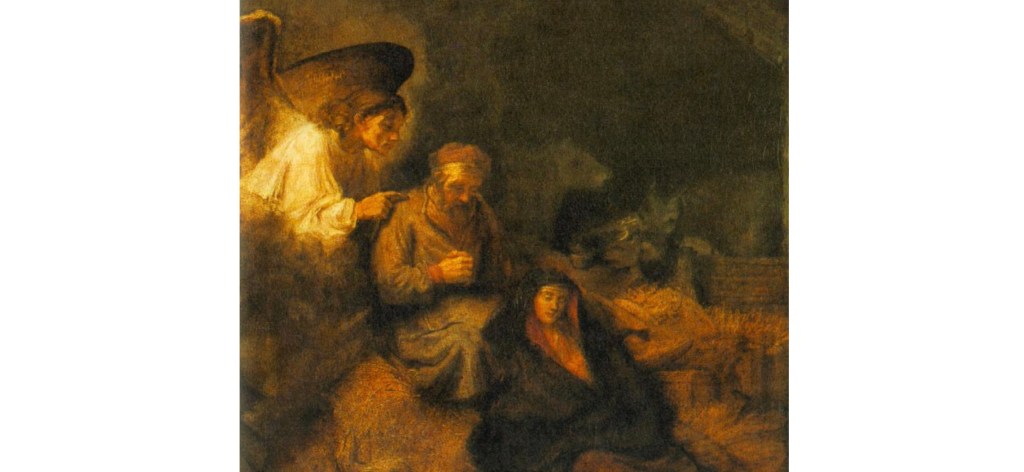
During Joseph’s sleep, the angel of the Lord delivered a message. “Joseph, son of David, do not be afraid to take Mary your wife into your home. For it is through the Holy Spirit that this child has been conceived in her. She will bear a son and you are to name him Jesus, because he will save his people from their sins” (Mt 1:20-21). When Joseph awoke, he was obedient to the angel of the Lord. Joseph was willing to change his mind and took his wife into his home (Mt 1:24).

We may hear this so many times, we may miss the power of Joseph’s choice. He could have felt anger that the child was not his own and that Mary was unfaithful, which is what most of us go to when we read this account. There is another interpretation of the “reverential fear view,” which “was held by Sts. Thomas Aquinas, Bernard, Basil, and Ephraim. In this view, Mary told Joseph about her conceiving by the Holy Spirit and he responds with religious awe over the mystery of what God is working in Mary” (Curtis and Sri, 44). Joseph, like many of the prophets when encountering the work of God concretely do not feel worthy to follow through on what is being asked of him.

We don’t know what was going through Joseph’s mind before the angel, but we do know that he as did Mary once he was clear of God’s will trusted in God’s will, and “that has made all the difference” to quote Robert Frost’s poem, “The Road Not Taken.” Because of Mary and Joseph’s, “yes”, to God and to family, the Son of God became man and opened up heaven for us in the humanity he assumed.

God often works in the same way when dealing with us. What may appear to be absurd, unimaginable, or downright impossible, is indeed possible when we align our will with God’s will. This is the week of Joy in Advent.

The source of joy does not come from external experiences but from an encounter with and acceptance of God’s invitation. Joy is an experience of communion with the love of God. This has been given to us in greater measure because Jesus became one with us, and so upon his ascension into heaven, we too can experience the loving communion he experiences with his Father. We can also experience the love of the Holy Spirit in our encounter with family and friends, this exchange of giving and receiving of ourselves in conversation, shared experiences, and in resolving challenges and conflicts together.

Mary and Joseph both received incredible news, that neither of them fully comprehended. They could have easily responded in a different way. They could have given into very real fears. Instead, they trusted in and obeyed God, they chose family, and because they did, we can rejoice not just during this week but we can rejoice always! The same God who sought out Mary and Joseph has a plan for us as well.

Mary and Joseph followed God’s lead and were willing to allow their unborn child, Jesus, to come to full term. Because they were willing to risk public ridicule and worse, Jesus entered into our human condition. There may be a difficult situation we are dealing with, we may feel like we are on our own, and that there is no way out, and/or no help on the horizon. God will make a way when there appears to be no way, and reveal it to us through his Son. We may not understand either, but like Mary and Joseph, let us trust in God, one another.

Jesus, Mary, and Joseph, please intercede on our behalf this Advent Season such that we will resist the temptation of taking each of our family members for granted, and instead give others the benefit of the doubt, appreciate and be thankful for one another. Help us to react less and breathe deeply more. Help us to be more understanding, patient, and willing to forgive, such that even though we have experienced past hurts, conflicts, disagreements, and different points of view, we may ultimately experience time and again the joy of being there for one another, through thick and thin.


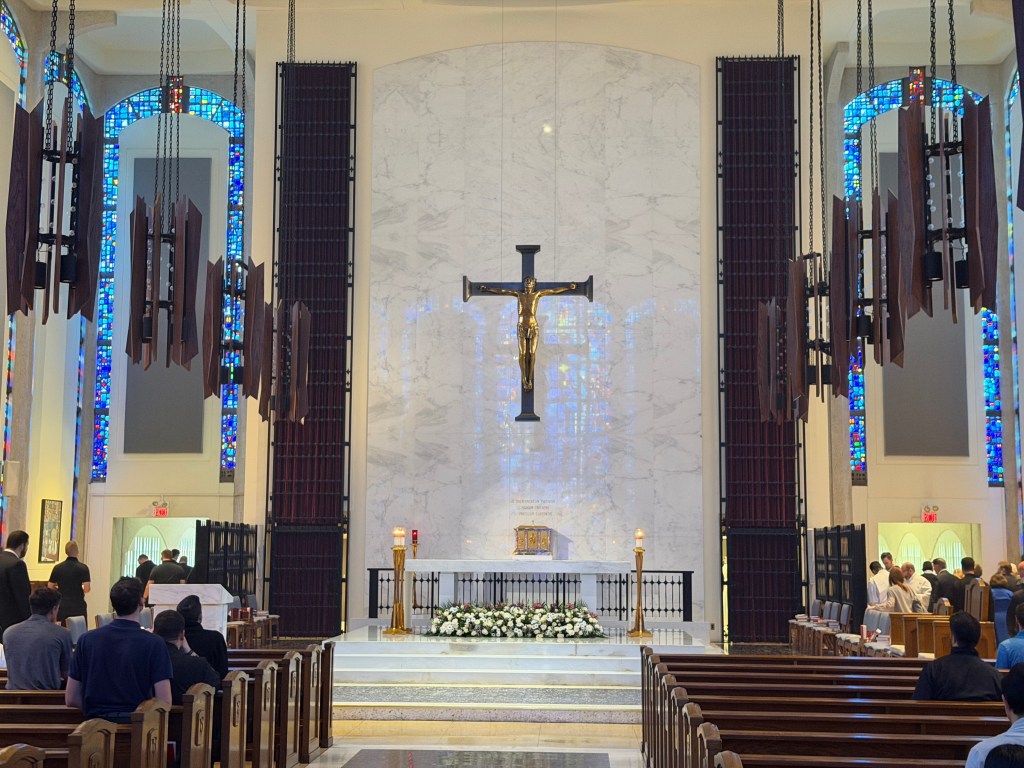
Photo: Blessed to spend time with the Holy Family each evening for my holy hour.

Link for the Mass readings for Thursday, December 18, 2025

“I will give you rest.”

Verses that we read, such as: “Come to me, all you who labor and are burdened, and I will give you rest” (Mt 11:28) really hit the spot, they arrive at the right time. I am sure that if you are reading these words you may also welcome Jesus’ invitation. Yet what is the labor and burden that we need to rest from? Teachers, administrators and students, of which I was a part for decades are coming into crunch time now as the end of the quarter or term is so much closer. Those in other occupations also work long hours, and sometimes, two or three jobs, just to get by.

Many also who oversee and care for their home, others with children, elder parents, family members, and dealing with family issues that can be enormous, especially at this time of year. Add to the above Christmas preparations: decorating, putting up lights, shopping, buying presents, cooking, baking, writing and mailing Christmas cards can also add to feeling weighed down.

Unfortunately, there are way too many who are not so much burdened by work but the lack of access to gainful or meaningful employment. They are burdened with keeping the bills paid and a roof over their heads as the temperatures fall. Some have no home or family, they are burdened with getting from day to day, seeking ways to get food, clean clothes, a place to wash and relieve themselves. Christmas cards are a distant thought. Many others are burdened and living in fear that they or their family member or members may be deported.

Speaking of fear, how many of us are burdened by fear, anxiety, stress, and strain from a myriad of swirling reasons? Concerns about our family, community, country, and the world are a burden that can also weigh heavily. Advent and Christmas, even when life is more stable, are still times in which many buttons can be pressed and many stressors can be triggered. What is the adage that is offered when family and friends gather? Resist talking about politics, religion, and… we all can add a few others.

If you are feeling weary and worn as we draw close to the midway point of this Advent Season, it is a good opportunity to make some time to just stop and take a slow, deliberate breath. Notice your shoulders coming out of your ears. Embrace the invitation of Jesus and rest in him. Allow the burdens to come to mind, then visualize yourself giving them to Jesus, open yourself to his guidance, ask for his help for the day to day challenges, and seek who may be best able to assist you in any particular situation. Slowing down may help us to become more aware of any sins that we feel burdened by. This is a good time to rest and trust in the forgiveness of Jesus and confess to him in the Sacrament of Reconciliation. Jesus will forgive you and bring you a lightness and fresh start!

Our God “does not faint or grow weary, and his knowledge is beyond scrutiny. He gives strength to the fainting; for the weak he makes vigor abound” (Isaiah 40:28-29). We do not have to deal with anything alone. We have help and support. My friend, Pastor Jerry Scott, taught me years ago a life lesson which I still return to, more often now as I begin my sixth decade. When a person is chopping down a tree, exerting a lot of energy and effort, but finding the results insufficient, he or she needs to realize that they need to step back, take a breath, and sharpen their ax. With a little rest, renewal, and a sharpened blade, the job can be accomplished sooner.

Let’s figuratively do the same daily with each of our endeavors. Let’s resist just putting our heads down and plowing through with blinders on and instead take some time to stop and assess from time to time what we need, where we need help, and yoke ourselves to Jesus for his guidance and strength. Sometimes, making time to breathe and plan, we can use our time more efficiently.

When we choose to intentionally breathe more, we can react less. We can bring our challenges to Jesus and he will help us to carry the burden, as we follow his will, we can work smarter instead of harder. In developing a pattern and place of trust and hope in him, seeking his guidance and direction this Advent, we will renew our strength and soar as with eagle’s wings; we will run and not grow weary, we walk and not grow faint (cf. Isaiah 40:31)!


Photo: Spending time outside, taking some breaths, and trusting in God, can do wonders.

Link for the Mass readings for Wednesday, December 10, 2025

“In no one in Israel have I found such faith?” How about with us?

Amen, I say to you, in no one in Israel have I found such faith. I say to you, many will come from the east and the west, and will recline with Abraham, Isaac, and Jacob at the banquet in the Kingdom of heaven” (Mt 8:10-11).

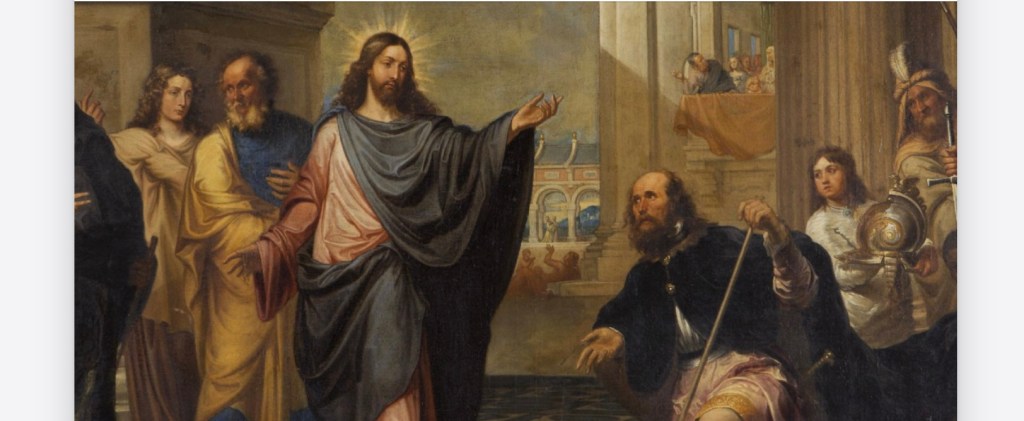
Nowhere else in the Gospel of Matthew is Jesus recorded as being amazed. Jesus was amazed with this man’s faith. Could he also have been amazed with his humility and his willingness to seek help for his slave? This Roman centurion, an occupying presence in Israel, clearly embodied the teachings of Jesus! We echo this centurion’s own words at each Mass just before we receive the glorified Body of Christ in the Eucharist: “Lord, I am not worthy that you should enter under my roof, but only say the word and my soul shall be healed.”

I would imagine that those around Jesus and the centurion were amazed as well. Here comes this commander of an occupying army of their land and he asks Jesus for this favor. Then if this is not unthinkable enough, he asks Jesus to heal a slave, and with his word from afar. Jesus recognizes the faith of this man and said, “You may go; as you have believed, let it be done for you” (Mt 8:13). The slave was healed. Jesus, in this generous gift of healing, showed that he came, yes, to the Jews, but also to the Gentiles and the slaves as well.

God chose the people of Israel not for themselves alone, but that they would be a light to all peoples. As Isaiah said, all nations shall stream toward mount Zion and “from Zion shall go forth instruction, and the word of the LORD from Jerusalem” (see Isaiah 2:1-5). Jesus echoes Isaiah’s prophetic words as is recorded in today’s Gospel: “Amen, I say to you, in no one in Israel have I found such faith. I say to you, many will come from the east and the west, and will recline with Abraham, Isaac, and Jacob at the banquet in the Kingdom of heaven” (Mt 8:11). The centurion’s act of faith is the beginning movement, like a drop of water that is the beginning of a majestic waterfall.

The first point we can learn from the centurion is that he was aware that his slave was in need. A slave held no dignity, value, or worth, and yet, he was not invisible to the centurion. Nor was the centurion indifferent to his suffering and pain. Are we aware of those in our midst who are in need? Let us resist the temptation to walk around, over, or by others and be willing to come close as Jesus did time and again.

Second, like the centurion, let us embrace humility and acknowledge our own sinfulness, and when we do that, we are better able to see the needs of others. None of us are perfect. No one person is above any other and all of us fall short of the glory of God. We all have gifts as well as shortcomings. We need each other because we complement one another and we are stronger together than apart.

Third, we cannot stand on our own. The centurion recognized his limitations. He acknowledged that he needed help. He needed Jesus. As do we. We cannot accomplish our salvation on our own merit or will power. We need a savior. Apart from Jesus, who we prepare to encounter this Advent season, we can do nothing, but with Jesus all things are possible.

Jesus is the Truth and the Fulfillment that we seek. He has sent out a universal invitation of communion, to Israel first and then to those from east and west, north and south, Jew and Gentile, slave and free, male and female. The Roman centurion modeled our response to Jesus’ presence when he recognized and acknowledged his own unworthiness before Jesus. He was also aware of and sought healing for his slave. The centurion had faith and hope that Jesus could and would provide healing with just his word.

May we follow his example this Advent as we take time to examine our conscience, have the humility to confess our sins, to acknowledge that we need help from Jesus and others. May we be willing to seek forgiveness and be willing to forgive. May we be willing to resist the temptation of fearing that we are unable and unworthy, close ourselves off, and be indifferent to the plight our own needs and needs of others, but instead, seek Jesus for help for ourselves and others.

Jesus was amazed with the faith of the centurion, is he amazed with our’s? We have so much to offer one another when we are willing to work together instead of apart from or against one another. May we who have received the forgiveness, healing, and grace of Jesus and felt the embrace of his love, reach out to provide hope to those of our family and friends, as well as those Jesus is calling us to draw closer to, those we may have kept at arm’s length.

——————————————————————-

Painting: A quiet moment in between Masses Sunday, God coming close. “Lord, I am not worthy that you should enter under my roof, but only say the word and my soul shall be healed.”

Link for the Mass readings for Monday, December 1, 2025

No matter what is on the horizon, Jesus will guide us through.

While some people were speaking about how the temple was adorned with costly stones and votive offerings, Jesus said, “All that you see here– the days will come when there will not be left a stone upon another stone that will not be thrown down” (Lk 21:5-6).

As we read yesterday, Jesus observed the widow donating her two coins. Today Jesus observes those who are commenting about the wonders of Herod’s temple. Jesus responds by sharing, as did Jeremiah, that the temple will fall, and not a stone upon another stone will be left. The reality of this statement would come to pass in 70 AD when the Romans destroyed the temple and crushed the Jewish rebellion during the Jewish War from 66-70 AD. The only significant remnant of the temple still to this day is the outer retaining wall, also known as the Wailing Wall.

The people of the ancient Near East certainly witnessed and passed on tales of the rise and fall of mighty kingdoms beginning with Egypt’s impressive reign from about 3,000 to 721 BC, followed by Assyria who then gave way to Babylon. The Babylonian army would destroy Solomon’s temple as predicted by the prophet Jeremiah. The Persians would then overtake the Babylonians and push west only to be repelled by the unification of the Greek city-states under the Macedonian Philip and then his son Alexander the Great who would continue south and east all the way to India. The massive Greek empire would then give way to Rome. Rome would then fall in 476 AD.

As each empire fell, and especially during the fall of Rome, there was a great concern that the end of the world drew nigh. Throughout the ages up until the present day, nation has continued to “rise against nation, and kingdom against kingdom…” and the world has experienced “powerful earthquakes, famines, and plagues from place to place” (Lk 21:10-11). Each made their historical impressions on those who lived through them. There has also been a plethora of end of the world predictions from the ancients up to the more well known modern prognosticators such as Jeane Dixon, Pat Robertson, a handful of predictors around 2000, and more recent but also slipping into the rearview mirror of doomsday prophesies, Harold Camping. He caught a lot of attention with his prediction of the end of the world that was to have happened on October 21, 2011.

As of this typing, we are still here. The Gospels of Mark and Matthew record Jesus addressing the same concern of those questioning him: “But of that day or that hour no one knows, not even the angels in heaven, nor the Son, but only the Father” (see Mark 13:32 and Matthew 24:36, RSV translation). In Luke’s presentation from today’s Gospel, he moves further away from Mark and Matthew’s eschatological or end of times talk and spoke more toward the destruction of the temple.

We have a few more days of Luke and Ordinary Time to go before the end of the liturgical year. Kingdoms have and will continue to rise and fall (hopefully not in these next few days). Abuse of power continues to lead to many who are displaced from war, terrorism, violence. Many reach out to provide compassion and support but there is never enough help. Many are enamored by our technological ingenuity and advancements, as were those who were admiring the adornment of Herod’s temple. Are we in the final days? Only the Father knows.

Yet, we are not to be anxious about tomorrow as Pope Francis encouraged those in his homily when he spoke at Tokyo Stadium in Japan a few years ago. We are to seek first the kingdom of God and “to re-evaluate our daily decisions and not to become trapped or isolated in the pursuit of success at any cost… [that] leave us profoundly unhappy and enslaved, and hinder the authentic development of a truly harmonious and humane society”.

When we place our hope and trust in Jesus, the Son who knows the Father, he will guide us through any challenge and strengthen us against any storm. Let us risk feeding the temptations of anxiety and worry. Instead may each thought, word, and action pass through the filter of a deep slow breath and seek the guidance of the Holy Spirit. As we do so, we will know Jesus, his voice, and the will of the Father better. We will be able to abide and rest in God who is our refuge and strength no matter what comes.


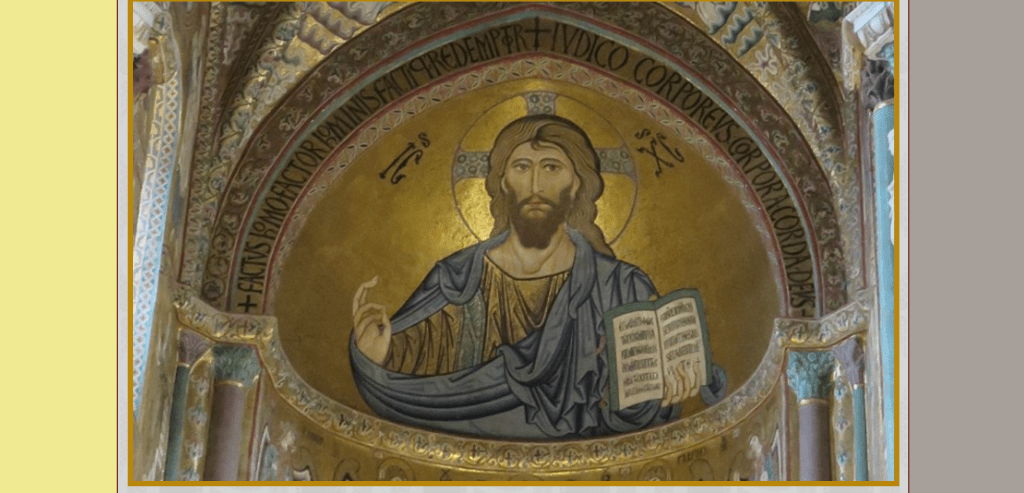
Photo: Jesus Christ, our King, fights for us.

Link for the Mass readings for Tuesday, November 25, 2025.

She gave all.

In the Gospel of Luke, we return to the widow we read about recently. She came to the Temple in Jerusalem as others came to share their offerings. These offerings were placed in the Shofar-chests in the Court of Women near the Temple. Scholars recognize that there were thirteen chests and each one was for a specific offering that ranged from annual dues, sacrificial offerings, and freewill offerings.

As Jesus pointed out, most of those who were giving, gave out of their excess, but this widow, who most likely had no support as her husband had died, gave all that she had in giving her last two coins. What her offering was for or why, we do not know, but in doing so, she showed a radical trust in God. She did not even hold back one of the coins. She instead gave all.

The widow sacrificed all she had, as did another, the widow of Zarephath, who gave her last oil and flour to Elijah (see 1 Kings 17:7-24). Each of them as well as all those who have trusted and been faithful to God throughout the ages followed the commandment of Jesus to love God with their whole heart, mind, soul, and strength and their neighbor as themselves. They resisted the temptations that could have lead them astray and instead placed all their trust and faith in God.

There are many distractions and diversions that can lead us astray, temptations from without and within. A false security in wealth is one Jesus talks about often. Jesus himself would give even more. He gave all of himself, holding nothing back as he gave himself on the cross. Jesus died for us so that we can be free to give.

There are those of his followers that were willing to do the same such as St. Andrew Dung-Lac and 116 others whose memorial we celebrate today because from 1820-1862 they were willing to give their lives in Vietnam. May they and those who have gone before us, the triumphant saints who now reign with Jesus Christ our King, who is seated at the right hand of the Father, intercede for, guide, and empower us. May we allow ourselves to be drawn by the tender chords of the Holy Spirit’s love to grow in trust and be as faithful to God as they were.


Painting: “The Widow’s Mite” by James C. Christensen

Link for the Mass readings for Monday, November 24, 2025

We need not fear to invest our gift because Jesus is with us.

In today’s Gospel, we have available to us the parallel to The Parable of the Talents from Matthew 25:14-30, which is The Parable of the Ten Gold Coins from Luke 19:11-28. There are a few differences. A key opening point is that in Matthew’s account, we do not know why or where the master goes after he entrusted three of his servants with talents; five, two, and one respectively. In Luke’s account the man is a noble and he “went off to a distant country to obtain the kingship for himself and then to return” (Lk 19:12). He called ten servants to invest a gold coin he gave to each of them. The theme that is similar in both accounts is that when the man returns, two of the servants invested well and brought about a greater return on their investment, and one hid what he was given out of fear of his lord.

Another added feature in Luke’s account was the fellow citizens of the nobleman that did not want him to be king and openly opposed him. The nobleman after attaining his kingship and returning successfully, dealt harshly, to say the least, with those who opposed him, having them slain. Those listening to Jesus tell the parable would understand this predicted outcome, as it was not uncommon in the ancient Near East for a ruler to slay those who opposed his rise to power.

The most immediate parallel and contemporary example was the current tetrarch, Archelaus, who was placed into power in Judea and was reigning at the time of Jesus. He was a cruel tyrant. The Jewish historian, Josephus, who during the time of the Jewish Wars was captured and later became a Roman citizen wrote that there were “fifty ambassadors were sent from Judea to Rome to request that Archelaus not become king, because he had already killed three thousand Jews in quelling an uprising” (Gadenz, 320).

Just as the wicked tyrant is rejected, the innocent Messiah will also be rejected in Jerusalem, and will give his life. Jesus again appears to be presenting the contrast between the fallen nature of humanity with the coming of the new kingdom under his reign. His apostles are not to be like the corrupt leadership of the age, but they are to go out to all the nations to proclaim the good news of the kingdom.

The readings this week also continue to present eschatological talk, references to the second coming of Jesus, and final judgment because we are in the final two weeks of the liturgical year. Jesus’ reference to going away and coming back, could be a reference to his death, resurrection, ascension, and the waiting until his second coming in which there will be a judgment by God. Jesus makes clear that we are not the judge and jury, though many appropriate this role for themselves. We are only accountable for the talent or gold coin we have been entrusted with.

God has called us each uniquely by name and given us a gift that he wants us to put into action to help build up his kingdom. We need to resist burying this gift or hiding it away. The most important thing we can do each day is to pray, and deepen our relationship with God and each other. The enemy will tempt us with doubts, fears, and anxieties which we are to renounce and instead trust in Jesus, seek his strength, and guidance.

We are invited each day to begin with prayer. In the beginning, the length of time is not as important as consistently spending time with God intentionally. We show up, breathe, allow ourselves to be still, allow the restlessness of our mind to quiet, and we listen. This may take some time or days, but when we continue to return to these daily anchors and trust that God has a purpose for us, we will hear his guidance, and then we are to follow his lead.

The encouraging words of St. John Paul II are helpful: “Remember that you are never alone. Christ is with you on your journey every day of your lives!” – St. John Paul II

We are called by Jesus to be contemplatives in action. We are not to follow the lead of mediocrity and fear. With humility and patience, let us trust in the guidance of the Holy Spirit who will light our path to maturing and actualizing our unique call and as we serve God and one another we will bear good fruit.


Painting: “The Lord of the Parables” by Jorge Cocco, Altus Fine Art

Gadenz, Pablo T. The Gospel of Luke. Grand Rapids, MI: Baker Academic, 2018.

Link for the Mass readings for Wednesday, November 19, 2025

Praying persistently helps us to grow in our relationship with God and one another.

Jesus told his disciples a parable about the necessity for them to pray always without becoming weary (Lk 18:1).

In the parable that Jesus offered in today’s gospel account, he is not saying that persistence in prayer is changing God or somehow bending his will to our’s. We are not wearing him down like the woman did with the judge. God does not need us. God is completely and totally self-sufficient. We are the ones who need him. Our persistence, our daily habit of prayer, changes us, transforms us, helps us to develop our relationship by interacting with God more consistently. Things happening in our lives help us to see that we are fragile and vulnerable and in need of help. Our persistence in prayer will help us to experience that we are not alone in our challenges. When we are dealing with a crisis or very real trauma, our persistence and faithfulness in prayer will help us to experience the closeness of Jesus in our midst as he accompanies us through our suffering and grants us the strength not just to endure but to overcome.

In fact, the practice of stopping everything and praying for five minutes when a crisis arises, often helps us to resist slipping into a fight or flight mode and helps us to resist reacting automatically based on our emotions. Consciously choosing to breathe while praying helps us to act more prudently than impulsively. We may also come to see that what we thought was a crisis, may have been more of a problem to be solved rather than something catastrophic. Our instant reactions to perceived crises can often escalate an issue rather than de-escalate one.

In the greater scheme of things, God answers all prayers of petition or intercession by saying yes, no, or not yet. Most seem to fall in the not yet or not the way we originally intended category. Remaining patient and faithful can help us to move away from seeking to conform God to our will and instead allow him to expand our hearts and minds to his will. Through this expansion, we can come to see the situation from a broader perspective. Our persistence in prayer also helps us to move away from seeking instant gratification and instead trust more in God’s will and timing. Sometimes we are blessed for unanswered prayers because with time, hindsight, and some distance, we find our original request was more an apparent than an actual good.

Persistence in prayer is also a discipline that deepens the roots of our relationship with God. Ready access through our modern technology, higher internet speeds, one-click access, and overnight shipping, can offer plusses, but we have to be careful that this mindset does not shape our mental, psychological, and spiritual growth. Physical fitness, wisdom, or spiritual maturity is not instantaneous. More importantly, development as human beings and our relationships take time, experience, discipline, prayer, and trust in God’s plan.

Patience, persistence in prayer, freeing ourselves from attachment, developing an authentic and intimate relationship with God and one another are all worth the effort. We need to take some time to breathe deeply, slow down our pace, discipline ourselves to resist even seeking small acts of instant gratification each day. No matter how busy, it is important to slow down. Even when we stop to pray and feel like nothing has happened and that doing so feels like a waste of time, God is present. God loves us, has our back, and we can trust in that.


Photo: Blessed to have a moment to pray evening prayer back at St. Peter Catholic Church. Keeping our eyes on Jesus helps us to quiet our minds.

Link for the Mass readings for Saturday, November 15, 2025

A prayerful pause can make a big difference.

“I have great sorrow and constant anguish in my heart” (Romans 9:2). Paul is sharing his great pain because his own people are rejecting the gospel of Jesus. Paul can certainly relate because he not only rejected but persecuted anyone who followed Jesus, the person he came to believe is truly the Messiah.

Jesus also experiences the same aguish as he is meeting yet again opposition as he heals a man with dropsy, a condition in which some part of his body was suffering with swelling. Instead of recognizing and rejoicing in the healing just witnessed, the people judge Jesus for healing on the sabbath.

In response, Jesus points out the obvious by asking, “Who among you, if your son or ox falls into a cistern, would not immediately pull him out on the sabbath day” (Luke 14:5)? No answer but crickets… Jesus, as he often does, builds his case from the lesser to the greater. Just as he did with the parable of the unjust judge who made a just verdict, and an unwilling neighbor gave bread to his persistent friend in the middle of the night, how much more will God provide for his children? He wants all of us to be saved. The healings of Jesus are invitations to the ultimate healing we all seek which is the restoration and reconciliation of our relationship with God.

We need to be careful that we don’t fall into the tunnel vision of some of the scribes and the Pharisees by limiting Jesus in our own lives because we are choosing our fears, insecurities, or doubts over his guidance. I have done both. I have resisted, chosen not to act, beaten myself up over it (which does not work because we are still focused on ourselves and not Jesus), and prayed to improve the next time. I have followed without hesitation. I have also hesitated and then acted. Each time I was willing to risk and follow Jesus, I have experienced his consolation and our relationship has grown stronger.

I invite you to listen to Jesus today and ponder where he might be leading you and in what way to act regarding yourself or another who may be in need of healing. Grant yourself a quiet moment to examine where you may be resisting his invitation no matter how small, trust him, and take the risk to love. With each thought we entertain, choice we make, word we speak, may each go through the filter of the Holy Sprit. Ask, God is this what you want me to think, choose, or say? If yes, go forward. Instead of a knee-jerk reaction, let us give ourselves a prayerful pause with the Lord.


Photo: There are some great views we receive when we stop and look up with a prayerful pause!

Link for the Mass readings for Friday, October 31, 2025