Discerning or feeling stressed about a decision, maybe time for a nap.

Who do we want to be? It is so easy to get caught up in being busy, taking care of children, the home, school assignments, work, as well as a myriad of other activities that each of us, experiencing our unique vocational state in life, can add to the list. These can all be good things, but we can lose ourselves in our business and responsibilities as well as how we define ourselves, such that we slip into a state of survival mode or merely existing. One day can move into one week, into one month, into one year, and then we wake up one morning and wonder where the last ten years have gone!

We can fall into the trap of being defined by what we do instead of who we are and who God is calling us to be. We may have heard or be told at some point in our lives, “Don’t just sit there, do something.” God has another way of presenting us this statement: “Don’t just do something, sit there, and let me do something in you.” God has a plan for each one of us with the end result being eternal communion with him in heaven. Living a life of holiness and becoming saints is who God seeks each of us to be. We need to remind ourselves of this from time to time, by assessing where we are now and if we are listening to the guidance of God.

Our Gospel account from Matthew today gives us an opportunity to see holiness in action. Joseph has become aware that Mary, his betrothed, is with child and he is not the Father. Pass the Pepto Bismol please… Joseph, “a righteous man” follows the law, but is “unwilling to expose her to shame, decided to divorce her quietly” (Mt 1:19). Joseph’s life of righteousness pulls him to follow the law, yet he shows that discernment in matters of the dignity of the person is just as important. Joseph not only was unwilling to make Mary into a public spectacle but was also unwilling to allow the possibility of her to be stoned to death.

Joseph pondered the idea of divorcing her quietly. Before he made his final decision, Joseph slept on the matter, which is often a good course of action when weighing heavy issues or dealing with stressful conflict. How many times do we rush into decisions only to regret them later? Joseph receives God’s direction through the angel of the Lord in a dream.

When Joseph awoke in the morning, he did not dig in his heels feeling that he knew best, that he knew better than Gabriel, and return to his original decision. Joseph did not let fear or anxiety about the possible scenarios that were running through his mind regarding what others may say or think sway him, nor did the possible and real difficulties he could envision deter him.

Joseph trusted God. With confidence and assurance of who he was and what God called him to do, Joseph acted on the guidance he had received without hesitation.

St. Joseph is a model for us. When faced with decisions to make, we need to remember who we are, whose we are, and who we are called to be. We are children of God, and that means we belong to God who loves and cares for us. He has a plan and each thought, decision and action we follow through on is a step in diverting from or fulfilling that plan.

There are many elements in good discernment, gathering information, ponder the reasonable options, praying and seeking God’s guidance, slowing down to breathe and think, seeking guidance from a trusted family member or friend, reading, praying, meditating with the Bible, his creation, being open to Godincidents, or a good nap or early to bed. Joseph followed some of the above and had the humility to listen to God’s messenger and he granted him not only the guidance he sought but the support to fulfill the commission he received. God will do the same as we discern his direction too.

St. Joseph, pray for us!

——————————————————————–

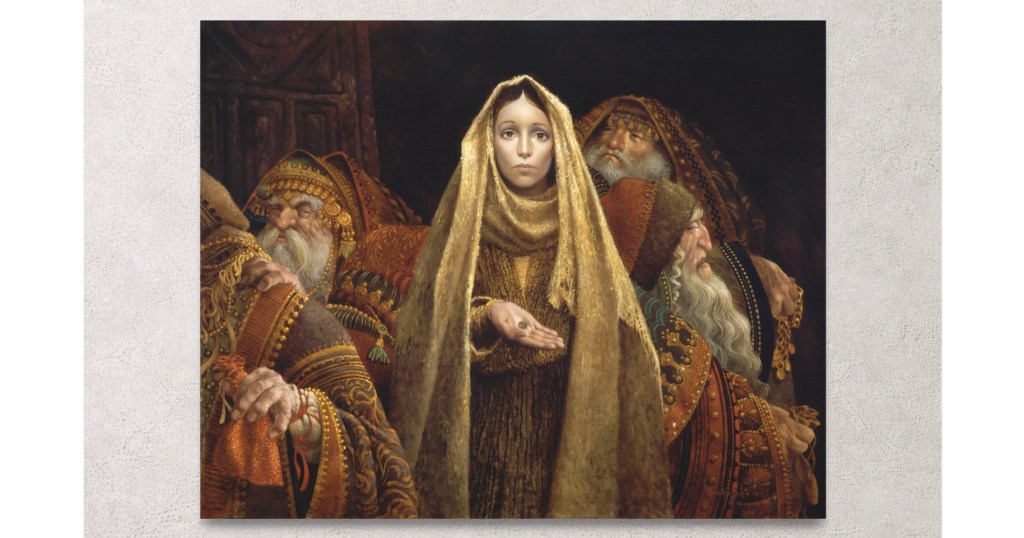
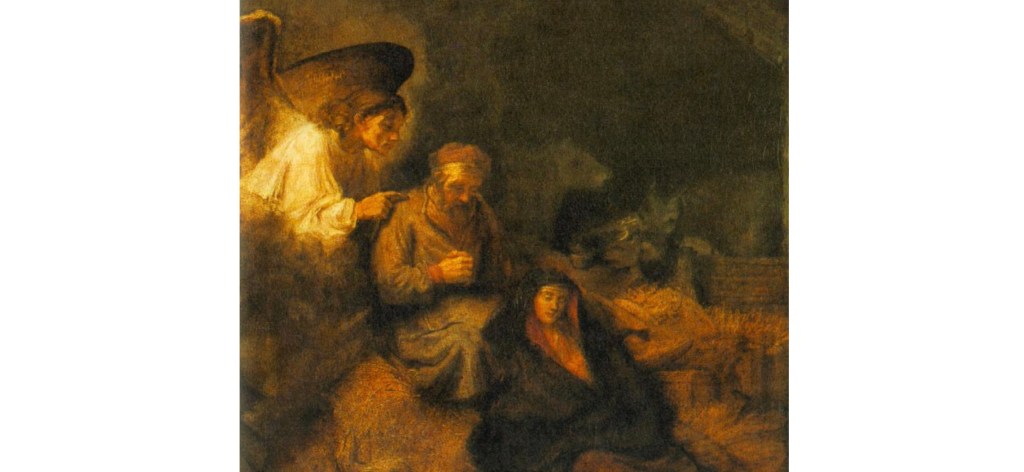
Painting: Closeup of Rembrandt’s “Dream of St. Joseph”

Link for the Mass readings for Thursday, March 19, 2026

Jesus knew he was when challenged, do we?

In today’s account from John, Jesus responded to the criticism that he received from healing the man at the pool of Bethesda. The issue for those who were incensed was that he healed on the Sabbath, and he did not help his case any when he justified himself by saying that he was directed to do so by his Father: “For just as the Father raises the dead and gives life, so also does the Son give life to whomever he wishes” (Jn 5:21). Jesus did not make concessions with those who opposed him.

He clearly stated the truth about who he is, the Son of God, the Lord of the Sabbath. For those not believing Jesus, that he said that he is equal with God… this is blasphemy of the highest order. This is one of the reasons they plot to kill him.

So too in our own age, there are many ways to express our understanding and belief about who Jesus was in his time and who he is still today. If you haven’t thought about Jesus beyond his name in a while, about who he really is and why he is relevant to our lives, then allow St. Athanasius, the bishop of Alexandria, who lived from 297 to 373 AD, to offer a point to ponder today.

St. Athanasius held firmly to and taught with conviction that, Jesus is, “the Son of God [who] became man so that we might become God” (Catechism of the Catholic Church, 480). We cannot be saved on our own merits, through our own will power, and discipline alone. Jesus can save us particularly because in what he assumes as fully human, he is able to redeem as fully divine.

The reality that the second Person of the Holy Trinity, was sent through the overshadowing of the Holy Spirit to enter the womb of Mary and take on flesh, became one with us in our humanity by becoming also human, so that we can become one with him in his divinity, is something worth meditating and praying about. There is much writing and discussion about how many people are leaving the Church, while at the same time their hunger still remains. I would say starving, for a deeper, more intimate relationship with God. This is true for those who leave as well as those who remain, whether either could or would articulate it in that way.

Could it be that we have forgotten the foundation of our faith, which is participating in and deepening our relationship with Jesus?

The words of St. Athanasius, “The Son of God became man so that we might become God.” Are words that will help us to remember who and whose we are, beloved daughters and sons of God. They are words that might help us to remember our meaning and purpose in life. They are words that might help us to stretch a little more from our comfort zones, to risk being who we are, and to trust God to walk with us in places where we are need of healing and reconciliation. Hopefully, they are words that help us to slow down and spend some time with Jesus and get to know him a little better.

————————————————————————–

Photo: Quiet walk on the way to celebrate Mass.

Link for the Mass readings for Wednesday, March 18, 2026

Jesus has come to heal and help to transform our minds and our hearts.

We hear often in the Gospels how those who believed in Jesus received healings, exorcisms, and were forgiven of their sins. We have also read accounts such as from the Gospel of Matthew that he “did not work many mighty deeds” in Nazareth “because of their lack of faith” (Mt 13:58).

In today’s Gospel account from John, Jesus speaks to a royal official whose son is close to death. Jesus said to him, “You may go; your son will live.” The man believed what Jesus said to him and left (Jn 4:50). On his way home to his son the man is met by the slaves from his household and they told him that his son would live and when they compared notes, they realized the healing occurred at the moment Jesus spoke and the man believed.

What do faith and belief have to do with Jesus being active in our lives? The way of the Gospel, the good news, is all about invitation and acceptance. Jesus enters our world, our reality, and he comes to each one of us intentionally, gently, and humbly. He came as a poor infant, completely dependent on Mary and Joseph for his very survival. He lived the majority of his life in the obscure village of Nazareth most likely working as a day laborer. When he began his public ministry he did so by inviting people to be a part of his life, to enter into a relationship with him and his Father. People are free to say, “no”, or to say, “yes”, to that invitation.

Faith is trusting that what Jesus says, is true, and that he is who he says he is. Belief is the act of our will that aligns with our faith, our trust in him. Jesus invited the man to believe that his son was healed and the man believed. He walked away with full confidence that his son would be healed. Belief is followed by an affirmative act of the will. I can believe my car will run, but unless I get in it and turn the key, I am not going anywhere.

This miracle was not just for the man and his son. As with each miracle, Jesus is teaching a lesson to those present. The preliminary statement to the people of Galilee is, “Unless you people see signs and wonders, you will not believe” (John 4:48). This was a challenge to the man and to those present. The father believed Jesus and went on his way. Did the people who were seeking signs believe as the father did? Because this father did, his son was healed.

Jesus is fully human and fully divine. He has come to show us the promise of the life his and our Father wants to give to us. Jesus, the first born of the new creation, is collaborating with his Father: “To set right a world that has gone wrong” (Barron, 92). Jesus comes into our lives each day to show us a new way, a better way. Are we willing to let go of our defense mechanisms, our comfort zones, stepping out of daily survival mode and instead walk the path of this new way with Jesus? Do we believe, as did this man seeking a healing for his son?

Just as the sun rises each day, Jesus comes to us to set our minds and our hearts on the right path, toward our forgiveness, healing, and freedom. Just as Jesus was present for this man and his son, he is present to each of us as our divine healer, teacher, and savior. We experience that truth the more we believe in and choose to seek his help and guidance with each thought, word, and deed and in every situation. May we trust in Jesus with everything, may we thank him for everything, and when we sin, let us seek his forgiveness and begin again.

——————————————————————————–

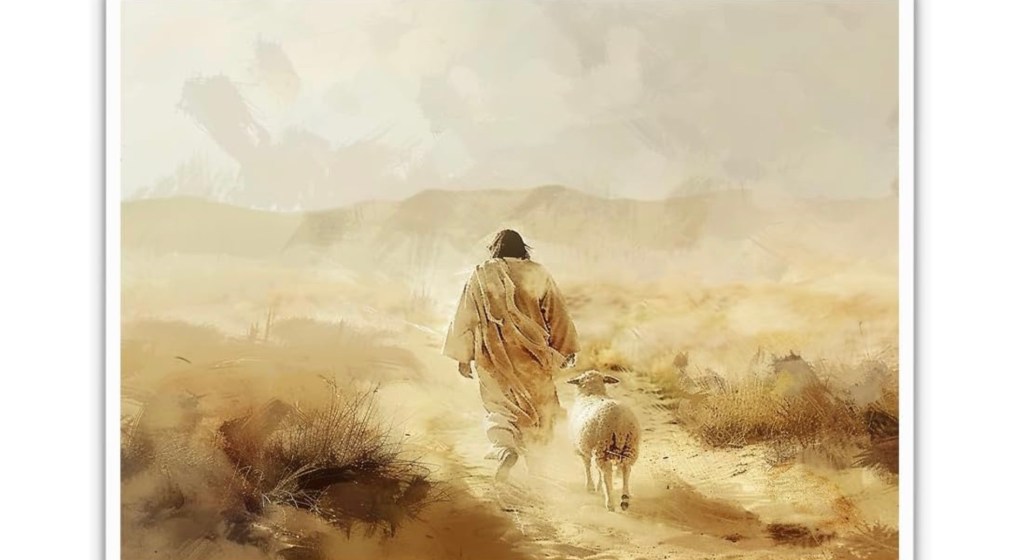
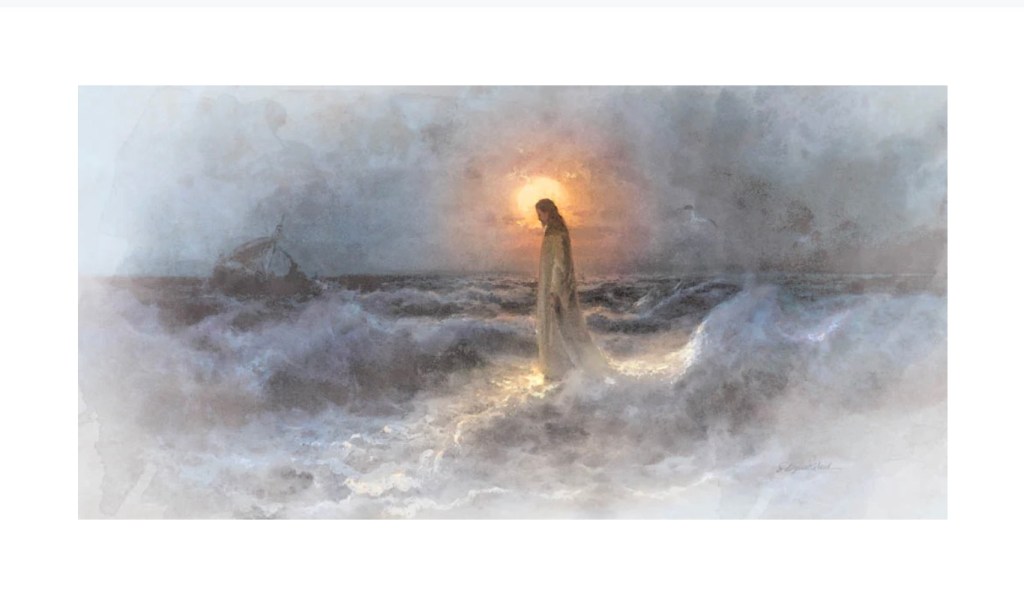
Painting: Jesus meets us where we are and as we are to provide healing for ourselves and those we intercede for.

Barron, Bishop Robert. Lenten Gospel Reflections. Word on Fire, 2020.

Link for the Mass readings for Monday, March 16, 2026

Let us put into practice Jesus’ teaching, and help one another with each step forward.

The challenge of Jesus’ convicting the hypocrisy of many of the Pharisees may be one for which most hearers and readers would agree with: “For they preach but they do not practice. They tie up heavy burdens hard to carry and lay them on people’s shoulders, but they will not lift a finger to move them” (Mt 23:3-4).

We have an innate sense that alerts us to hypocrisy and when hypocrisy raises its head with religious leadership it can be catastrophic because many, especially our youth, look to our leaders, as representatives of the God they are to be serving. Inexcusable behavior not only affects how we look at our leaders, it also affects the way we look at the institution, as well as God. The Catholic Church is still reeling from not only those clergy who have abused children, but those bishops who have covered up the abuse.

As horrific as these acts are, and even though there have been many improvements that have been made to put practices and protocols in place, the damage is still there and will take time to heal. There also are many other ways that people have been hurt or disillusioned by the hypocritical actions and statements of priests and leaders in the church. It is easy to give up, walk away and say this is not my problem, to point fingers and justify our own acts of hypocrisy by saying well at least I am not that bad. Yet even the human frailty and fallen nature of each of us does not change the truth that Jesus is the way, the truth, and the life. He is the source of our being and fulfillment.

Even for those who have left the Church, many would say they are still spiritual. This is true because, we all have the inborn desire to be in relationship with the God who has created us. Those of us who are followers of Jesus, are to receive the message as he gave it then directed toward the religious leadership of his time, as well as it was given for his disciples, and each of us who follow him today. The standard that is set and for which we strive after is to live as Jesus lived his life.

Jesus always pointed the way to the Father. We as human beings are finite and we are going to make mistakes and sin. While Jesus is our model, even more, he is the source for our living faithfully to his teachings. Through his forgiveness and love working through us and directed out toward others, we are capable of standing up for the dignity of those entrusted to us within our realm of influence. For we are to be our brothers’ and sisters’ keepers.

If we want to guide someone in the ways of our faith tradition it is not enough to say this is what you need to do and live accordingly. We need to put into practice and live what we are sharing, be willing to accompany, assist, and walk with those we accompany along the way. As a Christian, just giving someone the Bible, saying there you go, that’s all you need, and quoting a couple of scripture passages is not enough. If we are sharing a principle to put into practice and we are not willing to lift a finger to help them, or worse to not put it into practice ourselves, we do more damage than if we said nothing.

Jesus calls us this Lent, and everyday, to resist judging and condemning, to love our enemies, to be forgiving, and merciful. Powerful actions to live up to and even a heavier lift than the laws of the Pharisees. To say that the bar Jesus sets is high is an understatement, and yet, the One who calls us to follow them, lived them out perfectly. We not only learn about the life and teachings of Jesus but even more importantly, when we pray with, meditate upon, contemplate, and then seek to put into action his teachings, Jesus empowers and assists us to live them out. Apart from him we will not be able to carry out one of his commands, with him all things are possible.

Even when our leaders fall, we need to remain in the Church. Nor can we use poor leadership as an excuse not to be willing to see where we sin and seek to improve. When we miss the mark, let us be humble, ask Jesus for forgiveness, and his help to continue forward step by step. From our own experiences of falling down and getting back up, we are better able to help others. The most important guidance we can give anyone is to help them to encounter and experience Jesus for themselves. Even when we fall, they will still have Jesus as their ultimate guide. We can hold each other accountable and help each other as we continue our journey through this life side by side.

————————————–

Photo: Mosaic of Jesus the Pantocrator offering his blessing in the cathedral in Cefalu, Sicily, Italy.

Link for the Mass readings for Tuesday, March 3, 2026

Do we seek a sign or believe and trust in Jesus?

“Give me a sign!”

Often, when we ask for a sign, we have a preconceived notion of what we are seeking and we want God’s stamp of approval on it. The impetus is coming from us, seeking to bend the will of God to our will. More often times than not this approach will end in frustration. The Pharisees in today’s account are asking for a sign. Jesus has already been preaching with authority, healing, casting out unclean spirits and demons, encountering the unclean and restoring them to the community and right worship, and this is not enough?

The Pharisees hardness of heart echo their ancestors in the desert who constantly complained and were rebellious toward Moses and God. They refused to be grateful that God had freed them from their bondage in Egypt and was caring and providing for them every step of the way on their journey. They refused to see God working in their midst. The Pharisees refused to see in Jesus, the Son of God working miracles in their midst.

We can understand how: He sighed from the depth of his spirit and said, “Why does this generation seek a sign? Amen, I say to you, no sign will be given to this generation” (Mk 8:12). The majority of the Pharisee’s minds were set, they were “motivated not by a sincere desire for truth but by a refusal to relate to God on his own terms. To insist on irrefutable evidence is really a demand for control” (Healy, 153).  Jesus knew there was nothing he could say or do to prove to them that the kingdom of God was at hand in their very midst.

If they had not the eyes to see nor the ears to hear, there was no argument, point, or sign that would have changed their minds. Jesus sighed from the depths of his spirit because their hearts were hardened such that they closed themselves off from the gift of the grace he sought to share. There was nothing left to say, so he then got into the boat to go to the other shore. He was determined to now put his energy into preparing his disciples, to ready them for his death and their mission.

Do we believe, do we really believe, that Jesus is “the way, the truth, and the life” (Jn 14:6)? Do we seek to bend God’s will to our own or are we willing to change, be transformed, and seek to align our will with his? The woman with the hemorrhage for twelve years, Jairus whose daughter died, the Syrophoenician woman whose daughter was possessed, the friends with the man with the withered hand, and the leper, did not ask for a sign, they asked for healing. They trusted, believed, and risked getting closer to Jesus seeking to encounter him despite the barriers in place to prevent them. In each of these cases, Jesus recognized their faith and each received the healing they sought.

In our discernment, we need to be aware of our intent. There is a subtle distinction, but it is important. Are we seeking proof, a sign, on our terms, or do we have faith in Jesus? Do we believe him, trust him, and seek to know God’s will, as Mary did when she asked, “How can this be” (Lk 1:34)? Are we demanding proof, a three-point plan from God before we follow his lead, or do we trust his invitation and believe that he will reveal what we need to do each step of the way? Often times, if we knew the end result and full ramifications of his original request, our doubt would crush our spirit before we even started.

Let us not seek a sign but instead a relationship. Making time to be still, to pray, to open and lift up our hearts and minds to God and spend time with him each day in the living words of the Bible, the Mass, examining our conscience, going to confession regularly, will help us to better know him and his will. May we trust as Mary did when she said, “May it be done to me according to your word” (Lk 1:38), and as did her Son, “not my will but your will be done” (Luke 22:42). Let us take the hands of Jesus and Mary in ours. They who know God the Father can help us to know him as well and help us to discern and accomplish what he calls us to do just for today and that is enough.

————————————————————————————–

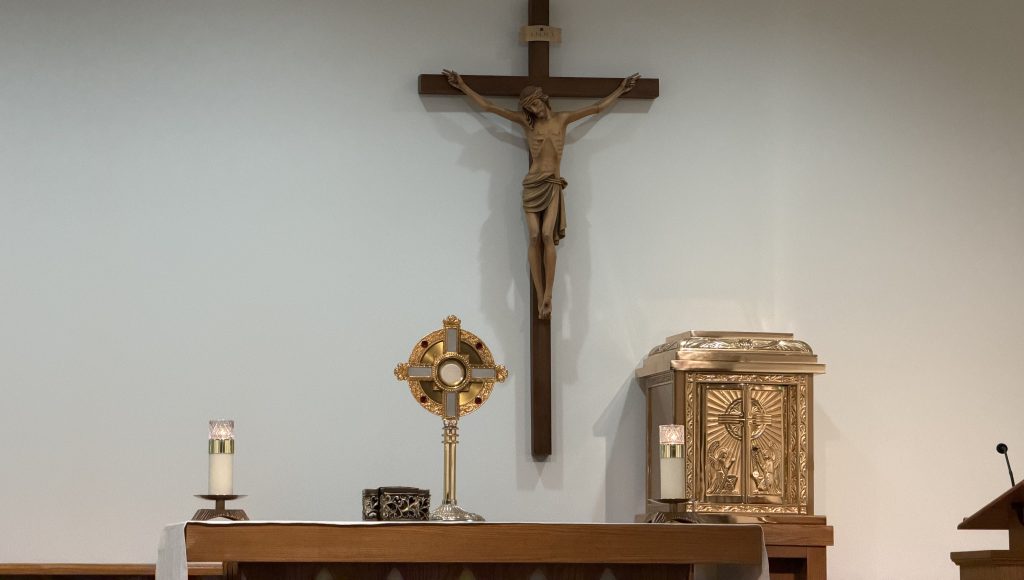
Photo: If we want the best sign of Jesus’ love for us, the crucifix is it.

Healy, Mary. The Gospel of Mark. Grand Rapids, MI: Baker Academic, 2008.

Link for the Mass readings for Monday, February 16, 2026

“What do you have, what can you offer?”

As Christians we are called to be disciples of Jesus, to learn about his life, his teachings, and follow him and his direction. This is not to be an academic exercise. Through reading, meditating, and praying with the Gospels as well as the whole of the Bible; participating in Sunday Mass and holy days of obligation, and if able, more often or even daily, receive Jesus in the Eucharist, we encounter and come to know Jesus.

Just as Jesus called each of the Twelve, we have been called, and as they modeled their lives around and were transformed by the love of Jesus, they and we are called to be apostles. Ones who are sent, as we are at then end of each Mass to proclaim and share that Jesus is who he said he is, and how he has affected our lives. Often when we are reminded of this message though, we may feel inadequate. We may question what it is that we can even possibly offer in an effort to help build the kingdom of God. We may feel we have nothing to share, nothing to give, nothing to say, or that what the Lord asks of us, we do not know how to even begin.

The Twelve expressed doubts and we see this on display. Jesus shows concern for the thousands who had just listened to him for three days and are readying to depart. He has satiated their spiritual hunger, they remained with him for three days listening! He now also is concerned about their physical hunger and that some may collapse or grow faint on their way home. The disciples were bewildered with Jesus’ request. How could they possibly feed the vast crowd of four thousand. Then Jesus asked,  “How many loaves do you have” (Mk 8:5)? With the minuscule amount, of seven loaves and a few fish, Jesus fed the multitude. “They ate and were satisfied” (Mark 8:8), with seven baskets of bread fragments left over.

Jesus asks us, “What do you have, what can you offer?” We may not have been asked or thought about this question before. We may not know initially how to answer. It is worth pondering. Where are there and who might have needs? Each day is a new opportunity to begin again and seek Jesus’ guidance. We can pray and meditate with this account from Mark. We can also look at a statue of Jesus we may have, a picture, a crucifix, or an icon. Then take some deep breaths, meditate on our present life condition, and assess where there is a need in our own life as well as those of others. Once we receive an answer or a nudge, then we can give what we have to Jesus.

Resist looking for the big response or grand plan. Ask yourself what you can offer no matter how small. What you give to Jesus, he will multiply and bring about amazing results. “Jesus takes what little his disciples have to offer, blesses it, and gives it back to them; in the very process the paltry amount mysteriously becomes more than enough to satisfy the needs of all” (Healy, 152). Jesus provides, Jesus works through us. We don’t need to be concerned whether or not we are capable or worthy. The question we need to answer is, “Are we willing?” If “yes”, then, with Jesus, all things are possible.


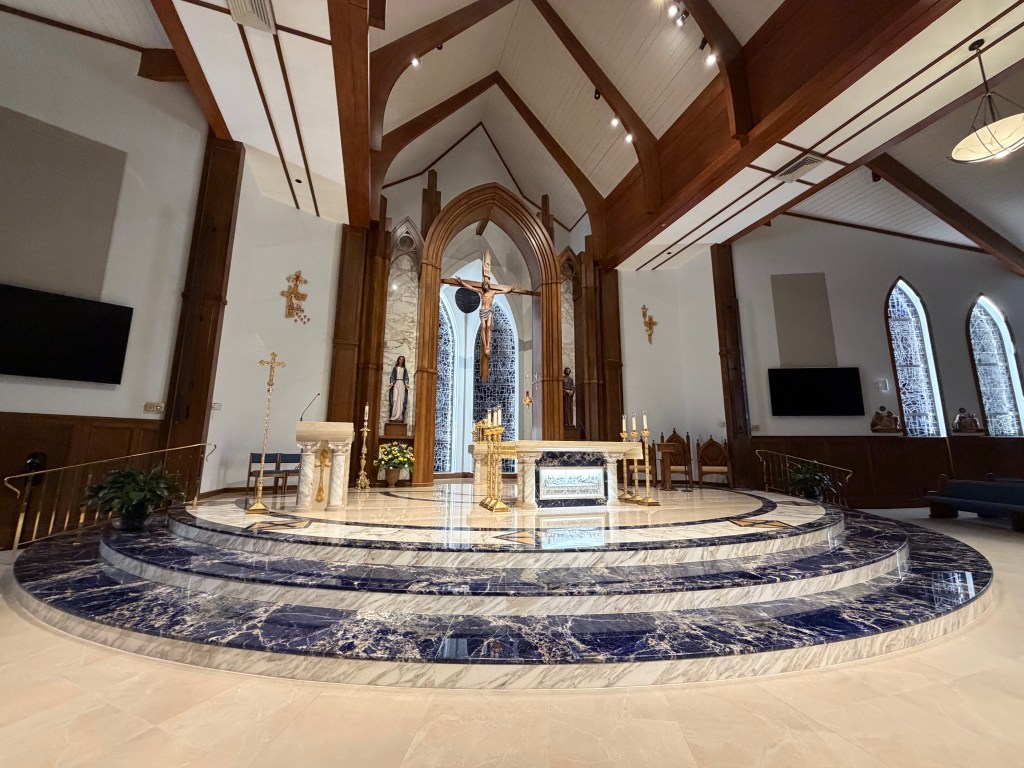
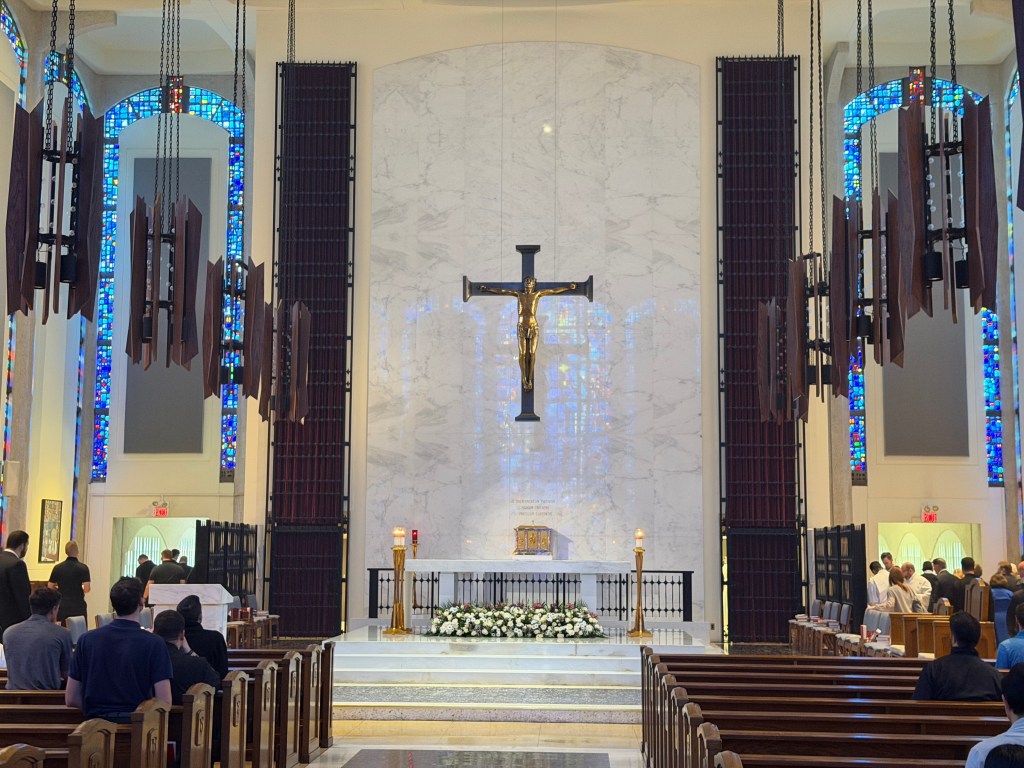
Photo: Some quiet time listening to Jesus, in the sanctuary of St. Gerard Majella Catholic Church, Los Angeles, CA.

Healy, Mary. The Gospel of Mark. Grand Rapids, MI: Baker Academic, 2008.

Link for the Mass readings for Saturday, February 14, 2026

The Syrophoenician woman exemplifies and models for us the courage and faith of a disciple.

In today’s encounter between Jesus and the Syrophoenician woman, we can observe again the crossing of societal norms. The woman, very much like the woman who had been hemorrhaging for twelve years, was desperate, faithful, and bold. She was “Greek” and a “Syrophoenician by birth” meaning that she was a Gentile in religious observation and also by birth. She then entered the home where Jesus was staying uninvited and “fell at his feet.” She was willing to risk breaking the social taboo of speaking with Jesus on one hand and entering into the place where he was staying uninvited on the other! She did so with the sole purpose that her daughter would be healed.

Jesus meets her with the derogatory language of equating her with a dog, considered one of the most unclean of animals by Jews: “Let the children be fed first. For it is not right to take the food of the children and throw it to the dogs” (Mk 7:27). This woman would have none of Jesus’ rebuke, she wasn’t leaving without receiving an exorcism for her daughter, even if that meant she was putting her life in danger. Her retort, “Lord, even the dogs under the table eat the children’s scraps”, emphasized this point. It was also the key that opened the door for the disciples and us to witness a consistent pattern with Jesus.

Just as the woman who was experiencing the hemorrhage (cf. Mk 5:25-34), both women had the faith and courage to approach Jesus. The outcome of this encounter was also similar to the one that Jesus had with another Gentile, the Roman centurion, who said that he was not worthy for Jesus to enter under his roof. In both accounts, Jesus healed solely by his word from afar. What is important to Jesus is the person’s faith and belief in who he is, was, and always will be – the Son of God!

Jesus’ apparent rebuke to the woman was more a statement of fact. He did come to proclaim the Good News to the “children” first, the chosen ones, God’s children, the people of Israel. And how sad was the day as we saw not too long ago when Jesus came to proclaim this message to those in his hometown and so few had the faith of this woman before him, a Gentile. Her faith not only saved her daughter from the possession of a demon, but was the opening for the Gospel to also be proclaimed to other Gentiles as well as to the Jewish people willing to believe.

Do we have the courage, faith, and belief in Jesus as did the Syrophoenician woman? Are we willing to take the risk of countering pressures from others seeking to divert our closer walk with Jesus? When we let nothing hinder us, including relinquishing control and the reigns of being our own masters, acknowledging that God is God and we are not, believing that Jesus is truly the Son of God and that he is still present and active in our lives, miracles still do happen! Jesus said that if we have faith the size of the mustard seed, we can move mountains (cf. Mt 17:20) and what we ask for in prayer, we will receive (as we shall see in Mark 11:24).

Life is hard. We or someone we know may be facing conflicts, challenges, sorrows, trials, and/or tribulations. We may be experiencing opposing forces that feel as big as mountains, or it may appear that Jesus himself is refusing our plea. Be not afraid! Trust in Jesus! He cares and is present and may just be allowing this time of suffering to awaken a deeper faith that has been there all along but has not yet been actualized.

Embrace any and all of the range of challenges and emotions that you are experiencing and lay them at the feet of Jesus, and then take his hand. With Jesus all things are possible. We just need to believe and trust that our Lord is present with us especially in the midst of our pain and struggles. Jesus has not left us as orphans. We are not alone, but we do need to, as did the Syrophoenician woman, have faith that Jesus is who he says he is. Jesus is the Christ, our Savior and Redeemer, he is present, the kingdom of God at hand, he cares and loves us more than we can imagine, and he will see us through step by faithful step.


Photo: The Woman of Canaan at the Feet of Christ by Jean Germain Drouais.

Link for the Mass readings for Thursday, February 12, 2026

Do we have the faith to be still?

“Why are you terrified? Do you not yet have faith” (Mark 4:40)?

Jesus asked this question of his apostles after he quieted the wind and the waves. These were seasoned fisherman, so for them this must have been quite the storm. They even thought that they were not going to survive it as the waves not only tossed their boat but it also began to take on more and more water. Then looking at Jesus, they turned to thinking that he was indifferent to their need, he didn’t care that they were perishing. Jesus cared. He slept because he trusted in his Father to take care of them.

The faith of Jesus in his Father was rock solid. The visceral threat of death did not shake his faith as it did his closest followers. This is the first time that they appeal to him as teacher. They are growing in their understanding of him, but they are not yet at the point of comprehending that he is the Son of God, who could even command the seas and to obeyed.

Jesus called his apostles and brought them into his inner circle so they could not only experience his teaching, healings, and exorcisms but also to get to know him as the Son of God. As with any relationships, this takes time, and their faith, their trust in him in all circumstances was still growing. But as we read yesterday, faith as small as a mustard seed, will bring large results. This would come to pass with the apostles as well in time.

We too may find ourselves in times of trouble. Our anxieties, fears, and insecurities are a good barometer of our faith in Jesus. Our emotions are human and good as they alert us to a real or perceived threats. The challenge is to discern the real from the perceived and to determine when the threat has passed and resist the temptation to play an unending loop in our minds that keep us stressed.

Where our emotions can present a problem is when we believe in, place our faith in, identify ourselves by them, react from and stay in the endless loop. We need to resist suppressing or feeding our emotions but instead, stop, breath, stretch and identify them. From a place of feeling safer, we can then address the immediate trigger. Trusting in Jesus in the face of our trials is also good step.

The apostles judged that he didn’t care instead of wonder how he could be sleeping through all this? Would he have brought them out into the deep to let them perish? Jesus quieted the their storm and he will help us to calm the real as well as the perceived storms in our lives. He can guide and empower us to sit with our emotions, get to the source of them, identify the deeper root causes, as well as if they are perceived or real, and then work through the them and the situation.

The apostles, did the right thing. They tried everything they could do to correct their dire circumstances, they judged incorrectly that Jesus didn’t care, but they still turned to him for help. We will be better off when we too continue to turn to Jesus in every situation. Our faith and trust in him will grow. We will heal, mature, and grow through the storms in our lives.

Easier said than done? Yes, for both our real and imagined storms. As we place our trust in Jesus, persevere, claim our authority in his name to renounce any attacks of the enemy, all things are possible!


Photo: As the clouds gather, the light still shines through. Taken on the way to celebrate a funeral Mass this morning. We need not fear death, for even it does not have the final say, Jesus does.

Link for the Mass readings for Saturday, January 31, 2026

In seeing and trusting in Jesus, we can experience peace and healing.

“Lord, now let your servant go in peace; your word has been fulfilled: my own eyes have seen the salvation which you prepared in the sight of every people, a light to reveal you to the nations and the glory of your people Israel” (Lk 2:29-32).

As Simeon receives Jesus in his arms to be consecrated to the Lord, he recognizes through the gift of the Holy Spirit that this child, is the one he and Israel have been waiting for. Simeon is witnessing the prophecy of Micah being fulfilled right before his eyes: “The lord whom you seek will come suddenly to his temple” (Micah 3:1). Jesus is the Messiah, the Christ. He has come to fulfill the Law and the Prophets as well as be a light to the Gentiles and to all the Nations.

These verses, called the Canticle of Simeon, as well as in Latin the Nunc Dimittis – from the first words of the canticle – now let depart, be dismissed, as offered above by Simeon, “now let your servant go in peace” was recorded by Luke and is recited each night by those of us who pray the Divine Office or the Liturgy of the Hours. They are prayed during Compline or Night Prayer, the last prayers before going to sleep.

The gift of reading a Gospel passage again and again is that when we are open, God can speak to us in deeper ways or help us to see something we have not seen before. We too can celebrate the birth of Jesus who is our savior, our fulfillment and our light also. We can see as Simeon saw, the face of God revealed before him and so he can go in peace. A good way to go to the land of dreams each night!

We are all invited to meditate with this same passage. We can enter the scene and, like Simeon, receive this child in our arms from Mary and Joseph. We too are invited to see the salvation that is offeredus, the invitation given to us. May we not run from the light of his truth, but may we embrace it so that we can be transformed. Let us glory in the joy of knowing that Jesus came to share his forgiveness, love, mercy, and grace, with each and every one of us. He is the promise of healing that we all need to realize and actualize in our lives.

Jesus invites but does not impose. This Christmas can be just another few days in a cycle of days that pass with no change, or we can immerse ourselves in the readings of this Octave of Christmas so as to take seriously the fact that Jesus is who he said he is, the one the prophets foretold, who the Apostles claimed him to be, and who the Church still announces him to be today: Jesus is the Christ the Son of the Living God. Do we also believe this truth?

I invite you to return to the meditation we started above and to hold the baby Jesus, our savior, in your arms as Simeon did. As you hold him look into his face, see his smile, the glint in his eye, and allow that exchange to melt away any sin of pride, lust, greed, envy, sloth, gluttony, prejudice, and/or wrath. Experience the warmth of his love radiate up from the depths of your soul to be filled with his joy to overflowing.

May we allow his gentle smile to penetrate those areas where we have not wanted to let anyone else in. Those places of pain, trauma, shame, grief, fear, and/or anxiety. In sharing our poverty, our imperfection, and to be willing to take off our masks, we can be loved in places we never thought possible. Let the image of Jesus’ smile be the healing salve that we did not even know we were seeking. As we trust in him and experience his healing, each night we then can go in peace, and each day we can rise and go forth to share that same smile and so radiate the love of Christ with those we encounter.


Painting: Arent de Gelder – the Song of praise from Simeon, ca. 1700-1710

Link of the Mass readings for Monday, December 29, 2025

To heal, we need to trust.

“You will be hated by all because of my name, but whoever endures to the end will be saved” (Mt 10:22).

Why are we talking about being hated the day after Christmas? One reason could be that Jesus, this baby whose birth we just celebrated is “the light that shines in the darkness” (Jn 1:5). The very reality of Jesus’ divinity exposes darkness, he is the very embodiment of Love that exposes evil and hatred.

St. Stephen, whose feast we celebrate today, and whose death we read about in the first reading from Acts, experiences his words personally. For he is killed for the sole purpose of speaking the Gospel. While during his persecution he sees and communicates how even the heavens open for him. The reaction to those who hear his words are infuriation and they then throw him out of the city and “stone him” (cf. Acts 7:54-59).

Stephen radiated the light, love, and wisdom of Jesus and like Jesus he was put to death. His persecutors felt threatened by the light instead of welcoming it and walking out of the darkness that held them bound. Jesus exposes the truth of those dark places within our own hearts, minds, and the very depth of our being as well. What is our response? Will we also reject the light, not aware that it is an invitation to healing and to wholeness?

We may wince at the luminous brightness of Jesus’ light and resist the intimacy of the love he seeks to share. We may unconsciously do so, because we have so often faced so much of the opposite; hurt, pain, betrayal, and lack of understanding or acceptance. Because of our past experiences we don’t want to be hurt again and so we assume a defensive crouch as the best way to protect ourselves. Unfortunately, we are protecting ourselves from the very One who can heal us from our wounds.

Yet, to be fully alive, we need to embrace the light, not hide from it. When we are open to the healing touch of Jesus and receive the gift of his light in our lives, we begin to die to our false self and the lies that we have believed. Allowing ourselves to breathe and rest in God’s loving presence helps us to heal, indentify, and allow Jesus to transform our vices into virtues. Once we allow ourselves to be loved by Jesus, we begin to recognize that we are turned in upon ourselves, and then we can adjust our posture and begin to open ourselves to him. We also begin to recognize that we are not the center of the universe.

As we follow the model of John the Baptist, St. Stephen, and the other saints, we become less so that Jesus becomes more in our lives. We too will face at times the same rejection that Jesus faced. We will be labeled crazy, out of step, simple-minded, irrational, and worse. Yet we are to resist returning to a defensive posture, to refuse to react in kind, but instead, to be present, call upon and trust in the Holy Spirit to give us the words to speak, and allow God to happen. We are to remain open, accepting of the person where they are and as they are, and share the same transformative mercy, love, and forgiveness that Jesus has offered to us.

Change, maturation, and growth is not easy. As disciples, we are to be disciplined and persevere, while at the same time remember that our redemption does not come from our own doing or will power alone. Our healing, restoration, and transformation comes when we are able to share our poverty, our weakness, and wounds with the divine healer. We begin to heal when we trust Jesus, even if only a little at first. When we accept his invitation to walk with him, let him in to our places of darkness, we will receive the healing salve of his love, mercy, and forgiveness.

Transformation is not a one-time event. Christmas is not just a day, it is not just a season. Christmas is a time to remember that Jesus came as an infant, as a savior that in no way is threatening. If we have not been able to trust Jesus, maybe imagine taking him into our arms as a baby and begin there. Allowing him to come close and hold him, will help our hearts and minds to soften and feel safe.

In becoming human in the most vulnerable way as a fetus in the womb of Mary, as an infant in a violent world, Jesus lived and thrived because he trusted in Mary and Joseph and his Father. When we trust in God and begin to know him as a person, we will see his guidance not as a threat, but as a way when we might experience no way. We can begin to experience peace even when in times of conflict and even persecution. We can resist the temptation to react in kind and instead follow the lead of the Holy Spirit for each thought, word, and action we choose.

————————————————————————–

Photo: To learn to trust, we need to first learn to breathe and slow down. Christmas Eve in between Masses.

Link for the readings for Friday, December 26, 2025