“Peace be with you all!”

Why so much violence? So many countries are and have been consistently embroiled by the ravages of war. Many countries, including our own, were founded on the taking of lands by force and oppression of aboriginal peoples. Too many of our youth and citizens die from gun violence and mass murders. So many examples of road rage, domestic abuse, human trafficking, terrorism – foreign and domestic, and the myriad of random acts of violence that continue daily.

We may hear goodwill speeches shared after each atrocity, participate in the petitions and intercessions ringing from our ambos and pulpits in our places of worship, and pray personally and in prayer groups, participate and/or witness demonstrations, marches, and votes for change. All the while, there are those working in the trenches of communities throughout the world, putting their own lives at risk, matching their words and prayers with their deeds. And yet, do any of these efforts make a difference?

There is a constant temptation of cynicism and despair biting at our heels, but let us never give in. There is a light the shines in the darkness of our fallen world, and there is hope that we can pray with and rest in from  Jesus’ Gospel from John: “Peace I leave with you; my peace I give to you” (Jn 14:27).

This peace that Jesus promises to leave with his apostles is a peace that is not of this world, a peace that surpasses all understanding (cf. Philippians 4:7), and this peace has been and continues to be offered to us as a gift. Many have indeed said, “If there is a God, well then, why doesn’t he do anything?” He did and he has. God sent his Son the King of kings and the Prince of Peace. The peace that God shares through his Son and the love of the Holy Spirit is offered to one person at a time. This is why when Jesus resurrected he only appeared to those he chose and not the whole world.

Jesus is to be encountered and his relationship is built one person at a time in each generation. Each of us have the invitation to accept or reject his invitation to believe in him, but so much more. Jesus invites us to be his disciples. Learning from and putting into practice his teachings, as did the original apostles and saints who in each generation have done just that, is the way we are to follow. We do this best when we surrender our minds and hearts and the very depths of our souls to the love and peace that Jesus offers and teaches.

Pope Leo XIV chose to do continue to offer our war worn and weary world Jesus’ peace with his first words as Pope: “Peace be with you all!” This “is the peace of the risen Christ. A peace that is unarmed and disarming, humble and persevering. A peace that comes from God, the God who loves us all, unconditionally.”

This peace of God that the risen Jesus offers is not some abstract formula and the command to love is not some pie in the sky universal love for all. The teachings and acts of peace and love that Jesus shares throughout the Gospels are very concrete, individual, and personal. Jesus interacts with people as people, not as numbers. He engages and directs us to do the same, by encountering, accompanying, and loving a person. The real question is not why isn’t God doing anything? The real question is why have we left the gift of God’s peace offered to us unwrapped?

If we want peace in our world or even our corner of the world, our hearts and minds must be open to receive God’s love. We must be still and receive, savor, and embrace the love he wants for give and then share with others what we have received and as he directs us to give. To receive and embrace the peace of Jesus, we must be willing to let go of our own weapons of hate, prejudice, cynicism, racism, division, selfishness, and the like. God created us as beings who are interconnected, which means that what one does affects all, for the sun rises and sets on the good and the bad alike.

If we want peace, as I believe all of us really do, we need to be more aware of and choose more intentionally our thoughts, words, actions, and even the expressions of our faces. The thoughts that we feed are the ones that bear fruit in our words and deeds. Figuratively and literally, we need to be willing to “beat our swords into plowshares and our spears into pruning hooks” (cf. Isaiah 2:4).

This verse becomes real in our lives when we choose to resist the temptation to react and choose instead to seek the guidance of the Holy Spirit. In the concrete, we can choose to disagree with someone without being  disagreeable or disrespectful. When we make a mistake and resist beating ourselves up over the process and instead learn from our misstep, and begin again. We also do so when we are willing to seek and offer forgiveness, acknowledge we need to be healed, are willing to be more patient and understanding and we can do none of these alone. We need a Savior, to heal us, save us, and lead us from our own darkness into his light.

Can we really bring about world peace? In some abstract form, for all people, for all time, no. What we can do is make a daily commitment to spending time with Jesus to receive his love, study, pray, meditate with and learn from him. Then we can begin to put into practice what we have learned and received. We can share the love and peace of Jesus with each other one person at a time.

—————————————————————

Photo: Pope Leo XVI’s first appearance praying for the Church and the world that we may receive and share the peace of the risen Christ. Credit: Dylan Martinez from Reuters 

Quotes of Pope Leo from full Urbi et Orbi message.

Link for the Mass readings for Tuesday, May 20, 2025

“Brothers and sisters, this is the hour to love!”

“Whoever has my commandments and observes them is the one who loves me” (John 14:21).

Especially in our modern western mind set, the idea of commandments and love are bristled at. Mostly this is because of abuse of power, abuse in relationships, and a weakening of trust in secular and religious institutions is still present for many.

Jesus though is clearly bringing commandments and love together, as he is sharing with his apostles in these beginning stages of his farewell discourse before his crucifixion, what he feels is most important to leave. His testament that he not only wants to share, but these final words he wants to impart upon them in such a way that they continue to learn and receive his teachings, put them into practice, and perpetuate them.

As commandment can lead one to bristle, love has many more superficial meanings than what Jesus means. One reason is that, even though the English language has a plethora of words to utilize and choose from, there is only one word for love and it is interpreted in many ways. In Ancient Greek, there are four words that are used to connote love. There is eros, which has to do with attraction. It is the beginning stage of love because we are drawn out of ourselves as we are attracted to another. The next word for love is philia, which aligns with friendship, a wanting to be together, to share between friends. If our love matures it moves from attraction or infatuation to friendship. The third word, storge, is the deeper love shared with family members which can be through blood or a deepening of friendship. The fourth word is agape, which is unconditional love, a sacrificial love.

When Jesus shares that we are to follow the commandments, he is not demanding that we do so as a tyrant would. He is providing the boundaries and parameters for us to grow and mature as people who love, who, in the words of St Thomas Aquinas, will the good of the other as other. As humans, we are social beings. We want to belong, to be accepted, and to be a part of. We seek meaning, purpose, and fulfillment in our lives. This is best done through cooperation and collaboration with God and with one another, striving to love unconditionally, agape.

As a good son of St. Augustine, Pope Leo XIV quoted Augustine in his inaugural Mass as Pope Sunday: “Lord, you have made us for yourself, and our heart is restless until it rests in you (Confessions, I: 1,1).” We are made by God to be loved and to love in return. Nothing we seek of this world will satisfy this deepest hunger that we all have in our soul besides the love God has for us. Unfortunately, we succumb to many disordered affections in pursuit of the love we seek. We are led astray by apparent goods that leave us hungry, thirsty, and wanting for more.

If we operate from a self-centered posture in which we are only turned in upon our self, and we only seek to manipulate and get from others, instead of working for consensus and sharing a common vision with others, we will ultimately be empty with the exchange on any level, because even in our relationships as with material things, we will be left wanting more. This is true because once the immediacy of the stimulation, whether material, personal, or sensual, ends, so does the experience of the feeling. Some happiness may linger from the effect, but we will never be filled or satisfied with that which is finite. We will continue to seek more and more until the pursuit of instant and constant gratification ensnares us and we are entangled in a web of addiction.

God’s commandments, grounded in love, are meant to provide boundaries for us, training wheels, and to keep us free from enslavement to sin, while at the same time help us to mature as persons moving away from being self-centered to becoming other-centered. Discipline in this way is meant to be a means of freedom for excellence such that we can become who God calls us to be and who we truly desire to be. God is not in competition with us. He is our biggest fan. As St Irenaeus wrote, the glory of God is the human being fully alive!

Commandments and morality imposed indiscriminately, without reason or an end goal is a bludgeon. Love and mercy without accountability and justice can be enabling. Jesus’ invites us to receive and observe his commandments so that we may be freed from disordered affections and so properly order and discipline our affections and passions to be free to love. Jesus knows what will truly fulfill and give us deeper meaning. May we trust in and learn from the deposit of faith passed on from Jesus to the Apostles, to each successive generation, as well as the ongoing guidance of the Holy Spirit who the Father sent in his name (John 14:26).

Pope Leo XIV continued to carry on Jesus’ teachings yesterday: “Brothers and sisters, this is the hour for love! The heart of the gospel is the love of God that makes us brothers and sisters.” We are brothers and sisters, disciples of Jesus, when we receive, rest, and abide in the love that Jesus offers us and come to realize that we do not do walk alone. As we receive and put into practice Jesus’s commandments, we love him and his Father, are given the discernment to reveal the lies of the enemy, we grow, and mature in our spiritual lives.

Let us allow the tender chords of the Holy Spirit’s love to draw us deeper into intimacy with him so that we can be transformed by his love, healed by his love, and freed from the false lures and promises that seek to divert us from being the beloved daughters and sons of God our Father that we have been created to be. As we allow ourselves to be loved, we, are “called to offer God’s love to everyone, in order to achieve that unity which does not cancel out differences but values the personal history of each person and the social and religious cultures of every people” (Pope Leo XIV).


Photo by Alberto PIZZOLI / AFP accessed from Catholic Herald

Quotes above from Pope Leo XIV from: Transcript of Pope Leo XIV’s Inauguration Mass

Link for the Mass readings for Monday, May 19, 2025

Jesus commands us to love. We can begin to do so by being a little more patient and kind with one another.

“I give you a new commandment: love one another. As I have loved you, so you also should love one another” (Jn 13:34).

All of creation is an expression and an outpouring of the divine love and communion of the Trinitarian love. Love, if it is true, goes out from the self to be there for the other. St. Paul wrote that love is patient and kind (1 Cor 13:4). These are virtues that flow out of our willing the good of the other as other.

When we act with patience, we love because we resist the temptation to react and strike out. We do not seek to protect our ego, but seek to understand and be present to the person. We are willing to see beyond their brokenness, we resist fueling and feeding their frustrations by not giving in to our own impatient responses, and thereby help to dissipate any growing negativity. We love when we make an act of our will to allow Jesus to love the person through us. A helpful way to do so practically is when we first feel any sense of reaction, we breathe. We slow down. We listen and ask the Holy Spirit to guide us on how best to respond.

When we are kind, we do so because we resist returning hurtful acts with acts of love, seeking nothing in return. We are kind because this is what it means to be a disciple of Jesus. We are not kind in the hope that people are kind in return. We are kind because that is the foundation of who God has created us to be.

So often we do not know what another is going through. When someone cuts us off in the course of our travel, we do not have to react in frustration, anger, or rage, but can choose instead to send a blessing, that the driver may find peace of mind, slow down, and have a safe trip. We can pray that all those driving may drive mindfully so all may be safe on the road.

When someone is short or curt with us, instead of reacting by being sharp or snarky in return, we can take a breath, and ask Jesus in that moment to be present in us and minister through us to the person in our midst. We can choose to be open to loving the person as Jesus loves us, accepting them as they are in that moment, and being willing to allow the Holy Spirit to be present in our encounter with them.

Some good beginning steps to love another is to be patient and kind in the moment, to smile, and offer a hand in greeting, and be available to listen. These very simple acts do have a cost in that our ego and focus on self becomes less, but what we gain in return is that Jesus becomes more and we see each other as human beings. In these simple acts we say to the other, even before we have said anything with our words, that they are important to us, they have worth and dignity, because we are willing to make the time to acknowledge and respect their presence, not reacting to and defining them by their weakness and brokenness in that moment.

“This is how all will know that you are my disciples, if you have love for one another” (Jn 13:35). Let us make a commitment for today to love one another as Jesus has loved us.


Photo: Came upon this mosaic on a walk after the first few days that I arrived here at Holy Cross. Blessed to have continually been welcomed by so many kind people here this past year!

Link for the Mass readings for Sunday, May 18, 2025

Jesus has come to show us his Father and ourselves.

Philip said to him, “Master, show us the Father, and that will be enough for us.” Jesus said to him, “Have I been with you for so long a time and you still do not know me, Philip? Whoever has seen me has seen the Father” (John 14:8-9).

Philip was one of the first of the apostles called by Jesus in Galilee (see John 1:43), and so had been with Jesus from the very beginning of his public ministry. He lived, learned, and traveled with Jesus. He experienced the power of his teaching with authority, the exorcisms, healings, and ways that Jesus interacted with him, the apostles, and others. Yet, he still had much to learn, as do we all about the core reality of who Jesus is.

Jesus, fully human, is also at the same time, fully divine. The struggle to understand this truth is on full display throughout the gospels. Those who believe in Jesus and have followed him, like Andrew and Philip, as well as the other disciples, are seeking to understand, but as we see with Philip in today’s account, they still fall short of the height of the truth regarding who Jesus really is. Which is understandable, because to understand that Jesus is who he says he is, “I and the Father are one” (See John 10:30), is beyond our rational comprehension.

This is why so many within the leadership of the scribes, Pharisees, Sadducees, and the Sanhedrin (The Jewish High Council) are so vehement about crushing the rise of Jesus and his popularity. They understand Jesus very clearly, that by his very words and actions, he is declaring himself to be God. To them, that a human being could be God is blasphemous. So they seek to crush this heresy.

like the apostles, there are others who saw Jesus differently. They expressed faith and trust in Jesus. Their hearts and minds were open that there was something about Jesus. They did not feel threatened, but something in the depths of their souls was moved to follow and stay close. Peter and Martha remained close and in time experienced deeper, spiritual insights. Peter, when Jesus asked the apostles, “Who do you say that I am?” replied, “You are the Christ, the Son of the living God” (see Mt. 16:15). During the exchange between Martha and Jesus regarding her brother Lazarus’ death, when Jesus asked her if she believed that he was “the resurrection and the life; whoever believes in me, even if he dies, will live… Do you believe this?” Martha said, “Yes, Lord. I have come to believe that you are the Messiah, the Son of God” (see John 11:17-27).

Even with these insights, Peter and Martha, still did not comprehend the fullness of who Jesus taught and revealed himself to be. As the apostles and other disciples would trust and grow in their understanding of Jesus so would the Church in the succeeding generations seek to understand and develop the truth of who Jesus is as well. From the Councils of Nicaea (325) and Constantinople (381) we received this line about the identity of Jesus in the Creed that each one of us affirms each Sunday: “I believe in one Lord Jesus Christ, the only Begotten Son of God, born of the Father before all ages. God from God, Light from Light, true God form true God, begotten, not made, consubstantial with the Father”.

This statement clearly affirms Jesus’ teaching that he and the Father are one. One God, while at the same time distinct in person and operation as Father and Son. Who Jesus is in relation to his human nature also was further understood as the hypostatic union. This is the dogmatic teaching that Jesus is one divine person, while experiencing two natures, fully human and fully divine. The incarnation is that historical event in which through the full ascent of Mary’s, “Yes,” the Son of God through the overshadowing of the Holy Spirit, entered the womb of Mary and took on flesh. The Son of God became human.

The Council of Chalcedon (451) helped to clarify this point of the two natures of Jesus subsisting in one divine person. Jesus has “two natures without confusion, without change, without division, without separation – the difference of the natures being by no means taken away because of the union, but rather the distinctive character of each nature being preserved, and [each] combining in one person and hyspostasis – not divided or separated into two persons, but one and the same Son and only begotten God, Logos, Lord Jesus Christ; as the prophets of old and the Lord Jesus Christ himself taught us about him, and the symbol of the fathers has handed down to us” (Pelikan, 264).

Jesus’ characteristics and natures of the divine and human are distinct. There is no co-mingling, no mixing of the divine and human. Jesus is not a stew or smoothie of the divine and the human. Nor are there two distinct persons in Jesus. Jesus is one divine person. He remained the Son, fully divine at the moment he took on flesh, and in that moment became fully human. As St. Irenaeus wrote, “The Word of God, our Lord Jesus Christ, who did through His transcendent love, become what we are, that he might bring us to be even what He is himself” (Against the Heresies).

What God the Father did in time and space, as an outpouring of his love for us, was to send his Son to become one with us in our humanity so that we can become one with him in his divinity. Jesus, fully human and divine, showed the face of his Father to Philip, the apostles, and all those who met him. He still does so with us today. In instituting the sacraments, especially in his Body and Blood, present in the Eucharist, he gave us a way to grow in greater intimacy with himself and his Father so that we can also experience the love they share between them, the Holy Spirit.

This truth, to be affirmed in each of us will not come about through just an intellectual pursuit or exercise. We come to know Jesus as one divine Person subsisting in two natures, the human and divine, not by memorizing this fact. We come to know the fullness and truth of who Jesus is by knowing him. A simple way we can begin, is to begin each day, before doing anything else, by being still and breathing, slowly and deeply. We listen and become a friend with silence for God speaks in the silence of our hearts.

Then think back over the last 24 and recall at least three people or things we are grateful for, no matter how small. Then make an intentional act to dedicate this day to Jesus by asking for his guidance to improve upon one thing in our lives as well as one way that we can help someone in a simple and concrete way. These simple choices of slowing down to be silent, pondering who and by what we have been blessed, and opening ourselves up to Jesus’ guidance and will, will help us to know Jesus a little more today than we did yesterday and our relationship will not only grow with him but as well, with those in our lives.


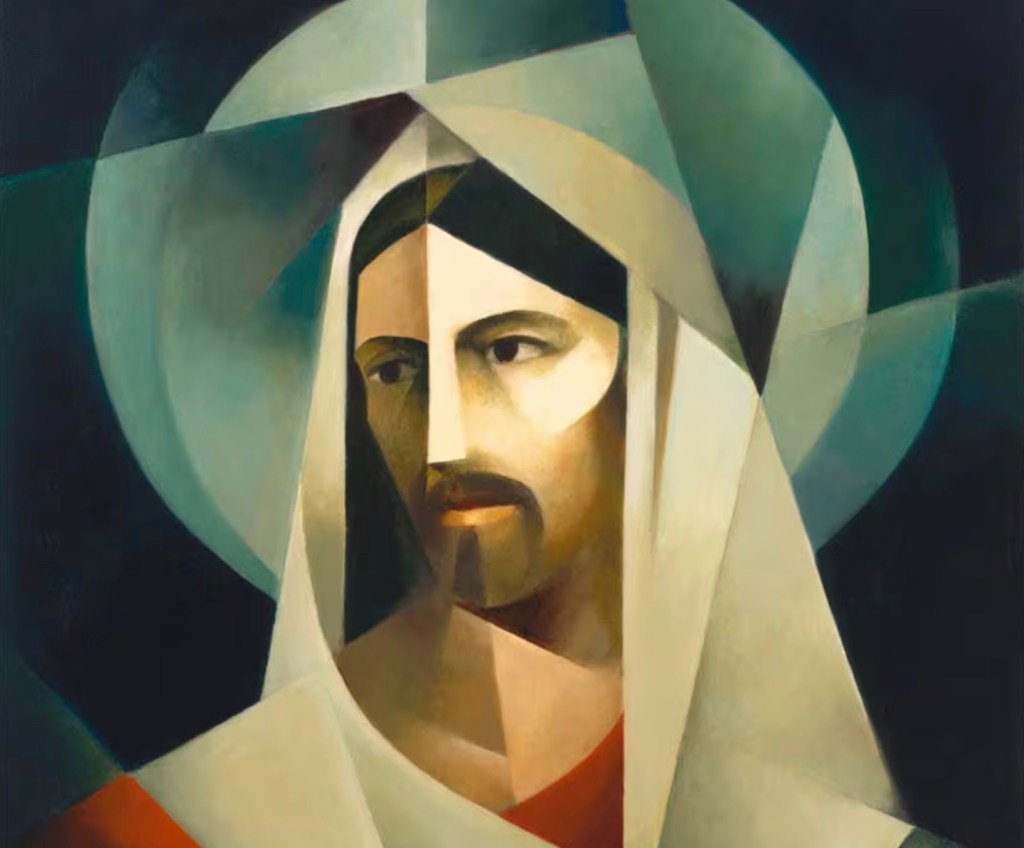
Painting: “Christ Divine” by Jorge Cocco accessed from Altus Fine Art blog.

Link for the Mass readings for Saturday, May 17, 2025

Pelikan, Jaroslav. The Emergence of the Catholic Tradition (100-600). Chicago and London: University of Chicago, 1971.

Accepting Jesus’ invitation to slow down can help us to grow in our relationship with him and experience more peace.

Our days are so full of activities, conflicts, health issues, technological stimulation, 24/7 news cycles, social media interaction, challenges, polarization, as well as good and healthy activities, pursuits, interaction, and engagements which can all contribute to our emotional, physical, psychological, and spiritual weariness. If we do not have the proper foundation and orientation, we can feel stretched, hollow, and/or fatigued at best. One day can seem to blend into another, and another, and another. The image of being on a hamster wheel or an unending treadmill can fall afresh in our mind’s eye when we actually do take a minute to breathe. Anxiety, worry, stress, fear, prescriptions, and addictions all appear to be on the rise and swirling out of control.

Is there an answer to this hyper pace or are we doomed to just keep going until the wheels fall off? The opening verse in today’s reading provides an antidote when we are feeling any or all of the above.

Jesus said to his disciples: “Do not let your hearts be troubled. You have faith in God; have faith also in me” (Jn 14:1).

Jesus was speaking specifically to his disciples after he had talked to him about leaving them. He was going back to the Father through the way of the cross. No matter the challenges that we face, even death, our own or a loved ones, we are invited to place our trust in God through his Son, Jesus. By putting God first does not mean that the externals to our life will immediately take an abrupt turn for the better. What establishing a foundational relationship with Jesus does mean is that we will have support and divine assistance. We are not alone in our struggles. The disciples found this out when in the midst of a sudden sea squall. Their boat was taking on water as the waves grew higher such that they were terrified and so, called to a sleeping Jesus. Jesus awoke and with a word, he calmed the sea (cf. Mk 4:35-41).

Jesus may or may not calm the sea of our trials and tribulations, but what he will do is be present with us through our storms in life and we can trust in him that he will guide us through. As we grow more confident in our trust in Jesus, we will be assured that no matter who or what comes at us, he will be there to assist us. We will experience a peace that surpasses all understanding and calm within ourselves. The ultimate assurance that Jesus provides is that when we surrender our life to him, we belong to him, we are not alone or orphaned. He gave his life for us, to redeem and save us so that we can be assured of our home for eternity. “I will come back again and take you to myself, so that where I am you also may be” (John 14:3).

Jesus promised he will come back for us at the hour of our death. He is preparing a place for us in the heavenly kingdom. We do not have to just wait for him to come back though. By growing in our relationship with him now, we enter into and participate in the loving relationship Jesus shares with his Father and experience the love of the Holy Spirit.

If we are struggling at any level and are seeking to build our trust and faith in Jesus, it is important to proceed patiently. God works slowly and this goes against our seeking of instant gratification. God is building a foundation in us which is meant to last not only in this life but in the next. When we make time to sit at the feet of  Jesus, slow down and breathe, ask for his help, seek his discernment about where we can make changes in our life, he will lead us. We just need to trust him and be willing to follow his lead.

This time does not need to be lengthy, three to five minutes a day to start can do wonders. On the surface level, by stopping for five minutes to pray and breathe more deeply and consciously, we get off the wheel, we step out of survival and reaction mode, so that we can then make more intentional and insightful decisions, and we can come to see that we truly have options, but more importantly, we begin to develop a relationship and intimacy with Jesus so to begin to recognize his voice in our stillness and in our activity. When we show up, God will happen.

The Liturgy of the Hours, and the daily readings of the Mass, meditating, praying, and contemplating the word of God have been foundational for me and my transformation, healing, and growth. Over my two years at the seminary, I was also introduced to practicing a holy hour of prayer, often before the Blessed Sacrament daily. Each of these practices have become foundational and non-negotiable anchors in my day. Setting the time aside with my busy daily schedule has been a challenge over my first year of priesthood, but doing so has helped me to better prioritize my time and seek the guidance of Jesus to guide me.

Having set times to stop to meditate and pray throughout the day has been helpful, especially on those days when my schedule is full to overflowing. Author Wanda E. Brunstetter, wrote, “If you are too busy to pray, you are busier than God wants you to be.” There is a lot of truth in her statement. I have had busy days, weeks and months, where I have wondered if taking the time to pray and meditate was really the most sensible choice. Time and again doing so has made an incredible difference and has now been helping me better reevaluate what I schedule into each day. 

The Rosary is another great way to get into God’s word by meditating on the mysteries of the life of Jesus and Mary. If you are not able to pray the whole Rosary in one sitting, start with one decade a day. Read for a few minutes from the Bible once in the morning and then return to meditate on the same verse or verses that touch or challenge you throughout the day. You can also read the daily Mass readings and place your self in the scene and allow the account to open up before you as if were actually there.

Each of these practices offer us a few of the many ways to stop the madness, to slow down, simplify, and connect with the power, the love, and the grace that Jesus yearns to share with us such that no matter the external or internal upheaval, we may experience his peace, that peace that surpasses all understanding (cf. Philippians 4:7).

—————————————————–

Photo: Jesus is “the way, the truth, and the life” (John 14:6) . Let us trust him, take his hand, and follow his lead.

Link for the Mass readings for Friday, May 16, 2025

Baptism, foot washing, and crucifixion show the depth of Jesus’ love for us.

Today’s Gospel from John begins as Jesus had just finished washing the feet of his disciples. Jesus then said, “Amen, amen, I say to you, no slave is greater than his master nor any messenger greater than the one who sent him” (Jn 13:16). Jesus not only taught the truth that God the Father sent his Son to serve and not be served, he modeled this practice consistently.

From his conception, gestation, and birth, the Son of God developed as a human being in the very simplest of conditions and endured the hardships of those on the margins. Joseph, Mary, and Jesus were political refugees very soon after his birth. The young family was forced to flee from Bethlehem to Egypt. When Herod the Great died they returned to Nazareth, and other than the incident when he remained in the Temple while Jospeh and Mary left him, we hear nothing about the life of Jesus until he begins his public ministry. The most likely reason for this was that there was nothing to tell. Jesus most likely apprenticed with Joseph, in the trade of a simple tektōn, a woodworker, which was pretty low on the rung of the social ladder.

Through the short time of his ministry, Jesus modeled for his disciples what a follower of his entailed and what it meant to be one of his successors. To follow in his footsteps they would need to participate in servant leadership. He not only taught them but lived and modeled that there is no task too menial that we can’t roll up our sleeves and dive in to help. There is no person too other that we can’t assist when they are in a need.

In this act of washing the feet, Jesus is also revealing something deeper. The depth of his love for the apostles and each of us. The Son was willing to come close, to become one with us in our humanity, to be in solidarity with us even in our sin, so that he could take the sin of the world upon himself first at his baptism and then upon the cross. In the washing of the feet, he is also showing the depth of his love in caring for them in such a menial way, that is another foreshadowing of the depths of his love in his willingness to give his life in a humiliating and horrific way for all of humanity.

Jesus, as fully divine, did not grasp at his divinity or lord it over anyone. He was willing to be baptized even though he is free of sin, to wash the feet of his apostles in the most menial of tasks even as master and teacher, and was willing to experience crucifixion and death as the Messiah. In each of these acts, Jesus reveals the full giving of himself and holding nothing back of himself from us. Jesus is encouraging his apostles and us with every breath, thought, word, and action to love each other as he has loved us.

A good prayer and meditation for us today is to ask Jesus to reveal for us how we have resisted his urgings in the past regarding serving and loving others as well as when we have refused to interact or treat someone with anything less than the basic human dignity which they deserved which is to love each other, to will each other’s good. Have we ever thought that what he was asking of us was beneath us? Have there been people we have kept at arm’s length or refused to reach out to? For those ways in which we have withdrawn within ourselves and refused to be of help may we ask for his forgiveness.

Being willing to allow Jesus to shed some light on our lack of embracing opportunities to be loved and to love in return is a good place to begin. Then renewed with his forgiveness, mercy, healing touch, and having been loved, may we be more willing to be bearers of the love, mercy, and understanding that we have received. May we be more open to each of the people and/or tasks that God will place before us, the discernment to know his will, and the clarity and courage to act as his servant with humility, with love, and without hesitation.
—————————————————————————-
Photo: Are we willing to reveal our needs to Jesus, to allow him wash our feet, to allow him to address our needs, and then be willing to serve the needs of others?

Link for the Mass readings for Thursday, May 15, 2025

When we are willing to die to our selfishness, we will love as God loves us.

“I have told you this so that my joy might be in you and your joy might be complete” (John 15:11).

What is this referring too? “If you keep my commandments, you will remain in my love, just as I have kept my Father’s commandments and remain in his love.”

And what is his commandment? “This is my commandment: love one another as I love you.”

Even when life appears pretty dark and division and suffering seem to be waiting around every corner, we need not give up or fall into despair. God wants us to experience fulfillment, meaning, and joy despite our experiences and not through being lemmings or slaves but as Jesus said, his “friends”. The friends of Jesus are those who hear the word he has received and shared from his Father which are his commandments, the greatest of these is the commandment to love as Jesus and the Father have loved us.

If we truly want to be happy, fulfilled, and have meaning in our lives, Jesus invites us to align our wills with the will of God who is Love. St. Irenaeus taught that the joy of God is the human being fully alive. For us to be fully alive, we need to allow ourselves to be loved by and then love as God loves us. God knows what will fulfill us. Many of us do not experience the fullness of this joy because we are distracted and diverted by apparent goods, instead of striving for what actually is good. Time and discernment with the guidance of the Holy Spirit can help us to distinguish the difference.

Neither will we experience fulfillment and joy through denying, covering over, or being so busy that we don’t face the sufferings in our or other’s lives. We ease suffering by entering into it and receiving God’s loving embrace. He will heal us when we are willing to experience our pain. When we experience our pain with him, we receive his mercy and love, and experience healing at the root. As we heal, as we experience God’s love, we can then help to alleviate some of the sufferings of those around us.

“To love as God does, we must be constantly dying to our own sinfulness and selfishness and living for God. And we live for God by obeying the Father’s will and loving one another” (Martin and Wright, 260). Each day we are invited to choose to curl up in our shell of selfish concern or allow ourselves to be loved and to love in return, to come out of our shell, to risk, and become agents of healing and love. As agents of God’s love and mercy we can help to make our corner of the world a little better.


Photo: With JoAnn, who taught me how to come out of my shell, to live, and to love.

Martin, Francis and Wright IV, William M. The Gospel of John. Grand Rapids, MI: Baker Academic, 2015.

Mass readings for Wednesday, May 14, 2025

“No one can take them out of my hand.”

Jesus continues to present the imagery of the shepherd in today’s Gospel reading from John. He offers the assurance of security and protection that is to be found for those that are in his fold when he says, “No one can take them out of my hand. My Father, who has given them to me, is greater than all, and no one can take them out of the Father’s hand. The Father and I are one” (Jn 10:28-30). How does one enter the fold of the Good Shepherd? All who hear his voice, believe in, and follow him will be known by him, come to know him, and so be a part of his flock.

Yet, there are those who hear his voice and do not recognize the Shepherd. They do not follow him and so are not known by him, although he seeks them out. They may know about the Shepherd, have heard of him, but do not know him. Their hearts and minds are closed. They do not believe in his miracles, his exorcisms, his teachings, and the question of those opposing him in today’s reading is, “If you are the Messiah, tell us plainly” (Jn 10:24). Jesus did just that by saying that he and the Father are one. The response to the forthright comment of Jesus is that those who are closed to his answer pick up rocks to throw at him (see Jn 10:31).

Jesus offers the gift of relationship with him and his Father, to experience the love shared between them, the Holy Spirit. Jesus offers eternal life. Jesus is open about who he is, who we are, and who we can become in participation with him. Those who say no to his invitation do so for their own reasons. Just as Jesus invites us to freely come to him, he will only come so far as we are willing to receive him. He does not conform to us or to our will.  Jesus does not need us nor does he force his will upon us, yet he loves us by willing our ultimate good.

Even we who have said yes, only go so far. We hedge our bets, dip our toes into the water, and maybe go in ankle-deep, but not too many of us are willing to relinquish control, let go, and surrender fully all at once. Jesus offers, eternal life, true, but also a life of meaning and fulfillment now. A perfect life? No, there will continue to be challenges, conflicts, mistakes, and missteps, all the while, Jesus’ voice continues to call us to follow him, to trust him, and seek freedom from our anxieties, fears, wounds, weakness, and sins. He empowers us to face our conflicts and resistances, to let go of our control and defense mechanisms, and to be more disciplined in resisting temptations and apparent goods.

Through all our experiences, the ups and downs, the only assurance is that we are not alone. No matter what we may face today or tomorrow, we can be assured that Jesus will never let us go and no one can take us out of his hand. Each step of the journey we take, we can be confident that Jesus, our Good Shepherd, will be there to guide and protect us as he leads us to experience deeper intimacy with him, his Father, and the Holy Spirit.

——————

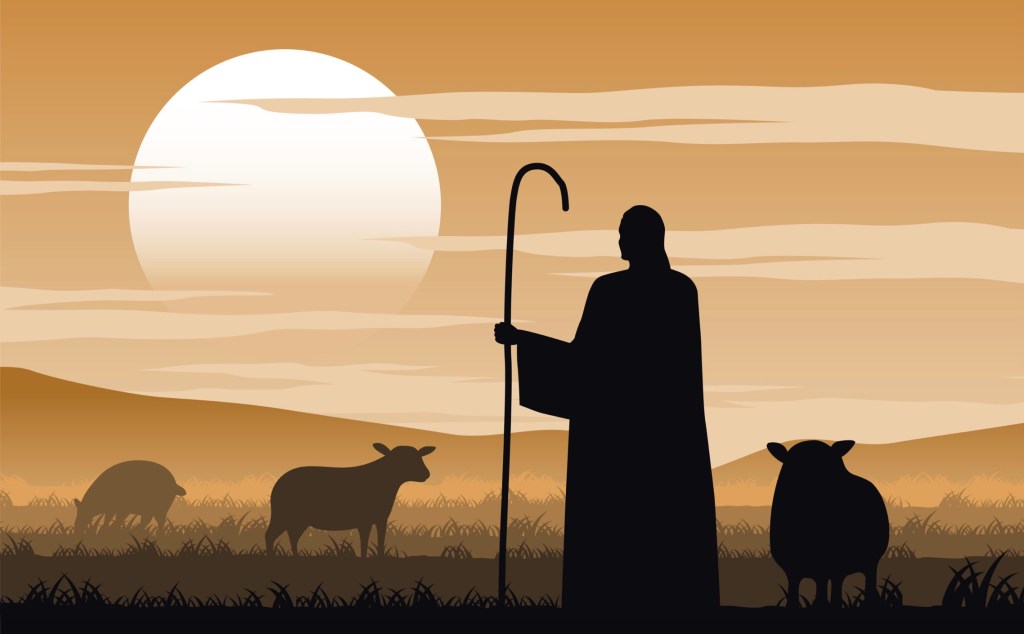
Painting: Accessed on Amazon.com wall art

Link for the Mass readings for Tuesday, May 13, 2025

Let us trust in the Good Shepherd who loves and will take care of us.

“[T]he shepherd calls his own sheep by name and leads them out” (John 10:4)

Jesus, distinguished himself as the Good Shepherd who cared for his sheep instead of “thieves and robbers” who sought to harm the sheep. In referencing, “thieves and robbers” Jesus continued his calling out those Pharisees from chapter nine. Those who did not listen to his voice and those who were not leading God’s sheep with care.

The imagery of the shepherds is an echo back to past abuses such as in the time of Ezekiel who spoke out against those leaders who had “been pasturing themselves”, and who failed to “strengthen the weak nor heal the sick nor bind up the injured”. Thus the sheep of God’s flock, were scattered for lack of a shepherd, and became food for all the wild beasts. They were scattered and wandered over all the mountains and high hills; over the entire surface of the earth my sheep were scattered. No one looked after them or searched for them” (Ezekiel 34:2-10).

God, the eternal Shepherd, spoke through Ezekiel and said: “I will take my sheep out of their hand and put a stop to their shepherding my flock, so that these shepherds will no longer pasture them” (Ezekiel 34:10). Jesus is the fulfillment of Ezekiel’s prophecy. Jesus is the Son who God sent to do just that. Jesus has come to gather the lost sheep and bring them to green pastures, and lead them with his voice to eternal life.

Even today, we have experienced so much abuse of power and corruption, self-seeking and self-aggrandizement, that we are weary and have lost faith in our leaders and institutions. Yet, all is not lost. Jesus is still among his flock and calling his sheep to himself. Let us not be deaf to the call of the Good Shepherd because of the “robbers and thieves” that have climbed over the fence and into the sheepfold.

Let us instead, listen for the voice of the Good Shepherd. We do so when we make the time to be still and wait upon the Lord to call. We do so when we resist the temptation to run away or react out of fear. We do so when we are patient and trust in the voice of the Good Shepherd who has our best interest in mind and will care for us. Jesus will not harm us, he loves us. We may have been wounded or hurt when we have gone astray or even when we thought we were safe in the sheep pen. We can trust Jesus when he seeks to come close. His healing may provide suffering for a time, as healing will do, but as we remain close to him, his healing balm will prevail. We will be healed, renewed, and restored.

Jesus loves us, knows and calls each of us by name. Mary Magdalene in her grief didn’t recognize Jesus when she met him after his resurrection, but when he called her by name she recognized his voice. May we, like Mary, remain still long enough so that we can allow the Good Shepherd to come close, trust him, and his voice even amidst the cacophony of so many other voices, robbers, and thieves. May we be patient and only move when the Good Shepherd calls our name and then follow his lead.


Photo: Accessed from IG Post: Strength_in_jesus_1

Link for the Mass readings for Monday, May 12, 2025

When we spend time with the Good Shepherd, we will come to know his voice, as well as know, trust and follow him.

“…the sheep follow him, because they recognize his voice” (Jn 10:4). This verse is one of the keys to growing in the spiritual life and becoming a disciple of Jesus. Amidst all the voices, distractions, diversions, and temptations clamoring for our attention, we want to develop an ear to hear and a mind to discern the voice of the Good Shepherd. There are so many directions we can take and opportunities we can be enticed by, many that are detrimental, but more challenging those that are good in and of themselves.

Jesus came to us so that we “might have life and have it more abundantly” (Jn 10:10). To live life, not merely survive, and do so abundantly, it is imperative to be able to discern the distinction between apparent goods and the true Good. An apparent good is appealing, attractive, and desirable, though once experienced, we conclude that it was indeed not good for us after all. We can see this in the promotion of processed foods, with additives and an excess incentive of enticing the taste buds with salts and sugars. The experience of eating many of these products is that they taste good going down, especially if eaten quickly and not savored, such that we can often eat them to excess. They not only have little, if any nutritional value, more importantly, if this is the main source of our nutrition, over time, we will feel the ill effects of eating in this way. They will actually sap our life force.

The same is true regarding how we spend our time and treasure. We all have the same amount of time in the day. In what ways do we use our time, who is it that we are listening to regarding how we use the time we have been given? What are we investing our time and treasure in? Do we listen to the Father of Lies or the Good Shepherd?

A good practice for developing an ear to hear the voice of the Good Shepherd is to resist making decisions impulsively, unconsciously, or from reaction, no matter how small the decision may be. When we discern, let us slow ourselves down by first taking a few, deep slow breaths and call on the guidance of the Good Shepherd. This is good to do in all areas of our lives. Let us pray before we speak, think, or do anything! We can ask ourselves each time, is what I am about to decide hindering or helping me to become a better disciple, to grow closer in my relationship with God, to be true to myself and who God is calling me to be?

When we combine this with a daily practice of reading, praying, and meditating with the words of the Bible, participating in Mass, and Confession, over time and through various experiences, we will come to better discern the voice of Jesus. Having a core group of people who we can trust is another avenue of hearing God. Having the humility to receive their perspectives and to help keep us accountable helps us to stay on the path. In dedicating ourselves to follow the way of the Good Shepherd and resisting to stray when distractions and diversions arise, we will not only be more confident in knowing the voice of the Shepherd, we will begin to know the Shepherd himself.

The wicked shepherds of the Old Testament and the religious leaders we heard about today, refused to listen to the voice of God or Jesus.  Jesus shared that he and the Father are One, and the line of hardening of the heart continued. They did not know the Shepherd’s voice nor do they know him. They did not know the Son nor the Father who sent him. Ezekiel prophesied that God would come himself to gather his flock (cf. Ezekiel 34). He did so in the person of his Son whom he sent. For as Jesus said, “I and the Father are One” (John 10:30). Do we believe, do we hear, and if we do, will we follow the Good Shepherd this day and each day?


Photo: Accessed from stlukesokc.org

Link for the Mass readings for Sunday, May 11, 2025