Elijah, the prophets, and John prepared the way for Jesus the Way.

The disciples who asked the question, “Why do the scribes say that Elijah must come first?” (Mt 17:10) were Peter, James, and John, who had just witnessed the transfiguration of Jesus. They were walking down from the Mount of Transfiguration, tradition identifying this mountain as Mt. Tabor, and the context of the question had to do with, Moses and Elijah, who they saw with Jesus as he revealed to them his divinity.

As the disciples were attempting to digest this Mystery of the Transfiguration just witnessed, they were drawn back to what they knew. Most likely what they were referring to were the accounts in the Books of Sirach and Malachi. In Sirach 48:10, we too can read that, “You [Elijah] are destined, it is written, in times to come to put an end to the wrath before the day of the Lord, to turn back the hearts of the fathers toward their sons, and to re-establish the tribes of Jacob.” In the last chapter of the Book of Malachi, which is incidentally the last lines of the Christian Old Testament ordering of the canon, are the words: “Remember the law of Moses my servant, which I enjoined upon him on Horeb, the Statutes and ordinances for all Israel. Lo, I will send you Elijah, the prophet, before the day of the Lord comes, the great and terrible day” (3:22-23).

Moses in this encounter represents the Torah, the Law or Teachings, and Elijah represents the line of prophets. Elijah also, as we can read in 2 Kings 2:11, was taken up by God into heaven, amid “a flaming chariot and flaming horses… and Elijah went up to heaven in a whirlwind”, and, it was believed, that he was to return again at the appointed time of the Messiah’s coming. Jesus clarified for his disciples that John was indeed the new Elijah. In the revealing of his divinity to Peter, James, and John, Jesus showed that he was the fulfillment of the salvific paths forged by Moses, Elijah, the line of prophets, and John the Baptist.

Jesus is the fulfillment of the Law and Prophets as well as our fulfillment. We are invited to prepare the Way of the Lord in our hearts and minds, to become less so that Jesus can become more, as well as to help prepare the way for others. When I began to attend church again in my late teens, I went to the Congregational Church that was about a half-mile walk from our home. At the end of that first service I attended, the interim pastor made an appeal for Sunday School teachers.

One of the things he said was that we do not know who Jesus’ Sunday School teacher was and he referenced that we could be teaching Jesus and not be aware. He was not speaking literally but his point rang true: we have the responsibility to continue to pass on the Greatest Story ever told. Also, his appeal was an avenue for the Holy Spirit to speak through him to me, and although I refused the invitation the first week, I accepted the following week. What might Jesus be inviting you to do this Advent? Trust in him and his invitation.

My trusting in the nudge of the Holy Spirit and “yes”, to teaching Sunday School, not knowing the first thing about what I was doing, thinking I was too young and way too inexperienced, both true, would eventually lead me back home to the Catholic Church, to the Franciscans, then leaving and to marriage, becoming a step-father, school teacher, permanent deacon, and now as I am typing, blessed to  be serving as a priest.

Let us all take heed of the invitation from the prophets and John the Baptist, summed up by Jesus, and carried on by the Apostles: “This is the time of fulfillment. The kingdom of God is at hand. Repent, and believe in the Gospel” (Mk 1:15). My journey has not come to an end and neither has your’s.
———————————————————
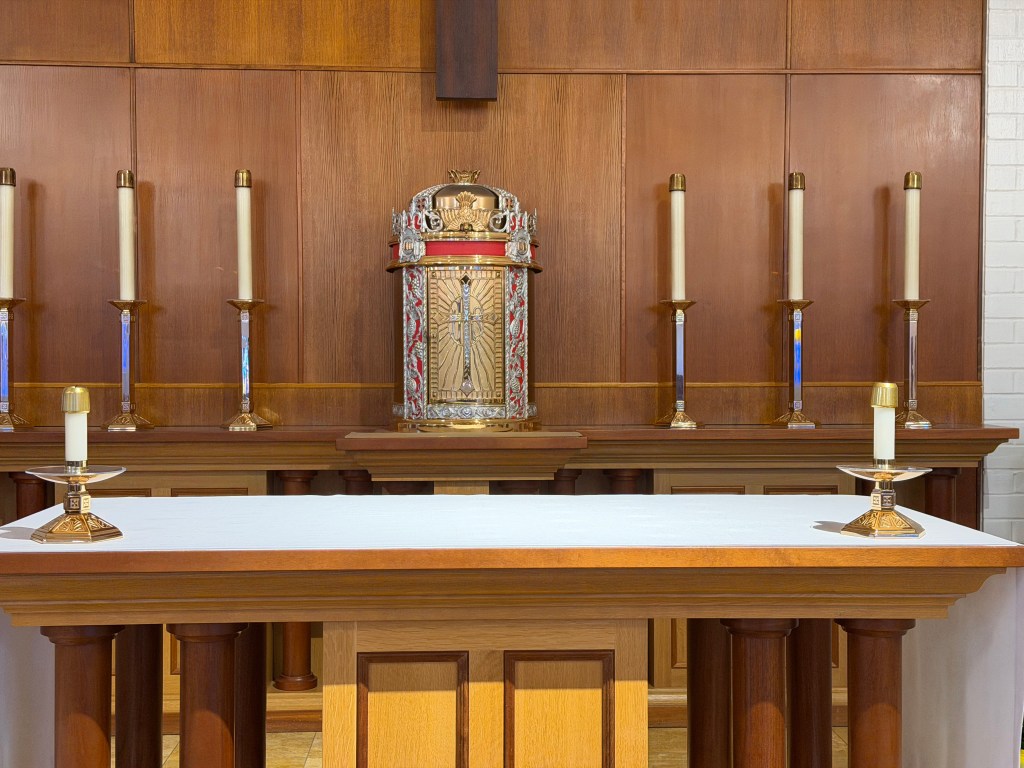
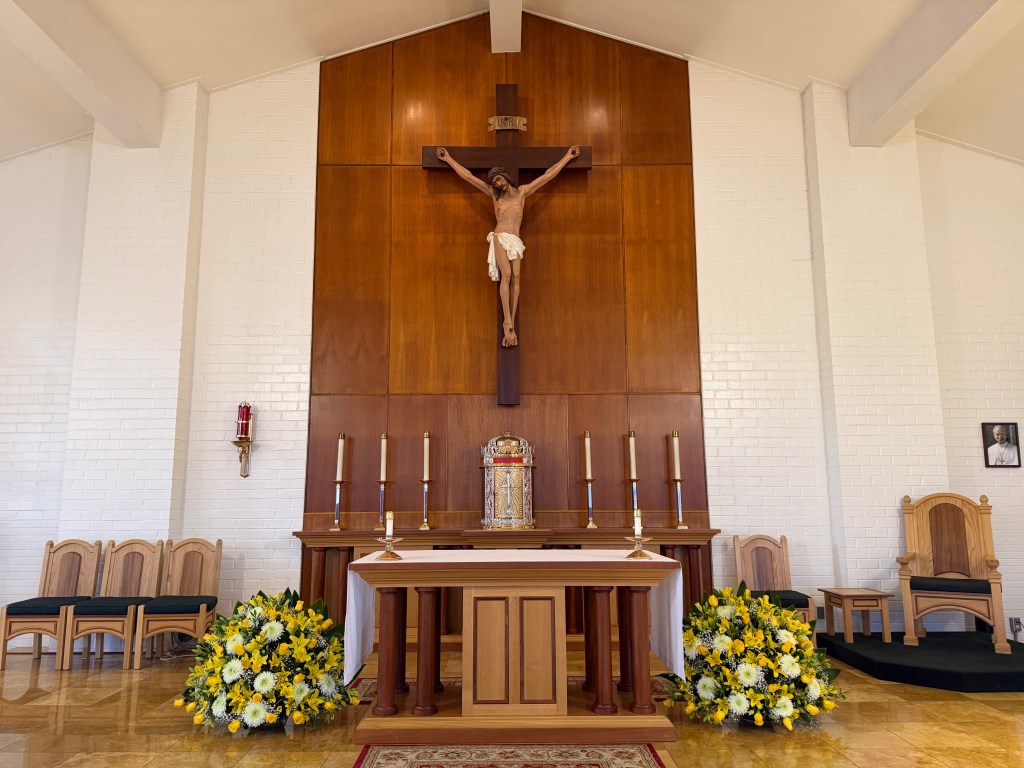
Photo: Blessed to experience an Advent day of reflection and prayer with my brother priests at Our Lady of Florida Spiritual Center. We can notice the kingdom of heaven at hand, when we are still and repent.

Link for the Mass readings for Saturday, December 13, 2025

Mary was filled with joy, for conceived in her womb was the One who forgives and heals.

“Mary set out and traveled to the hill country in haste” (Lk 1:39). Why? Because she was filled with joy. She had just experienced an incredible encounter with the angel Gabriel telling her that she was to bear the “holy, Son of God” (Lk 1:35). She also learned that her relative Elizabeth, who had been barren, was six months pregnant. Who better to understand and appreciate what she had gone through than Elizabeth? When we hear good news we want to share it with someone, especially when we believe another will fully appreciate our experience.

Is there a time when you felt overjoyed about something that you felt like you were going to burst and you couldn’t wait to share your experience? A memory may have already started forming in your mind, a smile and glow may already be radiating from your eyes as you re-experience that moment.

One such graced encounter I had was when I was in my early twenties and dealing with a heavy personal issue. I was living in Sharon, Connecticut at the time and had an opportunity to go to the Shrine of Divine Mercy in Stockbridge, Massachusetts to participate in a penance service. I walked up hesitantly to a kind-looking, elderly, polish, Marian priest. His name alludes me now, but not his face. He radiated invitation and mercy. After a few stammering words, I let loose and shared what I had been dealing with. When he offered absolution, I felt the burden physically lift, I felt almost like levitating. Then a surge of joy welled up in me that lasted for days.

There is a great gift in sharing a burden with a trusted friend or family member, being heard and supported, and/or receiving absolution from a priest. We need to resist the temptation of turning within ourselves, trusting in the lie that we need to handle our conflicts, challenges, and trials all on our own, that we will be a bother by asking for help. There is a pearl of great price, God’s healing grace, that is available to us when we share our experiences. In this way, we come to realize concretely that we do not have to go through our pain and suffering alone!

Many of us are struggling, and sometimes we are not at our best, nor do we make our best decisions. We react instead of act, we get caught in the momentum of behavior that we know is not acceptable, and we continue to slide. The key is not to beat ourselves up and walk around feeling guilty. There are enough people who would be happy to sign up to do that. Instead, we can choose to practice a healthy sense of guilt, examine our conscience, be mindful, and admit when we have done something inappropriate, sinful, or wrong.

The key to reconciliation is to embrace humility and admit our sin, be contrite – sorry for what we have done, resist getting upset, defensive or rationalizing away our behavior, and to follow the counsel of James and “confess your sins to one another, and pray for one another so that you may be healed” (James 5:16). Having experienced the joy of forgiveness, while still experiencing the grace of our reconciliation, may we be like Mary and share: “My soul proclaims the greatness of the Lord; my spirit rejoices in God my savior” (Luke 1:38).


Photo: “Do not fear any illness or vexation, anguish or pain. Am I not here who am your Mother? Are you not under my shadow and protection?” Mary to St. Juan Diego and to us. Our Lady of Guadalupe, pray for us!

Link for the Mass readings for Friday, December 12, 2025

The least of us are greater even than that John because of our baptism in Christ.

Amen, I say to you, among those born of women there has been none greater than John the Baptist; yet the least in the Kingdom of heaven is greater than he” (Mt 11:11).

Jesus shared that there has been no greater than John the Baptist. John is a bridge from the Old Covenant to the New. To say that John and Jesus played significant roles in ushering in the Kingdom of heaven is an understatement. For they both preached the same message of repentance, of the need for all to recognize how and where they had turned away from and needed to turn back to God. This is a key invitation for us as well during the preparatory seasons of Advent and Lent. May we have the ears to hear!

John lived a life of asceticism giving all to God, rejecting the material comforts of his time, choosing to live in the wilderness, and relying solely on the divine providence of God. He followed in the line of the prophets and he did so with full-throated confidence and fearlessness. Many were moved by his words and came to repent. John though ministered not to put himself on a pedestal, his role was to prepare the way for the coming of the Messiah. He was to assist in ushering in the Kingdom of heaven, as he himself was not the Kingdom. John knew well, Jesus was to increase and he was to decrease (cf. Jn 3:30). John’s words of speaking truth to power also led to his martyrdom. The death of John signaled the time for Jesus’ public ministry to begin.

Jesus recognized the contribution and place of John in his Father’s plan, yet he also shared how “the least in the Kingdom of heaven is greater than he.” The reason Jesus made this claim was that John’s baptism was one of repentance. The Baptism Jesus instituted was one of a new life of communion. Through our being baptized in the name of the Father, and of the Son, and of the Holy Spirit, we have been given a new life and are incorporated into his Mystical Body.

Through our Baptism, we, in participation with Jesus, become priests, prophets, and kings. Through the gift of the common priesthood, we are to sacrifice our time, giving of ourselves in prayer, worship, and service; our talent, embracing the unique gifts God has given us to share; and our treasure, being good stewards of the blessings God has given.

As prophets, we are to speak the word of God, speak truth to power as John and Jesus did, we are to be the voice of the voiceless and stand for up for the human dignity of all those who are vulnerable or mistreated from the moment of conception, through each stage of life, until natural death.

We are to be servant kings, resisting the temptation to seek our own power, glory, fame, and riches, and instead surrender ourselves to the will of our Father, and like his Son wash the feet of those in need. There is no service of our brothers or sisters that we ought to feel is beneath us in reaching out in love, which is to will the good of each other.

Advent is our time to repent, to recommit, to rediscover the wonderful relationship we are invited to embrace and are called to share: The infinite, divine love of God the Father, God the Son, and God the Holy Spirit, whose name we have been baptized in.

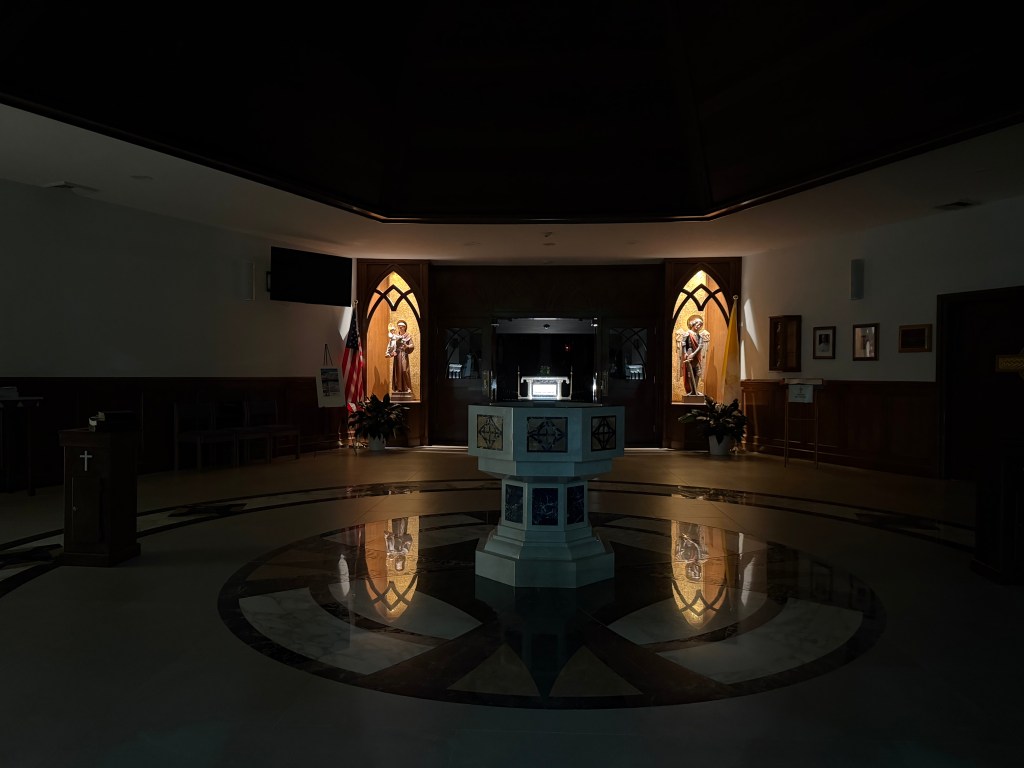
Advent is also an opportunity to slow down and remember why we do what we do. Each time we pass the baptismal font we bless ourselves with the Sign of the Cross. We are invited to resist the temptation of dipping in our fingers and continuing to move ahead on the fly. Instead, may we stop, dip our fingers and intentionally make the Sign of the Cross calling to mind each person of the Trinity.

This practice also provides us the opportunity to recommit ourselves to our baptismal vows, to renounce Satan and all evil, to affirm our commitment to the Trinity, Jesus Christ our Lord, and one Holy Catholic and Apostolic Church. Just as we do this when we enter, we may repeat the gesture and brief meditation when we depart. We leave as bearers of the Christ who we have received at Mass to go forth into our realm of influence to love one another as Jesus loves us, with an all-embracing, unconditional love!


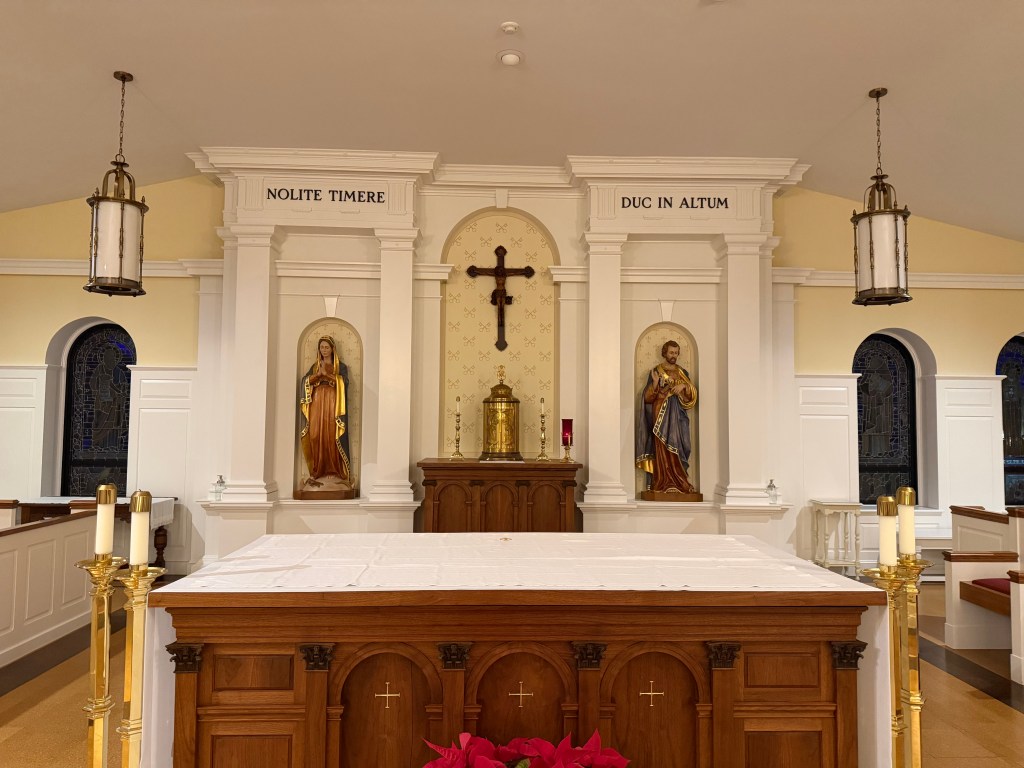
Photo: Last minute touch ups the eve before opening Holy Cross again for public Mass after completion of our renovation.

Link for the Mass readings for Thursday, December 11, 2025

“I will give you rest.”

Verses that we read, such as: “Come to me, all you who labor and are burdened, and I will give you rest” (Mt 11:28) really hit the spot, they arrive at the right time. I am sure that if you are reading these words you may also welcome Jesus’ invitation. Yet what is the labor and burden that we need to rest from? Teachers, administrators and students, of which I was a part for decades are coming into crunch time now as the end of the quarter or term is so much closer. Those in other occupations also work long hours, and sometimes, two or three jobs, just to get by.

Many also who oversee and care for their home, others with children, elder parents, family members, and dealing with family issues that can be enormous, especially at this time of year. Add to the above Christmas preparations: decorating, putting up lights, shopping, buying presents, cooking, baking, writing and mailing Christmas cards can also add to feeling weighed down.

Unfortunately, there are way too many who are not so much burdened by work but the lack of access to gainful or meaningful employment. They are burdened with keeping the bills paid and a roof over their heads as the temperatures fall. Some have no home or family, they are burdened with getting from day to day, seeking ways to get food, clean clothes, a place to wash and relieve themselves. Christmas cards are a distant thought. Many others are burdened and living in fear that they or their family member or members may be deported.

Speaking of fear, how many of us are burdened by fear, anxiety, stress, and strain from a myriad of swirling reasons? Concerns about our family, community, country, and the world are a burden that can also weigh heavily. Advent and Christmas, even when life is more stable, are still times in which many buttons can be pressed and many stressors can be triggered. What is the adage that is offered when family and friends gather? Resist talking about politics, religion, and… we all can add a few others.

If you are feeling weary and worn as we draw close to the midway point of this Advent Season, it is a good opportunity to make some time to just stop and take a slow, deliberate breath. Notice your shoulders coming out of your ears. Embrace the invitation of Jesus and rest in him. Allow the burdens to come to mind, then visualize yourself giving them to Jesus, open yourself to his guidance, ask for his help for the day to day challenges, and seek who may be best able to assist you in any particular situation. Slowing down may help us to become more aware of any sins that we feel burdened by. This is a good time to rest and trust in the forgiveness of Jesus and confess to him in the Sacrament of Reconciliation. Jesus will forgive you and bring you a lightness and fresh start!

Our God “does not faint or grow weary, and his knowledge is beyond scrutiny. He gives strength to the fainting; for the weak he makes vigor abound” (Isaiah 40:28-29). We do not have to deal with anything alone. We have help and support. My friend, Pastor Jerry Scott, taught me years ago a life lesson which I still return to, more often now as I begin my sixth decade. When a person is chopping down a tree, exerting a lot of energy and effort, but finding the results insufficient, he or she needs to realize that they need to step back, take a breath, and sharpen their ax. With a little rest, renewal, and a sharpened blade, the job can be accomplished sooner.

Let’s figuratively do the same daily with each of our endeavors. Let’s resist just putting our heads down and plowing through with blinders on and instead take some time to stop and assess from time to time what we need, where we need help, and yoke ourselves to Jesus for his guidance and strength. Sometimes, making time to breathe and plan, we can use our time more efficiently.

When we choose to intentionally breathe more, we can react less. We can bring our challenges to Jesus and he will help us to carry the burden, as we follow his will, we can work smarter instead of harder. In developing a pattern and place of trust and hope in him, seeking his guidance and direction this Advent, we will renew our strength and soar as with eagle’s wings; we will run and not grow weary, we walk and not grow faint (cf. Isaiah 40:31)!


Photo: Spending time outside, taking some breaths, and trusting in God, can do wonders.

Link for the Mass readings for Wednesday, December 10, 2025

Lost in the busyness, anxiety, and noise? Stop, breathe, and pray. Jesus is right there.

“What is your opinion? If a man has a hundred sheep and one of them goes astray, will he not leave the ninety-nine in the hills and go in search of the stray” (Mt 18:12)?

Many of those Jesus asked and us reading or hearing this Gospel today might share our opinion that the man leaving the ninety-nine to find the one would not be a wise choice. Jesus again appears to be turning the normal order of things upside down in painting a word picture of God’s folly. This parable clearly shows the abundant and extravagant love of his Father for each and every one of us. The act of this shepherd can appear not only unreasonable but unbelievable.

Yet, this is not the feeling to the sheep or the one who is lost. This extravagant love is a relief. God as a shepherd is presented in the Old Testament as well. God is the shepherd and Israel his sheep. This was presented in today’s first reading: “Like a shepherd he feeds his flock; in his arms he gathers the lambs, carrying them in his bosom, and leading the ewes with care” (Isaiah 40:11).

This expression of love and care we can also experience if we are willing to resist slipping into judgment and pride, as did the elder son who was not willing to forgive his brother who was lost but found. The father loved the elder son with the same love as the son that was found, but he was closed off from receiving it for years, not realizing that he was just as lost as his younger brother.

God gives us a choice to reject or accept him because of his extravagant love for us. His greatest joy for us is that we will experience being be fully alive. He also knows what will make us so, yet he won’t impose even what is best for us, on us. God is willing to risk us going astray such that we can come to realize the emptiness in any pursuit that ultimately does not bring us closer to him. God does not wish for any one of us to be lost.

God constantly coaxes, invites, and urges us to fulfill who he created us to be. He guides us along as a parent urging his child to walk with tender chords of love. Yet, though he lovingly implores us along, we can be distracted, turn, crawl away, and go in a different direction.

During Advent, we are invited to slow down, to breathe and examine where we have taken our eyes off and turned away from our Father, where we have crawled away from his invitation to walk with him. No matter how far we think we have gone astray, no matter how lost we may think we are, God always remains close, following, watching, ready for us to turn back to him. When we do turn back, we will find him there waiting for us, urging us to run back into his open arms and to experience his loving embrace.

God is eternally present. He is not in the regrets of the past nor the anxieties and insecurities that blur the promise of our freedom in the future. God loves us more than we can ever mess up, more than we can ever imagine, and even in the midst of the committing of our most egregious of sins. God not only refuses to define us by our worst choices and moments, but when we trust in him, when we ask for his help, he will forgive us, offer healing, and lead us a few steps at a time forward, carrying us “in his bosom” if necessary.

Once forgiven, healing, and back on the path, we are to then also follow Jesus and seek out the lost sheep. “Christ follower’s should imitate the Father’s pastoral care, seeking and saving the disciples who have gone astray” (Mitch and Sri, 230).


Photo: Jesus will lead us through the unclarity, insecurity, and stress if we are willing to stop, change course, and follow him.

Mitch, Curtis and Edward Sri. The Gospel of Matthew. Grand Rapids, MI: Baker Academic, 2010.

Link for the Mass readings for Tuesday, December 9, 2025

“The knot of Eve’s disobedience was loosed by the obedience of Mary.” – St. Irenaeus

And coming to her, he said, “Hail full of grace! The Lord is with you” (Luke 1:28).

With these words from the angel Gabriel, we can begin to understand the special and unique gift of grace that God bestowed upon Mary such that we are blessed each year to celebrate this magnificent Solemnity of the Immaculate Conception of the Blessed Virgin Mary. Mary was conceived without sin and she remained not only a virgin all her life, but also sinless and “full of grace” all her life.

The Catechism of the Catholic Church (492), echoes our second reading from St. Paul: “The Father blessed Mary more than any other created person ‘in Christ with every spiritual blessing in the heavenly places’ and chose her ‘in Christ before the foundation of the world, to be holy and blameless before him in love’” (cf. Ephesians 1:3-4). 

This special grace was bestowed upon Mary such that she could undo the sin of another who was created sinless: Eve. As we saw in our first reading from Genesis, Adam and Eve were created good, without sin, but both fell by disobeying God and bringing sin, suffering, and death into the world. The Church fathers and doctors saw in Mary, the new Eve. As St. Irenaeus of Lyons, (130-202 A.D.) wrote in his great work, Adversus Haereses, “the knot of Eve’s disobedience was loosed by the obedience of Mary.”

Mary’s, “yes”: “May it be done to me according to your word” (Luke 1:38), and her continued “yes” with each of her thoughts, words, and deeds aligned with God’s will for the rest of her life, kept her full of the special grace that God bestowed upon her from the moment of her conception. Adam and Eve fell when their trust in God was shaken by Satan’s temptation. Mary trusted God with Gabriel’s invitation even though she did not understand what was being asked of her. Her question to Gabriel, “How can this be, since I have no relations with a man” (Lk 1:34) was not a demand for proof, but a sincere seeking to understand what was being asked of her, a faith seeking understanding.

Mary embodied faith seeking understanding, though while she pondered, as St. Bernard of Clairvaux put it: “Tearful Adam with his sorrowing family begs this of you… Abraham begs it, David begs it… this is what the whole earth waits for, prostrate at your feet… Answer quickly, O Virgin. Reply in haste to the angel, or rather through the angel to the Lord. Answer with a word, receive the Word of God. Speak your own word, conceive the divine Word. Breathe a passing word, embrace the eternal word.”

When Mary said, “Behold, I am the handmaid of the Lord. May it be done to me according to your word” (Lk 1:38), a weary world wounded by the sin of her first parents, exhaled with relief, for the long-awaited savior would now be conceived, born, and come to redeem what had been lost. Mary, in her obedience, loosed the knot of the Sin of Origin committed by Adam and Eve in their disobedience. Mary inmaculatus, Immaculate Mary, was blameless, conceived without sin, for this very moment in time so that of her free will she could say, “yes” and become the new Eve and her Son the new Adam.

Mary, help us to ponder your “yes”, that we may be willing to say “yes” and follow the will of God in all we think, say, and do. Help us to be obedient, to resist a knee jerk reaction to reject outright what we do not understand and choose instead to be open to the possibilities you make available to us that are beyond the realm of our senses and limitations alone. Help us to place our trust in God, Jesus, his Son, and the love of the Holy Spirit in all situations and with every thought, word, and action.

——–

Photo: Mary, pray for us that we may repent, know your Son, his love, and follow our Father’s will.

Quote of St. Bernard of Clairvaux from volume 1, Liturgy of the Hours, p. 345.

Link for the Mass readings for Monday, December 8, 2025

“He will baptize you with the Holy Spirit and fire.”

I am baptizing you with water, for repentance, but the one who is coming after me is mightier than I. I am not worthy to carry his sandals. He will baptize you with the Holy Spirit and fire (Mt 3:11).

John is offering a baptism of repentance. The people are coming to him, some traveling up to twenty miles through the desert. They were not coming to the Temple, the formal place of worship, but to the wilderness. John, the son of a priest, and so a priest, represents an answer to the hunger of the people that is no longer being fulfilled by much of the religious leadership of his time. He is the embodiment of the prophet who has returned – Elijah, who himself also dressed in “a hairy garment tied with a leather belt” (2 Kings 1:8). He speaks for God and the people are willing to listen and follow him because of his authenticity. And in his time he was most likely more popular than Jesus was in his. Jesus himself said that there was no one born on the earth greater than John (Matthew 11:11).

Yet, John the Baptist is clear that he is not the long-awaited Messiah. He is just the precursor as was promised. “John’s appearing in the desert dressed like Elijah would have signaled to the Jews that he was playing the part of the long-awaited Elijah, preparing for the Lord’s coming” (Mitch and Sri, 63). John as with the prophets like Elijah who had gone before him was preaching the need for repentance. He is preparing the hearts and minds of the people, inviting them to repent, to turn away from their sins and self-centered ways so that they will be prepared to recognize the Lord when he comes.

The baptism of Jesus was and is different than John’s. It is a baptism not just of repentance, but also of “the Holy Spirit and fire.” The baptism of Jesus will be wholly transformative. Fire consumes and transforms that which it touches and the Holy Spirit is often symbolized by fire. Within the Jewish tradition and found in the Old Testament, fire is associated with purification. The purifying and transformative fire of the Holy Spirit is love.

Love is an expanding, unitive force. It is a direct counter to the self-focused, curving in upon oneself and divisiveness of the fallen nature of our humanity. Love is an act of the will and draws us out to be engaged with the betterment of others. When we experience the love of God we are changed and transformed. This is not a one time be all encounter, but one that is to be experienced and shared consistently. The more we share the love of God the more we receive, and the more love we receive, the more we are transformed.

John the Baptist reminds those coming to him and us who read the Gospel of Matthew today that none of us are worthy of God’s love. That does not mean that we are bad. We just fall, short on our own, of the glory of God. We do not deserve nor can we grasp God for ourselves. No matter our will power and diligence, we must be willing to receive the Holy Spirit on his terms, not ours. We simply accept the invitation to receive the love of God, allow him to heal and expand us beyond our limitations, and share what we have received with others.


Photo: A quiet moment with the setting sun between the 4:00 and 5:30 Vigil Mass.

Link for the Mass readings for Sunday, December 7, 2025.

“When everything is said and done, we are infinitely loved.”

Jesus sent out these twelve (Mt 10:5).

Jesus sent out his Apostles to minister in his name and share the Gospel as he did, declaring that the “Kingdom of heaven is at hand.” Our faith tradition is one of evangelizing, sharing the Good News. That means that first and foremost we need to be people of joy. We may share the most wonderful words about our faith, but if they are not backed up by a life of radiating joy, then our words will have little if any impact.

This does not mean that we are happy and buoyant every second of the day, it does not mean that we will not experience hardship, sorrow, and loss. What it does mean is that we are not defined by our suffering, the trials we face, nor our wide range of our emotions. God also calls us to face tough realities when it might be easier to remain in our comfort zone. In the midst of each of these and other challenges, we can experience hope because God is with us. He seeks to comfort us in our weeping, provide for our needs, guide us in the right way we are to walk, and give us the strength to do so with each step we take.

What defines us is God’s love. We will experience great joy when we slow down long enough to allow God to love us. We will then know that we are not alone in our trials. Jesus experienced the fullness of our human condition, from his conception, birth in a cave, having lived a life of hardship and poverty that led all the way into the depths of betrayal, injustice, and God forsakenness on the cross. He did not just suffer on the cross but he also experienced death. Yet, through the indelible, binding force of the Holy Spirit, the love shared between Son and Father, Jesus was drawn back to life and conquered death not only for himself but for us all.

This is the good news we are to share. Jesus conquered death for each of us. How we live our lives each day and interact with others may be the only Bible that someone else will ever read. May we share the joy of our relationship with Jesus, may we share the joy of the lives we have been given, for: “Joy adapts and changes, but it always endures, even as a flicker of light born of our personal certainty that, when everything is said and done, we are infinitely loved.” – Pope Francis from his apostolic exhortation, Joy of the Gospel, line 6.


Photo: Mary Magdalene, apostle to the apostles at the foot of the cross. She experienced the joy of being infinitely loved. May she intercede for us that we may as well!

Link for the Mass readings for Saturday, December 6, 2025

Out of the gloom of our fallen nature, Jesus’ light will help us to see.

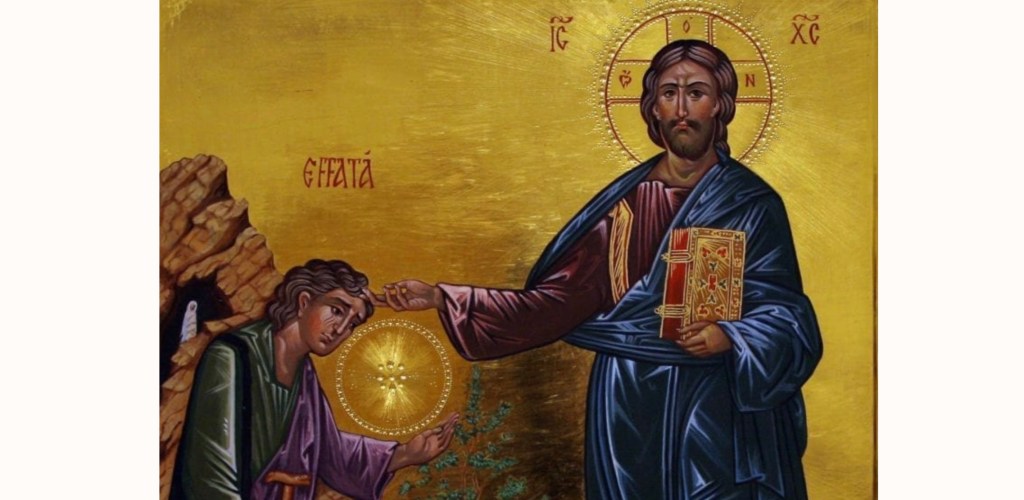
St. Augustine taught that the New Testament is hidden in the Old Testament and the Old is revealed in the New. We see this presented in the first reading as well as in the Gospel. We read how “the deaf shall hear” and “out of the gloom and darkness, the eyes of the blind will see” (Isaiah 29:18). Then we read how Jesus healed the blind men who call out to him believing that he is indeed the Son of David, the messiah, the anointed one (Matthew 9:27-31).

Jesus acknowledged that their faith was a catalyst in healing them but he also pointed out covertly that they were still in need of spiritual healing. Yes, they could now physically see, but they, like the apostles and others who hoped for the messiah, were looking for their idea of a messiah that is like David, a political and military leader that will lead a revolution to overthrow the occupying power of Rome.

Jesus told them clearly not to tell anyone what had happened, because he was not about to promote a cult of personality, nor have them portray him in a false way. Yet, share they did. They shared their encounter with Jesus with great joy.

Though we may have eyes to see and ears to hear, we too can be spiritually blind to who Jesus truly is. Jesus came into the world just over two thousand years ago as, God’s Son and visible reality of God who is love. Jesus calls us to be conformed to this same love. If we see ourselves and each other with the eyes of our fallen nature, from the perspective of our past wounds, and our present day reactions, we are going to miss the mark.

The saints are those who followed Jesus in each generation from the apostles to our own. They were willing to be transformed by the fire of his love. They encountered Jesus, had faith in him, believed, and put into practice what they learned. Just as something like scales fell from the eyes of St. Paul so that he could see anew, we too can see with the eyes of faith.

Let us pray together:

Jesus, this Advent, help me to choose to walk out from the gloom and darkness of anxiety, fear, and insecurity, and place my trust in your revealing light that I may walk with confidence on your path of love. Free me from any sins, distractions, and diversions such that I may experience the closeness you know with your Father. Please help me to place my trust in you, and please heal my blindness so that I can see more clearly, reject the lies that lead me astray, and see the path that leads to the way, the truth, and the life.

——————————–

Photo: Walking back after holy hour Wednesday night, sight of the super moon.

Link for the Mass readings for Friday, December 5, 2025

“Religious confession is no substitute for personal relationship with Jesus”.

Jesus said to his disciples: “Not everyone who says to me, ‘Lord, Lord,’ will enter the Kingdom of heaven, but only the one who does the will of my Father in heaven” (Mt 7:21).

I have written quite often, quoting and paraphrasing one of my favorite quotes from St. Irenaeus, that Jesus came to be one with us in our humanity so that we can become one with him in his divinity. In his becoming one with us in our humanity he invites everyone, no one is excluded, to participate in his divinity. Yet if everyone is invited, how can Jesus say that not everyone will enter the Kingdom of heaven?

The answer to that question is in the line that follows. The one who will enter heaven is, “the one who does the will of my Father in heaven.” If this verse does not help, then it might be helpful to understand a little about heaven, as best as we can, as the mere mortal, finite beings that we are.

Heaven is not so much a place but a state of being in relation to God, in which we are privileged to share communion and a deeper intimacy with God for all eternity. We will still not know everything about God because God is infinite and we will still be finite even in heaven. God is without limit, we are limited. We will never exhaust our relationship, never get bored with God.

Maybe a more three dimensional, an earthly example may be of help. If we were invited to play a sport, an instrument, or to act in a play, with the end goal being that we would play in the upcoming game, concert, or performance, we might feel pretty excited about the offer. We tell the coach, conductor, or director “That’s great news!” Yet, in the days that follow, we do not attend any of the practices, we do not practice the skills required to play the position, instrument, or role and we do not return any of the follow-up invitations by phone, email, or text. The day of the big game, concert, or performance comes, we gather our self together and head on over to the arena or hall. We arrive to see the coach, conductor, or director but are denied entrance. We might say, “I don’t understand, you invited us to play!” The reply is, “Not everyone who says to me coach, coach (conductor, conductor, or director, director) is ready and prepared.”

Jesus invites us to play a part in God’s theodrama, everyone. Some say yes and some say no. Some say yes, and then don’t put into practice what is then asked, some say yes and do some things, some say yes and dive in. Most of us take a few steps forward and a step or two back. Just like preparing to play in a big game or perform in a big concert, or play, we need to be committed, disciplined, and persistent. Unlike a missed opportunity to participate in a game or performance, that we can correct and make another attempt down the road, we don’t want to miss the opportunity to spend eternity with God in heaven.

The above analogy does not imply in any way that we earn our way into heaven, or we can do so on our own effort and will power. The bottom line is that Jesus gave his life for all of us and through his grace, we have been saved. Our salvation is a gift freely given. Yet, we have to be willing to receive and open the gift. Our time here on earth is the time we are given to: open the gift we have received, work out our salvation, not just hear but to also put into practice Jesus’ teachings, and be about building our relationship with him. As we do so, we will be transformed by and conformed to Jesus, so that we can come to know his Father as he does, and then we can reflect the light and love we have received to others.

It is not enough to say that we believe in Jesus. “Religious confession is no substitute for personal relationship with Jesus and the obligation to obey his Father’s will. If our creed and our conduct are out of alignment, then our profession of Jesus as Lord is not a true submission to his lordship. The mere fact that believers can perform miracles in Jesus’ name, which is an exercise in charismatic grace, is no proof that sanctifying grace has penetrated their lives or brought them closer to Christ” (Mitch and Sri, 121).

If we want to know and put into practice God’s will, we need to know God. Advent is a time of preparation, a time of getting to know Jesus who is already with us and inviting us to let him have reign of every part of our lives. Jesus helps us to recognize and see what our lives are like without God and how they are with God. If we are willing to see, that clarity helps us to better choose our thoughts, words, and actions.

When we are humble enough to acknowledge ways that weaken our relationship with God, we can then repent and seek forgiveness. God never tires of forgiving us. Let us never tire of asking for forgiveness and committing more to knowing and putting into practice his will. Each time we seek and receive forgiveness, our minds and hearts are not only expanded but properly aligned to Jesus so that we may experience more of the love of the Holy Spirit, which helps our relationship to grow and to put into practice our Father’s will.

——————————————————————————

Photo: “Prayer can truly change your life, for it turns your attention away from yourself and directs your mind and your heart towards the Lord.” – St. John Paul II

Mitch, Curtis and Edward Sri. The Gospel of Matthew. Grand Rapids, MI: Baker Academic, 2010.

Link for the Mass readings for Thursday, December 4, 2025