Will we reject or hear Jesus’ message?

He said to them, “Today this Scripture passage is fulfilled in your hearing” (Lk 4:21).

Jesus sat down after speaking these words to his hometown congregation in Nazareth who had just heard him read the passage from the prophet Isaiah. Jesus proclaimed that he was the one to whom Isaiah was talking about. Luke chose to place this event as the starting point of Jesus’ public ministry, of bringing glad tidings to the poor, proclaiming liberty to the captives, recovering sight to the blind, letting the oppressed go free, and proclaiming a year acceptable to the Lord (cf. Lk 4:18-19).

This is a message of universal healing for all of humanity. Restoration and reconciliation would come and Jesus would be the vehicle to bring all the nations, all people, back into communion and relationship with his Father. The poor mentioned were not just in reference to those experiencing material poverty but to those finding themselves on the margins of society, the outcasts, those on the peripheries. The captives were not only those imprisoned for debts or crimes but those bound in the chains of their own sin and addiction. The blind were not only those who could not physically see but those who experienced the spiritual blindness of pride and arrogance. The oppressed were not just those under the iron fist of totalitarian and dictatorial regimes but those pressed down through their own self imposed anxieties and fears.

In what ways are we in need of Jesus’ healing and restorative power? What is keeping us on the peripheries, apart from communion and fellowship? What sins and addictions keep us bound, what fears and anxieties keep us oppressed? Jesus invites us in today’s Gospel to be healed and to align ourselves with his will and ministry of loving service to others. The same words he spoke to his own hometown he is speaking to each one of us today.

Even though initially moved by the words of Jesus, they could not see past the boy and humble man of Nazareth they had or thought they had known. How could he be the Messiah? They also rejected his universal message that God was inviting Gentiles into the party. Jesus held up as models of faith, the widow of Zarephath who trusted Isaiah with her last bit of flour and oil and Naaman who trusted the advice of a slave girl and the prophet Elisha. Both, Gentiles, and both blessed by God through their trust in him. His own people chose to hold tighter to their biases and prejudices instead of let go and receive the freedom and healing Jesus offered.

How will we respond to Jesus? Will we follow the hometown crowd or ponder his words? Life is too short to allow our pride to get in the way. Examining our conscience and coming to Jesus with a contrite, sorrowful heart for what we have done and what we have failed to do helps us to be more open. Instead of rejecting, let us welcome Jesus and experience his healing hands on our bowed heads and the warmth of his love pouring through and purging us of our sin and pride so that we may participate with him in bringing the invitation of healing, reconciliation, and love to others and help to bring about an “acceptable year of the Lord” (Lk 4:19).

—————————————————-

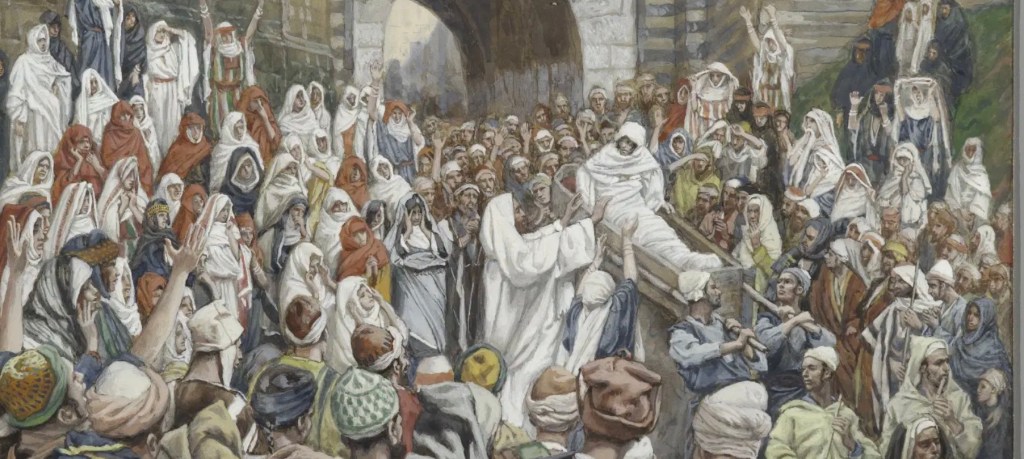
Photo from freebibleimages.org

Link for the Mass readings for Monday, September 1, 2025

Praying helps us to grow in our relationship with God, as well as in humility and love.

“Rather, when you hold a banquet, invite the poor, the crippled, the lame, the blind; blessed indeed will you be because of their inability to repay you. For you will be repaid at the resurrection of the righteous” (Lk 14:13-14).

At the end of this parable, Jesus is expressing a deeper definition of love that we in our culture may not be accustomed. When we hear someone talking about love, most likely we think of an emotion, a feeling, sentiment, or a state of mind. As I have written often, I follow St Thomas Aquinas in his definition of love as the willing the good of other as other. This definition of love is unconditional. There are no restrictions placed on another for a return of the good given. In fact, as we read Jesus’ words, no return is to be expected.

This is what Jesus means by inviting the poor, the crippled, the lame, and the blind. These are people of his time who had nothing to give to someone who has the means of offering a banquet. They could even come, because of their ostracized status without the proper etiquette to even express the most minimal of thank you for the invitation and the meal, and instead to complain about the food, the decor, and even be insulting to the host. Yet, they would be served with humility and grace anyway, because the point is to give without expectation of reciprocity.

Some may say this is impossible, that nobody gives without expecting something in return. Everybody’s got an angle, even if we do something for a compliment. Jesus would probably agree with this claim, for on our own we may not conceive of giving without looking to get something back in return, let alone make such an offer. Jesus has countered this claim in a different context, but it applies here just as well: “For human beings this is impossible, but for God all things are possible” (Mt 19:26).

To be able to love then, to will the good of the other without condition, we need to first be willing to receive the love of God that he offers. We are only capable of love because first and foremost, we have been loved ourselves. If we spend no time with God, no time in his word, prayer, worship, acts of service, or most importantly his silence, we set ourselves apart from the love of God, and separate ourselves from him, the very source of our being. Our very existence, in fact, the reality of all creation, is the result of the outpouring of the love of God.

To receive the love of God, it helps when we respond to the invitation of the Holy Spirit to pray each day. Our very desire to pray, seeking the existence of God, the urge to move out from our self to reach out to the need of another, is the first response we might experience to his invitation even if we may not even be fully be aware. Another important movement to make time for prayer is to resist the many distractions, diversions, and temptations that keep us from praying and make time for God and God alone.

Humility is a key virtue that helps us to resist seeing ourselves as first and foremost. God is God and we are his children. As we enter into relationship with him and receive his love, it is important to resist keeping his love for ourselves. Yes, share with those closest to us, but also with those who will not give back. We need not fear that there will be a finite end to our giving, for with God there is an inexhaustible supply and a joy for its own sake which comes up from within our soul from our loving Father who is the source.

Having received God’s caritas, charity, we are to give until it hurts, as St. Mother Teresa taught. Jesus is not teaching us to build up fame and fortune here in this life, but to build up treasure in heaven where we will receive our eternal reward. If we don’t follow through on the movement of love dwelling up and share, if we only seek a return or equal exchange for the love given, we will often be let down and disillusioned. When the Holy Spirit nudges us to reach out in concrete situations, we are to follow without hesitation and seek nothing in return.


Photo: Divine Jesus Prayer Canvas from ArtisianCanvasPrint

Link for the Mass readings for Sunday, August 31, 2025

When we pray, we are loved by God, and the love of God casts out our fear.

“Then the one who had received the one talent came forward and said, ‘Master, I knew you were a demanding person, harvesting where you did not plant and gathering where you did not scatter; so out of fear I went off and buried your talent in the ground. Here it is back'” (Mt 25: 24-25).

I used to struggle with this verse of Jesus’ Parable of the Talents, not because I didn’t relate to it, but because I did. The problem was that I sided with the servant who buried his talent in the ground. What the servant did made sense to me, he kept his master’s talent safe and returned what he had been given. Historically, burying was considered a safe and acceptable practice in ancient Palestine when protecting someone else’s money. Even in reading carefully back to the beginning of the parable, I could see no reference to investing the talents. Though in the Gospel of Luke, there is an explicit demand to “trade with these until I come” (Lk 19:13). What is Jesus saying?

Actually, Jesus in this parable offers a microcosm of salvation history, the thread of which has been woven through all of Sacred Scripture from Genesis to Revelation. God, through his sovereign will, has consistently called, calls today, and will continue to call into the future a people to himself. In each age, God has bestowed upon humanity the generous gift of his grace, inviting us to receive and share in his very life, which is what we have been created for. This is a free gift, to be freely accepted or rejected. Once received though – no matter how little we choose to receive, five, two or one talent, we are directed to share what we have been given. Through a life lived of accepting, receiving, giving back to God and to one another, we are given even “greater responsibilities”.

In receiving the gift of God, himself, and sharing what he has given, ultimately his love, for God is Love, we not only mirror on earth, albeit dimly, but share in the divine communion of the love between God the Father, God the Son, and God the Holy Spirit. To reject this gift outright, or to receive some of the benefits and not to share, we cut ourselves off from the very life force and source of our being.

The message of The Parable of the Talents is as clear as it is challenging. John P. Meier summarizes that “Jesus is insistent; along with sovereign grace, serious demand, and superabundant reward comes the possibility of being condemned for refusing the demand contained in the gift. Indeed, one might argue that no aspect of Jesus’ teaching is more pervasive in the many different streams of the Gospel tradition, and no aspect is more passed over in silence today” (Meier 2016, 309).

God has created us and all of creation from the abundant outpouring of his love. Will we reject the gift of his love and invitation of communion? Will we receive, yet not actualize who we are called to be for our self and others because we would rather merely just exist, willing to be lured and entrapped by the temptations of anxiety, fear, apparent goods, and half-truths? Will we give in to the fear, too afraid to risk, to go out from ourselves to serve others? Or, will we appreciate the gift of our life and say thank you for the breath that we breathe? Are we willing to expand the love we have received by being willing to share, to multiply our talents, to embrace who God calls us to be, to love in kind, to will the good of others in the unique way God calls us to serve, whoever they may be?

I have lived the life of the wicked servant who buried his talent out of fear. I have embraced the sin of sloth by overworking and thinking I was doing good, but was it really the good God wanted me to do? As I have recognized the importance of placing prayer front and center, so that I have grown in my relationship with God, my life has become more properly ordered. I do better when I reach out and seek the hand of Jesus and accept to be led by him. I have risked and fallen, made mistakes and duffed up time and again, but have learned and persevered.

When we learn who the enemy is, are able to identify his lies, renounce and turn away from them and back to God; when we slow down instead of run from what we are afraid of and invite the Lord into these areas we will be purified, we will heal; and when we realize that the most important thing that we can do each day is pray, then we will come to know in our core, that we are not human-doings, we are human beings. God loves us as we are. As we are loved, we will then act from being loved and share the love we have received.

We are not alone. What Jesus invites, gives, and yes, demands of us, he will at the same time provide the courage, guidance, support and strength we need to carry out the task given and to bring it to fulfillment. God has a talent or two to invest. We need not fear to invest what God has given. This morning, let us breathe deep and entrust ourselves to the words of Jesus and St John Paul II who echoed them as he began his pontificate:

“Be not afraid” (Mt 14:27).

———————————————————————————-

Photo credit: dpa Picture-Alliance via AFP accessed from Aleteia

Meier, John P. A Marginal Jew: Probing the Authenticity of the Parables. Vol. 5. New Haven: Yale University Press, 2016.

Link for the Mass readings for Saturday, August 28, 2021

Will we choose to remain in the darkness or follow Jesus into the light?

“He brought in the head on a platter and gave it to the girl. The girl in turn gave it to her mother” (Mark 6:28).

The momentum that led to the death of John the Baptist could have slow and the direction could have taken a different course. It did not even slow but only escalated. Once Herod Antipas offered to the girl “even half of his kingdom”, she went in haste to her mother. Without hesitation her mother asked for John the Baptist. There was a slight hesitation on Herod’s part when he received the request, but no one spoke about the atrocity or horror of this request. Herod, as would Pontius Pilate, gave in to the pressure of not saving a life, for even there no one spoke out against what was coming, but in taking the life of an innocent man, which the executioner executed efficiently.

John’s crime, what he was arrested for, was calling Herod and Herodias to repent, to turn away from the sin of adultery they were committing and to turn back to God. John sought to help this couple to see that their actions not only were leading to their own demise, but that they were leading many of their subjects with them. Each person chose to play their part in John’s death, they chose their own ego-drama over and above the principal actor before them playing out God’s theo-drama.

This horrific account, if it was not bad enough on its own, was a foreshadowing of another – John’s cousin. Jesus would also be tried, condemned, and crucified for choosing to speak God’s word of repentance, to invite others within ear shot to turn away from that which was keeping them from God. Many were not only closed to the idea of repentance, they not only ignored his message, but also called out for his death, “Crucify him” (Mark 15:13)!

John and Jesus were faithful to hearing and following the will of God. They exhibited true courage in their willingness to give their lives, and because they have done so, they have opened up for us the path to eternal life. Where do we find ourselves in the account of the beheading of John the Baptist and the crucifixion of Jesus? Are we on the side of the indifferent that will watch them die without a word, are we on the side of rejecting the light of God and choosing the darkness of our own sin? If our conscience is pricked, do we resist following the temptation of the Holy Spirit and listen to the lies of the enemy and follow him instead?

Is there another option than those witnessed in the Gospel accounts? Yes, those of Mary and the Apostles. They, despite the cultural, political, familial, internal, and even religious pressures of the time, chose to trust in Jesus and follow him, even when they didn’t understand. This is revealed powerfully when Jesus asked the Apostles at the end of the Bread of Life discourse, “Do you also want to leave?” Simon Peter answered him, “Master, to whom shall we go? You have the words of everlasting life” (John 6:67-68).

With each thought, word, and decision we make, we need to take the time to pause and discern what voices we are listening to. If they don’t align with the will of God, we need to follow the lead of John and Jesus and renounce them. Otherwise, we can get caught up in a momentum of thoughts that can lead to actions that can lead to some dark places we don’t want to go. The Holy Spirit can help us to change course, even when we have walked away… If we are willing to stop, take a breath, and listen. It is never too late to repent. It is never too late to turn away from sin, return to God, and get back on the path that leads to eternal life.


Photo: There is much distraction, diversion, and temptation that the enemy will place in our way. If we remain in and follow the light of Jesus he will “rescue our feet from the snare” (cf. Psalm 25:15).

Link for the Mass readings for Friday, August 29, 2025

Daily prayer with Jesus helps us to be better and more prudent stewards.

“Who, then, is the faithful and prudent servant, whom the master has put in charge of his household to distribute to them their food at the proper time” (Mt 24:45)?

Jesus is calling us to be that “faithful and prudent steward” and the household we are to serve is our own homes, churches, communities, states, countries, and world. For the world is our home and those we serve are our brothers and sisters. Jesus’ call is a universal call to solidarity. We are all invited to be united in this effort for and with one another because we are all created in the image of our loving God and Father.

God has created us, not as automatons or robots, or drone worker bees. He has created us as unique persons, one of a kind, distinct wonders that have never been nor ever will be again. Within our uniqueness, there is also the gift of diversity. We are not intended to be separate from one another, for God has created all of us to be interconnected, to be loved, and to love. What affects one, affects all.

Jesus clearly emphasizes this distinction in his parable, often called the Judgment of the Nations, when he stated: “Lord, when did we see you hungry and feed you, or thirsty and give you drink? When did we see you a stranger and welcome you, or naked and clothe you? When did we see you ill or in prison, and visit you?” And the king will say to them in reply, “Amen, I say to you, whatever you did for one of these least brothers of mine, you did for me” (Mt 25: 37-40).

Being faithful and prudent stewards means being aware of and willing to attend to the needs of the hungry, the thirsty, the stranger, the naked, those ill, and/or imprisoned. This is not an exhaustive list. We are to allow our hearts to be open to have compassion upon those for whom God calls us to serve. We begin this process with prayer, for prayer is the most important thing that we can do each day. We are to make the time to spend in silence to discern the will of God for each our thoughts, words, and actions.

Not all of us will be moved in the same way or for the same cause. We just need to remain open to the nudge of the Holy Spirit, trust his direction, and follow him regarding how and who best we can serve, no matter how small of a gesture. One thing that can limit us is if we are unwilling to admit to and confess our prejudices, insecurities, or biases, as well as toward whom we have been unaware or indifferent. When we have the humility to confess, God is ready to forgive, heal, and transform our hearts of stone into hearts of flesh.

As we are forgiven and begin to heal, as we experience the love and mercy of Jesus, we can draw strength from him, begin to see the dignity present in ourselves, and one another, begin to see each person we encounter as God sees them and begin to take steps to follow the lead of the Holy Spirit to love, to will each other’s good, in each thought, word, and deed.


Photo by Jay Mather, The Courier Journal, of St. Mother Teresa of Calcutta at Bellarmine College, Louisville, KY, June 22, 1982. “Until you can hear Jesus in the silence of your own heart, you will not be able to hear him saying, ‘I thirst’ in the hearts of the poor.” – St. Mother Teresa

Link for the Mass readings for Thursday, August 28, 2025

God only wants to love us and give us rest and peace.

“You have searched me and you know me Lord… Where can I go from your spirit? From your presence where can I flee? If I go up to the heavens, you are there; if I sink to the nether world, you are present there… You have searched me and you know me Lord” (From Responsorial Psalm 139:7-8).

God knows us through and through. He knows us better than we know ourselves. And yet, we hide from him. We seek to do things on our own, even while in the same breath we say we believe in him. For most of us, it is because deep down we are listening to the father of lies and we really don’t trust our loving God and Father. We choose not from freedom as much as from our reactions based in those lies that are fueled by the wounds we have inflicted and received by living in a fallen world.

The path out of the darkness of distraction, diversion, and doubt is lit by the light of Jesus. We are invited to trust him even when our instinct is to resist the light. We judge ourselves and project that judgment on God. We listen the liar who condemns, shames us, and accuses us, and then for a good dose adds, God will not forgive us or I will keep committing the same sins over and over again so why bother? What will God think of me if I reveal this to him?

God loves us to the very depths of our being, more than we can ever imagine. We do not need to be afraid of his reaction to even our most egregious sin, because he already knows! “You have searched me and you know me Lord.” God even loves us in the very act of our committing sin. The issue is, we don’t experience his love when we choose something else over him. We don’t experience his love when we don’t come to him for forgiveness. We don’t experience his love when he forgives us and we don’t forgive ourselves.

We experience his love when we repent. When we turn away from our sin and turn back to God. We may turn away from our sins out of guilt, but turning away or white knuckling with our will power alone is why we continue to fall for the same temptations. We need to turn away from the sin and turn to Jesus and allow ourselves to experience God’s love. Then filled with his love, we can resist the temptations awaiting us.

God has searched us to our very core, he knows the worst about us and loves us anyway. We can stop running and burying ourselves in busyness, distractions, diversions, false promises, and disordered affections, and instead allow ourselves, even if for only a few minutes today, to trust Jesus who is holding out his hand to lead us to a place of peace and rest. A peace and rest nothing in the world can give.


Photo: Moments of quiet, like a sunset walk can help us to slow down enough to experience God’s love for us. (University of St. Mary of the Lake)

Link for the Mass readings for Wednesday, August 27, 2025

Press pause and breathe for a while.

Jesus said, “Woe to you, scribes and Pharisees, you hypocrites. You are like whitewashed tombs, which appear beautiful on the outside, but inside are full of dead men’s bones and every kind of filth. Even so, on the outside you appear righteous, but inside you are filled with hypocrisy and evildoing” (Mt 23:27-28).

How many of us spend an inordinate amount of time regarding physical externals? Washing, makeup, the right clothes, the correct scents, teeth whitening, plucking, nipping, and tucking. How about time spent exercising through gym memberships, home exercise equipment, physical trainers, sports, stretching, running, or cycling. How about time spent towards a career through education, updating, professional learning, seminars, webinars, and networking. There are other categories that I can add, and the point is that there is not anything necessarily wrong with any of the above when they are properly ordered and each is in a healthy balance.

Yet, if external activities are all we are investing our time and energy in, then Jesus has a point. We may “appear beautiful on the outside” with great looks, a body that doesn’t quit, and a career to die for, but what is going on inside? Are we empty, unfulfilled, achieving goal after goal, yet feeling adrift or hollowed out? Do we have all the right social skills and etiquette down, know the right things to say in public, we have friends in the hundreds or thousands on our social media accounts, yet we feel alone and not a part of anything meaningful?

Worse yet, do we go to Church, say the right prayers, are active in ministry, tithe, are members of boards, involved in the community, and doing some great works of charity, but when the door is closed, and no one is looking… what kind of “hypocrisy and evil doing” are we up to? It is easy to rest in a false sense of security while Jesus chews out the Pharisees, right now, yet, do Jesus’ words have an effect on us if we allow his light to shine also on the imperfections and shadow sides of us as well.

We can spend our time whitewashing the outside, projecting a perfect image, while chasing the finite and material pursuits alone, which will more than likely leave us still feeling anxious, restless, unsatisfied, and worn out. Maintaining and protecting a false image on any level is exhausting. Instead, we can take a good look at the time we invest, where we focus our energies, examine our conscience, and assess the health of our relationship with God, family,  significant friendships, our vocation instead of occupation, and our service to those within and beyond our intimate circle.

Instead of expending energy maintaining a perfect persona, we will do better to be in touch with our weaknesses, our faults, and wounds, so we can resist defending or rationalizing them and seek healing, reconciliation, and transformation. By doing so, we may be more accepting, patient, understanding, and forgiving of others because we will come to realize that we are not all that perfect and we come to accept that the world does not revolve around us.

The path lit by Jesus will reveal our imperfections and sins and also will help us to distinguish between apparent goods and what is authentic and truly good. When we can step off the treadmill of chronic stress, come to a stop and breathe, and press pause, we will begin to experience the peace and love of God. We can rest in just being, just being ourselves and be ok with that.


Photo: Some quiet time with Jesus.

Link for the Mass readings for Tuesday, August 26, 2025

Are we locking the doors to the Kingdom of heaven or helping to open them?

“Woe to you, scribes and Pharisees, you hypocrites. You lock the Kingdom of heaven before men” (Mt 23: 13).

Context, in any reading of the Gospels, or any scriptural text, is important, but certainly with today’s reading. Our country is already experiencing enough division, polarization, and racial unrest as it is. These comments have too often been used to fuel anti-Semitic rhetoric. We need to remember that Jesus is Jewish. “The criticisms are leveled with those of power and/or influence as in the prophetic denunciations, not against the whole people of Israel. The aberrations denounced by Jesus were also denounced by other Jewish teachers in the rabbinic tradition. The goal of the denunciations is to highlight the error, to preserve others from it, and perhaps to bring those who err to the way of righteousness” (Harrington 2007, 327).

Those who would use these verses to denounce people of the Jewish faith tradition, just for being Jewish, would be acting in the same way as those for whom Jesus was convicting. Jesus spoke to the specific actions of specific leaders he had encountered who were using their power and influence for their own means and agendas. The hypocritical behavior that Jesus brought to light unfortunately still exists in some of our civil and religious leadership. This is one of the reasons many are disillusioned with authority and institutions. Jesus saw the danger of hypocrisy especially from the perspective of how it can alienate people such they turn away from his Father.

We seek truth, authenticity, and transparency because these qualities are foundational for building trust and relationships. St. Augustine, whose feast we celebrate this coming Thursday, wrote in his Introduction to his Confessions, “You have made us for yourself, O Lord, and we are restless until we rest in you.” He experienced a life without God and with him, and regretted the days he had resisted accepting Jesus’ invitation. It is unfortunate how many today have not come to embrace the words of Augustine, because of their experiences with those, who in the name of Christ, have “locked the kingdom of heaven” before them.

It is easy to point out the hypocrisy of others, but Jesus is convicting each of us as well. How have we erred, sinned, and been hypocritical? When have we allowed past hurts and wounds, anxieties and fears, prejudicial and judgmental attitudes, to limit us from living a life more aligned with his life and teachings? We all fall short in living the “Way, the Truth, and the Life” (cf Jn 14:6), but when we are willing to have the humility to be contrite, to recognize and to be sorry for the harm we have done, we have a loving Father with his arms wide open ready to embrace and comfort us, as well as offer us forgiveness and healing.

As we are more conformed to living and loving like Jesus, we have more credibility when we speak up, out, and against any act that diminishes or denounces the dignity of another, while at the same time resisting the temptation to do so in a way that diminishes even those who inflict division and hate. Jesus invites us to convict others and hold them accountable as he did with love and mercy but we need to begin with ourselves.

When we align our thoughts, words, and actions and are willing to be held accountable, we will have more credibility in guiding others. Our goal is not to humiliate, condemn, and/or shame, but to lead others to a place of contrition and reconciliation, such that each of us can be people of integrity, transparency, and holiness. Our hope is to win back a brother and sister and lead them toward the doors of heaven that Jesus opened for us in the humanity he assumed.


Photo: Pope Francis opening the Holy Door at St. Peter back in 2015 for the Jubilee Year of Mercy. Photo credit, Vatican News file.

Link for the Mass readings for Monday, August, 25, 2025

Harrington, S.J., Daniel J. The Gospel of Matthew, vol. 1, in Sacra Pagina, Ed. Daniel J. Harrington, S.J. Collegeville, MN: Liturgical Press, 2007.

Prayer will help us to heal and grow closer to God and each other.

“Lord, will only a few people be saved?” He answered them, “Strive to enter through the narrow gate, for many, I tell you, will attempt to enter but will not be strong enough (Lk 13:23-24).

This can be a challenging verse to understand and to put into practice. Our salvation is assured in Christ, for he died for all of us and not just for a select few. It is also true that there is no way we can buy or nothing we can do to earn our way into heaven. That said, with the free gift of the grace we have been given by Jesus in the giving of his life for us, we have a responsibility to work out our salvation in this life, “with fear and trembling” (see Philippians 2:12).

Christianity is not a pie in the sky or walk in the park religion, we do not seek a utopia, because Christianity is about a relationship. God loves us and gives us the choice to reject or accept his love. If we say yes, then we collaborate in building a relationship with him and one another. Our fear and trembling is not in a cowering observance, but through humble obedience. We recognize that God is God and we are not. When our relationship with God is properly understood, when he is first, then our relationships with each other as well as what we do and what we seek will stand a better chance of being properly ordered.

Authentic relationships take an investment of time and hard work if those relationships are to move beyond the masks and pretenses we project, pretending to be something we are not or trying to be who others want us to be. This is the same for God. We can pray falsely and for false purposes, and in so doing, grow no closer in our relationship with God. Jesus loves us as his Father loves him, and he invites us to experience the same. This is more than an emotional experience, but a willing of each other’s good. Love is accepting the other as other, in their brokenness and pain, their failings and shortcomings, their sin. It means being willing to take off our masks, being vulnerable, revealing our fears, and resist being defensive or reactive when we are hurt or offended by those who are close to us.

Our prayer becomes real, not when we say the right prayers or words, but when we are honest with God. Our relationship with him grows when we let go of our false understanding that we are self-reliant and we admit that we need the help of the Holy Spirit. When we trust in God, are humble and honest with him, allow ourselves to see our weakness and sin, we can begin to be loved and begin to heal, we can be forgiven and transformed.

When we approach our human relationships, love does not mean that we endure physical and emotional manipulation and abuse, for then we are enabling someone’s destructive behavior. The goal of healthy relationships is to mutually respect each other’s boundaries, be willing to support and empower one another and grow together. We accept each other as we are, while at the same time, we are willing to accompany one another as we seek to hold each other accountable, grow in our relationship with God and who God calls us to be.

Every relationship, if it is to grow and develop, will at some point, come to a cross-road, a narrow gate, in which each person needs to make a decision. We can remain stubborn, hold our ground, and build up a wall, or  we can instead work through the conflict, be honest, risk sharing what we truly believe, allow another to see our best and our worst, admit when we have been wrong or made a mistake, and then mutually support one another, as well as get the help from counseling or spiritual direction as needed.

Healing and growing together happens when we are willing to enter into and seek the root of the conflicts, to each own the parts we have played, and have the humility to say, I am sorry or I forgive you. We heal when we are willing to uncover the underlying issues below the surface, that is most likely veiled by our insecurities, anxieties, and fears. What can help us to feel safe and move toward healing and transformation is the willingness to invite God into our relationship through personal and mutual prayer.

Prayer is the most important thing we can do each day. The light of the Holy Spirit will help us to identify and let go of the baggage we carry and identify the voices we are listening to. Is it the father of lies or the Father who loves us more than we can imagine? Spending time with God and allowing the fire of his love to burn freely anything that is not of him, will help us to discern between the enemy’s voice and God’s. Jesus is the way, the truth and the life who seeks to lead us each step of the way to more intimate relationships. We get to decide whether we want to go our own way or follow Jesus through the narrow gate.


Photo: Praying together helped us to grow through conflicts, and closer to God and each other. Picture taken after we finished evening prayer with only 18 days before JoAnn would transition from this life to the next.

Link for the Mass readings for Sunday, August 23, 2025

“Whoever humbles himself will be exalted.”

“The greatest among you must be your servant. Whoever exalts himself will be humbled; but whoever humbles himself will be exalted” (Mt 23:11-12).

Jesus warns us to resist the sin of pride, and hubris, where we place ourselves as the focal point instead of God. This happens when we seek to be the center of the gravitational pull within our realm of influence. Through our subtle and not so subtle actions, we can embrace this temptation to live a life of, “Look at me, look at me!” Desiring to be affirmed is not a bad thing but that ought not to be our primary motivation for our actions. Ultimately, we will be better served when we seek our affirmation from God.

Choosing our own self-determination free of God’s guidance is the height of pride. God does not seek to limit us but to inspire us so that we may actualize the fullness of who he has created us to be. St Mother Teresa often guided her sisters not to seek to do great things but to do little things with great love. I came across a cassette tape of one of her talks during my freshman year of college. Her words started to plant a seed in my soul that urged me to look out beyond myself toward others.

Growing up with an introverted and shy nature, I spent much of my youth in my own world and spent more time with myself than others. The invitation to change that perspective would happen during my second semester of that same year. I took a psychology course and thought it would be interesting to work in a hospital. A close friend of mine, Steve, shared with me that his mother was a nurse in a nursing home in our hometown. That summer, when the semester ended, I applied for the job as a certified nursing assistant and was hired.

The first resident I assisted was named Margaret, age somewhere in her 90’s. She rolled passed me in her wheelchair and a particular odor followed. The aide I was training with caught my eye and I realized this would be my first solo attempt of service. I redirected and guided her to the toilet, which was in a small closet-sized area in between two adjoining bedrooms. It was a particularly hot day, and as I removed Margaret’s depends, I found quite the surprise. For the next fifteen minutes as I cleaned her up, I sweat, teared up, and repeatedly fought back the urge to gag, all the while Margaret – sang. Once finished and in a fresh nightgown, I helped her into her bed, tucked her in, and then Margaret said, “Give me a kiss lover.”

Others may have run for the door and never looked back. I stayed, and for the next four or five years, I experienced the wonderful gift of building relationships with the many residents and coworkers who drew me out of myself. What started out as a job became an extended family, and I served them with great joy.

God presents us with opportunities daily. We can choose to curve in upon ourselves or we can risk being present for and give of ourselves to others. Let us resist the urge to be led by anxiety or fear and instead pray for the courage to be open to the opportunities to extend the grace God offers us to serve in little ways with great love, one person, one encounter at a time. I pray that you may encounter your Margaret! For Margaret helped me to live what St Mother Teresa taught me: “Love only can become our light and joy in cheerful service of each other” (Teresa 2010, 355).

———————-

Photo: Let us serve one another with joy as St. Mother Teresa did.

Mother Teresa. Where There Is Love, There is God. Edited by Brian Kolodiejchuck, M.C. NY: Doubleday, 2010.

Link for the Mass readings for Saturday, August 23, 2025