We can be tempted, and with Jesus we can resist and remain faithful to God.

At that time Jesus was led by the Spirit into the desert to be tempted by the devil (Mt 4:1). As Adam and Eve were tempted, so Jesus experienced the temptations of Satan, the serpent, the father of lies, the accuser, the slanderer. Satan and his demons seek division and we dismiss the reality of their presence at great risk. On the other hand, we often give them more power than they deserve. Jesus was tempted directly by Satan himself, but unlike Adam and Eve, he did not succumb. Jesus remained grounded in the will of his Father, in the knowledge of his Sonship, and this is why Satan had no power over or was able to sway him.

Jesus could have dismissed Satan, yet he endured his temptation to teach us “how to triumph over temptation” (St Augustine 1976, 87). By our baptism and calling on the name of Jesus, we to will overcome Satan. The weakest Christian is more powerful than Satan because he or she  can call on the name of Jesus. This is not some magic incantation, but when we call on the name of Jesus, he, in the fullness of his humanity and his divinity, is present with us. God has given Jesus the name above every other name so that as his word is spoken, every knee shall bow in heaven and on earth (cf. Philippians 2:9-10). Just as a floodlight shines in the darkness, the darkness gives way to the light. This is even truer with Jesus. Where Jesus is present there is love, such that no fear or evil can remain.

I had a dream some time ago, some decades have passed since, but it is still just as vivid. I was sitting on a couch on the first floor of a house. The scene shifted as I witnessed myself from above sitting on the same couch and then my view was redirected to the attic. I spied a misshapen, dark figure rummaging through old boxes and newspapers. Typing this, I can still hear the rustling in my ears. This figure embodied pure evil. I was petrified as I felt the depth of evil present and then I was back in my body, sitting on the couch, and I knew this creature was now moving out of the attic and coming down the stairs to the room I was sitting in. My heart was pounding as I heard its steps drawing closer. I was frozen in fear. In a few more moments, he came into view. What I saw was not the misshapen figure in the attic, but a well groomed man. As he continued closer my fear increased, I knew he was the same creature, and I was afraid he was going to touch me. Then a hymn came to mind. He stopped the moment I began to sing, my fear began to dissipate, and I woke up.

Evil tends to present itself as an apparent good, as normal, and appears safe. Otherwise, we would reject the temptation outright. Satan and his demons are active through whispers and nudges, they look for our weaknesses and through the same tactics as peer pressure, seek to inject their poison and manipulate our actions. I am not talking about possession here, I am just talking about their divisive influence. The most dangerous evil is the one masked in faith. Someone who can speak the verses of a Bible and quote chapter and verse does not a Christian make. The devil can do the same thing as we saw in today’s Gospel from Matthew when he tempted Jesus to throw himself down from the parapet of the temple.

To call on Jesus through his name is one thing. To know Jesus is not just a historical figure of the past, to know and to build our relationship with him is a different matter. As I shared, calling on the name is no incantation to ward off evil. When we call his name, we invite him to be with us. The more we do so, the more we recognize that he is already here, just waiting for us to invite him to help, to guide, to expel Satan and his minions from our midst.

This Lent we are invited daily to examine our conscience and assess honestly who we are serving. As with the Parable of the Talents, we cannot sit on our hands and do nothing like the wicked servant. That is the most effective tool Satan has, that he can influence us to do nothing, to be indifferent in the face of the dehumanization of the person in all of its forms. Another horror is when we rationalize what we know is unacceptable in ourselves as well as others, such as giving in to the temptations of gossip, prejudicial, and/or divisive talk, that lead to actions, such as the centurions who placed a robe and crown of thorns on the bloody, scourged body of Jesus and mocked him.

May we see this icon of Jesus, scourged, bloody, wearing a crown of thorns, and mocked in our minds eye whenever we are tempted to or justify anyone who would, even in the smallest of ways, belittle, demean or degrade the dignity of another person, through thoughts, words, and/or actions. We need to remember St. Mother Teresa’s Five Finger Gospel – “You-Did-It-To-Me”: what we do to the least among us, we do it to Jesus (cf. Mt 25:35-45).

We need to resist the temptation of beating ourselves up when we have sinned, when we have forgotten the truth that we are God’s beloved daughters and sons. Beating ourselves up is a lie. May even appear good, but doing so keeps the focus on us not God. We are still caved in upon ourselves instead of opening up to the love and forgiveness of God and one another. God does not define us by our sin and our worst mistakes. As Pope Francis has said, God never tires of forgiving us, we tire of asking for forgiveness.

Jesus shows us the way to defend ourselves against Satan’s temptations. When we are tempted with disordered pleasures, let us fast, for: “One does not live on bread alone, but on every word that comes forth from the mouth of God.” When we are tempted with pride, a disordered self-love, putting ourselves in the place of God, let us not put “the Lord, your God, to the test” but instead pray and trust in Jesus. When we are tempted with grasping for possessions, seeking happiness in them, remember we do not worship things: “The Lord, your God, shall you worship and him alone shall you serve.” Let us give alms to release our attachments to the material.

We need to assess our day, our thoughts, actions, and words with the Holy Spirit honestly and humbly. Thank God and be grateful when we have chosen to follow Jesus, and acknowledge and repent when we have placed ourselves or something or someone else before Jesus or given into temptations of the enemy. We leave less room for the enticements and temptations of Satan when we seek our security not in ourselves, but in our relationship with Jesus. This Lent let us fast to free ourselves from disordered pleasures, pray to turn away from pride and back to God, and give alms to trust in God alone so not to be possessed by the things of this world.

———————————————————————-

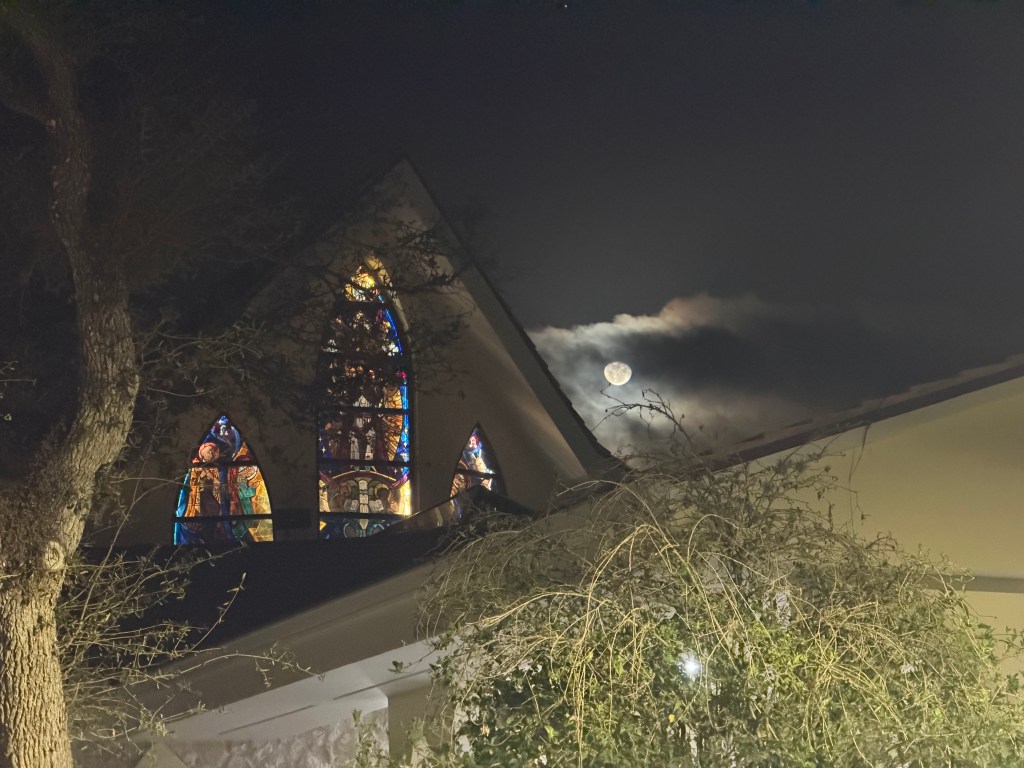
Photo: Quiet moments like these helps us to breathe, pray, and remember who we are and whose we are.

Quote from St. Augustine in The Liturgy of the Hours. New York: The Catholic Publishing Co., 1976.

Link for the Mass readings for Sunday, February 22, 2026

A fast from the busy can help us to decompress and reset.

In the Gospel of Matthew, we read today about the account of Jesus comparing himself to a bridegroom: “The days will come when the bridegroom is taken away from them, and then they will fast” (Mt 9:15). In a sense, the bridegroom has been taken from us, in another sense, he is closer to us now than he was when he was with his disciples and walked the earth. The fullness of his reign though will not be consummated until Jesus comes again, but while we wait, when we are willing to set aside other distractions and be still, we can hear and experience of the beating of his Sacred Heart.

We need food for our survival, but we don’t need as much as we think we do! Fasting from food is not the only focus of our Lenten fast. The discipline of fasting provides an opportunity to keep our passions in check. By resisting the impulse of instant gratification, we are able to better discern between apparent goods and the actual Good in our lives. When we are able to navigate through the maze of distractions, diversions, temptations, and allurements on a physical level, we can begin to go deeper into the spiritual reality to begin to expose some of the demons that we feed, such as “distrust, apathy, and resignation”.

Pope Francis mentioned that these three demons “deaden and paralyze the soul of a believing people.” He continued by stating that: “Lent is the ideal time to unmask these and other temptations, to allow our hearts to beat once more in tune with the vibrant heart of Jesus.”

When we are willing to discipline our impulsiveness, to slow down, to take time to recollect even with a few deep breaths, we can begin to see more clearly God’s will for our lives. We can then be more open to God’s invitation to grow in relationship with him and each other. We can better assume the posture of John the Apostle by resting our head on the chest of Jesus (cf John 13:25), such that our hearts will beat in the same rhythm as his Sacred Heart.

This is the gift of contemplation drives us to service. This is the same rhythm that beat in the prophet Isaiah who reminds us in today’s first reading what true fasting is all about:  “releasing those bound unjustly, untying the thongs of the yoke; Setting free the oppressed, breaking every yoke; Sharing your bread with the hungry, sheltering the oppressed and the homeless; Clothing the naked when you see them, and not turning your back on your own” (Isaiah 58:6-7).

————————————————————————

Photo: Stillness, quiet moments, while experiencing the wonder of God’s creation helps us to experience, can help us to slow down and allow our heart to beat with he rhythm of Jesus’ sacred heart.

Link for Pope Francis homily:

Pope Francis offers a “worksheet” for Lent: Check it out!

Link for the Mass readings for Friday, February 20, 2026

May we guard ourselves against the leaven of the Pharisees and Herod.

Jesus convicted the Pharisees for demanding a sign and for their continued hardness of heart, their unwillingness to see and hear the work and presence of God right before them. He also saw the unsettling yeast of the Pharisees present in his own disciples. In today’s reading, Jesus seized on the opportunity of being together in the boat, Jesus seized on this teachable moment. He wanted to help the disciples of his inner circle to resist the same path of corruption when he enjoined them: “Watch out, guard against the leaven of the Pharisees and the leaven of Herod” (Mk 8:15).

As has been their pattern, the disciples missed the point as they focused on the literal reality that they only had one loaf of bread among them. Jesus was not, as they thought, taking them to task for not thinking ahead to bring enough bread. He had twice now multiplied minimal amounts of bread to feed thousands. One loaf with them would not have been an issue. He was more concerned about them falling into the danger of pride, seeking honor, power, and fame which had lead many of the Pharisees and Herod astray. To be his followers, striving to place themselves first would be not only the undoing of each of them but also undermine the authenticity of the Gospel message they were to proclaim and affect those they would be charged to care for.

Unfortunately, too many have not heeded the lesson that Jesus offered in today’s Gospel to his disciples regarding being aware of the corrupting leaven of many of the Pharisees and Herod. Just as the effects of original sin has wounded humanity, so it has also affected those in the Church. Throughout the ages, clergy and laity alike have succumbed to the temptations of placing our needs before and focusing on ourselves instead of God and who he calls us to serve. The curving in upon ourselves and the hardening of our hearts, close us off to the love of God and the reality of the truth that we can be in relationship with him, this truth that Jesus came to bring.

Yet throughout the worst corruptions and abuses, the Church remains. God continues to work through many who are faithful, like Mary his mother, and say “yes” to his invitation and follow his will in simple ways, living lives of quiet prayer, worship, and giving of themselves in acts of service daily. It is unfortunate that there are those who leave because they see hypocrisy, injustice, abuse, and corruption. For it is those with eyes to see and ears to hear that need to stay and be faithful witnesses to the call of the one true Bread from Heaven.

We must remain persistent and lean on Jesus to give us the strength and clarity on how best to seek healing for ourselves and proceed to help to heal his wounded Body. We also need to be aware of the sinful leaven that would seek to undo each of us. It is easy to point fingers. We will be on stable footing when we seek forgiveness, healing, transformation, and guidance from Jesus and choose to place God primary before any self-serving pursuits. Doing so will help us to live simple and holy lives of loving God, our neighbors, and ourselves.

——————————————————

Photo: Daily prayer and meditation, pondering the word of God, participating in the sacraments, and opening our hearts and minds to God’s guidance will help us to resist the spiritual leaven of hypocrisy, sin, and the hardening of our hearts.

Link for the Mass readings for Tuesday, February 17, 2026

Do we seek a sign or believe and trust in Jesus?

“Give me a sign!”

Often, when we ask for a sign, we have a preconceived notion of what we are seeking and we want God’s stamp of approval on it. The impetus is coming from us, seeking to bend the will of God to our will. More often times than not this approach will end in frustration. The Pharisees in today’s account are asking for a sign. Jesus has already been preaching with authority, healing, casting out unclean spirits and demons, encountering the unclean and restoring them to the community and right worship, and this is not enough?

The Pharisees hardness of heart echo their ancestors in the desert who constantly complained and were rebellious toward Moses and God. They refused to be grateful that God had freed them from their bondage in Egypt and was caring and providing for them every step of the way on their journey. They refused to see God working in their midst. The Pharisees refused to see in Jesus, the Son of God working miracles in their midst.

We can understand how: He sighed from the depth of his spirit and said, “Why does this generation seek a sign? Amen, I say to you, no sign will be given to this generation” (Mk 8:12). The majority of the Pharisee’s minds were set, they were “motivated not by a sincere desire for truth but by a refusal to relate to God on his own terms. To insist on irrefutable evidence is really a demand for control” (Healy, 153).  Jesus knew there was nothing he could say or do to prove to them that the kingdom of God was at hand in their very midst.

If they had not the eyes to see nor the ears to hear, there was no argument, point, or sign that would have changed their minds. Jesus sighed from the depths of his spirit because their hearts were hardened such that they closed themselves off from the gift of the grace he sought to share. There was nothing left to say, so he then got into the boat to go to the other shore. He was determined to now put his energy into preparing his disciples, to ready them for his death and their mission.

Do we believe, do we really believe, that Jesus is “the way, the truth, and the life” (Jn 14:6)? Do we seek to bend God’s will to our own or are we willing to change, be transformed, and seek to align our will with his? The woman with the hemorrhage for twelve years, Jairus whose daughter died, the Syrophoenician woman whose daughter was possessed, the friends with the man with the withered hand, and the leper, did not ask for a sign, they asked for healing. They trusted, believed, and risked getting closer to Jesus seeking to encounter him despite the barriers in place to prevent them. In each of these cases, Jesus recognized their faith and each received the healing they sought.

In our discernment, we need to be aware of our intent. There is a subtle distinction, but it is important. Are we seeking proof, a sign, on our terms, or do we have faith in Jesus? Do we believe him, trust him, and seek to know God’s will, as Mary did when she asked, “How can this be” (Lk 1:34)? Are we demanding proof, a three-point plan from God before we follow his lead, or do we trust his invitation and believe that he will reveal what we need to do each step of the way? Often times, if we knew the end result and full ramifications of his original request, our doubt would crush our spirit before we even started.

Let us not seek a sign but instead a relationship. Making time to be still, to pray, to open and lift up our hearts and minds to God and spend time with him each day in the living words of the Bible, the Mass, examining our conscience, going to confession regularly, will help us to better know him and his will. May we trust as Mary did when she said, “May it be done to me according to your word” (Lk 1:38), and as did her Son, “not my will but your will be done” (Luke 22:42). Let us take the hands of Jesus and Mary in ours. They who know God the Father can help us to know him as well and help us to discern and accomplish what he calls us to do just for today and that is enough.

————————————————————————————–

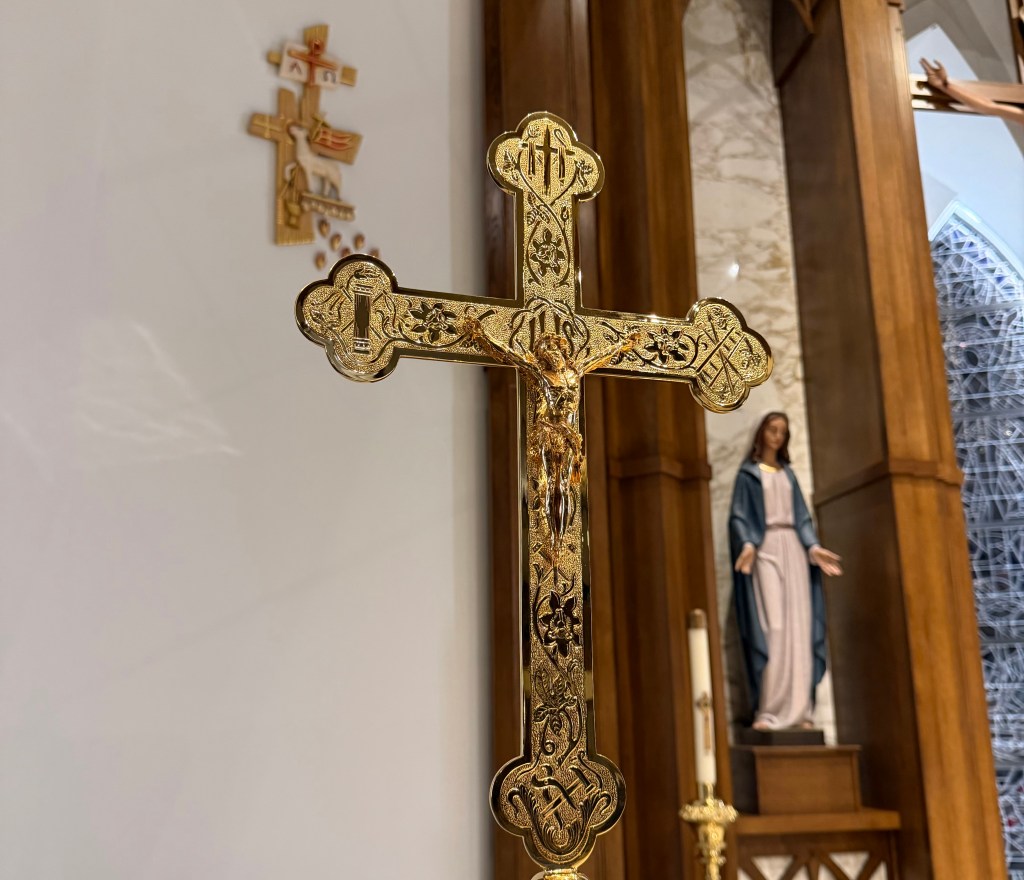
Photo: If we want the best sign of Jesus’ love for us, the crucifix is it.

Healy, Mary. The Gospel of Mark. Grand Rapids, MI: Baker Academic, 2008.

Link for the Mass readings for Monday, February 16, 2026

“What do you have, what can you offer?”

As Christians we are called to be disciples of Jesus, to learn about his life, his teachings, and follow him and his direction. This is not to be an academic exercise. Through reading, meditating, and praying with the Gospels as well as the whole of the Bible; participating in Sunday Mass and holy days of obligation, and if able, more often or even daily, receive Jesus in the Eucharist, we encounter and come to know Jesus.

Just as Jesus called each of the Twelve, we have been called, and as they modeled their lives around and were transformed by the love of Jesus, they and we are called to be apostles. Ones who are sent, as we are at then end of each Mass to proclaim and share that Jesus is who he said he is, and how he has affected our lives. Often when we are reminded of this message though, we may feel inadequate. We may question what it is that we can even possibly offer in an effort to help build the kingdom of God. We may feel we have nothing to share, nothing to give, nothing to say, or that what the Lord asks of us, we do not know how to even begin.

The Twelve expressed doubts and we see this on display. Jesus shows concern for the thousands who had just listened to him for three days and are readying to depart. He has satiated their spiritual hunger, they remained with him for three days listening! He now also is concerned about their physical hunger and that some may collapse or grow faint on their way home. The disciples were bewildered with Jesus’ request. How could they possibly feed the vast crowd of four thousand. Then Jesus asked,  “How many loaves do you have” (Mk 8:5)? With the minuscule amount, of seven loaves and a few fish, Jesus fed the multitude. “They ate and were satisfied” (Mark 8:8), with seven baskets of bread fragments left over.

Jesus asks us, “What do you have, what can you offer?” We may not have been asked or thought about this question before. We may not know initially how to answer. It is worth pondering. Where are there and who might have needs? Each day is a new opportunity to begin again and seek Jesus’ guidance. We can pray and meditate with this account from Mark. We can also look at a statue of Jesus we may have, a picture, a crucifix, or an icon. Then take some deep breaths, meditate on our present life condition, and assess where there is a need in our own life as well as those of others. Once we receive an answer or a nudge, then we can give what we have to Jesus.

Resist looking for the big response or grand plan. Ask yourself what you can offer no matter how small. What you give to Jesus, he will multiply and bring about amazing results. “Jesus takes what little his disciples have to offer, blesses it, and gives it back to them; in the very process the paltry amount mysteriously becomes more than enough to satisfy the needs of all” (Healy, 152). Jesus provides, Jesus works through us. We don’t need to be concerned whether or not we are capable or worthy. The question we need to answer is, “Are we willing?” If “yes”, then, with Jesus, all things are possible.


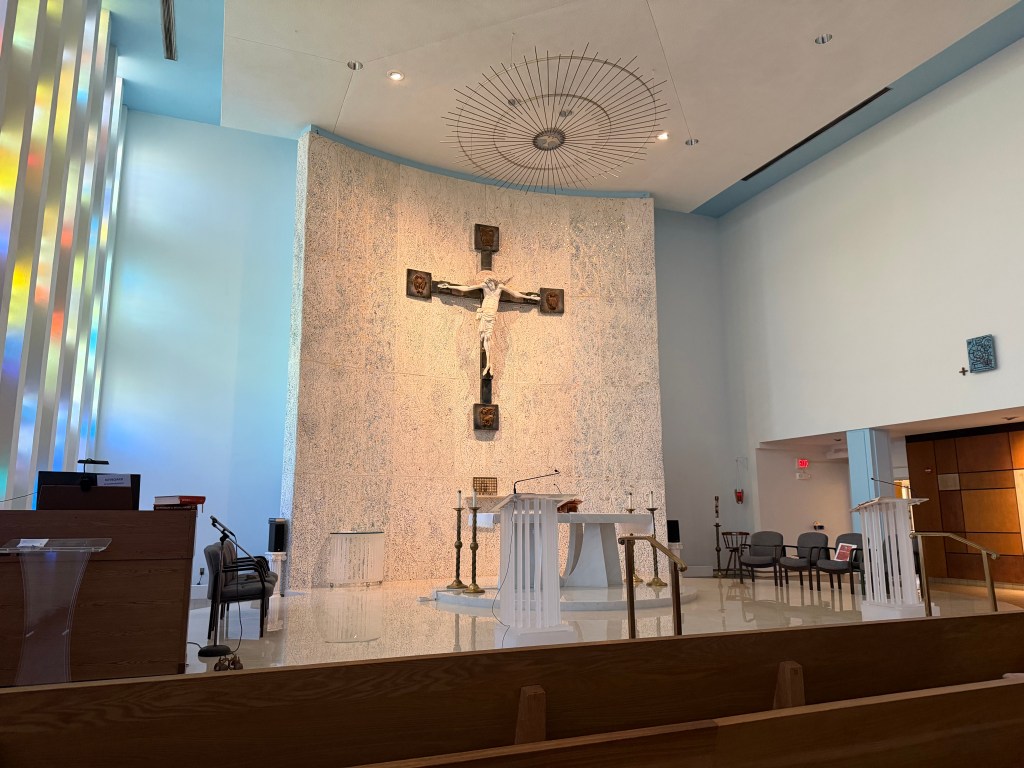
Photo: Some quiet time listening to Jesus, in the sanctuary of St. Gerard Majella Catholic Church, Los Angeles, CA.

Healy, Mary. The Gospel of Mark. Grand Rapids, MI: Baker Academic, 2008.

Link for the Mass readings for Saturday, February 14, 2026

When we can hear God, we can experience healing at a deeper level.

Those who witnessed Jesus healing the man who was deaf with a speech impediment grasped something more than just the healing when they stated: “He has done all things well. He makes the deaf hear and the mute speak” (Mk 7:37). With these words, they were acknowledging the deliverance of Israel by the Lord, promised by the prophet Isaiah, when he mentioned how, “the eyes of the blind will be opened, the ears of the deaf will be cleared” (Isaiah 35:5).

The beauty of this healing may be missed by us in the modern age because of the graphic nature of the details used by Mark. Jesus places his fingers in the man’s ears, spits into his own hands, and then touches the man’s tongue. Jesus is mixing his own saliva with this man in need of healing. We don’t even share drinks from the same bottle anymore as we used to do when we were kids! Still in the shadow of Covid and a new flu strain, this imagery can seem incomprehensible!

Yet, what Jesus is showing is the intimacy of communion that he offers us. He gave the very essence of his own being, his own saliva and mingled it with this man’s saliva. This physical teaching is an image or icon, of how the Son of God, in no way diminishing the fullness of his divinity, entered into the very real corporality of our humanity. He became one with us so that we can become one with him. This was true then and it is still true for us today, less the saliva!

This is also especially true because as with Jesus healing of the Syrophoenician woman’s daughter yesterday, this man too is not a Jew but a Gentile. In each of the healings, the good news is that the good news is still being proclaimed to the Jewish people but also Jesus is moving beyond, and all people are given access to God through Jesus. The eyes and ears of all will be opened to the glory of God’s message and invitation to relationship.

We all suffer at some point from physical, emotional, psychological, and/or spiritual trials. What is worse is when we close ourselves of from or have not learned to hear God’s word, and become deaf and mute. Jesus, even if he does not provide a healing or an immediate solution, is present. We are invited to resist avoiding or denying our suffering, pain, and/or challenges and instead embrace them with Jesus. In doing so, we align our suffering with his on the Cross. When we choose to offer up our pain and suffering on behalf of another, we participate in redemptive suffering. Others can experience relief and healing from our sacrifice in participation with Jesus.

This act of the will sometimes brings healing for ourselves, comfort, and even when the suffering continues, gives meaning. We do not endure what we are going through in vain. Better to face, head-on, that which challenges us open to the guidance of Jesus. Along with the advances in medicine, science, and psychology, engaging both our faith and reason, our discernment will be more balanced. Just masking struggles without dealing with the root cause(s) can prolong and possibly worsen the condition.

Jesus seeks to heal us at the core root of our wounds as well by saying to us: “Ephphatha!” so that we too can hear and speak his word, experience a closer walk with Jesus, and be more present to and love one another. Jesus wants to heal others through us. With ears open to the voice of God, we will become more aware of those in need. One of the best gifts of healing we can offer is to be present, listen to and hear those speaking with us. We know the peace and joy that we experience when he have been heard and loved. As we have received, so let us give!

——————————————————————————————-

Picture: Icon of Jesus healing the man deaf and mute – Artist unknown.

Link for the Mass readings for Friday, February 13, 2026

The Syrophoenician woman exemplifies and models for us the courage and faith of a disciple.

In today’s encounter between Jesus and the Syrophoenician woman, we can observe again the crossing of societal norms. The woman, very much like the woman who had been hemorrhaging for twelve years, was desperate, faithful, and bold. She was “Greek” and a “Syrophoenician by birth” meaning that she was a Gentile in religious observation and also by birth. She then entered the home where Jesus was staying uninvited and “fell at his feet.” She was willing to risk breaking the social taboo of speaking with Jesus on one hand and entering into the place where he was staying uninvited on the other! She did so with the sole purpose that her daughter would be healed.

Jesus meets her with the derogatory language of equating her with a dog, considered one of the most unclean of animals by Jews: “Let the children be fed first. For it is not right to take the food of the children and throw it to the dogs” (Mk 7:27). This woman would have none of Jesus’ rebuke, she wasn’t leaving without receiving an exorcism for her daughter, even if that meant she was putting her life in danger. Her retort, “Lord, even the dogs under the table eat the children’s scraps”, emphasized this point. It was also the key that opened the door for the disciples and us to witness a consistent pattern with Jesus.

Just as the woman who was experiencing the hemorrhage (cf. Mk 5:25-34), both women had the faith and courage to approach Jesus. The outcome of this encounter was also similar to the one that Jesus had with another Gentile, the Roman centurion, who said that he was not worthy for Jesus to enter under his roof. In both accounts, Jesus healed solely by his word from afar. What is important to Jesus is the person’s faith and belief in who he is, was, and always will be – the Son of God!

Jesus’ apparent rebuke to the woman was more a statement of fact. He did come to proclaim the Good News to the “children” first, the chosen ones, God’s children, the people of Israel. And how sad was the day as we saw not too long ago when Jesus came to proclaim this message to those in his hometown and so few had the faith of this woman before him, a Gentile. Her faith not only saved her daughter from the possession of a demon, but was the opening for the Gospel to also be proclaimed to other Gentiles as well as to the Jewish people willing to believe.

Do we have the courage, faith, and belief in Jesus as did the Syrophoenician woman? Are we willing to take the risk of countering pressures from others seeking to divert our closer walk with Jesus? When we let nothing hinder us, including relinquishing control and the reigns of being our own masters, acknowledging that God is God and we are not, believing that Jesus is truly the Son of God and that he is still present and active in our lives, miracles still do happen! Jesus said that if we have faith the size of the mustard seed, we can move mountains (cf. Mt 17:20) and what we ask for in prayer, we will receive (as we shall see in Mark 11:24).

Life is hard. We or someone we know may be facing conflicts, challenges, sorrows, trials, and/or tribulations. We may be experiencing opposing forces that feel as big as mountains, or it may appear that Jesus himself is refusing our plea. Be not afraid! Trust in Jesus! He cares and is present and may just be allowing this time of suffering to awaken a deeper faith that has been there all along but has not yet been actualized.

Embrace any and all of the range of challenges and emotions that you are experiencing and lay them at the feet of Jesus, and then take his hand. With Jesus all things are possible. We just need to believe and trust that our Lord is present with us especially in the midst of our pain and struggles. Jesus has not left us as orphans. We are not alone, but we do need to, as did the Syrophoenician woman, have faith that Jesus is who he says he is. Jesus is the Christ, our Savior and Redeemer, he is present, the kingdom of God at hand, he cares and loves us more than we can imagine, and he will see us through step by faithful step.


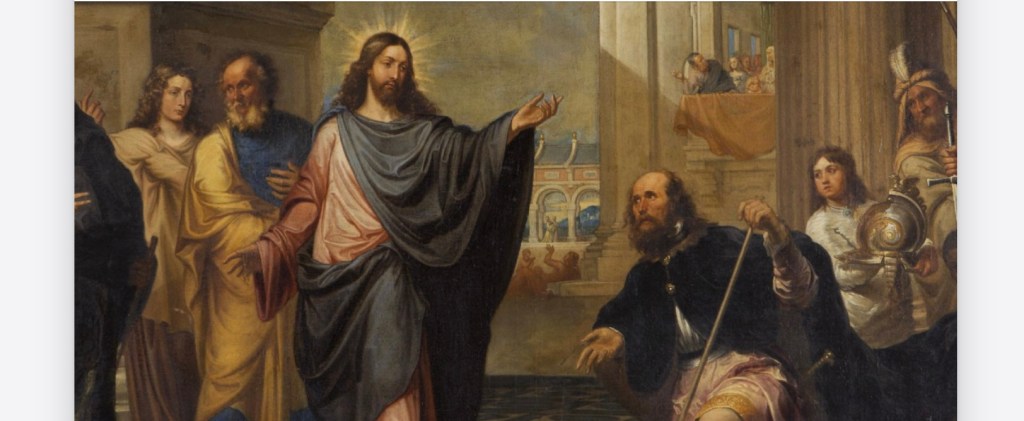
Photo: The Woman of Canaan at the Feet of Christ by Jean Germain Drouais.

Link for the Mass readings for Thursday, February 12, 2026

May we think, speak, and act as if Jesus was before us, because he is.

“[W]hat comes out of the man, that is what defiles him” (Mk 7:20).

Jesus offers a list in today’s gospel of what can be unleashed from within and then directed out toward another. These are examples of what defiles us because, at some level, we make the decision to think about, speak, and put into action those thoughts, words, and actions. Jesus is making a clear distinction that external things don’t defile or make a person unclean, “rather uncleanness comes from within, from the deep inner wellspring of a person’s words and actions” (Healy, 141).

To resist the temptation to defile ourselves and others, we can follow the lead of the writer from the letter to the Hebrews who offered a wonderful verse, which I pray each morning in my recitation of the Office: “Encourage each other daily while it is still today” (Hebrews 3:13). There are many that we will encounter or hear about each day that will do the exact opposite.

A valuable goal is to resist spending any time or energy supporting any thoughts, words, or actions that demean, belittle, or dehumanize. We can call those out who do so, stand up for those impoverished from these attacks who do not have a voice, but we must not succumb, engage, or in any way be lowered to the negativity unleashed. Otherwise, we become agents in perpetuating the same vileness and poison already unleashed.

Our thoughts, words, and actions matter because we are all interconnected, and even what we ruminate upon can be projected through our faces and directed out toward another without saying one word. Thoughts entertained can then lead to words and actions that deeply wound. Our thoughts can wound as well. We are better when we approach each moment accessing more intentional choices. Instead of reacting on automatic pilot, we can take a few, slow deep breaths, think, and pray about our response. If God is not calling us to think in some way, we renounce and resist speaking or acting upon it.

Let us choose to align our thoughts, words, and actions with those of Jesus. We can follow St Mother Teresa of Calcutta’s five-finger gospel as a reminder: “You-did-it-to-me.” What we say and do to the least of our brothers and sisters, we say and do to Jesus (cf. Mt 25:35-45). This begins when we resist defiling ourselves by never letting evil talk pass our lips and instead think, speak, and act in ways that empower, convict, and build up others. Our effort is strengthened when we choose to forgive any negativity hurled at us, and meet it with a posture of compassion that seeks to understand the perspective of the hurler. In our efforts, we are not alone when we call upon the help and strength of Jesus and strive to become ambassadors of his transforming love.

————————————————————————————————-

Photo: We become disciples of Jesus when we are willing to be transformed by his love and to live as he did and put into practice his teachings.

Link for the Mass readings for Wednesday, February 11, 2026

Our faith and practices are healthy when they lead us to Jesus and “a deep transformation of the heart.”

Jesus reacted to the criticism of not observing ritual washing prior to eating that was leveled at him from the Pharisees and scribes by recalling the tradition of the Prophets through the words of Isaiah: “This people honors me with their lips, but their hearts are far from me” (Mk 7:6). Jesus recognizes the context of these words as he uses them. Many of the Israelites of Isaiah’s time “lost an intimate contact with God, and serve him with an empty formalism devoid of authentic love… inherited rituals that are not rooted in interior conversion of heart” (Healy, 137).

Jesus is convicting the Pharisees and scribes of doing the same, following the law for the law’s sake which is an empty act. What is more important is encountering the living God, experiencing his love and forgiveness, developing a relationship, being transformed by him, and restoring what has been lost.

Isaiah, the prophet, the mouthpiece of God also invoked a promise. For when his children see the work of my hands in his midst, they shall sanctify my name; they shall sanctify the Holy One of Jacob, be in awe of the God of Israel” (Isaiah 29:23). When the people again are willing to see God among them and recognize his presence, change their minds and hearts, they will again be invited to turn away from their idolatrous and selfish ways and again worship God.

In quoting this verse, those with eyes to see and ears to hear will reflect on the life, teachings, exorcisms, and healings, they will ascent to the truth, that Jesus is his Father’s hands in their midst.

Are we willing to see this truth as well? Each of us as human beings were created in God’s image and likeness, but through sin, lost that likeness. Jesus us come to reveal where we have turned away and lead us back, heal where we have been wounded, forgive us of our sins, and show us where, in our religious practices, we may be going through the motions, offering empty lip service, rather than growing in our relationship with him as a person.

We must be careful and vigilant that we resist substituting “religiosity for genuine obedience to God and his word. What is needed is a personal encounter with Jesus leading to a deep transformation of heart. When that occurs, religious practices come to life and serve their true practice” (Healy, 138). Jesus challenged the hyper scrupulosity and exactitude of the rules that had nothing to do with being humble servants of and growing in relationship with God.

Just laws and practices are enacted to help us to build up and empower through discipline and clear boundaries so that we can identify the false promises and lies of the enemy, the apparent goods the distract us. Their aim is to help keep us from being enslaved to our passions and sins and instead lead us to freedom for excellence, for fulfillment, and to experience a heart on fire with an ever-growing love that yearns for a relationship with God and each other, like a deer that longs for running streams.

As with any game we play, there are rules and regulations, there are referees and officials to keep order. When the rules enforced encroach on the flow of the game, such that they inhibit the freedom of play, the game is stunted. When there is no enforcement, the game quickly devolves into chaos. When the rules are consistent, they provide the structure and boundaries that limit abuse, allow for the game to flourish, and the players to experience the freedom to actualize their potential, and as such, the play becomes something beautiful for God.

The first time I saw people skate, at around seven years, I was enraptured. My father was working on a project at our local, ice rink. We had not gone there to skate, and yet, I refused to leave until he took me on the ice. It didn’t matter that the only skates that fit my feet were figure skates or that my first attempt was a dismal failure. What mattered was that I made it to the ice and the joy of that experience inspired me as I learned the rules of balance, how to stop, and what a toe kick was and was not for. Soon I had the freedom not only to skate but to join a hockey team. The freedom and joy I felt any time I skated or played hockey, I still carry with me.

We as the Church, are not to lead with the rules and moralizing, but instead, share our time, presence, the joy of our faith, and build opportunities of encounter and relationship. We empower and support one another as we enter into the play between our finite freedom and God’s infinite freedom. We have been created for and to seek a deep and intimate relationship with him that will lead us to a deeper transformation of our hearts and minds. With both open to God’s guidance, we can better identify and discern between the voice of the enemy and God. There is a unique balance between the rules and the freedom of play in ice skating as well as our relationship with God.

Loving someone does not mean allowing them to do whatever. Loving means willing their good, offering invitations, options, establishing boundaries, corrections, opportunities for growth, maturity, and authentic freedom. This is how God guides us with his love. We are going to make mistakes, I have made plenty. The key is learning from those mistakes, recognizing that we are on a journey together, and we are to learn from God and one another. The boundaries, practices, and rules that God teaches us through the Church provides a foundation to identify and renounce that which seeks to divide and isolate us. They allow us to grow in relationship with God, who invites us to be; joyful, human beings that are fully alive!

———————————————————————————

Photo: Be aware what brings you closer to experiencing God and his love for you and do that! Holy Hour at St. Gerard Majella Catholic Church this morning.

Healy, Mary. The Gospel of Mark. Grand Rapids, MI: Baker Academic, 2008.

Link for the Mass readings for Tuesday, February 10, 2026

As Jesus heals us, may we help others to receive his healing.

“Whatever villages or towns or countryside he entered, they laid the sick in the marketplaces and begged him that they might touch only the tassel on his cloak; and as many as touched it were healed” (Mk 6:56).

The people of Jesus’ time were in need of healing, hungry to draw closer to God, often searching, wandering, and wounded. That some begged only to touch the tassel on his cloak is interesting. Had the story spread of the faith of the woman with the hemorrhage for twelve years who courageously reached out and touched the tassel of his cloak and was healed? Had the woman herself shared her story and inspired others who had all but lost hope to seek out Jesus?

Even though there was a lull in the momentum when Jesus’ healed only a few in his hometown, and Mark paused in his account to share the flashback of John the Baptist’s death, Jesus has not slowed and people continue to seek his healing. The apostles also have been sent to bring healing and with success. Though Jesus is not as visible to us as he was to those in the land of Gennesaret, he is just as present if not closer, especially in the sacraments, to us today. “Jesus is still the great Physician of our souls and bodies. In the power of the Holy Spirit he continues his work of healing and salvation through the Church, especially in the two sacraments of healing: Penance and the Anointing of the Sick” (Healy, 134).

Let us also not forget the gift of Jesus present in the Mass. After experiencing the word proclaimed at Mass as his disciples heard Jesus teach with authority, and then receiving his Body and Blood, we are not to go home as if nothing of any significance just happened. Jesus invites us to his banquet weekly, and daily, to encounter him so that in receiving his love and his presence, we may be transformed and go forth to bring Jesus who we have received to others. We are also to see Jesus present in others who are in need.

Pope Francis was asked in an interview by Fr. Antonio Spadaro, S.J., in 2013, “What does the church need most at this historic moment?” And Pope Francis answered, “that the thing the church needs most today is the ability to heal wounds and to warm the hearts of the faithful; it needs nearness, proximity. I see the church as a field hospital after battle.” We need to be “near”, in the same “proximity”, to bear Christ to one another: “The church sometimes has locked itself up in small things, in small-minded rules. The most important thing is the first proclamation: Jesus Christ has saved you. And the ministers of the church must be ministers of mercy above all.”

As in the time Jesus walked among the people of Galilee and they came to him seeking healing, we and so many are in need today. May we seek to breathe, receive, rest, and abide in God’s love, experience his healing, so that we may be then present, have compassion like Jesus and draw near to those who Jesus sends us. May we resist the temptation to keep others at a distance and refuse to be indifferent to the needs of those he brings to us in their time of need. May we too, in the words of Pope Francis, go out to “heal the wounds and to warm the hearts of the faithful” by being willing to accompany others in their sorrows, anxiety, trials, and tribulations.

We may be hurting and people are hurting. We are not called to fix others or their problems but to be present, to listen, to hear, and to allow the Holy Spirit to speak and love through us at the appropriate time, so that, in the end, we do not prevent people from encountering Jesus, but provide a means for them to encounter the divine Physician. Maybe we can be the tassel on the cloak of Jesus to help others to experience his healing.

—————————————————————————————————————

Photo: May we be Jesus to others and assist in his healing!

Healy, Mary. The Gospel of Mark. Grand Rapids: Baker Academic, 2008.

Spadaro, S.J., Antonio. “A Big Heart Open to God: An interview with Pope Francis”. America Magazine. September 30, 2013 Issue: https://www.americamagazine.org/faith/2013/09/30/big-heart-open-god-interview-pope-francis

Link for the Mass readings for Monday, February 9, 2025