bible

Saying, “Yes.” to the will of God helps our little faith to increase.
Some Pharisees came to Jesus and said, “Go away, leave this area because Herod wants to kill you” (Lk 13:31).
Even with this warning, from some Pharisees no less, Jesus continued to teach openly and publicly as well as performed healings and cast out demons. He did not fear the threat of retribution even from the likes of Herod who had killed John the Baptist. He willingly surrendered all to his Father.
The courage of Jesus makes him a very dangerous man because he cannot be controlled, threatened, or coerced. Jesus is sure of what God has sent him to do and he is going to follow through with his Father’s plan even to the point of giving his life.
Many, even those who didn’t believe like the centurion who ran his spear through his side, admired his courage, coming to believe that he was the Messiah (cf. Mark 16:39). Many of the first-century martyrs who followed Jesus to their own deaths were a big reason for those who came to believe and also became followers of this One who died on a Cross. Tertullian, one of the early Church Fathers, living from 155 – 220 AD, went so far as to say that “The blood of the martyrs is the seed of the Church.”
We are all called by God to be martyrs, not necessarily by shedding our blood. Martyr literally means witness. Each one of us is called by Jesus to bear witness to what we believe. Faith is a gift. If we feel that we are weak in our faith, we are in good company, because Jesus said on more than one occasion to his Apostles, the ones he would send out as his witnesses, “Oh, you of little faith.”
The Apostles continued with the little faith they had. They trusted in Jesus and continued to move forward. If we feel like our faith could use a little shoring up, let us not choose the path of Judas who isolated himself from the forgiveness of God. Let us instead ask God to increase our faith, to allow the Holy Spirit to dwell within us and transform us, and be open to opportunities to be more understanding, kind, and patient with ourselves and each other.
Jesus, please help us to be still and hear the Father calling us, challenging us, to resist indifference and be his witnesses in our everyday lives and to be more open with each stirring of the Holy Spirit to be better witnesses. Each time we say yes to the will of God, our faith increases.
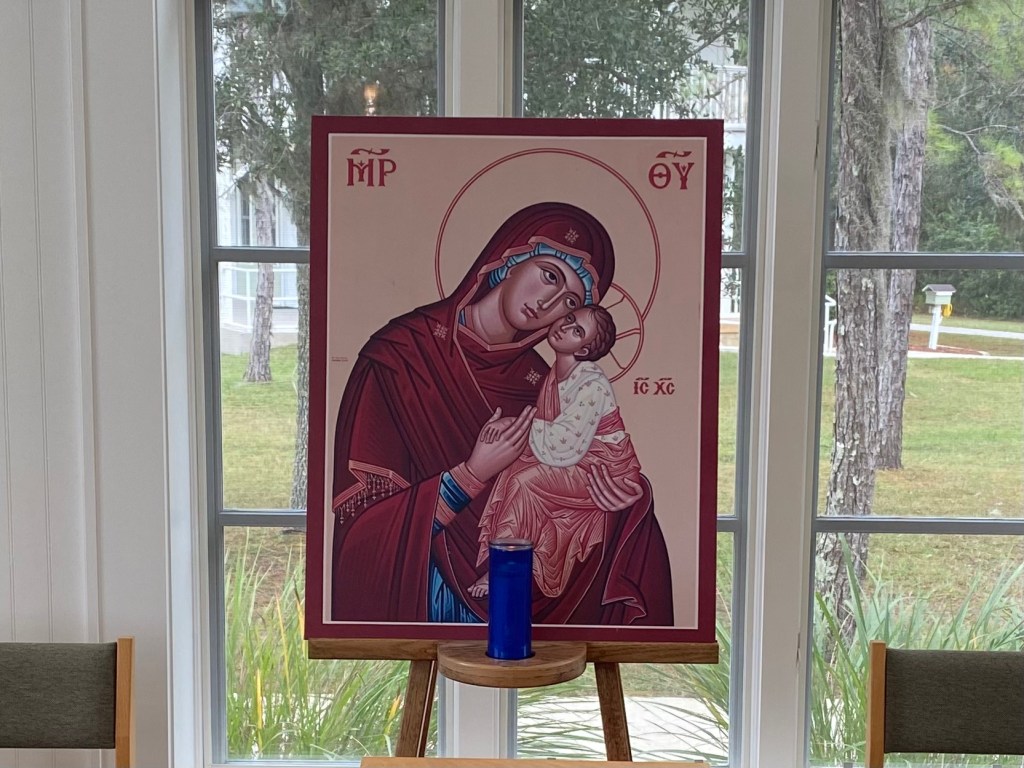
Photo: Mary’s, “Yes.” opened the way for our, “Yes.” Praying in front of an icon of Mary in the chapel at Bethany Retreat Center, in Lutz, FL while on my canonical retreat this time last year.
Link for the Mass readings for Thursday, October 30, 2024
Love is the narrow gate that we enter to grow closer to Jesus and one another.
He answered them, “Strive to enter through the narrow gate, for many, I tell you, will attempt to enter but will not be strong enough” (Lk 13:24).
Jesus offered this answer to the person who asked him, “Lord, will only a few be saved?” Jesus’ parables about it being easier for a camel to pass through the eye of a needle than for a rich man to enter heaven (cf Mt 19:24) and the rich man and Lazarus (Lk 16:19-31) also reveal to us that what we say and do in our lives regarding the welfare of others matter. Are we building walls or bridges regarding our relationship with God and one another, are we including or excluding?
There are many distractions, diversions, and temptations that pull at us. When we give in to them, we can strain or even break our relationships. Jesus said many will not be strong enough, and on our own he is right. St Paul also realized this, for he wrote, “I do not do the good I want, but I do the evil that I do not want” (Romans 7:19). How many of us could say the same?
Relationships are not easy in the best of circumstances, this is true on the human level as well as the spiritual. St Teresa of Avila, the 16th-century Spanish saint and doctor of the Church, shared openly and honestly with Jesus once after being thrown from a carriage into a mud puddle, “If you treat your friends so poorly, it is no wonder that you have so few!” I relate to the honesty of this quote. My maternal grandparents had the same kind of open, unfiltered relationship with each other. To an outsider looking in, they would have missed the depth of love they had developed for one another for over sixty years and which continued to grow into their last days.
Authentic relationships demand that we go through the narrow gate of love. Love is more than mere sentiment, emotions, or feelings. We must grow in our willingness to sacrifice, be committed, understanding and forgiving, present, patient, willing to risk being vulnerable, honest, to respect boundaries, and share who we truly are with one another, free of any pretense or masks. On our own, we are not strong enough to persevere, but with God, we will remain faithful.
My grandmother told me to take the time we needed to get to know each other, but once we knew, not to wait too long. We didn’t. JoAnn and I were married six months after we started dating. Each of us brought our own baggage, wounds, and made plenty of mistakes, to our relationship, yet each year was better than the one before because we remained committed to God and to each other. We became more patient and understanding, we empowered and were there for each other. At each of the crossroads that arose over our twenty-three years, we chose the narrow gate. We loved Jesus and each other and that made all the difference.
Jesus is the relationship we need to develop first and foremost and he will then help us to properly order our relationships as well as all aspects of our lives. He will be our foundation and strength as challenges arise. Jesus continually invites us with his tender chords of love to draw closer into relationship with him so better to grow closer into relationship with one another.
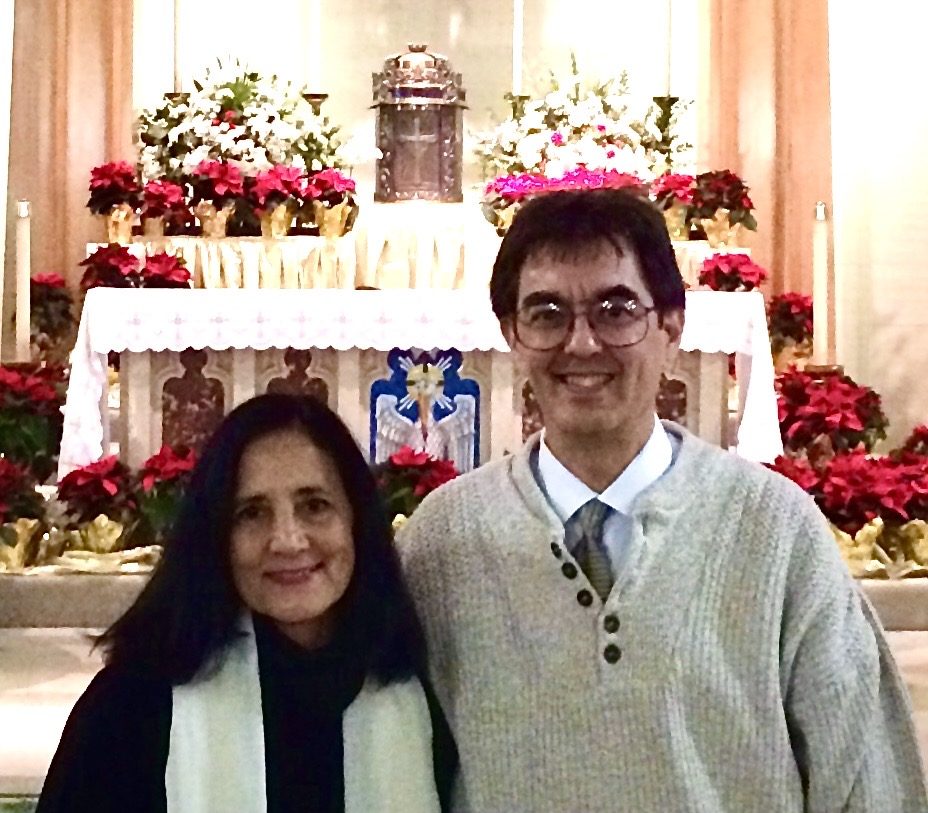
Photo: Jesus at the center of our relationship may all the difference.
Link for the Mass readings for Wednesday, October 30, 2024

A little awareness and an act of kindness can make a huge difference.
In today’s Gospel from Luke, Jesus compares the Kingdom of God to a mustard seed and yeast. Each of these elements is not only small but they are tiny. Though with the proper environment, resources of sustenance, water, and sunlight, this seed will germinate, sprout, and grow into a large bush. Yeast, a single-celled organism, is the catalyst for assisting dough to rise, strengthen, and ferment, thus providing a more appealing and tasty bread.
Jesus offered these simple examples from everyday agrarian life that his listeners understood from experience. If we have planted seeds or made our own homemade bread, we too are in a better position to relate to these two small parables as well.
Throughout the Gospels, Jesus lives out the parables by engaging person to person. Jesus’ interactions happened concretely, through walking along the road and breaking of bread together, sharing stories, teaching, healing, and exorcising demons with his touch, and he still does so today. The smallest, genuine act of kindness or love can seem insignificant and may even go unnoticed by many, but it is significant to the individual who is on the receiving end and can reveal dramatic results over time.
There is a story that expresses this point called, “A Simple Gesture” from the story collection, Chicken Soup for the Soul. The short tale describes how one day a boy named Mark was walking home from school and came upon another boy who had tripped and dropped all of his books and many other items. Mark offered to help carry some of the load of the other boy, who, as they walked home, found out was named Bill. They talked about common interests and when they approached Bill’s home, Bill invited Mark in for a Coke and to watch some T.V. They spent the afternoon together, then interacted on occasion for the rest of their time in middle school and into their high school years.
Three weeks before their graduation, Bill asked Mark if they could talk. Bill shared that the reason that he had been carrying all of that stuff home on the day they had first met was because he didn’t want to leave a mess for anyone else to clean up. Bill had planned to commit suicide that evening. Bill continued to share that, after their original encounter and afternoon together, he realized that if he had killed himself that day he would have missed more opportunities to talk and laugh. Bill finished the conversation by saying, “So you see, Mark, when you picked up my books that day, you did a lot more. You saved my life” (Canfield and Hansen, 35-36).
Personal encounters were how Jesus helped others to realize that the Kingdom of God was at hand. Just as in the example of how Mark, in making the simple effort to help Bill pick up his personal items, helped to shift the momentum away from a potential suicide attempt. This action shows how Jesus can continue to work through us today.
Like a modern-day Good Samaritan parable, “A Simple Gesture”, helps us to see that when we are aware of and engage in opportunities to help and act with genuine care, no matter how small, we can have a dramatic effect on another’s life. Unfortunately, the opposite is also true.
Many people have a lot on their plate, we may not be aware of even half of what they are going through. That is why we need to be attentive and open to the move of the Holy Spirit in our lives. He will lead us out beyond ourselves so that we notice others. In doing so, we can become like the mustard seed, or the yeast, in another’s life. Through a smile, a hello, a bent ear to listen, we can make a connection and then offer a simple act of kindness. What may appear to be minuscule or mundane at the moment, may, in fact, be life-changing and transforming for a lifetime.
Photo: My seminarian brothers helped me to get my nose out of the books to enjoy a Marlins game back in April of ’23.
Canfield, Jack, and Mark Victor Hansen. Chicken Soup for the Soul: 101 Stories to Open the Heart and Rekindle the Spirit. Deerfield Beach, FL: Health Communications, 1993.
Link for the Mass readings for Tuesday, October 29, 2024
Jesus “spent the night in prayer.” Can we give God ten minutes a day?
Jesus went up to the mountain to pray, and he spent the night in prayer to God (Lk 6:12).
Jesus spent the whole night in prayer to God. What is prayer? All of us as human beings seek for meaning and to belong. We desire security and stability, as well as direction and adventure. We want to be accepted, to be loved, to love, and to experience meaningful relationships. These primary yearnings are present within us. Often though we confuse what we truly desire for temptations that ultimately leave us unsatisfied and more importantly ignore what will truly fulfill us: developing a relationship with God through prayer.
If you want to pray, you have already begun. The desire in and of itself to pray is prayer. The danger of reading about prayer is that we think we are praying. In the turning of a page or the completion of a chapter, we feel as if we are accomplishing something, but we are only imagining how prayer can be. “It is tempting to remain in the comfortable theater of the imagination instead of the real world, to fall in love with the idea of becoming a saint and loving God and neighbor instead of doing the actual work, because the idea makes no demands on you” (Peter Kreeft, Prayer for Beginners, 12).
There is a myriad of ways to pray and each practice will match each of our unique personalities and temperaments. The key to prayer is to make a commitment to a time and a place to pray each day and then show up at that time and place to pray. Start with a timeframe, such as five minutes that you know you can do. Depending on the discipline of prayer you practice, your family, school, work, and/or ministerial demands will be indicators as to how much you might be able to increase the time you pray once you have built a consistent practice.
The amount of time that we dedicate to prayer is not as important as the commitment to pray each day. We need to set in our daily schedule our non-negotiables for prayer first and build around that. Again, this will depend on our station in life. Young parents’ non-negotiables are their infant whereas someone who is retired will possibly have some more time.
Mass, the liturgy of the Hours, reading the Bible, sitting or walking quietly outside, at the morning table with a favorite devotional, the Rosary, Chaplet of Divine Mercy, spiritual reading, and all with a healthy sprinkling of silent meditation and contemplation are all practices that can help us to grow in our relationship with God.
St Therese of Lisieux offers us a good approach to prayer: “For me, prayer is a surge of the heart; it is a simple look turned toward heaven, it is a cry of recognition and of love, embracing both trial and joy” (CCC, 2559). No matter how we pray, our goal is that we don’t seek to bend God’s will to our’s but to allow our lives to be conformed to Jesus, that we encounter and build a relationship with him and each other, such that our experience of prayer matches St Augustine’s: “True, whole prayer is nothing but love” (Foster, 1).
Photo: One of my favorite daily practices, Rosary night walk!
Foster, Richard J. Prayer: Finding the Heart’s True Home. NY: HarperCollins, 1992.
Kreeft, Peter. Prayer for Beginners. San Francisco: Ignatius Press, 2000.
Link for the Mass readings for Monday, October 28, 2024

Let us choose to walk out of the darkness and into the light of Jesus.
Wars continue to rage on, violence continues to be a steady diet, division, demonization, and polarization doesn’t appear to be slowing down anytime soon. What gets lost in the headlines of all this is the real people, human beings, family members, friends, classmates and colleagues. No wonder feelings of anxiety and stress are escalating exponentially. How are we to respond? In the Gospel today Jesus sheds some light on the darkness that beleaguers not only our country but our world.
On hearing that it was Jesus of Nazareth, he began to cry out and say, “Jesus, son of David, have pity on me.” And many rebuked him, telling him to be silent. (Mk 10:47-48).
Though Bartimaeus is blind, he seems to “see” better than those around him and know who Jesus is. He does not just call out the name of Jesus, but “Jesus, son of David.” This is not merely a genetic marker, but a Messianic title. Bartimaeus may have physical blindness, but he is one of the few in the Gospel of Mark to recognize Jesus as the Messiah. The disciples and the crowd walking with him, the many who “rebuked him”, showed their spiritual blindness, in that they prevented the blind man from coming to Jesus.
Where might we see ourselves in this scriptural account, who are we? Are we like those in the crowd who follow and identify with Jesus, yet rebuke others seeking to come to Jesus? Do we foster a posture of a fear of the other, embrace tribalism, nationalism, and contribute to and foster division, polarization, and prejudice? If we do, we then are suffering from the very spiritual blindness that Jesus has come to heal.
We can better help to bring about change by making an assessment of ourselves. Each thought we ponder and action we take ripples out from us and touches everyone. In what way do we contribute to the violence? Do we gossip, spread false reports knowingly about others only to degrade and belittle? Do we pass dehumanizing images and memes on social media? Do we talk over or at people, do we impose our views not even willing to listen to another? The smallest act of indignity shown to another, whether it be a snide remark, a racial, ethnic, or sexist epithet, or any manner of disrespect contributes to the darkness that seeks to blind us.
There is another way. There is another path we can walk upon. The one that Bartimaeus, once he could see, walked upon. To walk it, we need to be willing to allow Jesus to light the way, to convict us in the depths of our souls. In so doing, we are better able to counter the impulse to build walls that promote division, hate, and violence, and instead build bridges of forgiveness, unity, and love. We can then reflect his light in our present darkness.
Jesus did not rebuke Bartimaeus for causing a ruckus and calling out to him. Jesus called Bartimaeus to him. Jesus came close to others cast aside as well. He saw and sees each person as human beings, brothers and sisters created in the image and likeness of God. Jesus called the Apostles and Bartimaeus to him. We too are called to Jesus, called to be present to those within our realm of influence to be more understanding, and to meet each other with compassion and empathy. Darkness only spreads when we contribute to it and become the darkness. It dissipates when we remain in the light of Jesus. Hate only wins if we feed hate. Love wins when we are willing to forgive and love each other.
Let us have the humility to recognize our interconnectedness, that we cannot get through this life on our own. We, like Bartimaeus, need to be healed and made new. We need the Son of David in our lives, we need a savior, a healer, and we need each other. When we acknowledge this reality, we may better be able to resist the temptation to be indifferent to or dehumanize others. Instead let’s be more willing to notice, recognize, pray for and act to provide aide for each other. Jesus calls us to arise from our defensive posture and to open our arms wide to love, to will the good of each other as other.
Jesus asked Bartimaus, “What do you want me to do for you?” The blind man replied to him, “Master, I want to see.” Let that be our request of Jesus as well. May we ask Jesus to help us to see with the eyes of love, the eyes illumined by his light, and the wisdom of his Father. May we be willing to see each other as God sees us, as his beloved daughters and sons.
Photo: Night Rosary walk in Riverside Park, Vero Beach, FL.
Link to the Mass readings for Sunday, October 27, 2024
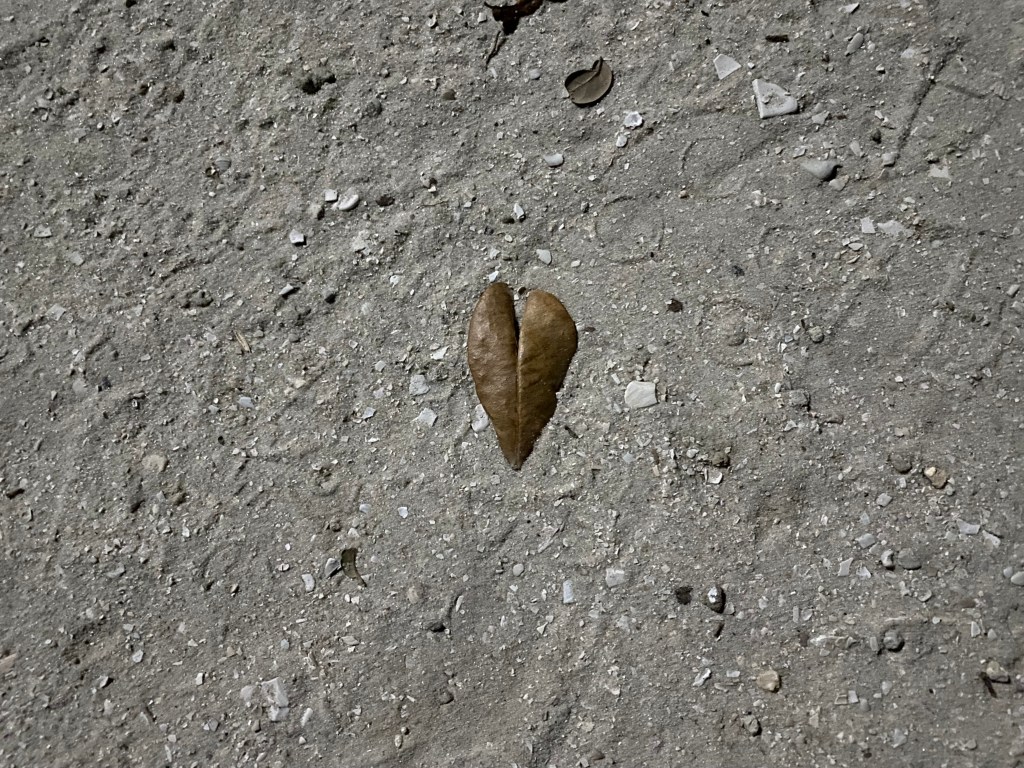
Repentance is a “conversion of the heart”.
In today’s Gospel, we read about two accounts of horrific deaths. The first is at the hands of Pontius Pilate, who has not only ordered the execution of Jesus’ fellow Galileans but had their blood mixed with “the blood of their sacrifices.” In the second incident, Jesus brought up the tragic accident in which eighteen people died “when the tower of Siloam fell on them.”
In both cases, Jesus rejected the common notion of the time that these incidents were caused by God’s punishment and focused instead on the importance of repentance. Jesus stated quite emphatically, that, “Do you think that because these Galileans suffered in this way they were greater sinners than all other Galileans? By no means! But I tell you, if you do not repent, you will all perish as they did” (cf. Lk 13:1-5)!
Jesus was emphatic about helping his followers understand the purpose of his coming. Jesus provided meaning and fulfillment in this life as well as being the way to the truth of eternal life in the next. Yet, to experience the benefits of his invitation, people needed to repent from their focus on self, misunderstandings of God, and the false substitutions that the world offered by having a change of heart and mind and turning back to God, the very source of their being. This is just as true for us today.
To repent and surrender to Jesus is not some submissive bowing to a tyrant but an acceptance of the aid offered by the divine gardener. Our repentance gives permission to Jesus to cultivate the ground of our being to rid us of that which sickens us and instead allow him to fertilize us with his word and grace in such a way that we are renewed. Jesus tends to our growth such that we can be more aligned with the will of his Father and the love of the Holy Spirit. In these ways, we are forgiven, healed and can better mature so that we will bear fruit that will last.
To repent is a good thing. As is written in the Catechism of the Catholic Church, line 1431: “Interior repentance is a radical reorientation of our whole life, a return, a conversion to God with our whole heart, an end of sin, a turning away from evil, with repugnance toward the evil actions we have committed. At the same time, it entails the desire and resolution to change one’s life, with hope in God’s mercy and trust in the help of his grace.”
When Jesus shared in his first public message: “Repent and believe in the Gospel” (Mark 1:15), he invited then and invites us still today to a new way of seeing, hearing, experiencing, and living our lives. No longer do we have to live in fear, be bound by addiction, and/or entrapped by our sins. As we open our heart and mind to Jesus, he reveals to us with his loving light that which is preventing us from experiencing the love of God more deeply and growing in our relationship with him more intimately. Let us trust in Jesus’ mercy, welcome the gift of his grace, repent, and allow our hearts and minds to experience conversion and transformation..
Photo: Heart found during Rosary walk in Riverside Park, Vero Beach. When we repent, Jesus receives our brittle hearts and infuses them with his water of life.
Link for the Mass readings for Saturday, October 26, 2024

God is in our midst!
“You know how to interpret the appearance of the earth and the sky; why do you not know how to interpret the present time” (Lk 12:56).
Reading this verse brought two memories from my childhood. The first one is from when my friend Steve and I as kids were interested in reading the natural signs and weather patterns, and we enjoyed watching our local weatherman, Hilton Kaderli, forecasting the weather each night. Another memory was with my cousin Danny. We were at my Uncle Pierre and Aunt Claudette’s house one afternoon and we saw a storm rising. We headed to the road and started running as fast as we could in the opposite direction to see how far we could get before the storm caught us, and when it did we walked home, sucking in air, being pelted by the rain, and enjoyed a good soaking. Steve, Danny, and I read the signs of the earth and the sky, but we didn’t pay all that much attention to the things of the spirit at that time.
Not only through his teachings, but also through his public actions, Jesus revealed some powerful signs that God was in their midst. Jesus taught and preached on his own authority, he cast out demons, forgave sins, healed people, met and ate with sinners and women. These were amazing signs that the Messiah came to dwell among them, yet some did not or would not see. They rationalized away that he could not be who he showed himself to be.
Some did see and believe and some two thousand years later because of their faithfulness, Jesus speaks to us again today. The stories and encounters of Jesus have been preserved, passed on generation after generation. They are not just a dead letter, nor is the sacred deposit of our faith some inanimate object passed on blindly generation after generation. We are invited time and again to be aware, to look for how Jesus still works in our lives today. He is not a mere historical figure. Jesus conquered death, rose again and became the first born of the new creation. The good news is that he invites us to read the signs of his presence in our lives in our times.
Do we see coincidences or God-incidences? Do we see God’s presence working in our lives? If not, could it be because our lives are so busy and fast-paced? If so, we need to schedule some time each day to stop and reflect, even if for only five to ten minutes to take some deep breaths, and ask God to help us review the past twenty-four hours with the express purpose of noticing how he has been involved and engaged in our lives.
It is often by reflecting and looking back over the course of a day, a week, or a month, that we will recall some God-incidents no matter how small. Being thankful for this growing awareness and asking God for greater insight each day will help us to grow in our awareness of how much he has been accompanying us all along in our daily experiences.
For those times that we have refused or failed to recognize this closeness to Jesus, especially in his presence coming to us through others seeking our help, we can ask for forgiveness and for Jesus to assist us in being more aware and more intentional in following the stirring of the Holy Spirit going forward. Opening our hearts and minds to God will help us to better read the signs that the kingdom of heaven is indeed at hand, in our very midst. Do we have eyes to see and ears to hear?
A moment to pause at another of God’s masterpieces as I begin my Rosary walk earlier this evening.
Link for the Mass readings for Friday, October 25, 2024

May God’s word enkindle a flame in our hearts and transform us.
Jesus said to his disciples: “I have come to set the earth on fire, and how I wish it were already blazing” (Lk 12:49)!
What has been burned does not remain the same. What fire touches, it transforms. Jesus wants us to be consumed so as to be transformed by the fire of the Holy Spirit. Encountering Jesus affects a change in us. When we are open to allow the Holy Spirit to breathe on the embers in the depths of our souls they are fanned like tinder and ignite. We continue to fuel the fire by getting in touch with what God has called us to do in our place and in our time.
We are not to be a Christian in name alone but in thought, word, and deed. Pope Francis, in his exhortation The Joy of the Gospel, wrote: “THE JOY OF THE GOSPEL fills the hearts and lives of all who encounter Jesus. Those who accept this offer of salvation are set free from sin, sorrow, inner emptiness, and loneliness” (Francis 2013, 9). Joy is a gift, a holy flame, that is given to us by the Holy Spirit, it wells up within, and rises up and out to be shared with others. It is different than pleasure which has its source in the stimulation of the senses being aroused but fades once the external stimulus has ended.
Happiness is also external and fleeting. It lasts longer than pleasure in that the memory of the experience will linger on but it too will also fade away. Joy wells up from within, as it is imparted to us by God and can be present even when the external experiences are stressful or chaotic. I experienced this when I was still teaching 5th and 6th Grade Religion and acting as the dean of students at Rosarian Academy. At the same time, I was also immersed in family and parish life, as well as my studies and formation activities for the permanent diaconate.
One particular morning I woke up exhausted. When the alarm went off my first response was to skip my morning prayer and hit the snooze button to get an extra twenty minutes before rising. Instead, I literally crawled to my small chapel area, lit the candles, and opened my breviary. When I read the words in Psalm 42: “Hope in God; I will praise him still, my savior and my God”, something ignited within. I felt an energy well up within me that I cannot to this day describe. I felt an inexpressible joy. Not only did the experience carry me into the day but lasted throughout the whole week.
God is the foundation of our lives and seeks to transform us with the fire of his love, and even when we are at our lowest, such that in our soul there are only smoldering embers, we need to resist the temptations of indifference and complacency and remember to turn to Jesus. Instead of brooding over what we don’t have, we will encounter him when we are thankful for that which he has given to us and for those he has placed in our lives. We will experience him in his Word, in prayer and worship, and in serving one another. We need to keep showing up, even if sometimes we have to crawl to get there, and allow God to fan the embers within our soul to set us ablaze.
This flame St. Paul experienced and shared in today’s first reading from his letter to the Church in Ephesus and he invites us to experience this gift of grace as well. May we, “know the love of Christ that surpasses knowledge, so that [we] may be filled with all the fullness of God” (Ephesians 3:19). To know the love of Jesus is more than knowing about him. We don’t read and study the Bible as we study a history text, but to experience the love of the Holy Spirit bringing alive the word into our hearts. In meditating, pondering, and praying with Sacred Scripture, we experience, breathe, rest, and receive his love and so become filled with the fullness of God.
Nothing else in this world can satisfy us as much as experiencing and being transformed by the love of God! When we seek God first, we resist the temptation of being attached to finite things. When we trust Jesus and align our will with his, we know him and experience his love for us and then our relationships and possessions are properly ordered. Knowing his love we can then experience fullness of his Father, we will no longer seek substitutes to place before God. We will experience fulfillment and better enjoy our relationships and those goods in our lives that God has blessed us with.
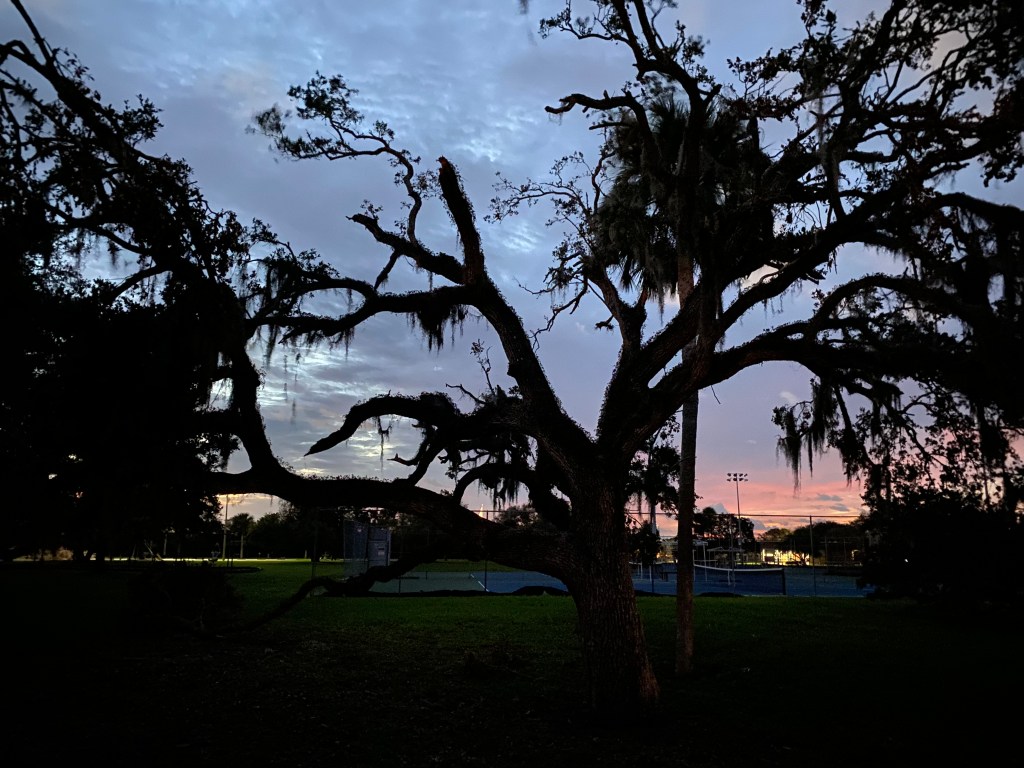
Photo: Rosary walk at sunset on Veteran’s Memorial Island, Vero Beach. Great way to ponder and mediate upon the mysteries of Jesus and his life.
Pope Francis. Evangelii Gaudium: The Joy of the Gospel. Frederick, MD: The Word Among Us Press, 2013.
Link for the Mass readings for Thursday, October 24, 2024