“I will give you rest.”

Verses that we read, such as: “Come to me, all you who labor and are burdened, and I will give you rest” (Mt 11:28) really hit the spot, they arrive at the right time. I am sure that if you are reading these words you may also welcome Jesus’ invitation. Yet what is the labor and burden that we need to rest from? Teachers, administrators and students, of which I was a part for decades are coming into crunch time now as the end of the quarter or term is so much closer. Those in other occupations also work long hours, and sometimes, two or three jobs, just to get by.

Many also who oversee and care for their home, others with children, elder parents, family members, and dealing with family issues that can be enormous, especially at this time of year. Add to the above Christmas preparations: decorating, putting up lights, shopping, buying presents, cooking, baking, writing and mailing Christmas cards can also add to feeling weighed down.

Unfortunately, there are way too many who are not so much burdened by work but the lack of access to gainful or meaningful employment. They are burdened with keeping the bills paid and a roof over their heads as the temperatures fall. Some have no home or family, they are burdened with getting from day to day, seeking ways to get food, clean clothes, a place to wash and relieve themselves. Christmas cards are a distant thought. Many others are burdened and living in fear that they or their family member or members may be deported.

Speaking of fear, how many of us are burdened by fear, anxiety, stress, and strain from a myriad of swirling reasons? Concerns about our family, community, country, and the world are a burden that can also weigh heavily. Advent and Christmas, even when life is more stable, are still times in which many buttons can be pressed and many stressors can be triggered. What is the adage that is offered when family and friends gather? Resist talking about politics, religion, and… we all can add a few others.

If you are feeling weary and worn as we draw close to the midway point of this Advent Season, it is a good opportunity to make some time to just stop and take a slow, deliberate breath. Notice your shoulders coming out of your ears. Embrace the invitation of Jesus and rest in him. Allow the burdens to come to mind, then visualize yourself giving them to Jesus, open yourself to his guidance, ask for his help for the day to day challenges, and seek who may be best able to assist you in any particular situation. Slowing down may help us to become more aware of any sins that we feel burdened by. This is a good time to rest and trust in the forgiveness of Jesus and confess to him in the Sacrament of Reconciliation. Jesus will forgive you and bring you a lightness and fresh start!

Our God “does not faint or grow weary, and his knowledge is beyond scrutiny. He gives strength to the fainting; for the weak he makes vigor abound” (Isaiah 40:28-29). We do not have to deal with anything alone. We have help and support. My friend, Pastor Jerry Scott, taught me years ago a life lesson which I still return to, more often now as I begin my sixth decade. When a person is chopping down a tree, exerting a lot of energy and effort, but finding the results insufficient, he or she needs to realize that they need to step back, take a breath, and sharpen their ax. With a little rest, renewal, and a sharpened blade, the job can be accomplished sooner.

Let’s figuratively do the same daily with each of our endeavors. Let’s resist just putting our heads down and plowing through with blinders on and instead take some time to stop and assess from time to time what we need, where we need help, and yoke ourselves to Jesus for his guidance and strength. Sometimes, making time to breathe and plan, we can use our time more efficiently.

When we choose to intentionally breathe more, we can react less. We can bring our challenges to Jesus and he will help us to carry the burden, as we follow his will, we can work smarter instead of harder. In developing a pattern and place of trust and hope in him, seeking his guidance and direction this Advent, we will renew our strength and soar as with eagle’s wings; we will run and not grow weary, we walk and not grow faint (cf. Isaiah 40:31)!


Photo: Spending time outside, taking some breaths, and trusting in God, can do wonders.

Link for the Mass readings for Wednesday, December 10, 2025

Lost in the busyness, anxiety, and noise? Stop, breathe, and pray. Jesus is right there.

“What is your opinion? If a man has a hundred sheep and one of them goes astray, will he not leave the ninety-nine in the hills and go in search of the stray” (Mt 18:12)?

Many of those Jesus asked and us reading or hearing this Gospel today might share our opinion that the man leaving the ninety-nine to find the one would not be a wise choice. Jesus again appears to be turning the normal order of things upside down in painting a word picture of God’s folly. This parable clearly shows the abundant and extravagant love of his Father for each and every one of us. The act of this shepherd can appear not only unreasonable but unbelievable.

Yet, this is not the feeling to the sheep or the one who is lost. This extravagant love is a relief. God as a shepherd is presented in the Old Testament as well. God is the shepherd and Israel his sheep. This was presented in today’s first reading: “Like a shepherd he feeds his flock; in his arms he gathers the lambs, carrying them in his bosom, and leading the ewes with care” (Isaiah 40:11).

This expression of love and care we can also experience if we are willing to resist slipping into judgment and pride, as did the elder son who was not willing to forgive his brother who was lost but found. The father loved the elder son with the same love as the son that was found, but he was closed off from receiving it for years, not realizing that he was just as lost as his younger brother.

God gives us a choice to reject or accept him because of his extravagant love for us. His greatest joy for us is that we will experience being be fully alive. He also knows what will make us so, yet he won’t impose even what is best for us, on us. God is willing to risk us going astray such that we can come to realize the emptiness in any pursuit that ultimately does not bring us closer to him. God does not wish for any one of us to be lost.

God constantly coaxes, invites, and urges us to fulfill who he created us to be. He guides us along as a parent urging his child to walk with tender chords of love. Yet, though he lovingly implores us along, we can be distracted, turn, crawl away, and go in a different direction.

During Advent, we are invited to slow down, to breathe and examine where we have taken our eyes off and turned away from our Father, where we have crawled away from his invitation to walk with him. No matter how far we think we have gone astray, no matter how lost we may think we are, God always remains close, following, watching, ready for us to turn back to him. When we do turn back, we will find him there waiting for us, urging us to run back into his open arms and to experience his loving embrace.

God is eternally present. He is not in the regrets of the past nor the anxieties and insecurities that blur the promise of our freedom in the future. God loves us more than we can ever mess up, more than we can ever imagine, and even in the midst of the committing of our most egregious of sins. God not only refuses to define us by our worst choices and moments, but when we trust in him, when we ask for his help, he will forgive us, offer healing, and lead us a few steps at a time forward, carrying us “in his bosom” if necessary.

Once forgiven, healing, and back on the path, we are to then also follow Jesus and seek out the lost sheep. “Christ follower’s should imitate the Father’s pastoral care, seeking and saving the disciples who have gone astray” (Mitch and Sri, 230).


Photo: Jesus will lead us through the unclarity, insecurity, and stress if we are willing to stop, change course, and follow him.

Mitch, Curtis and Edward Sri. The Gospel of Matthew. Grand Rapids, MI: Baker Academic, 2010.

Link for the Mass readings for Tuesday, December 9, 2025

“The knot of Eve’s disobedience was loosed by the obedience of Mary.” – St. Irenaeus

And coming to her, he said, “Hail full of grace! The Lord is with you” (Luke 1:28).

With these words from the angel Gabriel, we can begin to understand the special and unique gift of grace that God bestowed upon Mary such that we are blessed each year to celebrate this magnificent Solemnity of the Immaculate Conception of the Blessed Virgin Mary. Mary was conceived without sin and she remained not only a virgin all her life, but also sinless and “full of grace” all her life.

The Catechism of the Catholic Church (492), echoes our second reading from St. Paul: “The Father blessed Mary more than any other created person ‘in Christ with every spiritual blessing in the heavenly places’ and chose her ‘in Christ before the foundation of the world, to be holy and blameless before him in love’” (cf. Ephesians 1:3-4). 

This special grace was bestowed upon Mary such that she could undo the sin of another who was created sinless: Eve. As we saw in our first reading from Genesis, Adam and Eve were created good, without sin, but both fell by disobeying God and bringing sin, suffering, and death into the world. The Church fathers and doctors saw in Mary, the new Eve. As St. Irenaeus of Lyons, (130-202 A.D.) wrote in his great work, Adversus Haereses, “the knot of Eve’s disobedience was loosed by the obedience of Mary.”

Mary’s, “yes”: “May it be done to me according to your word” (Luke 1:38), and her continued “yes” with each of her thoughts, words, and deeds aligned with God’s will for the rest of her life, kept her full of the special grace that God bestowed upon her from the moment of her conception. Adam and Eve fell when their trust in God was shaken by Satan’s temptation. Mary trusted God with Gabriel’s invitation even though she did not understand what was being asked of her. Her question to Gabriel, “How can this be, since I have no relations with a man” (Lk 1:34) was not a demand for proof, but a sincere seeking to understand what was being asked of her, a faith seeking understanding.

Mary embodied faith seeking understanding, though while she pondered, as St. Bernard of Clairvaux put it: “Tearful Adam with his sorrowing family begs this of you… Abraham begs it, David begs it… this is what the whole earth waits for, prostrate at your feet… Answer quickly, O Virgin. Reply in haste to the angel, or rather through the angel to the Lord. Answer with a word, receive the Word of God. Speak your own word, conceive the divine Word. Breathe a passing word, embrace the eternal word.”

When Mary said, “Behold, I am the handmaid of the Lord. May it be done to me according to your word” (Lk 1:38), a weary world wounded by the sin of her first parents, exhaled with relief, for the long-awaited savior would now be conceived, born, and come to redeem what had been lost. Mary, in her obedience, loosed the knot of the Sin of Origin committed by Adam and Eve in their disobedience. Mary inmaculatus, Immaculate Mary, was blameless, conceived without sin, for this very moment in time so that of her free will she could say, “yes” and become the new Eve and her Son the new Adam.

Mary, help us to ponder your “yes”, that we may be willing to say “yes” and follow the will of God in all we think, say, and do. Help us to be obedient, to resist a knee jerk reaction to reject outright what we do not understand and choose instead to be open to the possibilities you make available to us that are beyond the realm of our senses and limitations alone. Help us to place our trust in God, Jesus, his Son, and the love of the Holy Spirit in all situations and with every thought, word, and action.

——–

Photo: Mary, pray for us that we may repent, know your Son, his love, and follow our Father’s will.

Quote of St. Bernard of Clairvaux from volume 1, Liturgy of the Hours, p. 345.

Link for the Mass readings for Monday, December 8, 2025

“He will baptize you with the Holy Spirit and fire.”

I am baptizing you with water, for repentance, but the one who is coming after me is mightier than I. I am not worthy to carry his sandals. He will baptize you with the Holy Spirit and fire (Mt 3:11).

John is offering a baptism of repentance. The people are coming to him, some traveling up to twenty miles through the desert. They were not coming to the Temple, the formal place of worship, but to the wilderness. John, the son of a priest, and so a priest, represents an answer to the hunger of the people that is no longer being fulfilled by much of the religious leadership of his time. He is the embodiment of the prophet who has returned – Elijah, who himself also dressed in “a hairy garment tied with a leather belt” (2 Kings 1:8). He speaks for God and the people are willing to listen and follow him because of his authenticity. And in his time he was most likely more popular than Jesus was in his. Jesus himself said that there was no one born on the earth greater than John (Matthew 11:11).

Yet, John the Baptist is clear that he is not the long-awaited Messiah. He is just the precursor as was promised. “John’s appearing in the desert dressed like Elijah would have signaled to the Jews that he was playing the part of the long-awaited Elijah, preparing for the Lord’s coming” (Mitch and Sri, 63). John as with the prophets like Elijah who had gone before him was preaching the need for repentance. He is preparing the hearts and minds of the people, inviting them to repent, to turn away from their sins and self-centered ways so that they will be prepared to recognize the Lord when he comes.

The baptism of Jesus was and is different than John’s. It is a baptism not just of repentance, but also of “the Holy Spirit and fire.” The baptism of Jesus will be wholly transformative. Fire consumes and transforms that which it touches and the Holy Spirit is often symbolized by fire. Within the Jewish tradition and found in the Old Testament, fire is associated with purification. The purifying and transformative fire of the Holy Spirit is love.

Love is an expanding, unitive force. It is a direct counter to the self-focused, curving in upon oneself and divisiveness of the fallen nature of our humanity. Love is an act of the will and draws us out to be engaged with the betterment of others. When we experience the love of God we are changed and transformed. This is not a one time be all encounter, but one that is to be experienced and shared consistently. The more we share the love of God the more we receive, and the more love we receive, the more we are transformed.

John the Baptist reminds those coming to him and us who read the Gospel of Matthew today that none of us are worthy of God’s love. That does not mean that we are bad. We just fall, short on our own, of the glory of God. We do not deserve nor can we grasp God for ourselves. No matter our will power and diligence, we must be willing to receive the Holy Spirit on his terms, not ours. We simply accept the invitation to receive the love of God, allow him to heal and expand us beyond our limitations, and share what we have received with others.


Photo: A quiet moment with the setting sun between the 4:00 and 5:30 Vigil Mass.

Link for the Mass readings for Sunday, December 7, 2025.

“When everything is said and done, we are infinitely loved.”

Jesus sent out these twelve (Mt 10:5).

Jesus sent out his Apostles to minister in his name and share the Gospel as he did, declaring that the “Kingdom of heaven is at hand.” Our faith tradition is one of evangelizing, sharing the Good News. That means that first and foremost we need to be people of joy. We may share the most wonderful words about our faith, but if they are not backed up by a life of radiating joy, then our words will have little if any impact.

This does not mean that we are happy and buoyant every second of the day, it does not mean that we will not experience hardship, sorrow, and loss. What it does mean is that we are not defined by our suffering, the trials we face, nor our wide range of our emotions. God also calls us to face tough realities when it might be easier to remain in our comfort zone. In the midst of each of these and other challenges, we can experience hope because God is with us. He seeks to comfort us in our weeping, provide for our needs, guide us in the right way we are to walk, and give us the strength to do so with each step we take.

What defines us is God’s love. We will experience great joy when we slow down long enough to allow God to love us. We will then know that we are not alone in our trials. Jesus experienced the fullness of our human condition, from his conception, birth in a cave, having lived a life of hardship and poverty that led all the way into the depths of betrayal, injustice, and God forsakenness on the cross. He did not just suffer on the cross but he also experienced death. Yet, through the indelible, binding force of the Holy Spirit, the love shared between Son and Father, Jesus was drawn back to life and conquered death not only for himself but for us all.

This is the good news we are to share. Jesus conquered death for each of us. How we live our lives each day and interact with others may be the only Bible that someone else will ever read. May we share the joy of our relationship with Jesus, may we share the joy of the lives we have been given, for: “Joy adapts and changes, but it always endures, even as a flicker of light born of our personal certainty that, when everything is said and done, we are infinitely loved.” – Pope Francis from his apostolic exhortation, Joy of the Gospel, line 6.


Photo: Mary Magdalene, apostle to the apostles at the foot of the cross. She experienced the joy of being infinitely loved. May she intercede for us that we may as well!

Link for the Mass readings for Saturday, December 6, 2025

Out of the gloom of our fallen nature, Jesus’ light will help us to see.

St. Augustine taught that the New Testament is hidden in the Old Testament and the Old is revealed in the New. We see this presented in the first reading as well as in the Gospel. We read how “the deaf shall hear” and “out of the gloom and darkness, the eyes of the blind will see” (Isaiah 29:18). Then we read how Jesus healed the blind men who call out to him believing that he is indeed the Son of David, the messiah, the anointed one (Matthew 9:27-31).

Jesus acknowledged that their faith was a catalyst in healing them but he also pointed out covertly that they were still in need of spiritual healing. Yes, they could now physically see, but they, like the apostles and others who hoped for the messiah, were looking for their idea of a messiah that is like David, a political and military leader that will lead a revolution to overthrow the occupying power of Rome.

Jesus told them clearly not to tell anyone what had happened, because he was not about to promote a cult of personality, nor have them portray him in a false way. Yet, share they did. They shared their encounter with Jesus with great joy.

Though we may have eyes to see and ears to hear, we too can be spiritually blind to who Jesus truly is. Jesus came into the world just over two thousand years ago as, God’s Son and visible reality of God who is love. Jesus calls us to be conformed to this same love. If we see ourselves and each other with the eyes of our fallen nature, from the perspective of our past wounds, and our present day reactions, we are going to miss the mark.

The saints are those who followed Jesus in each generation from the apostles to our own. They were willing to be transformed by the fire of his love. They encountered Jesus, had faith in him, believed, and put into practice what they learned. Just as something like scales fell from the eyes of St. Paul so that he could see anew, we too can see with the eyes of faith.

Let us pray together:

Jesus, this Advent, help me to choose to walk out from the gloom and darkness of anxiety, fear, and insecurity, and place my trust in your revealing light that I may walk with confidence on your path of love. Free me from any sins, distractions, and diversions such that I may experience the closeness you know with your Father. Please help me to place my trust in you, and please heal my blindness so that I can see more clearly, reject the lies that lead me astray, and see the path that leads to the way, the truth, and the life.

——————————–

Photo: Walking back after holy hour Wednesday night, sight of the super moon.

Link for the Mass readings for Friday, December 5, 2025

“Religious confession is no substitute for personal relationship with Jesus”.

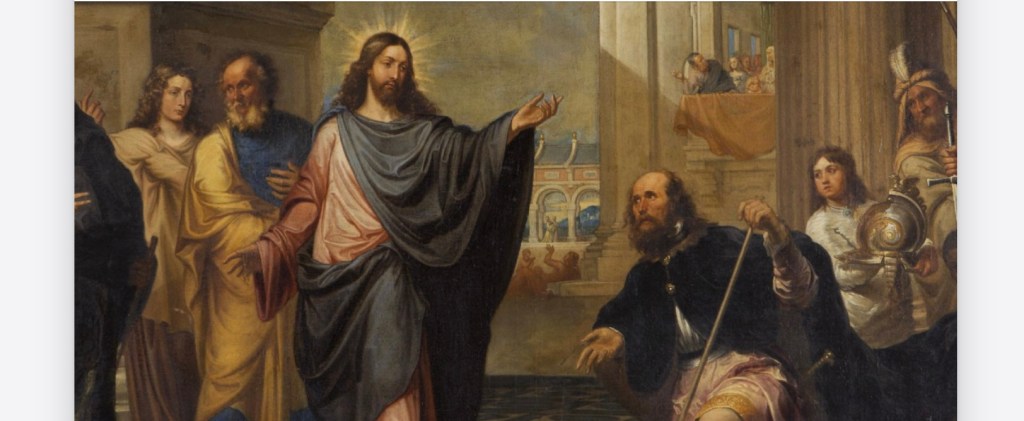
Jesus said to his disciples: “Not everyone who says to me, ‘Lord, Lord,’ will enter the Kingdom of heaven, but only the one who does the will of my Father in heaven” (Mt 7:21).

I have written quite often, quoting and paraphrasing one of my favorite quotes from St. Irenaeus, that Jesus came to be one with us in our humanity so that we can become one with him in his divinity. In his becoming one with us in our humanity he invites everyone, no one is excluded, to participate in his divinity. Yet if everyone is invited, how can Jesus say that not everyone will enter the Kingdom of heaven?

The answer to that question is in the line that follows. The one who will enter heaven is, “the one who does the will of my Father in heaven.” If this verse does not help, then it might be helpful to understand a little about heaven, as best as we can, as the mere mortal, finite beings that we are.

Heaven is not so much a place but a state of being in relation to God, in which we are privileged to share communion and a deeper intimacy with God for all eternity. We will still not know everything about God because God is infinite and we will still be finite even in heaven. God is without limit, we are limited. We will never exhaust our relationship, never get bored with God.

Maybe a more three dimensional, an earthly example may be of help. If we were invited to play a sport, an instrument, or to act in a play, with the end goal being that we would play in the upcoming game, concert, or performance, we might feel pretty excited about the offer. We tell the coach, conductor, or director “That’s great news!” Yet, in the days that follow, we do not attend any of the practices, we do not practice the skills required to play the position, instrument, or role and we do not return any of the follow-up invitations by phone, email, or text. The day of the big game, concert, or performance comes, we gather our self together and head on over to the arena or hall. We arrive to see the coach, conductor, or director but are denied entrance. We might say, “I don’t understand, you invited us to play!” The reply is, “Not everyone who says to me coach, coach (conductor, conductor, or director, director) is ready and prepared.”

Jesus invites us to play a part in God’s theodrama, everyone. Some say yes and some say no. Some say yes, and then don’t put into practice what is then asked, some say yes and do some things, some say yes and dive in. Most of us take a few steps forward and a step or two back. Just like preparing to play in a big game or perform in a big concert, or play, we need to be committed, disciplined, and persistent. Unlike a missed opportunity to participate in a game or performance, that we can correct and make another attempt down the road, we don’t want to miss the opportunity to spend eternity with God in heaven.

The above analogy does not imply in any way that we earn our way into heaven, or we can do so on our own effort and will power. The bottom line is that Jesus gave his life for all of us and through his grace, we have been saved. Our salvation is a gift freely given. Yet, we have to be willing to receive and open the gift. Our time here on earth is the time we are given to: open the gift we have received, work out our salvation, not just hear but to also put into practice Jesus’ teachings, and be about building our relationship with him. As we do so, we will be transformed by and conformed to Jesus, so that we can come to know his Father as he does, and then we can reflect the light and love we have received to others.

It is not enough to say that we believe in Jesus. “Religious confession is no substitute for personal relationship with Jesus and the obligation to obey his Father’s will. If our creed and our conduct are out of alignment, then our profession of Jesus as Lord is not a true submission to his lordship. The mere fact that believers can perform miracles in Jesus’ name, which is an exercise in charismatic grace, is no proof that sanctifying grace has penetrated their lives or brought them closer to Christ” (Mitch and Sri, 121).

If we want to know and put into practice God’s will, we need to know God. Advent is a time of preparation, a time of getting to know Jesus who is already with us and inviting us to let him have reign of every part of our lives. Jesus helps us to recognize and see what our lives are like without God and how they are with God. If we are willing to see, that clarity helps us to better choose our thoughts, words, and actions.

When we are humble enough to acknowledge ways that weaken our relationship with God, we can then repent and seek forgiveness. God never tires of forgiving us. Let us never tire of asking for forgiveness and committing more to knowing and putting into practice his will. Each time we seek and receive forgiveness, our minds and hearts are not only expanded but properly aligned to Jesus so that we may experience more of the love of the Holy Spirit, which helps our relationship to grow and to put into practice our Father’s will.

——————————————————————————

Photo: “Prayer can truly change your life, for it turns your attention away from yourself and directs your mind and your heart towards the Lord.” – St. John Paul II

Mitch, Curtis and Edward Sri. The Gospel of Matthew. Grand Rapids, MI: Baker Academic, 2010.

Link for the Mass readings for Thursday, December 4, 2025

When we come to sit at the feet of Jesus we experience healing and are nourished.

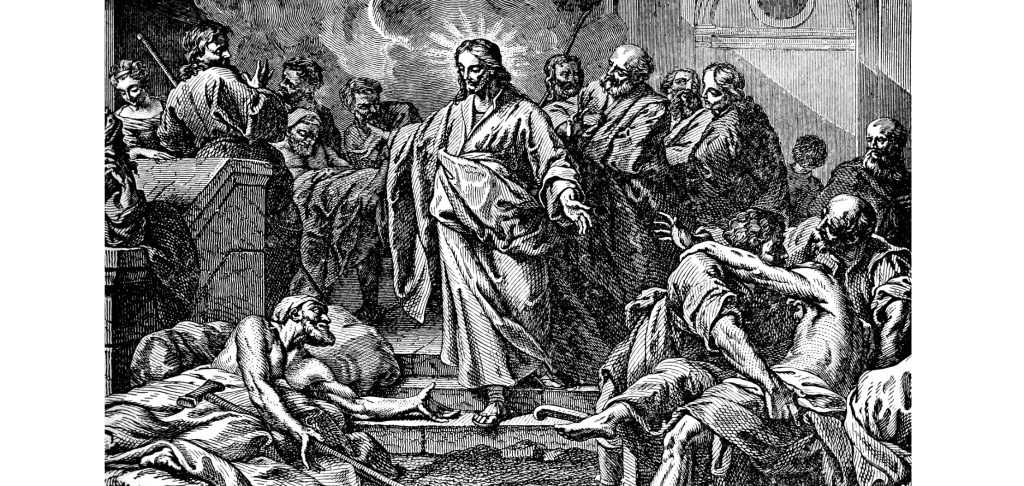
“Jesus walked by the Sea of Galilee, went up on the mountain, and sat down there. Great crowds came to him, having with them the lame, the blind, the deformed, the mute, and many others. They placed them at his feet, and he cured them” (Mt 15:29-30).

There is a key yet subtle point before Jesus began to heal that might be missed. Before great crowds came to him, Jesus “went up on the mountain, and sat down there.” This is no insignificant sentence. The posture of sitting on the mountain would have been recognized right away by the people of Jesus’ time. This was the posture of the teacher and sitting on the mountain a reference to Moses. Prior to the healing in this setting, as he did throughout the Gospels, Jesus most likely taught about the reign of God. In fact time and again, Jesus’ “works of healing took place in this context of his preaching of the kingdom of God” (Lohfink 2014, 58).

A great multitude of people came to Jesus to hear his message and also they came with a full range of needs. Jesus made himself available, exorcised, restored, and healed those who were brought to him. He encountered them as they were in their present condition of need. There is no record in this Gospel account that Jesus asked for any identification, that he discussed their belief system before healing them, nor did he ask if they were Jewish or Gentile, and nowhere in this account did Jesus deny anyone who came to him. The response of those to being healed and restored was that “they glorified the God of Israel“. This is because, “where God is master, there is salvation and healing” (Lohfink 2014, 62).

These recorded accounts of mass healings, are but a foretaste of the heavenly realm of eternal communion with the Father. Jesus is the kingdom of heaven at hand, for as St Irenaeus wrote, “Jesus opened up heaven for us in the humanity he assumed.” Jesus though was not done. The whole process took some time, which is probably an understatement, and as people were getting ready to leave, Jesus showed compassion yet again. He sought the assistance of the disciples because he did not want to send the people away hungry.

The disciples of course are taken aback because of the reality of the undertaking Jesus proposed. Jesus asked what they had and they shared just some bread and fish. Jesus took “the seven loaves and the fish, gave thanks, broke the loaves, and gave them to the disciples, who in turn gave them to the crowds. They all ate and were satisfied. They picked up the fragments left over–seven baskets full” (Mt 15:36-37).

This Advent let us surrender our will to God. May we pray with and meditate upon the Gospels such that they become relevant in our lives, so that we can serve God as Jesus did. Not stopping to ask for identification, religion, race, gender, creed, or political affiliation, but to see each person as God sees them as his children, human beings with dignity and value. In reading, meditating, and praying with the Gospels, we too come to sit at the feet of Jesus. We too can express our need, be nourished, and satisfied. We can then share what we have received.

Let us also not be dismayed by how little we have, but let us give what we do to Jesus in solidarity for his purpose, as did the disciples, so to experience with those we serve, the multiplication and abundance of the love, and grace we have received from our loving God and Father. For when God is our master, “there is salvation and healing.”

—————————————————————————

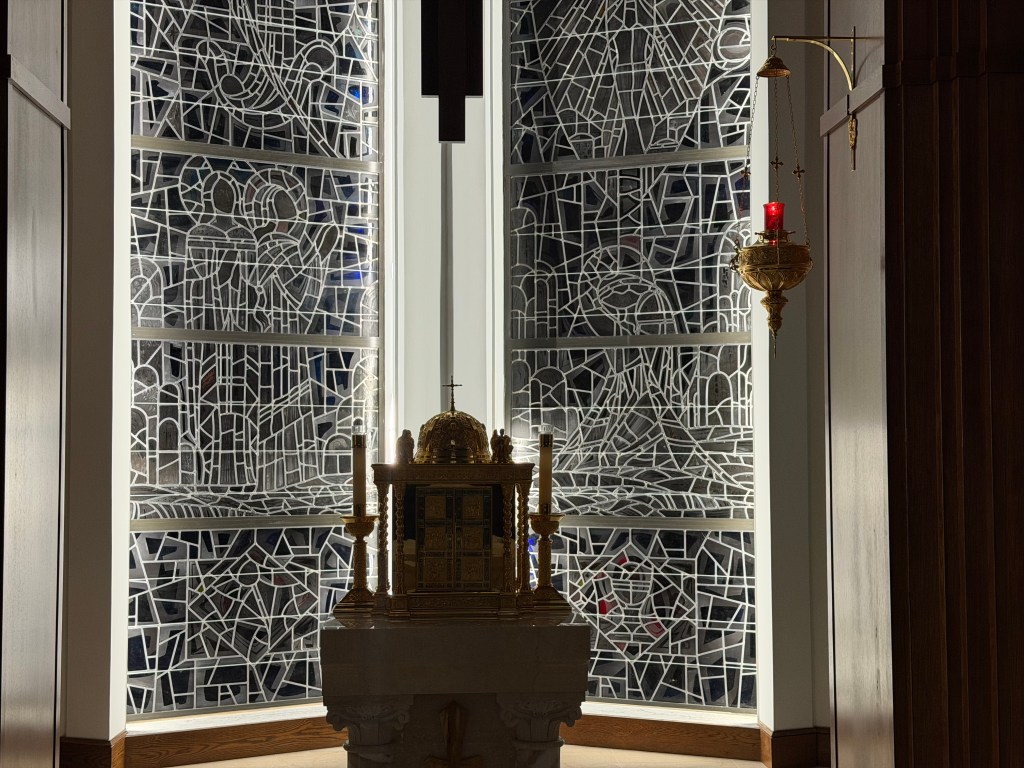
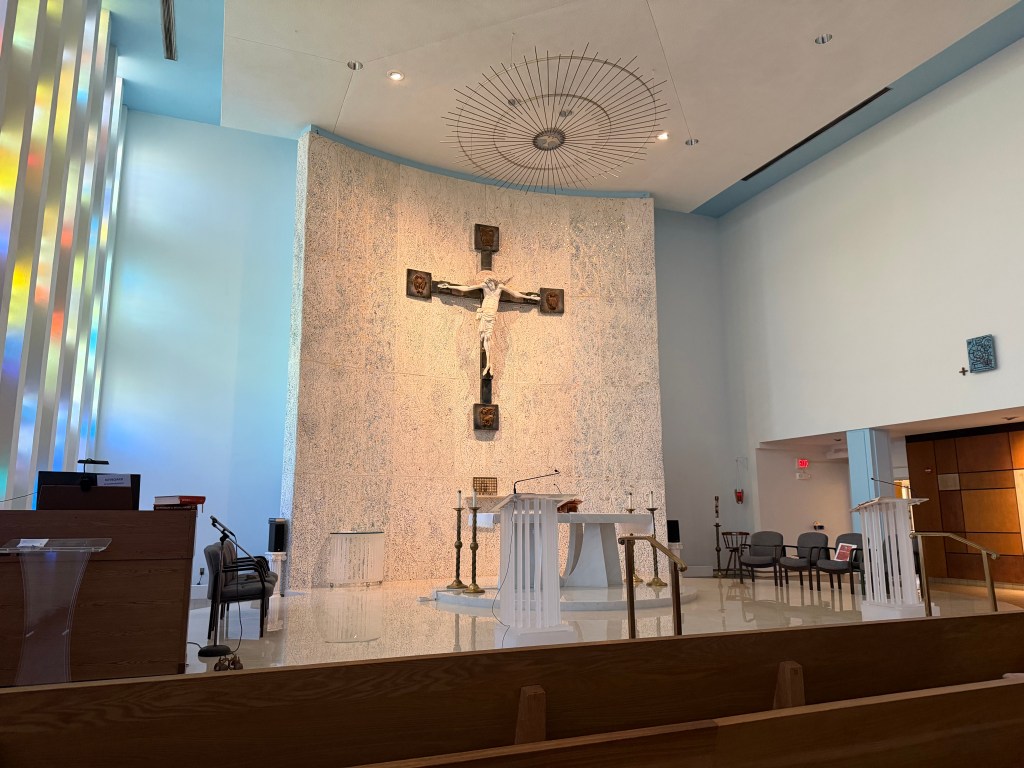
Photo: Where I come to sit at Jesus’ feet during my holy hour each evening since returning to our renovated church a few weeks ago.

Lohfink, Gerhard. No Irrelevant Jesus: On Jesus and the Church Today. Collegeville, MN: Liturgical Press, 2014.

Link for the Mass readings for Wednesday, December 3, 2025

Walking with Jesus will help us to experience the joy of the Father and the Holy Spirit.

“All things have been handed over to me by my Father. No one knows who the Son is except the Father, and who the Father is except the Son and anyone to whom the Son wishes to reveal him” (Lk 10:22).

God the Father knows God the Son and God the Son knows God the Father. They do not just know about each other, they know each other with a deep intimacy that is far beyond our human comprehension. Contemplating this reality can fill us with hope especially when we come to realize that Jesus is the Son of God who has come into our lives so that we can participate in the trinitarian communion of the Father and the Son and the love shared between them, who Jesus “rejoiced in” (Lk 10:21), the Holy Spirit!

Jesus has come as an agent of reconciliation, to restore our relationship with God, to undo the effects of the sin of separation that has so ruptured and wounded our relationship with him, each other, and his creation. Our hope this Advent is that we can come not just to a better understanding of God, but to restore our relationship with God and grow in intimacy with him through our participation in the life of his Son. Doing so, will also help us to do the same in our present relationships. Healing can happen when each of us are open to the Holy Spirit.

May the Advent season not get away from us before it even starts because of the external distractions from the material, commercial, and everyday busyness, nor from the everyday internal mental and psychological challenges that threaten. Choosing to be still, to breathe deep, and spend some time in God’s gift of creation, to enter into his natural rhythm, and bask in the wonder and vast expanse of it all can help us to step away from the distractions for even a little bit. In those moments we can find rest, reset, and react less. Reacting less helps relationships to heal.

I have done a lot of traveling in my life, but wherever I have gone, spending a year in the Bronx, six months in Los Angeles, a summer on the Pine Ridge and Rosebud Reservations, growing up and living in Connecticut for my first thirty years, or the last thirty years here in Florida, I have sought to spend time looking up at the sky. When I allow days to pass and I do not do so, I feel different and not for the better.

All of creation echoes the wonder and adoration of the gift that the season of Advent offers: Jesus, who became one with us in our humanity so we can become one with him in his divinity, invites us to participate in a deeper walk with his Father, the creator of heaven and earth, the one who knit us together in our mother’s womb, and who knows us better than we know ourselves! Please spend some time with God today in quiet reflection and allow him to love you where you are and as you are and rejoice in the Holy Spirit! Then share that joy with those in your lives.

———————————————————————————–

Photo: Walking on the way to our church hall for a meeting, turned back, and looked up. Wow. God is so good!

Link for the Mass readings for Tuesday, December 2, 2025

We begin another Advent to watch and pray for Jesus’ coming.

As the earth turned again one more time on its axis last night, and the shadows began to fall, night slowly crept over each part of our planet. Our sacred text, our sacred word, is not only written in the Bible, but the finger of God has traced his word across all of the earth, the galaxy, the universe, the whole of the created order. God continues to write and sing us his love song. The ground, foundation, and source of creation and our very being is the outpouring of the Trinitarian Love expressed between God the Father, God the Son, and God the Holy Spirit.

As the sun appeared to us to set, and night gently made its way across our minuscule earth in this part of the Milky Way last night, the vigil began and so also began the new liturgical year and we now find ourselves in the season of Advent. We heard or will hear again today the words of Jesus urging us to: “Stay awake” (Mt 24:42).

Paul in the second reading also sounds the alarm, for, “it is the hour now for you to awake from sleep” (Romans 13:11). Traditionally, the readings of the first two weeks of Advent focus on our watching for the second coming of Jesus. We are to watch and pray, to step away from the triggers of reacting. This Advent we are invited to slow down, observe how the daily cycle of day to night and night to day repeats itself. In doing so, we can enter into that daily rhythm of breathing, watching, and praying so that we can be more aware and more alert for the signs of his coming, like a watchman standing guard over the city. Then instead of reacting, we can choose to act according to God’s will.

During Advent, we also prepare in the final two weeks to remember again the first humble coming of Jesus, the Incarnation, in which the infinite Son of God took on flesh at his miraculous conception in the womb of Mary and became man. Fully God and fully man, Jesus experienced our human condition in the most vulnerable of settings. We are a people of memory, though we often forget, that is why we hear the story again of the simple birth of our savior, who many rejected even then, saying there was no room for him in the inn. Do we make room for Jesus to come to be present in our daily lives?

The third way we prepare for the coming of Jesus during Advent, is in our everyday experiences. We who have much in the way of material comfort need to remember, how God heard the cry of the poor and saved his people by sending Moses to free them from their bondage in Egypt. He sent judges and prophets to guide his people, and he sent his Son to be born in poverty, to free us from our bondage to anyone and anything that is not from him, anything that will lead us astray.

“God, in Christ, has come to set right a world gone wrong” (Grunow, 174). We have been made for God and nothing with fill our deepest desire to be in relationship with him. There is so much that attempts to lead us away from God. We can and do try to fill our deepest longings by grasping for anything but God and find ourselves dissatisfied time and again. We can’t save ourselves. The greatest willpower, discipline, and persistence is not enough. We need God, we need a savior. Let us remember this Advent who we are, whose we are, and who we are called to be. As we prepare for Jesus’ second coming and prepare to remember and celebrate his birth, may we also remember to set aside some time to enter into the rhythm of creation, to allow our hearts to beat in time with Jesus’ Sacred Heart.

We have been created by Love to love. As gently as the night gave way to the morning rays of the sun this morning, may we live and move more gently upon this earth. May our thoughts, words, and actions be filtered through the holy hepa filter of the Holy Spirit. So that we filter out that which is not, and accept that which is, of God. As we prepare well, we will not need to know the time or the hour, because we will know our Savior and so will be ready. Let us then awake, watch, and pray.

————————————————————–

Photo: Ready or not, Sunday Vigil here at Holy Cross, Advent has begun!

The Word on Fire Bible: The Gospels. Park Ridge, Illinois: Word on Fire, 2020.

Link for the Mass readings for Sunday, November 30, 2025