As Jesus called and sent the Apostles, he calls and will send us.

“Jesus summoned the Twelve and gave them power and authority” (Lk 9:1).

Just as Jesus summoned the Twelve, he does so with us and empowers us for mission in his name. The mission of the Church in each generation is to continue to ministry of Jesus and the Apostles. The expression of our service is unique to each of us. We might resist exploring or entering into a deeper commitment of our faith though because we might feel anxious or afraid that God may call us to do something that we would never want to do, or that we couldn’t conceive of being capable of. There also may be some trepidation even when we are clear of the direction God wants us to move in which may arise from our hesitancy to change and move out from our comfort zone. Ultimately, God wants for us what we want for ourselves deep down. We may not even know what that is, but God does.

God knows what will give us and with whom we will experience meaning, fulfillment, and joy in our lives. The challenge for us is to come to know this for ourselves as well. The work of discipleship begins by accepting the invitation of God to walk with him and trust that he knows what he is doing and where he is leading! No matter our age, we are never too young or too old to begin or recommit to the journey along the path of discipleship. One good practice is to reflect on our dreams and desires, bring them to God in prayer, and imagine ourselves embracing what we desire.

When I first joined the Franciscans to study for the priesthood in the early ’90s, I imagined from time to time my ordination day, especially in our second year as we were thinking about taking temporary vows. When I did so, a puzzling result consistently arose. I did not experience any excitement or joy. So, a year and a half into formation, I decided to take a leave of absence. I had asked to take off a year, but the minimum time for a leave of absence was two.

Though I balked at first about the two-year time frame required, I came to see the wisdom of my formation director. I would have come back after a year. About a year and a half after I left, I then realized that my vocational path was leading me to the Sacrament of Matrimony and not Holy Orders. Eighteen months after I came to that realization, I met JoAnn. As our relationship grew and we began to talk about marriage, whenever I envisioned our wedding day, I felt excitement and joy. Each year that we had together built on the one before. We grew closer to God and each other right up until the day of her death.

God led me to the Franciscans in my mid-twenties, he then led me out, and then to JoAnn. Almost three years after JoAnn’s death, he led me to seminary to be formed as a diocesan priest. Periodically when I imagined my ordination day, even though the schedule was more intense this time around, unlike during my novitiate year with the Franciscans, this time I felt excited. A year and almost two months after being ordained a priest, it is still more amazing than I could have ever imagined!

God loves us more than we can ever imagine, he has a plan for each and every one of us, and he knows what will fulfill us. When we ponder our dreams and desires, and as we investigate, research, explore potential opportunities and continue to pray and discern each step, we will come to see that as we align ourselves with God’s will that makes all the difference. We are not alone in this process, and we have a God who can see the full picture, where we see only a small part.

There will be fits and starts, missteps and slips, doubts as well as confirmations, and desolations as well as consolations. The key through it all, is to remain faithful, to continue to trust in Jesus who called us. He will continue to accompany us along the way. As he did with the Apostles, he will give us the resources and strength we need, and he will send the Holy Spirit to empower and transform our lives.

The process of discerning God’s will for our lives is not just for ourselves alone. Jesus is preparing us for mission. Making time to be silent, to meditate and pray with God, coming to know better his will and to put into practice his teachings, we will be transformed daily by the gift of God’s love. Continuing to breathe, receive, rest, and abide in his love, we will better know how best to serve God in others!


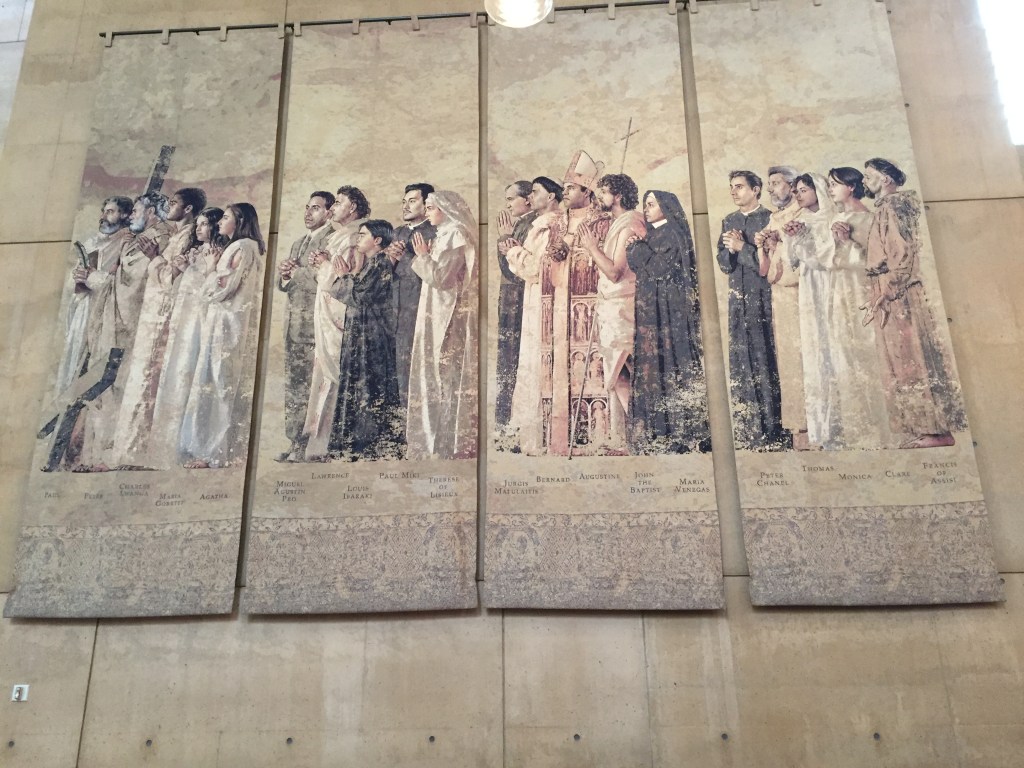
Photo: We too are called like St. Peter and St. Paul.

For Mass readings see bible.usccb.org and click on the link for Wednesday’s readings.

The family of Jesus are those who “hear the word of God and act on it.”

He said to them in reply, “My mother and my brothers are those who hear the word of God and act on it” (Luke 8:21).

There are many popular genetic testing kits that are advertised on TV and through the internet. People have asked me is it possible to be a blood relation to Jesus. Jesus’ reply today can help you to save some money. Asking if we are a blood relation with Jesus is missing the point of Jesus’ life and ministry. What is important more important is “those who hear the word of God and act upon it.” God is to be first, even before our blood family. We may experience a subtle shudder from this statement but to those of Jesus’ time, it would have been apoplectic. Family meant everything in the Ancient Near East.

Jesus is not making the point that we disregard family, he is instead teaching us that if we are to be authentically present to our family this will come about best by following the will of his Father. As we deepen our relationship with Jesus, hear his word, and put his teachings into action, we begin to bear the relational fruits of the Spirit. Would not our familial relationships be much better if we were more loving, joyful, peaceful, patient, kind, generous, faithful, gentle and practicing self-control? Jesus taught and showed from his own life that the path to fulfilling and intimate relationships flourish best when we put God first because as we grow closer in relationship with him, we also do so with those around us.

Another point we can glean from Jesus’ response in today’s Gospel is that our “family” is to transcend bloodline, tribe, and nation. Any one of “those who hear the word of God and act upon it” is spiritually akin to Jesus the Christ. The point is not that we have a genetic, lineal relation with Jesus, but that when we live and act according to his Father’s will, we are part of the universal family of God the Father.

As brothers and sisters in Christ, we will act with more caring and kindness, seek common ground through dialogue, be more willing to walk with, be present and instead of judging, seek to understand one another. The bottom line is that we are to love one another as Jesus loves us! When we do so our lives are transformed.

To hear the word of God, we are to attune our hearts, minds, and souls to it as it is proclaimed during Mass, as well as read, meditate and pray with his word in daily. In both situations, God’s word comes alive as he shares something of himself. As we then receive, at times struggle with, seek to understand, and put into practice God’s word, we come to better know the Father, and the Son, and the Holy Spirit, the saints, and our brothers and sisters in Christ. We continue to grow as one family in the Body of Christ when we regularly listen, hear, ponder, act upon, and allow God’s word to nurture and transform our lives.

————————————

Photo: We can also hear the word of God in his book of creation.

The Mass readings for Tuesday, September 24, 2024

May we shine the light that Jesus gives us.

Jesus said to the crowd: “No one who lights a lamp conceals it with a vessel or sets it under a bed; rather, he places it on a lampstand so that those who enter may see the light” (Luke 8:16).

God blesses us and invites us, mere human beings, tiny specks on specks in the universe, to be in relationship with him. He has given us our lives, sustains us, and he is the source of our fulfillment, meaning, and joy! We do not earn nor is there anything that we can do to gain God’s grace. God loves us as we are. All we need to do is accept his invitation to spend time with him and see him in everything, receive, and share his love. We lose the gift of God’s grace and love either by refusing what has been offered, or once accepting and receiving, not doing anything with what we have received. If we are people of faith in name only, but do not follow in action, we are concealing the light we have been given.

January of 2021 was an interesting time for me. It had been just over a year since JoAnn had died and I was not only diagnosed with Covid, but it had done a number on my lungs, full blown pneumonia, as well as compromised many of my other vital organs. Fortunately, after five days on the Covid wing of the hospital and a few months then home on oxygen, I slowly recovered. As with JoAnn’s diagnosis, I accepted what was happening and trusted God and felt his peace through both of those challenges.

JoAnn was not healed in the way that I had prayed but hopefully has now received the fullness of the healing that Jesus has come to bring all of us, eternal life with him and his Father through the love of the Holy Spirit. My time to leave this life and head on to the next did not come in January of 2021. As I recovered during those months, I continued to receive comfort in the gift of reading the daily Mass readings and shared these reflections.

Some have certainly been better than others, but I have been blessed by each step taken with the daily Mass readings, experiencing Jesus’ teachings, and their relevance in my life. I typed what I felt I God wanted me to share. These posts have been one way to reflect the light that Jesus has given me to shine. My hope is that these words can also be an invitation to those of you who are reading them to take your own walk about through God’s living word revealed in the Bible.

God has been a tremendous support and companion in my daily sitting, reading, meditating, praying, and walking with him. I pray that you may experience his closeness as well when you stroll: through the pages of the Bible, along the beads of your rosary, along a path for a pleasant walk prayerfully each day, and in the gift of the relationships God invites you to experience. As you do so, God will light your lamp with his love. Place it in the open and let the gift of God’s love and light shine brightly so it may be an inspiration for others.


Photo: The rising sun radiating through during my holy hour after Mass.

Link for the Mass readings for Monday, September 22, 2025

We become good stewards when we follow the will of our Father in heaven.

A rich man had a steward” (Lk 16:1). So begins Jesus’ telling of the parable of the dishonest steward. In this parable, the steward was placed in charge of overseeing the rich man’s affairs. Jesus is directing this parable toward his disciples. If we consider ourselves to be disciples of Jesus then he is speaking to us as well.

Might help us to understand that a steward is given the task to oversee someone’s affairs. In our case then we are overseeing God’s affairs and to be successful stewards we must remember who we are. The steward in the parable squandered the property of his master. He was not adequately fulfilling the charge he was given. Most likely because he was serving himself and his own needs instead of those of his master and as Jesus would later state, “No servant can serve two masters” (Lk 16:13).

For us to be good stewards, we must agree with the foundational principle that God is God and we are not. Maybe a pithy statement but if we don’t get this point right from the start we are going to be in trouble, because we are forgetting who we are. That is exactly the misstep with Adam and Eve. They were tempted and fell when they grasped at what God freely had given. Instead of excepting the gift of their humanity, their role as stewards, they sought to define their own path, they put themselves in the place of the master, instead of the steward, and there can only be one master and that is God.

When we place ourselves in the role of the master instead of God or attempt to force God, from our perspective, to fit into our image, then we are going to have problems. We can see the effects of this fallen reality on full display in our world today. The reason why Jesus never sinned was that he never forgot who he was. Jesus is the steward we are called to be. His mind and heart is open to following the will of God his Father. “Though he was in the form of God, Jesus did not deem equality with God something to be grasped at. Rather he emptied himself and took the form of a slave, being born in the likeness of men” (Philippians 2:6-7).

Jesus, though he was divine, did not grasp at his divinity, but received and embraced the gift of being human. That meant he was willing to be the steward and not the master. As Son, he was sent by his Father to do his Father’s will. Jesus did so with every thought, word, and deed. He showed this most profoundly in the Garden of Gethsemane. Jesus submit himself to the will of his Father and gave his life. Die he did and in willing to do so, he conquered death through the power of the Holy Spirit, rose from the dead, and leads the way for us to take up our cross and die to ourselves.

Being the steward and not the master is not easy for us because we are not willing to give up our control. When we let go though and surrender to God, we can feel safe in the assurance that God has our best interest in mind. St. Mother Teresa put it best when she sought just to be a pencil in God’s hand. By making the time to slow down and discern God’s will, we will remember who we are, God’s children. When we resist impulsively reactions, relinquish our control, and follow the lead of our Father in heaven, we will be more prudent stewards. Then we can begin to help our corner of the world to be a little more peaceful, caring, and loving.


Photo: Praying with some great stewards, Mary and Joseph.

Link for the Mass readings for Sunday, September 21, 2025

May we receive the word of God and nurture it so that it may grow within us.

A person can go on a walk and hear the beautiful sound of a bird and think to themselves, that is a very nice sound, enjoy it, and keep walking on. Another person may hear the bird song, actually stop, and listen for a time and then move on. Still, another person may not only hear the sound, stop, and listen, but also look in the tree to see what type of bird is making that sound, identify it as a cardinal and then walk on.

Each person experienced the bird on different levels. Even the one who stopped to appreciate its song and take the time to identify it as a cardinal, still limited himself from experiencing the deeper wonder and uniqueness of this particular cardinal. God knows though. He knows this bird intimately, as he does with the entirety of his creation, including knowing each of us better than we know ourselves.

We may hear or read Jesus begin with these words of his parable: “A sower went out to sow his seed” (Luke 8:5). Our minds may go immediately to say to ourselves, “Oh, I know this parable well,” identify it like the person identifying the cardinal, and may even appreciate the parable, but then tune out because we have heard it before or many times before. We too would then miss the greater depth and wonder of what God wants to share with us.

Jesus helps his disciples to understand the parable when he tells them, “The seed is the word of God,” and then identifies how different people hear, and then act or don’t act on the word they have received. Those on the path of hard, traveled ground, the word is stolen by the devil; those representing rocky ground which has some soil “receive the word with joy” but since there is no depth in which to root, “they believe for only a time and fall away”; and the seed that fell among thorns was choked by the anxieties, riches, and pleasures of life. The final resting place was the best, the “rich soil” symbolizing “those who embrace the word with a generous and good heart, and bear fruit through perseverance” (See Luke 8:4-15).

God knows each of us, knows our deepest and authentic desires, our deepest wounds, our sins, and our greatest promise. He loves us, wants the best for us, and so shares his seed, his word, with us in many ways.

Are we willing to open our hearts and minds to receiving the wonder of Jesus’ guiding and leading, are we willing to be patient to not only receive and savor his word, but also put it into practice? Are we willing to place his word in a place of prominence within our minds and hearts so that the many diversions, anxieties, stresses, and strains don’t choke its life? Are we willing to be persistent and daily call to mind this gift God has given to us each day and allow it to flourish and grow in our lives?

More than anything else, the most important practice that we can engage in each day is prayer. Not just saying prayerful words and moving on, but receiving God’s word as he wants to give it and allow it to germinate in our hearts and minds so we may be transformed. The enemy will seek to distract, divert, and dissuade us from this gift of spending time with God to meditate, pray, and rest with him.

We need to resist these temptations, renounce them, pull them out as we would weeds and repeat the word or phrase we have received from the Bible or meditate upon a simple phrase like,  “Jesus, I Trust in You”. Give this phrase all the room it needs to breathe and grow so that we may experience the greater depth and wonder from it that God wants to share. Each day we can gain something new.

Jesus invites us in the parable of the sower to hear his word, then we can receive, rest, and abide in it. God’s word is to be our foundation such that all that we think, speak, and do is directed from God’s guidance and standard. Even when tempted, while undergoing trials and tribulations, we will not be led astray, we will not doubt or be choked, when we anchor our trust in Jesus and his love for us. We will persevere through challenging times, as well as be grateful in tranquil times.

More than just words, our prayers are to be directed to a person, Jesus, his Father and/or the Holy Spirit. Doing so will help us to remain connected to the source of our lives. We will not only trust Jesus more, but we will also know him more intimately, and continue to be transformed by his love so that we too will bear abundant fruit from the seed God has planted in us.


Photo: Leaves beginning to change here in CT. Enjoying and pondering on an afternoon walk.

Link for the Mass readings for Saturday, September 20, 2025

As we commit to a deeper relationship with God our relationships with each other will improve.

Accompanying him were the Twelve and some women (Lk 8:1-2).

A simple statement but significant regarding how Jesus again is showing us how to live our lives as his followers, his disciples. Jesus is fully human and fully divine. What he has done and continues to do as the Son of God incarnate is to draw close to us in our humanity, as human beings, so that we can enter into a relationship with him and his Father through the love of the Holy Spirit, thus becoming one with him in his divinity.

From the beginning of his public ministry, throughout his time walking this earth, and continuing on after his resurrection and ascension into heaven, he  invites people to participate in his life and the kingdom of Heaven which is at hand in his very presence. Jesus does so by building relationships. This is how Luke can write the verses that Jesus was accompanied by the Twelve and Mary Magdelene, Joanna, and Susanna. These were real people with whom Jesus developed real and intimate bonds.

Christianity is not a Lone Ranger religion, it is not the survival of the fittest, and Jesus did not teach us to pull ourselves up by our own bootstraps. We are created by God to be in communion, to be in a relationship with him and each other, to experience his love and to love one another. That means we need to ask for help from God and each other when in need and to come to the aid of, accompany, empower, and support one other.

We are invited to welcome, engage with, and make time for each other by exchanging in the stories of our tragedies and our triumphs. Let us resist the temptation of withdrawing into our own bubbles and instead, risk encountering one another. Relationships are not perfect. By putting God first, making a commitment to him and his commandments, and putting them into practice, we can better commit to being there for each other.

When we are growing in our relationship with God, he feeds the deepest core of our being as no other can. Thus fulfilled by his love for us, our insecurities that seek to derail our human relationships will diminish. We can risk being ourselves even when tempted by our fears to be otherwise. As we begin to feel safe in God’s love we can better breathe, trust, keep an open heart and mind, give the benefit of the doubt, and be more understanding, kind, and forgiving, all of which are ingredients for healthier relationships.

Jesus chooses each one of us to accompany him and to forge relationships grounded in mutual respect, where no one is last and where no person is left behind. Our addictions, insecurities, and prejudices only survive when we keep people at a distance. When we allow Jesus to come close, spend time with him and one another, we will see our weaknesses, sins and shortcomings, but also our gifts, possibilities, and promise. Conflicts will arise as we heal and purify, leading to greater intimacy. We will realize that we are not alone, we can acknowledge and reject the lies we have believed, and our relationships will heal and deepen.

————————-

Photo: Quiet time with the Jesus and Mary in the sanctuary of St. Mary Catholic Church, Windsor Locks, CT.

Link for the Mass readings for Friday, September 19, 2025

Instead of pointing out the sins of another, let us confess our own.

Logistically, to our modern minds, the setting of this verse may appear confusing. How could this “sinful” woman be standing behind Jesus such that her tears would fall on his feet? When we think of someone sitting and eating, we imagine them doing so by sitting in a chair. Thus, the feet would be under the chair or toward the front of the person.

During the time period and cultural setting in which Jesus lived, the customary practice when eating was not to sit at all but to recline for the tables were lower. From this position of reclining then it would make sense that she, “stood behind him at his feet weeping and began to bathe his feet with her tears” (Luke 7:38). She then knelt down, dried his feet with her hair, and then anointed Jesus’ feet with the ointment she brought for him.

She did not rationalize, deny, ignore, or come grudgingly nor wait for Jesus to call her out, she came not asking for healing but with true contrition for her sins. Hopefully, we can be like this woman, and come to Jesus with the same open heart to his love so that we too will experience his compassion and have our hearts pierced with our own sorrow for the hurt we have caused others through our sinful actions.

Those quick to point the finger at other’s sins, like Simon, who judged this woman, are less apt to be aware of the depth of their own sin and thus “the one to whom little is forgiven, loves little” (Lk 7:47). We are not forgiven less because God is not willing to forgive but because God will not go against our free will. Hiding, being in denial of, rationalizing, or justifying our sins, curving in upon ourselves or listening to the father of lies keeps us at a distance. If we are unaware or unwilling to bring our sins forward in a contrite manner, we are cutting ourselves off from the healing forgiveness God wants so much to share.

When we are instead like the woman in today’s Gospel account by expressing the same trust and faith, are willing to bear our soul with humility and sorrow, with our deepest and darkest sins, we will not only be forgiven but experience a deeper outpouring of God’s love. The one who confesses truthfully, fully, and contritely is forgiven more, be loved more, and thus will love more.

We may not want to face our sins and as we open our hearts and minds to the purifying fire of the Holy Spirit we will experience the pain of seeing our sins. We will not physically heal without experiencing the pain of broken bones mending or skin growing back together to make a scar. Jesus experienced the excruciating pain of dying on the Cross. There could be no Resurrection until he experienced his death. When we are contrite, confess, and atone for our sins, the truth will set us free, and we will experience God’s freedom more fully and his love and peace more deeply.


Photo: Just as running water keeps a pool clean and fresh, so a daily examination of conscience helps us to remain open to the purifying flow of the Holy Spirit.

Link for the Mass readings for Thursday, September 18, 2025


Trusting the nudge of the Holy Spirit helps us to embrace change and experience inner freedom.

“To what shall I compare the people of this generation? What are they like? They are like children who sit In the marketplace and call to one another, ‘We played the flute for you, but you did not dance. We sang a dirge, but you did not weep'” (Lk 7:31-32).

Jesus convicted those who held a narrow view of who was a true follower of God by sharing the image of a flute being played and no one was dancing, thus in times of joy, there was no celebration. When the funeral dirge was sung, they did not weep, they did not mourn. Jesus then tied the analogy to his present condition regarding those who did not accept the ascetical practices of fasting and the call to repentance from John the Baptist, nor did they accept the inclusive and festive table fellowship of Jesus.

In our own time, we have encountered those that are not pleased beyond their own narrow focus and who suffer from tunnel vision. Anything that hints at even a slight variation of change sends tremors of discontent. If we are honest, we all have some resistance to change, but if we are to authentically live the Gospel, St. John Henry Cardinal Newman’s quote is an apt barometer: “To live is to change and to be perfect is to have changed often.”

JoAnn embraced change much more easily than I. She consistently helped me, even when I didn’t feel it was helpful in the moment, to resist getting too comfortable. She did so again in “changing her address” six years ago to a heavenly zip code. Working through the reality of her death, the adventure of two years of seminary, and adjusting to the blessings of my first year as a priest, have continued to present opportunities to embrace change.

It would have been easier to seek an early retirement and live a quieter life, which was what I thought was the prudent move at the time, but God had another plan. When most my age are thinking of or beginning an early retirement, I instead trusted in the Father’s guidance and embraced the invitation to change again and embark on a new adventure. Though not easy, I am very happy that I did.

The Church, at her best, is a balance between the rock, solid foundation of our core beliefs, such as is outlined in the Nicene Creed, which provides stability, assuredness, and identity. While at the same time, she is open to the life-giving inspiration of each nudge from the Holy Spirit. When we in each generation follow the lead of the Holy Spirit the Gospel will be relevant.

As we remain grounded in what we believe, it is important that, at the same time, we allow ourselves to be flexible and allow the Holy Spirit to lead us. In this way, we can avoid molding the Church into our image, and instead be conformed and transformed into the image and likeness of Jesus, who is the embodiment of Love, the Trinitarian communion of which we profess in the Creed.

We can live a life of joy when we resist the temptation to hold on too tightly. Nothing and no one in this world lasts because all is finite. When it is time to mourn, let us weep, and if we do so well, when it is time to embrace life we can do so with joy and we can dance and live again. What lasts, even eternally, as St. Paul wrote, is love. God is love and God created us out of an abundance of his love. When we are willing to surrender our will to the Father, our heart and mind to the Son, and allow our soul to be led by the Holy Spirit, we will better embrace change and live a life of inner freedom and joy!


Photo: The Holy Spirit has our back and will lead us into the future!

Link for the Mass readings for Wednesday, September 17, 2025

We can all have more compassion and help to raise each other’s spirit.

When the Lord saw her, he was moved with pity for her and said to her, “Do not weep.” He stepped forward and touched the coffin; at this the bearers halted, and he said, “Young man, I tell you, arise” (Lk 7:13-14).

Jesus’ immediate response to this woman was pity or compassion. The original Greek word used was splanchnizomai, meaning that Jesus was moved from the very depths of his bowels. The emotional depths to which Jesus was moved to reach out and help the widow of Nain, shows us his humanity. Jesus’ healing of the widow’s son, bringing him back from the dead, shows us his divinity. The entire event shows us the best of who we ought to aspire to be as his followers.

Instead of fear, judgment, prejudice, or indifference, may we instead follow the lead of Jesus and seek to understand, to place ourselves in the shoes of the vulnerable, misunderstood, and on the margins. May we start with those we interact with everyday in our families, our school and workplaces, our communities and places of worship. May our hearts, not be hearts of stone, but hearts of flesh so to be moved from the very depths with the same compassion and love of Jesus toward those, who, like the widow, are vulnerable and at risk.

We can all be more welcoming, hospitable, willing to walk with others and to share in their journeys. We can do this simply in our day-to-day interactions. Whenever we encounter another, may we resist that reactions of judgment, prejudice, or indifference that arise and instead be willing to be moved by compassion and concern and be present.

Listening and hearing each other’s stories, needs, and engaging in conversation are helpful in opening up relationships. Taking the time to smile, to listen, to respect one another even when disagree and being willing to work through conflicts, as well as giving others the benefit of the doubt, helps us to build and strengthen relationships.

Jesus looked upon those he interacted with as family. This widow who was weeping as she looked upon the dead body of her son was not a stranger to Jesus, but a sister in pain. Jesus was moved with compassion and immediately came close to help. He met and engaged with each person and treated everyone he came in contact with in the same way, as human beings. This was true with even those he was in conflict with like many of the Pharisees.

Jesus loved and showed people compassion and invited them to be free from that which bound them to their slavery to sin. He came to remind all of us of who and whose we are as his Father’s beloved children. “For whoever does the will of my Father in heaven is my brother, and sister and mother” (Mt 12:50).

JoAnn often prayed for God to reveal to her one person that she could help each day. When we ask, God will guide us and grant us greater awareness regarding those we can help. Our Father will also give us the means to be present and to assist. We may or may not be called to raise the dead, but we can all lift each other’s spirits, have compassion for one another, and see each other more as Jesus sees us, as brothers and sisters, not as somehow less or other, but each with dignity.

Come Holy Spirit, please stretch us beyond our comfort zones, beyond our limitations, and soften our hearts so that we too, like Jesus, may allow ourselves to be moved by compassion. Please help us to regularly and with more intention stop, breathe, and be more patient, understanding, and kind. Help us to love more, and with each person we interact with, to will each other’s good so that each of us are better for having met.

———————————————————-

Painting: “The Resurrection of the Widow’s Son at Nain” by James Tissot, 1890, online collection from the Brooklyn Museum

Link for the Mass readings for Tuesday, September 16, 2025

Standing in our sorrows with Jesus and Mary will help us to experience healing and joy.

When Jesus saw his mother and the disciple there whom he loved he said to his mother, “Woman, behold, your son.” Then he said to the disciple, “Behold, your mother.” And from that hour the disciple took her into his home (Jn 19:26-27).

During the summer of 1991, I joined the Franciscans of Holy Name Province as a pre-novitiate and was stationed at Holy Cross Friary in the Bronx. My ministry for that year was working in the friary and the adjoining parish of Holy Cross. Shortly after entering, one of the friars, Br. Paul Goldie, died. He had been serving at the friary since 1953 and had been a friar for 54 years. A practice among the friars was to pass on personal items to those in the community when one of their own passed away. I was honored to have been given a picture of St. Francis, that hangs in my room in the rectory of Holy Cross and Br. Paul’s rosary.

I noticed that the rosary was different from others but didn’t ask any of the friars, most likely because I already felt self conscious about how little I knew about Catholicism. Instead of a crucifix it had a Miraculous Medal, instead of five beads there were three beads leading to the decades of beads, and instead of five decades of beads, there were seven groupings of seven beads. In between each of the series of seven beads there was a small medal. On one side was a picture of Mary pierced in the heart seven times, and on the back of each medal was a different scene.

I would find out some time later that this was a Rosary of Our Lady of Sorrows. The depictions on the back of the seven medals represented Mary’s seven sorrows: Simeon announces the suffering destiny of Jesus, Mary escapes into Egypt with Jesus and Joseph, Mary seeks Jesus lost in Jerusalem, Mary meets Jesus as He carries his Cross to Calvary, Mary stands near the Cross of her Son Jesus, Mary receives into her arms the body of Jesus taken down from the Cross, and Mary helps place the body of Jesus in the tomb.

The fifth mystery, Mary stands near the Cross of her Son Jesus, is from our Gospel reading today. For Mary to witness her son dying such an agonizing death, it must have been the most sorrowful of the seven. Yet, Mary did not run from the pain, she embraced his and her own pain, the piercing of the lance, pierced her own heart, into the depths of her own soul. Mary, though free of sin, was not free of the pain of a fallen world. In fact, Mary, like Jesus, felt it more deeply.

By being willing to love, we risk experiencing and entering into the pain of those we love. So many times we run from love, because we do not want to experience the pain relationships entail. We are finite and fragile beings, and so we will let each other down, we will make mistakes, say the wrong things, do hurtful things, we will get sick or deal with chronic illness and need care, we will lose patience, we will sin, and those we care about will die. Jesus though calls us, like Mary and John present at the Cross, to remain present to one another, to love, to will the good of the other, and so to experience the fruit of an authentic relationship which is grounded in the unimaginable love that God the Father has for us.

Love is the bond of communion that gives us the strength to move through the crossroads and upheavals of life. Love is the bond of commitment that draws us out from our selfishness so to learn from one another, to grow stronger together, and to be present to one another. Where there is an authentic relationship, there is love at its foundation. When we love one another, we participate in the communion of the Holy Trinity, we participate in the very same divine communion of the Father, and the Son, and the Holy Spirit.

Is there risk of rejection in loving another? Yes. Is there pain in love? Yes. Is there conflict in relationship? Yes. Yet to be fulfilled, to be fully alive, for love to be real, we must be willing to take the risk to love and be rejected, just as God does with us. As we enter relationships or strive for better authenticity in our present relationships, we must be willing to love, to commit, be present, to sacrifice and share our pain and experience another’s pain. We must be willing to stand by each other in our imperfections as well as be humble and willing to offer and seek forgiveness and reconciliation.

We cannot come close to imagining what Mary and John experienced with Jesus at the climax of his crucifixion. Each of them embraced horrific pain and sorrow at the foot of the cross, yet they remained, and so they were able to mourn, heal, and experience the full joy of the Resurrection. At the coming of the Holy Spirit at Pentecost, they also experienced the divine communion of love between the Father and the Son and shared that same love and commitment with the community of Jesus’ followers and those who had never met him.

Br. Paul’s Rosary of the Seven Sorrows, is a reminder for me of the brotherhood I shared with the friars for the year and a half that I was with them. It is also a reminder that there will be pain and struggles in this life but that I am not alone. Mourning JoAnn’s death from 2019 and recovering from Covid and double pneumonia in 2021 are realities that I am continuing to heal and learn from. Not running away from but standing alongside Mary and John have helped me to face these and other challenges and experience Jesus waiting with his arms wide open to embrace and walk with me time and again.

We can trust Jesus and Mary, as well as John and the apostles, and turn to them when we are faced with challenges and suffering. Praying with the mysteries of the Rosary or the Seven Sorrows can be of great help. When we resist merely reciting but instead slowly pray and ponder the mysteries, we can experience with Jesus and Mary how they were able to face their suffering. They in turn will gently guide us to experience and face our own pain and challenges, and provide comfort and healing.


Photo: Br. Paul’s Seven Sorrows Rosary on the right, Franciscan Crown (Seven Joys of the Blessed Virgin) Rosary on the left, and standard five decade Rosary in the center. We can walk with Jesus and Mary in any and every season!

Link for the Mass readings for Monday, September 15, 2025