Slow down, breath, stop, and trust in Jesus.

Our days are so full of activities, conflicts, health issues, technological stimulation, 24/7 news cycles, social media interaction, and the mix of our own personal unique daily challenges. If we do not have the proper foundation and orientation, we can feel stretched, hollow, and/or fatigued at best. One day can seem to blend into another, and another, and another. The image of being on a hamster wheel or an unending treadmill can fall afresh in our mind’s eye when we actually do take a minute to breathe. Anxiety, worry, stress, fear, prescriptions, and addictions all appear to be on the rise and swirling out of control.

Is there an answer to this hyper pace or are we doomed to just keep going until the wheels fall off? The opening verse in today’s reading provides an antidote when we are feeling any or all of the above.

Jesus said to his disciples: “Do not let your hearts be troubled. You have faith in God; have faith also in me” (Jn 14:1).

We are invited to place our trust in God through his Son, Jesus. By putting them first does not mean that the externals to our life will take an abrupt turn for the better, but what it does mean is that we will have support and divine assistance. It means that we are not alone in our struggles. The disciples found this out when in the midst of a sudden sea squall. Their boat was taking on water as the waves grew higher they were terrified and so, called to a sleeping Jesus. Jesus awoke and with a word, he calmed the sea (cf. Mk 4:35-41).

Jesus may or may not calm the sea of our trials and tribulations, but what he will do is be present with us through our storms in life and we can trust in him that he will guide us through. As we grow more confident in our trust in Jesus we will come to be assured that no matter who or what comes at us, he will be there to assist us. We will experience more peace and calm within ourselves. The ultimate assurance that Jesus provides is that when we surrender our life to him, we belong to him, we are not alone or orphaned. He gave his life for us, to redeem and save us so that we can be assured of our home for eternity.

If we are struggling at any level and are seeking to build our trust and faith in Jesus, we do need to realize that this takes time. We need to remember to daily ask Jesus for help, seek his discernment about where we can make changes in our life, and make periodic efforts to stop in our day to be still. This time does not need to be lengthy, three to five minutes to start can do wonders. On the surface level, by stopping for five minutes to pray and breathe more deeply and consciously, we get off the wheel, we step out of survival and reaction mode, so we can then make more intentional decisions, and we can come to see that we truly have options, but more importantly, we begin to develop a relationship and intimacy with Jesus so to begin to recognize his voice that is calling out to guide us.

Author Wanda E. Brunstetter, wrote, “If you are too busy to pray, you are busier than God wants you to be.” There is a lot of truth in her statement. I have had busy days, weeks, and months, where I have wondered if taking the time to pray and meditate was really the most sensible choice. Time and again it has been. At the beginning of these two years of seminary when my workload was larger than I anticipated, I barely prayed much for a few days and realized that was a mistake. Making time for consistent prayer each day became my priority and doing so has made a tremendous difference.

Daily Mass, praying with the Liturgy of the Hours, reading and meditating on passages of the Bible, reciting the Rosary are great tried and true practices from our tradition that I find helpful. If any seem too much, especially if you are just starting, begin with Night Prayer in the Liturgy of the Hours each night before bed, or a couple of verses each day from the Bible or one decade. One slowly and well said Our Father and some quiet time to listen or just a few minutes of breathing slowly and opening our heart to Jesus can be transformative.

Consistent moments of stopping and being still and intentionally lifting our hearts and minds to God each day is a tremendous gift to help our hearts to learn to rest and trust in Jesus. Each of these practices offer us a few of the many ways to stop the madness, to slow down, simplify, and connect with the power, the love, and the grace that Jesus yearns to share with us such that no matter the external or internal upheaval, and even if life is going pretty well, we will experience his peace and security which is what we all truly long for.

—————————————————–

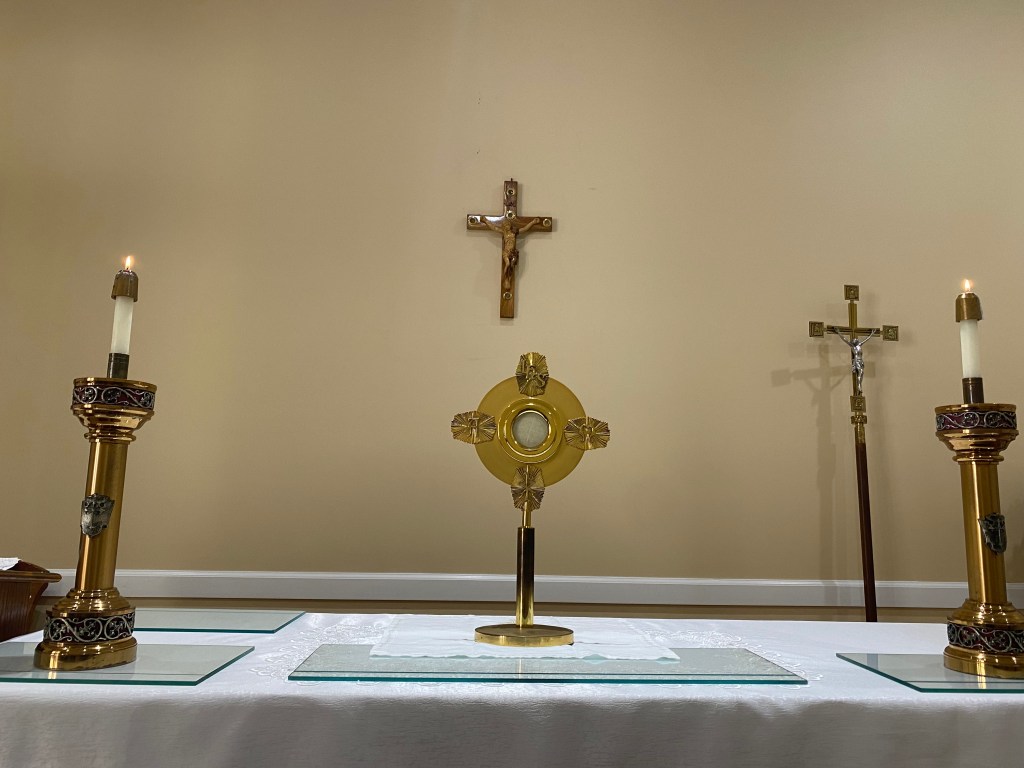
Photo: Quiet time before the Blessed Sacrament this past Tuesday while on silent retreat at Casa San Carlos, Delray Beach, FL. 

Link for the Mass readings for Friday, April 26, 2024


Our healing begins when we are willing to receive the embrace of Jesus.

A ghost is a disembodied spirit or an apparition. Jesus is no ghost, though when he appears to his disciples they believe him to be just that. Jesus then tells them: “Look at my hands and my feet, that it is I myself. Touch me and see, because a ghost does not have flesh and bones as you can see I have” (Lk 24:39). He also then requested from them something to eat, and Jesus received and ate the baked fish he was given.

Jesus, in showing the wounds on his hands and feet and in eating of the fish, revealed to his disciples that his resurrection is a bodily one. Jesus was not a disembodied spirit. Nor was he a mere apparition or hallucination. Jesus, was not resuscitated, just to die again. Jesus has conquered death and is risen from the dead. Jesus then proceeded, as he had done with Cleopas and the other disciple on the road to Emmaus, to share with those present how he is the fulfillment of the Law and the Prophets by opening the scriptures for them.

Jesus not only revealed himself as having risen from the dead and shared that he was the fulfillment of the Law and the Prophets, he embodied forgiveness. Though the disciples had betrayed him, and carried the weight of shame upon their shoulders for their lack of courage, the first words Jesus spoke were not words of condemnation but forgiveness: “Peace be with you” (Lk 24:36). In the showing of his wounds, the disciples were certainly reminded of what Jesus had gone through, his suffering and crucifixion. Could those wounds have also mirrored their own betrayal of him, their internal wounds, as well their own need for healing and repentance? Jesus did not bring up any of their past failures. He instead offered them peace.

All of us have been wounded in some way and have experienced trauma brought on by the myriad ways we have been exposed to the fallen nature of humanity. Jesus invites us to stop running from the fear of facing our hurts and the roots of our suffering and to instead kneel before him. He offers us his hands held out to us. May we gaze upon and ponder his wounds still present from the nails and come to a deeper appreciation of the suffering he endured for us.

Jesus invites us next to look up into his face, the face of the one who conquered death and rose again. Resist turning away from the smile that radiates his unconditional love. May we allow ourselves to lose ourselves in the eyes of his acceptance, that offer each and every one of us the realization that Jesus loves us in this moment just as we are.

Then listen, receive, and abide in the words he speaks, “Peace be with you.” In those words of invitation, may all our fears, anxieties, and hurts melt away. May we die to our pride and arise, allowing ourselves to be embraced by Jesus, embraced by his love, so to receive and abide in his love which is the foretaste of eternity. In the arms of Jesus, let our healing begin.


Pencil drawing: Kathryn J. Brown, 1982, hanging on my seminary room wall. Spend some time to rest in Jesus’ embrace this Lord’s Day.

Link for the Mass readings for the third Sunday of Easter, April 14, 2024

We are invited to be agents of calm and peace.

Some of the context for today’s reading of the Gospel is found in John’s account of the multiplication of the loaves which closes with this verse: “Since Jesus knew that they were going to come and carry him off to make him king, he withdrew again to the mountain alone” (Jn 6:15). Both Jesus and the people knew the Torah. In Deuteronomy 18:15-18, Moses shared that he was not the seal or end of prophetic tradition, he, like John the Baptist, pointed to one that would be greater than he.

As the five-thousand ate they talked among themselves, many may have then recalled how God fed the Hebrews in the desert, manna, bread from heaven. The miraculous multiplication mingled with the manna remembrance, comingled with the already growing messianic hope, could make a good case for why the people began to believe that Jesus was the “Prophet, the one who is to come into the world” (Jn 6:14), and then they rose to make him their king.

Recognizing their motivation and lack of understanding of the fullness of the kingship he would indeed assume, Jesus withdrew back higher up the mountain upon which he saw the people coming to him in the first place. The people presumably camped where they had eaten since evening drew near. Separation occurred between Jesus and the people because they moved to make him into something he was not. He refused, as he did during his fast in the desert, to give in to the temptation of power, pride, and honor.

The disciples were also separated from Jesus. They set out on the sea and headed toward Capernaum and would be reunited as they experienced a storm that arose on the sea of Galilee. Already full of anxiety as they were being tossed about by the waves, their fear grew as Jesus came closer to their boat, walking on the water. He calmed them as he said, “It is I. Do not be afraid” (Jn 6: 20).

Those present at the multiplication of the loaves and fish, the disciples, nor us today totally comprehend all of who Jesus is, for he embodies the fullness of humanity and divinity. Nor is he ours to tame. Jesus comes to us, is present to us, loves, and is willing to walk with us through all our trials and tribulations, as well as our joys and exhilarations. Though, what he will not do is be untrue to himself or to who he calls us to be. If we want to be fulfilled in this life, we need to let go of making Jesus in our image and likeness. Instead, with humility, we are invited to be conformed to his will, which, deep down is what we want too. We need to decrease, so that he may increase. We need to die in him, so that he may live in us.

In our willingness to surrender to the will of Jesus, we are able to keep our eyes focused on him. This does not mean our life will be perfect. There will continue to be challenges and conflict. The closer we come to Jesus the clearer we will see the truth and the absence of it within us and without. Conflicts with others will still arise. The difference is that when we experience the closeness of Jesus, while storms may rage on the outside, we will be calm on the inside. We will no longer feel the need react when our buttons are pressed, but can see another person with a wider lens, more  understanding, and love, and discern better how to engage or remain still.

We will grow stronger in our faith and trust in Jesus, and be more able to help others along the way to do the same, when we are willing to follow the guidance of Jesus and collaborate with him. In this free act of our will, we are aligning ourselves with the infinite power and ground of our being. In our participation with Jesus, we have access to his power working in and through us, we become agents of stillness and calm for ourselves and others, even while experiencing the storms of our everyday lives: “Be not afraid!” Trust in Jesus! When we do so, we will experience his peace.

——————————————————————

Photo: Spending some time winding down each day helps too! St. Vincent De Paul Regional Seminary, Boynton Beach, FL.

Link for the Mass readings for Saturday, April 12, 2024

Jesus seeks to heal and free us from our labels.

In the Gospel reading today, Jesus is accused of being an agent of Beelzebul, the prince of demons, because he was exorcising a demon from a man that was mute. Jesus addressed the critique and showed the polarizing nature of the onlookers who were unwilling to see the healing before them for what it was. Jesus then stated the obvious: “Every kingdom divided against itself will be laid waste and house will fall against house” (Lk 11:17).

Satan seeks to sow discord and division. Jesus seeks to bring about unity. Now it is true, that five verses later in the Gospel of Luke, Jesus is recorded as saying: “Do you think that I have come to establish peace on the earth? No, I tell you, but rather division” (Lk 12:51). Anyone feeling a bit confused? Welcome to the wonderful world of the Bible!

To understand Scripture, we need to understand the context of the whole of Scripture, not just isolated verses. Throughout the ministry of Jesus, he seeks the unity that all may be one as he and the Father are one (cf. John 17:21), yet he has consistently experienced those that rejected his message and healings as witnessed in today’s Gospel account.

Jesus demands a choice. We need to decide if we are either going to be for him or against him (cf. Lk 11:23). The division Jesus is talking about results from those who choose not to recognize that Jesus is who he says he is and reject him and those who accept him for who he is. This choice continues to cause division within households, families, and friends even today.

The greater take away from today’s Gospel and Jesus’ teachings as a whole, is that Jesus is the way and the truth and the life (see John 14:6). Jesus is the Son of God made man. Some will reject this truth. Some will accept only parts of the truth that Jesus teaches, while others will say there is not objective truth. We who identify with this truth and give our lives to him as his disciples, then like Jesus, we are to embrace the gift of our diversity.

We are more united rather than divided when we resist limiting ourselves by mere labels. In our modern context, labels, such as liberal and conservative are not helpful. It is certainly easier to cast labels, but interactions with people and developing relationships are much more nuanced. We are not mere cardboard cut outs, or caricatures.

To better understand the essence of who we are as human beings demands greater time and experience with each other than an outward appearance or isolated statement may portray. Many times, once we have cast a label, we believe that we have “defined” the person. They are classified in their box and tied up in a neat and pretty bow, and woe to the person who resists being boxed and bowed.

I remember reading from one of the books from the tracker, Tom Brown, Jr., in which he described how many people when seeing a bird, such as a blue jay, robin, or crow, are often satisfied with the label, the naming of it, and move on from that sighting self-satisfied. They think that in that simple identification they now have come to understand all that there is to know about that species. So much of the essence of one of God’s amazing creatures is missed by such a simplistic and limiting classification!

Unfortunately, we do the same with each other. We make a prejudgment on a person or group of people because of a word, statement, stance on a particular issue, or particular belief. We then falsely believe we know everything there is to know about that person or group. This is a limiting and divisive approach. Jesus invites us to encounter, accompany, spend time, and break bread with people. In spending time with one another, dialoguing, and respecting each other, the caricatures can be filled in with some substance and we can come to know a little better the person beyond the prejudgment. Maybe, just maybe, someone who we have been keeping at arm’s length, we can actually grow closer to, despite our differences.

———————————————————————————

Photo: During 30-Day silent retreat, St. Joseph and Mary Retreat House, Mundelein, IL.

Link for the Mass reading for Thursday, March 7, 2024

Peace comes when we align our will with our Father’s will.

Look at me, serve me, I want, are attitudes and dispositions that tempt us. Fame, honor, power, prestige may be another way of making the same point, which is that we often have a hyper-focus on self and self-promotion. Social media offers more of a platform to fuel this temptation. If we think this is something new with the advent of modern technology, we can look at today’s Gospel of Matthew to see that we have been operating from this posture for a very long time.

Jesus, for the third time, was attempting to prepare his disciples for his passion. He said: “Behold, we are going up to Jerusalem, and the Son of Man will be handed over to the chief priests and the scribes, and they will condemn him to death and hand him over to the Gentiles to be mocked and scourged and crucified, and he will be raised on the third day” (Mt 20:18-19).

The response of the mother of James and John (the two brothers make the request themselves in the Gospel of Mark) is actually not that surprising if we spend any time with people. She disregards what Jesus just mentioned about his imminent death and requests that when Jesus assumes his seat of power that her two sons will be number one and number two. The other disciples were quite indignant, and I can imagine what followed was not a pretty sight.

Jesus shares directly with the brothers that to give them a place at his right and left “is for those for whom it has been prepared for by my Father” (Mt 20:23). He addresses them all by letting them know that the preeminent place in his kingdom, whoever is to be first, is the one who serves his brother and sister.

Jesus is encouraging us this Lent to take the focus off ourselves and get out of our heads. To let go of I, me, and mine. Even when we let go a little, we will feel more peace. We will be able to take a few more deep breaths. We can experience this as well when we get outside, look up, and see the expanse of the sky. We’re no longer thinking about ourselves but touching the gift of our eternal nature and call to be one with God. Instead of feeling contraction, we can experience a sense of expansion.

When we allow ourselves to take a breath, we can then let go of the stress and the strain and the needless energy we expend following the distractions, diversions, and temptations that keep us on a treadmill pace. We can then instead spend a few moments with Jesus, and he can, as he did today with the apostles, correct any ways in which our mindset is not aligned with his Father’s will. We can then place God’s priorities for our life first, properly order our own, or let go of any that are not of his will.

When we are able to breathe, receive, and abide in God’s love, discern and make decisions from his guidance, we are changed and transformed. We will experience healing and renewal. We will begin to experience the fruit of the spirit: “love, joy, peace, patience, kindness, generosity, faithfulness, gentleness, self-control” (Galatians 5:22-23). In this way we can let go of being first or best, sitting at the right or left of Jesus, and instead, rest in being who we are as loved by God. As we experience more of the love of God, it is easy to let go of the need to be served and be more willing to serve and share the love we have received.

——————————————————————————

Photo: Looking up and outward, and breathing deep! St. Vincent de Paul Regional Seminary, Boynton Beach, FL.

Link for the Mass readings for Wednesday, February 28, 2024

God first before anyone and anything else will help us to experience more peace.

“Brothers and sisters: I should like you to be free of anxieties (I Corinthians 7:32).

Those in the Church at Corinth who heard this verse read to them as we just read or heard, would most likely have perked up. Who then, and now, would want to be in a steady state of stress? Who would rather experience a steady flow of peace, stillness, and tranquility?

Paul’s guidance to experience peace may be lost in his example of being married or not married. It is important to recognize that Paul is writing from the perspective that Jesus will be returning soon and not saying that one state is better than the other. His writings often reflect that if one is married it is good to stay married, if one is single or a virgin to stay in that state and not seek marriage.

Obedience to Jesus and his Father is the guidance that Paul gives. The husband and wife are going to feel the tension of their obedience to God and each other. They will be more divided, and this tension will grow when they put each other first over and above God. When we allow anyone or anything to have a place of priority before God there will be a greater potential for anxiety because we are placing our ultimate trust in someone or something that is finite and imperfect. When we are obedient to God and when he is first and primary in our lives, our wills will be more ordered to his will. To be obedient, we need to listen to his voice, and put his words into practice in our everyday lives.

Moses said before his death to those about to enter the promised land: “A prophet like me will the LORD, your God, raise up for you from among your own kin; to him shall you listen” (Deuteronomy 18:15).

“To him shall you listen.” As Christians, we believe Jesus is the One to whom Moses is speaking of, the one for whom we are to listen.

I remember Jesus being perturbed, angry, moved by compassion, experiencing sorrow, and extending love, healing, and mercy, but I don’t remember reading that he ever experienced anxiety. This is so because he was consistently obedient to and abided in the love of his Father. His Father also gave him authority to teach, heal, and cast out unclean spirits. Unlike the long tradition of rabbis who were given authority from those who they studied at the feet of, each rabbi would have traced their teaching pedigree through a succession of teachers back to Moses.

Jesus did not do so, and this may be one of the reasons the people were so amazed at hearing his teachings, witnessing his healing miracles, and the exorcising of unclean spirits. They wondered about where he had the authority to do, say, heal, and exorcise as he did. The demons and unclean spirits knew where Jesus got his authority from. They knew he was the Son of God and were obedient. When Jesus, as in today’s gospel, commands the unclean spirit to come out of the man, the spirit obeys. May we obey as well to love the Lord our God with all our heart, soul, and strength, and our neighbor as ourselves, in that order.

It may seem counter intuitive to place God before those closest in our lives; our spouse, family, and our friends, and even before ourselves, as Paul guides us to. Even if we do understand the principle, we may find it hard to put it into practice. David Kaiser-Cross, who was the associate pastor at Jupiter First Congregational Church, explained to me that if we put God first and strive to improve our relationship with him, as we grow closer to God, we grow closer to each other.

This is possible because as we receive and abide in God’s love, we are changed. We become more patient, more attentive, present, understanding, and loving. We experience forgiveness and healing. We are more grateful for what we have received. All of these graces lead us away from a selfish or grasping posture, and as we heal, we become less reactive, less insecure, less anxious, and more available to help others to heal and grow.

The more we are obedient and surrender to the commands of Jesus and put his guidance into practice in our lives, the more we will experience, not oppression but freedom, and the same peace that he experienced, “that peace that surpasses all understanding” (Philippian 4:5).

When we incorporate a daily practice of making time to be still, step away from our daily activities, even good and healthy ones and relationships, and rest and abide in the Father’s love, our anxiety will become less, and our peace and tranquility will become more. As challenges and conflicts arise, we will no longer be clinging to the person with white knuckles because of our fear of losing them, we will instead be more apt to remember to turn to Jesus, invite him into our situation because he is our anchor instead of them. We will be better able to let go of the unhealthy attachments that we have and allow for more breathing space between each other.

We will see our way through each crossroad with less stress, feel more of a sense of freedom and joy as we overcome our challenges. We will feel more stable and secure in our relationships with Jesus and each other as we work through each conflict. We will not feel we have to run away from or deny conflict as long as we remember that as we begin where we are right now, we are loved by Jesus as we are. May that reality be our foundation so that as we learn and mature, step by faithful step, we will consciously choose to be more patient and gentler with ourselves and each other.


Photo: One of the ways I have been experiencing more of God’s peace has been during my evening Rosary walks.

Link for the Mass readings for Sunday, January 28, 2024

Faith in Jesus instead of our anxieties and fears brings peace and stillness.

“Why are you terrified? Do you not yet have faith” (Mark 4:40)?

Jesus asked this question of his apostles after he quieted the wind and the waves. These were seasoned fisherman, so for them this must have been quite the storm. They even thought that they were not going to survive it as the waves not only tossed their boat but it also began to take on more and more water.

The question of faith was directed at their trust in him. Did they believe that Jesus was who he said he was and showed himself to be. If so, all would be well. Jesus called his apostles and brought them into his inner circle so they could not only experience his teaching, healings, and exorcisms but also to get to know him as the Son of God. As with any relationships, this takes time, and their faith, their trust in him in all circumstances was still growing. But as we read yesterday, faith as small as a mustard seed, will bring large results. This would come to pass with the apostles as well in time.

Our anxieties, fears, and insecurities are a good barometer of our faith in Jesus. These emotions are human and good in themselves as they are alerting us to a real or perceived threat. The challenge is to discern the real from the perceived and to determine when the threat has passed.

Where these emotions become a problem is when we believe in, place our faith in, and identify ourselves by them. Instead of saying to ourselves, I feel anxious, we define ourselves as anxious. Doing the opposite by denying and stuffing our emotions and feelings do not help either.

Jesus can help us to calm the real storms as well as the perceived storms in our lives. He can help and empower us to sit with our emotions, and ultimately get to the source of them and identify the root, identify if it is perceived or real, and then work through it. As with the apostles, when we continue to turn to Jesus, our faith and trust in him will grow, and we will also heal, mature, and grow through the storms in our lives.

Easier said than done? Yes for both our real and imagined storms. But for either, as we place our trust in Jesus, persevere, claim our authority in his name to renounce any attacks of the enemy, all things are possible!


Photo: Storm clouds on the way during retreat in January, all was calm and still.

Link for the Mass readings for Saturday, January 27, 2024