“He will baptize you with the Holy Spirit and fire.”

I am baptizing you with water, for repentance, but the one who is coming after me is mightier than I. I am not worthy to carry his sandals. He will baptize you with the Holy Spirit and fire (Mt 3:11).

John is offering a baptism of repentance. The people are coming to him, some traveling up to twenty miles through the desert. They were not coming to the Temple, the formal place of worship, but to the wilderness. John, the son of a priest, and so a priest, represents an answer to the hunger of the people that is no longer being fulfilled by much of the religious leadership of his time. He is the embodiment of the prophet who has returned – Elijah, who himself also dressed in “a hairy garment tied with a leather belt” (2 Kings 1:8). He speaks for God and the people are willing to listen and follow him because of his authenticity. And in his time he was most likely more popular than Jesus was in his. Jesus himself said that there was no one born on the earth greater than John (Matthew 11:11).

Yet, John the Baptist is clear that he is not the long-awaited Messiah. He is just the precursor as was promised. “John’s appearing in the desert dressed like Elijah would have signaled to the Jews that he was playing the part of the long-awaited Elijah, preparing for the Lord’s coming” (Mitch and Sri, 63). John as with the prophets like Elijah who had gone before him was preaching the need for repentance. He is preparing the hearts and minds of the people, inviting them to repent, to turn away from their sins and self-centered ways so that they will be prepared to recognize the Lord when he comes.

The baptism of Jesus was and is different than John’s. It is a baptism not just of repentance, but also of “the Holy Spirit and fire.” The baptism of Jesus will be wholly transformative. Fire consumes and transforms that which it touches and the Holy Spirit is often symbolized by fire. Within the Jewish tradition and found in the Old Testament, fire is associated with purification. The purifying and transformative fire of the Holy Spirit is love.

Love is an expanding, unitive force. It is a direct counter to the self-focused, curving in upon oneself and divisiveness of the fallen nature of our humanity. Love is an act of the will and draws us out to be engaged with the betterment of others. When we experience the love of God we are changed and transformed. This is not a one time be all encounter, but one that is to be experienced and shared consistently. The more we share the love of God the more we receive, and the more love we receive, the more we are transformed.

John the Baptist reminds those coming to him and us who read the Gospel of Matthew today that none of us are worthy of God’s love. That does not mean that we are bad. We just fall, short on our own, of the glory of God. We do not deserve nor can we grasp God for ourselves. No matter our will power and diligence, we must be willing to receive the Holy Spirit on his terms, not ours. We simply accept the invitation to receive the love of God, allow him to heal and expand us beyond our limitations, and share what we have received with others.


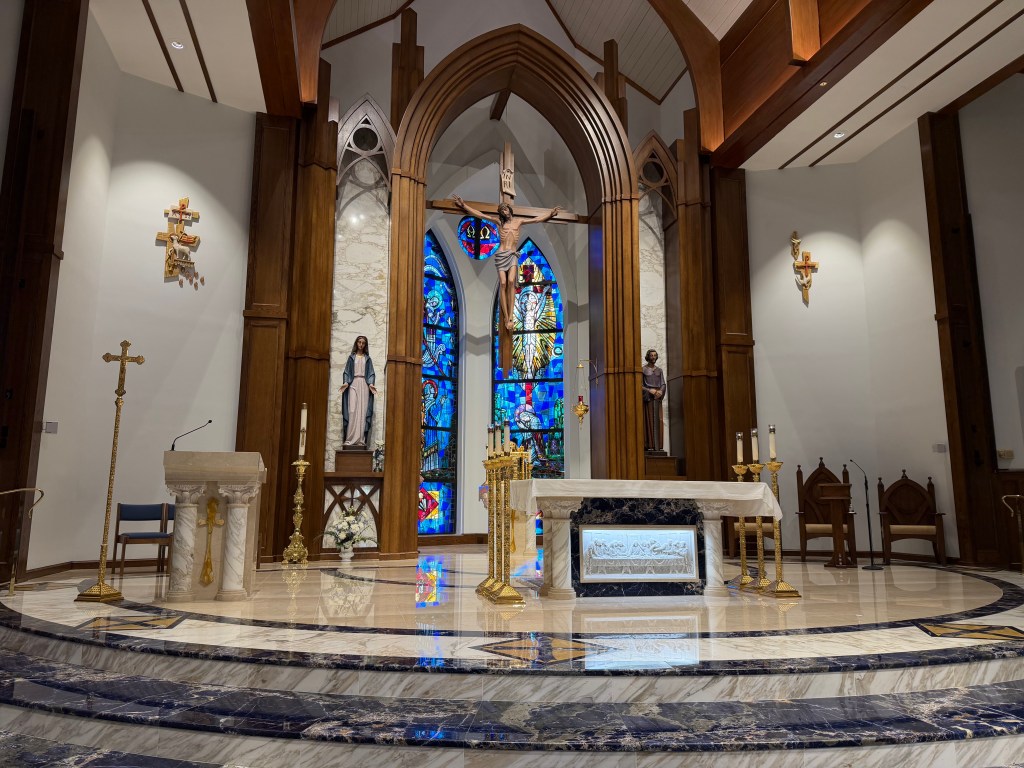
Photo: A quiet moment with the setting sun between the 4:00 and 5:30 Vigil Mass.

Link for the Mass readings for Sunday, December 7, 2025.

Our lives will be much better when we realize we are temples of the Holy Spirit.

When I was still teaching, I would ask my students if Jesus ever sinned. Inevitably, someone referenced the account from today’s Gospel. In these verses, we read how Jesus, “made a whip out of cords and drove them all out of the temple area” (Jn 2:15). Jesus is not sinning here, rather, he is acting in line with prophetic tradition. Jesus is making a bold spectacle to drive home the point that the temple is not a “marketplace” or a “den of thieves” but it is to be a place of worship and right praise to his Father.

We can see prophetic echoes from Zechariah 14:21 where he prophesied that there would be a time when there would no longer be “merchants in the house of the LORD of hosts” and Jeremiah 7:11 where Jeremiah asked, “Has this house which bears my name become in your eyes a den of thieves? I have seen it for myself!” Jesus not only places himself in the line of prophets and professes their words from God, he acts like them in make such bold statements. There is a difference though.

Greater still than the temple, is the people of God. Further down in the text, when those present ask for a sign to justify this act, Jesus said: “Destroy this temple and in three days I will raise it up” (Jn 2:19). John makes the point clear that Jesus was pointing to his body as the temple of God and referring to his Resurrection to come. Jesus is the new temple and he is establishing a new covenant.

The temple, the house of God, believed to be the corporal presence, the very seat of God among his people, Israel, was destroyed in 70 AD by the Romans. This left a tremendous spiritual, political, and social vacuum. Two groups that were intimately tied to the sacrificial cult of the temple, the Sadducees and the Essenes, very soon after the destruction, ceased to exist as a sect within Judaism. The Pharisees, who already were moving to a practice of home worship that mirrored the worship in the temple, would survive and be the ancestral root of different expressions of Judaism today. Another sect would also arise as the followers of the new way of Jesus which became the Church, “God’s building” and “the temple of God”.

After Jesus’ death and resurrection, his rising after the third day, Jesus becomes the first born of the new creation. Those who are baptized do not just gather in a church, they are the Church, the temple of God.

Each one of us has a unique part to play in the Church. We are called to bear witness and practice, in our own unique way, our faith in our everyday experiences. We may be the only church someone ever enters and the only Bible someone ever reads. This call to put our faith into action is not an invitation to be overwhelmed by nor an excuse to assume a posture of elitism. We are no better than anyone else.

Pope Leo recently said to students participating in the Jubilee of the World of Education: “How wonderful it would be if one day your generation were remembered as the ‘generation plus,’ remembered for the extra drive you brought to the Church and the world.” May we all hear these words, seek and follow Jesus, the Way, the Truth, and the Life, and allow his truth and his love to shape and transform our lives. When we are willing to encounter and walk together, we learn and grow from one another. We are also less apt to keep other at a distance and become more willing to draw close.

We need to resist all that contributes in any way to the dehumanization, division, hate, and violence by rooting ourselves in Jesus, the living Temple. In doing so, we will become aware that we ourselves are temples of the Holy Spirit. In spending consistent time in silence, prayer, meditation, study, worship, and service, we not only purify our temple, we better know God and his will, become conformed to and empowered by the love of Christ to be instruments of peace, contemplatives in action, and advocates for healing and reconciliation in a wounded and weary church, politics, country, and world.


Photo: God speaks to us in many ways when we give ourselves time to be still, breathe, and look up.

Link for the Mass readings for Sunday, November 9, 2025

May we allow ourselves to be ablaze with the transforming love of God.

Jesus said to his disciples: “I have come to set the earth on fire, and how I wish it were already blazing” (Lk 12:49)!

What has been burned does not remain the same. What fire touches, it transforms. Jesus wants us to be consumed so as to be transformed by the fire of the Holy Spirit. Encountering Jesus affects a change in us. When we are open to allow the Holy Spirit to breathe on the embers in the depths of our souls they are fanned like tinder and ignite. We continue to fuel the fire by getting in touch with what God has called us to do in our place and in our time.

We are not to be a Christian in name alone but in thought, word, and deed. Pope Francis, in his exhortation The Joy of the Gospel, wrote: “THE JOY OF THE GOSPEL fills the hearts and lives of all who encounter Jesus. Those who accept this offer of salvation are set free from sin, sorrow, inner emptiness, and loneliness” (Francis 2013, 9). Joy is a gift, a holy flame, that is given to us by the Holy Spirit, it wells up within, and rises up and out to be shared with others. It is different than pleasure which has its source in the stimulation of the senses being aroused but fades once the external stimulus has ended.

Happiness is also external and fleeting. It lasts longer than pleasure in that the memory of the experience will linger but it too will fade away. Joy wells up from within, as it is imparted to us by God and can be present even when the external experiences are stressful or chaotic. I experienced this when I was still teaching 5th and 6th Grade Religion and acting as the dean of students at Rosarian Academy. At the same time, I was also immersed in family and parish life, as well as my studies and formation activities for the permanent diaconate.

One particular morning I woke up exhausted. When the alarm went off my first response was to skip my morning prayer and hit the snooze button to get an extra twenty minutes before rising. Instead, I literally crawled to my small chapel area, lit the candles, and opened my breviary. When I read the words in Psalm 42: “Hope in God; I will praise him still, my savior and my God”, something ignited within. I felt an energy well up within me that I cannot to this day describe. I felt an inexpressible joy. Not only did the experience carry me into the day but lasted throughout the whole week.

God is the foundation of our lives and our Father seeks to transform us with the fire of his love. Even when we are at our lowest, with only the smoldering embers of our faith, we need to resist the temptation to feed indifference, desolation, and/or despair. When we turn to and trust in Jesus, he offers a way when there seems no way. Begin with a breath, be thankful for what we do have, even if it isn’t much. We can be thankful for God’s love and presence even when we don’t feel it. Keep showing up to pray, even if sometimes we have to crawl to get there, and the Holy Spirit will fan the embers within our soul to set us ablaze.

May we, “know the love of Christ that surpasses knowledge, so that [we] may be filled with all the fullness of God” (Ephesians 3:19). To know the love of Jesus is more than knowing about him. We don’t read and study the Bible as we study a history text. We meditate, ponder, and pray with Sacred Scripture daily, to encounter a Person, Jesus Christ the Son of the living God. In doing so, the Holy Spirit will also enkindle in us the fire of his love and moments of consolation that we can experience regardless of our external or internal struggles.

Nothing else in this world can satisfy us as much as experiencing and being transformed by the love of our Father! When we seek God first, the attachments to finite things will begin to loosen. When we trust Jesus and align our will with his, we will come to know him and experience his love and that can be enough. We will no longer seek substitutes to place before God and can begin to let go of anything that is not of his will. When the fire the Holy Spirit burns only that which is pure will remain.


Photo: “Holiness is standing in the fire of self knowledge and letting it burn.” – Fr. Wayne Sattler

Pope Francis. Evangelii Gaudium: The Joy of the Gospel. Frederick, MD: The Word Among Us Press, 2013.

Link for the Mass readings for Thursday, October 23, 2025

“From the fullness of the heart the mouth speaks.” What are we filling our hearts with?

“A good person out of the store of goodness in his heart produces good, but an evil person out of a store of evil produces evil; for from the fullness of the heart the mouth speaks” (Lk 6:45).

We can experience hardships, trials, and suffering. We may have experienced traumas, and even come face to face with evil. Yet, we are not evil because of what happens to us, nor how we are tempted. Neither are we defined by any trauma, suffering, or abuse. We have been created good by a loving God.

Negativity, sin, hate, and evil, can be seductive, can lure us to rationalize and decide that what we may think of as good in the moment, is in reality, just an apparent good or not good at all. To encounter or experience a word or act of unkindness, negativity, or even violence, we may feel justified in retaliation, yet if we speak or act in this way, we perpetuate the negativity or evil we seek to stand up against. In The Strength to Love, a collection of Dr. Martin Luther King’s sermons he wrote:

“Returning hate for hate multiplies hate, adding deeper darkness to a night already devoid of stars. Darkness cannot drive out darkness; only light can do that. Hate cannot drive out hate; only love can do that. Hate multiplies hate, violence multiplies violence, and toughness multiplies toughness in a descending spiral of destruction.”

At the moment we have a thought in our mind, we want to be aware of it and decide where and from whom this thought is coming from. Then, what to do with that thought. Many thoughts come from ourselves, others come externally from our experiences, our observations, our concupiscence – our tendency to sin, and yes even some from demonic influences.

What we listen to, read, and/or watch on a regular basis matters. We need to discern each thought or influence that comes our way. It is important to be aware what we are feeding on, literally and figuratively, and honestly assess our thoughts before we speak and act. Thinking through and deciding on what we will say and do is different from immediately or impulsively reacting.

Consuming the things of this world will lead to a different way of life than meditating and pondering on the things from above (cf. Colossians 3:1). Spending time in prayer and following Jesus’ commands will help us to bear the fruit of the Spirit: “love, joy, peace, patience, kindness, generosity, faithfulness, gentleness, self-control”(Galatians 5:22-23). Honestly examining our conscience daily will help us to purify that which is deadening and replenish that which will nourish.

Violence and the worst of our humanity continue through multiple media outlets, also, they horrifically materialize in real time, and ad nauseam on 24/7 cable coverage. The starting place to counter evil is to resist returning evil for evil, and to learn and put into practice Jesus’ teachings which will help to expose the darkness in our own hearts. We will see more precisely how to clear out the plaque of our own fears, wounds, frustrations, disruptions, and disordered affections. Then there will be more room for the love of the Holy Spirit to flow. With our hearts flowing with love, we will react less, listen, think, and speak better, and choose to act in ways that promote healing, understanding, forgiveness, reconciliation, and love.

——————————

Photo: Would that each of our hearts were open and receptive to God’s love as these flowers.

Link for the Mass readings for Saturday, September 13, 2025

“Holiness is standing in the fire of self-knowledge and letting it burn” – Fr. William Sattler

Jesus said to his disciples: “I have come to set the earth on fire, and how I wish it were already blazing” (Luke 12:49)!

This fire that Jesus has come to set is the purifying fire of God’s love which will be manifested brilliantly at the feast of Pentecost when the Holy Spirit will come like tongues of fire to land upon and transform the apostles. But before that time, there will be a baptism in fire, the passion, suffering, crucifixion and death of Jesus. As he did in the baptism of water he submitted to with John to join in solidarity with us in our human sinfulness, in the crucifixion, he is baptized with fire. Jesus took upon himself the worst fallen humanity had to offer, betrayal, injustice, violence, indifference, scapegoating, mob rule, indignity, inhumanness, and God forsakenness itself.

Impure metals, like gold and silver are placed in a crucible to be heated. The metals become liquified so that the dross, the impurities, will burn off and the metals are purified. The cleansing waters of baptism and the confirming fire of the Holy Spirit purifies and transforms us as well. Yet that is not enough. It is through our daily lives that this purification will continue. That is why Jesus continues: “Do you think that I have come to establish peace on the earth? No, I tell you, but rather division” (Lk 12:51).

Interesting words offered by the Prince of Peace. He has come to set fire on the earth and to establish division. What Jesus is sharing is that to be his disciples, God must be first in our lives. We are to love God with all our hearts, souls, strength, and minds and we are to love our neighbors as ourselves. We are to love in that order. When we love God first then all our loves will burn away as they are apparent goods, and those that remain will be properly ordered.

Putting God first will cause division because there will be those who are not willing to do so, even within the same family. Others might have different ideas of what it means to put God first. We can learn from Jeremiah and Jesus that putting God first has a cost, even if that meant all would turn on them.

Jeremiah followed God’s call to be a prophet. This did not exactly turn out to be a peaceful vocation. As is presented in our first reading, Jeremiah was persecuted for sharing the word of God with his own people of faith. They refused to repent and return to God and they refused to listen as the impending destructive power of the Babylonian army was storming upon them and about to be unleashed. Surrender was not in their vocabulary, to the Babylonians, and unfortunately, neither to God.

They refused to listen to God through Jeremiah and instead the princes received permission from the king to throw “him into the cistern of Prince Malchiah” (Jeremiah 38:6). Jeremiah was left sinking in the mud, and left for dead. It was only through the compassion of the appeal of the court official, Ebed-melech, that Jeremiah was pulled up to safety before he starved to death.

We can see not only Jeremiah’s faithfulness in the face of extreme opposition, but in this account we can also see a foretaste of Jesus. He was also persecuted by his own people and left for dead. There would be no Ebed-melech to come to his aide. Jesus died a humiliating and horrific death on the cross descended into the realm of the dead. Like Jeremiah, he went down. And like Jeremiah, he would be raised up. Jesus conquered death and rose through the power of the Holy Spirit.

Both Jeremiah and Jesus, in following the will of God, advocated for repentance and transformation, they sought to bring unity and peace, and yet for those who refused to receive their message and follow them, they were signs of division, demoralization, and ruin. Both followed God in the line of prophetic tradition, which announced that before there will be true reconciliation and peace, before the promised return and unification of the scattered Twelve Tribes of Israel, there will be a time of tribulation, a time of cleansing. For Jesus, there could be no resurrection until he went to the Cross.

How can we live our lives with the faithfulness of Jeremiah and Jesus? We can’t, on our own, alone. If we are to be disciples of Jesus, we need to be people of prayer. We need to daily turn our hearts and minds to God in prayer. “There is nothing more important that we will ever do than pray. That is why the devil hates prayer and tries to chase you away from any prayer” (Sattler).

The devil’s greatest weapon against us is distraction. If we are even willing and able to hear the call of the Holy Spirit inviting us to pray, our first response may be, I don’t have the time. And when we do, the next challenge will be resisting the myriad distractions, diversions, and temptations that the enemy will hurl at us to lead us away from even a minute of prayer.

“This restless being wants to pray. Can he do it? Only if he steps out of the stream  of restlessness and composes himself… No sooner has he started to pray than, conjured up by his inner unrest, all sorts of other things clamor for attention… prayer seems a sheer waste of time, and he fritters it away with useless activities. To recollect oneself means to overcome this deception which springs from unrest and to become still; to free oneself of everything which is irrelevant, and to hold oneself at the disposal of God, who alone matters now” (Guardini, 12).

The beauty of the temptations of the devil is that he is revealing to us exactly what God wants us to see. Our weakness, wounds, sins, attachments, disordered affections, and anything that is diverting us from keeping our face on Jesus. The same face that Peter held fast to when he walked on the water, and then sank when he allowed the distractions of the wind and the waves to look away. We continue to behold the gaze of Jesus when we are vigilant and consistent with praying daily and growing in our prayer so that we also pray in our activity and our challenges.

“Holiness is standing in the fire of self-knowledge and letting it burn” (Sattler). We are called to be still and identify our wounds, distractions, and temptations so that we can hear more clearly to identify whose voices we are listening to. When we are willing to enter into the crucible of the Holy Spirit and allow ourselves to be purified by the fire of his love, no matter what the devil throws our way, we can stand tall. When we resist running, trust in Jesus’ love for us, and remain, all that is not of God will be burned away.

The peace, stability, and unity that we seek comes by taking up our cross daily and walking with Jesus. When we are tempted in any way, let us turn to Jesus immediately. In this way, temptations and diversions will not lead to moments of sin, but will be invitations to receive God’s grace. When we do fall, we simply repent, turn away from the sin, turn back to God, learn from the experience, pick up our cross, and begin again.

With each step we will find healing, forgiveness, and courage. The fear, anxiety, and insecurities will become less, we will heal, as long as we remain in the presence of God’s purifying love and let him burn. We will slowly come to know God’s will for our lives and that is the meaning and fulfillment we all seek.  Jesus has blazed the trail before us. As we remain faithful to prayer, trust and follow him, he will continue to empower and strengthen us that we may continue to walk on as his disciples.

————————————————————–

Photo: Water and fire are powerful signs of the love of the Holy Spirit’s transformative power in the Bible.

Quotes from Fr. William Sattler received from his interview with Matthew Leonard on his podcast, The Art of Catholic on his YouTube channel.

Guardini, Romano. The Art of Praying: The Principles and Methods of Christian Prayer. Manchester, NH: Sophia Institute Press, 1985.

Link for the Mass readings for Sunday, August 17, 2025

Be still, and allow the Holy Spirit to burn!

Then the disciples approached Jesus in private and said, “Why could we not drive it out?” He said to them, “Because of your little faith.” (Mt 17:19-20).

How do the disciples get from this recurring theme of having little faith in the Gospel accounts to Peter healing a crippled beggar by saying with boldness, “I have neither silver nor gold, but what I do have I give you: in the name of Jesus Christ the Nazorean, [rise and] walk” (Acts 3:6)? And the man did just that!

A helpful definition “is to say that faith always entails a relationship between persons which stands or falls with the credibility of the person who is believed” (Rahner and Vorgrimler 1965, 164). Faith is not just an intellectual exercise, it is a lived experience. Christian faith is the conviction, belief, and relationship experienced with Jesus the Christ. The disciples learned from Jesus but more importantly developed an intimate relationship with him, such that the love they received and shared became so strong that there was no more room for doubt, distraction and/or fear, such that they would align themselves with the will of God and do what Jesus did.

The disciples did have some moments of doing as Jesus had done, but it was not until Jesus ascended and the Holy Spirit descended upon them at Pentecost that everything changed. Jesus had tilled the soil, he helped to unearth the rocks of the hardness of their hearts, he forgave them, and healed them. But it was not until they let him go after his Ascension that they were able to receive the Holy Spirit and by his power working through them they would do even greater deeds than he (cf. Jn 14:12-14)!

We are invited to do the same. If we only read the Gospels or hear them read we may know something about Jesus, but our life will for the most part remain unchanged. When we read, meditate, and pray with the Gospels and put into practice what we read, we will encounter Jesus as did his disciples. We too will come to know and develop a relationship with Jesus and our hearts and minds will be transformed by him. In this way, we are not just reading a dead letter but encountering the living Word, the Son of God, who invites us to share in the infinite dance of Love that he participates in with God the Father and God the Holy Spirit.

The enemy will do everything in his power to distract, divert, and tempt us from setting aside time to pray with God each day. And when we actually begin to discipline ourselves, enter into quiet time daily, we are invited not to stay there but to go deeper, to move beyond only reading, meditating, and praying. There will be times Jesus invites us to set aside our Bible, notes, journal, prayer cards, and/or vocal prayers of petition, and to just be still, to listen, and receive the love that Jesus and the Father experience, the Holy Spirit.

The same Holy Spirit who empowered the Apostles to fulfill what Jesus had begun with them is quietly nudging us on each day. Please listen! He is inviting us to see more clearly those subtle ways we are being distracted, tempted, and diverted from his guidance and what has been inhibiting the growth of our relationship with God. The love and light of the Holy Spirit will reveal, when we are willing to remain still, where and how, in minute and massive ways, we are refusing to follow the will of God.

One of the reasons that we have “little faith” is that we rely too much on ourselves. We are invited to stand in the presence of the Holy Spirit and let his fire burn, to purify us from our own misguided thoughts of self sufficiency. As gold and silver is placed in a crucible and heated, the dross is purified. We are purified in the crucible of our meditation, prayer, and contemplation by the love of the Holy Spirit. Through this purifying light we will see that we cannot save ourselves, that we need a savior, Jesus, with his arms wide open ready, willing, and able to forgive us and love us unconditionally and continually.

———————————————————————–

Photo:  A moment of stillness and purification back in December.

Rahner, Karl and Vorgrimler, Herbert. Theological Dictionary. New York: Herder and Herder, 1965.

Link for the Mass readings for Saturday, August 9, 2025

Not to wriggle free from but to surrender all to God.

Jesus said to the disciples: “The Kingdom of heaven is like a net thrown into the sea, which collects fish of every kind.” (Mt 13:47).

The invitation of God is universal and we are all lured by his invitation of love and intimacy. We long to belong, our very substance and essence as human beings is the reality that our ultimate fulfillment can only be reached in communion with the God who has created us. Yet, though drawn, we can resist being caught.

St Augustine (354-430), bishop of Hippo, came to a point in his life where he realized that the flame of his desire for wealth, fame, and pleasure was dimming. He clearly felt moved toward “one reality that cannot decay, from which all other realities are derived.” Though he was caught in God’s net and being pulled in, Augustine still sought to wriggle free, for: “Though drawn to the Path, who is my savior, I shied from its hard traveling” (Augustine 2008, 161).

How many of us echo Augustine’s dilemma? We have experienced God in our lives and feel the invitation to be drawn in, yet, we still seek to wriggle free. We are attracted to God but our attraction to other apparent goods still hold priority of place. At a baser level, we may believe that the minimalist approach is easier. God’s path is too hard.

Harder? Yes, but if we follow the will of God he will give us the strength to endure and persevere.

In reality it is more of an effort to work against God’s will, just read the Book of Jonah! May we instead surrender to the current of the Father’s Love and allow ourselves to be caught in the net of his Grace. At first, anxiety and fear will arise, just like being caught in a rip tide, because the pull may appear too strong, his love too pure. When we surrender to the will of God though, the anxiety will subside, the joy and consolation will arise, as we flow with ease and are empowered by the love of the Holy Spirit.

St. Ignatius of Loyola, whose feast day we celebrate today, resisted God for a time as well but then realized, during his long period of recuperation from a canon ball strike, a distinction between the invitations of the world and God’s. The intoxications of the world brought a momentary high which would then leave Ignatius wanting. “While reading the life of Christ our Lord or the lives of the saints, he would reflect and reason with himself: ‘What if I should do what St. Francis or St. Dominic did?'” (Gonzalez).

The thoughts of Jesus and the saints did not wane and after reading about them, left him with periods of ongoing consolation. The path that Ignatius then walked led him to sainthood and the Exercises he developed have helped countless, including myself, to experience healing and a deeper and more intimate relationship with Jesus. If you have read my encouragements to imagine yourself in the daily gospels before, you now know that I learned that practice from St. Ignatius. Give yourself some time getting caught in the net of God’s love today, resist the temptation to wriggle free, and offer the Lord all your liberty!

———————————————————————–

Photo: Ad Majorem Dei Gloriam – In the Ignatian tradition may we do all things for the greater glory of God! St. Ignatius, pray for us!!!

St Augustine. Confessions. Translated by Gary Wills. NY: Penguin Books, 2008.

Luis Gonzalez in The Liturgy of the Hours, vol III, 1975, 1566.

Link for the Mass readings for Thursday, July 31, 2025

“…whoever says to his brother, Raqa, will be answerable to the Sanhedrin…”

As was presented yesterday, Jesus made it clear that he did not come to abolish the law or the prophets but he came to fulfill them. In his Sermon on the Mount as recorded by Matthew, Jesus offered practical ways in which we can find fulfillment and happiness. In today’s account, he introduces the first of six antitheses. With these apparent contrasting statements, beginning with, “You have heard that it was said” followed by, “But I say to you”, Jesus provided for his disciples the way to avoid the trap that some of the religious leaders of his time fell into: “I tell you, unless your righteousness surpasses that of the scribes and Pharisees, you will not enter into the Kingdom of heaven” (Mt 5:20).

The scribes and Pharisees that Jesus pointed out were those who believed that they were following the letter of the law, but their hearts were not changed. They may have been adhering to the external provisions of the law, but there was no transformation, their hearts were hardened, they were focused more on their own access to honor and power. They were also imposing strict adherence to the law without providing the support or means for others to achieve what the law imposed. The law became more important than the dignity or value of the person. Jesus recognized the law, but also realized that it was in place to help to provide guidance and discipline so one could better resist the temptations of our fallen nature. The law was to be a foundation to be built upon, not the end goal in and of itself.

Just as children need clear boundaries and structures in place to provide a clear path toward healthy development, this is also true for those of us growing and maturing spiritually. We need to learn to crawl, to build strength and balance before we can take those first wobbly steps. With continued support, we are then able to walk and soon run. Jesus is not only providing the means to go through each of these stages in our faith life, figuratively teaching each of his disciples and us today to not only crawl, walk, and run but to also be able to fly as we seek to reach the heights that Jesus is willing to raise us to!

The Beatitudes and six antitheses are challenging because each one of them goes counter to much of the way the structure of our fallen world has been governed for centuries. If we are to catch the fire that Jesus has come to set, we need not only to read, pray, meditate, and contemplate upon on the teachings of the Sermon on the Mount, we need to also see their relevance and practicality to our time and place today, and begin to put them into practice. As Christians, our faith ought not to be shaped and informed by our culture, but we are to be shaped and conformed by the Gospel of Jesus the Christ, so to shape and inform our culture.

Today we start with the first antithesis: “You have heard that it was said to your ancestors, You shall not kill; and whoever kills will be liable to judgment. But I say to you, whoever is angry with his brother will be liable to judgment, and whoever says to his brother, Raqa, will be answerable to the Sanhedrin, and whoever says, ‘You fool,’ will be liable to fiery Gehenna (Mt 5:21-22). The seeds of anger begin to sprout in our mind from our knee jerk reactions to a perceived or actual threat, from our hearts hardened by prejudgments, prejudices, and/or a reflection of our level of spiritual immaturity.

Jesus addresses the known provision against murder. He then builds a hedge around the Torah. If one does not want to break the law, another is imposed so as to protect one from even getting close to breaking the first. If we can resist the temptation to react and instead step back for a moment, take some deep breaths, pray, and seek the guidance of the Holy Spirit, we will be less likely to criticize, judge, demean or dehumanize another, and then there is much less chance for our anger to grow into wrath, that left unbridled could lead to murdering someone.

Jesus is also saying that our words matter, that they have the power to destroy or to create. Calling someone Raqa, Aramaic for a block-head or idiot, and then calling someone a fool, would “be liable to fiery Gehenna” (Mt 5:22). How much more egregious are we today? How polarized we have become inside and outside of the Church because of the level of demeaning words, tone, and language that is spoken, condoned, and justified? This has a ripple effect that poisons our family, relationships, and spreads to the wider culture, politics, and the Church with growing hateful rhetoric, overt expressions of prejudice, and violence.

Instead of settling for two dimensional caricatures of one another, we can go deeper when we are willing to spend time with and get to know each other. Jesus challenges us to slow down and see the person before us with dignity and respect. When we resist reacting, giving in to our biases, and prejudgments, and instead recognize the value and dignity of each person, we will have a better chance of building relationships. We will also be more apt to reform policies and structures that respect the dignity of each person in the womb, after birth, and at each stage and condition of life until natural death.

May we all take some time today to reflect on Jesus’ teaching about how we think, speak to and about, and act toward one another. May we examine our conscience and seek forgiveness for those times we have thought, condoned, or justified thoughts, words, and/or actions that have been belittling, dehumanizing, and demeaning directly or while with others, we approved by our manner or our silence.

Jesus, please impart within us your infusing power of justice, love, and mercy so that we will be more inspired to live out your teachings in our daily lives. Help us to strive to encounter each other grounded in mutual respect and understanding as our brothers and sisters, no matter our race, ethnicity, creed, and/or gender, and to commit to building a culture of life and dignity for all, not in some abstract utopian way, but in the concrete moments of our everyday experiences, one person and one encounter at a time.

——————————————————————–

Photo: Let us listen to Jesus and do whatever he tells us.

Link for the Mass readings for Thursday, June 12, 2025

The love of Jesus will heal us and help us to heal others.

Jesus said to his disciples: “Do not think that I have come to abolish the law or the prophets. I have come not to abolish but to fulfill” (Mt 5:17). Jesus was a devout Jew, he was taught how to live out the law and the prophets in his daily life by Joseph, Mary, and his Father. Jesus grew up not only practicing but embodying a deep understanding of the law and the prophetic tradition. We see evidence of that when, at twelve, he is found by his parents among the teachers and scholars discussing the law with understanding and wisdom. Jesus, in his public ministry, very much spoke with authority, as God, calling the people of Israel back to the law, both those who have turned away from God as well as those who used the law as a bludgeon and for building a wall to keep others out.

Jesus also showed time and again that being true to Torah was more than just following the law but obedience to God and allowing God to transform each person from within was the point. The law was about building relationships with God and others. Jesus extended his hand, person to person, offering an invitation of welcome for people to come to know him and his Father intimately. He called out many religious leaders who taught the truth but lived another way. Jesus healed on the Sabbath, Jesus forgave sins, Jesus touched lepers and he ate with tax collectors, prostitutes, and sinners, those on the peripheries, not because he was being willy-nilly with the law, but because he was showing the deeper interiorization of how to live out God’s commands by his lived example that the greatest commandment of the law was and is to love God with all his mind, heart, and strength and to love his neighbor as himself.

This practice goes right to the foundation of who God created us to be. All of humanity has been created in God’s image and likeness. Each of us is endowed with dignity by the very fact that we exist as a daughter and son of God. Yet, it is in our choices to sin, that we lose our likeness to God. Jesus calls us to repent, to turn away from our sinful attitudes and ways, and to turn back to receive the love of God.

In Jesus, we see that the highest observance of the law of God is to love. Jesus met each person where they were and accompanied them. That also meant calling out those who misused the law by keeping others at arm’s length. Jesus did the opposite. As the Son of God, Jesus became one with us in our humanity, so that we can become one with him in his divinity. Jesus offered others his arms extended outward, inviting others to enter into his loving embrace. He showed this in a graphic and powerful way on the cross, where he opened his arms wide to embrace all peoples of every race, ethnicity, and gender, even in our deepest sins.

Jesus built on the law and the prophets, because he was the fulfillment of them, and in doing so, he gave the law its greater context. The foundation of the law and the prophets were founded in love, meaning its highest expression, which is to will the good of the other as other. This means that the law is not like a stagnant pool, where we grasp onto the law and tradition for its own sake, but the divine law of God is rather like a running stream, it is always fresh and being renewed by the Holy Spirit.

What Jesus ushered in, was the reign of God, which was possible through the foundations laid by those who had gone before him: Abraham, Isaac, Jacob, Joseph, the judges and prophets, David, and those who answered the call of God to serve in his name. From a person, Abraham, to a clan, a loose gathering of twelve tribes and then a nation, Israel, God called a people to himself to shine the light of his will to others. Then at the appointed time, he sent his Son, to be one with the people he called to draw all nations to himself so that all were and continue to be invited to come to be one with him, the God of all creation.

Our joy and fulfillment take shape most meaningfully as we are transformed by the love of God. As we build on the traditions of our faith that give us a solid foundation, we must resist holding on to them so tightly that they strangle and suck the life out of us. That which leads us to encounter and renew our relationship with Jesus in love is what we are to embrace and share. That which has become stagnant and no longer is an avenue for affirming life must be purified.

The love and mercy of God put into practice through Jesus was not a watering down of the law and the prophets. Jesus not only fulfilled both expressions, but he also raised the bar even higher when he taught his disciples to move beyond seeking an eye for an eye, to not resisting an evil person (see Mt 5:38-39), and challenged them further in requiring them to love their enemies and pray for those who persecute them (see Mt 5:44). To accept and put into practice these impressive expressions of love is only possible, by allowing God to love us in our weakness and frailty, by being willing to be transformed by his love, so that we can in turn will love others unconditionally with the same radical love we have received from Jesus.

God’s love invites us to identify the darkness of our own sins and idolatry not so that we become over zealous moralizers. We are not to lead with the law but with love. We do so best when we are willing to be humble enough to trust in the purifying fire and convicting movement of the Holy Spirit in our lives, are willing to confess with contrition our sins, and become less drawn to protecting our false and fallen selves. Emptying ourselves in this way, we are then open to drink from the living stream of Jesus’ love, we become more comfortable in our own skin, are true to ourselves, and who God calls us to be. Hurt people, hurt people. Let us be healed people who radiate joy, hope, and love to those seeking to be healed.

——————————————————————————–

Painting: by Melody Owens – The original painting is 11″x14″ gouache.

Link for the Mass readings for Wednesday, June 11, 2025

When we are willing to die to our selfishness, we will love as God loves us.

“I have told you this so that my joy might be in you and your joy might be complete” (John 15:11).

What is this referring too? “If you keep my commandments, you will remain in my love, just as I have kept my Father’s commandments and remain in his love.”

And what is his commandment? “This is my commandment: love one another as I love you.”

Even when life appears pretty dark and division and suffering seem to be waiting around every corner, we need not give up or fall into despair. God wants us to experience fulfillment, meaning, and joy despite our experiences and not through being lemmings or slaves but as Jesus said, his “friends”. The friends of Jesus are those who hear the word he has received and shared from his Father which are his commandments, the greatest of these is the commandment to love as Jesus and the Father have loved us.

If we truly want to be happy, fulfilled, and have meaning in our lives, Jesus invites us to align our wills with the will of God who is Love. St. Irenaeus taught that the joy of God is the human being fully alive. For us to be fully alive, we need to allow ourselves to be loved by and then love as God loves us. God knows what will fulfill us. Many of us do not experience the fullness of this joy because we are distracted and diverted by apparent goods, instead of striving for what actually is good. Time and discernment with the guidance of the Holy Spirit can help us to distinguish the difference.

Neither will we experience fulfillment and joy through denying, covering over, or being so busy that we don’t face the sufferings in our or other’s lives. We ease suffering by entering into it and receiving God’s loving embrace. He will heal us when we are willing to experience our pain. When we experience our pain with him, we receive his mercy and love, and experience healing at the root. As we heal, as we experience God’s love, we can then help to alleviate some of the sufferings of those around us.

“To love as God does, we must be constantly dying to our own sinfulness and selfishness and living for God. And we live for God by obeying the Father’s will and loving one another” (Martin and Wright, 260). Each day we are invited to choose to curl up in our shell of selfish concern or allow ourselves to be loved and to love in return, to come out of our shell, to risk, and become agents of healing and love. As agents of God’s love and mercy we can help to make our corner of the world a little better.


Photo: With JoAnn, who taught me how to come out of my shell, to live, and to love.

Martin, Francis and Wright IV, William M. The Gospel of John. Grand Rapids, MI: Baker Academic, 2015.

Mass readings for Wednesday, May 14, 2025