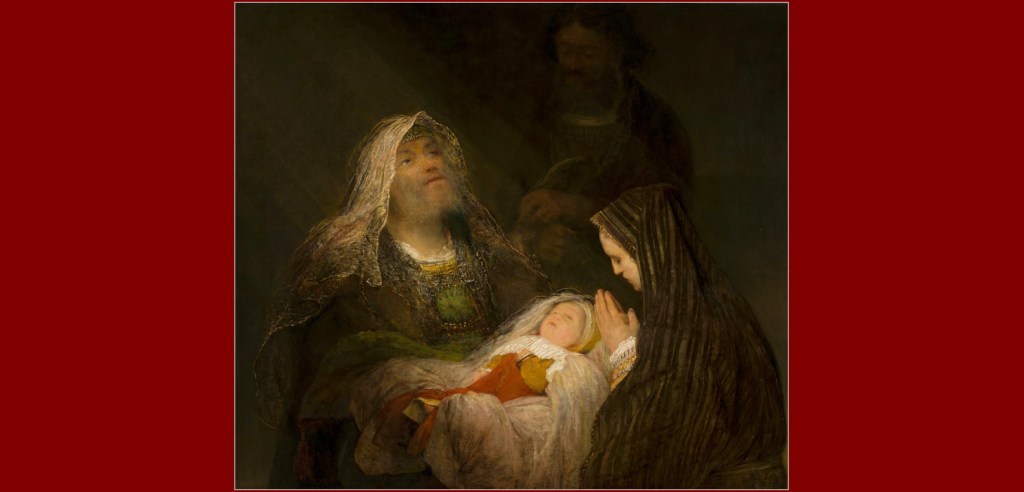
“Lord, now let your servant go in peace; your word has been fulfilled: my own eyes have seen the salvation which you prepared in the sight of every people, a light to reveal you to the nations and the glory of your people Israel” (Lk 2:29-32).
As Simeon receives Jesus in his arms to be consecrated to the Lord, he recognizes through the gift of the Holy Spirit that this child, is the one he and Israel have been waiting for. Simeon is witnessing the prophecy of Micah being fulfilled right before his eyes: “The lord whom you seek will come suddenly to his temple” (Micah 3:1). Jesus is the Messiah, the Christ. He has come to fulfill the Law and the Prophets as well as be a light to the Gentiles and to all the Nations.
These verses, called the Canticle of Simeon, as well as in Latin the Nunc Dimittis – from the first words of the canticle – now let depart, be dismissed, as offered above by Simeon, “now let your servant go in peace” was recorded by Luke and is recited each night by those of us who pray the Divine Office or the Liturgy of the Hours. They are prayed during Compline or Night Prayer, the last prayers before going to sleep.
The gift of reading a Gospel passage again and again is that when we are open, God can speak to us in deeper ways or help us to see something we have not seen before. We too can celebrate the birth of Jesus who is our savior, our fulfillment and our light also. We can see as Simeon saw, the face of God revealed before him and so he can go in peace. A good way to go to the land of dreams each night!
We are all invited to meditate with this same passage. We can enter the scene and, like Simeon, receive this child in our arms from Mary and Joseph. We too are invited to see the salvation that is offeredus, the invitation given to us. May we not run from the light of his truth, but may we embrace it so that we can be transformed. Let us glory in the joy of knowing that Jesus came to share his forgiveness, love, mercy, and grace, with each and every one of us. He is the promise of healing that we all need to realize and actualize in our lives.
Jesus invites but does not impose. This Christmas can be just another few days in a cycle of days that pass with no change, or we can immerse ourselves in the readings of this Octave of Christmas so as to take seriously the fact that Jesus is who he said he is, the one the prophets foretold, who the Apostles claimed him to be, and who the Church still announces him to be today: Jesus is the Christ the Son of the Living God. Do we also believe this truth?
I invite you to return to the meditation we started above and to hold the baby Jesus, our savior, in your arms as Simeon did. As you hold him look into his face, see his smile, the glint in his eye, and allow that exchange to melt away any sin of pride, lust, greed, envy, sloth, gluttony, prejudice, and/or wrath. Experience the warmth of his love radiate up from the depths of your soul to be filled with his joy to overflowing.
May we allow his gentle smile to penetrate those areas where we have not wanted to let anyone else in. Those places of pain, trauma, shame, grief, fear, and/or anxiety. In sharing our poverty, our imperfection, and to be willing to take off our masks, we can be loved in places we never thought possible. Let the image of Jesus’ smile be the healing salve that we did not even know we were seeking. As we trust in him and experience his healing, each night we then can go in peace, and each day we can rise and go forth to share that same smile and so radiate the love of Christ with those we encounter.
Painting: Arent de Gelder – the Song of praise from Simeon, ca. 1700-1710







 Spiritual Stepping Stones