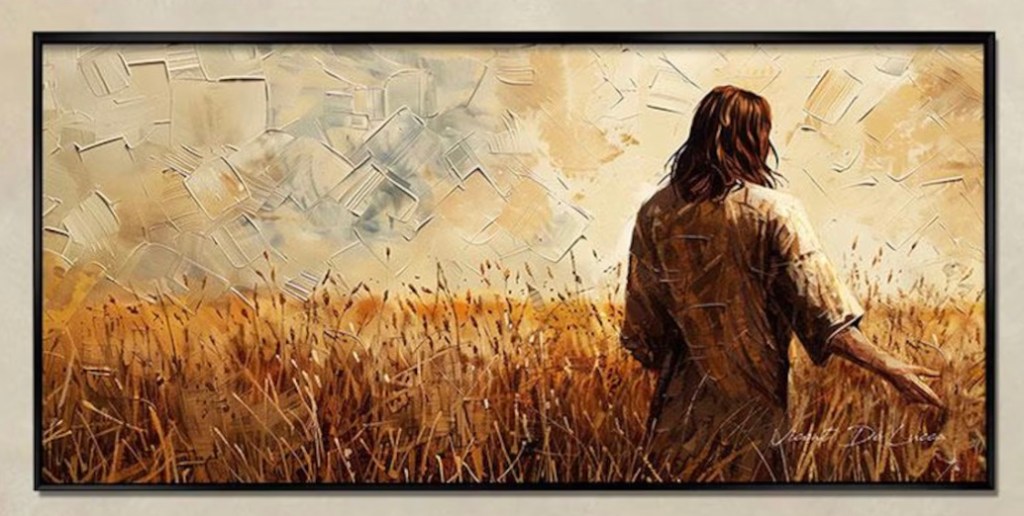
When we allow ourselves to be loved by God we can love in return.

When the Pharisees heard that Jesus had silenced the Sadducees, they gathered together, and one of them, a scholar of the law, tested him by asking, “Teacher, which commandment in the law is the greatest?” He said to him, “You shall love the Lord, your God, with all your heart, with all your soul, and with all your mind. This is the greatest and the first commandment. The second is like it: You shall love your neighbor as yourself. The whole law and the prophets depend on these two commandments.” (Mt 22:34-40).

Jesus, in response, was not just throwing up a cloud of theological dust into the eyes of the Pharisees. His answer to, “which commandment in the law is the greatest?” was drawn directly from the Torah. Showing again his knowledge of the Torah. Jesus quoted from Deuteronomy 6:5 and Leviticus 19:18 and merged the two verses together as one unit. His purpose was to emphasize the point that what is to be the greatest aspiration for humanity is to love God and to love our neighbor as ourselves, not either/or. Jesus again was showing that he did not come to abolish the law and the prophets, but that he came to fulfill them (cf. Mt 5:17).

In this statement, Jesus also revealed the foundation of reality, the Trinitarian communion of love. For the immanence of God – God within himself – has always been, always is, and always will be a communion of love. God the Father loves the Son, God the Son receives the Father’s love and in return loves God the Father, and God the Holy Spirit is the love expressed and shared between God the Father and God the Son. The overflow and abundance of this perichoresis, or divine dance of trinitarian communion, has been the loving of creation into existence.

This means that we as God’s created beings, his children, have been loved into existence too! We are loved by and capable of loving God and one another in return mirroring on earth the love that is shared in Heaven. It is through our participation in the life of Jesus that we can live up to his command to love our enemies, best expressed in the parable of the Good Samaritan (Lk 10:29-37).

This is why prayer is so important. If we don’t get our relationship with God right, if we don’t spend time with and allow ourselves to rest, receive, and abide in his love, we will not be able to return the love we have received, and then how can we truly love ourselves and each other? When we do get the love of God right, we and our realm of influence changes. We can experience that peace that surpasses all understanding, and we can find the rest, that rest within the depths of our souls that we all seek. This peace, love, and rest we can then share with God and one another.

We can do so in simple but powerful ways. When we catch the eye of another smile. This small gift can make such difference in another’s life. If someone says, “How are you today?” say, “Better that you asked.” When you are with someone be there as if they were the only person in the world. Go out of your way to do some random acts of kindness, especially for that someone who ordinarily and regularly gets under your skin.

Today – Perichoresis! Let us rest, receive, and abide in God’s love, participate in the dance of God’s trinitarian Love and let his Love reign free in your life to overflowing.


Picture: When we embrace the vertical of loving God with all our heart, mind, and soul, we can share the horizontal, loving our neighbors as we love ourselves.

Link for the Mass readings for Friday, August 22, 2025

Are we willing to accept the invitation and then show up for the wedding feast?

“The Kingdom of heaven may be likened to a king who gave a wedding feast for his son” (Mt 22:2).

Throughout the Gospels, Jesus not only talked about feasts but he is recorded as often celebrating table fellowship with others. Those he ate with ranged from people who were considered sinners to the religious elite among the Pharisees.

In the parable from today’s Gospel, Jesus presented a range of reactions to the invitation already supposed to have been accepted to a great, wedding banquet offered by the king for his son. The custom of the time for a wedding feast, which often was a celebration that would not last just a day but often a week. A first invitation would be sent out, and when accepted, at the time to begin the banquet, a second invitation would be sent for those to now come to enjoy the festivities.

In Jesus’ parable, the first group are so caught up in their own lives, that they are not willing to break away from their daily activities. The second group rejects the invitation outright and does so violently, by mistreating and even killing the servants of the king. The retribution of the king is swift and punitive. Then he sent his servants out into the streets, “and gathered all they found, bad and good alike,” and they welcomed the invitation and said yes to the invitation “and the hall was filled with guests” (Matthew 22:10).

God invites us into a relationship with him, but we must be willing to repent, to change our hearts and minds to see the invitation for what it is, then decide to receive an eternal gift. Those who refused were unwilling to change their plans, as well as others who, with hearts of stone, were outright hostile, willing to abuse and even kill the servants. Are we willing to choose our busyness over time with God each day or will we stubbornly hold on to our own self-reliance and pride and refuse God’s gift?

Near the end of the parable, Jesus presents a curious fellow that the king found present without the proper attire. This is not a literal indictment of not having the proper clothes, but the wedding garment imagery may be a recognition of a willingness to receive the benefits of the invitation without a yes to the responsibility involved. A desiring to reap the gift with accepting the responsibility. We need to be willing to take off the clothes of our old way of life, our ways of sin, self-indulgence and reliance, and receive the wedding garments offered to us by the king who seeks to clothe us “with the garments of salvation;” and cover us “with the robe of righteousness” (see Isaiah 61:10).

We are invited to participate in the banquet of eternal life with God. The invitation is freely given, yet it requires that we dress for the occasion. Again, this dress is no material garment of fine linen and gold embroidery, but our willingness to repent, to turn away from those idols, that which we have placed or put before God, to have our hearts and spirits renewed. We are invited to be a part of God’s new creation by participating in the life of his Son, the firstborn of the new creation.

We see this played out in salvation history as well. God the Father offered this invitation of the eternal banquet to the patriarchs, judges, prophets, and the people of Israel, to be one with him that they might shine brightly before all so to make his will and glory known to the world. In God’s timing, he sent his Son to fulfill that mission of invitation and to be with us in our present moment and in our present condition in life. Jesus meets us where we are right now in our everyday experiences and tells us that “the feast is ready.”

We are invited each day to begin again, to pray, to turn away from our selfish ways, to receive a new heart and a renewed spirit. God invites us but we need to be willing to let go of our idols, our disordered affections, and attachments. We are called to be transformed and perfected through our participation in the life of Jesus and through the purifying fire of the Holy Spirit.

Our yes demands accountability. We can’t just show up dressed for the part and take up space. Our ultimate attire is the transformation from within, in which our posture changes from a curving in upon ourselves to an opening and willingness to praying with and being guided by God, to devote our time, discipline, talent, and treasure to serving at the banquet and inviting others to attend.

“Many are invited, but few are chosen” (Mt 22:14). The first step is saying yes to the invitation. The second step is to be prepared for and be ready to come when the time for the wedding feast is announced. We need to be willing to allow the Holy Spirit to renew our hearts and minds, to take up our cross, to know and follow the Father’s will, serve and sacrifice by the giving up of ourselves in love. The way to the banquet is no easy path, but we can take comfort in the truth that we do not walk alone. Jesus guides and empowers us when we are willing to follow.


Painting: The Adoration of the Mystic Lamb, the central painting from the Ghent Altarpiece painted by Hubert and Jan Van Eyck in the 15th century.

Link for the Mass readings for Thursday, August 21, 2025

We can choose to be envious or grateful for God’s generosity to others.

Jesus told his disciples this parable: “The Kingdom of heaven is like a landowner who went out at dawn to hire laborers for his vineyard…” (Mt 20:1).

At dawn, nine, noon, three, and five o’clock the landowner hired day laborers to go into the field to bring in the harvest. Many, familiar with this parable, find themselves a bit bemused, bewildered, or even angry at the ending when they read or hear that the landowner had his foreman pay everyone the same pay. The immediate cry is, “That is not fair!” Those, more often than not, who respond this way are focused on the hired hands who started at dawn, worked all day, and were paid the same as the laborers who started at five o’clock.

The workers who started at dawn agreed to a certain wage and the owner paid that agreed amount. The landowner explained, “to one of them in reply, ‘My friend, I am not cheating you. Did you not agree with me for the usual daily wage” (Mt 20:13)? What is missed, if someone is feeling as perplexed as were some of the dawn laborers, is the generosity of the landowner.

We see this similar scene of generosity given and played out in some of Jesus’ other parables. The older son who refused to listen to his father’s invitation to come in to share in the celebration of the feast when his wayward brother had been lost but now was found (Lk 15:11-32); the man who was forgiven his entire debt from the king and then when he had the same opportunity to forgive the one who owed him, did not (Mt. 23-35), and in the parable of the Good Samaritan the priest and Pharisee left the man on the side of the road yet the Samaritan, the despised one, was the one to provide aid (Lk 10:25-37). Each of these parables represents the generosity and mercy of God.

There is a reason Jesus shared the parable of the workers in the vineyard after warning about the dangers of riches. Jesus is inviting the disciples and us to be generous with our time, talent, and treasure. He is also calling us out of our group think or tribal mentality. He is showing us that God’s invitation is for all and he is free to bestow his mercy, grace, and forgiveness on those for whom he chooses, whether we approve or not. Ideally, he seeks to bestow his mercy on others through us. We too are to be agents of his grace.

Are we aware of how generous and merciful God has been with us? If not, instead of focusing on what we do not have, may we give some daily thought to the blessings we do have in our life, otherwise, we will fall prey to the temptation of envy with the generosity that God shows to others. Envy arises when we don’t only seek what another has but begrudge what another has received. This attitude can even grow into wishing harm to befall them. And for what, because they have been blessed?

The parables of Jesus are great to pray with and it is important to be honest with our answers. Do we relate to: the laborers who worked all day for their fair share and begrudged those who received the same pay for an hour’s work, the older brother unwilling to be grateful for the return of his brother, the servant unwilling to show mercy to a debtor, and/or the priest and Pharisee that took the long way around the wounded man on the Jericho Road? If we answer yes, to any or all of the above, allowing the light of Jesus’ mercy and forgiveness can lead us to repent, experience forgiveness, and be grateful for God’s love, which is unmerited. Resting in gratefulness, we can rejoice in the generosity that God bestows upon others, even at the eleventh hour.

———————-

Photo: Mary can lead us through the clouds of our self-preoccupation to experience the light of her Son, taken at University of Mary of the Lake.

Link for the Mass readings for Wednesday, August 20, 2025

May we be grateful for who and what God has gifted to us in this life.

“Who then can be saved?” Jesus looked at them and said, “For men this is impossible, but for God all things are possible” (Mt 19:25-26).

The disciples are “greatly astonished” about Jesus’ comments about how difficult it would be for the rich to enter heaven. Their astonishment came from the belief system that those who had wealth did so because they had been blessed by God for following his commandments. Just remember the rich young man’s attitude from yesterday. He had followed God’s commands and was blessed with riches, but Jesus turned his world upside down when he asked the man to give up all he had to follow him.

Jesus attempted to help the man and his disciples to understand that what we have, all that we have, is a gift from God, starting with our very existence. He is the ground, the source, and sustenance of our life as well as our ultimate fulfillment. A problem arises when we place our security in material things instead of God who provides them for us.

When we place our security in and become dependent upon that which is finite, we are always going to be left unfulfilled, attached, and/or at worst addicted, and so like the rich man, unwilling to give of ourselves to those in need, because we are afraid, we won’t have enough. Also, when we look to our own effort and work ethic, we can build a reliance on our self alone. We can place ourselves as the supplier of our security instead of God. Pride then becomes a dangerous and corruptive idol. We think and start to believe that we don’t need God because we can do well enough on our own, thank you very much.

“Who then can be saved?” The disciple’s question appeared to be agreed upon by all, since Matthew infers that all of them were asking the same question. This can be our question as well. If we can’t buy, earn, or achieve our way into heaven, how will we get in? Jesus is clear. For men, this is impossible because there is no means for us to get there on our own merit. But for God, all things are possible because our salvation is a gift freely given by him.

As with any gift though, we need to be willing to receive it and accept it. One way is to be grateful for what we have and recognize that the source of all he has given us is God. In this way, we can share freely from what we have, because God, who is our source, is unlimited. As we give from what God has given, God will continue to supply. What is primary then is deepening our relationship with him and collaborating with him. As we do so, we will have the proper orientation to encounter one another in love.

What is essential in our life is not what we have, as much as that we recognize that God is the source of all we have, that he will provide for us, and is present with us when we are aware. Time goes fast. This life that we have been given is good, but it is also finite, and fragile. Let us not take the time we have be gifted with nor each other for granted, let us place our trust in Jesus who is our true foundation and with him, “all things are possible.

—————————————————————

Photo: I am thankful for Mary’s growing presence in my life these past few years. Great to spend some time praying at this grotto at the University of St. Mary of the Lake a few weeks ago.

Link for the Mass readings for Tuesday, August 19, 2025

What do we still lack?

A young man approached Jesus seeking to know what he must do to attain eternal life. Jesus shared that the key was to keep the commandments. The man asked which ones he was to follow, a reasonable request as there were 613 commandments to choose from! Jesus gave him six: do not kill, commit adultery, steal or bear false witness; do honor his father and mother, and love his neighbor as himself (cf. Mt19:18-19). The man affirmed that he had followed them all. Then he asked that next question, “What do I still lack” (Mt 19:20)?

I can feel the disciples wince, see the mouth of Jesus curl into a smile while his left eyebrow raises. Mark is more eloquent than me: “Jesus looked at him, and loved him…” (Mk 10:17). Matthew, in his Gospel account, does not engage in such subtleties.

Jesus said to him, “If you wish to be perfect, go, sell what you have and give to the poor, and you will have treasure in heaven. Then come, follow me.” When the young man heard this statement, he went away sad, for he had many possessions (Mt 19:21-22). The young man was so close!

Jesus saw that which was keeping this man from following him. Jesus gave him the opportunity to renounce what he had, give to the poor, and receive eternal life – his original request. It is what we have all been created for, “You have made us for yourself, O Lord, and our hearts are restless until they rest in you” (St Augustine, Confessions). The young man knew what he needed to do but was too attached to his wealth to let go, so he walked away sad.

We do not know if the young man reconsidered Jesus’ offer and returned. I invite you to find a quiet space today, enter the stillness, and return to this scene in your imagination. Play it out again in your mind and come to the same ending, with the disciples and Jesus watching the rich man walk away sad. Continue your observation of them as they ever so slowly turn their heads and gaze at you. Then ask Jesus, “What do I still lack that is keeping me from walking a more intimate walk with you?”

What are you holding onto that is keeping you from giving yourself to the One who is truly Good? “Jesus presents himself as the way to salvation; he is the ultimate good for which the young man” (Mitch and Sri, 247) was searching and we are searching. Jesus looks at you, loves you, and says, “If you wish to be perfect…” What does he ask you to let go of, to renounce, and follow him?
———————————————–

Painting: “Christ and the Rich Young Ruler” Heinrich Hoffman, 1889

Mitch, Curtis and Edward Sri. The Gospel of Matthew. Grand Rapids, MI: Baker Academic, 2010.

Link for the Mass readings for Monday, August 18, 2025

“Holiness is standing in the fire of self-knowledge and letting it burn” – Fr. William Sattler

Jesus said to his disciples: “I have come to set the earth on fire, and how I wish it were already blazing” (Luke 12:49)!

This fire that Jesus has come to set is the purifying fire of God’s love which will be manifested brilliantly at the feast of Pentecost when the Holy Spirit will come like tongues of fire to land upon and transform the apostles. But before that time, there will be a baptism in fire, the passion, suffering, crucifixion and death of Jesus. As he did in the baptism of water he submitted to with John to join in solidarity with us in our human sinfulness, in the crucifixion, he is baptized with fire. Jesus took upon himself the worst fallen humanity had to offer, betrayal, injustice, violence, indifference, scapegoating, mob rule, indignity, inhumanness, and God forsakenness itself.

Impure metals, like gold and silver are placed in a crucible to be heated. The metals become liquified so that the dross, the impurities, will burn off and the metals are purified. The cleansing waters of baptism and the confirming fire of the Holy Spirit purifies and transforms us as well. Yet that is not enough. It is through our daily lives that this purification will continue. That is why Jesus continues: “Do you think that I have come to establish peace on the earth? No, I tell you, but rather division” (Lk 12:51).

Interesting words offered by the Prince of Peace. He has come to set fire on the earth and to establish division. What Jesus is sharing is that to be his disciples, God must be first in our lives. We are to love God with all our hearts, souls, strength, and minds and we are to love our neighbors as ourselves. We are to love in that order. When we love God first then all our loves will burn away as they are apparent goods, and those that remain will be properly ordered.

Putting God first will cause division because there will be those who are not willing to do so, even within the same family. Others might have different ideas of what it means to put God first. We can learn from Jeremiah and Jesus that putting God first has a cost, even if that meant all would turn on them.

Jeremiah followed God’s call to be a prophet. This did not exactly turn out to be a peaceful vocation. As is presented in our first reading, Jeremiah was persecuted for sharing the word of God with his own people of faith. They refused to repent and return to God and they refused to listen as the impending destructive power of the Babylonian army was storming upon them and about to be unleashed. Surrender was not in their vocabulary, to the Babylonians, and unfortunately, neither to God.

They refused to listen to God through Jeremiah and instead the princes received permission from the king to throw “him into the cistern of Prince Malchiah” (Jeremiah 38:6). Jeremiah was left sinking in the mud, and left for dead. It was only through the compassion of the appeal of the court official, Ebed-melech, that Jeremiah was pulled up to safety before he starved to death.

We can see not only Jeremiah’s faithfulness in the face of extreme opposition, but in this account we can also see a foretaste of Jesus. He was also persecuted by his own people and left for dead. There would be no Ebed-melech to come to his aide. Jesus died a humiliating and horrific death on the cross descended into the realm of the dead. Like Jeremiah, he went down. And like Jeremiah, he would be raised up. Jesus conquered death and rose through the power of the Holy Spirit.

Both Jeremiah and Jesus, in following the will of God, advocated for repentance and transformation, they sought to bring unity and peace, and yet for those who refused to receive their message and follow them, they were signs of division, demoralization, and ruin. Both followed God in the line of prophetic tradition, which announced that before there will be true reconciliation and peace, before the promised return and unification of the scattered Twelve Tribes of Israel, there will be a time of tribulation, a time of cleansing. For Jesus, there could be no resurrection until he went to the Cross.

How can we live our lives with the faithfulness of Jeremiah and Jesus? We can’t, on our own, alone. If we are to be disciples of Jesus, we need to be people of prayer. We need to daily turn our hearts and minds to God in prayer. “There is nothing more important that we will ever do than pray. That is why the devil hates prayer and tries to chase you away from any prayer” (Sattler).

The devil’s greatest weapon against us is distraction. If we are even willing and able to hear the call of the Holy Spirit inviting us to pray, our first response may be, I don’t have the time. And when we do, the next challenge will be resisting the myriad distractions, diversions, and temptations that the enemy will hurl at us to lead us away from even a minute of prayer.

“This restless being wants to pray. Can he do it? Only if he steps out of the stream  of restlessness and composes himself… No sooner has he started to pray than, conjured up by his inner unrest, all sorts of other things clamor for attention… prayer seems a sheer waste of time, and he fritters it away with useless activities. To recollect oneself means to overcome this deception which springs from unrest and to become still; to free oneself of everything which is irrelevant, and to hold oneself at the disposal of God, who alone matters now” (Guardini, 12).

The beauty of the temptations of the devil is that he is revealing to us exactly what God wants us to see. Our weakness, wounds, sins, attachments, disordered affections, and anything that is diverting us from keeping our face on Jesus. The same face that Peter held fast to when he walked on the water, and then sank when he allowed the distractions of the wind and the waves to look away. We continue to behold the gaze of Jesus when we are vigilant and consistent with praying daily and growing in our prayer so that we also pray in our activity and our challenges.

“Holiness is standing in the fire of self-knowledge and letting it burn” (Sattler). We are called to be still and identify our wounds, distractions, and temptations so that we can hear more clearly to identify whose voices we are listening to. When we are willing to enter into the crucible of the Holy Spirit and allow ourselves to be purified by the fire of his love, no matter what the devil throws our way, we can stand tall. When we resist running, trust in Jesus’ love for us, and remain, all that is not of God will be burned away.

The peace, stability, and unity that we seek comes by taking up our cross daily and walking with Jesus. When we are tempted in any way, let us turn to Jesus immediately. In this way, temptations and diversions will not lead to moments of sin, but will be invitations to receive God’s grace. When we do fall, we simply repent, turn away from the sin, turn back to God, learn from the experience, pick up our cross, and begin again.

With each step we will find healing, forgiveness, and courage. The fear, anxiety, and insecurities will become less, we will heal, as long as we remain in the presence of God’s purifying love and let him burn. We will slowly come to know God’s will for our lives and that is the meaning and fulfillment we all seek.  Jesus has blazed the trail before us. As we remain faithful to prayer, trust and follow him, he will continue to empower and strengthen us that we may continue to walk on as his disciples.

————————————————————–

Photo: Water and fire are powerful signs of the love of the Holy Spirit’s transformative power in the Bible.

Quotes from Fr. William Sattler received from his interview with Matthew Leonard on his podcast, The Art of Catholic on his YouTube channel.

Guardini, Romano. The Art of Praying: The Principles and Methods of Christian Prayer. Manchester, NH: Sophia Institute Press, 1985.

Link for the Mass readings for Sunday, August 17, 2025

“The Kingdom of heaven belongs to such as these.”

“Let the children come to me, and do not prevent them; for the Kingdom of heaven belongs to such as these” (Mt 19:14).

Again we see the disciples refusing access to Jesus. The scriptures are not clear why they consistently act this way. We see them doing so with the blind man Bartimaeus, the tax collector Zacchaeus, and the Canaanite woman. In today’s reading, they are refusing access to children. The characteristic of each of those being refused is that they are considered to be on the periphery of Jewish society.

Children, paidia in Greek, especially so. Paidia could represent a child from infancy to twelve years of age. In ancient Palestine, children were particularly vulnerable, had no status and were completely dependent on their families for survival. Luke goes even further than Mark and Matthew by using, brephē, meaning infant, to describe the children. It is to these children and infants that Jesus states the Kingdom of heaven belongs.

Just as consistent as the disciples are in turning away those in need, Jesus is just as consistent in his ministry of paying particular interest to the individual person in their particular need. He welcomes the children and blesses each one of them. Jesus continually acknowledges and affirms the dignity of each person he meets, especially those neglected and ignored. Those who have been on the other side of the glass looking in, Jesus grants admittance. Jesus bridges the divide of separation through his presence and healing touch.

To enter the Kingdom of heaven, we must be willing to trust and place, as children, even more so, as infants, our total dependence on God alone, instead of relying on our own initiative or effort. There is nothing we can do to earn our way into heaven. The entrance into the Kingdom of heaven is a free gift of God’s grace. This gift is not about our worthiness, for all of us fall short. It is about our willingness to acknowledge our utter dependence on our loving God and Father and accept the invitation he offers all of us to be in relationship with him. As we do so, we are to resist the temptation to prevent others from having access to this wonderful gift, but instead we are to share the same invitation we have received with others.


Photo: A stained glass image of Jesus with children at Our Lady of the Angels Cathedral, Los Angeles, CA.

Link for the readings for the Mass for Saturday, August 16, 2025

“Holy Mary Mother of God, pray for us sinners, now and at the hour of our death.”

There was no one on this earth closer to Jesus than Mary. He was conceived in her womb, she bore him, nursed him, raised him, initiated his public ministry, held him in her arms as he was taken down from the cross, and she was with the Apostles in the upper room when the Holy Spirit descended upon them. Mary from her own beginning, through God’s grace, experienced an Immaculate Conception. When her time came to leave this life, who better than Mary to have experienced the “singular participation in her Son’s resurrection and an anticipation of the resurrection of other Christians” (Catechism of the Catholic Church 1997, 966)?

Today we celebrate the official dogmatic constitution issued by Pope Pius XII in 1950, the Assumption of Mary, acknowledging what the Church has recognized from the beginning, the special grace she received from her Son. Jesus is the promise and Mary is the hope that we will live eternally with our heavenly Father, for Mary is now where we will one day be, body and soul.

Jesus and Mary have undone the sin of Adam and Eve. They, in their continual faithful life of saying yes to the will of God, opened up heaven for us. In our darkest trials, when the storm clouds of injustice, racism, violence, division, and polarization gather, when a situation or conflict does not appear to be getting any better, when death may be imminent, and/or when a loved one has died, even then, death does not have the last word because we are not alone.

As St. Paul wrote to the Church in Corinth, “Christ has been raised from the dead” (1 Corinthians 15:20). Jesus is the first born of the new creation. We are invited to join Jesus in participating in his new Kingdom on earth as it is in heaven, preparing ourselves in this life for eternity in the next. How? By doing what Jesus and Mary did. We are to open our hearts and minds to God, hear and observe his word, and put into practice what we receive.

Mary was not blessed so much because she gave birth to the Son of God but because she heard the Word of God, pondered it in her heart, obeyed, and put it into practice. This is why the Church calls Mary the model of discipleship. Just as the moon does not radiate because of its own light but reflects the light from the Sun, so Mary reflects the light of her Son.

Mary radiates the light of Jesus in her thoughts, words, and deeds and we are to do the same such that when people look at us they no longer see us but the love of Jesus radiating from us. How do we radiate Christ to others? We become deified, our likeness to God is to be restored through our participation in the life of Jesus. This happens when we make a daily commitment to meditate, pray, and contemplate the words that God has given to us in Sacred Scripture, so as to allow the Holy Spirit to transform us by the holy fire of his love.

A simple way to begin is to commit to a time and place every day to ponder the mysteries of Jesus and Mary. One beautiful way is to practice the Rosary which embodies all three of the traditional forms of Catholic prayer, vocal, meditative, and contemplative. You may feel that praying a Rosary in one setting is too much of a task to undertake, then start with one mystery. Make the Sign of the Cross, take in three, deep breathes for each Person of the Trinity, announce the mystery and begin to ponder the mystery you have chosen.

Since today we are celebrating the Solemnity of the Assumption of Mary, ponder this beautiful mystery. The Lord’s Prayer helps to quiet our minds so we can ponder. Each Hail Mary, like background noise in a movie, helps our minds to resist distraction. Then as our mind stills we can stop the vocal part of the prayer and just imagine Mary’s final hours, maybe with the Apostle John by her side. We can imagine ourselves joining him and experiencing the peace of not only her passing but of her Assumption into heaven, body and soul. We can contemplatively rest in God’s peace that we have received from our time with Mary and the promise that she is where we will one day be and remember who we are, beloved daughters and sons of our loving God and Father.


Photo: “… by her Assumption, she goes ahead like her son to prepare a way for us.” – From The World’s First Love, by Fulton J. Sheen.

Link for the Mass readings for Friday, August 15, 2025

Forgive seven, seventy-seven, or seventy times seven times?

Peter approached Jesus and asked him, “Lord, if my brother sins against me, how often must I forgive him? As many as seven times” (Mt 18:21)?

Peter may have thought he was being quite generous in asking to forgive seven times because the custom of the time was considered to forgive someone three times. It may also sound pretty generous to us, because the usual question most of us ask is, “Do I have to forgive at all?” Many of us do not do forgiveness well, even if we recognize that it is a virtue. If someone says to us they are sorry, do we reply, “I forgive you.” Often our automatic response is, “That’s alright”, “It’s ok”, or “No problem”. When we are convicted of a mistake, error or offense, do we ask for forgiveness or operate from a defensive posture to explain away why we did what we did, or defend that what we did as right, not willing to admit any inappropriate action?

We are very habitual creatures, and much of what I shared above is learned behavior. We are conditioned and shaped since the time of our youth and even from our time in the womb. We also may recall those cases in which we feel justified in our stance of unforgiveness. Jesus will support no justification or rationalization. He will instead raise the bar for us as he did for Peter: “I say to you, not seven times but seventy-seven times”, which can also be translated as seventy times seven. In either case, we may dismiss Jesus’ statement as mission impossible.

Yet is we are to be disciples of Jesus, we are to strive to forgive as our heavenly Father forgives. Forgive the same person seventy-seven times? Yes. If someone is seeking forgiveness, we are called to forgive. God has forgiven us and will do so unlimitedly. We are to do the same. Jesus does not mean that we don’t hold people accountable. He offered three steps of how to hold one accountable in yesterday’s readings (Matthew 18:15-20). Nor is he saying that we are to remain in a dangerous or life-threatening situation, or enable people in their self-destructive behavior.

Forgiveness has to do with not holding on to the hurt, not allowing the offense to fester as a grudge that builds to hate and negative or violent behavior. Forgiveness is also not a curse but a blessing. For when we forgive, it is an antidote to the poison someone has injected us with. If we refuse to forgive, we allow the person who has injured us to do so over and over again. In our unwillingness to forgive we allow that poison to continue to fester.

If you are struggling with holding onto a grudge and/or past hurts. One approach that may be helpful is to visualize yourself approaching the person you have the issue with and saying to them, “I forgive you”. You may also find it helpful to visualize Jesus standing beside you while you do this exercise. Repeat the process each day in your time of prayer until you start to feel yourself coming to a place of forgiveness, and can imagine that reconciliation is indeed possible.

If you find visualizing difficult, sit down and talk to Jesus. Be honest with him, tell him the situation and share with him that you do not want to forgive the person. Then ask for Jesus to help you. Embrace the sacrament of Reconciliation and confess your unwillingness to forgive. When ready, determine how best to reach out to the person to say that you forgive them; a phone call, email, text message, or in person.

A third idea that may work is to write the person a letter, whether you send it or not. Each of these practical ways provides an opportunity to approach the great gift that Jesus offers us, to forgive seventy-seven times, or to forgive each and every time we are given the opportunity to do so.

We don’t do forgiveness well. But with Jesus, we can begin again. Let us practice saying each morning, “Please forgive me, (Name)” and think of a few thoughts, words, or actions you need to be forgiven for. Then say, “I forgive you (Name), for…” and think of a few words, actions, or inactions to insert. Also, Jesus gave us a pretty good prayer: “Forgive us our trespasses as we forgive those who trespass against us.” We are not alone. Remember, Jesus asked God to forgive those who crucified him. We can ask God to forgive those who have offended, hurt, or abused us. Then we can actually move to the point where we begin to develop the freedom of heart to say to others, “I forgive you”, and “Please forgive me.”


Photo: As God forgives us without limits we are to do the same. Looking upon the wonders of creation which none of us deserve can help come to a place of gratefulness for the love and mercy of God that we have received which can help us to forgive our brothers and sisters from the heart. Photo from the grounds of the University St. Mary of the Lake.

Link for the Mass readings for Thursday, August 14, 2025

Let us say only the good things people need to hear.

Gossip is a seductive and enticing poison. Many of us fall for its lure and its intoxication. There are many different reasons we engage in gossip. We may think we feel better about ourselves by putting someone else down, we may be jealous of what another has, envious because we wish someone ill, maybe someone just rubs us the wrong way, or there is a sense of intimacy with another in the commonality of talking about someone else. We may even feel justified to do so when someone has hurt, offended, or wronged us or someone close to us in some way. Even in that instance, we observe Jesus offering a different approach in today’s Gospel.

Jesus said to his disciples: “If your brother sins against you, go and tell him his fault between you and him alone” (Mt 18:15). Jesus is drawing on his Jewish heritage. Leviticus 19:17 warns against holding hate in your heart and instead encourages seeking to reason with your brother. Jesus is redirecting us from disparaging, gossipping, adding fuel to the fire by seeking revenge or stewing in our own hurt, which will build resentment and hate. Instead, he is inviting us to seek reconciliation.

Pope Francis, in his September 9, 2016, General Audience was very clear: “[G]ossip is a ‘terrorist’ who throws a grenade – chatter – in order to destroy,” he added. “Please, fight against division, because it is one of the weapons that the devil uses to destroy the local Church and the universal Church.” Let us refuse to be a weapon of the devil in his plot to divide us with our thoughts or our words, but instead, seek to be a disciple of Jesus by advocating for forgiveness and reconciliation.

St. Paul guides us to let no evil talk pass our lips and say only the good things people need to hear (see Ephesians 4:29). May we meditate upon and pray with this verse as well as put it into practice. With our words, we can cut, wound, and destroy, or we can convict, reconcile, and heal. We can commit to being more discerning with our thoughts and tongue, and choose to lift up and empower one another.

Pope Leo XIV encouraged the youth at Rate Field in Chicago on June 14: “To share that message of hope with one another – in outreach, in service, in looking for ways to make our world a better place – gives true life to all of us, and is a sign of hope for the whole world.” We can share messages of hope and make our world a better place when we discern well in our minds what we are going to say before letting the words fly.

Yes, it is easier to grumble about someone than to approach them in love and work for reconciliation. But this only perpetuates division. It is worth the time and energy to be more intentional with our words. When needing to hold another accountable, it is important to do so directly and with respect. It is also helpful to step out of reactive mode, by taking some breaths, seeking the help of the Holy Spirit, and thinking before we speak. If we just aren’t there yet, maybe we can start with a slow breath and a simple smile. We will all be better for the effort.


Photo: With my seminarian brother, now Dcn. Carlos, on our 30-day silent retreat back in July of 2023. A good fast from words and making friends with silence can help us better discern what to think and speak.

Link for the Mass readings for Wednesday, August 13, 2025