May we allow ourselves to be ablaze with the transforming love of God.

Jesus said to his disciples: “I have come to set the earth on fire, and how I wish it were already blazing” (Lk 12:49)!

What has been burned does not remain the same. What fire touches, it transforms. Jesus wants us to be consumed so as to be transformed by the fire of the Holy Spirit. Encountering Jesus affects a change in us. When we are open to allow the Holy Spirit to breathe on the embers in the depths of our souls they are fanned like tinder and ignite. We continue to fuel the fire by getting in touch with what God has called us to do in our place and in our time.

We are not to be a Christian in name alone but in thought, word, and deed. Pope Francis, in his exhortation The Joy of the Gospel, wrote: “THE JOY OF THE GOSPEL fills the hearts and lives of all who encounter Jesus. Those who accept this offer of salvation are set free from sin, sorrow, inner emptiness, and loneliness” (Francis 2013, 9). Joy is a gift, a holy flame, that is given to us by the Holy Spirit, it wells up within, and rises up and out to be shared with others. It is different than pleasure which has its source in the stimulation of the senses being aroused but fades once the external stimulus has ended.

Happiness is also external and fleeting. It lasts longer than pleasure in that the memory of the experience will linger but it too will fade away. Joy wells up from within, as it is imparted to us by God and can be present even when the external experiences are stressful or chaotic. I experienced this when I was still teaching 5th and 6th Grade Religion and acting as the dean of students at Rosarian Academy. At the same time, I was also immersed in family and parish life, as well as my studies and formation activities for the permanent diaconate.

One particular morning I woke up exhausted. When the alarm went off my first response was to skip my morning prayer and hit the snooze button to get an extra twenty minutes before rising. Instead, I literally crawled to my small chapel area, lit the candles, and opened my breviary. When I read the words in Psalm 42: “Hope in God; I will praise him still, my savior and my God”, something ignited within. I felt an energy well up within me that I cannot to this day describe. I felt an inexpressible joy. Not only did the experience carry me into the day but lasted throughout the whole week.

God is the foundation of our lives and our Father seeks to transform us with the fire of his love. Even when we are at our lowest, with only the smoldering embers of our faith, we need to resist the temptation to feed indifference, desolation, and/or despair. When we turn to and trust in Jesus, he offers a way when there seems no way. Begin with a breath, be thankful for what we do have, even if it isn’t much. We can be thankful for God’s love and presence even when we don’t feel it. Keep showing up to pray, even if sometimes we have to crawl to get there, and the Holy Spirit will fan the embers within our soul to set us ablaze.

May we, “know the love of Christ that surpasses knowledge, so that [we] may be filled with all the fullness of God” (Ephesians 3:19). To know the love of Jesus is more than knowing about him. We don’t read and study the Bible as we study a history text. We meditate, ponder, and pray with Sacred Scripture daily, to encounter a Person, Jesus Christ the Son of the living God. In doing so, the Holy Spirit will also enkindle in us the fire of his love and moments of consolation that we can experience regardless of our external or internal struggles.

Nothing else in this world can satisfy us as much as experiencing and being transformed by the love of our Father! When we seek God first, the attachments to finite things will begin to loosen. When we trust Jesus and align our will with his, we will come to know him and experience his love and that can be enough. We will no longer seek substitutes to place before God and can begin to let go of anything that is not of his will. When the fire the Holy Spirit burns only that which is pure will remain.


Photo: “Holiness is standing in the fire of self knowledge and letting it burn.” – Fr. Wayne Sattler

Pope Francis. Evangelii Gaudium: The Joy of the Gospel. Frederick, MD: The Word Among Us Press, 2013.

Link for the Mass readings for Thursday, October 23, 2025

The saints reflected the light of Jesus in the darkness, we are to do the same!

“That servant who knew his master’s will but did not make preparations nor act in accord with his will shall be beaten severely” (Lk 12:47).

Jesus, as did the prophets, spoke in ways that can be jarring. The purpose was to shake his listeners out of a dull stupor and to make clear his point. In today’s Gospel passage, Jesus addressed Peter’s question: “Lord, is this parable meant for us or for everyone” (Lk 12:41)? Jesus was most likely speaking to Peter and the Twelve. They are the ones he entrusted with continuing his mission. And just as he had been clear to point out those Pharisees who had abused their positions, he was being just as clear with Peter and the apostles.

Jesus wanted to make sure that his successors were not to continue on with business as usual and going through the motions as those entrusted with the deposit of faith he had given them. What Jesus required of them was not just for themselves, but those whose care they had been entrusted with and beyond them to all the nations. His parable was for both the Twelve first and foremost, and then to their successors and all who would choose to be his followers.

Unfortunately, we have witnessed those in Church leadership who have in effect, “beat the menservants and the maidservants, to eat and drink and get drunk” (Lk 12:45) on their own power. Those who have: abused children, covered abuse, skimmed off the top of the donations from the blood, sweat, and tears of their parishioners’ donations, limited access to positions within the leadership of the Church to only male or clergy, been unmerciful confessors, held up the sin of one group or groups while turning a blind eye to others. These and other forms of hypocrisy do irreparable damage.

The world has been darkened by sin and it has crept into the Church. Even though all of us have been wounded we have not been destroyed by sin. The Son of God entered into the condition of our fallen nature, became one of us, one with us, in all things except sin. Yet he received our sin and the sin of the world upon himself, and was crushed by it on the Cross, and he died. Jesus experienced the consequences of our sin which led to his death. Because he did not sin, and was willing to give his life for us, giving us all of himself and holding nothing back, not even his life, throught the power of the Holy Spirit, he conquered sin and death.

Even when those in his name have participated in and perpetuated in that which Jesus warned his Apostles against, we are not to lose heart nor hope. I agree with Bishop Robert Barron that we are called out of “the realm of hatred, racism, sexism, violence, oppression, imperialism, what Augustine termed the libido dominandi (the lust to dominate).”

We are called out of darkness to be children of the light. We do so by following Mary’s directive to do whatever Jesus tells us to do and reject anything that is not of his love. This is just what the saints have done. They were purified in the crucible of the love of the Holy Spirit and became a radiating light in the darkness. They reflected the light of Jesus in their time and place. We will be like them when we are willing to, in the words of St. John Paul II, “be taken over by the light of Christ, and spread that light wherever” we “are.”


Photo: Reflecting the light of Jesus in the darkness as the moon reflects the sun is our call.

Barron, Robert. Catholicism: A Journey to the Heart of the Faith. NY: Image, 2014

Link for the Mass readings for Wednesday, October 22, 2025

We are better prepared for the unexpected when our relationship with Jesus grows daily.

Jesus said to his disciples: “Gird your loins and light your lamps and be like servants who await their master’s return from a wedding, ready to open immediately when he comes and knocks” (Lk 12: 35-36).

As disciples, we need to be ready for the coming of Jesus. Yes, for when he comes again at the end of time, but just as importantly, to be prepared for his coming each day in the midst of our lives. If we do not prepare to encounter him daily, the likelihood of us being prepared for his coming again will be slimmer, and only the Father knows the time or the hour.

To plan something means that we outline all that needs to be done down to the last detail. This can be an advantage especially when we are dealing with blueprints for a home or building. By having detailed plans we can be sure that we have the proper materials and tools, an estimated budget, and hire the help needed to accomplish the goal. I have been blessed to experience this process as we have been overseeing the rebuilding and renovation of our church which was damaged a year ago.

There are many areas in our life where planning has its advantages. Planning our spiritual life is important, deciding when and how we are to pray, meditate, study, engage in Bible and spiritual reading and/or which service we are going to attend, establishing a routine of spiritual direction, time for fellowship and small groups, and how, when and where we can serve others. These are all plusses for planning.

The challenge with planning pops up when we become too attached to the plan and we leave no room for the Holy Spirit, no awareness for the knock at the door because we are so focused on sticking to the plan. Thanksgiving and Christmas dinners are on the horizon. How many times have we experienced planning a dinner with guests, gotten stressed when things did not go exactly as planned and spent more time adhering to the plan and its execution such that we missed engaging with those we were working so hard to provide hospitality for? Martha learned this lesson.

Preparing is akin to planning, in that we get ready for an endeavor but we are more flexible to other options not governed by our fixed mind and our sense of being in control. Jesus calls us to be prepared to receive him at any moment. Are we prepared to encounter and be present to a classmate, colleague, family member, or neighbor who asks for help at an inopportune time, the homeless person in need, the undocumented immigrant, migrant, or refugee looking for safety and security, the unborn striving to actualize his or her potential, the coworker that has not been the most pleasant, the person that we perceive as somehow different from us – who we keep at arm’s length?

The complementarity of planning and preparing shows best when unexpected events in life arise. When we heard of JoAnn’s diagnosis we went into planning mode, and as anyone who has spent any time with JoAnn knows, she was in her element when there was some planning to be done. There were many things in those final months we planned for and for the most part, they came together. There were also interruptions and blocks to the plan where we needed to adjust, sometimes without notice. Preparing helped us to be flexible and so open to following the guidance of the Holy Spirit.

Even before JoAnn’s diagnosis, she often said that life was hard. She saw many people suffering and couldn’t understand why people couldn’t be kinder to one another. St. Oscar Romero wrote, “It would be beautiful if people saw that their flourishing and the attainment of their highest ideals are based on their ability to give themselves to others.” In her suffering, JoAnn focused less on her condition and became more compassionate and empathetic.

We can better give ourselves to others when we focus less on ourselves, and resist following the voices of our fears, wounds, and insecurities. We are much better prepared when we invite Jesus into our poverty so that we will instead experience courage, healing, and security grounded in his love for us. When we daily trust and follow Jesus in each situation, ground ourselves in his love, we will experience life more fully, handle challenges more gracefully, and our hearts will expand and be more compassionate toward others.


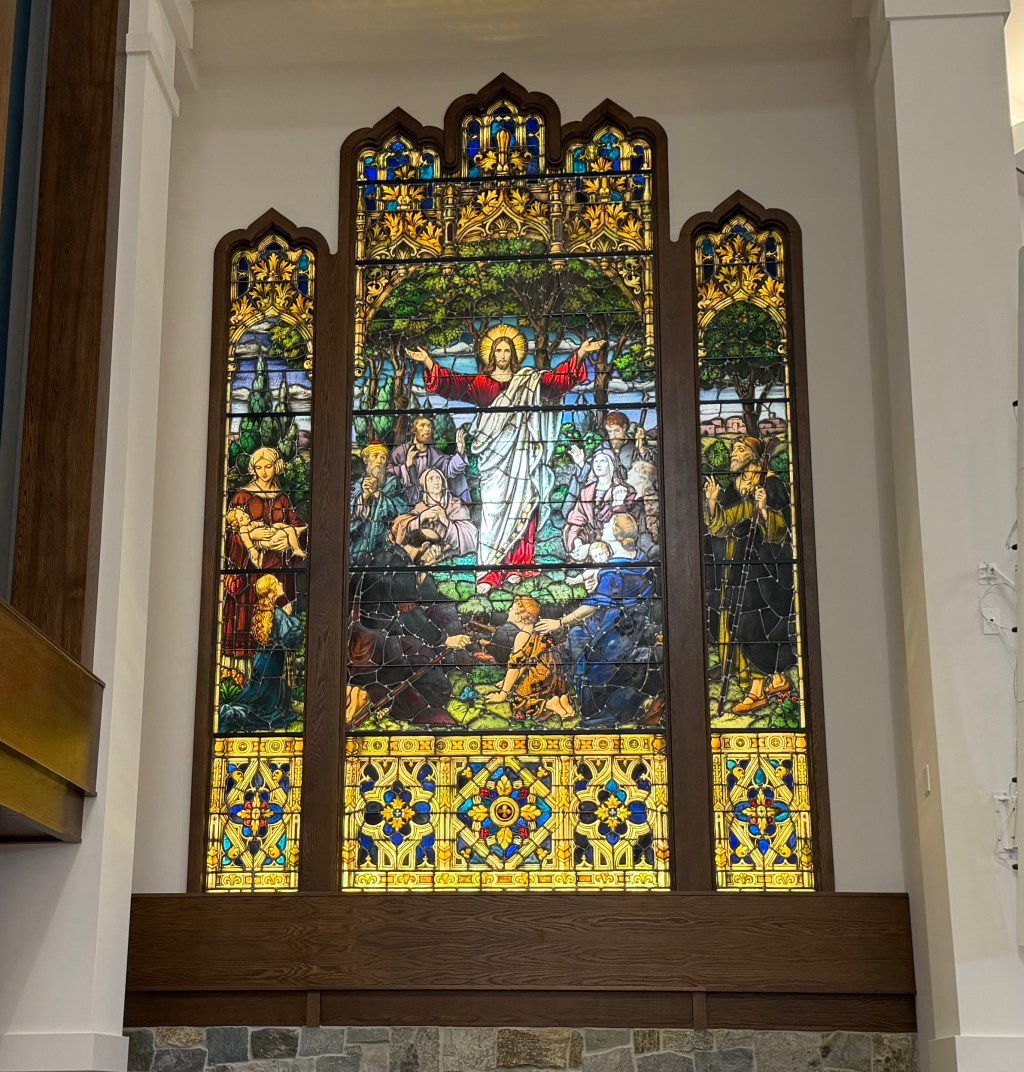
Photo: Beautiful stained glass of those trusting in Jesus from our neighbors at St. John of the Cross.

Link for the Mass readings for Tuesday, October 21, 2025

As did the Apostles and the saints in each age, let us trust in Jesus.

There are times when it feels like life is too hard, we are let down, or even feel betrayed as Paul shared in today’s first reading when he wrote: “At my first defense no one appeared on my behalf, but everyone deserted me” (2 Timothy 4:16). And then in today’s gospel, Jesus sent seventy-two of his disciples off “like lambs among wolves.” He gave them nothing to take with them, “no money bag, no sack, no sandals” (Luke 10:4).

Paul, the Apostles, and disciples through the ages have experienced the limitations of our fallen and finite world. The Saints have not only experienced the poverty of our human condition, they realized that only in childlike dependence on God as Father could they be fulfilled. In reading the Bible and the lives of the saints we are offered the sound truth that we are to place our firm foundation on God and him alone. Nothing or no one else can be there for us like him. Why, because all else is finite. Only God is infinite.

When we find ourselves in challenging moments or seasons, we are not alone. In those moments we have the opportunity to draw on the same strength and source that Paul and the saints did. We too will experience the Lord standing by us and giving us his strength because Jesus is already there! It can feel hard to believe that sometimes, especially in situations that are chronic and ongoing.

In moments of trial, temptation, and/or tribulation, when we remember to breathe, to pray those prayers we know, as well as pray spontaneously from the depths of our hearts, not just the words but directing them to a Person, we have a better chance of experiencing God’s presence. Once we have shared, then let us trust and listen, be still and wait on the Lord. God cares, he never abandons us. Trust in Jesus and be not afraid.


Photo: Jesus walks with us each step of the way.

Link for the Mass readings for Saturday, October 18, 2025

Are we willing to receive the “key of knowledge.”

Woe to you, scholars of the law! You have taken away the key of knowledge. You yourselves did not enter and you stopped those trying to enter” (Lk 11:52).

We all yearn to be loved, to belong, to be accepted, and fulfilled. God knows the depth of our yearning because as St. Augustine taught, God knows us better than we know ourselves. For God sees past the apparent goods that we cling to and cloud our vision, and he invites us to take steps into his light that we might see the truth of his love and our fulfillment that can only be fulfilled in him. From that core communion all else in our lives can be properly ordered.

To willingly prevent access to those who seek, as did those “scholars of the law” for whom Jesus convicts in today’s Gospel, is an egregious offense. Especially in the way that Jesus describes. They themselves have the key to enter, do not avail themselves of the gift they have received, and worse, prevent others from going in! I remember a time in eighth grade where I had wanted to ask a girl out to the school dance. I confided this hope with someone but of course, the word got out. A few days later at the beginning of math class, our teacher announced to the whole class that I was the first one he had ever heard of being rejected before I could even ask someone out. I wanted to melt into the floor.

The scholars of the law, as well as the scribes and the Pharisees were charged to teach and lead people to God. Instead they were making it harder by laying heavy burdens upon them and not raising a finger to help them. Jesus fulfilled the Law. His teachings further built on the Torah and challenged the people even further. The difference was that he invited his listeners to align themselves to him, for his yoke is easy and his burden is light. Jesus strengthens and transforms us when we trust in him and seek his strength.

Jesus is the “key of knowledge”. He offered himself to the scholars but they refused to receive him or his message. Jesus came to open up heaven for all in the humanity he assumed. In his conviction of the Pharisees, scribes, and scholars of the Law he hoped that they would repent and also enter into the kingdom of Heaven. Unfortunately, many hardened their hearts further, and “began to act with hostility toward him”.

Jesus offers us the same invitation today to repent and believe in the Gospel. We are to love and support one another, even when some express their hunger in unpleasant of ways. Here it is even more important that we resist reacting in kind. Instead, let us be patient, give another the benefit of the doubt, and be willing to listen with our spirit instead of our ego for what their need truly may be. May we receive the “key of knowledge” not to lock but to open the door to the healing love and teachings of Jesus.

As Pope Francis said: “Each one of us is called to be an artisan of peace, by uniting and not dividing, by extinguishing hatred and not holding on to it, by opening paths to dialogue and not by constructing new walls! Let us dialogue and meet one another in order to establish a culture of dialogue in the world, a culture of encounter.”


Photo: As the vines can’t keep the light from shining, the scholars of the law could not stop Jesus.

Link for the Mass readings for Thursday, October 16, 2025

When we align our will with God’s, we experience freedom.

Jesus continues to call out those Pharisees who follow their own will and put themselves in places of honor instead of God, and then one of the scholars of the law interjects: “Teacher, by saying this you are insulting us too.”

Jesus did not soften his words or hold back. He went right at the scholar and convicted him as well, “Woe also to you scholars of the law! You impose on people burdens hard to carry, but you yourselves do not lift one finger to touch them” (Lk 11;45-46).

Jesus is clear about his mission, about what the kingdom of God is not and what it is. Jesus is shining a light on the practices of those Pharisees and the scholars of the law that are not fulfilling the Law and the Prophets. I believe that there were those who were. Yet, for those he challenged, he did so in the hope that they would see the darkness that was blinding them. Unfortunately, unlike Bartimaeus (see Mk 10:46-52) who knew that he was blind and wanted to see, this was not true for many whom Jesus confronted.

How about us? Are we aware of our blind spots? Are we willing to allow Jesus to shine his light and love in our direction? Will we cover our eyes because the light is too bright and withdraw further into the shadows, or will we remain still and allow our eyes time to adjust so that the brightness of the Mystery of God will reveal to us that which has kept us bound? Will we justify or rationalize our behavior or will we be transparent, repent, believe in the Gospel, and walk further into the light and the embrace of Jesus? Will we stand in the brilliance of God’s love and truth and let the fire of his love burn away all that is not of him?

Let us resist the path of those Pharisees and scholars of the Law who imposed heavy burdens without being willing to help others along the way. It is important for us to know the Catechism, the Bible, Canon Law, participate in the sacraments, and be people of prayer and service. The purpose of each of these pursuits are not for themselves along though. We do so that we will come to know Jesus and the love he shares with the Father who is the Holy Spirit. We have been created for nothing less than to participate in the very love of God, to become divine through our participation in the life of Jesus. This love and relationship with God increases when we confess our sins, are forgiven, and then having received God’s mercy, share what we have received with others.

Jesus did not come to abolish the Law and the Prophets but to fulfill them. In fact, his interpretation and expansion of the law was much more demanding than the Pharisees or the scribes. The difference was and continues to be, that, Jesus meets us where we are and loves us where we are. He does not lower the bar but raises it. He wants us to realize that we can only follow God’s law with him. Without Jesus we won’t be able to even come close. Apart from Jesus we can do nothing, but with him, all things are possible.

In admitting our weakness and revealing to Jesus our poverty, he then gives us the strength mature, for he is our “rock and salvation” (Psalm 62:2-23). He is the solid foundation upon which we can stand and build. “The whole aim of any person who is beginning prayer – and don’t forget this because it’s very important – should be that he work and prepare himself with determination and every possible effort to bring his will in conformity to God’s will” (St. Teresa of Avila).

In aligning our will with Jesus, we are empowered to fulfill the prescriptions and practices that God has commanded, not for God’s sake but for ours! God’s prescriptions that we receive in the Old and the New Testaments are not to restrict but to free us from our slavery to sin.

In identifying and renouncing our sins, we will experience freedom from the false truths, diversions, distractions, and attachments that the enemy has been poisoning us with. Through daily reading, meditating, and praying upon God’s law and putting them into practice we become like a tree planted near a fresh running stream that will never wither and fade. Our roots will run deep and continue to receive nourishment and sustenance we were created for: the eternal spring of the Holy Spirit which purifies and heals us.

Jesus beckons us to come out from the shadows and into the radiance of his light. As we experience his love and mercy, he encourages us to continue to move out of our comfort zones, attachments, and slavery which is paralyzing us. Jesus calls us to experience freedom. When we trust him and walk with him, our souls will experience the rest that it is starving for, the peace that we yearn for, and the love we have been created for.


Photo: As each sun sets, may we repent from our sins and die to our false selves, so that we may rise the next day with the light of Jesus in our hearts!

Link for the Mass readings for Wednesday, October 15, 2025

The antidote for our hypocrisy is to accept our poverty.

The Lord said to him, “Although you cleanse the outside of the cup and the dish, inside you are filled with plunder and evil. You fools” (Lk 11:39).

Jesus’ harshest critiques were for acts of hypocrisy. He did so to show, in no uncertain terms, how dangerous this was, especially for religious leaders. These men were entrusted with the care of God’s people. They may have observed the proper rituals, spoke, and dressed to match the part but this all meant nothing if their hearts were hardened such that they were closed to the love and will of God. This situation was more perilous when they themselves became obstacles and stumbling blocks to those who sought God. Jesus indicting them as fools meant that they were bereft of the wisdom of God they projected to have.

In the depths of our very being, we seek and yearn for the transcendent, the infinite. We are spiritual seekers. We seek God while at the same time we experience suffering, injustice, and hypocrisy at the hands of the very ones who are our leaders in both the religious and political sphere. This is why Jesus convicted those who abused their positions because he knew the significant damage that they could inflict.

No one is perfect, our leaders nor ourselves. We all fall short of the glory of God, even those of us who seek and aspire to live by the Gospel. If we put anyone up on a pedestal, they, sooner or later, are going to fall, and the higher up they go, the greater the fall. God is to hold priority of place. We are to seek God first. God is to be our foundation, the light shining on the hill, our guide, and source.

One way we can sidestep the trap of hubris is by resisting the urge to project all is well and good, that we are fine when we are not. None of us are super men or women. If we think we can go it alone, on our own power and persistence, we will fall sooner or later. A hyper sense of self-reliance means we seek God and each other less for help and support.

When we turn to Jesus to reveal our weakness and our sin, we can experience his transformative and healing power in our lives. To be vulnerable, to allow Jesus to shine his light into our inner darkness takes courage, but when we open all of our lives to him, we will identify and be able to release our own “plunder and evil”. The Holy Spirit can also help us to trust one another with our weaknesses, faults, and shortcomings.

We are healthier and stronger when we accept our own spiritual poverty, where we need help, and reach out to ask for assistance. We are better when we entrust ourselves to Jesus and a core group of people we trust, firmly ground ourselves in the love of God and one another. We grow stronger when we support the unique gifts of each other while at the same time hold each other accountable. Isolated and in the darkness, our sin festers and grows. When brought into the light, sin starves and withers away.

Jesus challenges us to resist projecting an image of perfection when all is not well on the inside. When willing to reveal our weaknesses, sins, suffering, and pain, we can receive help, heal, and let go of carrying the weight of seeking an internal perfectionism. Healed and transformed from being the center of the universe, which we never were or never can be, we can let go of having to project an image of perfection. We can instead be free to be ourselves as God calls us to be and radiate his love as we receive his love. Instead of driving people to the nearest exit, we can begin to welcome people back home to be forgiven, healed, loved, and transformed.


Photo: Not a cloud in the sky. Would that we can say, no sin on our soul! We can get closer by seeking the cleansing healing from sin when we are willing to confess regularly and often.

Link for the Mass readings for Tuesday, October 14, 2025

“Blessed are those who hear the word of God and observe it.”

While Jesus was speaking, a woman from the crowd called out and said to him, “Blessed is the womb that carried you and the breasts at which you nursed.” He replied, “Rather, blessed are those who hear the word of God and observe it.” (Luke 11:27-28).

Jesus is not discounting his mother nor putting her down in any way by his response. Especially because Mary is the exemplar of not just someone who, but one who other than he, consistently heard the word of God and observed it. Probably even before but the earliest record of this we have is Mary saying, “I am the handmaid of the Lord, may it be done to me according to your will” (cf. Luke 1:38). She was instrumental in collaborating with God’s will to bring about the salvation of the world in her willingness to bear his only Son.

The wonderful gift of what Jesus said is also an invitation to all of us. If we ever felt at some point that we never fit in somewhere, if we did not quite belong, or we didn’t measure up to someone’s or our own expectations, we need no longer feel that way. Jesus is inviting us to have a seat at the table. And the good news is that there is unlimited seating! If we feel anxious or out of sorts, are discerning a heavy decision and feel paralyzed, dealing with a relational conflict and not sure how to respond, the Holy Spirit provides a way.

All we have to do is hear the word of God and observe it. Simple as that. And yet there is so much keeping us busy, distracted, and diverted from spending time reading, meditating, and praying with God’s word. We might look at the Bible as just another book because there is so much that is more enticing, inviting, and engaging. What God has made us for though is not merely finite but infinite pursuits, to seek the things of heaven. 

The Bible, initially in his youth, did not offer much to St. Augustine. After many years though seeking and indulging in the things of the world, even the pursuit of truth, and still feeling empty, he found great solace in reading the Bible which only increased when he “transcended the literal sense.” The literal sense being that which he read and understood with his mind and reason. In allowing himself time to ponder, the Holy Spirit touched him in the depth of his soul and “enabled him to find at last the answer to his deep inner restlessness and his thirst for truth” (Pope Benedict, General Audience, January 9, 2008).

We too are restless and tired existing in a world that entices us with so many other voices and attractions. Yet, the daily discipline of reading and praying with the Bible provides peace and rest for our souls like nothing else can. Slowly and gently our intimacy with God grows when open up our Bible each day. When we not only read the words, but also meditate and pray with them, we transcend the literal and experience God’s living stream flowing in our veins. We are refreshed and renewed. 


Photo:  One of my joys each day is to spend time in God’s word, and share from my own pondering. Picture of today’s Gospel reading from The Word on Fire: The Gospels.

Link for the Mass readings for Saturday, October 11, 2025


For Jesus or against, to not decided is to decide.

In today’s gospel account, Jesus is accused of collaborating with Satan because he has cast out a demon. Jesus quickly counters the absurdity of the claim by stating that, “Every kingdom divided against itself will be laid waste and house will fall against house” (Luke 11:17).

If there is one thing that Satan, the one who accuses, the father of lies, and his demons are unified on, it is to promote disunity, isolation, and chaos. They will seek any way to break through our defenses, our weaknesses, tempt, and mislead, to get us to even doubt the truth. They also seek to isolate us from one another. Here Jesus is healing a person from being possessed and it is made to look like he is in league with the devil.

Jesus reveals the error and builds on it with the truth, “But if it is by the finger of God that I drive out demons, then the Kingdom of God has come upon you” (Luke 11:20). The kingdom of God reveals and casts out demons, uncovers lies, and reconciles division. Jesus in his perfection comes to purify, cleanse, and to restore the true Father’s original purpose of harmony, oneness, and unity.

The closer that Jesus gets to Jerusalem, the opposition to him appears to be growing. Jesus offers those listening a choice: Recognize him as the Son of God who acts in the name of the Father and join with him, or reject him and side with the enemy. Jesus’ does not leave a middle ground. If one does not decide, “the last condition will be worst than the first” (Luke 11:26). Even those healed by Jesus, if  they do not commit their lives to him and fill themselves with the love of God, there is room for evil to creep back in.

We are given the same choice with each choice we make. Do we take a moment before deciding to ask is this the will of God? Are our thoughts, words, and actions, divisive, hurtful, unkind, or are they unifying, empowering, and loving? If we can admit any ways in which we have turned away from God or chosen any from the list in the first category, the good news is that we can repent for the kingdom of heaven is at hand. It is important to recognize our need for healing, which helps us to be more prudent, and ask Jesus for forgiveness and help to begin again.

For those choices that land in the second category, let us thank Jesus for working through us. In both ways, we recognize the truth, and we continue to build on the love that Jesus offers. When we trust him, we grow in relationship with him, and can better share the love he offers us with others.

We are free to choose and receive the consequences of our choices. Let us choose to turn away from anything not of God and follow Jesus today. Let us choose to be loved and to love in return.


Photo: Stained glass window in St. Joseph Catholic Church, Poquonock, CT.

Link for the Mass readings for Friday, October 12, 2025

Let us choose the better part, slow down to receive, and reflect the light of Jesus.

“Martha, Martha, you are anxious and worried about many things. There is need of only one thing. Mary has chosen the better part and it will not be taken from her” (Lk 10:41-42).

My wife, JoAnn, and I used to have more than a few spirited discussions on this Gospel passage each time that it arose because, at first reading, it appears that Jesus does not show any empathy or regard for Martha’s gift of hospitality nor for all the work that she is doing. All the men are sitting around listening to Jesus, and Mary… she is doing the same, and who is left to do all the work? Martha.

Blessed to serve as a permanent deacon for ten years, I saw my own, as well as other deacon’s wives, carry extra weight and burdens in support on the home front to allow their husbands the time to serve, many of us who also still held full time jobs. Not only deacon’s wives, this reality is also true for many wives who are full-time homemakers, run in-home businesses, or carry a job outside the home, as well as care for the children, overseeing the bills, the day to day grind, and so find themselves at times, feeling under-appreciated, undervalued, and not respected for all they do.

Husbands can do a better job of being present, more patient, respectful, and attentive to their wives and be more of an equal partner on the journey. For those married as well as single, the point Jesus is making, that he makes throughout the Gospels is to put God first, then family, work, and our unique vocation. The expression of that is going to be different for each station in life. There will be more time constraints for parents of infants. No matter how little time we may have, we must pray daily, we must be still and sit at the feet of Jesus. As we do so, we will find that the time we did not think we have, through the guidance of the Holy Spirit will be properly ordered.

This prelude acknowledges the reality of how much we juggle in every age. There is much to do and much to be done. Jesus was not disregarding Martha’s hospitality. Especially in the Gospel of Luke, there are many instances in which Jesus empowers women so far beyond the cultural reality of his time. We read this as we do any biblical account from our twenty-first-century mindset. Contextually, the men sitting at the teacher’s feet in a different room, the women cooking, and most times eating separately were commonplace for those in the ancient near east of the first century AD. Mary was the only person out of step with the times.

The interpretive key to understanding this account is what Jesus said. He pointed out that Martha was “anxious and worried about many things.” Mary could have been one of those worries, and not so much that Mary wasn’t helping in the kitchen, but because she was breaking the social norm of sitting with the men. When Martha calls Jesus to redirect Mary, she probably expects him to support her plea. Yet, Jesus acknowledges that: “There is need of only one thing. Mary has chosen the better part and it will not be taken from her” (Luke 10:42).

Mary, sitting and having her primary focus on Jesus was the posture of a disciple. Jesus was not only allowing her to do so, he was commending her for doing so. I can visualize Martha being taken aback at first, but then slowly feeling the muscles in her face relax as the lightbulb went on. We don’t know, but could she in that moment have experienced that peace, that peace that surpasses all understanding, and the anxiety and worry left her? Feeling the peace, instead fear in approaching Jesus as Mary had done, did Martha then take her apron off, throw it to the side, and sit down next to her sister and also become his disciple?

There is biblical evidence that beyond the Twelve, Martha, Mary, and Lazarus, were Jesus’ friends. When Jesus came four days after the death of Lazarus, as soon as Martha heard Jesus was outside, she, not Mary, came immediately out to Jesus, and in that exchange, it was Martha who made the claim that Jesus was the Messiah, the Son of God (cf Jn 11:27). Would she have had this insight, the same as Peter, if she was still holding a grudge from this encounter?

Our modern reaction and push back to this Martha and Mary account in Luke may not so much be a reflection on Jesus but how poorly men have treated women over the generations and how poorly women continue to be treated even today. No matter their ages, young, old, and everywhere in between, women are human beings created in the image and likeness of God. No one has the right to abuse, demean, disparage, devalue, or exploit any woman. Women are to be appreciated, heard, respected, cherished, and valued.

God has given each of us gifts to participate in his Father’s plan. May we resist the temptation to fear coming close to Jesus and taking time out to sit at his feet, to engage in mental maelstroms, to be “anxious and worried about many things.” Instead, when we experience the beginning tremors of any stress or strain, instead, be still and rest in Jesus’ presence as Mary, and hopefully Martha, did.

In this way, any anxiety will begin to dissipate as we experience feeling safe in his presence and experience Jesus’ love. Doing so will help us to better know Jesus, his voice, and his teaching, know and follow his will, love others as he loves us, and live our lives respecting, encouraging, and supporting one another with the gifts and guidance that God has given us.

One woman who may have learned the Martha and Mary account well was Lydia. Luke and Paul encounter her and some other women in the city of Philippi. When Paul preached, Lydia, “listened, and the Lord opened her heart to pay attention to what Paul was saying.” She then asked to be baptized with her household, and then invited them into her home (cf Acts 16:11-15). She listened and pondered God first, then acted.

When we choose the better part of sitting at Jesus’ feet before making a decision, we can experience less chaos and more of his peace and guidance. Instead of living in a perpetual state of chronic stress and anxiety, we can instead choose to breathe, rest, receive and abide in God’s love. Then from that place of stillness, like Mary and Lydia, and I believe Martha, instead of reacting, we can make a choice based on God’s guidance.


Photo: Mary, Jesus’ mother, was the premier disciple for she “pondered” the mysteries she experienced with Jesus “in her heart” (Luke 2:19) and “heard the word of God and observed it” (Luke 11:28). She also chose the better part and so like the moon that reflects the light of the sun, Mary reflects the light of her Son. Our Lady of the Rosary, pray for us!

Link for the Mass readings for Tuesday, October 7, 2025