Jesus is willing to save the one.

“What man among you having a hundred sheep and losing one of them would not leave the ninety-nine in the desert and go after the lost one until he finds it” (Lk 15:4)?

At first hearing, how many of those present hearing the parable, or us today reading it, would answer yes? To most of us it would not make sense to leave the ninety-nine to go and search for the one that was lost.

What this parable represents is the love that God has for each and everyone of us. He knows us better than we know ourselves. God loves us with an everlasting love and is continually reaching out to us because he is the foundation and source of who we are. He wills our good and wants the best for us, even when we may not see the truth. This parable also represents a microcosm of the public ministry of Jesus.

Jesus met people one on one, person to person. He encountered the blind, the lame, the leper, the Syrophoenician woman, the woman at the well, the woman accused of adultery, the daughter of Jairus, the widow’s son, and Lazarus. Jesus not only healed these people and so many others who were considered to be on the outside looking in, he restored their dignity as human beings. Jesus loved each of them as a unique person.

In crafting this parable of the good shepherd seeking the lost sheep, Jesus may be echoing, Isaiah. He prophesied that because the leadership of his time was not bringing back the stray nor seeking out the lost, God would “appoint one shepherd over them, to pasture them” (See Ezekiel 34:23). Jesus sought out and continues to seek out the lost, no matter how far we have strayed, or messed up, Jesus loves comes for us.

He opens his arms and invites us into his loving embrace so that we may feel and experience the beating of his Sacred Heart. As we enter into that sacred rhythm, all our anxiety, fears, and pain begin to fade away and we begin to heal. We begin to experience our dignity as we experience being loved for who we are, not defined by our worst sins nor by what we do.

We just need to be willing to be found and allow him to lift us up on his shoulders and carry us back into the fold. As we do so and as we continue to experience his love, we will come to believe and say, as did St Paul,“Who can separate us from the love of Christ? Trial, or distress, or persecution, or hunger, or nakedness, or danger, or the sword?… Yet in all this we are more than conquerors because of him who has loved us” (cf. Romans 8:35-37).

Once we slow down enough to place our head on the chest of and experience the beating of the Sacred Heart of Jesus, renew in the rhythm of it, we will experience his peace and rest. We too are to love with the same radical love of the Shepherd who left the ninety-nine to rescue the one, who just happens to be us if we are willing to be rescued.

—————————————————–

Photo: Stain glass window at Cathedral of Our Lady of the Angels, Los Angeles, CA

Link for the Mass readings for Friday, June 27, 2025, Solemnity of the Sacred Heart of Jesus

Let us build our spiritual homes on the love of the Father, the Son, and the Holy Spirit.

“Everyone who listens to these words of mine and acts on them will be like a wise man who built his house on rock” (Mt 7:24).

Jesus speaks to us: in the Gospels, in the silence of our hearts, through our conscience, through the words of others, in our daily activities, and through creation which has been loved into existence through collaboration with his Father and the Holy Spirit.

We can be unaware of the words he speaks, we can hear his words but not listen, hear his words but ignore, listen but not act upon them, or we can do with his words as Jesus encourages us to do. We can listen to his words and put them into action. We can experience the gentle nudge of the Holy Spirit and follow his lead. When we follow the urgings of Jesus and the Holy Spirit, no matter how small of a nudge it is, that step in alignment with the Father’s love will make all the difference. For each affirmation and putting into action their guidance helps us to experience the love of God our Father.

Jesus became one with us so that we can share in the love of his Father. Not one with us, so that we can know about him. Not one with us, so that we can say that we prophesy, cast out demons, do mighty works, cite Bible chapter and verse to show our knowledge or justify our behavior in his name. One with us so that we can share in the very life of God the Father as he and the Spirit does. 

Jesus meets us on our level and when we are willing to follow his lead, he will lead us up to the heights of participating in his divine life. Jesus has been doing just that in his Sermon on the Mount which we have been reflecting upon these past few weeks. If you are just coming in today or need a refresher, this gathering of teachings began in chapter five of Matthew and takes us up to today with chapter seven. Jesus presented us with the Beatitudes, that we are called to be salt and light, he built on the law and the prophets by giving us the six antitheses (“You have heard it said, but I say to you…” statements), he taught us to pray the Our Father, that we are to depend and place our trust in God and not the things of this world, we are to refrain from judging others, we are not to cast our pearls before swine, we are to do to others as we would have them do to us, we are to seek to enter through the narrow gate, and to be aware of false prophets.

The teachings of Jesus in chapters five, six, and seven of Matthew, his Sermon on the Mount, put into practice will help us to build the foundation of our spiritual houses on solid rock. The same rock that Peter built his foundation on, the Christ the Son of the Living God. May we go back through chapters five, six, and seven of Matthew and see which teaching Jesus is leading us to ponder, meditate upon, put into action, and place our next foundational stone of discipleship.

If that is a bit much, we can start with St. Irenaeus who learned from St. Polycarp, who learned from the beloved Apostle John who learned from Jesus. St. Irenaeus taught that Jesus became one with us so that we can become one with him. Jesus entered our humanity so that we can participate in his divinity. Jesus invites us to be in relationship with him, to know him, so that we can know his Father and experience the love of the Holy Spirit that he wants to share with us. The goal is that we can be one as Jesus and the Father is one.

Jesus loves us as we are, and for who we are, right now at this very moment. Jesus loves us more than we can ever imagine. Jesus loves us so much, he invites us to repent and turn away from anyone and anything that may be leading us away from God. He invites us to turn back and walk in the direction of the Father’s arms that are wide open to embrace us. When we experience God’s loving embrace, may we rest there, savor, and abide in his love. Filled up with his love to overflowing, we have a wonderful gift to share.


Photo: The Sanctuary of Madonna della Corona in the province of Verona, Italy. Photo accessed from Italiabsolutely

Link for the Mass readings for Thursday, June 26, 2025

Want to know Jesus? Spend some time daily with him in the Gospels.

“Beware of false prophets, who come to you in sheep’s clothing, but underneath are ravenous wolves. By their fruits you will know them” (Mt 7:15-16).

So as not to be taken in by false prophets within in our Church and society, and most importantly, so as not to be wolves in sheep’s clothing ourselves, we need to know the Shepherd. We need to know, as St Irenaeus (whose feast we celebrate on Saturday the 28th) described: Jesus, “who did, through His transcendent love, become what we are, that He might bring us to be even what He is Himself” (p. 526 Against Heresies, Book V, Introduction). Jesus Christ, the second person of the Trinity, who entered into and embraced our fallen and wounded condition to become fully human while remaining fully divine, came to shine a light in our lives.

Jesus came to reveal those sinful acts which estrange us from God and one another. Jesus came to show us the value of our unique dignity as human beings, the wonder of God’s creation that we are, and empower us so we may restore our likeness to God and deepen our relationship with God and one another. In allowing Jesus to come close to us and getting to know him, he through his love and light, will reveal to us those road blocks that prevent us from following his way.

How can we know Jesus today since we are removed from the time of the Apostles?

One practice is to follow the encouragement of Pope Francis who invited us to read and prayerfully reflect upon the Gospels each day and Pope Leo XIV who in his first audience on May 21 said that, “every word of the Gospel is like a seed that is thrown on the ground of our life.” Especially, during this Season of Ordinary Time we may receive these “seeds”, the teachings of Jesus, through the daily Mass readings. Reading them on our own is a powerful daily practice that allows us to come to not just know about Jesus and his teachings but to know him.

This does not happen by just reading the words on the page with the sole intent to finish it and move on to something else, so as to complete one more task. Instead we are invited to read slowly, meditatively, and prayerfully. We can read a section as in today’s Gospel about knowing true disciples from false prophets. Reading through a section three to four times or more until we feel a movement within from the Holy Spirit guiding us to ponder a particular verse or word is helpful.

We then stay there with Jesus by mediating on a word or phrase from the Gospel that peaks our attention. We may receive an insight, an intuition, a confirmation, a sense of excitement, a challenge, or a question. We can also be confused, perplexed, or frustrated. We can also place ourselves in the scene as if we are watching a movie and allow through our imagination our senses to come alive and pay attention to what arises.

Another gift of encountering Jesus in the Gospels, that some may not recognize as a gift, is that we will naturally be drawn to examine our conscience as we read and ponder the life and teachings of Jesus. We don’t have to read long to experience how challenging Jesus’ teachings are. In pondering today’s account about a bad tree bearing bad fruit, some of our own bad fruit may come to light: selfishness, greed, judgment, gluttony, lust, pride, indifference, sloth, envy, wrath, or others.

This in not an invitation to experience shame. This is Jesus’ invitation to identify, repent, and confess and to turn to God to receive his forgiveness, mercy, and love so that we can be transformed. Jesus’ call to repentance is an invitation to prune those branches within us that bear such fruits. The discipline of repentance and confession that leads to pruning will provide more energy and nourishment for those good branches we have so they may flourish with the fruits of love, joy, peace, patience, kindness, chastity, goodness, generosity and self-control.

It is important to sit with what we experience from a meditative and prayerful reading of the Gospels. The Holy Spirit will reveal insights and experiences of consolation and joy. It is just as important to be willing to wrestle with passages that challenge us, that we do not understand, or disagree with. Each experience provides us with the opportunity to ponder and discern what God seeks to reveal to us.

Through a daily commitment of reading, meditating upon, praying with, and allowing the Gospels to come alive in our hearts, minds, and souls, we be drawn to deeper moments of quiet contemplation, and we will encounter and grow in our relationship with Jesus, Mary, and the apostles. That which we have received in each prayerful time of reading, we can then carry with us throughout the day to call upon and experience rest with him as needed.

I have been drawn to remain with and pray with the same verse for the past week during my holy hour:  Jesus, “went up on the mountain by himself to pray. When it was evening he was there alone” (Matthew 14:23). I have been seeking to put God first in my life more and more, and letting go of any attachments and disordered affections that may be leading me astray. What a gift Jesus has given me to step away for an hour each day to go up on the mountain and pray with him.

As we experience the Gospels with a pondering and prayerful approach, we will grow in our relationship with Jesus and know his voice. With his guidance we will better identify those apparent goods, temptations, and false prophets who seek to lead us astray. In trusting in, being obedient to, and putting into practice Jesus’ teachings, we will better know the truth of who we are and who God calls us to be. As we grow in our relationship with Jesus we will not lead others astray but help them to encounter Jesus so that they too may experience his love, mercy, forgiveness, and rest for their souls.


Photo: Bishop Barron link captured from YouTube introducing the Word on Fire Bible, Volume I: The Gospels. I have found the Word on Fire Bible a great resource for reading, prayer, and study. Also, great for those who are just beginning or are looking to return to reading and praying with the Bible.

Link for the Mass readings for Wednesday, June 25, 2025

When there appears to be no way, trust in Jesus the Way.

Luke records how Jesus had been teaching and healing a large crowd of five thousand men. As the day was drawing to a close, the Twelve approached him and said, “Dismiss the crowd so that they can go to the surrounding villages and farms and find lodging and provisions; for we are in a deserted place here” (Lk 9:12). The disciples appear to show concern for the many gathered. Yet the response of Jesus may reveal otherwise.

When Jesus tells them to, “Give them some food yourselves” (Lk 9:13), the disciples are stymied, for all that they had, five loaves and two fish, would barely be just enough to feed themselves. The disciples first sought to send the people away, then could see nothing but the limited resources they had, they saw lack.

What follows is the miracle of the multiplication of the loaves and the fish such that everyone present had enough to eat. “They all ate and were satisfied. And when the leftover fragments were picked up, they filled twelve wicker baskets” (Lk 9:17). This miraculous account is recorded in all four Gospels. Time and again, throughout the Gospel accounts, Jesus is  able to provide a way where there appeared to be no way.

It is interesting as well that the word the disciples used, deserted, for we are in a deserted place, is erēmos in Greek. The immediate allusion is to the Hebrews who Moses had freed from Egypt. They too were in the deserted place, the wilderness. They also say their lack and constantly grumbled to Moses that they didn’t have enough and yet, God consistently provided for them bread from Heaven, the manna. Each day they did have enough to eat.

Erēmos can also be translated as lonely, a lonely place. One thing that is common among all of humanity is that we all experience loneliness. This is partly true because we separate ourselves from the deepest desire and hunger of our soul, our hunger to be loved by God. When we allow anyone or anything to be placed before our relationship with God, we will always experience a lack because only our relationship with God will truly satisfy us. Even the best of relationships, the best of things are finite, and will not last. In establishing and developing our relationship with God, all our other relationships and appetites can be properly ordered.

The next time, we feel like we can’t, we want to give up, we feel alone or are experiencing desolation, let us turn to our loving God and Father who will provide for our needs. He provides for us at every Mass the opportunity to experience his Son, the true miracle of bread and wine becoming the Body and Blood of Jesus the Christ. We can be nourished weekly, even daily, by the “source and summit of the whole Christine life” (Lumen Gentium) so that we can have the strength to persevere, that we can persevere, we know that we really and truly are never alone, and our desolation can be transformed into consolation by experiencing the love of the Holy Spirit.

Let us not buy into the lie of lack. Where his disciples saw lack, Jesus saw a way provided for by trusting in his Father and he multiplied the five loaves so the 5,000 all had their fill. We are finite human beings living in a finite world, yet we are not alone. Jesus, fully human and fully divine, continues to still be with us, present to us, just as he was with his disciples. As with them, when we trust in Jesus, all things are possible. When there appears to be no way, Jesus is the way. “When we give ourselves to Him, we receive a hundredfold in return. Yes, open wide the doors to Christ – and you will find true life” (Pope Benedict XVI in his inaugural homily, Sattler). Trust in Jesus today!


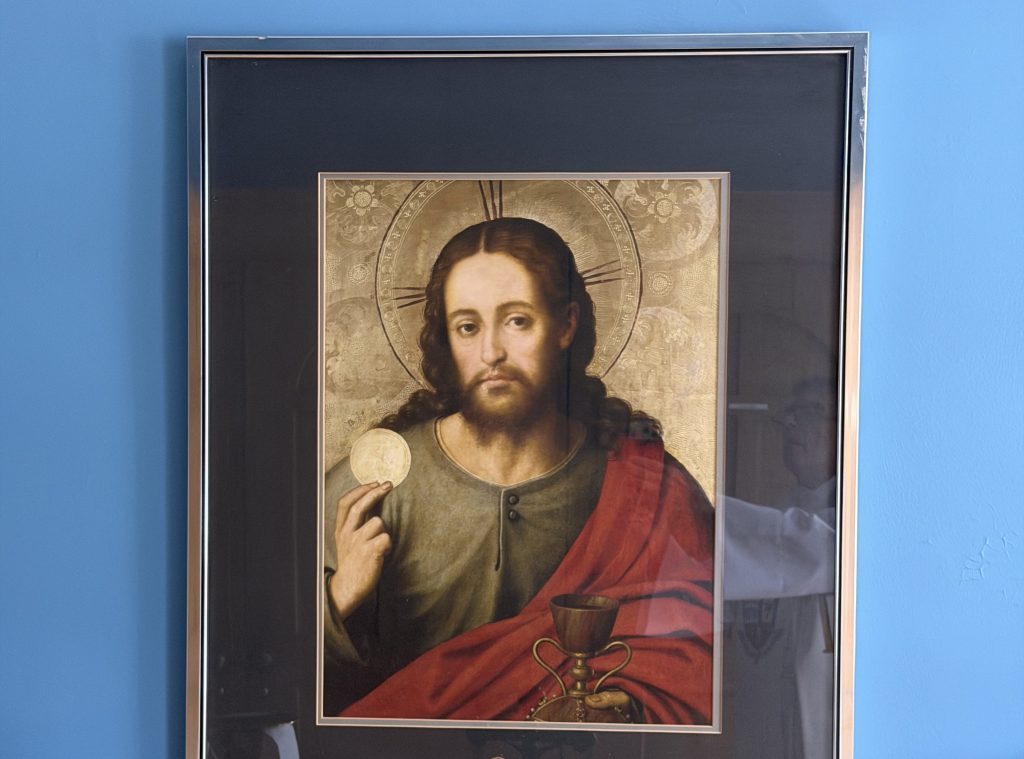
Photo: “Christ with the Host” by Paolo da San Leocadio

Link for the Mass readings for Sunday, June 22, 2025

Putting God first will help us to experience his love and peace.

In today’s Gospel from Matthew, Jesus draws a direct correlation between our level of worry and our faith. Having faith is a common theme throughout Jesus’ teaching. How many times have we read or heard, “O you of little faith” (Mt 6:30). Faith is defined in the Catechism of the Catholic Church as, “man’s response to God, who reveals himself and gives himself to man, at the same time bringing man a superabundant light as he searches for the ultimate meaning of his life” (CCC, 26.) Jesus came to reveal his Father to us, to show us that he cares for, loves, and wants to provide for us in our need.

When we are feeling anxious or worried, we are most likely not placing our trust or putting God first in our lives. We may be dwelling on the past, rehashing something we did or did not do, what someone did or did not do, fixating on whether or not we made the right decision, or we could be anxious about the future. Our minds plague us often with the worst-case scenarios of what might be or what could happen. We also may react to another’s actions or words, not fully understanding the context or source of the hurt or struggle they may be going through that caused those words or actions. When we seek security first in anything other than God, remain hyper-focused and absorbed on our own reaction(s), and/or stay stuck in our emotions, we become tossed about like a tumble weed and our insides can experience a perpetual churning.

When we focus on what we do not have instead of being grateful for what we do, we will also experience unrest. We exercise little faith or trust in God when we allow ourselves to be hyper preoccupied with anyone or anything apart from and other than God. Jesus is helping us to see that, “No one can serve two masters” (Mt 6:24). Either we place ourselves, someone, or something first, or we place God first. Jesus’ command is to put God first in our lives and to trust in him above all and everyone else.

Anxiety, worry, and fear can be debilitating and paralyzing and can lead toward a downward spiral, a curving in upon ourselves, that leads to an unsettled mental state. From this posture we can become impatient, reactive, and more fearful. Too many of us buy into the enemy’s lies to isolate ourselves, to keep ourselves busy, distracted, and perpetually tired. Even when we seek to find some rest and to wind-down and renew, we may reach for activities that do not bring us the rest we seek but instead continue to keep us in a perpetual state of unrest. Mindless channel surfing, lost hours on social media, or binging on YouTube clips, will not bring rest to our souls. These practices do the opposite; they keep us in a constant state of busy and overstimulation fueled by dopamine hits that contribute to a growing cycle of chronic stress.

One of the reasons we may be drawn to these technological avenues is to escape the anxieties and stresses we experience. They can distract and divert us for the moment, we can enjoy instant gratification, and we may feel satisfied for the moment. It comes at the cost though of further separating us from God and each other. At our core, we are deeply hungering to be loved and to love. “The desire for God is written in the human heart, because man is created by God and for God; God never ceases to draw man to himself. Only in God will he find the truth and happiness he never stops searching for” (CCC, 27).

Jesus’ life, words, and actions provide a starting point for shifting the momentum of the cycle of enslavement to our unbridled anxieties, attachments, and emotions. The way out of this inner downward spiral is to, “seek first the Kingdom of God and his righteousness, and all these things will be given you besides” (Mt 6:33). God truly knows what we seek and need in the depths of our souls. At the foundation is deepening our relationship with him. When we spend time consistently reading the Bible, praying and meditating, walking in creation, seeking the things of heaven instead of this world and bringing our anxieties, fears, and sources of stress to God, we will experience moments of peace and renewal. We can come to a place of rest where we can breathe again and we can begin to heal.

Intentionally setting aside key anchor times to be with God each day is one way to put God first in our lives. As we offer vocal prayers to God our Father, share with him our needs, our thanks, our hopes and anxieties, we will find rest in knowing that God hears our prayers and will guide us. As we spend time meditating on God’s word, we are nourished, transformed, and recognize we are not alone in our struggles as we engage with the lives of our ancestors in faith. And as we become more consistent with vocal and meditative ways of praying, we can then engage in the deeper gift of contemplative prayer in which we can just be silent with God and rest in his presence. We can be like St. John who rested his head on the sacred heart of Jesus.

Let not our hearts be troubled, let us not be afraid, but have faith and trust in Jesus, his Father, and the love of the Holy Spirit, and put God first in this moment and often with each drawing of our breath throughout the day.

———————————————————-

Photo: Making some time for a silent holy hour, looking at Jesus as he looks at me.

Link for the Mass readings for Saturday, June 21, 2025

We will experience more peace, even in the face of death, when we follow Jesus and put his teachings into practice.

Jesus said to his disciples: “Do not store up for yourselves treasures on earth, where moth and decay destroy, and thieves break in and steal. But store up treasures in heaven, where neither moth nor decay destroys, nor thieves break in and steal. For where your treasure is, there also will your heart be” (Mt 6:19-21). Jesus helped his disciples then and is helping us today to be aware of the reality of our world. All that exists is finite and material. Each thing, each being, has a beginning and an end. We need to resist the temptation to be attached to anything, even to our family and friends, because in this life and this side of heaven, nothing and no one lasts forever.

Adopting an attitude of non-attachment to material things can be freeing as long as we do not embrace the opposite extreme of placing no value in created things, thinking that we can destroy and abuse the environment, exploit each other, because neither will not last. We can also be tempted to see all things not spiritual as corrupt and bad, even our material reality as human beings, such that our soul is imprisoned until we die. This extreme will not bring us happiness, joy, or fulfillment either.

Living a life directed by Jesus’ teachings will help us to embrace a more balanced life of recognizing that much of what is material and finite is good, as well as very good, and yet each has a time and a season. We have the opportunity and invitation to be participants in God’s eternal plan of salvation, and we can embrace and enjoy the wonders and gifts of his creation when we don’t hold onto the things of this world too tightly.

We need to resist grasping for and clutching anything material and finite. We will then be freer to embrace and follow the steady movement of the Holy Spirit, which is ever fresh and new. The Holy Spirit invites us to deepen and grow in our relationship with our loving God and Father and one another. Refusing to fill the deepest core of our being with the things of this world will help us to be less distracted and more open to God working in our lives.

When we embrace the reality that our time here on this earth is limited, we will be less apt to take it for granted, and instead realize how precious life is, show greater appreciation, be more present, understanding, kinder, supportive, and patient with one another. We will be freer to let the petty things go and embrace the love that Jesus offers us, so we that will have more love to share with one another through thick and thin.

I don’t mind repeating what helped me and JoAnn in her final months was the gift of knowing that her time was short. We appreciated each moment we had together. What also helped was that even before the news, we had already begun the journey years before of deepening our relationship with Jesus and so each year grew closer to each other. A lot of the material things of this world became less important.

Dealing with death is never easy. Trusting that Jesus opened up heaven for us in the humanity he assumed and that he conquered death in his resurrection, helps. Instead of denying or keeping death at a distance, we will be better off by facing the reality of death. Doing so helps us to define who and what is truly important in this life and helps us to “store up treasures in heaven where neither moth nor decay destroys, nor thieves break in and steal” (Mt 6:20).

———————————————————————–

Photo: Together with less than three months left. Appreciate every moment!

Link for the Mass readings for Friday, June 20, 2025

“Love your enemies and pray for those who persecute you.”

The sixth antithesis may be the most challenging of them all. “You have heard that it was said, You shall love your neighbor and hate your enemy. But I say to you, love your enemies and pray for those who persecute you, that you may be children of your heavenly Father” (Mt 5:43-45). The parable of the Good Samaritan provides a nice parallel to this verse. It can be found in Luke 10:25-37. For in that parable, Jesus shows our enemy and our neighbor to be one and the same.

A good examination of conscience would be to read the above verse, ponder who would come up for us as an enemy, and then read the Parable of the Good Samaritan. Whenever the word Samaritan comes up, we drop the word Samaritan and insert the person or persons who came up for us. When we have finished this exercise, then, may we pray for the person or persons defined by us as our enemy, for if we only love those who love us, what makes us any different than anyone else? If we are to be disciples of Jesus, if we are to be children of our heavenly Father, we are not only to love those who love us, but we are to also love our enemies. We are to love those for whom there is little chance of being loved in return.

Jesus offers us the way to be able to accomplish this seemingly impossible feat: “So be perfect, just as your heavenly Father is perfect” (Mt 5:48). We are able to love our enemy as ourselves by being perfect. This is not much help unless we understand that the English word used here is translated from the Greek word telios, which means complete, whole, to reach one’s goal or purpose in life. As a Christian, our end goal, our purpose, our fundamental option, is to be in full communion with God our Father, who is Love. God the Father is not just loving, not just a lover, but Love. “God is love” (1 John 4:8).

God is love and so, “makes his sun rise on the bad and the good, and causes rain to fall on the just and the unjust” (Mt 5:45). We strive in our life to attain the end goal of being perfected by Jesus the Christ, when we, through an act of our will, allow ourselves to become transformed into becoming agents of his love. The most challenging of enemies is facing the enemy within. To love as God loves, we are to follow the words and actions of Jesus and the prophets.

Each day we are given a choice. We can choose to feed our fears, seek revenge, dig in our heels, embrace our egos, react in kind to negativity, and/or remain indifferent to the suffering around us and in our world. We can refuse to love our enemies, withdraw our love, and so reap what we sow and contribute to the condition of separation, polarization, violence, and dehumanization that plagues our communities, nation, and world.

Or, we can choose instead to resist giving in to all of the above and instead allow ourselves to be perfected by Jesus, brought into alignment with his Father’s will, and collaborate with the love of the Holy Spirit so to be agents and models of love, mercy, forgiveness, and justice in our realm of influence. By loving our enemies, we will help to diffuse the power of hate.

We can only be perfected and transformed by the love of Jesus when we spend time with him in meditation and prayer. We are called to receive his teachings, to resist hearing and letting them go in one ear and out the other, and instead read them again a second, third, and fourth time to allow the light of the Holy Spirit to convict us. Where do we fall short or resist putting into practice the teachings of the Sermon on the Mount? Answering honestly will help us to receive more of the love of God and the strength to put these seemingly impossible commands into practice in our lives with those real people we engage with every day.

—————————————————————-

Photo: Pope St. John Paul II modeled for us this antithesis when he met, prayed with, and forgave Mehmet Ali Agca at Rebibbia prison on December 27, 1983, for shooting and attempting to kill him on May 13, 1981. (CNS photo/L’Osservatore Romano accessed from catholic sun.org)

Link for the Mass readings for Tuesday, June 17, 2025

The Spirit of God will reveal the truth of his infinite love for us.

Today we celebrate Trinity Sunday. The Trinity is the foundation of not only our faith but the reality of all that exists. God has been, is, and always will be. God exists as a communion of three Persons, God the Father, God the Son and God the Holy Spirit. Three Persons in one God, but not three beings.

Anything we say about God is going to be woefully inadequate regarding the truth of who God is. Jesus, as the Son of God incarnate, revealed to his disciples the truth of who he is and who his Father is. As he approached his crucifixion, he began to prepare his disciples for the coming of the Holy Spirit. “I have much more to tell you, but you cannot bear it now. But when he comes, the Spirit of truth, he will guide you to all truth” (John 16:12-13).

We consistently how hard it was for the disciples to understand that he was the Son of God, that he in fact is God. Jesus to explain the Holy Spirit to them he knew would not happen. But the seeds that he planted would take firm root for the appointed time at Pentecost which we celebrated last Sunday. The Holy Spirit would come upon Mary and the Apostles, and then we see them, as expressed in the Acts of the Apostles, coming into their spiritual maturity as they are willing to be led by the Holy Spirit.

We are not going to understand the deepest truth of our faith and who God is by intellect and reason alone. To begin we have a better chance of saying what God is not. God is not a being, not one being among many, nor the greatest of all beings. God is not in the same genus as us, nor in any genus. God is not even a supreme being, because God transcends beyond all space and time. God is completely self sufficient, thus he does not need us for our existence, nor does he need anything to exist. God is the very ground and source of all being.

God is infinite act of existence, or in the Latin of St Thomas Aquinas, ispum esse subsistens, the sheer act of “to be”. This means that God has no limitations. To say that God is three Persons is even harder for us to comprehend because we often in our modern sense use the words person and being synonymously. To use the word person in speaking of God means to speak relationally.

We describe God as Father because he begets God the Son, God the Son is the one begotten. The Son is not generated or created, because the Son has always existed with the Father. This is true because they are not finite beings separate from one another. They are infinite, though distinct, in their relation to one another. God the Holy Spirit is then the Love shared between God the Father and God the Son. God within himself then is an infinite communion because of the infinite giving, self-emptying, and infinite receiving between each other. Each Person gives and receives infinitely, perfectly giving all and holding nothing back.

We will never fully comprehend God because he transcends our finite reality. We will be frustrated also if we treat the mystery of God as a problem to be solved. God is not an equation to formulate but a person that we can encounter and develop a relationship with. This is possible because to be in relationship with God and one another is the very reason we have been created. God draws close to us, he reveals himself to us, he seeks us out, his created beings. We are blessed to live in a time when he has already drawn close to us in the Person of his Son through the love of the Holy Spirit.

Jesus and the Holy Spirit continue to reveal the truth of God the Father to us. When we allow the Holy Spirit to dwell within us and follow his guidance, we too can experience the communion of love shared between God the Father, God the Son, and God the Holy Spirit.

The best way to understand, to know, to build our relationship with God, is not to force God to fit into our finite reality, mindset or limited view, but to be open to, “the Spirit of truth,” and “he will guide [us] to all truth” (Jn 16:13). The Holy Spirit will guide and lead us to all truth when we resist curving or turning in upon ourself and instead make the time to be still, to breathe, to ponder his living word, and lift our hearts and minds to him in prayer. When we do so we will be expanded and transformed by his love and conformed to God’s will. This gift of grace will grow the more we are open to opportunities to be loved and to love in our everyday moments. For where the willing of the good of each other is, God is, because God is love” (1 John 4:8).

When we as fathers follow the will of the Father, when we are willing to be loved by the Holy Spirit and to love our children and others in return, and when we are willing to sacrifice and serve as Jesus, we are at our best. Happy Father’s Day!


Photo: Spending some quiet time receiving the love of God.

Link for the Mass readings for Sunday, June 15, 2025

“Tell the truth and you don’t have to remember anything.”

In today’s Gospel, we read about the fourth antithesis where, Jesus said to his disciples: “You have heard that it was said to your ancestors, Do not take a false oath, but make good to the Lord all that you vow. But I say to you, do not swear at all (Mt 5:33-34). The taking of an oath in Jesus’ time became an acceptable practice to confirm that someone was telling the truth. Taking an oath by invoking God made the testimony or presentation of one’s statement more believable because he was willing to receive God’s judgment upon himself if he was lying.

People expanded this oath taking as Jesus pointed out by replacing God’s name with taking an oath by heaven, earth, Jerusalem, or one’s head. The thought being that one would escape God’s judgement if they were not being fully honest. Jesus points out that this would not be the case. For heaven is God’s throne, the earth is his footstool, Jerusalem is the city of the great King, and it was even God who made the color of one’s hair.

As with his other antitheses, Jesus called his disciples to go deeper, to be better. The word of the disciple ought to stand on its own weight such that they need not take an oath at all. Jesus spoke the truth always and his disciples are called to do the same. If his disciple tells the truth, there is no need to take an oath. The “Yes” or “No” of a disciple is sufficient. “Anything more is from the evil one” (Matthew5:37).

We can see remnants of this practice today, when we hear someone say, “I swear on my mother’s grave that I did not…, I swear on our friendship that I did not…, or I swear to God as my witness that I did not…”

Jesus is teaching us as well that we are to resist the temptation to swear an oath at all. We are to just tell the truth in all circumstances. We are to be people of integrity and stand on what we say as the truth. We are definitely living in a time period in our country where the ability to tell the truth is certainly being called into question, where lies and the bending of the truth are becoming common place. This is one of the reasons why so many people have such a low opinion of secular as well as religious leadership. But it is also present in our day to day interactions with one another.

In a 2014 episode of his television show, Dr. Phil, gave a list of reasons researchers gave for why people lie: People lie to take what is not rightfully theirs, to escape accountability, to create a fantasy/false self-esteem to escape their mundane life, to avoid punishment, to inflict pain, to feel better in the moment, steal admiration, and to gain advantage to exploit others.

This is by no means an exhaustive list, but it is a very good place to start. Lying destroys the very foundation of relationships which is trust. Once trust has been broken, it is very hard to come back from and rebuild. Lying also supports our false self of the ego, so even if we do not get caught in a lie, we know, and our conscience convicts us of that fact. There is an ache in our soul because we are not being true to who we really are.

Covering up lies expends a lot of energy because we have to remember what we said. Left unchecked, one lie leads to another, and we string together a web of lies. We also begin to feel sick inside, because we have not been created to be deceitful and dishonest. We have been created good, to be people of honesty and integrity. We will experience less stress if we, as Mark Twain is believed to have said, “Tell the truth and we don’t have to remember anything.”

Examining our conscience is a good daily practice, and being humble enough to admit where we have lied is the next best step. In the beginning, when we begin to work to undo a habit of lying, we can visualize ourselves apologizing to the person we have lied to and ask God to help us to imagine how we could have handled the original situation in a more honest way. Then we can actually reach out to the person and apologize, move toward reconciliation, and living a life of honesty.

If we recognize a deep seeded pattern in which we habitually lie, then the Sacrament of Reconciliation is an opportunity to express our contrition and seek not only forgiveness, but the grace of Jesus to help and strengthen us to tell the truth. Jesus will help us to catch ourselves at the instant we begin to form a lie in our mind, and when we call on his name, we can harness the courage to tell the truth instead. In time, with the help of the Holy Spirit, our vices of deceit will be transformed into new virtues of honesty. Let us live by Jesus’ command to make our, “‘Yes’ mean ‘Yes,’ and [our] ‘No’ mean ‘No.’ Anything more is from the evil one” (Mt 5:37).

——————————————————————–

Photo of Mark Twain in 1906 accessed online from National Endowment for the Humanities.

Link for the clip of the Dr. Phil list for why we lie:

Link for the Mass reading for Saturday, June 14, 2025

We will experience joy and fulfillment with friendships grounded in the love of Jesus.

Jesus continued with his next antithesis in today’s account to his disciples: “You have heard that it was said, You shall not commit adultery. But I say to you, everyone who looks at a woman with lust has already committed adultery with her in his heart (Matthew 5:27-28).

Too many people today believe that our sexual urge is too powerful to channel and direct in chaste ways. In fact, to even attempt to do so, some would say is damaging. The Church has confused the matter a bit more because of those within her number who have not only abused children sexually but also those who have turned a blind eye to warning signs and/or covered up the abuse.

Yet, even these horrific acts by a few do not change the fact that Jesus calls us to practice chastity. Our sexuality is a powerful gift that when properly ordered in the marital embrace enhances intimacy and unity as well as offers the potential to bring life into the world. This is a wonderful gift. But the enemy seeks to distort and destroy all that God has created good. Twisting and manipulating the gift of our sexuality such that it can be used for mere physical gratification and objectification of another.

The normalization of lust, pornography, objectification of another must be countered with healthier and chaste ways of living. We figuratively tear out an eye or cut off a hand that leads us to sin by recognizing, identifying, and renouncing any disordered practices or variations. We also need to resist the opposite pull to the puritanical, opposite extreme, and identify our sexuality and all things human as bad. Suppressing our sexuality is not what Jesus is guiding us to engage in. God created humanity good, and our sexuality is good when we integrate it into the wholeness of the physical and spiritual aspects of our humanity.

This is a hard lesson to grasp if the majority of what we read, listen to, watch, think and fantasize about, are erotic and evocative. Living in a culture that is hyper-sexualized, condones enticing advertisements on TV, the computer, and billboards; normalizes pornography, acting out sexually at a younger and younger age, and the like, will make being and living a chaste life seem impossible. Jesus offers us a better way that will lead us to more authentic love and joy. We just need to be willing to allow him to transform our hearts and minds.

Self discipline and the dignity of human beings are true and authentic goods. Unbridled passions do not lead to happiness but instead to slavery and addiction. Seeing each other as objects for our own personal gratification demeans and reduces us to the bestial. Human beings are not merely objects and there is much more depth to our beingness beyond mere sensuality. As St. Pope John Paul II stated, “There is no dignity when the human dimension is eliminated from the person. In short, the problem with pornography is not that it shows too much of the person, but that it shows far too little.”

There is a greater intimacy that can be experienced when we engage in a wider range of personal engagement. Chaste friendships are a wonderful gift that is becoming a lost art. We all seek to belong, to be a part of, and to be loved. Making the time to have in depth conversations where we can speak and listen, share common interests, experience activities; work through challenges, conflicts, and accomplish goals together; as well as being able to take the risk to be ourselves, take off our masks, share our fears, insecurities, hopes, and dreams, and be heard, accepted, and loved, are ways we grow in intimacy and deep friendship.

Lust is too often linked with love. The sole pursuit of lust is to objectify another for our own self-gratification. The sole pursuit of the unconditional love that Jesus calls us to, is to will the good of the other as other, to seek their best. Jesus lived a chaste life full of love, joy, and meaning. He invites us to settle for nothing less. Jesus invites us experience the love of God, who fills our deepest longing. As we experience God’s love, we realize we don’t have to settle for counterfeit relationships. Our friendships can be properly formed such that we don’t see each other as objects for our pleasure, but instead friends to experience and grow in relationship with.

———————————————————————

Photo: Blessed by Jesus to be friends for decades!

Link for the Mass readings for Friday, June 13, 2025