Behold Jesus on the Cross and be healed.

“In punishment the LORD sent among the people saraph serpents, which bit the people so that many of them died” (Numbers 21:6).

What kind of God would bring poisonous snakes upon his children? When Jesus taught his disciples about prayer didn’t he say, “Is there anyone among you… if a child asks for a fish, will give it a snake? If you then, who are evil, know how to give good gifts to your children, how much more will your Father in heaven give good things to those who ask him” (Mt 7:10).

Is God a loving Father or a harsh taskmaster?

He is a loving Father who not only wants his children to live but to live life to the full. God freed his people from slavery and was not only leading them to the promised land but also providing for and protecting them on the way. And yet, the people consistently grumbled and then rose up against Moses.

God chose to share with them a stark image of their choice of opposition to him by sending the serpents. The imagery of the serpent would have come to mind quickly to the people. For it was the serpent who tempted Eve and Adam and led them to their Fall. As St. Ephrem the Syrian (306-373 AD) wrote: “The serpent struck Adam in paradise and killed him. [It also struck] Israel in the camp and annihilated them” (Word on Fire Bible, p. 643).

We as Christians interpret the serpent in Genesis as Satan, which in Hebrew means adversary or opposer. Those of the people who rose up against God opposed him as Satan did. God revealed to them who they were serving in their rebellion and also showed them that if they rejected God and his love, protection, and provision, what the consequences to that choice would look like. Apart from God they will die. Trusting in and following God, even when the desert held no promise, they will live. “This particular punishment is another way of insisting that negativity necessarily follows from rebellion against God’s will” (Barron, p. 641).

When the people saw their sin in opposing God, they correctly repented. Moses again interceded for them, and God provided the healing antidote. He guided Moses to place a bronze image of a poisonous serpent on a pole. All who then looked upon it, were cured. In seeing clearly what had led to their poisoning, they could renounce it and receive God’s mercy, forgiveness, and healing. “Somehow, seeing sin for what it is serves to disempower the hold it has upon us” (Barron, p 641).

Jesus, the divine Son of God becomes one with us in our humanity to reveal to us the path to participate in his divinity. He shows to us our own rebelliousness, pride, and sins that separate us from God. Jesus has not come to condemn us for our sin but to save us, to free us from our slavery to sin. Jesus took the sin of the world upon himself as he was lifted up on the Cross. As he shared with Nicodemus, “just as Moses lifted up the serpent in the wilderness, so must the Son of Man be lifted up, that whoever believes in him may have eternal life” (Jn 3:14-15).

This is why we celebrate the feast of the Exaltation of the Holy Cross this day each year. What was a wicked sign of oppression and horrific suffering has now become a sign for our salvation. As we look upon the crucifix, we are reminded of the suffering that Jesus bore. Jesus took upon himself “all the dysfunction of the fallen human race” (Barron, p. 642).

When we look upon Jesus hanging on the cross, we see death but also the path to eternal life when we are willing to renounce, repent, atone for, and seek forgiveness for our sins. For on that Cross is where Jesus died for each and every one of us, and in so doing conquered the sin and death brought into the world by Adam and opened up for us the door to eternal life through his resurrection.


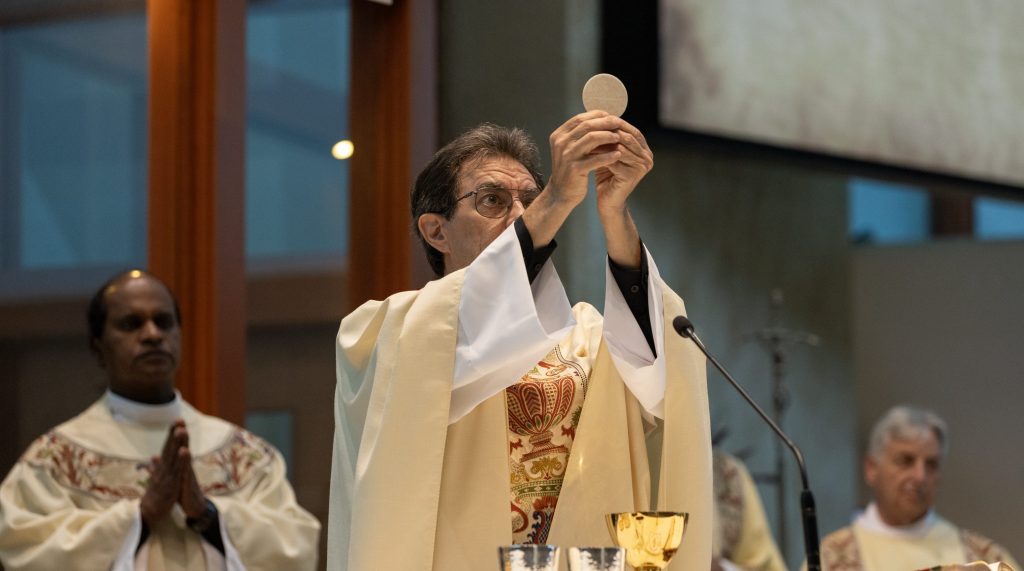
Photo: St Mary Chapel, St, Vincent de Paul Regional Seminary, Boyton Beach, FL.

Link for the Mass readings for Saturday, September 14, 2024

Word On Fire Bible: The Pentateuch. Elk Grove Village, IL: Word on Fire, 2023.

Praying today

Praying today for those who lost their lives on September 11, 2001. Praying for those first responders who gave their lives seeking to save others as well as those who lived and are suffering from the physical, emotional, and psychological effects of that day. Praying today for those still grieving and mourning the loss of those they love.

Praying for the people of our country and our leaders at the local, state, and federal levels. Praying that we see each other as human, as fellow citizens that can embrace our differences and diversity, praying that we can work together to welcome the stranger, provide for the various needs of each other in every area of our nation, urban and rural, and seek for ways to empower and lift each other up. Praying that each person is willing to play their part no matter how small so that we can be one nation under God united in a common purpose that respects the dignity of everyone from the moment of conception throughout every step of life until natural death. Praying that each of us may learn to be better, learn to forgive, learn to heal, and learn to breathe, rest, receive, and abide in God’s love and from that space think, speak, and act.

Praying.


Photo: Veteran’s Memorial Island Sanctuary where I will often walk and pray.

Jesus leads us from the darkness of our fears into the light of his love.

Jesus said to his Apostles: “No disciple is above his teacher, no slave above his master. It is enough for the disciple that he become like his teacher, for the slave that he become like his master (Mt 10:24-25).

Following the teachings and guidance of Jesus was hard for his apostles and disciples then and it is just as challenging today. To live as authentic disciples, we need to learn from and put his teachings into practice. That means more than reading some of his teachings: love God with your whole heart, mind, and soul and your neighbor as yourself, turn the other cheek, and what you do to the least of my brothers, you did it to me, and acknowledging, that, “That is some good stuff!” Then just moving on to the next thing on the to-do list.

Living as a disciple also happens in a public way, which means public scrutiny. One thing we all have in common as human beings is that we want to belong, to fit in, and to be a part of. We risk rejection and ridicule by following Jesus and living as his disciple because we run up against our own fallen nature and the fallen nature of others. Jesus said he would be sending us as sheep among wolves yesterday and in today’s reading, he announces that we are not to be afraid of those who kill the body. Not exactly the kind of encouragement many of us are looking for.

Yet, Jesus affirms consistently that we are not to be afraid. Jesus leads us to the most important relationship that we will ever develop and that is with his Father. God cares for us, just as Jesus said, as his Father cares for the sparrows, but even more. God knows us by name, and we are his, we belong to him. Our loving God and Father has known us not only before we were born, but before all creation began. Never have we been, are we now, nor will we ever be, alone. As we risk, grow in confidence, and begin to live our life in alignment, in relationship with Jesus and God through the love of the Holy Spirit, we will begin to become unified with him so to feel a joy and a fulfillment that is unmatched.

One of the keys to living the Christian life is understanding that it is more than a philosophy, a set of teachings, or a theology. Being a Christian means allowing ourselves to be known, loved, and to build our relationship with a person. Jesus is that person. Instead of hiding or running we are invited to trust and turn to him. By admitting and giving him our weaknesses and our fears, our anxieties and overthinking, our worries and our sins, we can begin to slowdown, to breathe, and begin to reset our brain’s wiring.

As Isaiah had his mouth purged by the ember placed in his mouth by a seraphim, as Peter recognized in the presence of Jesus that he was a sinful man, we too in the presence of God will see our weaknesses, our failures and our shortcomings. The light of Christ reveals to us our darkness not to condemn us, but to free us. To bring our sin into the light, so it can be purged, that we can be purified, and ultimately deified. Jesus became one with us in our humanity so that we can become one with him in his divinity. It is precisely in turning our weaknesses over to Jesus, and admitting our utter dependence on him, that we become strong.

Acknowledging Jesus is our teacher does not mean that we will gain all the answers to life, but it does mean we will be more aware of his presence during each step of our journey through this life. Take courage, be not afraid, and like Isaiah, the prophets, the Apostles, and Mary let us say, “Yes.” to the will of God and take our next step along the path to our freedom.
————————

Photo: Rosary walk last night in Riverside Park, Vero Beach, FL.

Link for the Mass readings for Saturday, July 13, 2024

Repent, receive Jesus, and bear him to others.

Return to the LORD is the plea of Hosea. In beautiful and loving language the prophet encourages Israel to come home, to leave the idols and their unfaithfulness behind. God, through Hosea, promises to heal, to love, to be “like dew for Israel.” God does not approve of Israel’s unfaithfulness, while at the same time, does not stop loving his children. With gentleness, he seeks to let his grace fall on them like the dewfall, he seeks to wash his children clean, to nourish them and satiate their thirst, to give them strength, and be the source of their life.

Jesus has come to give a visible face to the presence and promise of our God’s loving presence. He healed, cast out demons, consoled, and preached with authority. He too, in the prophetic tradition, called for repentance. Even though God never stops loving us, we cut ourselves off from his love when we choose anything and anyone over him. God must be first and we must spend time with him to grow in our relationship with him. The wonderful gift of our repentance and letting go of our control is that which is not of God is burned away like dross, and what we give to God is purified and made whole.

By trusting in and surrendering our lives to Jesus, we will heal and grow in our relationship with him, and we too like the Apostles will be sent. Jesus calls us to share the Good News of how he has been working in our lives. Not when we become perfect, but right now, even in small ways. As we receive the love of Jesus, we are to share his love with one another. We too, like Hosea, Jesus, and the Apostles will face opposition in sharing his good news. Jesus has assured us that he will send the Holy Spirit to guide us and give us the words to speak.

When we speak the words of God faithfully, that is sufficient. We are not to convince or command, but instruct and invite. As St. Bernadette of Soubirous said when pressured about the validity of her experience with our Mother Mary, “My job is to inform, not convince.” We do well to follow her lead. The Holy Spirit will work through the seeds we have planted. Let us avoid the temptation to impress and instead express the love we have received.

Jesus continually gives himself to us in the Eucharist. When we leave our sins and shortcomings in the confessional and before altar and receive Jesus, his Body and Blood, Soul and Divinity, we receive and become Christ bearers to a weary and worn world in need of repentance and hungering to experience the gentle love and forgiveness of God our Father.


Photo: First Mass of Thanksgiving at St. Peter Catholic Church. So blessed and feeling thankful to be able to share Jesus in the holy sacrifice of the Mass!!!

Link to the Mass readings for Friday, July 12, 2024

Jesus will lead us to our fulfillment, if we are willing to listen and follow.

“At the sight of the crowds, his heart was moved with pity for them because they were troubled and abandoned, like sheep without a shepherd” (Mt 9:36).

There is much that pulls at us for our time and attention. Jesus witnessed the anxieties, struggles, pain, and feelings of being lost regarding those in his midst. Are we so different today? Jesus knows the Father, he knows the joy and fulfillment of what being in a full relationship with him entails. Jesus saw then and sees in us now how lost can become, how easily distracted and diverted can be, he knows how many things we put before our relationship with God, and he “is moved with pity.”

Jesus’ heart goes out to us, he yearns to be one with us, he loves us, but in that very act of love, he risks. He loves us so much, that he is willing to let us choose ourselves, others, or a myriad of other pursuits over him. Jesus invites us to the joyful experience of developing a relationship with him so we can come to know his Father, while at the same time he does not impose himself on us. We are given the whole world to choose from or we can choose him. Who do we put first? Is God a priority in our life? If we find that God is at best an after-thought, or at worst a no thought, instead of getting to know God better, what is it that we are choosing over him?

Jesus invites us, but too often we miss, ignore, or do not follow through on his invitation. Too often we choose other pleasures, distractions, diversions, temptations, and/or apparent goods. With time and experience, we may come to see the emptiness of the lure of these worldly promises, as well as begin to recognize that our attachments and disordered affections often lead to many of our troubles, trials, stresses, and anxieties. We are often led astray because we are seeking address our underlying experiences of unfulfillment, abandonment, and/or loneliness. There is only one source, one person, that will ultimately fulfill our innermost longing; God our Father.

I am not advocating for a rejection of the material world. All that God has created is good. We are human beings and a part of God’s glorious creation. Nor do I believe that we are souls trapped in this body waiting to be released upon our death. As human beings, we are a unique unity of body and soul. The key to our fulfillment, finding meaning and belonging is choosing to put God first. In establishing a firmer relationship with God, we can better discern that which we need to let go of, and/or how to reorder that which God wants to remain. Once we establish God as our firm foundation, even the challenges and trials that arise with not disturb our peace.

This might be the moment to be still and evaluate where we are in our lives and to ponder who we belong to. Jesus offers to lead us, just as he has led his disciples through the ages. Those of every age have experienced trials and tribulations and found the promises of this world fleeting. What made the difference for the saints was that they said yes to the call of the Shepherd and then followed him. Are we willing to slow down, to breathe, and listen to the Shepherd’s invitation today? Are we willing to follow his lead?


Photo: Rosary walk Sunday evening, Veteran’s Memorial Island Sanctuary, Vero Beach.

Link for the Mass readings for Tuesday, July 9, 2024

May we also trust and have courage to reach out to Jesus in our need.

“If only I can touch his cloak, I shall be cured.” Jesus turned around and saw her, and said, “Courage, daughter! Your faith has saved you.” And from that hour the woman was cured (Mt 9:21-22).

Just to touch his cloak may seem a small and insignificant act, but by doing so, this woman showed tremendous courage. Suffering from hemorrhaging for twelve years, broke from spending all her resources to be healed, she risked. She could have been severely punished, beaten, or stoned for this small act. Under the Levitical code, her condition deemed her unclean, in the same category as a leper, a pariah. Touching someone else in that condition would then make them unclean. Yet, in that small touch, that great act of courage, “power had gone forth from him” (Mk 5:30), and she was completely healed. Not only did the woman exhibit the courage to touch Jesus, but to admit she had done so when Jesus questioned who had touched him.

In calling the woman who touched him out, Jesus was not condemning her, Jesus was acknowledging her faith and restoring her to the community from which she had been ostracized. Jesus restored her dignity. How many women today still feel and experience the pain of exclusion, not having access to the full and equal benefits of society and the Church? How many people are still considered outcasts and pariahs in our communities?

Pope Francis in his general audience from August 31, 2016, stated: “Once again Jesus, with his merciful behavior, shows the church the path it must take to reach out to every person so that each one can be healed in body and spirit and recover his or her dignity as a child of God”. We too then are to treat each person we encounter, in-person and online, with dignity, love, mercy, and respect.

The courage and persistence of the woman with a hemorrhage from today’s Gospel led her to reach out to touch Jesus even though she was crossing social norms. Jesus affirmed her move. May we also place our trust in Jesus, have the same courage to reach out to Jesus for our needs, when in our weakness, and to seek his guidance. While at the same time, may we be available and willing to allow Jesus to work through us to provide healing and support for those in our realm of influence who are in need.


Painting: James J. Tissot, The Woman with the Issue of Blood (1886-94)

Link for the Mass readings for Monday, July 7, 2024

Just as the sun will rise, we know Jesus will be there for us no matter what.

Jesus continues to present the imagery of the shepherd in today’s Gospel reading from John. He offers the assurance of security and protection that is to be found for those that are in his fold when he says, “No one can take them out of my hand. My Father, who has given them to me, is greater than all, and no one can take them out of the Father’s hand. The Father and I are one” (Jn 10:28-30). How does one enter the fold of the Good Shepherd? All who hear his voice and follow him will be known by him and so be a part of his flock.

Yet, there are those who hear his voice and do not recognize the Shepherd. They do not follow him and so are not known by him, although he seeks them out. They may know about the Shepherd, have heard of him, but do not know him. Their hearts and minds are closed. They do not believe in his miracles, his exorcisms, his teachings, and the question of those opposing him in today’s reading is, “If you are the Messiah, tell us plainly” (Jn 10:24). Jesus did just that by saying that he and the Father are one. The response to the forthright comment of Jesus is that those who are closed to his answer pick up rocks to throw at him (see Jn 10:31).

Jesus offers the gift of relationship with him and his Father, to experience the love shared between them, the Holy Spirit. This offer is without condition. Jesus is open about who he is, who we are, and who we can become in participation with him. Those who say no to his invitation do so for their own reasons; a demand for proof, a listing of the terms and conditions that need to be met first, assurances sought for, and/or excuses offered, diversions, distractions, temptations… Just as Jesus invites us to freely come to him, he will only come so far as we are willing to receive him. He does not conform to us or to our will.  Jesus does not need us, yet he loves us by willing our ultimate good.

Even we who have said yes, only go so far. We hedge our bets, dip our toes into the water, and maybe go in ankle-deep, but not too many of us are willing to relinquish control, let go, and surrender fully all at once. Jesus offers, eternal life, true, but also a life of meaning and fulfillment now. A perfect life? No. There will continue to be challenges, conflicts, mistakes, and misfires as well as Jesus’ voice continuing to call us to follow him to go into deeper waters, to seek freedom and healing from our anxieties, fears, and weaknesses. He urges us to face conflicts, to be disciplined in resisting temptations, and to continue to surrender and trust him.

Through all our experiences, the ups and downs, the only assurance is that we are not alone. No matter what we may face today or tomorrow, just as we know the sun will rise, we can be trust that Jesus will never let us go and no one can take us out of his hand. Each step of the journey we take, we can be confident that Jesus, our Good Shepherd, will be there to guide and protect us.

——————

Photo: Looking up while praying my holy hour during Holy Week at Our Lady of Florida Spiritual Center, North Palm Beach, FL.

Link for the Mass readings for Tuesday, April 23, 2024

Jesus is with us, even when we fall.

“Everything that the Father gives me will come to me, and I will not reject anyone who comes to me, because I came down from heaven not to do my own will but the will of the one who sent me” (Jn 6:37-38). Jesus does not reject us, he accepts us as we are, first and foremost. Jesus has come to do his Father’s will which is to lead us all to salvation, to be redeemed and restored to the proper order of freedom from our enslavement to sin. This is why Jesus met Cleopas and the other disciple on the road to Emmaus. They were walking the wrong way! Jesus did not tell them that, he just opened the Scriptures for them, so that they could see that he was who he claimed to be and then revealed himself to them in the breaking of the bread. Once they had a deeper encounter with him, they determined on their own to turn back, and even though evening approached they went back to tell the Apostles the Good News of their experience.

It was through sharing a meal with them that they recognized him. How many meals had they shared together before his death? A close reading of Sacred Scripture shows how important table fellowship is for Jesus and his followers before his death and after his Resurrection. True, Jesus eating with his disciples after his Resurrection shows that he is no ghost, he is human, but also that he is reestablishing the cornerstone of his ministry, table fellowship.

Here the basic needs of sustenance are met, for the body, and in also in sharing his time and conversation with anyone willing to eat with him, no matter their level of ritual purity, touches the deepest hunger within each of us, which is to belong, to be accepted as we are, for who we are. The majority of the crowd that Jesus is speaking to has continued to come to him because he fed them with only a few loaves and some fish. In the miraculous multiplication, Jesus is providing for their bodily nourishment, but also preparing them for the deeper spiritual nourishment of the body and soul to come in the next verses as he goes deeper into his Bread of Life discourse.

Jesus loves us, he wills the best for us. Many resist this claim for different reasons. It could be the callouses, scars, growing cynicism resulting from wounds inflicted by others as well as from those within the Church. Each of us could have experienced the same and have also been let down by those we have looked up to and trusted. If we are involved in a relationship long enough, we will experience disappointment or worse. This is because sooner or later, when we allow ourselves to get close enough, the masks will come down and who we truly are, the fullness of our wounds and our gifts will come to the fore. Conflicts will arise because we are finite beings. We are still a work in progress. Conflict is not a bad thing. It is healthy when we are willing to work together to resolve the conflict together.

None of us are perfect. We are all on a journey. On our own, not only will we consistently fall short of our goal, we will often be headed in the wrong direction. That is why we need a savior. Jesus, fully divine as Son, came down from heaven and became human to meet us in our humanity. He is there for us when we fall down face-first into the mud. He is willing to be there with us, to look us in the eye, and smile.

Even if we are not able to look past the predicament, can we resist Jesus? His eyes looking at us and his smile that lets us know we can get through this together. His hand offered to us that we can grasp and feeling the strength of his grasp, then rise together and stand again. That is how Jesus shows his mercy and love for us. He enters our chaos and meets us in the muck and grime of our mistakes, brokenness, and sin. He loves us there, and when we are ready to accept his offer of love, he invites us to get up, and begin to walk again toward the fullness of who we are called by his Father to be.

As our relationship grows and deepens with Jesus and as our trust renews, we begin to believe that we belong. We begin to heal and realize that we are a part of something greater than ourselves and then, with wobbly steps, we begin to offer attempts of the same mercy, forgiveness, and unconditional love with others. This is the path of discipleship. This is the road we are on, together. This is not a hundred-yard dash but a long and winding road. Let us be willing to persist, to be led, to love, to be there for, and accompany one another each step of the way. And especially may we have the willingness to help each other when we fall.

———————————————————————————

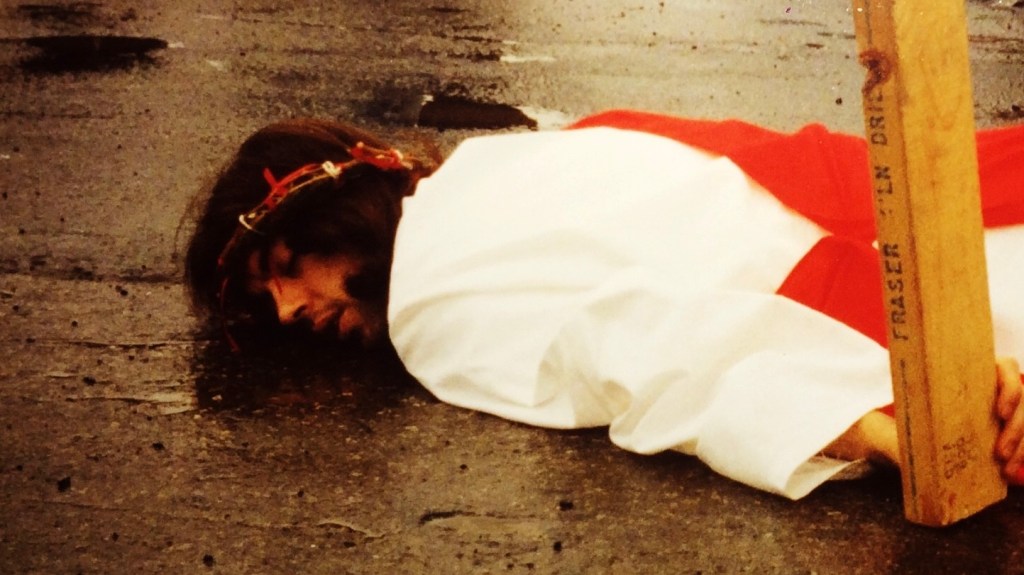
Photo: Living Stations of the Cross in the streets of the Bronx, me, as Jesus, falling a third time – around 1991.

Link for the Mass readings for Wednesday, April 17, 2024

Our healing begins when we are willing to receive the embrace of Jesus.

A ghost is a disembodied spirit or an apparition. Jesus is no ghost, though when he appears to his disciples they believe him to be just that. Jesus then tells them: “Look at my hands and my feet, that it is I myself. Touch me and see, because a ghost does not have flesh and bones as you can see I have” (Lk 24:39). He also then requested from them something to eat, and Jesus received and ate the baked fish he was given.

Jesus, in showing the wounds on his hands and feet and in eating of the fish, revealed to his disciples that his resurrection is a bodily one. Jesus was not a disembodied spirit. Nor was he a mere apparition or hallucination. Jesus, was not resuscitated, just to die again. Jesus has conquered death and is risen from the dead. Jesus then proceeded, as he had done with Cleopas and the other disciple on the road to Emmaus, to share with those present how he is the fulfillment of the Law and the Prophets by opening the scriptures for them.

Jesus not only revealed himself as having risen from the dead and shared that he was the fulfillment of the Law and the Prophets, he embodied forgiveness. Though the disciples had betrayed him, and carried the weight of shame upon their shoulders for their lack of courage, the first words Jesus spoke were not words of condemnation but forgiveness: “Peace be with you” (Lk 24:36). In the showing of his wounds, the disciples were certainly reminded of what Jesus had gone through, his suffering and crucifixion. Could those wounds have also mirrored their own betrayal of him, their internal wounds, as well their own need for healing and repentance? Jesus did not bring up any of their past failures. He instead offered them peace.

All of us have been wounded in some way and have experienced trauma brought on by the myriad ways we have been exposed to the fallen nature of humanity. Jesus invites us to stop running from the fear of facing our hurts and the roots of our suffering and to instead kneel before him. He offers us his hands held out to us. May we gaze upon and ponder his wounds still present from the nails and come to a deeper appreciation of the suffering he endured for us.

Jesus invites us next to look up into his face, the face of the one who conquered death and rose again. Resist turning away from the smile that radiates his unconditional love. May we allow ourselves to lose ourselves in the eyes of his acceptance, that offer each and every one of us the realization that Jesus loves us in this moment just as we are.

Then listen, receive, and abide in the words he speaks, “Peace be with you.” In those words of invitation, may all our fears, anxieties, and hurts melt away. May we die to our pride and arise, allowing ourselves to be embraced by Jesus, embraced by his love, so to receive and abide in his love which is the foretaste of eternity. In the arms of Jesus, let our healing begin.


Pencil drawing: Kathryn J. Brown, 1982, hanging on my seminary room wall. Spend some time to rest in Jesus’ embrace this Lord’s Day.

Link for the Mass readings for the third Sunday of Easter, April 14, 2024

The sun is setting on Lent as we begin Holy Week.

A core group within the leadership of Israel has decided. They will not deny themselves their power, prestige, and their place. They will not take up their cross and follow Jesus, the way, the truth, and the life. They will not allow the teaching and momentum of the growing number of those following Jesus to continue unchecked. As Passover drew nearer, thousands of people were coming up to Jerusalem to purify themselves for the great feast.

This meant the Romans would have many more centurions in place to keep the peace. The division and commotion that Jesus was causing could cause conflict and unrest and then swift and violent retribution from the Roman presence. The Sanhedrin, the Jewish High Council, followed the lead of the high priest, Caiaphas, who said, “You know nothing, nor do you consider that it is better for you that one man should die instead of the people, so that the whole nation may not perish” (Jn 11:49-50). With these words, they began to plan how to put to death the carpenter of Nazareth.

With the words of Caiaphas, the sun began to set on the life of Jesus. These words affect us even today as they usher in the sunset of our Lenten observance. The gift of our liturgical readings allows us to relive the story of our faith. Lent has given us a time to reflect and to meditate upon who Jesus is. Is he just a carpenter, another teacher, a holy man from the past, or is he each of these, but someone so much more. Is he the Son of God who became one with us in his humanity so that we can become one with him in his divinity?

Do we see his teachings and life as a threat as did the Sanhedrin? Do we like our life the way it is, such that we do not want Jesus to come into our home and start turning over the tables and disrupting our order and comfort? Or do the Gospels cut us to the heart and inspire us to shake off our complacency, our indifference, our cynicism, our comfort, our routine.

Jesus evades the centurions, because his hour is not yet, but when his Father willed it, Jesus was willing to give his life, not just in an abstract way, but very personally: for each and every one of us. Does that mean anything? Jesus gave everything for us. Does this truth spark a desire to acknowledge our sins, to repent, and to begin anew? Are we willing to open our hearts and minds to his love that transforms, are we willing to spend some time in quiet and allow Jesus to speak in the silence of our hearts, are we willing to be encouraged to fast, to pray, meditate, and to be moved with compassion to help those in need?

As Holy Week begins with the Vigil Mass for Passion Sunday may we meditate on the words of Caiaphas, “consider that it is better for you that one man should die instead of the people, so that the whole nation may not perish” (Jn 11:49-50). Caiaphas did not know that what he proclaimed would be so true, that the One, Jesus, would die, not only so the nation would not perish, but that all humanity could be saved.

Jesus died for each and every one of us that we might have life and have it to the full. As the sun sets this Saturday evening, may it not be just another rotation of the earth on its axis, but an opportunity to commit once again to die to our false selves, our egos, our self-centered postures, to be forgiven, and healed, and take up our cross and follow Jesus into Holy Week.
———
Photo: From Rosary walk last fall, SVDP Regional Seminary, Boynton Beach, FL

Link for the Mass readings for Saturday, March 23, 2022