Will we reject or hear Jesus’ message?

He said to them, “Today this Scripture passage is fulfilled in your hearing” (Lk 4:21).

Jesus sat down after speaking these words to his hometown congregation in Nazareth who had just heard him read the passage from the prophet Isaiah. Jesus proclaimed that he was the one to whom Isaiah was talking about. Luke chose to place this event as the starting point of Jesus’ public ministry, of bringing glad tidings to the poor, proclaiming liberty to the captives, recovering sight to the blind, letting the oppressed go free, and proclaiming a year acceptable to the Lord (cf. Lk 4:18-19).

This is a message of universal healing for all of humanity. Restoration and reconciliation would come and Jesus would be the vehicle to bring all the nations, all people, back into communion and relationship with his Father. The poor mentioned were not just in reference to those experiencing material poverty but to those finding themselves on the margins of society, the outcasts, those on the peripheries. The captives were not only those imprisoned for debts or crimes but those bound in the chains of their own sin and addiction. The blind were not only those who could not physically see but those who experienced the spiritual blindness of pride and arrogance. The oppressed were not just those under the iron fist of totalitarian and dictatorial regimes but those pressed down through their own self imposed anxieties and fears.

In what ways are we in need of Jesus’ healing and restorative power? What is keeping us on the peripheries, apart from communion and fellowship? What sins and addictions keep us bound, what fears and anxieties keep us oppressed? Jesus invites us in today’s Gospel to be healed and to align ourselves with his will and ministry of loving service to others. The same words he spoke to his own hometown he is speaking to each one of us today.

Even though initially moved by the words of Jesus, they could not see past the boy and humble man of Nazareth they had or thought they had known. How could he be the Messiah? They also rejected his universal message that God was inviting Gentiles into the party. Jesus held up as models of faith, the widow of Zarephath who trusted Isaiah with her last bit of flour and oil and Naaman who trusted the advice of a slave girl and the prophet Elisha. Both, Gentiles, and both blessed by God through their trust in him. His own people chose to hold tighter to their biases and prejudices instead of let go and receive the freedom and healing Jesus offered.

How will we respond to Jesus? Will we follow the hometown crowd or ponder his words? Life is too short to allow our pride to get in the way. Examining our conscience and coming to Jesus with a contrite, sorrowful heart for what we have done and what we have failed to do helps us to be more open. Instead of rejecting, let us welcome Jesus and experience his healing hands on our bowed heads and the warmth of his love pouring through and purging us of our sin and pride so that we may participate with him in bringing the invitation of healing, reconciliation, and love to others and help to bring about an “acceptable year of the Lord” (Lk 4:19).

—————————————————-

Photo from freebibleimages.org

Link for the Mass readings for Monday, September 1, 2025

When we pray, we are loved by God, and the love of God casts out our fear.

“Then the one who had received the one talent came forward and said, ‘Master, I knew you were a demanding person, harvesting where you did not plant and gathering where you did not scatter; so out of fear I went off and buried your talent in the ground. Here it is back'” (Mt 25: 24-25).

I used to struggle with this verse of Jesus’ Parable of the Talents, not because I didn’t relate to it, but because I did. The problem was that I sided with the servant who buried his talent in the ground. What the servant did made sense to me, he kept his master’s talent safe and returned what he had been given. Historically, burying was considered a safe and acceptable practice in ancient Palestine when protecting someone else’s money. Even in reading carefully back to the beginning of the parable, I could see no reference to investing the talents. Though in the Gospel of Luke, there is an explicit demand to “trade with these until I come” (Lk 19:13). What is Jesus saying?

Actually, Jesus in this parable offers a microcosm of salvation history, the thread of which has been woven through all of Sacred Scripture from Genesis to Revelation. God, through his sovereign will, has consistently called, calls today, and will continue to call into the future a people to himself. In each age, God has bestowed upon humanity the generous gift of his grace, inviting us to receive and share in his very life, which is what we have been created for. This is a free gift, to be freely accepted or rejected. Once received though – no matter how little we choose to receive, five, two or one talent, we are directed to share what we have been given. Through a life lived of accepting, receiving, giving back to God and to one another, we are given even “greater responsibilities”.

In receiving the gift of God, himself, and sharing what he has given, ultimately his love, for God is Love, we not only mirror on earth, albeit dimly, but share in the divine communion of the love between God the Father, God the Son, and God the Holy Spirit. To reject this gift outright, or to receive some of the benefits and not to share, we cut ourselves off from the very life force and source of our being.

The message of The Parable of the Talents is as clear as it is challenging. John P. Meier summarizes that “Jesus is insistent; along with sovereign grace, serious demand, and superabundant reward comes the possibility of being condemned for refusing the demand contained in the gift. Indeed, one might argue that no aspect of Jesus’ teaching is more pervasive in the many different streams of the Gospel tradition, and no aspect is more passed over in silence today” (Meier 2016, 309).

God has created us and all of creation from the abundant outpouring of his love. Will we reject the gift of his love and invitation of communion? Will we receive, yet not actualize who we are called to be for our self and others because we would rather merely just exist, willing to be lured and entrapped by the temptations of anxiety, fear, apparent goods, and half-truths? Will we give in to the fear, too afraid to risk, to go out from ourselves to serve others? Or, will we appreciate the gift of our life and say thank you for the breath that we breathe? Are we willing to expand the love we have received by being willing to share, to multiply our talents, to embrace who God calls us to be, to love in kind, to will the good of others in the unique way God calls us to serve, whoever they may be?

I have lived the life of the wicked servant who buried his talent out of fear. I have embraced the sin of sloth by overworking and thinking I was doing good, but was it really the good God wanted me to do? As I have recognized the importance of placing prayer front and center, so that I have grown in my relationship with God, my life has become more properly ordered. I do better when I reach out and seek the hand of Jesus and accept to be led by him. I have risked and fallen, made mistakes and duffed up time and again, but have learned and persevered.

When we learn who the enemy is, are able to identify his lies, renounce and turn away from them and back to God; when we slow down instead of run from what we are afraid of and invite the Lord into these areas we will be purified, we will heal; and when we realize that the most important thing that we can do each day is pray, then we will come to know in our core, that we are not human-doings, we are human beings. God loves us as we are. As we are loved, we will then act from being loved and share the love we have received.

We are not alone. What Jesus invites, gives, and yes, demands of us, he will at the same time provide the courage, guidance, support and strength we need to carry out the task given and to bring it to fulfillment. God has a talent or two to invest. We need not fear to invest what God has given. This morning, let us breathe deep and entrust ourselves to the words of Jesus and St John Paul II who echoed them as he began his pontificate:

“Be not afraid” (Mt 14:27).

———————————————————————————-

Photo credit: dpa Picture-Alliance via AFP accessed from Aleteia

Meier, John P. A Marginal Jew: Probing the Authenticity of the Parables. Vol. 5. New Haven: Yale University Press, 2016.

Link for the Mass readings for Saturday, August 28, 2021

Prayer will help us to heal and grow closer to God and each other.

“Lord, will only a few people be saved?” He answered them, “Strive to enter through the narrow gate, for many, I tell you, will attempt to enter but will not be strong enough (Lk 13:23-24).

This can be a challenging verse to understand and to put into practice. Our salvation is assured in Christ, for he died for all of us and not just for a select few. It is also true that there is no way we can buy or nothing we can do to earn our way into heaven. That said, with the free gift of the grace we have been given by Jesus in the giving of his life for us, we have a responsibility to work out our salvation in this life, “with fear and trembling” (see Philippians 2:12).

Christianity is not a pie in the sky or walk in the park religion, we do not seek a utopia, because Christianity is about a relationship. God loves us and gives us the choice to reject or accept his love. If we say yes, then we collaborate in building a relationship with him and one another. Our fear and trembling is not in a cowering observance, but through humble obedience. We recognize that God is God and we are not. When our relationship with God is properly understood, when he is first, then our relationships with each other as well as what we do and what we seek will stand a better chance of being properly ordered.

Authentic relationships take an investment of time and hard work if those relationships are to move beyond the masks and pretenses we project, pretending to be something we are not or trying to be who others want us to be. This is the same for God. We can pray falsely and for false purposes, and in so doing, grow no closer in our relationship with God. Jesus loves us as his Father loves him, and he invites us to experience the same. This is more than an emotional experience, but a willing of each other’s good. Love is accepting the other as other, in their brokenness and pain, their failings and shortcomings, their sin. It means being willing to take off our masks, being vulnerable, revealing our fears, and resist being defensive or reactive when we are hurt or offended by those who are close to us.

Our prayer becomes real, not when we say the right prayers or words, but when we are honest with God. Our relationship with him grows when we let go of our false understanding that we are self-reliant and we admit that we need the help of the Holy Spirit. When we trust in God, are humble and honest with him, allow ourselves to see our weakness and sin, we can begin to be loved and begin to heal, we can be forgiven and transformed.

When we approach our human relationships, love does not mean that we endure physical and emotional manipulation and abuse, for then we are enabling someone’s destructive behavior. The goal of healthy relationships is to mutually respect each other’s boundaries, be willing to support and empower one another and grow together. We accept each other as we are, while at the same time, we are willing to accompany one another as we seek to hold each other accountable, grow in our relationship with God and who God calls us to be.

Every relationship, if it is to grow and develop, will at some point, come to a cross-road, a narrow gate, in which each person needs to make a decision. We can remain stubborn, hold our ground, and build up a wall, or  we can instead work through the conflict, be honest, risk sharing what we truly believe, allow another to see our best and our worst, admit when we have been wrong or made a mistake, and then mutually support one another, as well as get the help from counseling or spiritual direction as needed.

Healing and growing together happens when we are willing to enter into and seek the root of the conflicts, to each own the parts we have played, and have the humility to say, I am sorry or I forgive you. We heal when we are willing to uncover the underlying issues below the surface, that is most likely veiled by our insecurities, anxieties, and fears. What can help us to feel safe and move toward healing and transformation is the willingness to invite God into our relationship through personal and mutual prayer.

Prayer is the most important thing we can do each day. The light of the Holy Spirit will help us to identify and let go of the baggage we carry and identify the voices we are listening to. Is it the father of lies or the Father who loves us more than we can imagine? Spending time with God and allowing the fire of his love to burn freely anything that is not of him, will help us to discern between the enemy’s voice and God’s. Jesus is the way, the truth and the life who seeks to lead us each step of the way to more intimate relationships. We get to decide whether we want to go our own way or follow Jesus through the narrow gate.


Photo: Praying together helped us to grow through conflicts, and closer to God and each other. Picture taken after we finished evening prayer with only 18 days before JoAnn would transition from this life to the next.

Link for the Mass readings for Sunday, August 23, 2025

Be still, and allow the Holy Spirit to burn!

Then the disciples approached Jesus in private and said, “Why could we not drive it out?” He said to them, “Because of your little faith.” (Mt 17:19-20).

How do the disciples get from this recurring theme of having little faith in the Gospel accounts to Peter healing a crippled beggar by saying with boldness, “I have neither silver nor gold, but what I do have I give you: in the name of Jesus Christ the Nazorean, [rise and] walk” (Acts 3:6)? And the man did just that!

A helpful definition “is to say that faith always entails a relationship between persons which stands or falls with the credibility of the person who is believed” (Rahner and Vorgrimler 1965, 164). Faith is not just an intellectual exercise, it is a lived experience. Christian faith is the conviction, belief, and relationship experienced with Jesus the Christ. The disciples learned from Jesus but more importantly developed an intimate relationship with him, such that the love they received and shared became so strong that there was no more room for doubt, distraction and/or fear, such that they would align themselves with the will of God and do what Jesus did.

The disciples did have some moments of doing as Jesus had done, but it was not until Jesus ascended and the Holy Spirit descended upon them at Pentecost that everything changed. Jesus had tilled the soil, he helped to unearth the rocks of the hardness of their hearts, he forgave them, and healed them. But it was not until they let him go after his Ascension that they were able to receive the Holy Spirit and by his power working through them they would do even greater deeds than he (cf. Jn 14:12-14)!

We are invited to do the same. If we only read the Gospels or hear them read we may know something about Jesus, but our life will for the most part remain unchanged. When we read, meditate, and pray with the Gospels and put into practice what we read, we will encounter Jesus as did his disciples. We too will come to know and develop a relationship with Jesus and our hearts and minds will be transformed by him. In this way, we are not just reading a dead letter but encountering the living Word, the Son of God, who invites us to share in the infinite dance of Love that he participates in with God the Father and God the Holy Spirit.

The enemy will do everything in his power to distract, divert, and tempt us from setting aside time to pray with God each day. And when we actually begin to discipline ourselves, enter into quiet time daily, we are invited not to stay there but to go deeper, to move beyond only reading, meditating, and praying. There will be times Jesus invites us to set aside our Bible, notes, journal, prayer cards, and/or vocal prayers of petition, and to just be still, to listen, and receive the love that Jesus and the Father experience, the Holy Spirit.

The same Holy Spirit who empowered the Apostles to fulfill what Jesus had begun with them is quietly nudging us on each day. Please listen! He is inviting us to see more clearly those subtle ways we are being distracted, tempted, and diverted from his guidance and what has been inhibiting the growth of our relationship with God. The love and light of the Holy Spirit will reveal, when we are willing to remain still, where and how, in minute and massive ways, we are refusing to follow the will of God.

One of the reasons that we have “little faith” is that we rely too much on ourselves. We are invited to stand in the presence of the Holy Spirit and let his fire burn, to purify us from our own misguided thoughts of self sufficiency. As gold and silver is placed in a crucible and heated, the dross is purified. We are purified in the crucible of our meditation, prayer, and contemplation by the love of the Holy Spirit. Through this purifying light we will see that we cannot save ourselves, that we need a savior, Jesus, with his arms wide open ready, willing, and able to forgive us and love us unconditionally and continually.

———————————————————————–

Photo:  A moment of stillness and purification back in December.

Rahner, Karl and Vorgrimler, Herbert. Theological Dictionary. New York: Herder and Herder, 1965.

Link for the Mass readings for Saturday, August 9, 2025

Denying ourselves, taking up his cross and following Jesus, leads us to greater intimacy and freedom.

Jesus said to his disciples, “Whoever wishes to come after me must deny himself, take up his cross, and follow me” (Mt 16:24).

Jesus invites us to deny our self-centered default position which places I, me, and mine (As George Harrison sang) at the center of each of our decisions. We can deny ourselves when we resist making excuses for our sins and come to a genuine place of sorrow for the pain we have caused God, ourselves, and others. By acknowledging our sins and confessing them, we die to our selfish ways, and then we rise again through the power of Christ. Empowered by our humility and the strength of Jesus we are better equipped to resist those temptations in the future.

We are also in a better position to then take up our cross, which is to follow the will of God. Jesus showed us the proper orientation of surrender when he said at Gethsemane: “Father, if you are willing, take this cup away from me; still, not my will but yours be done” (Lk 22:42). Jesus followed his Father’s will to the cross and endured horrific suffering, excruciating pain, humiliation, and abandonment, unto death… while doing so, gave him the opportunity to conquer death and become the first born of the new creation!

Many a mother I have talked with has shared the struggles of labor, but also expressed the joy of giving birth; many students who I taught were exasperated by the time and effort expended for an examination, a sporting event, art show, musical or theatrical performance and yet experienced the joy from the feat they accomplished; and how many times have we faced a challenge, trial, or cleared some obstacle and felt the exhilaration of overcoming the hurdle?

Taking up our cross and following the will of God means accepting a disciplined approach to our lives. When we follow God’s will, as opposed to our own apart from God, the difference is that we are not alone in our persistent effort. Seeking God’s will in the midst of our discernment and trials for our everyday physical as well as spiritual pursuits is the key.

In my mid-twenties, I entered the Franciscan Friars of Holy Name Province to study for the priesthood. In the year and a half of discernment, from time to time I would imagine my ordination day. To my surprise, I did not feel any joy. I enjoyed every aspect of my experience with the friars and the ministries but there was something or someone missing. I took a leave of absence and about a year and a half later, I realized what was missing was a family.

About two years later I met JoAnn, and her three children, Mia, Jack, and Christy. Six months after that we were married and seventeen years later, I was ordained to the permanent diaconate. This is the short version of the story. There were bumpy moments as we learned to grow together by being willing to see each other’s point of view, some perspectives took a little longer than others, and we were at our best when we were willing to sacrifice for and serve one another.

Our greatest challenge came almost six years ago when we experienced JoAnn’s final weeks this side of heaven. From the beginning of JoAnn’s diagnosis of pancreatic cancer. This cross was the heaviest to bear, yet Jesus shouldered it with us and blessed us richly in our surrender. I am truly grateful for those final months that we had together.

When the realization that JoAnn wasn’t coming back finally sank in about a year and a half later, I decided I needed to learn to live again without her. I followed JoAnn’s advice to put all options on the table and over some months whittled eight choices down to two. Standing in our bedroom, I pondered whether to leave teaching for a year and collapse or pursue the priesthood.  I then asked God, “What do you want me to do?” A quiet voice within confirmed, priesthood. My body sank but my spirit soared.

I would be accepted into the seminary to study for the priesthood and with the support of some great people and the strength of the Holy Spirit guiding and carrying me, I made it through to my ordination day. This time I anticipated ordination with joy, but there was a lingering feeling that I was betraying JoAnn by going ahead and living my life without her. We need to be careful what voices we listen to! The Father of lies seeks to wreak havoc but the Holy Spirit invites us to experience freedom, healing, and wholeness.

Some of the doubt lingered into my ordination Mass, until the moment when each priest walked by, placed their hands on our heads while each remained silent. About half way through the progress, one priest leaned close and whispered, “Your wife has the best seat in the house.” The tears began to flow and purify the lies. During the Eucharistic Rite, for a moment, I felt JoAnn with me, helping to realize that I was actually celebrating my first Mass as a priest, concelebrating with our bishop.

A few months later, I realized that I could be happy again. I was not happy JoAnn had died (which enemy fed me), I was happy because I was following the will of God. JoAnn told me that I would be sad but not to stay there and that she would be closest to me when I was doing that which made me happy. I have also come to realize that during the Mass, because of the presence with Jesus, the veil between heaven and earth is so thin.

When Jesus calls us to “deny ourselves”, he is talking about denying those attachments and disordered affections that we have to things and people, which is anything and anyone we place before God. When we are willing to surrender all and follow Jesus, allow the purifying fire of the love of Holy Spirit to burn the dross of our sin, attachments, and apparent goods away, we will experience the love and intimacy with God we have been created for, and experience a freedom we never thought possible.


Photo: Blessed and filled with joy to be serving in the priesthood of Jesus Christ.

Link for the Mass readings for Friday, August, 8, 2025

Jesus has our back in our successes as well as our failures.

Peter shows, as he did when he walked on and then sank in the water, how our faith journey can be compared to a rollercoaster ride of ups and downs, sometimes more intense than others. As expressed time and again in the Gospels, Peter provides examples of taking a step forward and two steps back.

In today’s Gospel from Matthew, Peter still called Simon at this time, exemplified this balancing act of our growth process as he first answered Jesus’ question as to who Jesus was when he stated, “You are the Christ, the Son of the living God” (Matthew 16:16). Jesus not only commended Simon for being open to sharing this revelation given to him by God the Father, but also added, “And so I say to you, you are Peter, and upon this rock I will build my Church, and the gates of the netherworld shall not prevail against it” (Matthew 16:17-18).

Name changes in the Bible were common when there was a significant change in one’s life. We can see evidence of this in the examples of Abram, changing his name to Abraham, Sarai to Sarah, and Jacob to Israel, just to name a few. Without a doubt, this event was a significant giant step forward for Simon Peter!

Yet, just as Peter reached the heights of theological insight he would just as quickly come crashing down again as he cut his teacher off. Jesus began to share with his disciples about how he would suffer, be killed, and rise again on the third day when, Peter took Jesus aside and began to rebuke him, “God forbid, Lord! No such thing shall ever happen to you.” He turned and said to Peter, “Get behind me, Satan! You are an obstacle to me. You are thinking not as God does, but as human beings do” (Matthew 16:22-23).

From being called the rock upon which Jesus would build his Church in one instant, to Satan in the next, Peter’s experiences offer some solace for us who are on our own faith journeys. Peter apprenticed with Jesus and as in any learning experience, he made mistakes. We need to realize that in our spiritual life this is going to happen to us as well.

We will have days when we feel the joy of the Holy Spirit filling our soul, and yet in the next instant, we may feel empty. We may have clear discernment and direction and then feel indecisive and confused. Some days we discern well our loving God and Father’s voice and some moments we choose to follow the Father of Lies. Some days our prayer is fruitful and we feel energized and other days we may experience dryness and that we are just going through the motions.

Jesus’ admonition of Peter to get behind him was not the end of the story. In fact, it would get worse when Peter gave into his fear and denied Jesus three times! Peter persisted and Jesus did not give up on him. After his resurrection, Jesus asked Peter three times if Peter loved him, and three times, the third a bit exasperated, Peter said yes, undoing the travesty of his denials. After the Ascension of Jesus, Peter lead the early Church and gave the ultimate witness and measure of his spiritual growth and maturity by giving his life.

We too will have fits and starts along the way, but the key is to remain faithful to God and the Way he guides us to walk. We are to continue to dust ourselves off when we have fallen down and be willing to learn from our mistakes, to repent, be forgiven, to seek the help and support of Jesus and one another, and be willing to begin again. The Good News for us today, is that Jesus does not define us by our mistakes or our worst moments. He does not give up on us. He loves us and continues to hold out his hand to us, to lead us onward!


Photo: A great compass to access as we journey is to ask, “Is our heart beating with the same rhythm as Jesus’ Sacred Heart?”

Link for the Mass readings for Thursday, August 7, 2025

No or little faith?

“Where did this man get such wisdom and mighty deeds? Is he not the carpenter’s son?” (Mt 13:54-55).

Many people wonder what Jesus did from the age of twelve until he began his ministry around the age of thirty. Today’s reading gives us some insight into that question. Most likely, Jesus did nothing extraordinary, he was just as ordinary, if that, as any other first-century Palestinian Jew living in the small town of Nazareth, with a population of about 250 to 500 people.

Jesus most likely worked as a carpenter. This was rough, menial work, and as a day laborer, a position that was looked down upon. We can even see evidence of this in the Gospel accounts. Mark describes Jesus as the carpenter, the son of Mary, Matthew in today’s account portrays Jesus as the carpenter’s son, and Luke and John just refer to Jesus as Joseph’s son, leaving out any reference to carpenter altogether. Most scripture scholars believe Mark was written first, so we can see a progression in the biblical tradition moving away from identifying Jesus as a carpenter.

Jesus’ return to his hometown and his teaching was first met with wonder. The question arose, “Where did he get such wisdom and how did he work such mighty deeds?” But wonder soon turned to judgment. Who is he? Isn’t he just the carpenter of Nazareth, no better than any of us. In effect, “Who does he think he is?” Not only does this show that Jesus probably lived a very simple peasant life, but that Jesus’ social status was set in stone.

The people’s hearts and minds were closed to Jesus. THEY KNEW who he was and there was no way someone like him could do what they had heard, so they “took offense at him… And he did not work many mighty deeds there because of their lack of faith” (Mt 13:57-58).

How many times have we judged someone? Have we said to ourselves, “I know who he or she is.” We box them in, not as they are, but as WE see them, as we define or label them. We look at another individual not as a person with dignity, but as a two-dimensional caricature to satisfy our own prejudgments and lack of vision. We also do this to ourselves by limiting our potential when we say we can’t do this or that. Husbands and wives, having been married for years, can fall into the routine of everyday and not allow themselves to be surprised by one another, to wonder at what about each other they still don’t know!

Maybe we have had a similar experience as Jesus did in returning to his hometown, in that we have sought or are seeking to move beyond our particular social status, or follow a dream or career out of the norm of familial or community expectations. No matter our age, through no fault of our own, by pursuing this path some or many may feel threatened. Thus, not willing to accept our vision, those who are not willing to grow beyond what they have always known.

I read an account from the writer/producer Stirling Silliphant and how one day Bruce Lee challenged him to run five instead of his usual three miles. Into their fourth mile, Stirling said, “if I run any more I’m liable to have a heart attack and die.” [Bruce] said, “Then die.” He was so mad he finished the five miles. Afterward, Stirling approached Bruce and asked him why he said that.

Bruce replied, “Because you might as well be dead. Seriously, if you always put limits on what you can do, physical or anything else, it’ll spread over into the rest of your life. It’ll spread into your work, your morality, into your entire being. There are no limits. There are plateaus, but you must not stay there, you must go beyond them. If it kills you, it kills you. A man must constantly exceed his level” (p. 23).

Jesus rebukes limiting attitudes and perspectives. His Father has a plan for our lives and so he invites us to open our minds and hearts, to see the potential he sees in us. Jesus, the carpenter, invites us to embrace the infinite possibilities that will arise when we participate in his life and love. With God there are no limitations. The villagers of Jesus’ hometown are said to have had a lack of faith or unbelief, and because of that limitation, Jesus “did not work many mighty deeds there” (Mt. 13:58). When Jesus challenged his disciples, he said that they had “little faith” (Mt. 14:31). The disciples struggled to understand Jesus, but they were open.

We just need a little bit of faith to let Jesus in. If we are closed, if our hearts are hardened, Jesus will respect the boundary we place. He will not go against our free will. If we give him a little though, just as with the feeding of the five and four thousand, Jesus can do wonders in our lives.

The Holy Spirit seeks to free us from the shackles that bind us, the limitations imposed upon us from without, as well as those we impose upon ourselves from within. Let us cooperate with the urgings of the Holy Spirit, to be free with each breath and step we take into embracing the freedom of the love of God. With the leading of the Holy Spirit and experiencing the love of God, the limiting attitudes can begin give way to accept what God already sees, that we are his beloved daughters and sons with whom he is well pleased.
———————————————————————–
Photo: Picture does not do the view justice, but a moment of wonder as I was getting ready to drive home and chose to stop for a quick pic.

Stirling Silliphant story accessed from Bruce Lee: The Art of Expressing the Human Body, compiled and edited by John Little. North Clarendon, VT: Charles E. Tuttle, Co., 1998.

Parallel Gospel accounts: Mark 6:3, Matthew 13:55, Luke 4:22, and John 6:42

Link for the Mass readings for Friday, August 1, 2025

Not to wriggle free from but to surrender all to God.

Jesus said to the disciples: “The Kingdom of heaven is like a net thrown into the sea, which collects fish of every kind.” (Mt 13:47).

The invitation of God is universal and we are all lured by his invitation of love and intimacy. We long to belong, our very substance and essence as human beings is the reality that our ultimate fulfillment can only be reached in communion with the God who has created us. Yet, though drawn, we can resist being caught.

St Augustine (354-430), bishop of Hippo, came to a point in his life where he realized that the flame of his desire for wealth, fame, and pleasure was dimming. He clearly felt moved toward “one reality that cannot decay, from which all other realities are derived.” Though he was caught in God’s net and being pulled in, Augustine still sought to wriggle free, for: “Though drawn to the Path, who is my savior, I shied from its hard traveling” (Augustine 2008, 161).

How many of us echo Augustine’s dilemma? We have experienced God in our lives and feel the invitation to be drawn in, yet, we still seek to wriggle free. We are attracted to God but our attraction to other apparent goods still hold priority of place. At a baser level, we may believe that the minimalist approach is easier. God’s path is too hard.

Harder? Yes, but if we follow the will of God he will give us the strength to endure and persevere.

In reality it is more of an effort to work against God’s will, just read the Book of Jonah! May we instead surrender to the current of the Father’s Love and allow ourselves to be caught in the net of his Grace. At first, anxiety and fear will arise, just like being caught in a rip tide, because the pull may appear too strong, his love too pure. When we surrender to the will of God though, the anxiety will subside, the joy and consolation will arise, as we flow with ease and are empowered by the love of the Holy Spirit.

St. Ignatius of Loyola, whose feast day we celebrate today, resisted God for a time as well but then realized, during his long period of recuperation from a canon ball strike, a distinction between the invitations of the world and God’s. The intoxications of the world brought a momentary high which would then leave Ignatius wanting. “While reading the life of Christ our Lord or the lives of the saints, he would reflect and reason with himself: ‘What if I should do what St. Francis or St. Dominic did?'” (Gonzalez).

The thoughts of Jesus and the saints did not wane and after reading about them, left him with periods of ongoing consolation. The path that Ignatius then walked led him to sainthood and the Exercises he developed have helped countless, including myself, to experience healing and a deeper and more intimate relationship with Jesus. If you have read my encouragements to imagine yourself in the daily gospels before, you now know that I learned that practice from St. Ignatius. Give yourself some time getting caught in the net of God’s love today, resist the temptation to wriggle free, and offer the Lord all your liberty!

———————————————————————–

Photo: Ad Majorem Dei Gloriam – In the Ignatian tradition may we do all things for the greater glory of God! St. Ignatius, pray for us!!!

St Augustine. Confessions. Translated by Gary Wills. NY: Penguin Books, 2008.

Luis Gonzalez in The Liturgy of the Hours, vol III, 1975, 1566.

Link for the Mass readings for Thursday, July 31, 2025

Trusting in Jesus will help us to heal and prepare fertile soil to receive God’s Word.

The root of the message offered in today’s Gospel is what is foundational to the beginning and continuing as a disciple of Jesus. This being the disposition of our hearts. Are we closed to receiving the message of the Gospel, or are we open to embrace the invitation Jesus shares with us to become more active in living out our faith in our everyday lives?

The exchange of Jesus with his disciples in today’s reading from Matthew comes after his sharing of the Parable of the Sower (Mt 13:1-9). In this parable, Jesus offers scenarios regarding the conditions of seeds sown. Some fell on a hardened path, some on rocky ground, some fell among thorns, and some fell on the rich soil. The seeds on the hardened path could not even germinate. Those in rocky ground and among thorns germinated and began to even sprout but would not come to full maturity. The seed that was sown in rich soil germinated, sprouted, matured, and bore fruit.

As disciples, we are meant to bear fruit and that means we need to prepare ourselves so that we will have rich soil. The beginning step is to have open hearts and minds. If we have a desire to pray, the hardened soil has given way somewhat. The seed has penetrated, died and has begun to grow. God is the originator of our prayer. The desire to spend time in prayer is good news. The devil has not stolen that from us. Now if we do not follow through on the inspiration of nor follow the nudging of the Holy Spirit, means we have some tilling to do. We need to remove the rocks of resistance, distraction, and diversion so that we can get deeper.

Daily coming to a place that we have created and set aside for ourselves to breathe and be still will help us to begin the work of facing those internal resistances and diversions. We can begin to see where are hearts and minds may have been hardened. By breathing and slowing down, we get in touch with our body and may be surprised by how tense we are. With just a few breathes we may notice that our shoulders come to a more peaceful place of rest. Our neck and our hips can begin to let go. Once we have prepared the soil, the next preparation is the weeding. Among good soil grows what has been planted, the seeds of the enemy as well as the seeds of God.

As we continue to return each day and allow God to happen, to acknowledge his presence and closeness, we can begin to then allow his light to reveal to us those thorns and other weeds that seek to choke the growth that has begun. Anxieties, worries, frustration, and reactions all choke out the peace, faith, confidence, and love that God seeks to sow and grow within us. Being diligent and disciplined in showing up, allows us to begin to feel safe in the place we have set aside. In encountering God each day, we begin to know him. In this place of stability, we come to know that God is our refuge and strength, and we begin to feel safe. From this place of safety, we can begin to face and breathe into where we notice our bodies hold anxiety, fear, and stress.

God helps us to tend the gardens of our souls patiently and gently. Thoughts of condemnation and shame are the weeds of the enemy that seek to choke out our healing, growth, and spiritual maturity. The gentle light of Jesus is that light that brings warmth and safety. The conviction he brings is the light that helps us to identify that which needs to be weeded and pruned so that our soil becomes richer and our growth can continue unimpeded. In time and with disciplined attention, daily coming to our places of quiet with the Lord, spending time in his word, we will be forgiven, healed, and freed from that which seeks to stunt our growth and we will continue to mature and begin to bear good fruit, the gifts and charisms that the Holy Spirit has sown within our good soil.

Whatever the state of the soil of our soul that we bring to this reading whether it be a hardened and worn path, rocky ground, weeds and thorns, know that there is some soil to work with. Like any garden that is to grow, mature plants that bear good fruit will take time, energy, and work. The most difficult state and the one Jesus addressed in today’s Gospel is the heart of indifference that is closed, the seed falling on the well-trod path, that is hard and packed so nothing gets through. For these people, “they look but do not see and hear but do not listen or understand” (Mt 13:13). Yet, even this soil can be turned and tilled. Even the hardest heart can be softened if one is willing to turn to Jesus.

Jesus, in his explanation of why he spoke in parables, returned to the inaugural message of his ministry: “This is the time of fulfillment. The kingdom of heaven is at hand. Repent and believe in the Gospel” (Mk 1:15). Before we may be willing to repent, we may need to first acknowledge the places in our hearts and minds that are closed, those areas that are hardened from real or perceived past pain or trauma, those situations in which we chose to shut down and separate ourselves from God and others.

When we allow Jesus in, we can experience his healing touch. When we take the risk to accept his help, we will receive his forgiveness and healing. When we trust in Jesus, are willing to take his hand, follow his lead, and learn from our mistakes, turn away from our sins, and return to him for healing and confession, our hearts will soften and our minds will open.

Jesus wants to help us to turn over the rocks we have been hiding our pain under so that we can experience those deeper wounds that we have kept buried. This will only happen when we trust Jesus and feel safe. Spending quiet time each day, surrendering and being docile to the Holy Spirit, helps us to do just that. In time, we will feel safer and more confident to turn over those stones, pull up the weeds, and begin to till the fertile soil underneath. Through experiencing our pain, our emotions, and facing our fears, we help to prepare the fertile soil, in which the seed of God can thrive and in which we will mature to bear good fruit the will last.


Photo: Enjoying the fruit of this tree in bloom on my walk after morning prayer at University of St. Mary of the Lake.

Link for the Mass readings for Thursday, July 23, 2025

“Courage daughter! Your faith has saved you.”

“If only I can touch his cloak, I shall be cured.” Jesus turned around and saw her, and said, “Courage, daughter! Your faith has saved you.” And from that hour the woman was cured (Mt 9:21-22).

Just to touch his cloak may seem a small and insignificant act, but by doing so, this woman showed tremendous courage. Suffering from hemorrhaging for twelve years, broke from spending all her resources to be healed, she risked. She could have been severely punished, beaten, or stoned for this small act. Under the Levitical code, her condition deemed her unclean, in the same category as a leper, a pariah. Touching someone else in that condition would then make them unclean. Yet, in that small touch, that great act of courage, “power had gone forth from him” (Mk 5:30), and she was completely healed.

In the parallel account from Mark 5:21-43, he reveals more details than Matthew does in today’s reading. Not only did the woman exhibit the courage to touch Jesus, but she was then willing to admit that she had done so when Jesus questioned who had touched him. Many of the disciples looked at Jesus wondering how he could ask such a question because so many people had been around and touching him. She could have easily slinked away, but she didn’t. She admitted to touching him and would receive whatever the consequence for doing so.

So many around Jesus as his disciples pointed out, and yet why was she the only one healed? Pope Leo addressed this in his June 25, 2025 audience: “In his commentary on this point of the text, Saint Augustine says – in Jesus’ name – “The crowd jostles, faith touches” (Sermon 243, 2, 2). It is thus: every time we perform an act of faith addressed to Jesus, contact is established with Him, and immediately his grace comes out from Him. At times we are unaware of it, but in a secret and real way, grace reaches us and gradually transforms our life from within.”

Jesus recognized immediately that the power came out from him. He may indeed have known who received his grace and gave the woman the chance to be healed on a deeper level and to set aside her fears completely. When she did so, Jesus did not reprimand but affirmed her faith and courage. In this act of healing, Jesus restored her to the community from which she had been ostracized. Jesus restored her dignity.

Pope Francis in his general audience from August 31, 2016, stated: “Once again Jesus, with his merciful behavior, shows the church the path it must take to reach out to every person so that each one can be healed in body and spirit and recover his or her dignity as a child of God”. May we too establish contact with Jesus, and experiencing his grace, reach out, in-person and online, and encounter others offering the same dignity, love, mercy, and respect we have received.


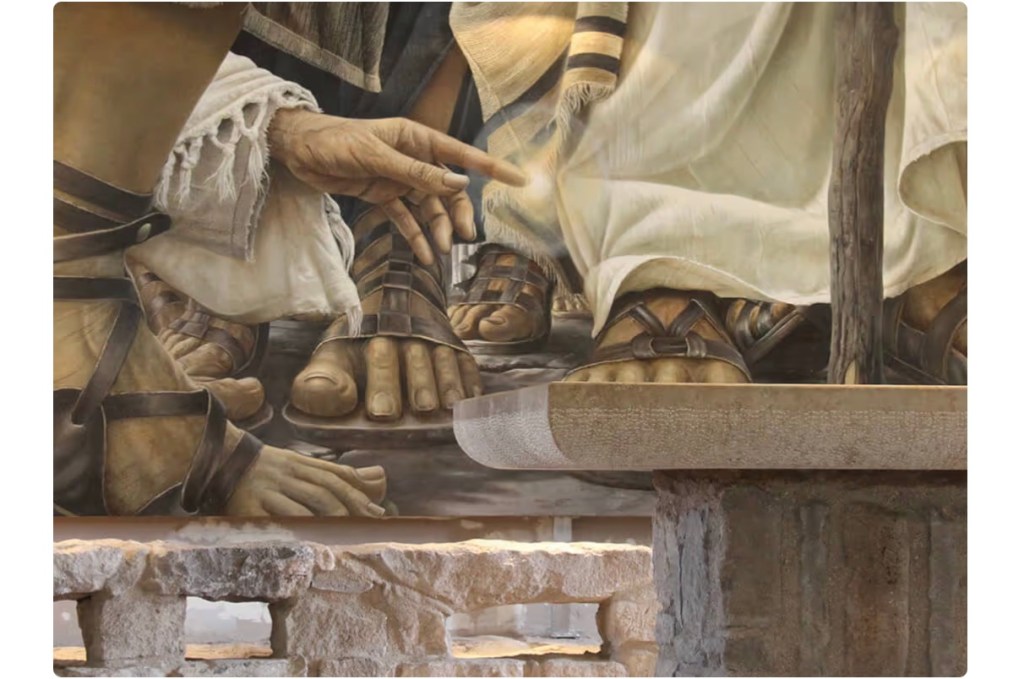
Photo of painting from Magdala.org

Link for the Mass readings for Monday, July 7, 2025