Reflections on the Gospel Reading for the Day
“This is the work of God, that you believe in the one he sent.”
One of the best ways to celebrate the Easter Season is to continue to conform our lives to the one who gave his life for us that we may experience and be engaged in our life to the full. We can accomplish this better by putting into practice what we read in the Gospels as well as being open to encountering God in our daily experiences and one another.
Today’s Gospel reading continues after Jesus not only fed the 5,000 but also after he had walked across the Sea of Galilee and guided his disciples safely to the shore. Those who had eaten as a result of the multiplication of the loaves and fish, got into their own boats to follow Jesus to Capernaum as well.
When the crowd found and gathered around Jesus, he continued to teach them, guiding them to “not work for food that perishes but for the food that endures for eternal life, which the Son of Man will give you.” The people asked him what they could, “do to accomplish the works of God?” Jesus answered and said to them, “This is the work of God, that you believe in the one he sent” (cf: Jn 6:27-29).
To believe in the one he sent. The response of Jesus may not appear to fit the request of how to accomplish the works of God. But to believe is not passive. Belief is to be followed by action. If we say that we believe in Jesus, we are invited to pray with him, worship him in communion with fellow believers, sing songs praising him, give to and serve one another by practicing the corporal and spiritual works of mercy.
Believing in the one God the Father sent, believing in his Son, also means that we allow Jesus into our minds and hearts, we allow his light to shine in our places where there is darkness and pain, where we are in need of confessing and healing. When we believe in Jesus, we are willing to submit our will to his will. The good news is that Jesus knows what: is the best for us, will heal and truly fulfill us, and give our lives meaning. The challenge is, are we willing to trust Jesus with the direction and path of our lives?
To accomplish the work of God, we must believe in the one whom he sent. To believe in Jesus, we need to trust him and know him. As we spend time reading, meditating upon and praying with the recorded accounts of Jesus in the gospels, our lives become transformed when we then put what he has taught us into practice. We will accomplish the work of God by trusting, learning from, and following his Son, Jesus, who the Father sent to be one with us in our humanity so that we can become one with him in his divinity.
——————————————————-
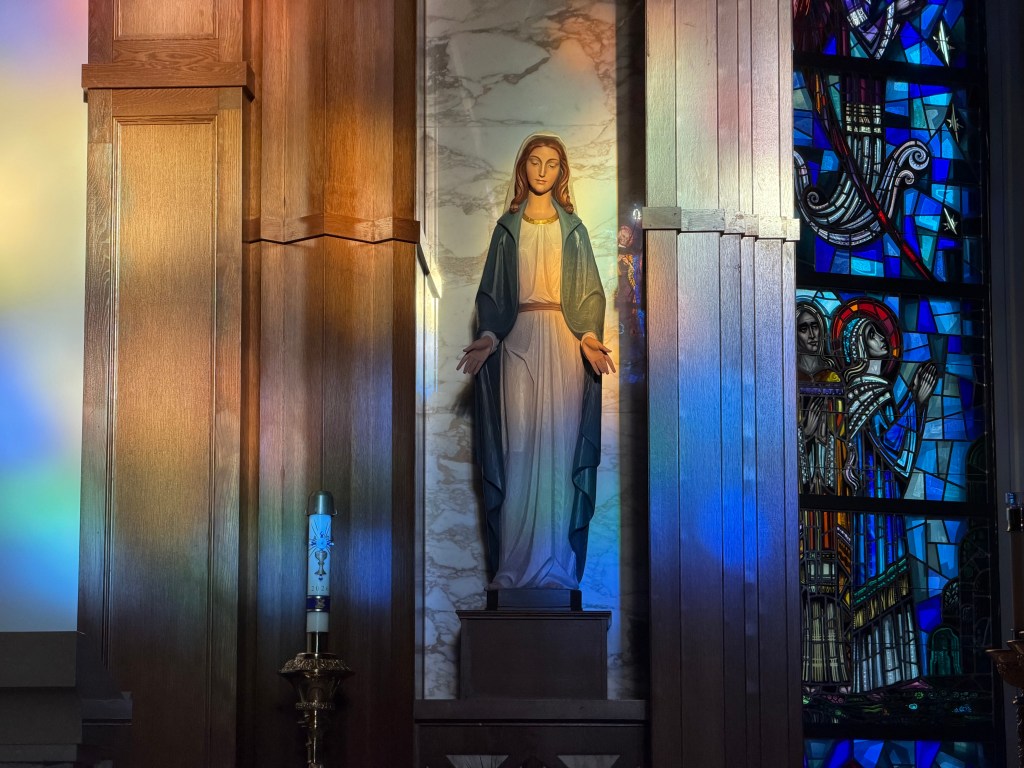
Photo: Jesus is the light that shines in our darkness. When we believe, trust, and follow his lead we will experience his love and healing. Statue on the grounds of University of St. Mary of the Lake.
Jesus did not give up on Thomas or Cleopas. He will not give up on us.
We return again to the reading of the Road to Emmaus pericope that we heard less than two weeks ago. This rich record is certainly worth many readings because there is within its telling so much contained in its depths that one, two, or three readings is nowhere near sufficient.
Jesus comes upon Cleopas and another disciple heading away from Jerusalem feeling devastated because not only had their teacher been brutally crucified but their hopes of him truly being the Messiah were also dashed. The interesting points that come up when they begin to talk to Jesus are that “some women…had indeed seen a vision of angels who announced that he was alive.” They also announced to Jesus: “Then some of those with us went to the tomb and found things just as the women had described, but him they did not see.”
Cleopas and the other disciple were certainly close enough to the inner circle of the Apostles to know Mary Magdalene and the Eleven to be in hiding with them after the crucifixion. This also meant that they knew Jesus pretty well. They had to have heard on more than one occasion either from Jesus himself or the other Apostles that Jesus would rise again on the third day.
Why then did they leave after hearing the tomb was empty? Wouldn’t they want to find out if what Jesus said about his Resurrection was actually true? Jesus had told them to wait for him in Jerusalem, not Emmaus. Cleopas and the other are heading the wrong way! Last week we read about how Thomas was away when Jesus reappears to the Apostles. Could he have gone his own way and leave like Cleopas and the other disciple did?
There were those like Mary, Peter, and John who stayed in Jerusalem, while at the same time we know about Thomas, Cleopas, and another disciple who had left, even after hearing about the empty tomb. Jesus was clear in what he taught about his coming back on the third day, just as he was when he told his followers that they would eat his flesh and drink his blood. People left then as well.
How many times have we given up or given in just when what we had been waiting for or working for would have been fulfilled? We may never know. Fortunately, for Cleopas and the other disciple that we read about this week and Thomas last week, Jesus was willing to reach out to them a second time. They heard his words about the Resurrection but they did not grasp or comprehend the full meaning of what Jesus meant.
The same is often true of us. Jesus invites us to follow him as he did the others, as he does with all of humanity, yet we often do not understand or fully appreciate the fullness of what Jesus is offering. Until we are able to relate to and value the deeper meaning and worth of what it means to truly develop a relationship with Jesus, to know, be loved by and love him, and be a follower of his, we will not be willing to invest our time and commitment. The Good News is that Jesus did not give up on Thomas or Cleopas nor will he give up on us. One day we too will also be able to exclaim with joy, “The Lord has truly been raised,” and our life we never be the same.
Painting: The Supper at Emmaus by Rembrandt 1648
Link for the Mass readings for Sunday, April 19, 2026
Choosing Jesus will help us to experience his peace.
Some of the context for today’s reading of the Gospel is found in John’s account of the multiplication of the loaves which closes with this verse: “Since Jesus knew that they were going to come and carry him off to make him king, he withdrew again to the mountain alone” (Jn 6:15). Both Jesus and the people knew the Torah. In Deuteronomy 18:15-18, Moses shared that he was not the seal or end of prophetic tradition, he, like John the Baptist, pointed to one that would be greater than he.
As the five-thousand ate they talked among themselves, many may have then recalled how God fed the Hebrews in the desert, manna, bread from heaven. The miraculous multiplication mingled with the manna remembrance, comingled with the already growing messianic hope, could make a good case for why the people began to believe that Jesus was the “Prophet, the one who is to come into the world” (Jn 6:14), and then they rose to make him their king.
Recognizing their motivation and lack of understanding of the fullness of the kingship he would indeed assume, Jesus withdrew back higher up the mountain upon which he saw the people coming to him in the first place. The people presumably camped where they had eaten since evening drew near. Separation occurred between Jesus and the people because they moved to make him into something he was not. He refused, as he did during his fast in the desert, to give in to the temptation of power, pride, and honor.
The disciples were also separated from Jesus. They set out on the sea and headed toward Capernaum and would be reunited as they experienced a storm that arose on the sea of Galilee. Already full of anxiety as they were being tossed about by the waves, their fear grew as Jesus came closer to their boat, walking on the water. He calmed them as he said, “It is I. Do not be afraid” (Jn 6: 20).
Those present at the multiplication of the loaves and fish, the disciples, nor us today totally comprehend all of who Jesus is, for he embodies the fullness of humanity and divinity. Nor is he ours to tame. Jesus comes to us, is present to us, loves, and is willing to walk with us through all our trials and tribulations, as well as our joys and wonders. Though, what he will not do is be untrue to himself or to who he calls us to be. If we want to be fulfilled in this life, we need to let go of making Jesus into our image and likeness. Instead, with humility, we are invited to be conformed to his will, which, deep down is what we want too. We need to decrease, so that he may increase. We need to die in him, so that he may live in us.
In our willingness to surrender to the will of Jesus, we are able to keep our eyes focused on him. This does not mean our life will be perfect. There will continue to be challenges and conflict. The closer we come to Jesus the clearer we will see the truth and the absence of it within us and without. Conflicts with others will still arise. The difference is that when we experience the closeness of Jesus, while storms may rage on the outside, we will experience more calm on the inside. We will feel less need to react when our buttons are pressed, see people with a wider lens, experience more understanding, and love, and discern better how to engage or remain still.
We will grow stronger in our faith and trust in Jesus, and be more able to help others along the way to do the same, when we are willing to follow the guidance of Jesus and collaborate with him. In this free act of our will, we are aligning ourselves with the infinite power and ground of our being. In our participation with Jesus, we have access to his power working in and through us, we become agents of stillness and calm for ourselves and others, even while experiencing the storms of our everyday lives: “Be not afraid!” Trust in Jesus! When we do so, we will experience his peace.
——————————————————————
Painting: “Christ Walking on Water after. Julius Von Klever by Jay Bryant Ward
Link for the Mass readings for Saturday, April 17, 2026
Engaging both our physical and spiritual natures helps us to embrace wonder!
The feeding of the five thousand that we encounter in today’s Gospel from John is reported in each of the four Gospels. This point is relevant because biblical scholars look to the multiple attestation theory as one means as to whether an account in the Gospel record is more or less plausible. Having the same account present in each of the four is strong evidence in support for that event happening.
From a different perspective, there are those that embrace a scientism that they will not believe in anything that can not be measured, experimented upon, or proven within the realm of the five senses. For those ascribing to this strict interpretation, religion and accounts of miracles are often dismissed as superstition, that if something indeed did happen, there is a scientific explanation to dismiss the miraculous. Even some believers may discount the record of the feeding of the five thousand as more of a symbolic representation of the generosity and service encouraged by Jesus such that everyone gave their small share and there was enough for all, not that he actually was able to multiply the bread and fish.
These perspectives of downplaying the miracle of multiplication seek to reduce or limit Jesus to just his humanity, but he is so much more. Jesus is human, fully human, yes, even more so after his resurrection, but he is also fully divine. Coming to understand the wonder of the unity of the divinity and humanity of Jesus can help us better understand the reality of our world and the whole of the cosmos.
One of the core aspects of who we are as human beings is that we are people of wonder. The physical sciences are tools that we have in our toolbox that we can access to help us to understand our physical realm, while at the same time we also have spiritual tools that help us to receive insights from both physical and spiritual realities. The physical sciences actually emerge precisely because of our spiritual pursuit to understand the wonders of God’s creation. In accessing both faith and reason, we come to have a broader picture, more pieces of the puzzle in which to put together and better experience our world.
When we limit or explain away the miracles of Jesus we rob ourselves of a more accurate picture of reality. One concrete example of this is when our third president, Thomas Jefferson, took a sharp object and painstakingly cut out verses from the Bible and pasted them to blank pages. He did so in columns of Latin and Greek on one side of the paper and French and English on the other. This eighty-four-page tome is commonly called the Jefferson Bible, but the president titled it: The Life and Morals of Jesus of Nazareth. This text offers a human portrayal of Jesus that dismisses anything divine.
If we remove ourselves from the divine such that we experience, explore, and think from the perspective of the finite material realm solely, we will miss a deeper expression of who we are as human beings and much of the joy and gift of life. It stands to reason then why we would find it hard to believe in miracles, the mystical, and the spiritual. The miracles are not a self-aggrandizing move on Jesus’ part, but a move of love and empathy. Jesus is moved, time and again, to reach out in love, to care for and support those who are in need. They are also a foretaste of heaven. Jesus entered into our human condition, fully divine to become fully human. In doing so, he opened up heaven for us.
We need to resist the temptation to write off too quickly the miracles of Jesus. May we also not dismiss the gift and value of the sciences. By approaching our world with a both/and approach, we will get a better understanding of and appreciation for not only the gift and wonder of creation but also who we are as human beings. God has imparted within us the ability to access and develop both our faith and reason, to think critically, and to pray and meditate more deeply.
Jesus as the firstborn of the new creation embodies the reality of the fullness of who we are called by God and in the depths of our souls, aspire to be, human and divine. Jesus is still present to us today, knocking on the doors of our hearts, minds, and souls. If we only follow the moral and social teachings of Jesus, as did Thomas Jefferson, we will experience some benefit but we will limit ourselves by cutting out the very life force that sustains those virtues we hope to aspire to and we will not understand the ground and foundation of those morals and social teachings in the first place.
We will access more of the fullness of all that God the Father offers us when we open the door to his Son this Easter Season and invite the Holy Spirit in. Let us continue our journey, to read and pray together the Gospels of Matthew, Mark, Luke, and John. May we resist rejecting outright what we do not understand or comprehend, and instead be willing to ponder the wonders that God seeks to unfold for us, the gift of God’s grace building on nature, the reality of God-incidences all around us, and embrace the eternal foundation and ground of our being which is the Trinitarian Love of God. In this way, we will then come to know and love God, so we can serve him and one another better,
Photo: A moment to be grateful for the wonder of God’s creation.
Link for the Mass readings for Friday, April 17, 2026
Jesus does not ration his gift of the Spirit.
The question that arises and is foremost regarding Christianity above all else is, “Who is Jesus?” How this is answered has a lot to do with what we believe. Biblical scholars debate whether today’s passage, John 3:31-36 is a continuation of John the Baptist talking with his disciples or these are an insertion by John the author. No matter who is the source of these points of concern, the goal is coming to understand and to believe that Jesus is the one who “comes from above” and the one who “comes from heaven is above all”; he “testifies to what he has seen and heard” and he is sent by God to speak “the words of God”; he is also generous in that he “does not ration the gift of the Spirit”; and the Son is loved by the Father and God “has given everything over to him”.
Each of these phrases are revealing the truth that Jesus is the Son of God who has come from above to reveal the truth about his Father and that he is able to do so because he has seen and has an infinite relationship with his Father. Jesus preaches the Gospel, the Good News, that God loves us, that he seeks and has always sought, to be in communion with us, his created beings. Jesus has come to reveal the love of the Father and that his love is unlimited.
The proclamation that Jesus is the Messiah, is not just revealed in the Gospel of John, but each of the three other Gospels, Matthew, Mark, and Luke, as well as the other epistles of the New Testament. Jesus, as the Son of God, is also the key to unlocking the Hebrew Scriptures, and we can see how the Torah, the Prophets, and the Writings all point to Jesus as well. Jesus shared this outline of salvation history with Cleopas and the other disciple on the road to Emmaus, such that their hearts were burning within them while Jesus opened the scriptures to them (cf. Lk 24:32).
John the Baptist got it and the Apostle John and the other apostles eventually got it. They came to understand that Jesus is the Son of the Living God and that he offers a model for us to follow, but more than that, Jesus empowers us with his very life. This was a key point of surrender for John the Baptist when he shared with his disciples, the truth that, he, they and we are all called to ascribe to if we are to grow in our faith: “He must increase; I must decrease” (Jn 3:30). May we spend some time in quiet reflection today by pondering the phrases offered to us regarding who Jesus is. Which one, two, or do all of them call to you?
“The one who comes from above is above all.”
“The one who comes from heaven is above all.”
“He testifies to what he has seen and heard.”
“For the one whom God sent speaks the words of God.”
“He does not ration his gift of the Spirit.”
“The Father loves the Son and has given everything over to him.”
When we have finished, what is our response? Do we disobey or discount that Jesus is who he says he is or do we “accept his testimony” and “certify that God is trustworthy”? If we “accept his testimony”, are we willing to decrease, such that he will increase his influence in our lives? Do we believe that Jesus is the Christ, the Son of the Living God?
Reading, meditating, praying with and listening to the Gospel readings, helps us to encounter, sit at the feet of, and be in the presence of Jesus who teaches us in our time as he did with each generation of believers from the time of the apostles to our present age. Are we willing to be still, listen, and come to him daily? If yes, then in the words of Pope Benedict XVI, we will meet the Risen Christ and “know him intimately by the power of the Holy Spirit…” and have “actually touched him” so that we “can witness to him” (Martin and Wright, 79).
Let us not follow the lead of the rich man who walked away sad from his encounter with Jesus. May we instead follow the lead of the Apostles, Mary Magdalene, the woman at the well, Cleopas and his companion, surrender our lives to him, and so be loved, forgiven, healed, transformed, that we may be witnesses of Jesus’ joy.
Photo: Jesus did not ration his love, he gave all of himself, holding nothing back, not even his life, so that we may know him and his Father intimately and so experience the outpouring of their love shared between them, the Holy Spirit.
Pope Benedict XVI, “Homily,” May 7, 2005 found in: Martin, Francis and Wright IV, William M. The Gospel of John. Grand Rapids, MI: Baker Academic, 2015.
Link for the Mass readings for Thursday, April 16, 2026
Our path to eternal life begins when we accept the invitation of, then receive and share God’s love.
Jesus continues his conversation with Nicodemus in today’s Gospel from John. In the opening verse, Jesus outlines why he came into the world: “God so loved the world that he gave his only-begotten Son, so that everyone who believes in him might not perish but might have eternal life” (Jn 3:16). God has created us out of love and shepherds us out of love. God loves what he has created, and in his order and timing, he sent his Son to enter humanity to become one with us, to heal us and invite us to come out of the shadows and dark recesses of turning in upon ourselves, from living in fear and sin and sometimes at best survival and to experience peace, forgiveness, healing, and wholeness.
Loving means to risk being rejected. Jesus entered humanity as we all did, in the utter vulnerability of the womb. His very life was at risk from the moment of his conception. Mary, a young woman, betrothed to Joseph, in a time and culture in which a woman found to be with child and not from her husband, could be stoned to death. Mary could have made a different choice, Joseph could have made a different choice, but both chose to follow the will of God. They resisted the temptation to close in upon themselves and make an isolated decision based on their own needs, anxieties, and fears. While all of creation held its collective breath, Mary and Joseph trusted God, they chose the light, they chose to protect life.
“Whoever believes in him will not be condemned, but whoever does not believe has already been condemned, because he has not believed in the name of the only-begotten Son of God” (Jn 3:18). Jesus did not come to condemn, he came to redeem, to save, to love us into eternity. For love to be real, it must be truly free. Free to the full extent that it can be rejected. To love is to risk rejection. Otherwise, what is experienced by the other is coercion, conditional, manipulation, pressure, but not love.
The Son of God entered the womb of Mary risking rejection by her, Joseph, and/or their extended family. The only difference between Jesus in the womb and Jesus who ministered to those on the margins was that he was smaller and more vulnerable. Those who, like Mary and Joseph, believe will come to have eternal life, and those who do not have already been condemned, not by God but by themselves who reject or turn away from the invitation. For they choose to curve in upon themselves and remain in their sin, choose to remain separated from God, choose the darkness instead of embracing the light.
Those rejecting God have been invited to receive his love also, but for reasons they may or may not be aware of say no. They may not even be aware that by some of their choices that they are choosing something other than God. We who choose Jesus are to receive and be his presence of love among those we encounter, even those who shy away or reject him. We may be the only Bible someone ever reads.
We are to protect the the unborn as well as those who have been born. We are not just pro-birth, but we are also pro-life. That means that each of us has a charism of who we are called to reach out to, speak up for, and touch with the love of Jesus, to be present to those who God brings into our lives. We can think, speak, and act by respecting the dignity of each person we encounter, in-person and online, supporting a consistent ethic of life from the moment of conception until natural death and at every stage in between.
“God so loved the world that he gave his only-begotten Son, so that everyone who believes in him might not perish but might have eternal life” (Jn 3:16). We, even in our wounds, imperfections, and sin, are loved by Jesus. We can reject or accept his love. As Pope Francis wrote: “We are called to be holy by living our lives with love and by bearing witness in everything we do, wherever we find ourselves.” As we receive and experience the love of Jesus, may we seek to love every person we encounter as he has loved us. If there are those that we might not necessarily include in every person, may we be willing to allow Jesus to love them through us until we can.
Photo: Quiet time with Jesus is a good way to breathe, receive, rest, and abide in his love.
Link for article on Gaudete et Exultate (“Rejoice and Be Glad”)
Link for the Mass readings for Wednesday, April 15, 2026
The Son has come down from heaven, to show us the way to heaven.
Jesus continued to teach Nicodemus and with these words, “No one has gone up to heaven except the one who has come down from heaven, the Son of Man” (Jn 3:13), Jesus expressed the truth about who he is, the Son of the Living God. He called himself the Son of Man back in the first chapter when he described how angels will be ascending and descending on him, how in his very person, he opens up heaven for humanity (John 1:51). Jesus is the Son of God and the Son of man. From all eternity and for all eternity the Son is begotten not made. The Son has always existed with the Father and at the appropriate time, the Father sent his Son to be one with us in our humanity so that we can become one with him in his divinity.
We have been loved into existence, along with all of creation, by the outpouring of the love shared between God the Father and God the Son, who is God the Holy Spirit. The Son came to invite us back to restore our relationship with his Father, to show us where we have strayed, so that we may correct the course of our journey and return back to who we have been created to be. We have been created to be in communion, in an intimate relationship with God and one another.
Jesus, the Son of God became incarnate, took on flesh, and entered into our human condition that we would be deified, transformed into the very likeness of God by our participation in the life of Christ. This is why Jesus tells Nicodemus that we are to be born from above because through our baptism we are born again as daughters and sons of God our Father. The one who has come down from heaven has, as St Irenaeus wrote, “opened up heaven for us in the humanity he assumed.”
It is important to make time each day to savor the truth that we have been loved into existence. As we do so, we will realize that our lives are gifts from God and we have been created to receive God’s love and love others in return. During these present, uncertain times, we are given an opportunity to be more aware of what is important to us as well as Who and with Whom our true stability lies. It is in times like these that we are given a chance to appreciate and grow closer to God, our family and friends, as well as begin to be more aware of those who are in dire need around us.
The gift of all life is precious. May we resist taking this precious gift for granted, and love others today in our own special and unique way. Jesus has loved us from the beginning, more than we can ever imagine and more than we can ever mess up! Just as the sun shines on the good and bad alike, so God loves each one of us with a love that is beyond all our understanding. The flow of our lives as disciples is to receive and share the love of God.
Photo: With each sunrise, may the Son of God rise in our hearts!
“By means of baptism, we are born into communion with Jesus and the Father through the Holy Spirit”.
Nicodemus came to Jesus in the night. He was a Pharisee, showing that not all Pharisees refused to believe that Jesus was the Messiah. Most likely, Nicodemus was not there alone as he shared, “Rabbi, we know that you are a teacher who has come from God”. Although, Nicodemus did not reject Jesus outright, he did not understand the fullness of who he was either. His heart and mind was open to what Jesus was teaching and he recognized that Jesus was sent by God. His coming at night most likely showed he was also not yet willing to support Jesus publicly and also on the spiritual level conveyed his lack of understanding regarding the message of Jesus.
He was not alone. For throughout the gospels, it is rare that anyone gets Jesus’ teaching on the first presentation, or second or third, if they are willing to stay with him that long. Nor do they get his deeper meanings if they do have some comprehension. Jesus though recognizes the opening that Nicodemus offers and he approaches Nicodemus as he did with his disciples. Where they are willing and open to learn, Jesus met them where were are and sought to stretch and expand there understanding to move from the things of the finite and below to lift them to spiritual insight and the things from above.
Jesus offers the image of being “born from above” to Nicodemus to help him to exercise his spiritual sight and muscles. Nicodemus takes Jesus words on the literal level and asks how someone can be born again and go back into their mother’s womb. Jesus taught Nicodemus that we as human beings are in need of receiving a new life, a life “born of the Spirit.” When we are born from above we are born again a second time. Jesus is speaking of baptism. We are given our life the first time through our parents, being born from below, and through the water and the Spirit are born again and made new. We are baptized into the death of Jesus and born again in the newness of his resurrection.
“This second birth from heaven is baptism. which is an action of the Holy Spirit. Through the water rite, the believer is joined to Jesus’ death and resurrection (Rom 6:4-5) and receives the indwelling Holy Spirit. If the kingdom of God is Jesus himself, then to enter the kingdom is to be given a share in Jesus’ own life. By means of baptism, we are born into communion with Jesus and the Father through the Holy Spirit” (Martin and Wright, 71).
What Jesus has begun to convey to Nicodemus, he will continue. He has done the same with his Apostles, other disciples, as well as anyone with eyes to see and ears to hear. His teachings have continued because there are those who have stuck with even while struggling with his teachings, have been willing to be transformed by them through the Holy Spirit and so have passed Jesus teachings, such as, the life of being born from above through baptism and the other sacraments, on. This continued for generations and in each age up to us our present day.
Christianity is not like Gnosticism, some secret sect of knowledge that is shared with a select, elite few. Neither is Christianity a form of dualism or Manicheism such that our body and all that is material are bad and we need to shed the physical as soon as possible to attain the fullness of our potential through the absolute embrace of the spiritual only. Nor is Christianity Pelagianism, where we just need the proper discipline, will power, and persistence to follow the teachings of Jesus.
Jesus offers us a universal invitation for all to “be born from above”, which means to be baptized in his name, to follow him into his death, to die to our our false sense of self, to our sin, our pride, that attitude and disposition that strives to set apart, diminish, devalue, dehumanize, divide, and polarize, and to rise with him. In being “born from above”, we receive the offer to participate in his divinity through the purifying fire and love of the Holy Spirit and so, instead of rejecting our humanity, embrace the fullness of our humanity, as we are being perfected by our participation in the life of Jesus.
The grace of God builds on our nature, the goodness of the creation he has made and formed into existence through an outpouring of his love. We accomplish this the same way his mother Mary, the Apostles, Mary Magdalene, the disciples, and Nicodemus did. We answer the call to holiness and sanctity. We say, “Yes” to Jesus and give him all we are and recognize all that we have is a gift from God the Father.
Day by day we need to be willing to be lead by the hand of Jesus, the firstborn of the new creation, he will lead us to our healing and guide us to offer our hand to others. May we resist the temptation to put up barriers, to keep others at arm’s length. We are all, every one of us, invited to become saints through our participation in the life of Jesus.
I agree with Pope Francis who in his exhortation, Gaudete et Exsultate (“Rejoice and Be Glad”), wrote that we cannot “claim to say where God is not, because God is mysteriously present in the life of every person, in a way that he himself chooses, and we cannot exclude this by our presumed certainties. Even when someone’s life appears completely wrecked, even when we see it devastated by vices or addictions, God is present there. If we let ourselves be guided by the Spirit rather than our own preconceptions, we can and must try to find the Lord in every human life.”
God is present to us in each of our lives. For those of us who have been, may we embrace the gift of our baptism, so to better understand what Jesus was teaching Nicodemus, that we have been “born from above”. Through our dying and rising in Christ, we have better access and a share in the breath and life of the Holy Spirit. In this way, we are transformed and made new by the Holy Spirit when we believe and follow his guidance. We are invited to share and draw deeply from this spring of living water and lead others to the same source.
————————————————————————–
Photo: My baptism, July 18, 1965 and my journey to the priesthood begins.
Martin, Francis and William M. Wright IV. The Gospel of John. Grand Rapids, MI: Baker Academic, 2015.
Link for the Pope Francis article on “Rejoice and Be Glad”
Link for the Mass readings for Monday, April 13, 2026
May our Lord and our God grant us forgiveness and mercy.
The disciples locked themselves in a room fearing further persecution from the Jewish leadership. Jesus was crucified and as their followers, they believed that they would be next. The distinction needs to be made that Jesus and his disciples are Jewish. When John referenced the fact that the disciples were locked in the room because they were “afraid of the Jews”, John was referring to the Jewish leaders from Jerusalem that led to the crucifixion of Jesus. Jesus and his followers were Galilean Jews from the north.
The Apostles were not only afraid of the potential persecution, they were also most likely ashamed of having turned away from Jesus during his time of dire need, as well as mourning his death. While they gathered in the darkness and were locked away experiencing fear, shame, and grief, Jesus “came and stood in their midst”. As a light shining in their darkness, Jesus returned as he promised. Their reaction of amazement and fear of the possibility of Jesus’ impending judgment had no time to form in their minds. As quickly as Jesus arrived and stood in their midst, he said to them, “Peace be with you.”
Jesus forgave them for their betrayal. He did not rub their nose in their shame or say that he had told them so. Jesus came among them and immediately bestowed upon them his mercy. He then commissioned them to be his Apostles as he said: “Receive the Holy Spirit. Whose sins you forgive are forgiven them, and whose sins you retain are retained.” As Jesus is the Son of God, he has the power to forgive, and he is now sending his Apostles to be bearers of his forgiveness and mercy in his name. Just as the Father sent his Son and gave him authority to act in his name, Jesus was now giving the same authority to his brothers.
Thomas was not among the eleven and when they shared with him the good news of their encounter with the risen Lord. Thomas did not believe. Just like the apostles did not believe Mary Magdalene’s nor Cleopas and his companion’s account that they had encountered the risen Lord. The following week, Jesus returned again, and seeing the marks on Jesus’ hands and his side, Thomas too believed, saying, “My Lord and my God!” Jesus acknowledged Thomas’ affirmation but also built on it for those who would come after: “Have you come to believe because you have seen me? Blessed are those who have not seen and have believed.”
Today, we still have access to the gift of God’s mercy and forgiveness instituted by Jesus as is recorded in today’s Gospel of John. Jesus is just as present to us as he was to his disciples. He is present in his word when we receive it proclaimed in the Mass or read, meditate, and pray with his word on our own. Jesus is present in the Eucharist that we receive, where we behold again the Lamb of God who takes away the sin of the world. Jesus is present through our priests who hear our confession, and he is present in each one of us through our Baptism.
On this Divine Mercy Sunday, may we spend some quiet time with today’s Gospel and imagine ourselves in the locked room with the disciples. May we allow Jesus to appear to us in the midst of any sorrow, grief, fear, or doubts and challenges that we may be struggling with. May our minds and hearts be open to hear his words, “Peace be with you!” and allow the radiating light of his mercy, peace, and forgiveness to wash over and through our whole being. May we allow ourselves to be healed and transformed by the love and forgiveness of Jesus.
Jesus sends us out as he sent his apostles to practice mercy and forgiveness. We do so when we react less and breathe deeply more as well as become advocates for peace, healing, joy, and reconciliation. Is there someone who could benefit from the presence of Jesus through our being present with them, someone who may in the words of Pope Francis, the Pope of Mercy, who we lost just about a year ago, need “to hear God’s good news of forgiveness and love” (Francis, 25)? Allowing ourselves to be loved by Jesus we can then be filled to overflowing to share a smile, radiate his joy, and share God’s love and mercy as he did. Alleluia!
—————————————————————————————–
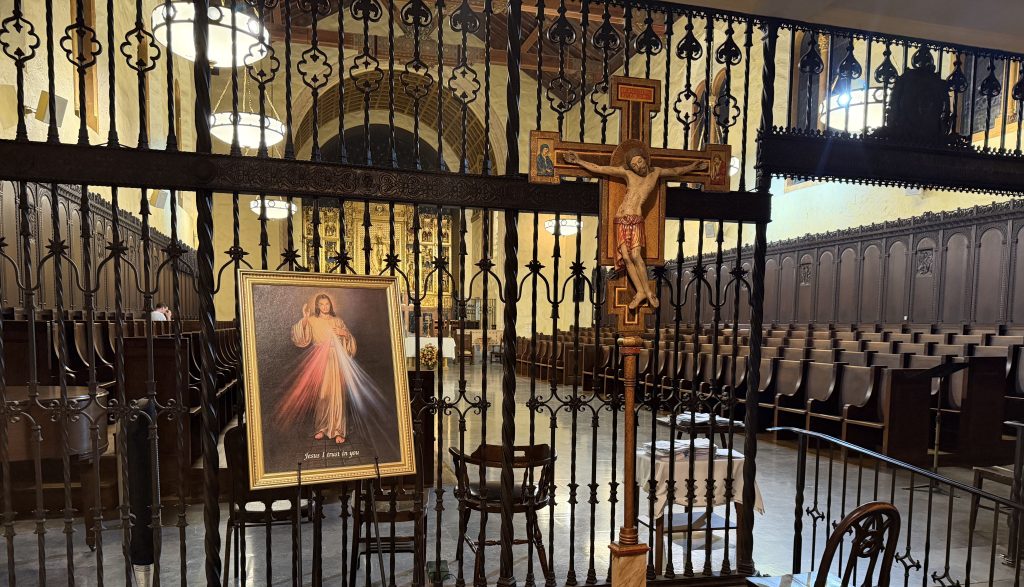
Copy of the painting of Divine Mercy image by Eugeniusz Kazimirowski that is hanging in my office. “Have mercy on us and on the whole world.”
McCann, Deborah. 30 Days of Reflections and Prayers: What Pope Francis Says About Mercy. New London, CT: Twenty-Third Publications, 2015.