We can choose to be envious or grateful for God’s generosity to others.

Jesus told his disciples this parable: “The Kingdom of heaven is like a landowner who went out at dawn to hire laborers for his vineyard…” (Mt 20:1).

At dawn, nine, noon, three, and five o’clock the landowner hired day laborers to go into the field to bring in the harvest. Many, familiar with this parable, find themselves a bit bemused, bewildered, or even angry at the ending when they read or hear that the landowner had his foreman pay everyone the same pay. The immediate cry is, “That is not fair!” Those, more often than not, who respond this way are focused on the hired hands who started at dawn, worked all day, and were paid the same as the laborers who started at five o’clock.

The workers who started at dawn agreed to a certain wage and the owner paid that agreed amount. The landowner explained, “to one of them in reply, ‘My friend, I am not cheating you. Did you not agree with me for the usual daily wage” (Mt 20:13)? What is missed, if someone is feeling as perplexed as were some of the dawn laborers, is the generosity of the landowner.

We see this similar scene of generosity given and played out in some of Jesus’ other parables. The older son who refused to listen to his father’s invitation to come in to share in the celebration of the feast when his wayward brother had been lost but now was found (Lk 15:11-32); the man who was forgiven his entire debt from the king and then when he had the same opportunity to forgive the one who owed him, did not (Mt. 23-35), and in the parable of the Good Samaritan the priest and Pharisee left the man on the side of the road yet the Samaritan, the despised one, was the one to provide aid (Lk 10:25-37). Each of these parables represents the generosity and mercy of God.

There is a reason Jesus shared the parable of the workers in the vineyard after warning about the dangers of riches. Jesus is inviting the disciples and us to be generous with our time, talent, and treasure. He is also calling us out of our group think or tribal mentality. He is showing us that God’s invitation is for all and he is free to bestow his mercy, grace, and forgiveness on those for whom he chooses, whether we approve or not. Ideally, he seeks to bestow his mercy on others through us. We too are to be agents of his grace.

Are we aware of how generous and merciful God has been with us? If not, instead of focusing on what we do not have, may we give some daily thought to the blessings we do have in our life, otherwise, we will fall prey to the temptation of envy with the generosity that God shows to others. Envy arises when we don’t only seek what another has but begrudge what another has received. This attitude can even grow into wishing harm to befall them. And for what, because they have been blessed?

The parables of Jesus are great to pray with and it is important to be honest with our answers. Do we relate to: the laborers who worked all day for their fair share and begrudged those who received the same pay for an hour’s work, the older brother unwilling to be grateful for the return of his brother, the servant unwilling to show mercy to a debtor, and/or the priest and Pharisee that took the long way around the wounded man on the Jericho Road? If we answer yes, to any or all of the above, allowing the light of Jesus’ mercy and forgiveness can lead us to repent, experience forgiveness, and be grateful for God’s love, which is unmerited. Resting in gratefulness, we can rejoice in the generosity that God bestows upon others, even at the eleventh hour.

———————-

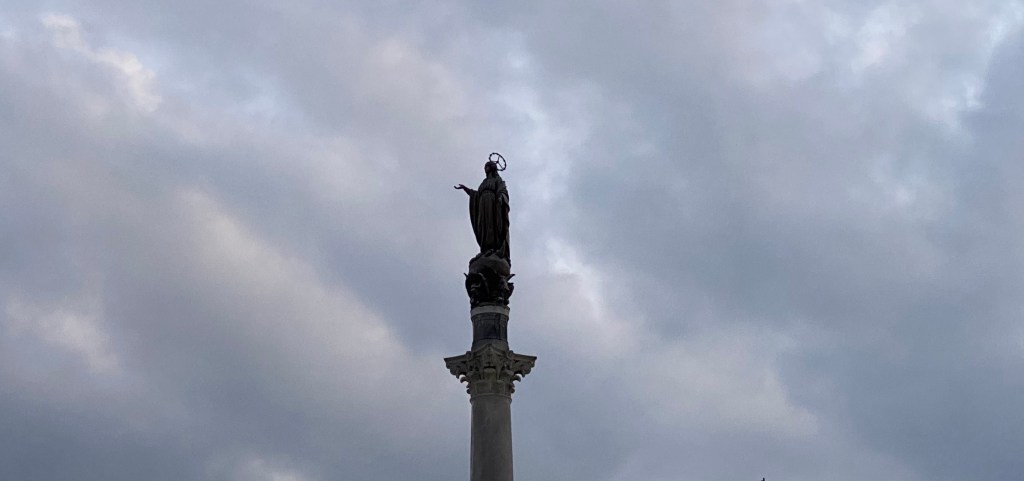
Photo: Mary can lead us through the clouds of our self-preoccupation to experience the light of her Son, taken at University of Mary of the Lake.

Link for the Mass readings for Wednesday, August 20, 2025

May we be grateful for who and what God has gifted to us in this life.

“Who then can be saved?” Jesus looked at them and said, “For men this is impossible, but for God all things are possible” (Mt 19:25-26).

The disciples are “greatly astonished” about Jesus’ comments about how difficult it would be for the rich to enter heaven. Their astonishment came from the belief system that those who had wealth did so because they had been blessed by God for following his commandments. Just remember the rich young man’s attitude from yesterday. He had followed God’s commands and was blessed with riches, but Jesus turned his world upside down when he asked the man to give up all he had to follow him.

Jesus attempted to help the man and his disciples to understand that what we have, all that we have, is a gift from God, starting with our very existence. He is the ground, the source, and sustenance of our life as well as our ultimate fulfillment. A problem arises when we place our security in material things instead of God who provides them for us.

When we place our security in and become dependent upon that which is finite, we are always going to be left unfulfilled, attached, and/or at worst addicted, and so like the rich man, unwilling to give of ourselves to those in need, because we are afraid, we won’t have enough. Also, when we look to our own effort and work ethic, we can build a reliance on our self alone. We can place ourselves as the supplier of our security instead of God. Pride then becomes a dangerous and corruptive idol. We think and start to believe that we don’t need God because we can do well enough on our own, thank you very much.

“Who then can be saved?” The disciple’s question appeared to be agreed upon by all, since Matthew infers that all of them were asking the same question. This can be our question as well. If we can’t buy, earn, or achieve our way into heaven, how will we get in? Jesus is clear. For men, this is impossible because there is no means for us to get there on our own merit. But for God, all things are possible because our salvation is a gift freely given by him.

As with any gift though, we need to be willing to receive it and accept it. One way is to be grateful for what we have and recognize that the source of all he has given us is God. In this way, we can share freely from what we have, because God, who is our source, is unlimited. As we give from what God has given, God will continue to supply. What is primary then is deepening our relationship with him and collaborating with him. As we do so, we will have the proper orientation to encounter one another in love.

What is essential in our life is not what we have, as much as that we recognize that God is the source of all we have, that he will provide for us, and is present with us when we are aware. Time goes fast. This life that we have been given is good, but it is also finite, and fragile. Let us not take the time we have be gifted with nor each other for granted, let us place our trust in Jesus who is our true foundation and with him, “all things are possible.

—————————————————————

Photo: I am thankful for Mary’s growing presence in my life these past few years. Great to spend some time praying at this grotto at the University of St. Mary of the Lake a few weeks ago.

Link for the Mass readings for Tuesday, August 19, 2025

What do we still lack?

A young man approached Jesus seeking to know what he must do to attain eternal life. Jesus shared that the key was to keep the commandments. The man asked which ones he was to follow, a reasonable request as there were 613 commandments to choose from! Jesus gave him six: do not kill, commit adultery, steal or bear false witness; do honor his father and mother, and love his neighbor as himself (cf. Mt19:18-19). The man affirmed that he had followed them all. Then he asked that next question, “What do I still lack” (Mt 19:20)?

I can feel the disciples wince, see the mouth of Jesus curl into a smile while his left eyebrow raises. Mark is more eloquent than me: “Jesus looked at him, and loved him…” (Mk 10:17). Matthew, in his Gospel account, does not engage in such subtleties.

Jesus said to him, “If you wish to be perfect, go, sell what you have and give to the poor, and you will have treasure in heaven. Then come, follow me.” When the young man heard this statement, he went away sad, for he had many possessions (Mt 19:21-22). The young man was so close!

Jesus saw that which was keeping this man from following him. Jesus gave him the opportunity to renounce what he had, give to the poor, and receive eternal life – his original request. It is what we have all been created for, “You have made us for yourself, O Lord, and our hearts are restless until they rest in you” (St Augustine, Confessions). The young man knew what he needed to do but was too attached to his wealth to let go, so he walked away sad.

We do not know if the young man reconsidered Jesus’ offer and returned. I invite you to find a quiet space today, enter the stillness, and return to this scene in your imagination. Play it out again in your mind and come to the same ending, with the disciples and Jesus watching the rich man walk away sad. Continue your observation of them as they ever so slowly turn their heads and gaze at you. Then ask Jesus, “What do I still lack that is keeping me from walking a more intimate walk with you?”

What are you holding onto that is keeping you from giving yourself to the One who is truly Good? “Jesus presents himself as the way to salvation; he is the ultimate good for which the young man” (Mitch and Sri, 247) was searching and we are searching. Jesus looks at you, loves you, and says, “If you wish to be perfect…” What does he ask you to let go of, to renounce, and follow him?
———————————————–

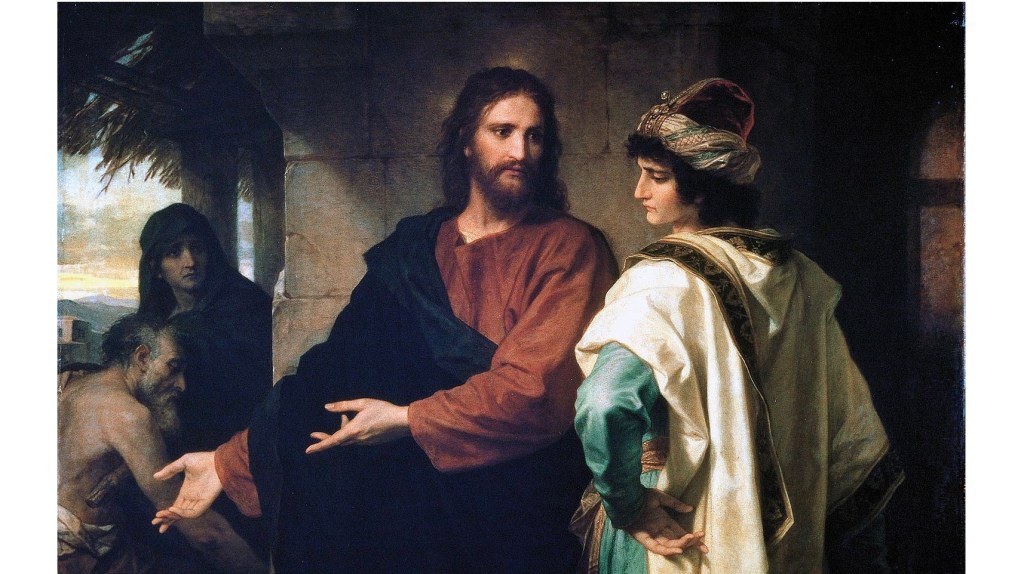
Painting: “Christ and the Rich Young Ruler” Heinrich Hoffman, 1889

Mitch, Curtis and Edward Sri. The Gospel of Matthew. Grand Rapids, MI: Baker Academic, 2010.

Link for the Mass readings for Monday, August 18, 2025

“The Kingdom of heaven belongs to such as these.”

“Let the children come to me, and do not prevent them; for the Kingdom of heaven belongs to such as these” (Mt 19:14).

Again we see the disciples refusing access to Jesus. The scriptures are not clear why they consistently act this way. We see them doing so with the blind man Bartimaeus, the tax collector Zacchaeus, and the Canaanite woman. In today’s reading, they are refusing access to children. The characteristic of each of those being refused is that they are considered to be on the periphery of Jewish society.

Children, paidia in Greek, especially so. Paidia could represent a child from infancy to twelve years of age. In ancient Palestine, children were particularly vulnerable, had no status and were completely dependent on their families for survival. Luke goes even further than Mark and Matthew by using, brephē, meaning infant, to describe the children. It is to these children and infants that Jesus states the Kingdom of heaven belongs.

Just as consistent as the disciples are in turning away those in need, Jesus is just as consistent in his ministry of paying particular interest to the individual person in their particular need. He welcomes the children and blesses each one of them. Jesus continually acknowledges and affirms the dignity of each person he meets, especially those neglected and ignored. Those who have been on the other side of the glass looking in, Jesus grants admittance. Jesus bridges the divide of separation through his presence and healing touch.

To enter the Kingdom of heaven, we must be willing to trust and place, as children, even more so, as infants, our total dependence on God alone, instead of relying on our own initiative or effort. There is nothing we can do to earn our way into heaven. The entrance into the Kingdom of heaven is a free gift of God’s grace. This gift is not about our worthiness, for all of us fall short. It is about our willingness to acknowledge our utter dependence on our loving God and Father and accept the invitation he offers all of us to be in relationship with him. As we do so, we are to resist the temptation to prevent others from having access to this wonderful gift, but instead we are to share the same invitation we have received with others.


Photo: A stained glass image of Jesus with children at Our Lady of the Angels Cathedral, Los Angeles, CA.

Link for the readings for the Mass for Saturday, August 16, 2025

“Holy Mary Mother of God, pray for us sinners, now and at the hour of our death.”

There was no one on this earth closer to Jesus than Mary. He was conceived in her womb, she bore him, nursed him, raised him, initiated his public ministry, held him in her arms as he was taken down from the cross, and she was with the Apostles in the upper room when the Holy Spirit descended upon them. Mary from her own beginning, through God’s grace, experienced an Immaculate Conception. When her time came to leave this life, who better than Mary to have experienced the “singular participation in her Son’s resurrection and an anticipation of the resurrection of other Christians” (Catechism of the Catholic Church 1997, 966)?

Today we celebrate the official dogmatic constitution issued by Pope Pius XII in 1950, the Assumption of Mary, acknowledging what the Church has recognized from the beginning, the special grace she received from her Son. Jesus is the promise and Mary is the hope that we will live eternally with our heavenly Father, for Mary is now where we will one day be, body and soul.

Jesus and Mary have undone the sin of Adam and Eve. They, in their continual faithful life of saying yes to the will of God, opened up heaven for us. In our darkest trials, when the storm clouds of injustice, racism, violence, division, and polarization gather, when a situation or conflict does not appear to be getting any better, when death may be imminent, and/or when a loved one has died, even then, death does not have the last word because we are not alone.

As St. Paul wrote to the Church in Corinth, “Christ has been raised from the dead” (1 Corinthians 15:20). Jesus is the first born of the new creation. We are invited to join Jesus in participating in his new Kingdom on earth as it is in heaven, preparing ourselves in this life for eternity in the next. How? By doing what Jesus and Mary did. We are to open our hearts and minds to God, hear and observe his word, and put into practice what we receive.

Mary was not blessed so much because she gave birth to the Son of God but because she heard the Word of God, pondered it in her heart, obeyed, and put it into practice. This is why the Church calls Mary the model of discipleship. Just as the moon does not radiate because of its own light but reflects the light from the Sun, so Mary reflects the light of her Son.

Mary radiates the light of Jesus in her thoughts, words, and deeds and we are to do the same such that when people look at us they no longer see us but the love of Jesus radiating from us. How do we radiate Christ to others? We become deified, our likeness to God is to be restored through our participation in the life of Jesus. This happens when we make a daily commitment to meditate, pray, and contemplate the words that God has given to us in Sacred Scripture, so as to allow the Holy Spirit to transform us by the holy fire of his love.

A simple way to begin is to commit to a time and place every day to ponder the mysteries of Jesus and Mary. One beautiful way is to practice the Rosary which embodies all three of the traditional forms of Catholic prayer, vocal, meditative, and contemplative. You may feel that praying a Rosary in one setting is too much of a task to undertake, then start with one mystery. Make the Sign of the Cross, take in three, deep breathes for each Person of the Trinity, announce the mystery and begin to ponder the mystery you have chosen.

Since today we are celebrating the Solemnity of the Assumption of Mary, ponder this beautiful mystery. The Lord’s Prayer helps to quiet our minds so we can ponder. Each Hail Mary, like background noise in a movie, helps our minds to resist distraction. Then as our mind stills we can stop the vocal part of the prayer and just imagine Mary’s final hours, maybe with the Apostle John by her side. We can imagine ourselves joining him and experiencing the peace of not only her passing but of her Assumption into heaven, body and soul. We can contemplatively rest in God’s peace that we have received from our time with Mary and the promise that she is where we will one day be and remember who we are, beloved daughters and sons of our loving God and Father.


Photo: “… by her Assumption, she goes ahead like her son to prepare a way for us.” – From The World’s First Love, by Fulton J. Sheen.

Link for the Mass readings for Friday, August 15, 2025

Let us say only the good things people need to hear.

Gossip is a seductive and enticing poison. Many of us fall for its lure and its intoxication. There are many different reasons we engage in gossip. We may think we feel better about ourselves by putting someone else down, we may be jealous of what another has, envious because we wish someone ill, maybe someone just rubs us the wrong way, or there is a sense of intimacy with another in the commonality of talking about someone else. We may even feel justified to do so when someone has hurt, offended, or wronged us or someone close to us in some way. Even in that instance, we observe Jesus offering a different approach in today’s Gospel.

Jesus said to his disciples: “If your brother sins against you, go and tell him his fault between you and him alone” (Mt 18:15). Jesus is drawing on his Jewish heritage. Leviticus 19:17 warns against holding hate in your heart and instead encourages seeking to reason with your brother. Jesus is redirecting us from disparaging, gossipping, adding fuel to the fire by seeking revenge or stewing in our own hurt, which will build resentment and hate. Instead, he is inviting us to seek reconciliation.

Pope Francis, in his September 9, 2016, General Audience was very clear: “[G]ossip is a ‘terrorist’ who throws a grenade – chatter – in order to destroy,” he added. “Please, fight against division, because it is one of the weapons that the devil uses to destroy the local Church and the universal Church.” Let us refuse to be a weapon of the devil in his plot to divide us with our thoughts or our words, but instead, seek to be a disciple of Jesus by advocating for forgiveness and reconciliation.

St. Paul guides us to let no evil talk pass our lips and say only the good things people need to hear (see Ephesians 4:29). May we meditate upon and pray with this verse as well as put it into practice. With our words, we can cut, wound, and destroy, or we can convict, reconcile, and heal. We can commit to being more discerning with our thoughts and tongue, and choose to lift up and empower one another.

Pope Leo XIV encouraged the youth at Rate Field in Chicago on June 14: “To share that message of hope with one another – in outreach, in service, in looking for ways to make our world a better place – gives true life to all of us, and is a sign of hope for the whole world.” We can share messages of hope and make our world a better place when we discern well in our minds what we are going to say before letting the words fly.

Yes, it is easier to grumble about someone than to approach them in love and work for reconciliation. But this only perpetuates division. It is worth the time and energy to be more intentional with our words. When needing to hold another accountable, it is important to do so directly and with respect. It is also helpful to step out of reactive mode, by taking some breaths, seeking the help of the Holy Spirit, and thinking before we speak. If we just aren’t there yet, maybe we can start with a slow breath and a simple smile. We will all be better for the effort.


Photo: With my seminarian brother, now Dcn. Carlos, on our 30-day silent retreat back in July of 2023. A good fast from words and making friends with silence can help us better discern what to think and speak.

Link for the Mass readings for Wednesday, August 13, 2025

We are to “turn and become like children.”

“Amen, I say to you, unless you turn and become like children, you will not enter the Kingdom of heaven. Whoever becomes humble like this child is the greatest in the Kingdom of heaven. And whoever receives one child such as this in my name receives me (Mt 18:3-5).

The above response Jesus gave was to the disciple’s question regarding, “Who is the greatest in the Kingdom of heaven.” Jesus offered an unexpected response, as children had no esteem, honor, let alone greatness in the cultural realm of his time. Jesus was also not pointing out so much the innocence of children, but emphasizing that children were completely dependent on others for their very survival.

If we are to embark or stay on the journey that will lead us to the Kingdom of heaven, we need to do the same. Jesus is inviting us to give up our control, our apparent, self-sufficiency, and surrender all we are to God and place our dependence on him alone. We are to depend on God as would an infant or young child depends on his or her parents.

Very young children also have not developed a defensive filter and they say what is on their mind, often with precise insights! How often do we do the opposite by automatically responding in a defensive manner, thinking about how we will be received or fearing an ulterior motive from the question? Jesus has taught us that our yes is to be yes, and our no is to be no, and anything more is from the evil one (cf. Mt 5:37). As his disciples, Jesus calls us to be humble, to admit to our sins, our mistakes, to confess, correct, learn from them, and so mature in the spiritual life.

We grow in humility when we depend on God and place our trust in him. Doing so, we will experience the truth and see through our own rationalizations for accepting apparent goods instead of that which is truly good. Having turned away from the false promises and turned toward the truth, we will mature and begin to discern between what St. Ignatius of Loyola calls the competition of goods – choosing between those things that are indeed good, but accepting only those that align with God’s will for our unique station in life.

Trusting in God for everything and depending completely on him will also make our lives much simpler because we will no longer be chasing after that which is really not helpful or healthy. We will also come to accept that what we have, is a gift from God. From this place of gratitude, we will experience more peace and more rest, or as St. Jane de Chantal’s offers: “How blessed is the person who, in tranquility of heart, lovingly maintains the sacred sense of God’s presence! For this person’s union with divine Goodness will continue growing perpetually, though imperceptibly, and will fill her whole spirit with its infinite sweetness…”


Photo: When we allow ourselves to be childlike we can also embrace wonder again!

Link for the readings of the Mass for Tuesday, August 12, 2025

Jesus leads us through death into life.

Jesus said to them, “The Son of Man is to be handed over to men, and they will kill him, and he will be raised on the third day.” And they were overwhelmed with grief (Mt 17:22-23).

This is the second time in the Gospel of Matthew that Jesus shares with his disciples that he will die soon. They are overwhelmed with grief because their focus is on the first part of Jesus’ statement that he will be handed over to death. They do not understand or yet comprehend the second part about how he will be raised on the third day. How could they? There was no point of reference for them. Jesus did bring three people back to life during his ministry, but Jesus would not be merely resuscitated as they were and just die again. Jesus would resurrect and conquer death.

For us, we can read today’s Gospel about the impending death of Jesus and gloss over it a bit too easily. Because we celebrate Easter each year, we celebrate that Jesus has risen. Yet, do we really take in what this means? Does the fact of the Resurrection, the reality that Jesus has conquered death and become the firstborn of the new creation really have relevance in our lives?

The life, death, and Resurrection of Jesus matters! The missing piece for those for whom this statement doesn’t register any relevance may be that they do not want to think about death all that much. To be honest, none of us really want to come face to face with our own mortality, and most of us don’t until we or a loved one is forced to.

Beginning the summer after my freshman year of college, I began working the second shift in a nursing home as a CNA. It was the first time that I experienced death up close through the care of the residents I worked with. They were not merely patients but became family. What happened when I was present when some of them died was surprising. I was blessed with an experience of peace.

I learned from these moments of grace, revisited with my own wife, JoAnn’s death, and in this past year as a priest walking with about forty families from anointing to funeral masses, is to not take life for granted. Life is fragile and when we are able to contemplate and face the impending reality of our own deaths as well as those we love, we have an opportunity to live our lives more fully as well as appreciate a bit more those still with us! And when we experience this practice with the One who conquered death, life and our purpose takes on an even deeper meaning.

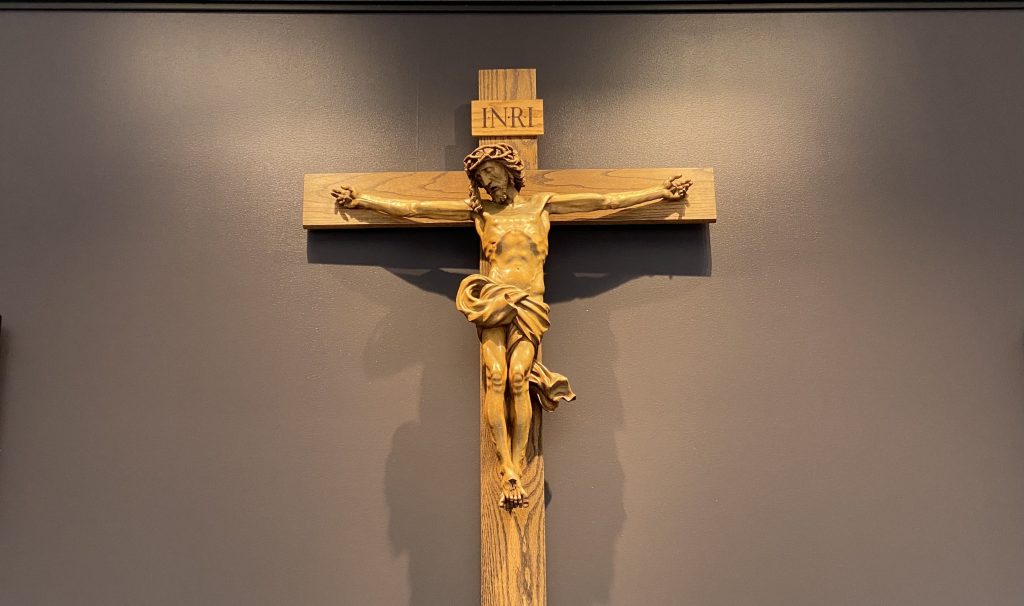
Jesus understands each of our struggles and tribulations, our sins and our failings, as well as our deepest hopes and dreams. Jesus also knows about our deepest fear of death, for he, as a human being, experienced it too in the Garden of Gethsemane. The gift of the crucifix, the sacramental object of Jesus on the Cross, is a reminder of the reality of death while at the same time that death does not have the final answer, Jesus, fully human and fully divine, does.


Photo: Crucifix outside the dining hall at University of St. Mary of the Lake.

Link for the Mass readings for Monday, August 11, 2025

Our Father is pleased to give us the kingdom.

We live in a fallen world where suffering, violence, hatred, anxiety, and fear abound and this reality does not appear to be getting better any time soon. Yet, there is still cause for hope. Jesus says in the opening of today’s Gospel: “Do not be afraid any longer, little flock, for your Father is pleased to give you the kingdom” (Luke 12:32).

Unfortunately, far too many do not find comfort in these words. A common complaint is “Well, Jesus said these words some two thousand years ago, I do not see any kingdom, and not only has this world not gotten any better, but it also seems to be getting worse!” To say or buy into this perspective is to miss what God’s kingdom is.

The first words that we have recorded from the beginning of the ministry of Jesus were, “This is the time of fulfillment. The kingdom of God is at hand. Repent, and believe in the Gospel” (Mk 1:15). What Jesus said then and is saying to us now is that the kingdom of God is about a relationship and a relationship happens person to person and builds slowly over time.

Jesus came to restore the relationship that has been lost with his Father. We live in a fallen world because most of us have forgotten who we are – children of God. Instead of our primary focus being the building and strengthening our relationship with God, we are distracted, diverted, tempted, and led astray by so many other material pursuits and voices. We put ourselves first. We are the priority instead of God and each other. There is suffering, pain, and deep hunger in the world because too many are selfish and self-centered.

The “little flock” that Jesus is offering the kingdom of God to is the disciples who are willing not only to hear his word but those who are willing to receive and put God’s will into action and practice. Because the Apostles did just that, we can do the same today, but each of us have to make our choice about who we are going to follow and which voice we are going to listen to. Our Father is pleased to offer us the kingdom, relationship with him. Will we receive this gift and seek that which is above, or choose to be diverted and entranced by the things here below that only wither and fade?


Photo: God was willing to come close to us through his Son. Are we willing to come close to Jesus to know his Father and be a part of his kingdom?

Link for the Mass readings for Sunday, August 10, 2025

Be still, and allow the Holy Spirit to burn!

Then the disciples approached Jesus in private and said, “Why could we not drive it out?” He said to them, “Because of your little faith.” (Mt 17:19-20).

How do the disciples get from this recurring theme of having little faith in the Gospel accounts to Peter healing a crippled beggar by saying with boldness, “I have neither silver nor gold, but what I do have I give you: in the name of Jesus Christ the Nazorean, [rise and] walk” (Acts 3:6)? And the man did just that!

A helpful definition “is to say that faith always entails a relationship between persons which stands or falls with the credibility of the person who is believed” (Rahner and Vorgrimler 1965, 164). Faith is not just an intellectual exercise, it is a lived experience. Christian faith is the conviction, belief, and relationship experienced with Jesus the Christ. The disciples learned from Jesus but more importantly developed an intimate relationship with him, such that the love they received and shared became so strong that there was no more room for doubt, distraction and/or fear, such that they would align themselves with the will of God and do what Jesus did.

The disciples did have some moments of doing as Jesus had done, but it was not until Jesus ascended and the Holy Spirit descended upon them at Pentecost that everything changed. Jesus had tilled the soil, he helped to unearth the rocks of the hardness of their hearts, he forgave them, and healed them. But it was not until they let him go after his Ascension that they were able to receive the Holy Spirit and by his power working through them they would do even greater deeds than he (cf. Jn 14:12-14)!

We are invited to do the same. If we only read the Gospels or hear them read we may know something about Jesus, but our life will for the most part remain unchanged. When we read, meditate, and pray with the Gospels and put into practice what we read, we will encounter Jesus as did his disciples. We too will come to know and develop a relationship with Jesus and our hearts and minds will be transformed by him. In this way, we are not just reading a dead letter but encountering the living Word, the Son of God, who invites us to share in the infinite dance of Love that he participates in with God the Father and God the Holy Spirit.

The enemy will do everything in his power to distract, divert, and tempt us from setting aside time to pray with God each day. And when we actually begin to discipline ourselves, enter into quiet time daily, we are invited not to stay there but to go deeper, to move beyond only reading, meditating, and praying. There will be times Jesus invites us to set aside our Bible, notes, journal, prayer cards, and/or vocal prayers of petition, and to just be still, to listen, and receive the love that Jesus and the Father experience, the Holy Spirit.

The same Holy Spirit who empowered the Apostles to fulfill what Jesus had begun with them is quietly nudging us on each day. Please listen! He is inviting us to see more clearly those subtle ways we are being distracted, tempted, and diverted from his guidance and what has been inhibiting the growth of our relationship with God. The love and light of the Holy Spirit will reveal, when we are willing to remain still, where and how, in minute and massive ways, we are refusing to follow the will of God.

One of the reasons that we have “little faith” is that we rely too much on ourselves. We are invited to stand in the presence of the Holy Spirit and let his fire burn, to purify us from our own misguided thoughts of self sufficiency. As gold and silver is placed in a crucible and heated, the dross is purified. We are purified in the crucible of our meditation, prayer, and contemplation by the love of the Holy Spirit. Through this purifying light we will see that we cannot save ourselves, that we need a savior, Jesus, with his arms wide open ready, willing, and able to forgive us and love us unconditionally and continually.

———————————————————————–

Photo:  A moment of stillness and purification back in December.

Rahner, Karl and Vorgrimler, Herbert. Theological Dictionary. New York: Herder and Herder, 1965.

Link for the Mass readings for Saturday, August 9, 2025