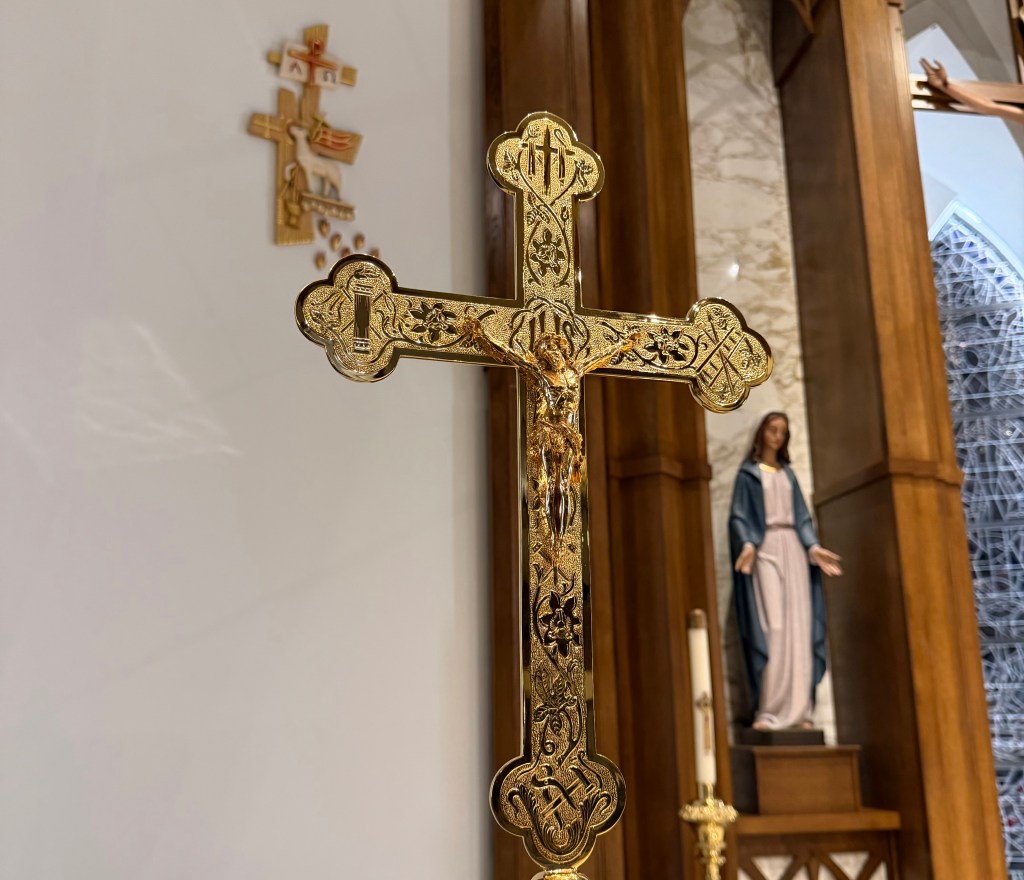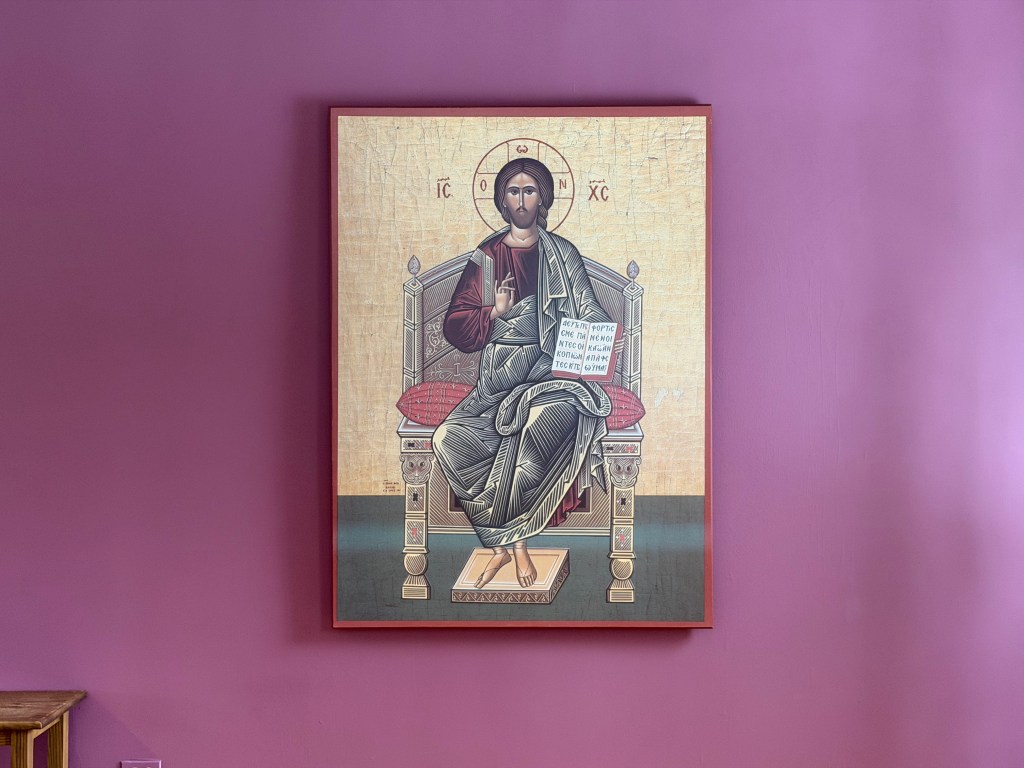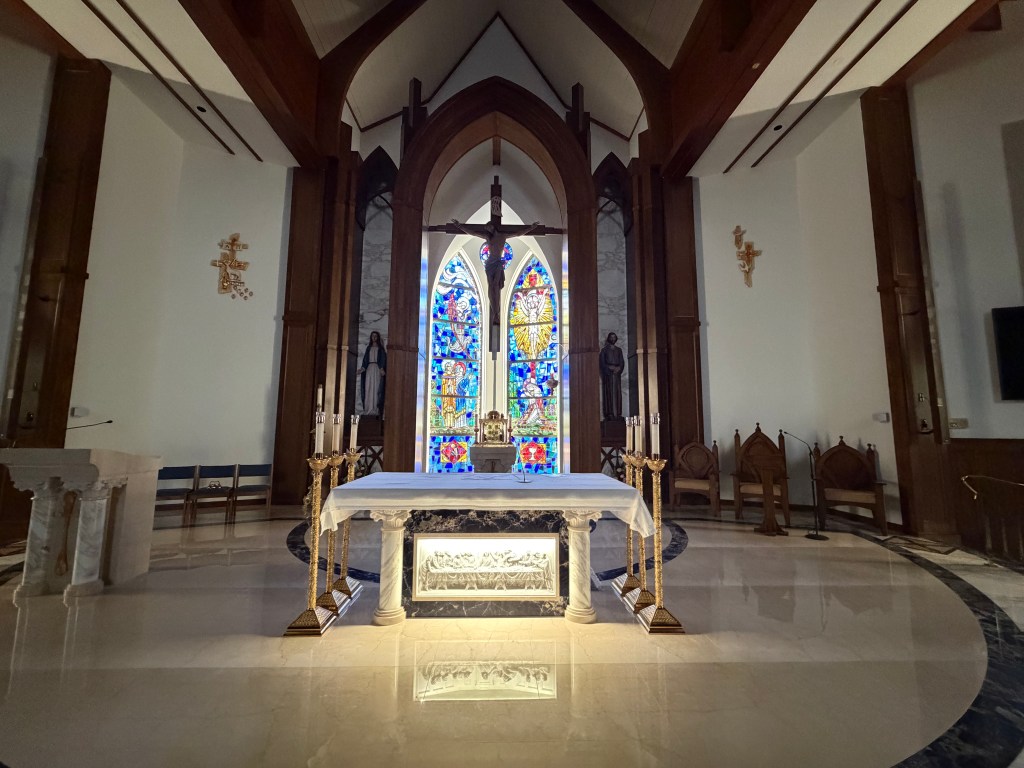
We have been created to love and to serve as Jesus loves and serves.

“When you have done all you have been commanded, say, ‘We are unprofitable servants; we have done what we were obliged to do'” (Lk 17:10).

This closing line from our Gospel reading today can be a hard verse to digest at first glance, especially with our track record of slavery in the U.S. We need to remember and recognize that this was a teaching that Jesus shared in a different time period, in a different culture, and in a place far removed from any clear modern context. The master/slave relationship is also a theme that Luke returns to often.

Another important point to touch upon when reading the Gospels is that when Jesus made the statement that, “we are unprofitable servants; we have done what we are obliged to do”, we are not to read this verse in isolation from the full context of Scripture. Jesus also shared a parable about a master and servants in which when the master returns, he waits on them (Luke 12:35-40). Jesus himself modeled this same service at the last supper when he washed his disciples’ feet (cf. Jn 13:1-17). This was the lowest of menial tasks. St Paul wrote to the Galatians informing them that in the Body of Christ there is no Jew or Gentile, slave or free, male nor female (cf. Galatians 3:28). The ultimate point is that God is God and we are not. We all have a part to play in participating in and promoting the kingdom of God by following his lead.

As a disciple of Jesus, we are not to seek adulation and glory. We are to serve God and one another without hesitation. We serve God because he is the director and we are the directed. He is the master and we are the servant. In aligning ourselves in this way, we also experience the intrinsic joy of following his will. As we follow Jesus’ lead and guidance, we grow in our relationship with him, his Father, and experience more of the love of the Holy Spirit. As the apostles followed Jesus, there came a point where he said to them that he no longer called them servants but his friends (see John 15:15). That is to be our hope as well.

No task is too menial or beneath us, nor do we need to be concerned about doing big and grandiose things. We just need to be obedient and act as God leads. Instead of reacting, losing our temper, fuming in anger, or twisting ourselves in anxious knots, we each can choose to smile, to hold a door, to respect and appreciate one another, to be patient and present to one another. When conflicts arise, breathe and ask the Holy Spirit to guide us before we react. We serve best when we listen with understanding, give others the benefit of the doubt, forgive, and allow ourselves to love and serve as God directs us.

Pope Leo shared during a recent gathering of bishops on September 11, 2025 that: “Service is neither an external characteristic, nor a way of exercising a role. On the contrary, those whom Jesus calls as disciples and proclaimers of the Gospel, in particular the Twelve, are required to have inner freedom, poverty of spirit and readiness to serve, which are born of love, to embody the same choice made by Jesus, who made himself poor in order to enrich us (cf. 2 Corinthians 8:9). He manifested the style of God, who does not reveal himself to us in power, but in the love of a Father who calls us to communion with him.” We may not be bishops, but we are disciples. We begin in simple ways and with each act of kindness, our hearts expand, we are moved to serve, to love and to grow in communion with God and one another. As St. Mother Teresa said, we are to be a pencil in God’s hand. In our willingness to be moved by God to serve, we as well as those in our realm of influence that we serve, will be better for the effort.

———————————————————

Photo credit: In giving ourselves prayerful pauses we can experience God’s love and so are recharged to love and serve some more.

Link of Pope Leo’s address to the bishops

Link for the Mass readings for Tuesday, November 12, 2025

Forgiveness helps us to walk the path that leads to our healing.

“If your brother sins, rebuke him; and if he repents, forgive him. And if he wrongs you seven times in one day and returns to you seven times saying, ‘I am sorry,’ you should forgive him” (Lk 17:3-4).

Forgiveness is one of the foundational principles of our faith tradition as Christians. If we question or struggle with the degree of forgiveness we engage in, we are in good company with Peter. Thinking he was being generous, Peter asked Jesus how many times should he forgive, seven times? Jesus responded, “I say to you, not seven times but seventy-seven times” (cf. Mt 18:21-22).

Luke records the exchange of the disciples asking Jesus to teach them to pray. He taught them the Our Father or Lord’s Prayer. While reciting this prayer often each day or multiple times each day, we say, “Give us this day our daily bread, and forgive us our trespasses as we forgive those who trespass against us” or “forgive us our debts as we forgive our debtors” (Mt 6:11-12).

One of the barometers of being a faithful disciple of Jesus is that we are people who practice the sacred art of forgiveness. To forgive does not mean in any way that we condone or justify the offense or even necessarily forget about it. We are to hold people accountable, as Jesus said, we are to “rebuke them” in the hope that they will repent and come to a greater appreciation and respect of our dignity and the dignity of others. When they do repent, we are to then forgive them.

Holding on to grudges, seeking revenge, being unwilling to forgive, can be incapacitating, debilitating, and can lead to a premature as well as eternal death. What can be of help is if we can choose to be more mindful of our thoughts and actions. At the moment we experience discomfort from what someone says or does, instead of giving in to the temptation to react or to let our mind run with the offense, it is very helpful to take some deep breaths, relax our shoulders, and/or loosen our grip. As the negative thoughts attempt to rise again, don’t fight or feed the thoughts, just return to being aware of our breath and ask Jesus to help us be more understanding and forgiving. This will also help our body to discharge the stress and experience God’s peace.

We may struggle with being forgiving because we may not have sought or received much forgiveness ourselves. Advent is coming. It is a season to prepare to celebrate the coming of Jesus into our lives. This season provides a wonderful opportunity to prepare and participate in the Sacrament of Reconciliation. Forgiveness is a healing gift of God’s grace. Once we have felt the healing balm of forgiveness, we might be more willing to forgive others.

A good practice to engage in is to go to a place of quiet and ask God to help you to forgive someone or a few people. Even if your prayer begins, “God, I cannot forgive, I hurt too much, but help me to let go, please help me to forgive, (insert name).” Return each day until you can bring yourself to say, “I forgive, (insert name).” Visualize yourself saying that you forgive the person face to face and imagine a healing between each of you. If the opportunity presents itself you may want to say that you forgive the person directly, send an email, or write a letter – even if you do not press send or mail it.

With the intent to forgive and asking for the help of Jesus, who has forgiven us, even if in the beginning we are unwilling, with time, reconciliation is possible. Depending on the hurt that has been inflicted, you may not reach out to the other person as it may be healthier to stay apart. Forgiveness will help you to heal and not allow the person who has hurt you to continue to do so. Forgiveness is an act of love, for to love is to will the good of the other. In our willingness to forgive, there is freedom. Let us remember: “Forgive and you will be forgiven”.

——————————————————————–

Photo: Our willingness to love will help us to walk the path of forgiveness.

Link for the Mass readings for Monday, November 10. 2025

Our lives will be much better when we realize we are temples of the Holy Spirit.

When I was still teaching, I would ask my students if Jesus ever sinned. Inevitably, someone referenced the account from today’s Gospel. In these verses, we read how Jesus, “made a whip out of cords and drove them all out of the temple area” (Jn 2:15). Jesus is not sinning here, rather, he is acting in line with prophetic tradition. Jesus is making a bold spectacle to drive home the point that the temple is not a “marketplace” or a “den of thieves” but it is to be a place of worship and right praise to his Father.

We can see prophetic echoes from Zechariah 14:21 where he prophesied that there would be a time when there would no longer be “merchants in the house of the LORD of hosts” and Jeremiah 7:11 where Jeremiah asked, “Has this house which bears my name become in your eyes a den of thieves? I have seen it for myself!” Jesus not only places himself in the line of prophets and professes their words from God, he acts like them in make such bold statements. There is a difference though.

Greater still than the temple, is the people of God. Further down in the text, when those present ask for a sign to justify this act, Jesus said: “Destroy this temple and in three days I will raise it up” (Jn 2:19). John makes the point clear that Jesus was pointing to his body as the temple of God and referring to his Resurrection to come. Jesus is the new temple and he is establishing a new covenant.

The temple, the house of God, believed to be the corporal presence, the very seat of God among his people, Israel, was destroyed in 70 AD by the Romans. This left a tremendous spiritual, political, and social vacuum. Two groups that were intimately tied to the sacrificial cult of the temple, the Sadducees and the Essenes, very soon after the destruction, ceased to exist as a sect within Judaism. The Pharisees, who already were moving to a practice of home worship that mirrored the worship in the temple, would survive and be the ancestral root of different expressions of Judaism today. Another sect would also arise as the followers of the new way of Jesus which became the Church, “God’s building” and “the temple of God”.

After Jesus’ death and resurrection, his rising after the third day, Jesus becomes the first born of the new creation. Those who are baptized do not just gather in a church, they are the Church, the temple of God.

Each one of us has a unique part to play in the Church. We are called to bear witness and practice, in our own unique way, our faith in our everyday experiences. We may be the only church someone ever enters and the only Bible someone ever reads. This call to put our faith into action is not an invitation to be overwhelmed by nor an excuse to assume a posture of elitism. We are no better than anyone else.

Pope Leo recently said to students participating in the Jubilee of the World of Education: “How wonderful it would be if one day your generation were remembered as the ‘generation plus,’ remembered for the extra drive you brought to the Church and the world.” May we all hear these words, seek and follow Jesus, the Way, the Truth, and the Life, and allow his truth and his love to shape and transform our lives. When we are willing to encounter and walk together, we learn and grow from one another. We are also less apt to keep other at a distance and become more willing to draw close.

We need to resist all that contributes in any way to the dehumanization, division, hate, and violence by rooting ourselves in Jesus, the living Temple. In doing so, we will become aware that we ourselves are temples of the Holy Spirit. In spending consistent time in silence, prayer, meditation, study, worship, and service, we not only purify our temple, we better know God and his will, become conformed to and empowered by the love of Christ to be instruments of peace, contemplatives in action, and advocates for healing and reconciliation in a wounded and weary church, politics, country, and world.


Photo: God speaks to us in many ways when we give ourselves time to be still, breathe, and look up.

Link for the Mass readings for Sunday, November 9, 2025

Mammon or God? There is only one choice.

“No servant can serve two masters. He will either hate one and love the other, or be devoted to one and despise the other. You cannot serve God and mammon” (Lk 16:13).

Jesus consistently emphasizes the priority of making God primary in our lives. Anything that moves into the slot of preeminence before God is idolatrous. Anything, even family, as we heard a few days ago. We cannot have two firsts, because either we will “hate the one and love the other, or be devoted to one and despise the other.” This balancing act is not an easy discipline.

It becomes especially challenging when we look at mammon, money, or material wealth. Many of us seek our security in having a home, insurance policies, savings, retirement plans, market investments. Setting up this security is often considered prudent. The problem is when material security becomes the foundation of our life, our fulfillment, our god.

This has certainly influenced the Church at times with movements governed by a prosperity gospel. The approach to a faith life that is not so much building up a relationship with our loving God and Father, but one of seeking God as a holy investor. There is a perspective offered on verses such as the Parable of the Sower (cf. Mark 4, Matthew 13, and Luke 8) in which the primary intent in giving is to reap a financial return of ten, twenty, or a hundredfold. God certainly wants us to be good stewards, and he will indeed bless us and wants us to be generous and cheerful with our giving, but again, if in our giving the primary intent is to receive more of our treasure, we are serving Mammon and not God.

Following are two scriptural verses and two Church Father quotes that may help us to see that in giving away and not accumulating the material, thus trusting in God for our security, is the more prudent path:

“If one of your kinsmen in any community is in need in the land which the Lord, your God, is giving you, you shall not harden your heart nor close your hand to him in his need. Instead, you shall open your hand to him and freely lend him enough to meet his need” (Deuteronomy 15:7-8).

“For I was hungry and you gave me food, I was thirsty and you gave me drink, a stranger and you welcomed me, naked and you clothed me, ill and you cared for me, in prison and you visited me” (Matthew 25:35).

“When giving to the poor, you are not giving him what is yours; rather, you are paying him back what is his” (St Ambrose of Milan, 340-339).

“If each one of us took only what is necessary for his sustenance, leaving what is superfluous for the indigent, there would be no distinction of rich and poor” (St Basil of Caesarea, 330-379).

Our reactions to the above can be a barometer as to whether we are putting gold first or God first. God is to be our source and our fundamental option. The blessing we receive, the hundredfold we seek, is to be measured in love, mercy, and generosity received and given. Pope Francis, in a 2013 address, expressed his concern “that some homeless people die of cold on the streets [and this] is not news. In contrast, a ten-point drop in the stock markets of some cities is a tragedy. A person dying is not news, but if the stock markets drop ten points it is a tragedy! Thus people are disposed of as if they were trash. Consumerism has led us to become used to an excess and daily waste of food, to which, at times, we are no longer able to give a just value, which goes well beyond mere economic parameters” (Vatican Insider).

Do we place our trust, faith, and security in Mammon, or God? Do we build up treasure for ourselves at the expense of or indifference toward others or build up our treasure in heaven, aware of and reaching out to those who are in need? Were someone to observe us objectively, and closely would they say about us, “There goes someone that lives their life believing: In Gold we Trust.” Or would they say, “There goes someone that lives their life believing: In God we Trust?”


Photo: Seeking each day to breathe slow and allow each thought, word, and deed to be filtered through God’s will.

Link for the Mass readings for Saturday, November 8, 2025

Faith in Jesus “lights up our journey.”

In the Parable of the Dishonest Steward, the steward who is on the block to lose his job for squandering his lord’s property comes up with a plan to settle his lord’s accounts. He lessened the amount owed with the intent to gain some support from those indebted to his master. He could have been giving up his own profits in settling these debts, much like a real estate agent or car salesman today would forego their commission to make a sale. There is no evidence though within the account to support this premise. 

Pushed up against the wall, this dishonest steward is not even repentant. He does a quick assessment, realizes he is not strong enough to work for a wage nor is he willing to beg, he makes the judgment that his best course of action to save himself is to cheat “his master to gain favor with his debtors” (Gadenz, 282). He hopes that this gesture will at least grant his some good well when is seeking a place to stay.

Although continuing his dishonest ways, his master recognizes his prudence or cleverness He is commended by the lord because he had utilized foresight, which was a better quality to develop than the original squandering that landed him in this predicament in the first place.

Jesus commenting on this parable also acknowledged those who were clever in worldly ways. Being shrewd and having the foresight to navigate potential conflicts to acquire the desired goal is admirable. Jesus is not holding up the dishonesty of the steward as a model, but his prudence. We see again a common feature in Jesus’ parables, as well as rabbis of the time, is to build from the lesser to the greater.

Jesus is pointing out that in the ways of the world, many like the dishonest steward can act with prudence and so the “children of the light” ought to act with prudence as well. “The parable thus instructs disciples to take initiative and plan wisely  so as to enter God’s kingdom” (Gadenz, 282). Our creative energy and cleverness ought to also expended to help in evangelization. As we spread the Gospel, we do so, not in a one size fits all approach. We are to be present and adjust to each person’s uniqueness.

Many in the Church have gone before us aware of the needs of those people in their midst and coming up with creative ways to minister to them. Often they too, utilized the model of the steward’s prudence in today’s Gospel, giving up their opportunity for immediate gain to provide for the needs of others.

St. Francis of Assisi, lived his youth, not as a faithful steward, but as a pampered troubadour, part of the social elite. Then as his transformation began to take hold, he began to sell off his father’s cloth and gave it to the poor. He would ultimately renounce his family name as well as all material possessions, and give all to follow Jesus.

St. Mother Teresa, left her home at eighteen, never to see her family again to become a missionary in India with the Loretto Sisters. She became a school teacher in Calcutta, by no means squandering what the Lord gave her, but she too was called to go deeper. She left the convent to serve the poorest of the poor in the streets, those in the most deplorable of conditions.

Jesus has a unique call for each of us. We too are called to be faithful, prudent stewards, to be holy, and to be saints. What needs do we see in our midst? In what ways can we meet those needs? Each of us is invited into a deeper embrace of the Gospel. “We experience faith and encounter God in our own particular time in history, and faith lights up our journey through time. Faith must be passed on in every age” (Pope Francis, 20). May we allow ourselves to ponder the unique way that Jesus is calling us to serve.


Photo: We like Jesus, Mary, and the Saints are to be a light shining in the darkness.

Gadenz, Pablo T. The Gospel of Luke. Grand Rapids, MI: Baker Academic, 2018.

Walking With Pope Francis: Thirty Days with the Encyclical The Light of Faith. New London, CT., Twenty Third Publications, 2013

Link for the Mass readings for Friday, November 7, 2025

Feeling lost or insignificant? Jesus cares.

Luke records Jesus being critiqued for eating with tax collectors and sinners. Jesus responds to the criticism by sharing three parables, two of which we read today, and the third, the Prodigal Son, which is often reserved for reading on Sunday during this liturgical cycle of readings.

The two parables we are given today display the love that God the Father has for his children. Though we may not find being compared to a sheep or a coin endearing, the imagery of the shepherd going to find the one lost sheep and the woman searching all over her house for the one lost coin is a message well worth meditating upon.

Someone hearing this parable might say, “Why bother looking for the one sheep when you have ninety-nine other sheep or why bother looking for one insignificant coin when you have nine other ones?” But if we reflect upon this parable for a bit we might recall a time or feel right now that we may feel lost or insignificant. What Jesus is telling us is that we matter. That God loves us more than we can ever imagine, and he is constantly seeking us out. God is the creator of the vast expanse of the cosmos while at the same time he cares for each and every one of us. He cares for you as if you were the only person in the world.

We do not need to look for God so much as we need to just stop, be still, and notice he is already waiting for us. If we feel a bit worn, weary, misunderstood, lost, lonely or underappreciated, rest assured. God cares. God is present, yes, even in the midst of any conflicts, challenges, trials and/or tribulations that we may be going through. Even if we have separated ourselves from him through our sin, Jesus loves us more than we can ever mess up and he is the shepherd that watches over us and seeks us out even when we walk away from him. Return to him and allow yourself to experience the healing balm of his forgiveness.

As we return, we can let go, breathe, and allow ourselves to experience the loving embrace of Jesus and allow ourselves to be carried, embraced, loved, to be filled up, and so have more to share with someone we encounter who may also need to know that they matter, they have dignity, are not alone, and that they too are loved.


Photo: One of my favorite pencil drawings by Kathryn J. Brown, 1982 hanging in my office.

Link for the Mass readings for Thursday, November 6, 2024

We are to love Jesus more than anyone or anything.

This is a scene that I enjoy imagining and praying with. Jesus striding along with a gathering of people walking, talking, and moving about, and then he just stops and turns. Those closest to Jesus pull up to a stop, others continue right past, while at the same time others bump into and trip over those who had stopped before them. The subtle hum of random conversation then slowly comes to a halt, a stillness ripples through the crowd, and then there is silence. The dust begins to settle. Those closest to Jesus have their eyes locked on his, while those further back are craning their necks, moving left and right to get a better look, while still others are cupping their ears to catch the sound of Jesus’ voice.

These crowds most likely consisted of some disciples, while the greater majority were those on the periphery gathering because of curiosity, intrigue, maybe even wonder, as well as hope. Jesus then speaks, “If anyone comes to me without hating his father and mother, wife or children, brothers and sisters, and even his own life,…” and then, “Whoever does not carry his own cross and come after me…” and then he finishes with  “In the same way, everyone of you who does not renounce all his possessions cannot be my disciple” (cf. Lk 14:25-33).

Those who may be hearing these words second hand, as they were further away from the point of direct hearing, may not believe that the message was transmitted to them correctly. These words cut to the quick, just as surely as when Jesus shared about eating his flesh and drinking his blood, and when he told another follower, who wanted to bury his father to let the dead bury their dead. Luke does not say, but I am sure that many of those gathered around him were just as shocked and began to walk away.

The familial bond for ancient peoples was strong. Though the invitation of salvation that Jesus offers is for all to be saved, he is not going to dumb down or sugar coat his message just to get numbers. Jesus presents, time and again, that the way to live a life of wholeness, to restore that which has been lost, is to put God first. God must be the primary focus, the primary relationship, for nothing else can have priority of place before him. When we do so, everyone and everything will fall into their proper order and place.

Do we want to be an onlooker, just someone looking at Jesus from a distance, or a disciple? An onlooker does not have to make a commitment, a disciple does. The cost of that commitment is to let go of anything and anyone that we have put before God and will distract and divert us from the very flow of his life force that fuels our existence. If we are willing to walk the path of discipleship, we must be willing to surrender our will to God, place him first in our lives, take up our cross, and be transformed by his love.

Jesus is the interpretive key that opens our understanding. All that which is material and finite in our lives find meaning in relation to him. Only when we are able to detach from the things of this world will we then truly be free. St. Francis embodied this in a radical way. One of his foundational prayers, which he sometimes would pray for hours was, “My God and my all!” And that is the life he lived and which Jesus invites us to live.


Photo: Jesus showed his love for us in holding nothing back, giving all he had, himself, of the cross. We are called to love just as radically, a little more today than yesterday, a little more tomorrow than today.

Link for the Mass readings for Wednesday, November 5, 2025

We are invited, and then invited to invite others.

One of those at table with Jesus said to him, “Blessed is the one who will dine in the Kingdom of God.” He replied to him, “A man gave a great dinner to which he invited many. When the time for the dinner came, he dispatched his servant to say to those invited, ‘Come, everything is now ready'” (Lk 14:15-17)

Judaism was far from unified during Jesus’ time. The Sadducees, Pharisees and scribes, Samaritans, Zealots, and Essenes all felt they were the authentic expression of Israel. Jesus not only addressed this division by sitting down to break bread with as diverse a population as possible but he also shared parables around the same idea of the invitation to share in the celebration of a feast, as we read today.

Jesus is the man who was inviting people to a great dinner, his servant, is the one who is sent, an apostle, to invite others to share in this great banquet. Those invited in the first wave were those of the Israelites that were rejecting Jesus’ invitation, the second invitation were for those of the people of Israel that were within, but at the same time on the outside:  the poor, cripple, blind, and the lame. The final invitation went out to those outside of Israel, meaning the Gentiles. Thus, Jesus’ invitation of salvation and participation in the eternal banquet to come is to all of humanity, first to the Chosen People, and then to the Gentiles. Only those who rejected the offer would not be admitted.

Each encounter that we are blessed to partake in is an invitation to experience relationship. We have the opportunity to engage in person, face to face, or through the myriad of social media outlets. We can choose to demean, degrade, dehumanize, gossip, and defame or we can embrace the opportunity to treat each other with dignity, respect, kindness, and understanding, and yes, even when we disagree.

We all have wounds. Each of us have suffered or are suffering, and we have or are experiencing anxieties, overwhelm, and/or insecurities in some form or fashion. We all seek to belong, to be a part of, and to be accepted. We need God and each other. When we acknowledge these, and turn to God with them, we begin to heal and can also be more understanding. Yet, as Fr. Greg Boyle, SJ, wrote, “If you’re a stranger to your own wound, then you’re going to be tempted to despise the wounded.”

When we are willing to see our own wounds, and offer them in our poverty to Jesus, he will help. When others are not respectful, we can be less reactive, breathe, and resist reacting in kind. When someone serves up harsh words, we can resist the defensive retort and instead ask if there is any way we can help. To will each other’s good does not mean that we condone the inappropriate act or word, it means we genuinely seek their good and their healing. When we can be advocates of healing, we can then be God’s servants of invitation.  Jesus invites us to the feast of community and sharing, to prepare us for the eternal feast. Are we willing to attend and are we willing to invite others?

———————————————————————–

Photo: As we heal and experience the light of Jesus, we can receive his light and reflect it to others!

Link for the Mass for Tuesday, November 4, 2025

We pray, love, and serve because we are loved by the One who is Love.

“[W]hen you hold a banquet, invite the poor, the crippled, the lame, the blind; blessed indeed will you be because of their inability to repay you” (Lk 14:13-14).

Jesus means what he says here, though I am not sure many of us are ready to live this Gospel out. If we are going to get to the point where we can, we must understand the deeper point that he is making. The words of Jesus above give us an example of what it means to love unconditionally. We are to resist the temptation of doing anything with the primary purpose of receiving thanks or praise. We are to instead reach out to those in need because they are in need seeking nothing in return. We embrace our dignity as human beings when we recognize the inherent dignity of another and serve them without hesitation, without holding anything back.

This is the root of what we mean when we say that we are believers in the God of Jesus Christ. God is a divine community of persons, Father, Son, and Holy Spirit. The Father gives all that he is to the Son perfectly, infinitely, holding nothing back. The Son receives all that he has been given perfectly, infinitely and returns, in like fashion, what he has received back to the Father, holding nothing back. The infinite love shared between the Father and the Son is the Holy Spirit.

The Son of God became incarnate, one with us in our humanity, and he also gave all of himself to us on the cross, holding nothing back. He conquered death, rose from the dead, ascended to the Father so that we now can participate in that same divine love given and received between Father, Son, and Holy Spirit. We do not give of our time, talent, and treasure, so that we will receive more of each. We give, we love, we will the good of each other, because we have been loved into existence and are continually loved more than we can ever imagine by God. We are to receive his love and love in return because that is who he created us to be.

The very fact that we exist, that we have life, is a gift, yet we are not meant to merely exist. Jesus teaches us that the height of our humanity is to allow him to love us and through us, love others unconditionally. When we look into the eye of each and every person we meet, we are to see a brother, sister, mother, father. With each smile, each embrace, each listening ear, each act of invitation to walk not ahead, not behind, but with another, and by simply being present, we reaffirm to each other that we have dignity. This is true because each and every one of us has been created in the image of God, who is Love.

——————————————————–

Photo: St. Martin de Porres lived out this gospel literally. From the Dominican monastery in Lima, Peru, he fed several hundred people a day, provided healing, financial support, and began a school for street children. St. Martin, pray for us that we also may be people of prayer and service.

Link for the Mass readings for Monday, November 3, 2025

The will of God is that all of humanity will be saved through his Son, Jesus.

“For this is the will of my Father, that everyone who seeks the Son and believes in him may have eternal life, and I shall raise him on the last day” (Jn 6:40).

This is our hope and what we believe, that we who encounter Jesus, believe in, know him, and follow him shall have eternal life. God’s will, what he created all of us for, is to be in communion with him and one another in this life and the next. A word of assurance that I often lean on is from the book of Wisdom from our first reading today, “The souls of the just are in the hand of God, and no torment shall touch them. They seemed, in the view of the foolish, to be dead; and their passing away was thought an affliction and their going forth from us utter destruction. But they are in peace” (Wisdom 3:1-3).

The miracle of Jesus raising the daughter of the Roman official, Jairus, embodies these verses from Wisdom. As Jesus entered the home of the official many were “making a commotion” and Jesus dismissed them stating: “Go away! the girl is not dead but sleeping.” He was ridiculed by the crowd but paid them no heed. He went to the girl, took her hand, “and the little girl arose” (cf. Mt 9:18-26).

Jesus assured his followers as he assures us today that the will of his Father is that all will be saved. Experiences like the raising of Jairus’ daughter, the son of the widow from Nain, and Lazarus, were not only seeds of hope planting the promise of his resurrection to come but a foretaste of the raising of humanity on the last day. His disciples witnessed Jesus’ actions and words, and not only kept these experiences in their hearts but shared them.

Through the Gospels we are able to enter into and experience the encounters Jesus experienced with others again and again. We also experience Jesus each time we pray, participate in the sacraments, communal worship, and in our willingness to love one another through concrete actions of sacrifice and service. In each of these moments, we are conformed and shaped into who we have been created and called by God to be in this life and the next.

This All Souls Day we celebrate the gift that Jesus was victorious over sin and death, not only for himself but for all of us. Unlike those he raised from the dead and died again: “We know that Christ, raised from the dead, dies no more; death no longer has power over him” (Romans 6:9). The difference between All Saints yesterday, and the commemoration of all souls today, is that we pray for those who have died still in need of the purifying fire of God’s love. Just as “gold in the furnace” (Wisdom 3:6) is purified, so God purifies those in purgatory. Let us pray for them today that they may be freed from any stain of sin so to also join the communion of Saints!

“Merciful Father, hear our prayers and console us. As we renew our faith in your Son, whom you raised from the dead, strengthen our hope that all our departed brothers and sisters will share in his resurrection, who lives and reigns with you and the Holy Spirit, God, forever and ever” (Prayer for All Souls, from the Liturgy of the Hours).


Photo: For All Saints, we ask the saints to pray for us, for all souls, we pray for them that they may be saints. I pray for JoAnn and many each day. Who are you praying for?

Link for the Mass readings for Sunday, November 2, 2025