Daily prayer with Jesus helps us to be better and more prudent stewards.

“Who, then, is the faithful and prudent servant, whom the master has put in charge of his household to distribute to them their food at the proper time” (Mt 24:45)?

Jesus is calling us to be that “faithful and prudent steward” and the household we are to serve is our own homes, churches, communities, states, countries, and world. For the world is our home and those we serve are our brothers and sisters. Jesus’ call is a universal call to solidarity. We are all invited to be united in this effort for and with one another because we are all created in the image of our loving God and Father.

God has created us, not as automatons or robots, or drone worker bees. He has created us as unique persons, one of a kind, distinct wonders that have never been nor ever will be again. Within our uniqueness, there is also the gift of diversity. We are not intended to be separate from one another, for God has created all of us to be interconnected, to be loved, and to love. What affects one, affects all.

Jesus clearly emphasizes this distinction in his parable, often called the Judgment of the Nations, when he stated: “Lord, when did we see you hungry and feed you, or thirsty and give you drink? When did we see you a stranger and welcome you, or naked and clothe you? When did we see you ill or in prison, and visit you?” And the king will say to them in reply, “Amen, I say to you, whatever you did for one of these least brothers of mine, you did for me” (Mt 25: 37-40).

Being faithful and prudent stewards means being aware of and willing to attend to the needs of the hungry, the thirsty, the stranger, the naked, those ill, and/or imprisoned. This is not an exhaustive list. We are to allow our hearts to be open to have compassion upon those for whom God calls us to serve. We begin this process with prayer, for prayer is the most important thing that we can do each day. We are to make the time to spend in silence to discern the will of God for each our thoughts, words, and actions.

Not all of us will be moved in the same way or for the same cause. We just need to remain open to the nudge of the Holy Spirit, trust his direction, and follow him regarding how and who best we can serve, no matter how small of a gesture. One thing that can limit us is if we are unwilling to admit to and confess our prejudices, insecurities, or biases, as well as toward whom we have been unaware or indifferent. When we have the humility to confess, God is ready to forgive, heal, and transform our hearts of stone into hearts of flesh.

As we are forgiven and begin to heal, as we experience the love and mercy of Jesus, we can draw strength from him, begin to see the dignity present in ourselves, and one another, begin to see each person we encounter as God sees them and begin to take steps to follow the lead of the Holy Spirit to love, to will each other’s good, in each thought, word, and deed.


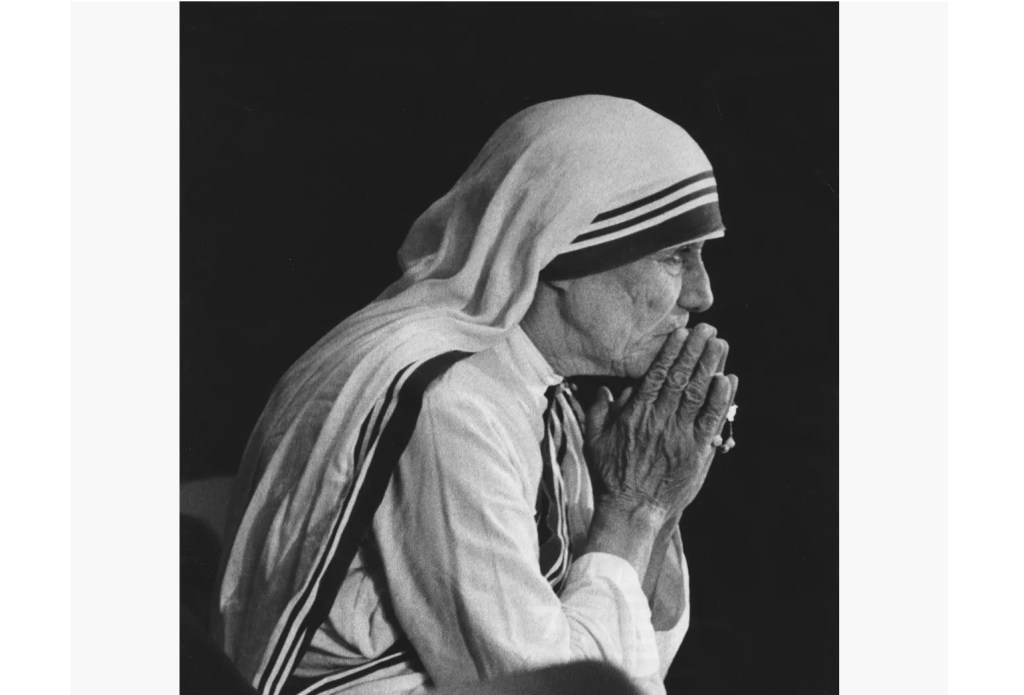
Photo by Jay Mather, The Courier Journal, of St. Mother Teresa of Calcutta at Bellarmine College, Louisville, KY, June 22, 1982. “Until you can hear Jesus in the silence of your own heart, you will not be able to hear him saying, ‘I thirst’ in the hearts of the poor.” – St. Mother Teresa

Link for the Mass readings for Thursday, August 28, 2025

Press pause and breathe for a while.

Jesus said, “Woe to you, scribes and Pharisees, you hypocrites. You are like whitewashed tombs, which appear beautiful on the outside, but inside are full of dead men’s bones and every kind of filth. Even so, on the outside you appear righteous, but inside you are filled with hypocrisy and evildoing” (Mt 23:27-28).

How many of us spend an inordinate amount of time regarding physical externals? Washing, makeup, the right clothes, the correct scents, teeth whitening, plucking, nipping, and tucking. How about time spent exercising through gym memberships, home exercise equipment, physical trainers, sports, stretching, running, or cycling. How about time spent towards a career through education, updating, professional learning, seminars, webinars, and networking. There are other categories that I can add, and the point is that there is not anything necessarily wrong with any of the above when they are properly ordered and each is in a healthy balance.

Yet, if external activities are all we are investing our time and energy in, then Jesus has a point. We may “appear beautiful on the outside” with great looks, a body that doesn’t quit, and a career to die for, but what is going on inside? Are we empty, unfulfilled, achieving goal after goal, yet feeling adrift or hollowed out? Do we have all the right social skills and etiquette down, know the right things to say in public, we have friends in the hundreds or thousands on our social media accounts, yet we feel alone and not a part of anything meaningful?

Worse yet, do we go to Church, say the right prayers, are active in ministry, tithe, are members of boards, involved in the community, and doing some great works of charity, but when the door is closed, and no one is looking… what kind of “hypocrisy and evil doing” are we up to? It is easy to rest in a false sense of security while Jesus chews out the Pharisees, right now, yet, do Jesus’ words have an effect on us if we allow his light to shine also on the imperfections and shadow sides of us as well.

We can spend our time whitewashing the outside, projecting a perfect image, while chasing the finite and material pursuits alone, which will more than likely leave us still feeling anxious, restless, unsatisfied, and worn out. Maintaining and protecting a false image on any level is exhausting. Instead, we can take a good look at the time we invest, where we focus our energies, examine our conscience, and assess the health of our relationship with God, family,  significant friendships, our vocation instead of occupation, and our service to those within and beyond our intimate circle.

Instead of expending energy maintaining a perfect persona, we will do better to be in touch with our weaknesses, our faults, and wounds, so we can resist defending or rationalizing them and seek healing, reconciliation, and transformation. By doing so, we may be more accepting, patient, understanding, and forgiving of others because we will come to realize that we are not all that perfect and we come to accept that the world does not revolve around us.

The path lit by Jesus will reveal our imperfections and sins and also will help us to distinguish between apparent goods and what is authentic and truly good. When we can step off the treadmill of chronic stress, come to a stop and breathe, and press pause, we will begin to experience the peace and love of God. We can rest in just being, just being ourselves and be ok with that.


Photo: Some quiet time with Jesus.

Link for the Mass readings for Tuesday, August 26, 2025

Are we locking the doors to the Kingdom of heaven or helping to open them?

“Woe to you, scribes and Pharisees, you hypocrites. You lock the Kingdom of heaven before men” (Mt 23: 13).

Context, in any reading of the Gospels, or any scriptural text, is important, but certainly with today’s reading. Our country is already experiencing enough division, polarization, and racial unrest as it is. These comments have too often been used to fuel anti-Semitic rhetoric. We need to remember that Jesus is Jewish. “The criticisms are leveled with those of power and/or influence as in the prophetic denunciations, not against the whole people of Israel. The aberrations denounced by Jesus were also denounced by other Jewish teachers in the rabbinic tradition. The goal of the denunciations is to highlight the error, to preserve others from it, and perhaps to bring those who err to the way of righteousness” (Harrington 2007, 327).

Those who would use these verses to denounce people of the Jewish faith tradition, just for being Jewish, would be acting in the same way as those for whom Jesus was convicting. Jesus spoke to the specific actions of specific leaders he had encountered who were using their power and influence for their own means and agendas. The hypocritical behavior that Jesus brought to light unfortunately still exists in some of our civil and religious leadership. This is one of the reasons many are disillusioned with authority and institutions. Jesus saw the danger of hypocrisy especially from the perspective of how it can alienate people such they turn away from his Father.

We seek truth, authenticity, and transparency because these qualities are foundational for building trust and relationships. St. Augustine, whose feast we celebrate this coming Thursday, wrote in his Introduction to his Confessions, “You have made us for yourself, O Lord, and we are restless until we rest in you.” He experienced a life without God and with him, and regretted the days he had resisted accepting Jesus’ invitation. It is unfortunate how many today have not come to embrace the words of Augustine, because of their experiences with those, who in the name of Christ, have “locked the kingdom of heaven” before them.

It is easy to point out the hypocrisy of others, but Jesus is convicting each of us as well. How have we erred, sinned, and been hypocritical? When have we allowed past hurts and wounds, anxieties and fears, prejudicial and judgmental attitudes, to limit us from living a life more aligned with his life and teachings? We all fall short in living the “Way, the Truth, and the Life” (cf Jn 14:6), but when we are willing to have the humility to be contrite, to recognize and to be sorry for the harm we have done, we have a loving Father with his arms wide open ready to embrace and comfort us, as well as offer us forgiveness and healing.

As we are more conformed to living and loving like Jesus, we have more credibility when we speak up, out, and against any act that diminishes or denounces the dignity of another, while at the same time resisting the temptation to do so in a way that diminishes even those who inflict division and hate. Jesus invites us to convict others and hold them accountable as he did with love and mercy but we need to begin with ourselves.

When we align our thoughts, words, and actions and are willing to be held accountable, we will have more credibility in guiding others. Our goal is not to humiliate, condemn, and/or shame, but to lead others to a place of contrition and reconciliation, such that each of us can be people of integrity, transparency, and holiness. Our hope is to win back a brother and sister and lead them toward the doors of heaven that Jesus opened for us in the humanity he assumed.


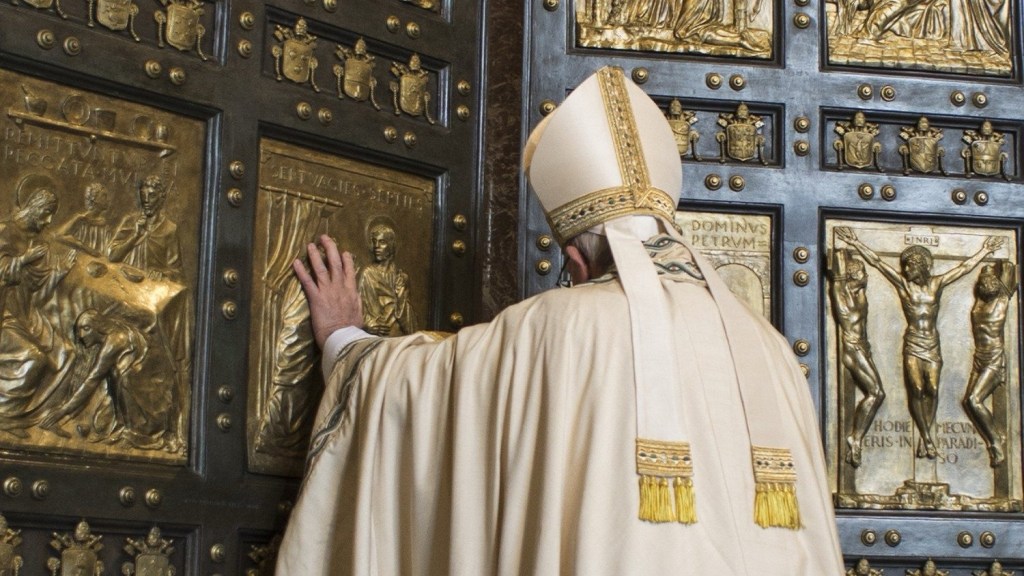
Photo: Pope Francis opening the Holy Door at St. Peter back in 2015 for the Jubilee Year of Mercy. Photo credit, Vatican News file.

Link for the Mass readings for Monday, August, 25, 2025

Harrington, S.J., Daniel J. The Gospel of Matthew, vol. 1, in Sacra Pagina, Ed. Daniel J. Harrington, S.J. Collegeville, MN: Liturgical Press, 2007.

Prayer will help us to heal and grow closer to God and each other.

“Lord, will only a few people be saved?” He answered them, “Strive to enter through the narrow gate, for many, I tell you, will attempt to enter but will not be strong enough (Lk 13:23-24).

This can be a challenging verse to understand and to put into practice. Our salvation is assured in Christ, for he died for all of us and not just for a select few. It is also true that there is no way we can buy or nothing we can do to earn our way into heaven. That said, with the free gift of the grace we have been given by Jesus in the giving of his life for us, we have a responsibility to work out our salvation in this life, “with fear and trembling” (see Philippians 2:12).

Christianity is not a pie in the sky or walk in the park religion, we do not seek a utopia, because Christianity is about a relationship. God loves us and gives us the choice to reject or accept his love. If we say yes, then we collaborate in building a relationship with him and one another. Our fear and trembling is not in a cowering observance, but through humble obedience. We recognize that God is God and we are not. When our relationship with God is properly understood, when he is first, then our relationships with each other as well as what we do and what we seek will stand a better chance of being properly ordered.

Authentic relationships take an investment of time and hard work if those relationships are to move beyond the masks and pretenses we project, pretending to be something we are not or trying to be who others want us to be. This is the same for God. We can pray falsely and for false purposes, and in so doing, grow no closer in our relationship with God. Jesus loves us as his Father loves him, and he invites us to experience the same. This is more than an emotional experience, but a willing of each other’s good. Love is accepting the other as other, in their brokenness and pain, their failings and shortcomings, their sin. It means being willing to take off our masks, being vulnerable, revealing our fears, and resist being defensive or reactive when we are hurt or offended by those who are close to us.

Our prayer becomes real, not when we say the right prayers or words, but when we are honest with God. Our relationship with him grows when we let go of our false understanding that we are self-reliant and we admit that we need the help of the Holy Spirit. When we trust in God, are humble and honest with him, allow ourselves to see our weakness and sin, we can begin to be loved and begin to heal, we can be forgiven and transformed.

When we approach our human relationships, love does not mean that we endure physical and emotional manipulation and abuse, for then we are enabling someone’s destructive behavior. The goal of healthy relationships is to mutually respect each other’s boundaries, be willing to support and empower one another and grow together. We accept each other as we are, while at the same time, we are willing to accompany one another as we seek to hold each other accountable, grow in our relationship with God and who God calls us to be.

Every relationship, if it is to grow and develop, will at some point, come to a cross-road, a narrow gate, in which each person needs to make a decision. We can remain stubborn, hold our ground, and build up a wall, or  we can instead work through the conflict, be honest, risk sharing what we truly believe, allow another to see our best and our worst, admit when we have been wrong or made a mistake, and then mutually support one another, as well as get the help from counseling or spiritual direction as needed.

Healing and growing together happens when we are willing to enter into and seek the root of the conflicts, to each own the parts we have played, and have the humility to say, I am sorry or I forgive you. We heal when we are willing to uncover the underlying issues below the surface, that is most likely veiled by our insecurities, anxieties, and fears. What can help us to feel safe and move toward healing and transformation is the willingness to invite God into our relationship through personal and mutual prayer.

Prayer is the most important thing we can do each day. The light of the Holy Spirit will help us to identify and let go of the baggage we carry and identify the voices we are listening to. Is it the father of lies or the Father who loves us more than we can imagine? Spending time with God and allowing the fire of his love to burn freely anything that is not of him, will help us to discern between the enemy’s voice and God’s. Jesus is the way, the truth and the life who seeks to lead us each step of the way to more intimate relationships. We get to decide whether we want to go our own way or follow Jesus through the narrow gate.


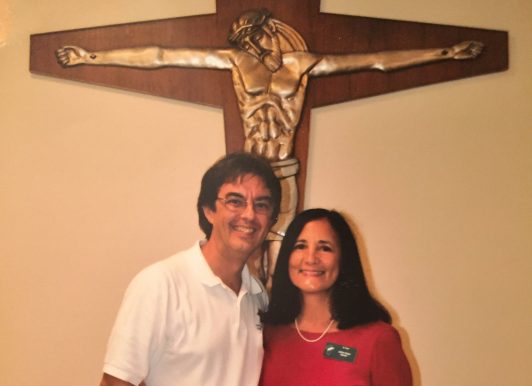
Photo: Praying together helped us to grow through conflicts, and closer to God and each other. Picture taken after we finished evening prayer with only 18 days before JoAnn would transition from this life to the next.

Link for the Mass readings for Sunday, August 23, 2025

“Whoever humbles himself will be exalted.”

“The greatest among you must be your servant. Whoever exalts himself will be humbled; but whoever humbles himself will be exalted” (Mt 23:11-12).

Jesus warns us to resist the sin of pride, and hubris, where we place ourselves as the focal point instead of God. This happens when we seek to be the center of the gravitational pull within our realm of influence. Through our subtle and not so subtle actions, we can embrace this temptation to live a life of, “Look at me, look at me!” Desiring to be affirmed is not a bad thing but that ought not to be our primary motivation for our actions. Ultimately, we will be better served when we seek our affirmation from God.

Choosing our own self-determination free of God’s guidance is the height of pride. God does not seek to limit us but to inspire us so that we may actualize the fullness of who he has created us to be. St Mother Teresa often guided her sisters not to seek to do great things but to do little things with great love. I came across a cassette tape of one of her talks during my freshman year of college. Her words started to plant a seed in my soul that urged me to look out beyond myself toward others.

Growing up with an introverted and shy nature, I spent much of my youth in my own world and spent more time with myself than others. The invitation to change that perspective would happen during my second semester of that same year. I took a psychology course and thought it would be interesting to work in a hospital. A close friend of mine, Steve, shared with me that his mother was a nurse in a nursing home in our hometown. That summer, when the semester ended, I applied for the job as a certified nursing assistant and was hired.

The first resident I assisted was named Margaret, age somewhere in her 90’s. She rolled passed me in her wheelchair and a particular odor followed. The aide I was training with caught my eye and I realized this would be my first solo attempt of service. I redirected and guided her to the toilet, which was in a small closet-sized area in between two adjoining bedrooms. It was a particularly hot day, and as I removed Margaret’s depends, I found quite the surprise. For the next fifteen minutes as I cleaned her up, I sweat, teared up, and repeatedly fought back the urge to gag, all the while Margaret – sang. Once finished and in a fresh nightgown, I helped her into her bed, tucked her in, and then Margaret said, “Give me a kiss lover.”

Others may have run for the door and never looked back. I stayed, and for the next four or five years, I experienced the wonderful gift of building relationships with the many residents and coworkers who drew me out of myself. What started out as a job became an extended family, and I served them with great joy.

God presents us with opportunities daily. We can choose to curve in upon ourselves or we can risk being present for and give of ourselves to others. Let us resist the urge to be led by anxiety or fear and instead pray for the courage to be open to the opportunities to extend the grace God offers us to serve in little ways with great love, one person, one encounter at a time. I pray that you may encounter your Margaret! For Margaret helped me to live what St Mother Teresa taught me: “Love only can become our light and joy in cheerful service of each other” (Teresa 2010, 355).

———————-

Photo: Let us serve one another with joy as St. Mother Teresa did.

Mother Teresa. Where There Is Love, There is God. Edited by Brian Kolodiejchuck, M.C. NY: Doubleday, 2010.

Link for the Mass readings for Saturday, August 23, 2025

When we allow ourselves to be loved by God we can love in return.

When the Pharisees heard that Jesus had silenced the Sadducees, they gathered together, and one of them, a scholar of the law, tested him by asking, “Teacher, which commandment in the law is the greatest?” He said to him, “You shall love the Lord, your God, with all your heart, with all your soul, and with all your mind. This is the greatest and the first commandment. The second is like it: You shall love your neighbor as yourself. The whole law and the prophets depend on these two commandments.” (Mt 22:34-40).

Jesus, in response, was not just throwing up a cloud of theological dust into the eyes of the Pharisees. His answer to, “which commandment in the law is the greatest?” was drawn directly from the Torah. Showing again his knowledge of the Torah. Jesus quoted from Deuteronomy 6:5 and Leviticus 19:18 and merged the two verses together as one unit. His purpose was to emphasize the point that what is to be the greatest aspiration for humanity is to love God and to love our neighbor as ourselves, not either/or. Jesus again was showing that he did not come to abolish the law and the prophets, but that he came to fulfill them (cf. Mt 5:17).

In this statement, Jesus also revealed the foundation of reality, the Trinitarian communion of love. For the immanence of God – God within himself – has always been, always is, and always will be a communion of love. God the Father loves the Son, God the Son receives the Father’s love and in return loves God the Father, and God the Holy Spirit is the love expressed and shared between God the Father and God the Son. The overflow and abundance of this perichoresis, or divine dance of trinitarian communion, has been the loving of creation into existence.

This means that we as God’s created beings, his children, have been loved into existence too! We are loved by and capable of loving God and one another in return mirroring on earth the love that is shared in Heaven. It is through our participation in the life of Jesus that we can live up to his command to love our enemies, best expressed in the parable of the Good Samaritan (Lk 10:29-37).

This is why prayer is so important. If we don’t get our relationship with God right, if we don’t spend time with and allow ourselves to rest, receive, and abide in his love, we will not be able to return the love we have received, and then how can we truly love ourselves and each other? When we do get the love of God right, we and our realm of influence changes. We can experience that peace that surpasses all understanding, and we can find the rest, that rest within the depths of our souls that we all seek. This peace, love, and rest we can then share with God and one another.

We can do so in simple but powerful ways. When we catch the eye of another smile. This small gift can make such difference in another’s life. If someone says, “How are you today?” say, “Better that you asked.” When you are with someone be there as if they were the only person in the world. Go out of your way to do some random acts of kindness, especially for that someone who ordinarily and regularly gets under your skin.

Today – Perichoresis! Let us rest, receive, and abide in God’s love, participate in the dance of God’s trinitarian Love and let his Love reign free in your life to overflowing.


Picture: When we embrace the vertical of loving God with all our heart, mind, and soul, we can share the horizontal, loving our neighbors as we love ourselves.

Link for the Mass readings for Friday, August 22, 2025

We can choose to be envious or grateful for God’s generosity to others.

Jesus told his disciples this parable: “The Kingdom of heaven is like a landowner who went out at dawn to hire laborers for his vineyard…” (Mt 20:1).

At dawn, nine, noon, three, and five o’clock the landowner hired day laborers to go into the field to bring in the harvest. Many, familiar with this parable, find themselves a bit bemused, bewildered, or even angry at the ending when they read or hear that the landowner had his foreman pay everyone the same pay. The immediate cry is, “That is not fair!” Those, more often than not, who respond this way are focused on the hired hands who started at dawn, worked all day, and were paid the same as the laborers who started at five o’clock.

The workers who started at dawn agreed to a certain wage and the owner paid that agreed amount. The landowner explained, “to one of them in reply, ‘My friend, I am not cheating you. Did you not agree with me for the usual daily wage” (Mt 20:13)? What is missed, if someone is feeling as perplexed as were some of the dawn laborers, is the generosity of the landowner.

We see this similar scene of generosity given and played out in some of Jesus’ other parables. The older son who refused to listen to his father’s invitation to come in to share in the celebration of the feast when his wayward brother had been lost but now was found (Lk 15:11-32); the man who was forgiven his entire debt from the king and then when he had the same opportunity to forgive the one who owed him, did not (Mt. 23-35), and in the parable of the Good Samaritan the priest and Pharisee left the man on the side of the road yet the Samaritan, the despised one, was the one to provide aid (Lk 10:25-37). Each of these parables represents the generosity and mercy of God.

There is a reason Jesus shared the parable of the workers in the vineyard after warning about the dangers of riches. Jesus is inviting the disciples and us to be generous with our time, talent, and treasure. He is also calling us out of our group think or tribal mentality. He is showing us that God’s invitation is for all and he is free to bestow his mercy, grace, and forgiveness on those for whom he chooses, whether we approve or not. Ideally, he seeks to bestow his mercy on others through us. We too are to be agents of his grace.

Are we aware of how generous and merciful God has been with us? If not, instead of focusing on what we do not have, may we give some daily thought to the blessings we do have in our life, otherwise, we will fall prey to the temptation of envy with the generosity that God shows to others. Envy arises when we don’t only seek what another has but begrudge what another has received. This attitude can even grow into wishing harm to befall them. And for what, because they have been blessed?

The parables of Jesus are great to pray with and it is important to be honest with our answers. Do we relate to: the laborers who worked all day for their fair share and begrudged those who received the same pay for an hour’s work, the older brother unwilling to be grateful for the return of his brother, the servant unwilling to show mercy to a debtor, and/or the priest and Pharisee that took the long way around the wounded man on the Jericho Road? If we answer yes, to any or all of the above, allowing the light of Jesus’ mercy and forgiveness can lead us to repent, experience forgiveness, and be grateful for God’s love, which is unmerited. Resting in gratefulness, we can rejoice in the generosity that God bestows upon others, even at the eleventh hour.

———————-

Photo: Mary can lead us through the clouds of our self-preoccupation to experience the light of her Son, taken at University of Mary of the Lake.

Link for the Mass readings for Wednesday, August 20, 2025

What do we still lack?

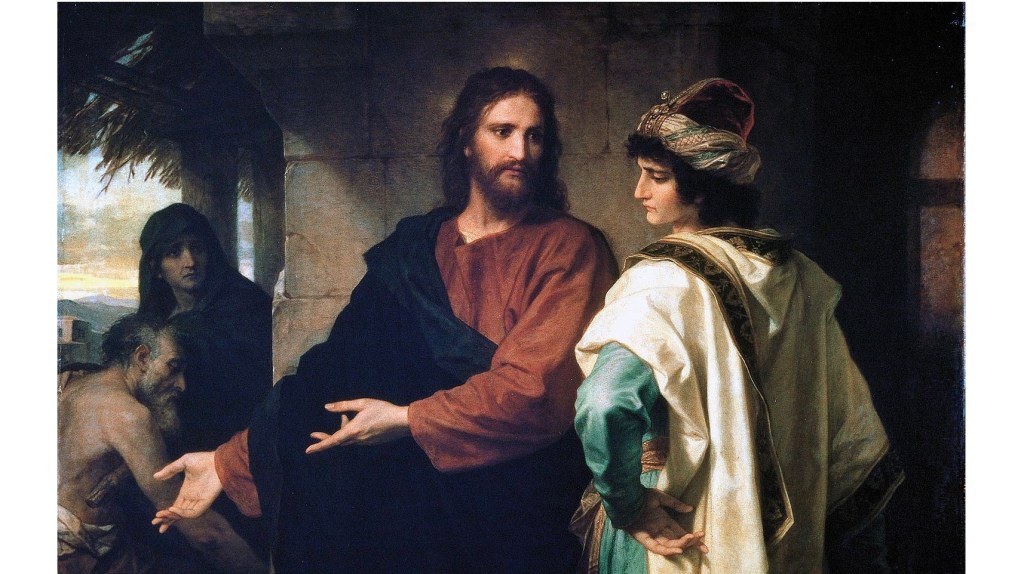
A young man approached Jesus seeking to know what he must do to attain eternal life. Jesus shared that the key was to keep the commandments. The man asked which ones he was to follow, a reasonable request as there were 613 commandments to choose from! Jesus gave him six: do not kill, commit adultery, steal or bear false witness; do honor his father and mother, and love his neighbor as himself (cf. Mt19:18-19). The man affirmed that he had followed them all. Then he asked that next question, “What do I still lack” (Mt 19:20)?

I can feel the disciples wince, see the mouth of Jesus curl into a smile while his left eyebrow raises. Mark is more eloquent than me: “Jesus looked at him, and loved him…” (Mk 10:17). Matthew, in his Gospel account, does not engage in such subtleties.

Jesus said to him, “If you wish to be perfect, go, sell what you have and give to the poor, and you will have treasure in heaven. Then come, follow me.” When the young man heard this statement, he went away sad, for he had many possessions (Mt 19:21-22). The young man was so close!

Jesus saw that which was keeping this man from following him. Jesus gave him the opportunity to renounce what he had, give to the poor, and receive eternal life – his original request. It is what we have all been created for, “You have made us for yourself, O Lord, and our hearts are restless until they rest in you” (St Augustine, Confessions). The young man knew what he needed to do but was too attached to his wealth to let go, so he walked away sad.

We do not know if the young man reconsidered Jesus’ offer and returned. I invite you to find a quiet space today, enter the stillness, and return to this scene in your imagination. Play it out again in your mind and come to the same ending, with the disciples and Jesus watching the rich man walk away sad. Continue your observation of them as they ever so slowly turn their heads and gaze at you. Then ask Jesus, “What do I still lack that is keeping me from walking a more intimate walk with you?”

What are you holding onto that is keeping you from giving yourself to the One who is truly Good? “Jesus presents himself as the way to salvation; he is the ultimate good for which the young man” (Mitch and Sri, 247) was searching and we are searching. Jesus looks at you, loves you, and says, “If you wish to be perfect…” What does he ask you to let go of, to renounce, and follow him?
———————————————–

Painting: “Christ and the Rich Young Ruler” Heinrich Hoffman, 1889

Mitch, Curtis and Edward Sri. The Gospel of Matthew. Grand Rapids, MI: Baker Academic, 2010.

Link for the Mass readings for Monday, August 18, 2025

“Holiness is standing in the fire of self-knowledge and letting it burn” – Fr. William Sattler

Jesus said to his disciples: “I have come to set the earth on fire, and how I wish it were already blazing” (Luke 12:49)!

This fire that Jesus has come to set is the purifying fire of God’s love which will be manifested brilliantly at the feast of Pentecost when the Holy Spirit will come like tongues of fire to land upon and transform the apostles. But before that time, there will be a baptism in fire, the passion, suffering, crucifixion and death of Jesus. As he did in the baptism of water he submitted to with John to join in solidarity with us in our human sinfulness, in the crucifixion, he is baptized with fire. Jesus took upon himself the worst fallen humanity had to offer, betrayal, injustice, violence, indifference, scapegoating, mob rule, indignity, inhumanness, and God forsakenness itself.

Impure metals, like gold and silver are placed in a crucible to be heated. The metals become liquified so that the dross, the impurities, will burn off and the metals are purified. The cleansing waters of baptism and the confirming fire of the Holy Spirit purifies and transforms us as well. Yet that is not enough. It is through our daily lives that this purification will continue. That is why Jesus continues: “Do you think that I have come to establish peace on the earth? No, I tell you, but rather division” (Lk 12:51).

Interesting words offered by the Prince of Peace. He has come to set fire on the earth and to establish division. What Jesus is sharing is that to be his disciples, God must be first in our lives. We are to love God with all our hearts, souls, strength, and minds and we are to love our neighbors as ourselves. We are to love in that order. When we love God first then all our loves will burn away as they are apparent goods, and those that remain will be properly ordered.

Putting God first will cause division because there will be those who are not willing to do so, even within the same family. Others might have different ideas of what it means to put God first. We can learn from Jeremiah and Jesus that putting God first has a cost, even if that meant all would turn on them.

Jeremiah followed God’s call to be a prophet. This did not exactly turn out to be a peaceful vocation. As is presented in our first reading, Jeremiah was persecuted for sharing the word of God with his own people of faith. They refused to repent and return to God and they refused to listen as the impending destructive power of the Babylonian army was storming upon them and about to be unleashed. Surrender was not in their vocabulary, to the Babylonians, and unfortunately, neither to God.

They refused to listen to God through Jeremiah and instead the princes received permission from the king to throw “him into the cistern of Prince Malchiah” (Jeremiah 38:6). Jeremiah was left sinking in the mud, and left for dead. It was only through the compassion of the appeal of the court official, Ebed-melech, that Jeremiah was pulled up to safety before he starved to death.

We can see not only Jeremiah’s faithfulness in the face of extreme opposition, but in this account we can also see a foretaste of Jesus. He was also persecuted by his own people and left for dead. There would be no Ebed-melech to come to his aide. Jesus died a humiliating and horrific death on the cross descended into the realm of the dead. Like Jeremiah, he went down. And like Jeremiah, he would be raised up. Jesus conquered death and rose through the power of the Holy Spirit.

Both Jeremiah and Jesus, in following the will of God, advocated for repentance and transformation, they sought to bring unity and peace, and yet for those who refused to receive their message and follow them, they were signs of division, demoralization, and ruin. Both followed God in the line of prophetic tradition, which announced that before there will be true reconciliation and peace, before the promised return and unification of the scattered Twelve Tribes of Israel, there will be a time of tribulation, a time of cleansing. For Jesus, there could be no resurrection until he went to the Cross.

How can we live our lives with the faithfulness of Jeremiah and Jesus? We can’t, on our own, alone. If we are to be disciples of Jesus, we need to be people of prayer. We need to daily turn our hearts and minds to God in prayer. “There is nothing more important that we will ever do than pray. That is why the devil hates prayer and tries to chase you away from any prayer” (Sattler).

The devil’s greatest weapon against us is distraction. If we are even willing and able to hear the call of the Holy Spirit inviting us to pray, our first response may be, I don’t have the time. And when we do, the next challenge will be resisting the myriad distractions, diversions, and temptations that the enemy will hurl at us to lead us away from even a minute of prayer.

“This restless being wants to pray. Can he do it? Only if he steps out of the stream  of restlessness and composes himself… No sooner has he started to pray than, conjured up by his inner unrest, all sorts of other things clamor for attention… prayer seems a sheer waste of time, and he fritters it away with useless activities. To recollect oneself means to overcome this deception which springs from unrest and to become still; to free oneself of everything which is irrelevant, and to hold oneself at the disposal of God, who alone matters now” (Guardini, 12).

The beauty of the temptations of the devil is that he is revealing to us exactly what God wants us to see. Our weakness, wounds, sins, attachments, disordered affections, and anything that is diverting us from keeping our face on Jesus. The same face that Peter held fast to when he walked on the water, and then sank when he allowed the distractions of the wind and the waves to look away. We continue to behold the gaze of Jesus when we are vigilant and consistent with praying daily and growing in our prayer so that we also pray in our activity and our challenges.

“Holiness is standing in the fire of self-knowledge and letting it burn” (Sattler). We are called to be still and identify our wounds, distractions, and temptations so that we can hear more clearly to identify whose voices we are listening to. When we are willing to enter into the crucible of the Holy Spirit and allow ourselves to be purified by the fire of his love, no matter what the devil throws our way, we can stand tall. When we resist running, trust in Jesus’ love for us, and remain, all that is not of God will be burned away.

The peace, stability, and unity that we seek comes by taking up our cross daily and walking with Jesus. When we are tempted in any way, let us turn to Jesus immediately. In this way, temptations and diversions will not lead to moments of sin, but will be invitations to receive God’s grace. When we do fall, we simply repent, turn away from the sin, turn back to God, learn from the experience, pick up our cross, and begin again.

With each step we will find healing, forgiveness, and courage. The fear, anxiety, and insecurities will become less, we will heal, as long as we remain in the presence of God’s purifying love and let him burn. We will slowly come to know God’s will for our lives and that is the meaning and fulfillment we all seek.  Jesus has blazed the trail before us. As we remain faithful to prayer, trust and follow him, he will continue to empower and strengthen us that we may continue to walk on as his disciples.

————————————————————–

Photo: Water and fire are powerful signs of the love of the Holy Spirit’s transformative power in the Bible.

Quotes from Fr. William Sattler received from his interview with Matthew Leonard on his podcast, The Art of Catholic on his YouTube channel.

Guardini, Romano. The Art of Praying: The Principles and Methods of Christian Prayer. Manchester, NH: Sophia Institute Press, 1985.

Link for the Mass readings for Sunday, August 17, 2025
“The Kingdom of heaven belongs to such as these.”

“Let the children come to me, and do not prevent them; for the Kingdom of heaven belongs to such as these” (Mt 19:14).

Again we see the disciples refusing access to Jesus. The scriptures are not clear why they consistently act this way. We see them doing so with the blind man Bartimaeus, the tax collector Zacchaeus, and the Canaanite woman. In today’s reading, they are refusing access to children. The characteristic of each of those being refused is that they are considered to be on the periphery of Jewish society.

Children, paidia in Greek, especially so. Paidia could represent a child from infancy to twelve years of age. In ancient Palestine, children were particularly vulnerable, had no status and were completely dependent on their families for survival. Luke goes even further than Mark and Matthew by using, brephē, meaning infant, to describe the children. It is to these children and infants that Jesus states the Kingdom of heaven belongs.

Just as consistent as the disciples are in turning away those in need, Jesus is just as consistent in his ministry of paying particular interest to the individual person in their particular need. He welcomes the children and blesses each one of them. Jesus continually acknowledges and affirms the dignity of each person he meets, especially those neglected and ignored. Those who have been on the other side of the glass looking in, Jesus grants admittance. Jesus bridges the divide of separation through his presence and healing touch.

To enter the Kingdom of heaven, we must be willing to trust and place, as children, even more so, as infants, our total dependence on God alone, instead of relying on our own initiative or effort. There is nothing we can do to earn our way into heaven. The entrance into the Kingdom of heaven is a free gift of God’s grace. This gift is not about our worthiness, for all of us fall short. It is about our willingness to acknowledge our utter dependence on our loving God and Father and accept the invitation he offers all of us to be in relationship with him. As we do so, we are to resist the temptation to prevent others from having access to this wonderful gift, but instead we are to share the same invitation we have received with others.


Photo: A stained glass image of Jesus with children at Our Lady of the Angels Cathedral, Los Angeles, CA.

Link for the readings for the Mass for Saturday, August 16, 2025