Ponder death this Holy Saturday, so that we may better appreciate life.

“So they laid Jesus there because of the Jewish preparation day; for the tomb was close by” (John 19:42).

“They” is a reference to Joseph of Arimathea and Nicodemus. Joseph appealed to Pontius Pilate seeking to receive his body for burial. The common Roman practice would be to leave the dead bodies of those who died on their crosses to be picked at and eaten by animals. This display further emphasized that if one decided to go against the Roman leadership, this would also happen to them. Joseph and Nicodemus were able to give him a proper resting place in an unused tomb near the place where he died. Up to this point, these disciples in secret now have come forward publicly to show their alliance with Jesus.

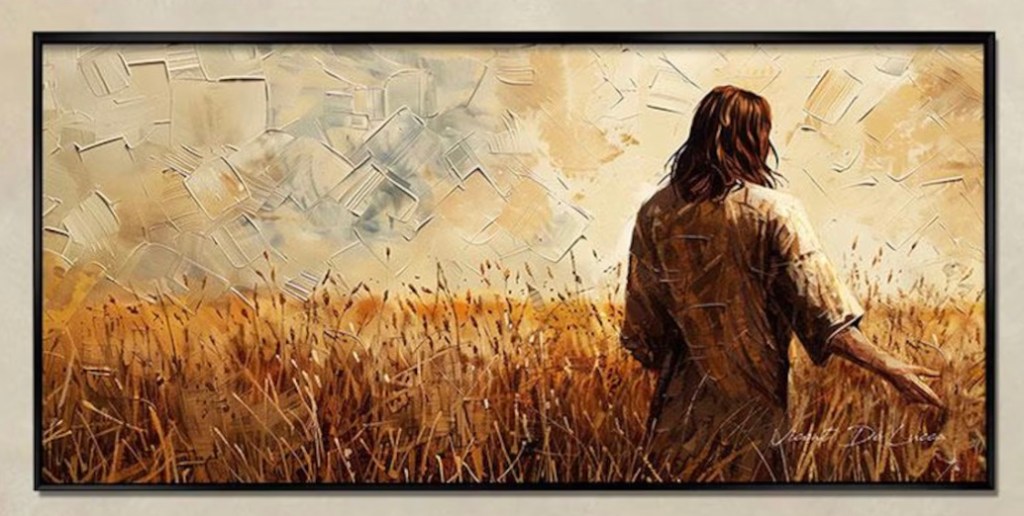
The place of Jesus’ burial, though at first glance was opportune because it was close to Golgotha, has deeper significance as does all of Scripture. For Jesus was buried in a tomb in a garden (see John 19:41). The image of Jesus being buried in a garden echoes the idea of Adam being cast out of the garden he was first created in. The image of Jesus as the new Adam, being buried in a new tomb, is not the end of the story but only the beginning.

This moment of Holy Saturday was the in between time of the death of Jesus until his resurrection. Death appeared to have the final word but as we know, Jesus experienced death, just as he was laid in the tomb, but he conquered death and rise again. The reality of this fact we will celebrate beginning tomorrow night as we celebrate the Easter Vigil and then Easter Sunday when Jesus indeed did conquer death and become the first born of the new creation!

May we give ourselves some time this Holy Saturday to be simple, to be still, to ponder the mystery of this moment in Jesus’ life as he experienced death and slept in that state of death, alone in a tomb. May this pondering of Jesus’ death help us to also reflect upon our own death. Doing so is not a morbid practice, but instead helps us to appreciate the gift of life that God has given us. Pondering our mortality helps us to acknowledge that our time is limited and that we are only passing through this life.

All of us will die. That is the truth. Facing and pondering that truth will help us to decide more intentionally how we want to live our lives, now and in the life to come. Instead of being governed by reactive thoughts, words, and actions, we can come to a place of peace and stillness, breathing, resting, receiving, and abiding in God’s love. From that place of experiencing and resting in God’s love, we can open our hearts and minds to the guidance of the Holy Spirit.

Through following the lead of the Holy Spirit, we are granted a path that will lead us to heal, be forgiven, and be restored to the original glory, to be transformed into the image and likeness of God that was intended from the beginning of creation. Jesus has opened up to us the possibility of returning to the new garden by undoing the sin of Adam that cast us out in the first place. Jesus’ obedience to and love of the Father we are invited to participate and share in. Are we willing to take his hand and follow him to where he will lead? This question as well as a few of the other points above are good to ponder this Holy Saturday.


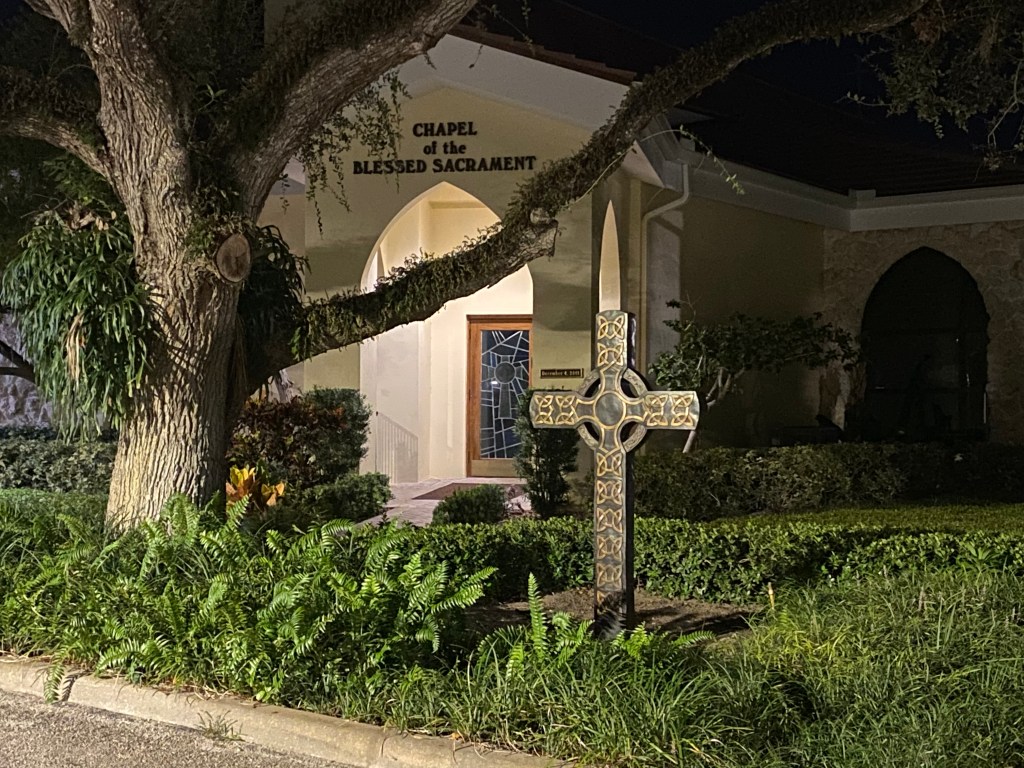
Photo: Even in the darkness of Holy Saturday, even in our darkest moments, the light of Jesus is present.

Link to the Mass readings for Good Friday to ponder on Holy Saturday

Today is Good Friday because in dying, Jesus conquered death.

Jesus was betrayed, arrested, falsely accused, tried, scourged, and beaten. Jesus carried his cross, was crucified, and with his words, “It is finished” (Jn 19:30), Jesus died. The gift of a crucifix is that it is an icon of the moment of the death of Jesus. Having a crucifix is not a morbid fascination with death, nor is it a rejection of his resurrection. The crucifix is not a magic talisman either, but a sacramental, that helps us to remember the reality of what the Son of God, who became one with us, did. Jesus embraced humanity all the way even unto his death, even dying on the cross and giving his life for us that we might have the opportunity to be born again, to be one with him, to be deified, and live with him forever. Without the crucifixion, there would have been no resurrection.

On this Good Friday, let us spend time in venerating Jesus on the Cross, meditating before a crucifix, before this expression of the most intimate act of Love ever expressed in human history. This icon expresses the wonderful bestowal of the grace of God upon humanity, in that it reminds us that we have a God who has experienced and understands betrayal, loss, suffering, pain, anguish, and even death. Jesus is relevant to our lives because he meets us in the chaos and suffering of our own lives.

In making time to be still and looking upon the cross upon which he died, seeing his body slumped and lifeless, we can call to mind the times we have been betrayed, the struggles, trials, pains, sorrows, and losses that we have or are enduring right now. We can also recall those times we have betrayed and hurt others with our actions or inactions, as well as caused pain and suffering. With each conflict or experience of injustice, we can be comforted in knowing that Jesus understands because he has experienced them all.

Making time to gaze upon the crucifix in times of fear, anxiety, temptation, indecision, and/or in need of forgiveness, can give us the strength and courage to endure or go through what lies before us. Jesus with his arms outstretched represents for us his eternal welcome, that he loves us more than we can ever mess up, that he does not define us by our sins or worst mistakes, and that he loves us more than we can ever imagine.

When we resist running from our trials, our suffering, and our pain, and instead face them, we will find that Jesus is waiting for us with his arms outstretched and wide open, just as he did on the Cross. Jesus meets us in the depths of the whirlwind of our deepest hurts, struggles, and confusion, as well as when and where we need him most.

I still remember thinking, in the final weeks of JoAnn’s life when she was just skin and bones, that her suffering was like watching a crucifixion. Yet, she never lost her dignity, beauty, or her grace. JoAnn radiated love for me, our children, and any of those who helped to care for her in her final days. Jesus held each of us up and drew us closer together. Our twenty-three years and especially those final months together has helped me to be a better priest. God indeed does bring about a greater good from even the worst of circumstances.

This is why we venerate Jesus on the cross today, this is why today is Good Friday, so we remember that death does not have the final word, for Jesus conquered death. This is why we can say with St. Paul, “Where, O death is your victory? Where, O death is your sting” (1 Cor 15:55). Jesus did not leave us orphans when he died on the Cross. Jesus conquered death and became the firstborn of the new creation. We are not alone because as St Irenaeus wrote, “Jesus opened up heaven for us in the humanity he assumed.” Jesus is present in whatever we may be dealing with, now, always, and forever.

——————————————————————–

Painting: Christ Crucified by Diego Valázquez

Link for the Mass readings for Friday, April 18, 2025

Jesus’ washing of his disciple’s feet – an act of humility and a foreshadowing of the cross.

A key focal point of the last supper narrative in the Gospel of John is Jesus washing the feet of his disciples. Washing feet was certainly a custom in the ancient Near East, for either people walked barefoot or wore sandals. In either event, people’s feet became quite sore and dirty getting from here to there. Walk accumulated on a person’s feet was also substantial. Washing of the feet was a hospitable way to welcome guests into one’s home. This action though was the most menial of tasks and often performed by slaves or the lowest of servants.

After washing his disciples’ feet and sitting down, Jesus said to them, “Do you realize what I have done for you? You call me ‘teacher’ and ‘master,’ and rightly so, for indeed I am. If I, therefore, the master and teacher, have washed your feet, you ought to wash one another’s feet” (Jn 13:13-14). Jesus is sharing with those who will carry on his message and ministry that they are not to feel so high and mighty in their being called to follow him. The Apostles, those sent by Jesus, are to look at their ministry as seeking how best to serve others, not seeking to be served themselves.

The ultimate service will be displayed in only a few more days. Jesus’ washing on his disciples feet is a foreshadowing of the ultimate act of humility and service that Jesus will show in giving his life for them on the cross. The most degrading, humiliating, and painful of deaths. Jesus will give his life on the cross as will Peter: “Unless I wash you, you will have no inheritance with me” (John 13:8). Peter does not grasp what Jesus is talking about. He followed Jesus on the literal level of the feet washing and much as he did when Jesus told him that he must die, Peter did not understand then either.

Traditionally, this evening at the Mass of the Lord’s Supper, select members of the parish will come to have a foot washed by the priests, following the model set by Jesus washing his disciples’ feet. This would remind all of us, as members of the Church, that we are all an integral part of the Body of Christ. Reenacting the actions of Jesus proclaimed in the Gospel brings the vivid reality of Jesus’ invitation. We are at our best when we are willing to serve, support, and lift one another up. This is to be true when all is well and rosy, in addition to when conflict and challenges arise in the messiness of our daily lives.

Pope Francis, in his homily on April 5, 2020 highlighted this same point: “Dear brothers and sisters, what can we do in comparison with God, who served us even to the point of being betrayed and abandoned? We can refuse to betray him for whom we were created, and not abandon what really matters in our lives. We were put in this world to love him and our neighbors. Everything else passes away, only this remains. The tragedy we are experiencing summons us to take seriously the things that are serious, and not to be caught up in those that matter less; to rediscover that life is of no use if not used to serve others. For life is measured by love.”

We best exemplify Jesus’ washing of the feet when we resist the allure and temptation of pride because our life is not about us. We are not the center of the universe. We are invited to walk away from the table presenting a buffet of the false substitutes for God: pleasure, wealth, fame and power. We are not to curve in upon ourselves either, afraid that our sins are not forgivable. Jesus has not abandoned us and he never tires of loving, forgiving, and serving us. Jesus gave his life for us, and is with us every step of our journey and we experience him with us when we keep him first. As we receive and experience his love and forgiveness, may we be more willing to love and serve one another.

————————————————————

Painting: “Jesus Washing Peter’s Feet” by Ford Madox Brown

Link for the Mass readings for Thursday Evening Mass of the Lord’s Supper, April 17, 2025

May we, like Mary, give without counting the cost.

“Mary took a liter of costly perfumed oil made from genuine aromatic nard and anointed the feet of Jesus and dried them with her hair; the house was filled with the fragrance of the oil” (Jn 12:3). This is indeed some gift that Mary shares with Jesus, though Judas’ critical response showed that he missed the point of her offering, which went well beyond the material cost of the perfume. Mary even exceeded the gesture of hospitality by going beyond washing Jesus’ feet and anointing them as well. This act of caring could have been a bestowal of appreciation and gratefulness toward Jesus who brought Lazarus, her brother, back to life, but it was even more than that.

In Jesus’ correction of Judas, “Leave her alone. Let her keep this for the day of my burial” (Jn 12:7), we may intuit the best source for interpreting Mary’s act. Mary comprehended better than any of the Apostles that Jesus’ death was imminent. Mary’s washing the feet of Jesus, anointing them, and drying them with her hair was a gift of love, of giving herself in service to the Son of God. This exchange mirrors the communion between God the Father, God the Son, and the love shared between them, God the Holy Spirit. Mary follows the will of the Father and plays her part in salvation history.

Martha is again present and seemed to have learned from their last encounter. She is again serving the meal, but this time she is not complaining. Martha was not anxious and worried about many things. Judas was the one corrected this time when Jesus told him to, “Leave her alone.” Mary has shown her spiritual growth as well. She is no longer sitting at Jesus’ feet but anointing them for his imminent death. Her generosity in pouring out such a large amount of perfumed oil which was evident because the fragrance filled the entire house. Mary’s generosity foreshadowed the generosity of Jesus not just in his eventual washing of the feet of his apostles but ultimately, his total self-gift that he will give of himself on the cross.

We do not know how Mary came to possess this precious oil, but what we do know is much more important. She did not grasp or cling to the oil, she did not count the cost and just pour out a little bit. When she felt moved to pour the costly nard and anoint the feet of Jesus she freely poured the perfume out in an act of love to serve the need of Jesus by anointing him for his death and burial.

What is something that we may hold as precious that God may be calling us to give up, to let go of, to pour out, not just for the sake of doing so, but in service to Jesus? The path to holiness and sanctity, is coming to a place in our lives in which we can let go of that which we are attached to, so to hear clearly the will of God, know what is required of us, and give freely in love and service without counting the cost. May we follow the lead of St. Mother Teresa who said that she sought to be just a pencil in God’s hand. May we come to spend time in prayer and quiet meditation and contemplation each day so we may know, hear, and act without hesitation on God’s voice.

————————————————————————————–

Painting: Mary anointing the feet of Jesus.

Link for the Mass readings for Monday, April 14, 2025

“Better for you that one man should die instead of the people…”

A core group within the leadership of Israel has decided. They will not deny themselves, their power, prestige, their place. They will not take up their cross and follow Jesus, the way, the truth, and the life. They will not allow the teaching and momentum of the growing number of those following Jesus to continue unchecked. As Passover drew nearer, thousands of people were coming to Jerusalem to purify themselves for the great feast.

This meant that many more centurions would be in place to keep the peace. The division and commotion that Jesus was causing could escalate conflict, unrest, and then swift and violent retribution from the Roman presence. The Sanhedrin, the Jewish High Council, followed the lead of the high priest, Caiaphas, who said, “You know nothing, nor do you consider that it is better for you that one man should die instead of the people, so that the whole nation may not perish” (Jn 11:49-50). With these words, they began to plan how to put to death the carpenter of Nazareth.

With the words of Caiaphas, the sun began to set on the life of Jesus. These words even affect us still today as they usher in the sunset of our Lenten observance. The gift of our liturgical readings allows us to relive the story of our faith. Lent has given us a time to reflect, to meditate upon who Jesus is. Is he just a carpenter, another teacher, or a holy man from the past? Is he each of these, but someone so much more, the Son of God who became one with us in our humanity so that we can become one with him in his divinity?

Do we see Jesus’ teachings and life as a threat as did the Sanhedrin? Do we like our life the way it is, such that we do not want Jesus to come into our home and start turning over the tables and disrupting our order and comfort? Do the Gospels cut us to the heart and inspire us to shake off our complacency, our indifference, our cynicism, our fear, so to be inspired to acknowledge our sins, to repent, and to begin anew? Are we willing to have our hearts opened such that we see the needs of our brothers and sisters and so are moved with compassion to help?

As Holy Week begins with the Vigil Mass for Passion Sunday may we meditate on the words of Caiaphas, “consider that it is better for you that one man should die instead of the people, so that the whole nation may not perish” (Jn 11:49-50). Caiaphas did not know that what he proclaimed would be so true. The one, Jesus, would die, not only so the nation would not perish, but that all of humanity would not perish and be saved.

Jesus died for each and everyone of us that we might have life and have it to the full. As the sun sets this Saturday evening, may it not be just another rotation of the earth on its axis, but an opportunity to commit once again to make time to ponder and appreciate Jesus dying for us that we may be empowered to die to our false selves, our egos, our self-centered postures, and better take up our cross and follow Jesus into Holy Week.
———
Photo: As each day ends, may we examine what we have been grateful for and where we have fallen short ask for forgiveness and help to begin again.

Link for the Mass readings for Saturday, April 12, 2025

Blasphemer or Son of God?

Two groups of Jews emerged in today’s Gospel account. There were those about to stone Jesus for blasphemy and those who began to believe. The first group did not recognize Jesus as the Son of God. There may have been some opening, which Jesus appeals to, in the good works that Jesus had done. These works came from his Father, and so Jesus sought to reason with them, “even if you do not believe me, believe the works, so that you may realize and understand that the Father is in me and I am in the Father” (Jn 10:38). They listened to the claim that Jesus was making but they refused to accept the fulfillment of the assertion: Jesus did the works of his Father because he was then and still is today the Son of God. Jesus knew the voice of his Father and was obedient to his Father’s will.

The more that Jesus sought to help them to understand that he was who he says he is, the more they dug in their heels. They may have left the stones on the ground but then moved to have him arrested. Jesus evaded their grasp and moved on to the region across the Jordan where John first baptized. John did not preach in the Temple precincts either, even though he was the son of a priest. John followed the lead of God to prepare the way for Jesus and his eternal priesthood. The Temple had not been the seat of God for some time. Jesus would become the new living Temple.

Jesus returned to the place of his baptism, where he joined in solidarity with sinful humanity. This visible image of consecration revealed what happened silently in his conception and birth: the Son of God took on flesh and became man to open up heaven for us in the humanity he assumed. As people came to John in the Jordanian wilderness, so too, people came to Jesus. Not all rejected his message. Many came to him and said, “John performed no sign, but everything John said about this man was true.” And many there began to believe in him (Jn 10:41-42).

The question that arises for us as our steps take us closer to Palm Sunday and Holy Week is to which group of Jews recorded in today’s Gospel account will we align ourselves with? Will we label Jesus as a blasphemer or accept that Jesus is the Son of God? The scriptural record does not reveal indifference as an option, the accounts do not leave any room for Jesus being only human; a good teacher, a wise man, or a revolutionary radical.

We either accept Jesus is fully human and fully divine or we don’t. If he isn’t who he claimed to be, the Son of God, then Christianity is just another philosophical, theological pursuit. If we accept that Jesus is the Christ, the Son of the Living God, then our lives ought to be aligned to his. Our thoughts, words, actions, and even our faces need to reflect that truth.

A good way to begin each day is affirming this fact by stating with an attitude of prayer, “Jesus I believe in you, I need you,” and asking him what works of the Father he would have us offer in his name this day? In what ways can we be of help and support to those around us? May we have the openness of mind and heart to hear his words and the courage to act upon his guidance, so to be the precious, living stones we are, radiating the light from our source, Jesus the Christ, the Son of the Living God.

————————————————————————-

Painting credit: Sacred Heart of Jesus by Charles Chambers, hanging in my bedroom.

Link for the Mass readings for Friday, April 11, 2025

“I AM”

Jesus’ listeners “picked up stones to throw at him” (Jn 8:59). Though less violent, this interaction has some similarities found in Jesus’ Bread of Life discourse (cf. John chapter 6), where Jesus made the statement, that, “I am the bread of life” (Jn 6:48). In both cases, the people do not understand what Jesus is sharing and yet Jesus doubles down on the points that he made.

In John 6, Jesus holds firm to the truth that his followers will consume him and in today’s Gospel Jesus does not equate himself as being just a representative of God, a prophet or a rabbi, but that he, in fact, is God when he states: “Amen, amen, I say to you, before Abraham came to be, I AM” (Jn 58). With these words, Jesus has just done the unthinkable, he not only has spoken God’s sacred name, which is not to be uttered because it is considered too holy to do so, he equates this sacred name, “I AM”, with himself. Jesus is making his point very clear, that he is God. During the Bread of Life discourse, people walked away from him because they were repulsed and most likely considered him mad, here they believe he is speaking blasphemy of the highest order. The reactions would be appropriate in both cases, unless of course, Jesus is who he said he is.

As his listeners then, we too have a choice to believe or disbelieve in Jesus. One option that is off the table, if we give the Gospel accounts any rational reading, is that Jesus presented himself as just another teacher, philosopher, prophet, or guru. Jesus, during his public ministry, is consistently embroiled in conflict, which is evident in all four Gospels because Jesus presents himself as God incarnate. Jesus heals on the Sabbath because he is the Lord of the Sabbath, Jesus is the Bread of Life, Jesus is: “I AM.”

The Apostles struggle to make sense of the words and actions of Jesus and we may also struggle with our understanding of who God is and who Jesus is. We may have doubts, concerns, and unanswered prayers and/or questions. To walk the path of discipleship is not to walk with constant assurance, for we walk by faith and not by sight (cf. 2 Corinthians 5:7). Walking by faith does not mean we throw up our hands, toss out all reason, and believe blindly. Dr. Holly Ordway defined faith as “trust based on a reasoned knowledge of the evidence.” Faith means that we trust that Jesus is who he claimed himself to be based on the scriptural evidence, our own experiments with the truth based on these claims, and our experiences of him in our time of prayer, meditation, contemplation, and everyday actions.

Jesus calls and we are to follow. He does not give us the full picture, but as we step out trusting in his call, he will reveal to us each step of the way what we need to know. He will be present and work through us as we continue to turn our life over to him and one another more and more each day. When we begin to doubt, we can lean on Peter’s claim, “Master, to whom shall we go? You have the words of eternal life. We have come to believe and are convinced that you are the Holy One of God” (Jn 6:68-69). Peter made this claim based on his experience and trust in his relationship with Jesus. Our relationship and belief in Jesus will also grow to the same depth, moment by moment, with each, “Yes” to the invitation of Jesus, the Holy One of God.

———————————————————————————-

Photo: Icon of Jesus as Pantocrator – ruler of the universe.

Holly Ordway’s quote comes from Lesson 2: Bridging the Meaning Gap in her course: Imaginative Apologetics which can be accessed by registering for the Word on Fire Institute, the home page of which can be accessed: https://wordonfire.institute/

Link for the Mass readings for Thursday, April 10, 2025

If we are willing, Jesus has come to set us free from our sins and lead us home.

It is interesting to note that in today’s Gospel reading from John, Jesus spoke to those who “believed in him” (Jn 8:31). But the more he talked, the less they seemed to understand who he was: “If you remain in my word, you will truly be my disciples, and you will know the truth, and the truth will set you free.” His listeners balked at the word “free”, asserting that because they were ancestors of Abraham they have never been enslaved by anybody.

In the United States of America, freedom is also highly valued. Many of us would probably react very much in the same way. We may have different ways of expressing why we feel that we are free, but we would certainly assert that we are not enslaved to anybody or anything.

Jesus’ words ring just as true then as they do today: “Amen, amen, I say to you, everyone who commits sin is a slave of sin.” Jesus shined his light on the truth that many of us do not see, which is our enslavement to sin. If we truly seek to be free, then we need to acknowledge this point. What many of us claim to be freedom, doing whatever we want to do, when we want to, and how we want to do it, is not true freedom. We cannot even hear the clanking of the chains or feel the weight of the shackles chaffing at our skin as we raise and shake our fists to assert our freedom of indifference!

Our response to Jesus’ statement: “who commits sin is a slave of sin” ought not to be one of hiding, denying, rationalizing, attacking, fleeing, or refusing to acknowledge such a thing as sin. It is better to embrace the truth that Jesus is placing before us. In this way, we allow his light to expose the darkness in our hearts where sin speaks and we realize where we have said yes to the father of lies. Becoming aware of our fault for those things we have done and have failed to do is the first step in becoming truly free.

When Pope Francis was asked in an interview, “Who is Jorge Mario Bergoglio?” he answered, “I am a sinner, but I trust in the infinite mercy and patience of our Lord Jesus Christ, and I accept in a spirit of penance.” We are all sinners because of the fact that we all in some form or fashion place idols before God. This is not a negative or defeatist attitude, quite the contrary. When we call out our sins in truth, we can be freed from them. When we think our life is about us first and foremost, and ignore or rationalize our sin, we allow them to have power over us.

We become free from our sins by acknowledging that we have sinned and fallen short of the glory of God. This does not mean that we are awful people. It just means that we have fallen for an apparent good instead of the true Good that God wants for us. We have missed the mark of our true fulfillment. We need a savior to free us. Jesus accepts us as sinners but does not want us to remain in our sins. We do not have to be perfect nor have our house in order for him to come close, for he is already waiting for us. We do not need to be worthy, we just need to be willing to open the door when he knocks, and invite him into the chaos of our lives so that he can heal us with his grace, love, and mercy. When, “the Son frees you, then you will truly be free.” 

——————————————————————

Photo: Jesus is always, always looking for us and seeking to carry us back home.

Link for the interview with Pope Francis from America Magazine, September 30, 2013

Link for the Mass readings for Wednesday, April 9, 2025

Will we choose death or life?

“[Y]ou will die in your sin” (John 8:21).

Jesus continued his discussion with the Pharisees but they still remained on different planes of understanding. Jesus coming from above and the Pharisees remaining below. Jesus came to meet us in our humanity to free us from what binds us to the physical realm alone. For God created man in his image and likeness and although we retain our image, we lost our likeness when Adam and Eve disobeyed God’s command: “And the LORD God commanded the man, saying, ‘You may freely eat of every tree of the garden; but of the tree of good and evil, you shall not eat, for in the day you eat of it you shall die'” (Genesis 2:16-17).

In establishing this first covenant with Adam, God sought to invite him to not only participate in a relationship with his very own creation, he sought to have man perfected through obedience and participation in God’s life. When Adam and Eve disobeyed God, through their sin, suffering and death entered the world and was made worse in their lack of willingness to repent. The separation from the source of any living, mortal being leads to death. Separation from God means death.

God did not give up. He continued to seek to re-establish a relationship and covenants with his children, seeking to do so through Noah, Abraham, Moses, and David, until the appointed time when he sent his Son to help to shine the light on our fallen world. He brought the light to reveal the truth of the way back to the Father, the way to restore the glory and likeness to the Father that all of humanity was created to participate in.

Some of the Pharisees still did not understand that Jesus was telling them about being the Son of God that the Father has sent. He continued to reveal his intimate knowledge of the Father so that they could see, believe, and come to know the Father as he does. Jesus also gave them a clear choice that those who continued to reject him were choosing darkness and sin over the light and life of Christ and so will die in their sin. Those who believe in Jesus will become one with him in his divinity. They will not only continue to share in the image of the Father, but they will also be restored to experience their likeness of him.

This is the holiness we are all called to participate in. We are called to repent and renounce the attachments to the things of this world. Jesus shows us our deepest hunger, which is to grow in our relationship with him and his Father. Jesus’ consistent obedience, doing nothing on his own, saying only what the Father taught him, and always doing what was pleasing to his Father was a constant untying of the knots of Adam’s disobedience and a constant growing in intimacy that we are invited to participate in.

Jesus’ sharing of this intimacy with his Father started to shine through the darkness. The beautiful ending line of today’s gospel account is that while at the beginning some of the Pharisees were still struggling to understand him, they now began “to believe in him” (John 8:30). The question for us to ponder is, do we see and believe?


Photo: Making time to be still, to breathe, to think, helps us to better hear God speaking in the silence of our hearts.

Link for the Mass readings for Tuesday, April 8, 2025

May we look to and trust in the light of Jesus.

Jesus seeks again to help the Pharisees understand who he is. In the preceding section of today’s Gospel of John, the Pharisees do not believe in his claim of being “the light of the world” because he testifies on his “own behalf, so [his] testimony cannot be verified” (Jn 8:13). The point being made here is that for verification there must be support given by two or three valid witnesses (cf. Deuteronomy 19:15). Jesus states that he testifies on his own behalf as does his Father who sent him (cf. Jn 8:19). His witness in this matter is God.

Jesus continues in today’s Gospel account to attempt to help the Pharisees and those gathered around them to understand who he is and what is about to transpire regarding his crucifixion. Jesus shared that God his Father sent him and continues to be with him. He has not left Jesus alone because Jesus maintains the intimacy of their relationship as he follows the will of his Father and will continue to do so all the way to being lifted up on the Cross.

Those listening to Jesus do not understand. They asked if he was talking about killing himself. Often throughout the ministry of Jesus many, even his Apostles, do not understand what Jesus taught, and that was because they were trying to make sense of what he said from this purely material and finite reality. Jesus invited them to seek a deeper understanding by sharing that he is from above and they were from below. They were needing to be born from above, to open their minds and hearts to him, as Simon Peter did when he came to realize that Jesus was the Christ, the Son of the living God. Jesus gave those he taught a choice. They could die in their own sin and stay in their present darkness, or receive his light, repent and choose to live in participation with him.

Discipleship is a journey. We will not come to understand Jesus from one instance or encounter. Even Saul, who had an amazing experience and encounter with Jesus and changed his name to Paul, would take about three years to digest the significance of what happened to him that day on the road to Damascus and would continually grow in his relationship and understanding. It will be so with us as well. We need to resist the world’s craving for instant gratification, especially regarding growth in our discipleship and spiritual maturity.

Our faith journey will be smoother as we acknowledge and repent from our sin, believe in Jesus, remain committed to him, receive and put Jesus’ teachings into practice. When we walk with him day by day, we will learn to follow the will of his Father as he did. The gift of the liturgical seasons is that as we walk each year with Jesus and assess our growth, we will, like a finger making an upward spiral motion, come again and again to the same point each year, and hopefully, we are higher up that spiral each time.

Sometimes it is hard to see our changes in our day to day reality, but over time with the gift of hindsight, we can discover that we indeed have made our closer walk with Jesus a reality. When we can honestly assess that this is not so, it is not too late to begin again, to repent from that which keeps us bound to this world and turn our gaze to that which is above. Jesus made his choice to follow the will of his Father, to be lifted up, and to die on the cross for us. We too have been given a choice. We can hold tight to our selfish nature, remain in the darkness of our sins, and curve in upon ourselves, or we can open our heart to the cross, allow the light of Jesus to shine in our darkness, identify, and repent from our sins, and be free.

——————————————–

Picture: Holy Hour and quiet time with Jesus.

Link for the Mass readings for Monday, April 7, 2025