
Let us not be corrupted by the leaven of the enemy but be nourished by the water of life.

Today’s account from the Gospel of Mark is a continuation of what we read yesterday when Jesus convicted the Pharisees for demanding a sign. He recognized their hardness of heart and hypocrisy and with the opportunity of being together in the boat, Jesus seized on this encounter as a teachable moment. He wanted to warn those of his inner circle to be aware not to follow the same path of corruption when he enjoined them: “Watch out, guard against the leaven of the Pharisees and the leaven of Herod” (Mk 8:15).

The disciples missed the point as they focused on the literal reality that they only had one loaf of bread among them. Jesus’ intent was to warn his followers about the danger of pride, seeking honor, power, and fame which had lead many of the Pharisees and Herod astray. To be his followers, striving to place themselves first would be not only the undoing of each of them but also this posture would undermine those they would be charged to care for.

Unfortunately, too many have not heeded this lesson that Jesus offered in today’s Gospel regarding being aware of the corrupting leaven of many of the Pharisees and Herod. Just as the effects of original sin has wounded humanity, so it has also affected those in the Church. Throughout the ages, clergy and laity alike have succumbed to the temptations of placing the focus first on our needs and on ourselves instead of God first and loving and serving others as he loves us.

Yet throughout the worst corruption and abuse throughout the generations, the Church is still here. God continues to work through many who are faithful to his invitation and follow his will in simple ways, living lives of quiet service. It is unfortunate that there are those who leave because they see hypocrisy, injustice, abuse, and corruption. For it is those of us with eyes to see and ears to hear that need to stay and continue to be true to the teachings of Jesus in our daily lives. Frustrations will arise for we are all imperfect and fall short of the glory of God, yet we must remain persistent as James mentioned in our first reading.

At the same time, we need to be aware of the sinful leaven that would seek to undo each of us. It is easy to point fingers outward. God does not tempt us, but in respecting our free will, he does allow us to be tempted. May we resist the temptations of the enemy, seek nourishment in the Eucharist, to live simple and holy lives, while seeking to be aware of the needs of others, and work to serve, protect, and empower the dignity of those in our midst each day. We need to remember to lean on Jesus to give us the strength and clarity on how best to help to heal his wounded Body.

——————————————————

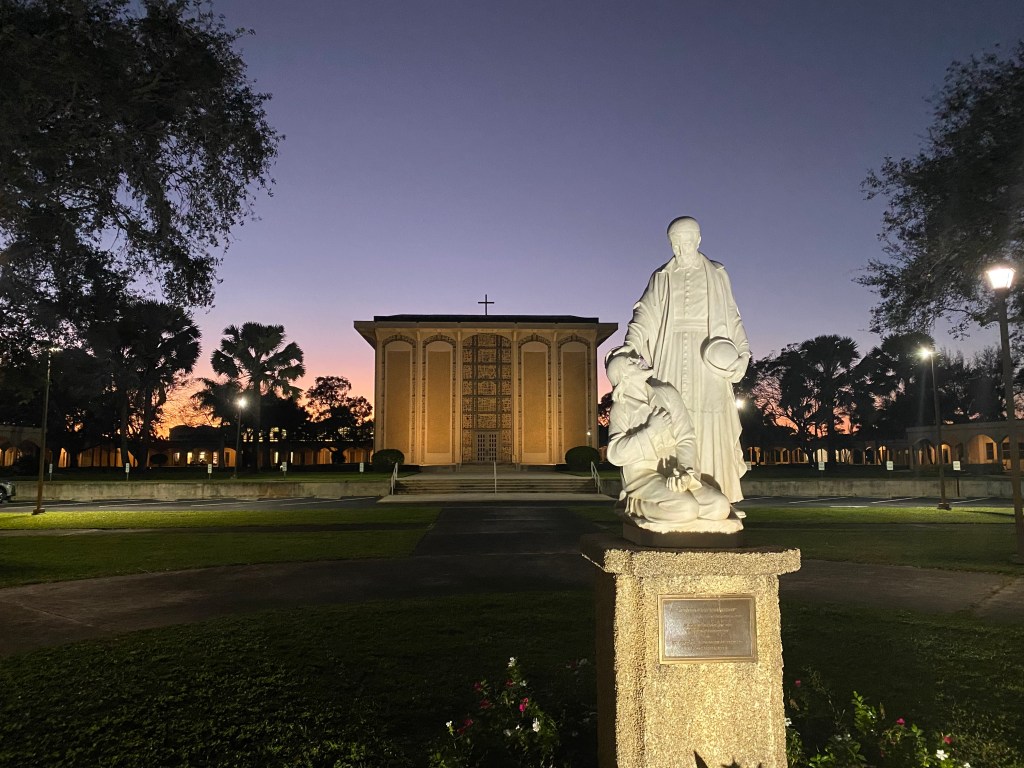
Photo: Like a tree planted near fresh water, may our roots reach out to be nourished by Jesus, the water of life. Rosary walk, St. Vincent De Paul Regional Seminary, Boynton Beach, FL.

Link for the Mass readings for Tuesday, February 13, 20214

Sign or trust?

“Give me a sign!”

Often, when we ask for a sign, we have a preconceived notion of what we are seeking, and we want God’s stamp of approval on it. The impetus is coming from us, seeking to bend the will of God to our will. More often than not this approach will end in frustration. The Pharisees in today’s account are asking for a sign. Jesus has already been preaching with authority, healing, casting out unclean spirits and demons, encountering the unclean and restoring them to the community and right worship, and this is not enough?

We can understand how: He sighed from the depth of his spirit and said, “Why does this generation seek a sign? Amen, I say to you, no sign will be given to this generation”(Mk 8:12). The majority of the Pharisee’s minds were set. Jesus knew there was nothing he could say or do to prove to them he was who he said he was; the kingdom of God at hand. If they had not the eyes to see and the ears to hear there was no argument, point, or sign that would have changed their minds. Jesus sighed from the depths of his spirit because their hearts were hardened such that they closed themselves off from the gift of the grace he sought to share. He then got into the boat to go to the other shore, to share his message with others: “This is the time of fulfillment. The kingdom of heaven is at hand. Repent and believe in the gospel” (Mk 1:15).

The question for us today is, do we believe, do we really believe, that Jesus is who he says he is; do we believe that Jesus is “the way, the truth, and the life” (Jn 14:6)? Do we seek to bend God’s will to our own will or seek to align our will with his? The woman with the hemorrhage for twelve years, the woman whose daughter was possessed, the friends with the man with the withered hand, and the leper, did not ask for a sign, they asked for a healing. They trusted, believed, and risked getting closer to Jesus so as to encounter him despite the barriers in place to prevent them. In each of these cases, Jesus recognized their faith, and each received the healing they sought.

In our discernment, we need to be aware of our intent. There is a subtle distinction, but it is important. Are we seeking proof, a sign, or are we willing to surrender, believe, and seek to understand God’s will, as Mary did when she asked, “How can this be” (Lk 1:34)? Are we demanding proof, a three-point plan from God before we follow his lead, or do we trust his invitation, and seek to understand how he wants us to act, knowing that he will reveal what we need to do each step of the way? Often, if we knew the end result and full ramifications of his original request, our doubt would crush our spirit before we even started.

Let us embrace a posture of faith seeking understanding today, trust in Jesus, and seek to align our will with our loving God and Father. May we make time to be still and enter a place of prayer and to open our hearts and minds to the leading of the Holy Spirit. May we with confidence, say in the words of Mary, “May it be done to me according to your word” (Lk 1:38), then arise, grasp the hand of her Son, Jesus, and face head-on that which is before us, to accomplish what he calls us to do, knowing that with Jesus, we can overcome any obstacle that is placed before us.

————————————————————————————–

Photo: God sharing a sign is different than us demanding one! Evening Rosary walk back in September, St. Vincent de Paul Regional Seminary, Boynton Beach, FL.

Link for the Mass readings for Monday, February 12, 2024

Any willingness to share, Jesus will multiply.

As Christians we are called to be disciples of Jesus, to learn his teachings, and follow his ways. We are also called to be apostles in that we are to go out, proclaim, and share that he is who he said he is, and how he has affected our lives. Often when we are reminded of this message though, we may feel inadequate. We may question what it is that we can even possibly offer to help build up the kingdom of God. We may feel we have nothing to share, nothing to give, nothing to say, or that what the Lord asks of us, we do not know how to accomplish.

The disciples express similar feelings today for the latter point. Jesus shows concern for the thousands who had just listened to him for three days and are readying to depart. He is concerned that they are hungry and that some may collapse on their way home. The disciples look about bewildered as to how they could possibly feed the vast crowd. Then Jesus asked, “How many loaves do you have” (Mk 8:5)? They responded that they had seven loaves and two fish. Jesus would go on to feed, not only the whole multitude gathered, but when all ate their fill, seven baskets of bread fragments were left over.

We may not know how to take active steps to live our faith out in our daily lives, we may not even be aware of how to begin. On the other hand, we may have actually been engaged in service, but have started to coast, gotten complacent. If we are not moving ahead in the spiritual life, we are moving behind.

Each day is a new opportunity to begin again, and a good way to do so is to place ourselves in the presence of Jesus. We can sit before a statue, a picture, or an icon of him, we can look out a window, sit on a porch, or go outside. Any place that we can just be still and close our eyes will work. Then take some deep breaths, be silent and return to today’s Gospel account. The need of the people that were with Jesus for three days was hunger. As you reflect, what is your need? What needs might there be in your family, friends, neighbors, colleagues, or classmates? What needs in your community?

As you ponder these questions, resist any temptation to self-censor. Allow any need or needs to arise. Once you identify a concern, listen to the same words Jesus asked, “What do you have, what can you offer?”

You may not have an immediate answer. Stay with the question for a period of time, take it with you throughout the day if need be. Resist looking for the big response, a grand plan. Ask yourself what you can offer, no matter how small. Your willingness to share and to help, Jesus can multiply and bring about amazing results.

The disciples only gave seven loaves and two fish, which seemed insignificant to feed the thousands, and yet, Jesus multiplied that meager amount to feed all present with seven baskets left over. Jesus provides, Jesus works through us. The question we need to answer is not are we worthy, wise, or strong enough? The question we need to answer is, “Are we willing?”


Photo: St. Vincent De Paul, our patron saint at the seminary, was willing to help and Jesus touched many through him. Entry to St. Vincent De Paul Regional Seminary, Boynton Beach, FL.

Link for the Mass readings for Saturday, February 10, 2024

We can choose to defile and demean or understand and empower each other.

“[W]hat comes out of the man, that is what defiles him” (Mk 7:20).

Jesus offers a list in today’s gospel of what can be unleashed from within and then directed out toward others. These are examples of what defiles because, at some level, we make the decision to think about, speak, and put into action those thoughts, words, and actions.

To resist the temptation to defile ourselves and others, we can follow the lead of the writer from the letter to the Hebrews who offered a wonderful verse, which I pray each morning in my recitation of the Office: “Encourage each other daily while it is still today” (Hebrews 3:13). There are many that we will encounter or hear about each day that will do the exact opposite.

Our goal each moment is to resist spending any time or energy in supporting any thoughts, words, or actions that demean, belittle, or dehumanize. We can call those out who do so, stand up for those impoverished from these attacks who do not have a voice, but we must not succumb, engage, or in any way be lowered to the negativity unleashed. Otherwise, we become an agent in perpetuating the same vileness and poison already unleashed.

Our thoughts, words, and actions matter because we are all interconnected. Even what we ponder can be projected on our faces and directed outward without saying one word. Thoughts entertained can lead to words and actions that wound. We need to approach each moment more thoughtfully, resist reacting, and instead take some slow breaths, think, and pray about our response before we choose what to say or do. The only time our silence can be harmful is when we refuse to stand up for others when they disregard the dignity of a person.

Let us choose this day to align our thoughts, words, and actions with those of Jesus. What we think, say, and do to our brothers and sisters, we say and do to Jesus (cf. Mt 25:35-45). We resist defiling ourselves by never letting evil talk pass our lips and instead thinking, speaking, and acting in ways that empower, convict, and build up others. Our effort is strengthened when we choose to forgive any negativity hurled at us and instead meet the darkness with the light of compassion and understanding. We are not alone in our efforts when we call upon the help and strength of Jesus as we strive to become ambassadors of his transforming love.

————————————————————————————————-

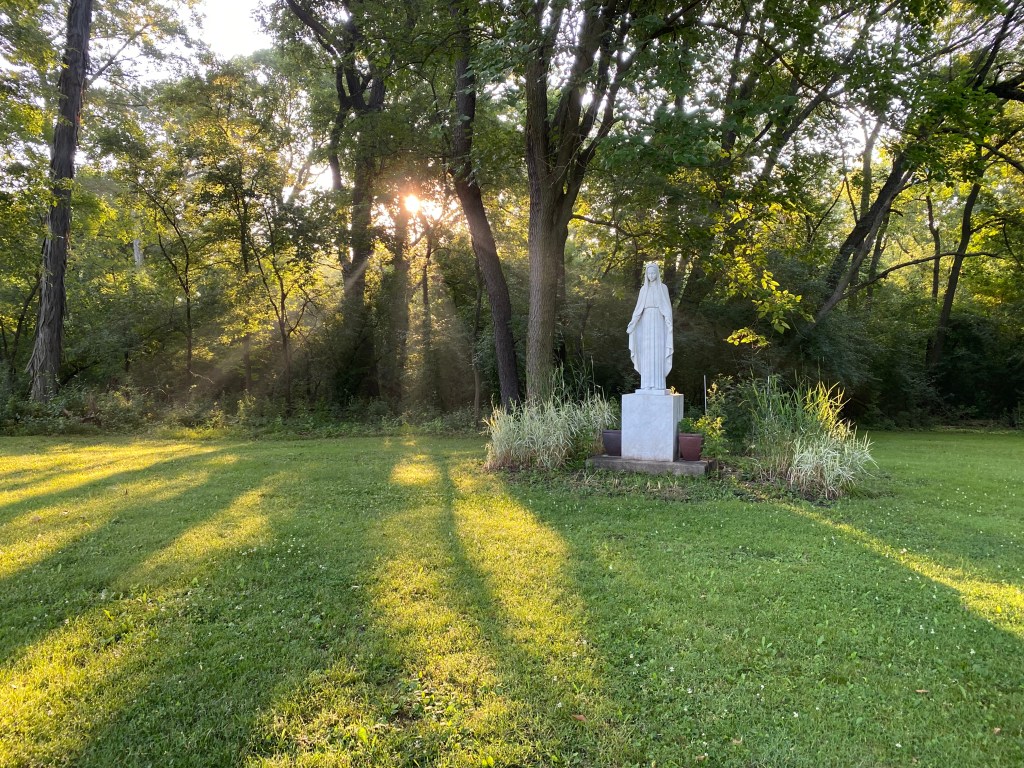
Photo: We can learn a lot about loving and caring for one another from the Holy Family. St. Vincent De Paul Regional Seminary, Boynton Beach, FL.
Link for the Mass readings for Wednesday, February 7, 2024

Discipline and love can lead to freedom.

Jesus reacted to the criticism of not observing ritual washing prior to eating that was leveled at him from the Pharisees and scribes by recalling the tradition of the Prophets through the words of Isaiah: “This people honors me with their lips, but their hearts are far from me” (Mk 7:6). For Jesus, following the law for the law’s sake is an empty act. What is important is encountering God, experiencing his love and forgiveness, developing a relationship with him, being transformed by him, and restoring what has been lost from being created in his image and likeness, so as to be able to glorify him by serving others and inviting others into communion with him. Jesus challenged the hyper scrupulosity and exactitude of the rules that had nothing to do with being humble servants of God.

Just laws and practices are those that are enacted to build up and empower people through discipline and clear boundaries. They help keep us from being enslaved to our passions and sins and instead lead us to freedom for excellence, for fulfillment, and to experience a heart on fire with an ever-growing love that yearns for a relationship with God and each other, like the deer that yearns for running streams.

As with any game we play, theatrical or musical performance, there are rules and regulations, there are referees, officials, directors, and conductors to keep order. When the rules enforced encroach on the flow of the game or performance, such that they inhibit the freedom of play, the communal interplay is stunted. When there is no enforcement, the opposite happens and all devolves into chaos. When the rules are consistent, they provide the structure and boundaries that limit abuse, allow for a freedom to flourish, and all those engaged to experience the freedom to actualize their potential, and as such, there is the experience of the true, the good, and the beautiful.

The first time I saw people skate, I was enraptured. I think I was seven. My father was working on a project at our local ice rink and even though we were not there to skate, I refused to leave until he took me on the ice. It didn’t matter that the only skates to rent that fit my feet were figure skates. It didn’t matter that my first attempt was a dismal failure. What mattered was that I made it to the ice and the joy of that experience carried me as I learned the rules of balance, how to stop and what a toe pick was and was not for. Soon I had the freedom not only to skate but to join a hockey team. The freedom and joy I felt any time I skated or played hockey, I still carry with me to this day.

The Church, when we are at our best, leads love and joy of what we believe and live in our everyday lives. We don’t lead with the rules and moralizing, but instead, we share our time, presence, and the joy of our faith. We empower and support one another as we enter into the play between our finite freedom and God’s infinite freedom. We are built for a relationship with God and one another and as our relationships mature, we start to learn and share the finer points of our life of faith. We experience the meaning of why we do what we do and why certain thought patterns and actions lead us either away from or closer to God. There is a unique balance between the rules and the freedom of play.

Loving someone does not mean we allow them to do whatever they want, but in willing their good, we offer practices of discipline, invitations, options, corrections, critiques, which establish boundaries that will provide opportunities for growth, maturity, and authentic freedom and we are open to receive the same. We are going to make mistakes, I have made many. Those we let into our lives will make mistakes. The key is recognizing that we are on a journey. As we walk together, when we are willing to be patient, understanding, forgiving, and kind, we will better support and learn from one another. In this way, the boundaries, disciplines, and rules we follow are meant to set a foundation for healthy relationships and actualizing who God invites us to be; joyful, human beings that fully love and are alive!

———————————————————————————

Photo: Back on the ice over Christmas break at Bushnell Park, Hartford, CT!

Link for the Mass readings for Tuesday, February 6, 2024

“Awake my soul, awake lyre and harp, I will awake the dawn.”

Rising very early before dawn, he left and went off to a deserted place, where he prayed” (Mk 1:35). This was a common practice of pious Jews at the time. The intent was to spend time away from the everyday hustle and bustle, to be still, to better be able to connect with God. Jesus is making the effort and time to do the same, to go off to a place of quiet and stillness before the day’s activity begins, and to seek guidance from his Father as to how best to proceed in his ministry. When Simon Peter tracked Jesus down, Jesus shared the guidance he received to move on to the nearby villages to preach there also.

I have found this practice beneficial as well. In the early 90’s when I entered the Franciscans, I learned how to pray the Liturgy of the Hours. During my first week of participating in this practice, a verse resonated with me: “My heart is ready, O God, my heart is ready. I will sing, I will sing your praise. Awake my soul, awake lyre and harp, I will awake the dawn” (cf. Psalm 57). Even though my body and mind groan in protest, there is a feeling and experience of peace, renewal, and empowerment with making the time to “awake the dawn.”

I have been blessed to do so over the past eighteen years or so. Having the privilege and opportunity to teach for eight and a half years at Rosarian Academy and then nine years at Cardinal Newman HS, I began each day in the chapel sitting quietly and praying the Office of Readings and Morning Prayer. For the past year and a half, I have been able to not only pray the Liturgy of the Hours but also participate in daily Mass with the clergy, religious, and my brother seminarians at St. Vincent de Paul Regional Seminary.

It is nice to begin the morning slowly with God, to be infused with his Word and to be in the presence of Jesus in the Eucharist, then to go forward into the day to share the joy of that morning’s encounter. I also introduced a “Holy Hour” into my day as well since coming to the seminary which has been an opportunity to grow even closer in intimacy with Jesus and experience moments of healing and growth.

How we go off to a deserted place will be different for each of us based on our station and responsibilities in life. There is much pulling at us to distract and divert us from making the time, but our lives will be transformed when we do. To commit to 10 to 20 minutes of quiet a day to start will mean we need to let go of something else. It may mean hitting the snooze button is no longer an option, maybe it is getting up 20 minutes before your spouse and kids, quiet time with morning coffee or breakfast, sitting quietly on the porch, at the kitchen table, or favorite quiet spot, quiet time in the car, maybe there is a gap in between classes, any time outside for a quiet walk or sitting by water is great. There are so many options.

There is something for me that is special about the stillness before the dawn, experiencing night giving way to the morning light, hearing the bird song, and yet, there are many ways, as there are many places and times that we can create for ourselves to show up with God and allow him to happen. I also enjoy ending the day with a quiet walk around our lake after supper. As we make time to experience stillness, we will also begin to notice God more often in our activities, interactions, and interruptions. Making time to go off to a deserted place is a wonderful gift that I pray you may give to yourself this week.


Photo: Waking the dawn during my 30-Day silent retreat this past July at Joseph and Mary Retreat House, Mundelein, Illinois.

Link for the Mass readings for Sunday, February 4, 2024

Come away and rest for a bit.

After hearing the accounts of the missionary trip, Jesus invited his apostles to step away from the crowds “to a deserted place [to] rest awhile” (Mk 6:31). Jesus is showing the apostles the importance of balance. There are times to serve and times to recharge, to reconnect, and spend some quiet and reflective time with him. Jesus is our model, our guide and teacher, but he is at the same time more than that. Jesus is the source and sustenance of who we are as a living craving, hunger, and desire to be one with God and each another. As the deer longs to refresh itself from the waters of a running stream, we long to be nourished by the living water, the love and communion with Jesus, and this is true for the atheist as well as the mystic alike, for each and every one of us, whether we are aware of this reality or not.

Our thirst for communion can be stifled because it is so easy to be caught up in our day-to-day schedule, life’s demands, and even survival. There is so much that needs to be done, and at the same time, there are so many distractions and diversions that vie for our energy and attention.

In today’s Gospel, the intent of Jesus is to escape with his apostles for some rest and renewal. They get in a boat to do just that, yet the crowd that they thought they had left behind has arrived on the other side before they did! “When Jesus disembarked and saw the vast crowd, his heart was moved with pity for them, for they were like sheep without a shepherd; and he began to teach them many things” (Mk 6:34). So much for being able to “rest away for awhile”! Or maybe the boat ride across was that moment of rest.

Choosing five to ten minutes to be still, to rest in the Lord, may not seem like much but can make a huge difference. Our challenge is to be able to discern and develop a healthy balance that becomes fruitful through aligning our will with Jesus. When we intentionally put God first and make the time each day to spend with him, often there is a serendipitous alignment that we experience in our day, that we did not think possible at the outset. This often happens when we consciously make time for stillness, for meditation, contemplation, and prayer, even and especially, during those moments when we may feel we just don’t have the time. As St. Francis de Sales taught, no matter what station we are in life it is good to pray at least thirty minutes a day, and for those who are busy, sixty.

If you haven’t practiced time sitting still and silent, that may be too much to ask in the beginning. It is better to start with small increments of time and be consistent.

I invite you to begin with today’s Gospel. Read it slowly and reflectively for a few minutes. Then step into and sit in the boat with Jesus and his disciples. Breathe in deep, let your head fall back to feel the breeze of the Sea of Galilee, feel the warmth of the sun on your face, and experience the rhythm of the boat on the water. Does Jesus remain silent and rest with you? Does he begin to teach, what does he share? In your time of quiet, do you have questions for him, what do you ask, and what is his answer?

Allow yourself to leave the desire for doing at the shore and rest in just being. Enter into the experience, and when the boat comes to shore, go forth into the day renewed and blessed by Jesus so to go forward with a heart and mind able to be moved with compassion to serve others. From such periods of renewal, breathing, resting, receiving, and abiding in God’s love, even for short periods, we can better embrace interruptions in our days with the heart and compassion of Jesus, and see them instead as opportunities of encounter and service.

—————————————————————-

Photo: Enjoying some quiet time with a Rosary walk in Egret Landing, Jupiter, FL as I prayed in the new year.

Link for the Mass readings for Saturday, February 3, 2024

Confession – Intimate and healing encounter with Jesus.

“So they went off and preached repentance” (Mark 6:12).

They, being the Twelve Apostles, preached repentance. There is a pattern. John the Baptist called people to a baptism of repentance. The first words of Jesus’ public ministry were, “This is the time of fulfillment. The kingdom of heaven is at hand. Repent and believe in the Gospel” (Mark 1:15). And now in today’s Gospel, the Twelve are going off two by two preaching repentance.

What does repentance have to do with us almost two thousand years later? What repentance had to do then. We all have in the deepest part of us a yearning to belong, to be part of, to be loved. We want to be seen, heard, and understood. We want our lives to have meaning, fulfillment, and a sense of worth and dignity. This deepest longing has been placed in us to be filled by God and as we receive and abide in God’s love, we are better able to encounter and share his love with each other.

The problem is that since the Fall, we all fall short of the glory of God. The good news is that we have not been totally corrupted. We are still good. Even though we have intentionally and consciously chosen to turn away from God and seek to feed our deepest longings with something or someone other than God. We can change. We can come to realize that who and whatever we place before the Father separates us from a deeper and more intimate communion with him.

We can realize that when we sin, we turn away from God, isolate ourselves from God, and feel the loneliness of that choice. This worsens when we decide that we don’t need God, that we are self-sufficient, and can take care of ourselves. Our hunger grows and is unsatisfied by the finite ways we try to fill our infinite hunger. The answer then is to slow down, be still, and listen to the invitation of God that he constantly offers and then to decide to repent, to turn back to him, to change our heart and mind.

What we see in the path blazed by John the Baptist, Jesus, and then his Apostles are the seeds of the Sacrament of Confession which Jesus will institute with the Twelve in the upper room after his Resurrection. Jesus has experienced the loneliness of the separation that we all feel in our sinful state. Only he felt it much more intimately and profoundly as he received the full assault of the weight of all our sin on the Cross. And what did Jesus do when he met the same Twelve who betrayed him? He forgave them and called them to forgive others in his name.

Jesus instituted the Sacrament of Confession to help provide the healing we need to repent and to turn back to the Father. He gave this gift to the Apostles who then passed it on to their followers, and who then successively passed this gift on through each generation of priests to our present day. Confession is a grace, a bridge that leads back to the Father that keeps on giving for those who come to receive this miracle of healing. “Confession is the personal gift of redemption, always unique, to each person, just as each person can accept and apply it” (Confession, Adrienne von Speyr, p. 93).

God the Father loves us more than we can imagine, and he wants us to experience his love. Confession is one of the most intimate ways we can experience his love. We are only as sick as our secrets. In Confession, we can bring forth the deepest and darkest of what we have done and what we have failed to do. We don’t need to buy into the lie that we will be abandoned if anyone knew. Instead, Jesus, who was abandoned, does not abandon us. Jesus forgives, loves, heals, frees, and restores us so that we can experience what we have been created for, to be loved by God and to love him and each other in return.


Photo: Rosary walk St. Vincent De Paul Regional Seminary, Boynton Beach, FL.

Link for the Mass readings for Thursday, February 1, 2024

Let’s embrace the wonder of God’s creation and one another.

There is a sadness and an ache that accompanies today’s readings. David sins again and many people suffer because of the choices he makes as leader. In the Gospel of Mark, Jesus preached and taught in his “native place”, but for the most part, his words were not received. Because of the lack of faith of his hometown crowd, their unwillingness to trust in him, Jesus did not perform many healings or exorcisms. He was not able to bring those who knew him for the majority of his life into deeper communion with his Father.

The whole reason that the Son of God became man was to bring light to a world suffering in darkness and to reconcile humanity to their rightful place as sons and daughters of his Father. And yet, those closest to him refused the invitation such that: “he was not able to perform any mighty deed there, apart from curing a few sick people by laying his hands on them. He was amazed at their lack of faith” (Mk 6:6).

Is our world today becoming more and more like Jesus’ “native place”? Is Jesus taken for granted? Do we pay attention to him at all? Many expend more energy on cynicism, taking care of number one, and an uncritical acceptance of empiricism or scientism. Again, a sad state because science is an awesome gift. Science and faith come from the same source, our intrinsic ability to embrace the wonder of God’s creation! These two are not incompatible. Authentic faith seeks understanding. A questioning and searching mind are the ingredients for a living, relevant, and vibrant faith, and life.

Faith without reason, as well as reason without faith, leads to a more limited understanding of the vast expanse of our world. Scientism is limiting the very gift of science itself because it stops when the questions get really interesting, when the exploration goes beyond the measurable, the sensate experiences as we know them. Faith without reason can devolve into mere superstition and legalism.

Jesus invites us to resist setting limits, settling for a minimalist or cynical approach, and the hardening of our hearts. He instead is inviting us to open ourselves up to the limitless possibilities God opens up before us! There is so much to experience in God’s creation if we just slow down and are still enough to experience the wonder of our everyday moments all around us.

The Holy Spirit works through each of us when we resist keeping each other at a distance and placing each other in a box. Many of Jesus’ own people could not see Jesus as anyone other than a simple carpenter and son of Mary. There was no way he could do all the things people were saying about him.

May we resist the lie that we know all there is to know about each other. There is so much wonder to the gift of each individual, especially when we allow ourselves to expand by following the will of God for our lives and helping each other to do the same. We can experience so much more by embracing our faith and reason, opening our hearts and minds to the wonder and glory of God and each encounter with one another. As we do so, we will begin to experience God’s greatest joy, the human being fully alive!

———————————————————————–

Photo: Short morning walk yesterday, enjoying some blue sky and sight of the moon. Mary has often been compared to the moon as she reflects the light of her Son!

Link for the Mass readings for Wednesday, January 31, 2024

God first before anyone and anything else will help us to experience more peace.

“Brothers and sisters: I should like you to be free of anxieties (I Corinthians 7:32).

Those in the Church at Corinth who heard this verse read to them as we just read or heard, would most likely have perked up. Who then, and now, would want to be in a steady state of stress? Who would rather experience a steady flow of peace, stillness, and tranquility?

Paul’s guidance to experience peace may be lost in his example of being married or not married. It is important to recognize that Paul is writing from the perspective that Jesus will be returning soon and not saying that one state is better than the other. His writings often reflect that if one is married it is good to stay married, if one is single or a virgin to stay in that state and not seek marriage.

Obedience to Jesus and his Father is the guidance that Paul gives. The husband and wife are going to feel the tension of their obedience to God and each other. They will be more divided, and this tension will grow when they put each other first over and above God. When we allow anyone or anything to have a place of priority before God there will be a greater potential for anxiety because we are placing our ultimate trust in someone or something that is finite and imperfect. When we are obedient to God and when he is first and primary in our lives, our wills will be more ordered to his will. To be obedient, we need to listen to his voice, and put his words into practice in our everyday lives.

Moses said before his death to those about to enter the promised land: “A prophet like me will the LORD, your God, raise up for you from among your own kin; to him shall you listen” (Deuteronomy 18:15).

“To him shall you listen.” As Christians, we believe Jesus is the One to whom Moses is speaking of, the one for whom we are to listen.

I remember Jesus being perturbed, angry, moved by compassion, experiencing sorrow, and extending love, healing, and mercy, but I don’t remember reading that he ever experienced anxiety. This is so because he was consistently obedient to and abided in the love of his Father. His Father also gave him authority to teach, heal, and cast out unclean spirits. Unlike the long tradition of rabbis who were given authority from those who they studied at the feet of, each rabbi would have traced their teaching pedigree through a succession of teachers back to Moses.

Jesus did not do so, and this may be one of the reasons the people were so amazed at hearing his teachings, witnessing his healing miracles, and the exorcising of unclean spirits. They wondered about where he had the authority to do, say, heal, and exorcise as he did. The demons and unclean spirits knew where Jesus got his authority from. They knew he was the Son of God and were obedient. When Jesus, as in today’s gospel, commands the unclean spirit to come out of the man, the spirit obeys. May we obey as well to love the Lord our God with all our heart, soul, and strength, and our neighbor as ourselves, in that order.

It may seem counter intuitive to place God before those closest in our lives; our spouse, family, and our friends, and even before ourselves, as Paul guides us to. Even if we do understand the principle, we may find it hard to put it into practice. David Kaiser-Cross, who was the associate pastor at Jupiter First Congregational Church, explained to me that if we put God first and strive to improve our relationship with him, as we grow closer to God, we grow closer to each other.

This is possible because as we receive and abide in God’s love, we are changed. We become more patient, more attentive, present, understanding, and loving. We experience forgiveness and healing. We are more grateful for what we have received. All of these graces lead us away from a selfish or grasping posture, and as we heal, we become less reactive, less insecure, less anxious, and more available to help others to heal and grow.

The more we are obedient and surrender to the commands of Jesus and put his guidance into practice in our lives, the more we will experience, not oppression but freedom, and the same peace that he experienced, “that peace that surpasses all understanding” (Philippian 4:5).

When we incorporate a daily practice of making time to be still, step away from our daily activities, even good and healthy ones and relationships, and rest and abide in the Father’s love, our anxiety will become less, and our peace and tranquility will become more. As challenges and conflicts arise, we will no longer be clinging to the person with white knuckles because of our fear of losing them, we will instead be more apt to remember to turn to Jesus, invite him into our situation because he is our anchor instead of them. We will be better able to let go of the unhealthy attachments that we have and allow for more breathing space between each other.

We will see our way through each crossroad with less stress, feel more of a sense of freedom and joy as we overcome our challenges. We will feel more stable and secure in our relationships with Jesus and each other as we work through each conflict. We will not feel we have to run away from or deny conflict as long as we remember that as we begin where we are right now, we are loved by Jesus as we are. May that reality be our foundation so that as we learn and mature, step by faithful step, we will consciously choose to be more patient and gentler with ourselves and each other.


Photo: One of the ways I have been experiencing more of God’s peace has been during my evening Rosary walks.

Link for the Mass readings for Sunday, January 28, 2024