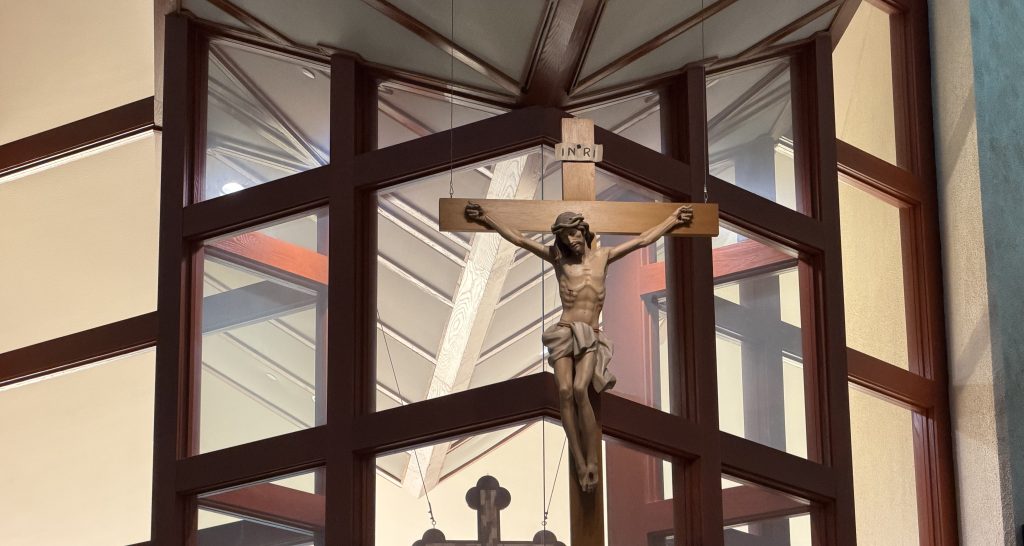
God cares more than we think.

In the Gospel, Jesus receives the seventy-two he had commissioned to heal and exorcize demons in his name. They returned rejoicing at the wonders that they experienced in their service and Jesus invited them to see that what was more amazing was not so much that “the spirits are subject to you, but rejoice because your names are written in heaven” (Luke 10:20).

What is amazing about what Jesus is sharing is that much more than what we do, even in doing God’s will, is who we are in relationship with God. That are names are written in heaven means, we know God. God cares about us personally and intimately. God knows each of us by name and knows us better than we know ourselves. Even though God does not need us, God yearns for relationship with us and has planted that very desire to be in relationship with him in the very depths of our minds, hearts, and souls. God also wants us to participate in his plan of salvation history and has a particular part for us to play.

When we give ourselves some time to take this in, to rest and stop, to breathe, really take some deep and slow breaths, and ponder not only how much God loves us, but actually give ourselves time to rest in and receive his love. Wow! You’ll never breathe or see the world in the same way again. When we receive something negative or harmful we are able to process and receive that in three seconds. To receive something good or to hear someone say we are loved, can take from 30 – 90 seconds to process.

We might hesitate or question whether God cares because we might believe that he allowed something to happen or not to happen, or because we are unwittingly welcoming the negative influence and lies of the enemy, such as: we may not care about having our name written in heaven; for what’s the point of having an eternal relationship with someone who doesn’t care enough to listen. Lies such as these keep God at a distance. But God hears all our prayers even while they are still thoughts in our mind.

He knows our deepest needs, hurts, and desires more than we do. To experience God’s love though, to know that he hears our prayers, we need to slow down and be still. God speaks in the silence of our hearts and we can hear his voice of love when we remain still long enough to hear, receive, and rest in his word.

Just taking a moment to be still, and to bring our questions to God is a good first step. For God is the best one to answer them. We just need to be prepared that he may answer our question with more questions. As long as we enter into the conversation, God will happen. It is not so much that we need to get up and do something, as much as instead, we need to sit and allow God to do something in us, and to remain still long enough to hear, receive, and rest in the gift of God’s love that he wants to share with us. Then, once have received what he has given and guided us to share, we do so.


Photo: “Be still, and know that I am God.” – Psalm 46:10

Link for the Mass readings for Saturday, October 4, 2025

May we not reject but welcome the light of Jesus.

“Whoever listens to you listens to me. Whoever rejects you rejects me. And whoever rejects me rejects the one who sent me” (Lk 10:16).

On the surface, today’s Gospel as well as the first reading and the psalm may sound like a Debbie Downer of a message, but it is actually the road map, the passage that will lead us from the darkness of slavery steeped in our own sin to the light of truth and freedom found in dedicating our life to Christ. Jesus is continuing to prepare the 72 that are about to go out to proclaim his message of repentance. This echoes Mark’s recording of Jesus’ mission statement: “This is the time of fulfillment. The kingdom of God is at hand. Repent, and believe in the gospel” (Mk 1:15).

A sin is any actively contemplated thought, word, or action that we knowingly know goes against the will of God and we freely choose to act upon it anyway. This is why many of us prefer the darkness to the light because we do not have to see and name our sins. We hold on to apparent goods or substitutes that we believe will make us happy and fulfill us, otherwise we would not hold on to them. Yet, they are empty promises. After experiencing the lack of satisfaction, once the emotion or passion of the moment or experience wanes, we either seek more to fill the void or hopefully, recognize the false lure and begin to seek something else to fill the void.

If we choose to seek more or seek within the material and world of finite creation apart from God, we continue along a slippery slope that may lead to our ensnarement or addiction. When we instead heed Jesus’ call and repent, allow the light and truth of Jesus into our darkness, trust that he truly wills our good, we can begin to see our sin, name it, repent from it, let it go, be forgiven, be healed, and fulfilled by receiving the true good, the love that God seeks to give and deepen our relationship with him for whom we have been created.

As servants of the Lord, we are invited to repent, to realign ourselves and our lives in such a way that we are saying yes to building a relationship with God. This is a daily, moment by moment, lifetime task of examining our conscience, asking God to reveal to us our sins, and willingness to embrace the humility to see and confess. This process is not just for ourselves.

Having experienced God’s love and forgiveness, we are called to bring the light of truth we have received to those we meet. This does not mean we are perfect. Through the awareness and confession of our sins, we are incrementally more open to receiving more of the love and light of Jesus within us than before, such that he can shine his light through us into another’s darkness and gently guide them to come out of the shadows.

We need to resist though the temptation to go forth and wag our finger of judgment. For then we are only a darker storm cloud approaching those needing a healing balm. This approach can either cause people to slip deeper into their own shell or come out fighting, seeking to dispel us from their midst. Jesus sends us out like the 72 to encounter one another with understanding, mercy, patience, and love. In the beginning, our light needs to be soft, like the morning dawn, so as not to blind those we seek to offer an invitation.

Jesus, this day and each day going forward, please dwell within us. Help us to be open to those you place near us that we may be present to them with your warmth, welcome, and joy. May we respect each person we encounter and be present, so that they may know that they are not alone, that they, in fact, do exist, that they matter, that they are loved as you love us. May we be like the light of the dawn to help awaken those in the darkness of their pain, suffering, and sin. May we be a lamp unto their feet and a light unto their path, that leads to an encounter and embrace with you; our Truth, our Way, and our Life. Amen.

———————————————————

Image: When we allow the light of Jesus to shine in our hearts and minds, he will lead us to freedom from that which and those who hold us captive.

Link of the Mass readings for Friday, October 3, 2025

Want to be great? Reject self sufficiency and depend on God like a little child.

“Whoever humbles himself like this child is the greatest in the Kingdom of heaven. And whoever receives one child such as this in my name receives me” (Mt 18:4-5).

Children during the time of Jesus were seen, if there were acknowledged at all, to have little worth. They were vulnerable, had little if any status in society. They were often nothings, nobodies, and completely dependent on their parents for survival. Jesus invites a child to come to him, identifying himself with the child, as a response to the disciples’ question as to who would be considered the greatest in the Kingdom of heaven.

Jesus taught his disciples, and us today that we need to be completely dependent on God our Father, just as a small child is totally dependent on his or her parents. What leads us to greatness in the Kingdom of heaven is our turning away from the temptation to curve in upon ourselves, resisting the urge to feed our ego, place ourselves first, and as St Thomas Aquinas taught, resisting the cultural lures and substitutes for God: power, pleasure, honor, and wealth.

We are also to reject the image of the Übermensch, the super man, popularized by Friedrich Nietzsche, the 19th century German philosopher. Nietzsche wrote that God was dead and promoted the idea that humanity needed to create a world that would create new values based on the power of their will alone. Supermen and women striving for complete autonomy and self-sufficiency. Jesus teaches the exact opposite. We need to place our complete dependency and trust in and on God and rely on him for everything.

Participating in the reign of God is not one of lordship over another. Instead we are to assume the humility to accompany, walk along with, and serve each other along our journey in this life. Jesus embodied this reality. He, as the Son of God, entered into our human condition. He did not grasp at his divinity but instead surrendered it to his humanity. While remaining fully divine, he became fully human when through the power of the Holy Spirit was conceived in the womb of Mary. In such vulnerability and weakness, he developed through his period of gestation, and was born into our world. As an infant and child, he was completely dependent on Mary, Joseph, and God his Father.

As Jesus continued to grow as a young child, he experienced the fullness of the human condition. He laughed, he cried, he got sick, he was tempted, he felt pain, he experienced heartache and joy. Throughout his life, and especially during his public ministry, he experienced human suffering up close and personal. He understood the suffering of his neighbor and experienced his own human and finite limitations. He loved and wept as we saw in his encounters with Lazarus, Martha, and Mary.

Jesus invites us to relate to God as our Father often in the Gospels, in the best sense of that intimacy of dependence. St Thérèse of Lisieux, whose memorial we celebrated yesterday got this. “Jesus has chosen to show me the only way which leads to the Divine Furnace of love; it is the way of childlike self-surrender, the way of a child who sleeps, afraid of nothing, in its father’s arms.”

Accepting Thérèse’s image is an acknowledgment that we are just as dependent on God and others, that we are not self-sufficient, that we are not capable of living radically independent lives, nor are we supposed to. God created us to be loved and to love, to be in community, to care for, empower, and support one another.

Our guardian angels, whose memorial we celebrate today, are at the ready awaiting our call. When we have the humility to ask for their help, we will realize that we are not alone. When we experience some supernatural support, from God, his angels and the saints, we might just be willing to seek help from and support each other. We can offer a shoulder to lean on, a smile, a hug, a voice that speaks for the voiceless, a soul open to pray with and for others, an ear to hear, and we can embody the courage to serve and stand up for the dignity of each other.

St Mother Teresa was willing to come close and pick up that first dying man in the street. She did not ask his religion, was not concerned if he was of a different race or nationality, was not afraid to risk illness or injury by attending to him. She knelt down and was present in his time of dire need. We are at our best when we follow Jesus, St. Thérèse, St Mother Teresa, the saints, and our guardian angels, and surrender to, and place our dependency and complete trust in God and support each other by doing little things with great love.


To be loved and to love in return is why we are here at this time. Photo credit François Le Diascorn

Mass readings for Thursday, October 2, 2025

We are fit for the kingdom of God when Jesus is first before all and everyone else.

And another said, “I will follow you, Lord, but first let me say farewell to my family at home.” Jesus answered him, “No one who sets a hand to the plow and looks to what was left behind is fit for the Kingdom of God” (9:61-62).

This is one of the three challenges that Jesus offers to potential followers of his in today’s account. As Jesus is continuing on to Jerusalem, to the ultimate gift he will give to humanity, himself on the cross, Jesus invites those who are still with him to embrace the radical call of the Gospel. God is to be first before anyone and everything else. Even the security of home and family are not to hold one back from following Jesus. His listener’s would don’t have missed the biblical allusion Jesus is countering. When Elijah called Elisha to follow him, Elijah allowed Elisha to say goodbye to his family and settle his estate, so to speak, before they left together (cf 1 Kings 19:19-21).

Jesus is showing in his request, not just the demands of being a follower of his but also why. Jesus is God and if that is true, those seeking to follow him are not to do so with any naïveté nor false presumptions. They are to be willing to give all without holding anything back in following him. Demanding? Yes. But Jesus is about to do the same thing that he asks in giving all he has, his very life on the cross.

These three invitations offered by Jesus are not responded to by those he invites. This is most likely on purpose because the invitation is not only for them but for all who hear this invitation or read it today. We are invited to participate in the life of Jesus and build up the Church. The important foundational point is that we understand what Jesus means by the Church. The original Greek term that we have in the earliest manuscripts was ekklēsia. This is more than just a gathering or an assembly of like minds. Ekklēsia means to be called out from.

Jesus reveals to us anything or anyone that we have placed before God, and he calls us to a new way of living. He calls us to participate more intimately in his life and the life of the Trinity. We will do so when we let go of our grasp of the false substitutes that really don’t bring true happiness and fulfillment. Pleasure, power, honor, and wealth when properly ordered can be goods in and of themselves, but placed first and foremost in our lives, they will not fulfill, provide stability, nor will they give us control over our lives that we seek.

Jesus is revealing in today’s message that home and family also cannot be first. By accepting the invitation of Jesus to place him first and follow him, then our lives in this world will be properly ordered. Nothing else will satisfy, nothing and no one. In fact, we put unrealistic expectations on each other when God is not first because no one can live up to our deepest desires of intimacy and communion. Nothing can fully satisfy us because all is finite and we will only seek more. Only God can satisfy our deepest longing.

Once we reorient our life, put God before all else, grow in our relationship with him, then the other matters and material realities of our lives will fall into place. Our relationships with one another will be more realistic and we will be more understanding when those we are in relationships make mistakes and let us down. We will be more loving and forgiving toward one another when God is the foundation of our lives. God will provide all that we need and he loves us more than we can imagine. When we are confident in God as our refuge and our strength, we can appreciate the material things of creation more and being free of the unrealistic expectations we place on family and friends, we can love each other more.


Photo: When we make daily time to spend with God, we experience so much more wonder even in the simplest of moments.

Link for the Mass readings for Wednesday, October 1, 2025

We can choose reaction and revenge or understanding and forgiveness.

“Lord, do you want us to call down fire from heaven to consume them?” Jesus turned and rebuked them, and they journeyed to another village (Lk 9:54-56).

James and John’s request of Jesus ought to be recognizable to many, if not all of us. How many times when feeling slighted or disrespected do we want to act in kind or offer some retribution to our perceived offender? Many times, we don’t even think, we just react overtly back or we engage in our own tumultuous internal maelstrom.

Jesus rebuked James and John’s request immediately and moved on. He did not allow the rejection of the Samaritans to deter his course for even one second. Jesus had his face firmly set. His time was approaching and to Jerusalem he was headed. Also, he knew there would be a time for the Samaritans to believe. That time was not yet.

Our starting point in putting this gospel into practice is to decide that Jesus has chosen the better course. Seeking revenge is not the way. Not looking left or right, but keeping our eyes fixed on the will of God is the way to proceed. If we can agree with that as our starting point, then we can seek to understand what Jesus can teach us when encountering others.

First, our approach to others extending unkind behavior toward us is to be one of understanding. We are all dealing with a lot, and much of what others are dealing with are unknown to us. If we approach another’s unkind or disrespectful action from a place of understanding instead of seeking revenge, we will have a better chance of not reacting in kind and also possibly being able to help another to get in touch and reveal something they are struggling with. St. Ignatius’ counsel to give the other person the benefit of the doubt is a solid practice.

Often a negative response may come from misunderstandings. In giving the person the benefit of the doubt to explain their understanding of what happened in a given situation, helps to de-escalate the situation instead of adding fuel to the fire . We are not mind-readers and we also are not the best of communicators so resisting jumping to rash conclusions is a better course of action.

Along with being understanding and giving someone the benefit of the doubt, is to receive other’s action with humility. Maybe, we have done something to cause hurt toward another, intentionally or unintentionally. By taking a moment to pause, we can assess if we have done something to instigate the action we are receiving. Taking responsibility for that which we have done and apologizing for it, we create a better bridge for reconciliation.

We are responsible for our thoughts, words, and actions. We cannot dictate or change the behaviors of others nor are we to be doormats for another’s abuse nor take on their stuff either. We are to approach conflicts and obstacles with patience, understanding, a willingness to bring clarity, to give the benefit of the doubt, and humility for acknowledging what we have done and what we have failed to do. If another is not willing to hear reason after multiple attempts or closed, we move on.

We pray for and respect the dignity of the person whether we agree or disagree with the outcome while holding them accountable at the same time. Jesus is very clear that we are to love, meaning that we are to will each other’s good. That means putting the prayer he taught us, the Our Father into practice: We need to be willing to forgive.

None of these steps are easy. Human relationships are difficult in the best of scenarios, but still well worth the effort. None of us are perfect. When we do our best to follow these principles as well as other practices not mentioned to work toward reconciliation and build relationships, our conflicts will become moments of grace. Conflicts will become opportunities that help us to grow closer together rather than further apart. Inviting Jesus into the conflict is the most important step, for he can help us to see others from his infinite perspective instead of our limited perspective.

—————————————————

Photo: Spending time in quiet and prayer, especially in reading the book of God’s creation, helps us to slow down so that when we return to our interactions with people again, we can begin more peacefully.

Link for the Mass readings for Tuesday, September 30, 2025

Jesus invites us to participate in his life and the communion of the angels and saints.

He promised that he would be there so that she would not have to die alone. The hospital called that her time was closer while the priest was visiting another ill parishioner. He finished up as fast as he could, and unfortunately ran into traffic, and too many lights turning red instead of staying green. And although he pushed the speed limit, when the priest arrived at the nursing station and asked for the name of the woman, the nurse informed him that he was too late, she had already passed.

He felt horrible because he promised her that she would not die alone. As he was mulling over the unfortunate timing, the nurse continued. “An interesting thing happened. An orderly came in with another patient, and I had no order for her to be in this room. This woman looked at your friend and asked if she could have her bed closer to hers, then reached out her hand. They held hands while the orderly and I left to check into the matter. When we returned, your friend was dead. The orderly then moved her bed out. The funny thing is that I have been checking since they left and found no record of this orderly or his patient being in the hospital.”

She did not die alone after all. Was this a visit from two angels?

Today we celebrate the feast of the archangels, Michael, Gabriel, and Rafael. Angels are eternal, spiritual beings. They are not human but can take on human form in their appearance. Also, when we die, we do not become angels. We are human beings, and as such we are human and spiritual.

One of the possible reasons that Satan, who is the archangel, Lucifer, and the other angels, now called demons, rebelled against God was because in our participation in the life of Christ, we become higher than the angels. That was too much for them to take and so choosing their pride over God, they rebelled.

Jesus, fully God and fully man, is infinite and eternal as Son, while at the same time finite as human. In Jesus coming close to be one with us in our humanity, we are offered the opportunity to participate with him in his divinity. Like the angels, God has given us the ability to reason and the freedom to choose. We can choose to grasp at divinity on our own terms through our pride, as Satan and his minions, or we can receive the gift of God’s love, participate in the life of his Son, and become like God. The Father and the Son and the Holy Spirit are divine by their very nature, whereas we are given the grace to participate in their divine nature.

We don’t lose ourselves and become absorbed by God, we remain distinct and experience the fullness of our humanity in our participation in the divinity of Jesus. In his resurrection and ascension, Jesus has assumed his glorified Body. He is the first born of the new creation and through our baptism we participate in his life and through him, the life of the Trinity. As we surrender our lives to God, take up our cross, die to ourselves, and follow Jesus, we grow in holiness. We join in the new creation Jesus has won for us. With each faithful step we draw closer to the heavenly Jerusalem, and we become more united to the Body of Christ.

The wonderful reality we can ponder today is that in God’s order of creation, with each breath we take, we can rest in the truth that we belong to an incredibly extended family of Father, Son, and Holy Spirit, Jesus, Mary, and Joseph, the angels, and the saints. We can rest in the reality that no matter what challenges we are going through, we all have a significant part to play in God’s plan, we are all interconnected, and we are not alone. We are loved, we are in communion with many in heaven and on earth who are not only cheering us on but loving us, willing our good, and guiding us on our journey.


Photo: Each unique ripple reflects the brilliance of the rays of the sun, making for a beautiful symphony. Much like each angel and saint in heaven and us here below.

Link for the Mass readings for Monday, September 29, 2025

We care for one another when we are willing to see God in one another.

Jesus said to the Pharisees: “There was a rich man who dressed in purple garments and fine linen and dined sumptuously each day. And lying at his door was a poor man named Lazarus, covered with sores, who would gladly have eaten his fill of the scraps that fell from the rich man’s table” (Lk 16:19-21).

Two key points stand out right from the beginning of today’s Gospel regarding the two main characters of Jesus’ parable. The first is that this rich man has all he needs, and more, and is quite comfortable, and in his wealth and excess, he never even noticed the man Lazarus or his need. Lazarus who sat at his door presumably for some and died there from neglect.

Biblical scholars from the Church Father, Tertullian, living in the second and third century, to modern scholars today see in this telling of the rich man an allusion to Herod Antipas (Gadenz, 287). Herod who was compelled as well as feared, and then had John the Baptist killed, also “kept trying to see Jesus” (Luke 9:9). Had he spent some time himself with the poor, he would have had a better chance of that happening. Herod would later get his chance and was “very glad to see Jesus” when Pilate sent Jesus to him to be judged.

Whether or not Jesus intends the rich man to be Herod, the Pharisees, or anyone who does not follow the will of his Father in being generous to the poor, In sharing this parable, Jesus is not just pointing out something new. He is echoing the prophets such as Amos who said “Woe to the complacent in Zion” (Amos 6:1). The rich man is complacent, indifferent to the dire need of Lazarus who is right at his door. How many times did this rich man just walk by him paying him no notice?

The second point in this account is that the poor man, Lazarus, a homeless, hungry, and dying man is named, and the rich man is not. For ancient people’s, those without a name were those that had no status, were outcasts, lost. Jesus is turning over the table on this man from the very beginning of his parable in leaving him unnamed. The tragedy, because of this man’s unrepentance while he is alive, is that he will remain unnamed after his death.

The man’s indifference and complacency toward those he kept at arm’s length, highlighted by his treatment of Lazarus, allowed there to be a separation between them instead of the unity God calls for. This choice became an eternal choice and created the wide chasm between him and Abraham. This distance was of his own making because he did not seek to come close to Lazarus in life. In separating himself from Lazarus, he separated himself from God.

Jesus makes this same point in Matthew 25:31-46 when he taught that what we do not do to the least of these: the hungry, thirsty, the stranger, the naked, the imprisoned, you do not do to me. Jesus identifies himself with the poorest of the poor. Lazarus also dies and experiences an opposite fate as he is brought to the bosom of Abraham.  Jesus here is echoing the Beatitude he shared earlier: “Blessed are you who are poor, for the kingdom of God is yours” (Luke 6:20).

The parable of the Rich Man and Lazarus that Jesus shared speaks an important truth to us today. Jesus is showing the importance of our interconnectedness and call to nurture relationships. He is not calling us to create a utopian ideal but to repent and allow the Holy Spirit to transform us as we learn and follow the commandments of God. We are to be open to meeting each other not as the rich man regarded Lazarus with indifference and contempt but to instead be aware of the needs of our neighbors, our brothers and sisters, to care, and to love one another person to person by willing their good.

Pope Leo offered similar advice a few weeks ago: “We need an extensive ‘covenant of humanity,’ founded not on power but on care; not on profit but on gift; not on suspicion but on trust. Care, gift and trust are not virtues to be practiced only in one’s spare time: they are pillars of an economy that does not kill, but deepens and broadens participation in life.”

Jesus encourages us to resist the temptation of callousness, cynicism, and indifferentism and to be open to breathing, receiving, resting and abiding in his love and to follow his lead to love others in concrete ways. A good place to start is to be willing to come close, to offer a smile, or to listen to another in need. In being willing to see Jesus in each other, “God in every human being” (St. Mother Teresa), we can then learn and put into practice the corporal and spiritual works of mercy. In doing so, we love God, our neighbor, and ourselves and help to make our corner of the world a little better.

————————————————

Painting: “The Poor Lazarus at the Rich Man’s Door” by James Tissot.

Link for the Mass for Sunday, September 28, 2025

Link for Pope Leo XIV’s address to the 3rd world meeting on human fraternity, September 12, 2025

Through Jesus we can experience a new and infinite horizon.

The term horizon is often defined as where the earth and sky meet. This is actually an apparent horizon or sensible horizon because we see an apparent plane based on our observation point. If we are able to broaden our viewpoint and look beyond the present location we are standing at on the earth, say from the space shuttle, we could then experience a rational or celestial horizon: where the great circle of the celestial sphere whose plane passes through the center of the earth is parallel to the celestial horizon of a given position. Journeying deeper into space we could discuss event horizons, the boundaries marking the limits of black holes.

Before delving any deeper and getting lost in space, let’s return to the earth and today’s Gospel where Jesus stated: “Pay attention to what I am telling you. The Son of Man is to be handed over to men” (Lk 9:44). What Jesus offers to us in this statement is the horizon of the cross, the place where heaven and earth meet, where the physical and the spiritual, where the finite and infinite meet.

Many of Jesus’ followers were and are still confounded by the cross. As Paul wrote to the Church at Corinth: “For Jews demand signs and Greeks look for wisdom, but we proclaim Christ crucified, a stumbling block to Jews and foolishness to Gentiles, but to those who are called, Jews and Greeks alike, Christ the power of God and the wisdom of God” (1 Cor 22-23).

Paul echoes what Jesus was talking about – his imminent fate and our ultimate horizon – death. None of us will be able to avoid the final result of our mortality. Jesus taught both through his words and in his death that to be truly free we need to be willing to lose our life to gain it. We have to face and walk through our deepest fears to grow. Our life is not lived until we give it away.

The more willing we are to face the reality of our own death, the less likely we are to take the time we have for granted, and the better we can live our lives here and now. During our final four months together, JoAnn and I experienced God’s grace because we faced the reality that her time was near, we embraced the gift of the time we had together, and through the prayers of so many, we experienced the infinite presence of the love of God in our midst.

There is so much we can experience and enjoy, but if we only limit ourselves to that which we can experience with our physical senses alone, if we deny our own mortality, we limit ourselves. What makes us fully human, alive, and fulfilled is an embrace of both the physical and the spiritual, of both reason and faith, seeking the horizon where the finite and infinite meet, where earth and heaven come together. This approach opens up endless possibilities.

This union happens most perfectly in Jesus Christ, who is fully human and fully divine. Jesus helps us to  experience the beauty of God’s creation and our relationships. This happens best when we are willing to enter with him into, instead of resist, the natural rhythm of life and death. We come to appreciate the truth of how fragile our lives really are and so can better appreciate the time we have been given.

Death is not a truth to run from but to embrace. And as we do, we will be less apt to take each other for granted and instead better love one another because we will not be on this side of heaven forever. We will also be able to slow down and rest more in the moments that God offers in which we can experience foretastes of heaven now. We will better prepare ourselves for that time when Jesus will lead us into our own death so that we may rise with him and experience a new and infinite horizon.


Photo: Lead me, Lord, along the path to eternal life.

Link for the Mass readings for Saturday, September 27, 2025

Jesus has entered into and experienced suffering to free us from our own suffering.

Jesus asked his disciples about who people said that he was and Peter, through the revelation of God answered, “the Christ of God” (Lk 9:20). Jesus then responded that “The Son of Man must suffer greatly and be rejected by the elders, the chief priests, and the scribes, and be killed and on the third day be raised” (Lk 9:22).

The point of who Jesus is never gets old. As we grow in our relationship with Jesus, we come to a deeper understanding of Peter’s words.

Jesus is indeed the Christ, the Messiah, the Son of the Living God. Yet, that meant many things to many people who were awaiting the coming of the Messiah. For most, they were hoping for a military leader to come to lead them and overthrow their Roman occupiers. As soon as Peter made his statement, Jesus clarified what kind of Messiah that he would be, a suffering servant. Peter had trouble with understanding this and he represents us as well. One of the points of faith many of us struggle with is the same as Peter, why did Jesus have to suffer?

Jesus was willing to be sent by his Father to become human and to experience all of humanity, even the suffering of our humanity, because only that which Jesus assumed could he redeem. Also, in experiencing our suffering, even unto death, we can know without hesitation or doubt that Jesus understands our struggles and anguish. And that means we are never alone in our suffering.

The reality is that the Messiah, the Christ, the Anointed One, is Jesus. He is the suffering servant, the One willing to give his life on the Cross for all of humanity and creation. Jesus did not do this in some abstract way. He died for each and every human being that has lived, is now living, now reading these words, or ever will live. He died for you because he loves you.

Jesus “died in body through a love greater than anyone had known” (St. Bernard). Are we not only willing to receive his love but also suffer and sacrifice for one another, some of us even unto death as did St. Cosmas and St. Damian whose memorial we celebrate today? Our discipleship will be ultimately expressed in this radical love, in our willing the good of each other no matter the cost. We must be willing to let our hearts be moved with compassion and as St. Mother Teresa taught by, “Giving until it hurts.”

To give until it hurts means allowing our hearts to be open to love. For our hearts to be open to the pain of another means we need to be healed. The Divine Physician seeks to remove our hearts of stone and replace them with hearts of flesh. This divine surgery happens at the Cross when we are willing to bring our suffering to Jesus whose arms are wide open and ready to embrace us.

The Suffering Servant understands and experiences our pain. He can help us to experience instead of run from our pain. There is no way to cover up, go around, sidestep, and/or deny, our suffering. It will remain until we face and experience it head on. But we don’t have to do so alone, nor can we. For what Jesus has assumed he will redeem. When we are ready and at the pace, we are willing to go, Jesus will provide healing. As we are healing, we are then able to experience more empathy and compassion, to suffer with, to love others, and walk with them on their own journey toward healing, toward receiving the love we all have been made for.

———————

Photo: Just as the sun is present even as clouds gather, Jesus is present in our time of suffering.

Link for the Mass readings for Friday, September 26, 2025

Is Jesus just an idea or a person?

“‘Who then is this about whom I hear such things?'” And he kept trying to see him” (Lk 9:9).

Herod Antipas, the ruler over Galilee and Perea, heard stories about Jesus. The range of his thoughts, expressed by Luke, is confusion to curiosity, and regarding what he did to John the Baptist, his rumination could have been much worse. Herod may have started to feel concern over the possibility of a growing revolt, some guilt for his execution of John the Baptist, or just as had feared John while at the same time “liked to listen to him” (Mark 6:20). Could this Jesus accomplish even half of the things Herod had heard about him? One question that did not seem to cross Herod’s mind was whether he had any interest in changing his life and becoming a follower of Jesus.

Herod was not the only one in Luke’s Gospel who asked questions about who this man, Jesus, was. Nor did the asking of those questions die with Jesus on the cross. They continued after his resurrection and ascension, they continued into the first centuries of the Church, which led to the calling of the first ecumenical councils that dealt directly with who Jesus was, and they continued in each following century and continue today. There are even at present, within some academic circles, that question whether Jesus even existed at all.

One could ask why this question about the identity of Jesus still persists? One answer is that we are finite beings seeking to understand an infinite Mystery. To comprehend the reality that Jesus is the incarnate Son of God, fully divine, who took on human flesh in the womb of Mary, lived fully human, died on the cross, conquered death through his resurrection, and ascended to and sits at the right hand of the Father transcends can stretch our capacity of our ability to reason. Also, Jesus’ invitation is a universal but personal one. Each individual person has to encounter Jesus for her or himself.

Jesus called the Twelve, as well as Mary Magdalene, St. Irenaeus, St Thomas Aquinas, St. Francis and St. Clare of Assisi, St. Catherine of Siena, St. Teresa of Avila and St. John of the Cross, St. Ignatius, St. Francis de Sales and St. Jane Frances de Chantal, St. Mother Teresa, Thomas Merton, Dorothy Day, along with two of our newest saints – St. Pier Giorgio and St. Carlo. He also calls each one of us as well. He did not call us to just merely embrace a new philosophy, a new ethical way of life, or even a new religion. Jesus called and calls us to be a part of his Body, the Mystical Body of Christ.

Who is Jesus? Herod asks in today’s Gospel. It is a good question for us to ask as well. For me, Jesus is the Christ, the Son of the living God, who became incarnate, becoming one with us in our humanity so that we could become one with him in his divinity. This same Jesus who called others through the ages invites us to follow him today as well and he continues to walk this journey with us, whether we say yes or no to his invitation. We are more aware of his presence with us and receive more of his help when we say yes!

Life with Jesus isn’t perfect, and we will at times echo St. Teresa of Avila, who stated after she was thrown from a carriage into a mud puddle, “If you treat your friends this way, it is no wonder you have so few.” But we will, as did Teresa, also experience moments of inexpressible joy, of wonder and exhilaration, and feel blessed when Jesus works and loves through us.

St. Teresa of Avila had a deep and intimate relationship with Jesus and knew him as her closest friend because she heard him knocking and let Jesus in. She spent determined and intentional time consistently with him. She spent an hour before and an hour after Mass each day. She set aside specific, daily anchor times of personal meditation and prayer, contemplated upon and experienced deep intimacy with God, which allowed her times of such closeness such that she experienced Jesus as well in her daily activities. She was able to share with him her joys and frustrations because Jesus was that close to her.

Let Jesus not be just a passing curiosity as he was with Herod Antipas. Jesus is standing, knocking, (cf. Revelation 3:20) inviting us to open the door and let him in. Jesus is inviting us as he did with Zacchaeus to come down from the tree and take him to his home (cf. 19:5). Jesus is calling us to come and follow as he did with Matthew (cf. Matthew 9:9-13). Jesus is no myth, nor was his death the end. He died and conquered death for us. He is alive and well, and inviting us to follow him today. All Jesus waits for is our, “Yes.” and for us to make a few steps with him. Jesus will take care of the rest!


Photo accessed through Pinterest. Maybe we don’t know Jesus as well as we like because when we pray, we just say words, instead of realizing that we are really praying with a person.

Link for the Mass readings for Thursday, September 25, 2025