lent


The setting sun helps us to remember how Jesus’ life set.
A core group, the Sanhedrin, within the leadership of Israel has decided. They will not deny themselves, their power, prestige, their place. They will not take up their cross and follow Jesus, the way, the truth, and the life. They will not allow the teaching and momentum of the growing number of those following Jesus to continue unchecked. As Passover drew nearer, thousands of people were coming to Jerusalem to purify themselves for the great feast.
This meant that many more centurions would be in place to keep the peace. The division and commotion that Jesus was causing could escalate conflict, unrest, and then swift and violent retribution from the Roman presence. Also, messianic hopes were at a fever pitch during this time. The foundational hope was that the Messiah would come, and amass followers to overthrow the Roman occupiers.
The Sanhedrin, the Jewish High Council, followed the lead of the high priest, Caiaphas, who said, “You know nothing, nor do you consider that it is better for you that one man should die instead of the people, so that the whole nation may not perish” (Jn 11:49-50). Caiaphas was looking to protect his people. Even if the image of followers amassing around Jesus was people, the Roman leadership could take this for a mounting rebellion, and would come down with swift, cruel force that would not be an eye for an eye.
With these words, they began to plan how to put to death the carpenter of Nazareth. With the words of Caiaphas, the sun began to set on the life of Jesus. These words even affect us still today as they usher in the sunset of our Lenten observance. The gift of our liturgical readings allows us to relive the story of our faith. Lent has given us a time to reflect, to meditate upon who Jesus is. Is he just a carpenter, another teacher, or a holy man from the past? Is he each of these, but someone so much more, the Son of God who became one with us in our humanity so that we can become one with him in his divinity?
Do we see Jesus’ teachings and life as a threat as did the Sanhedrin? Do we like our life the way it is, such that we do not want Jesus to come into our home and start turning over the tables and disrupting our order and comfort? Do the Gospels cut us to the heart and inspire us to shake off our complacency, our indifference, our cynicism, our fear, so to be inspired to acknowledge our sins, to repent, and to begin anew? Are we willing to have our hearts opened such that we see the needs of our brothers and sisters and so are moved with compassion to help?
As Holy Week begins with the Vigil Mass for Passion Sunday may we meditate on the words of Caiaphas, “consider that it is better for you that one man should die instead of the people, so that the whole nation may not perish” (Jn 11:49-50). Caiaphas did not know that what he proclaimed would be so true. The one, Jesus, would die, not only so the nation would not perish, but that all of humanity would not perish and be saved.
Jesus died for each and everyone of us that we might have life and have it to the full. As the sun sets this Saturday evening (or even Friday if you are reading now), may it not be just another rotation of the earth on its axis, but an opportunity to commit once again to make time to ponder and appreciate Jesus dying for us. Let us take up our crosses with Jesus this Passion Sunday, so to die to our false selves, our egos, our self-centered postures, fears, pride, and vices. In dying with Christ, we shall put to death our vices, so to live a new life of virtue and love.
———
Photo: As each day ends, may we examine where we have been blessed, said yes to God, and be grateful, as well as acknowledge where we have fallen short, resisted God’s invitation, ask for forgiveness and help to begin again.
Link for the Mass for Saturday, March 28, 2026

Are we walking away or closer to Jesus this Lent?
In today’s account from the Gospel of John, we see as we have been seeing, a division. There were those about to stone Jesus for blasphemy and those who began to believe. The first group did not recognize Jesus as the Son of God. Although Jesus sought to create an opening through reminding them of the good works he had done. These works came from his Father, and so Jesus sought to reason with them, “even if you do not believe me, believe the works, so that you may realize and understand that the Father is in me and I am in the Father” (Jn 10:38). They listened to the claim that Jesus was making but they refused to accept the fulfillment of his assertion: Jesus did the works of his Father because he was then and still is today the Son of God. Jesus knew the voice of his Father, was obedient to his Father’s will, and did what the Father asked him to do.
The more that Jesus sought to help them to understand that he was who he says he is, the more they dug in their heels. They may have left the stones on the ground but then moved to have him arrested. Jesus evaded their grasp and moved on to the region across the Jordan where John first baptized. John did not preach in the Temple precincts either, even though he was the son of a priest. John followed the lead of God to prepare the way for Jesus and his eternal priesthood. The Temple had not been the seat of God for some time. Jesus would become the new living Temple.
Jesus returned to the place of his baptism, where he joined in solidarity with sinful humanity. This visible image of consecration revealed what happened silently in his conception and birth: the Son of God took on flesh and became man to open up heaven for us in the humanity he assumed. As people came to John in the Jordanian wilderness, so too, people came to Jesus. Not all rejected his message. Many came to him and said, “John performed no sign, but everything John said about this man was true.” And many there began to believe in him (Jn 10:41-42).
A question that arises for us as our steps take us closer to Palm Sunday and Holy Week is to which group will we align with? Will we label Jesus as a blasphemer or believe that Jesus is the Son of God? The scriptural record does not reveal indifference as an option, the accounts do not leave any room for Jesus being only human; no matter how good a teacher, a wise man, or a revolutionary radical.
We either accept Jesus is fully human and fully divine or we don’t. If he isn’t who he claimed to be, the Son of God, then Christianity is just another philosophical, theological pursuit. If we accept that Jesus is the Christ, the Son of the Living God, then we are invited to align our lives to his. Opening our minds and hearts and believing the deeper truth of this reality, as did the apostles, will take time and experience with Jesus. Our thoughts, words, actions, and even our faces will slowly begin to be transformed as we answer Jesus’ invitation and spend time with him.
A way to begin or continue our walk, is to call Jesus to mind more often as St. Francis de Sales suggests: “pronounce either on your lips or in your heart whatever love suggests to you on the spot because that will provide as much as you wish… there are certain words that have a particular power to satisfy the heart in this situation… psalms of David… invocations of the Name of Jesus… bursts of love written in the Song of Songs. Spiritual hymns… sung with care” (p. 103). One thought and phrase I have been recently been using is, “Jesus, I choose you.”
————————————————————————-
Photo credit: Nice to get back out for an evening Rosary walk!
Fr. John-Julian, OJN. The Complete Introduction to the Devout Life Francis de Sales. Second Edition. Brewster, MA: Paraclete Press, 2016.
Link for the Mass readings for Friday, March 27, 2026
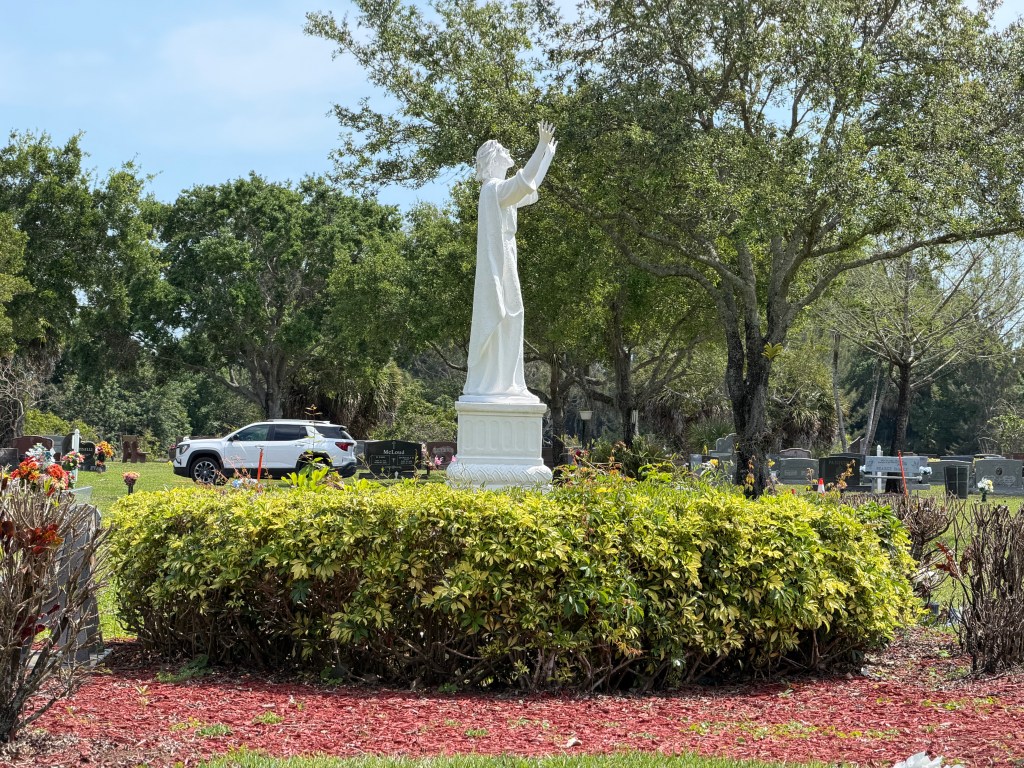
Jesus knows who he is. Do we?
Jesus’ listeners “picked up stones to throw at him” (Jn 8:59). This interaction has some similarities found in Jesus’ Bread of Life discourse (cf. John chapter 6), though less of a violent reaction, where Jesus made the statement, that, “I am the bread of life” (Jn 6:48). In both cases, the people do not understand what Jesus is sharing about his identity, and yet, in both cases, Jesus doubles down on the points he had made.
In John 6, Jesus holds firm to the truth that his followers will consume him and in today’s Gospel Jesus does not equate himself as being just a representative of God, a prophet or a rabbi, but that he, in fact, is God when he states: “Amen, amen, I say to you, before Abraham came to be, I AM” (Jn 58). With these words, Jesus has just done the unthinkable, he not only has spoken God’s sacred name, which is not to be uttered because it is considered too holy to do so, he equates this sacred name, “I AM”, with himself.
Jesus is making his point very clear, that he is God. During the Bread of Life discourse, people walked away from him because they were repulsed and most likely considered him mad, when he stated that they were to eat his flesh and drink his blood. Here they believe he is speaking blasphemy of the highest order. The reactions would be appropriate in both cases, unless of course, Jesus is who he said he is.
As his listeners then, we too have a choice to disbelieve or believe in Jesus. One option that is off the table, if we give the Gospel accounts any rational reading, is that Jesus presented himself as just another teacher, philosopher, prophet, or guru. Jesus, during his public ministry, is consistently embroiled in conflict, which is evident in all four Gospels, because Jesus presents himself as God incarnate. Jesus heals on the Sabbath because he is the Lord of the Sabbath, Jesus is the Bread of Life, Jesus is: “I AM.”
The Apostles struggle to make sense of the words and actions of Jesus and we may also struggle with our understanding of who God is and who Jesus is. We may have doubts, concerns, and unanswered prayers and/or questions. To walk the path of discipleship is not to walk with constant assurance, for we walk by faith and not by sight (cf. 2 Corinthians 5:7). Walking by faith does not mean we throw up our hands, toss out all reason, and believe blindly. Dr. Holly Ordway defined faith as “trust based on a reasoned knowledge of the evidence.”
Faith means that we trust that Jesus is who he claimed himself to be, who he still claims himself to be, based on the scriptural evidence, our own experiments with the truth based on these claims, and our experiences of him in our time of prayer, meditation, contemplation, and everyday actions and engagements with others.
Jesus calls and we are to follow. He does not give us the full picture, but as we step out trusting in his call, he will reveal to us each step of the way what we need to know and do. He will be present and work through us as we continue to turn our life over to him and one another more and more each day. When we begin to doubt, we can lean on Peter’s claim, “Master, to whom shall we go? You have the words of eternal life. We have come to believe and are convinced that you are the Holy One of God” (Jn 6:68-69). Peter made this claim based on his experience and trust in his relationship with Jesus. Our relationship and belief in Jesus will also grow to the same depth, moment by moment, with each, “Yes” to the invitation of Jesus, the Holy One of God.
———————————————————————————-
Photo: At Our Lady Queen of Peace, spending some time with Jesus and JoAnn.
Holly Ordway’s quote comes from Lesson 2: Bridging the Meaning Gap in her course: Imaginative Apologetics which can be accessed by registering for the Word on Fire Institute, the home page of which can be accessed: https://wordonfire.institute/
Link for the Mass readings for Thursday, March 26, 2026
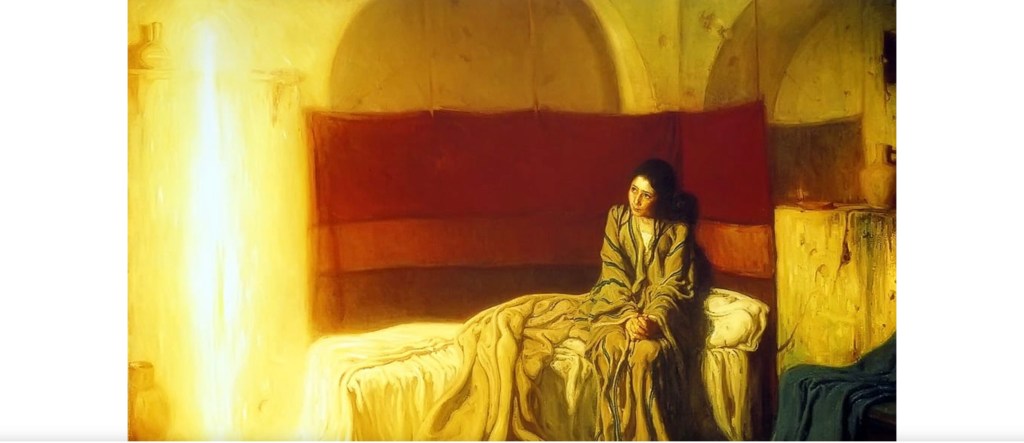
Though Mary did not fully understand, she said, “Yes.” Will we?
Why celebrate the Annunciation at the beginning of the third week of Lent? Simple math. If we celebrate the birth of Jesus on December 25, it is logical to celebrate his conception nine months earlier on March 25.
Gabriel, an angel, a messenger of God, a spiritual being, interacts with a human being; though Mary is not the first one to experience such an encounter. There are personal encounters with God and his messengers throughout the Bible. This is how the God of Israel, the God of Jesus Christ acts, person to person, through invitation, either directly himself or indirectly through one of his angels.
We can read such encounters going back to Genesis. God invited Abraham to be the father of a people that God would call to be his own. This reality would come to be with the birth of Isaac, while Sarah, like Elizabeth, was well past child-bearing years. Jacob would wrestle all night with an angel and become the father of the twelve tribes of Israel, during the time of the Judges, the mother of Sampson, and Hannah, the mother of Samuel, both barren women, would encounter angels bearing the message that each would give birth to those who would grow to lead the people Israel in their time of need. Moses, the judges, David, and the prophets all would hear and answer God’s invitation. Zechariah had an encounter in the temple and his wife Elizabeth, also barren and older, would give birth to John the Baptist. God has communicated and reached out to his created beings in history, at specific times and in specific places.
With Mary, this announcement and encounter was different, for, at this appointed time, the Son of God himself would become, while remaining fully divine, a human being in the womb of Mary. The God who is. Period. Full stop. God is not a being, not a human, or even a supreme being. Word fall short to describe the Infinite Act of Existence, the Sheer Act of to Be. At the appointed time, the Son of God, was sent to take on flesh in the womb of Mary. This is the message that Mary receives, and we can understand why she might be “troubled”. Mary, the model of discipleship, pondered what this might mean as Gabriel said to her:
“Do not be afraid, Mary, for you have found favor with God” (Lk 1:30).
Mary, who knew the arch of salvation history as briefly sketched above, knew of the encounters that God had with his people, her ancestors. She knew of the promised coming of the Messiah, Joseph her bethrothed, was from the line of David. She would now be the bridge between heaven and earth, the bridge between the old and the new covenant, the bridge between a people lost and a people to be found. Mary in her fiat, her “yes,” would become Theotokos, the God-bearer.
This is a solemnity that we celebrate each year because the Son of God has been born to us because Mary said “yes.” Yet, her yes is not in isolation. It was made possible by so many who had gone before her. Joachim and Anna, Mary’s parents, who provided care and guidance, as well as the many named above and not named throughout the Biblical tradition who said, “yes” to God and played a part in making this moment possible. Mary is not alone in the Annunciation, not alone in this definitive moment. This is the distinctive feature of Judaism and Christianity: We cannot save ourselves. We are not God. Our very life as created beings is a gift from God and we are in need of constant help and support from God and one another (cf. Lohfink, 254).
God invites us, not just today as we celebrate the feast day of the Annunciation, but every day. Each day is a day to ponder, to wonder, to be still, to be silent, to be experience awe. The Son of God, the Second Person of the Trinity, loves us so much more than we can ever imagine, more than we can ever even begin to conceive, that he became one with us in our humanity so that we can become one with him in his divinity. Us, you reading this, me writing this, and each unique person taking a breath on this earth.
No matter how much we have messed up, no matter how distant we feel we may be from him, no matter how confused, overwhelmed, disillusioned… Jesus, is present for and with us. The question is not whether we are worthy to play a part in salvation history, for none of us are worthy. The question is, “Are we willing?”
Are we willing to trust as Mary did even when we may not understand God’s will for our lives. Mary’s answer to her invitation was: “Behold, I am the handmaid of the Lord. May it be done to me according to your word” (Lk 1:38). We too are called to participate in God’s invitation. What will our response be?
——————————————
Painting: “The Annunciation,” by Henry Ossawa Tanner – One of my favorite paintings of the Annunciation.
Lohfink, Gerhard. No Irrelevant Jesus: On Jesus and the Church Today. Collegeville, MN: Liturgical Press, 2014.
Link for the Mass readings for Wednesday, March 25, 2026

Are we willing to allow Jesus to reveal to us our darkness and sin?
“[Y]ou will die in your sin” (John 8:21).
Jesus continued his discussion with the Pharisees but they still remained on different planes of understanding. Jesus coming from above and the Pharisees remaining below. Jesus came to meet us in our humanity to free us from what binds us to the physical realm alone. For God created man in his image and likeness and although we retain our image, we lost our likeness when Adam and Eve disobeyed God’s command: “And the LORD God commanded the man, saying, ‘You may freely eat of every tree of the garden; but of the tree of good and evil, you shall not eat, for in the day you eat of it you shall die'” (Genesis 2:16-17).
In establishing this first covenant with Adam, God sought to invite him to not only participate in a relationship with his very own creation, he sought to have man perfected through obedience and participation in God’s life. When Adam and Eve disobeyed God, through their sin, suffering and death entered the world and was made worse in their lack of willingness to repent. The separation from the source of any living, mortal being leads to death. Separation from God means death.
God did not give up. He continued to seek to re-establish a relationship and covenants with his children, seeking to do so through Noah, Abraham, Moses, and David, until the appointed time when he sent his Son to help to shine the light on our fallen world. The light to reveal the way back to and restore the glory and likeness to the Father that all of humanity was created to participate in.
Some of the Pharisees still did not understand what Jesus was telling in being the Son of God whom the Father has sent. He continued to reveal his intimate knowledge of the Father so that they could see, believe, and come to know the Father as he does. Jesus also gave them a clear choice that those who continued to reject him were choosing darkness and sin over the light and life of Christ and so would die in their sin, by their own choice. Those who believe in Jesus will become one with him in his divinity. They will not only continue to share in the image of the Father, but they will also be restored to experience their likeness of him.
This is the holiness we are all called to participate in. We are called to repent and renounce the attachments to the things of this world. Jesus shows us our deepest hunger, which is to grow in our relationship with him and his Father and experience the love of the Holy Spirit. Jesus’ consistent obedience, doing nothing on his own, saying only what the Father taught him, and always doing what was pleasing to his Father was a constant untying of the knots of Adam’s disobedience and a constant growing in intimacy that we are invited to participate in.
Jesus’ sharing of this intimacy with his Father started to shine through the darkness. The beautiful ending line of today’s gospel account is that while at the beginning some of the Pharisees were still struggling to understand him, some now began “to believe in him” (John 8:30). The question for us to ponder is, are we beginning to see and believe, so we can repent from our sin, and live with God now and into eternal life?
Photo: Slowing down helps us to see our dark sides as well as the light within us.
Link for the Mass readings for Tuesday, March 24, 2026
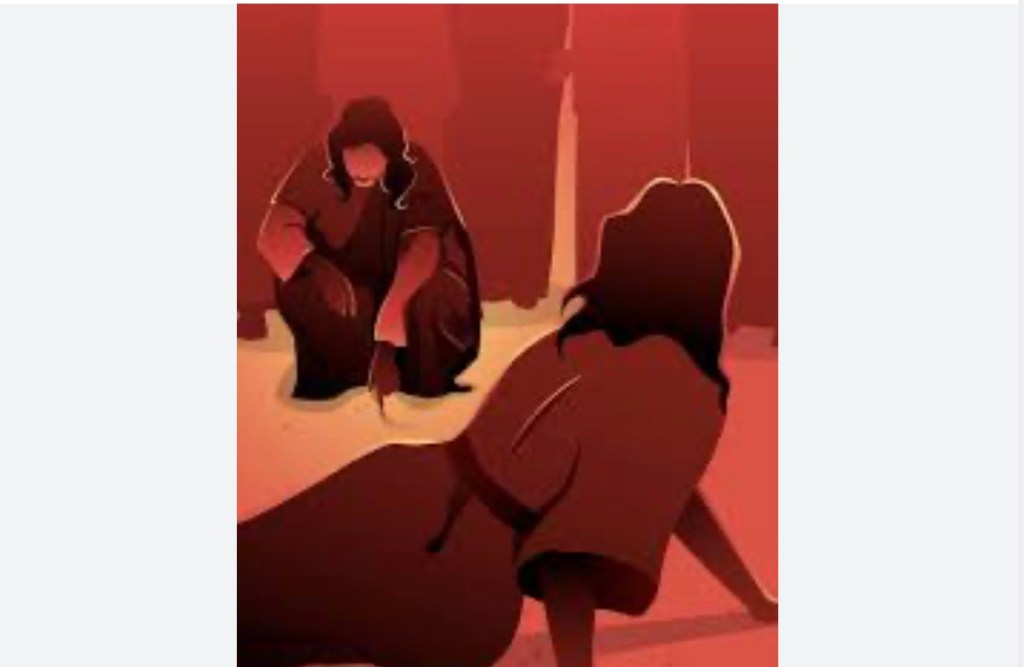
Let not the sins and wounds of our past define us. Let Jesus do something new in us.
In today’s Gospel account from John, many people gathered around Jesus in the temple area and were sitting and listening to him, when a horrific display of human wickedness breaks in as, “the scribes and the Pharisees brought a woman who had been caught in adultery and made her stand in the middle” (Jn 8:3).
This act of depravity is worse if we spend any time thinking about this verse. This was a calculated plan hatched by the scribes and Pharisees. They had been watching this woman for the opportune time to break in and catch her, using their own words of accusation, in “the very act of committing adultery” (Jn 8:4). If they were this calculated and malicious, they would not have probably even given her the opportunity to put her clothes on.
The shame that this woman must have had to endure as she was dragged openly and publicly through the streets was made worse because they brought her to the temple area. The temple was where people came to give sacrifice to atone for their sins and to worship God. What was worse was that the dehumanization of this woman most likely had nothing to do with bringing her to repentance, but had all to do with demeaning her for their own twisted ends to trap Jesus.
The Pharisees and scribes hatched this plot just to trap Jesus in what they believed was a fool proof way to bring charges against him. If Jesus did not follow the law of Moses and condemn her to be stoned, he could be charged for speaking out against the Mosaic law. If he did condemn her, he then could be charged by Roman law. Only the Roman authorities could institute the death penalty.
Jesus bent down and began to write on the ground with his finger (Jn 8:6). With this action, Jesus could have been buying some time to think over his response. He could have just been showing an attitude of indifference toward the charges presented. The truth is, we don’t know what Jesus wrote in the dirt that day. St. Jerome proposed that he was writing the sins of those gathered around him as they were waiting for his judgment. Another interesting speculation is that Jesus was again showing his foundation in the prophetic tradition.
Jesus could have been quoting the prophet Jeremiah: “O LORD… all who forsake you shall be put to shame; those who turn away from you shall be written in the earth, for they have forsaken the LORD, the fountain of living water” (Jeremiah 17:13, RSV). Jesus had just shared a few verses earlier that anyone who believed in him : “Out of his heart shall flow rivers of living water” (John 7:37, RSV). Those who came to trap Jesus could have found themselves getting caught in the trap instead and receiving God’s judgement for their forsaking God present before them in His Son (Pitre).
Whatever Jesus wrote had an effect and allowed for the pregnant pause before Jesus spoke: “Let the one among you who is without sin be the first to throw a stone at her” (Jn 8:7). Jesus returned to writing in the dirt, allowing for another pregnant pause. One by one, starting with the elders, the accusers, and even those who had gathered to listen to Jesus that morning, all walked away.
Jesus stood a second time only to find the woman standing before him. This is the first time he addressed her: “Has no one condemned you?” She replied with three simple words, “No one, sir.” And Jesus replied, “Neither do I condemn you.” Jesus did not seek to inflict any more shame on this woman and forgave her. Nor did he dismiss the sin. In Jewish law, there needed to be two witnesses to condemn someone of a capital crime. There was no witness left to do so. Jesus chose not to condemn her but also stated clearly, “Go, and from now on do not sin any more” (Jn 8:8-11)
Jesus and the woman looked eye to eye in the temple area, a stone’s throw away from the Mercy Seat of God. Jesus met this woman surrounded in her sin, shame, and anguish and met her with mercy and forgiveness. He cleansed the temple precincts of the hypocrisy of the Pharisees and scribes who had darkened the area that day and his forgiveness purified this woman from the stain of her sin. This was no cheap grace. Jesus did convict the woman of her sin, but did so in a way that respected her dignity, unlike those who hauled her out publicly to humiliate her for their own malicious purposes. Jesus convicted her in private, once everyone had gone.
In forgiving her with love and mercy, I can imagine, that she, who had been dragged through the streets, not only experiencing the humiliation, but fearing that her death was imminent, then walked away from her encounter with Jesus crying. Crying not just with tears of relief, but with tears of joy. Could the words of Isaiah have come to her mind then, “Remember not the events of the past, the things of long ago consider not; see I am doing something new” (Isaiah 43: 18-19). This woman having drunk from the “stream of living water” walked away born again, a new creature, transformed by the purifying love of God.
This account embodies the gift of the Sacrament of Reconciliation. We all sin and fall short of the glory of God. We bring our sins, contrition, fears, and are to be met with the loving mercy and forgiveness of Jesus in the priest. Not so that we can then just go out to do whatever we want to again, but with his help, to go and sin no more. To not only be forgiven, but to also receive the grace to help us to resist temptation, to heal, and through participating in the life in Jesus, walk with him along the way to restore the glory we have lost.
————————————————————–
Painting: May we experience and share the same mercy and forgiveness.
Dr. Brant Pitre, Catholic Productions
Link for the Mass readings for Monday, March 23, 2026
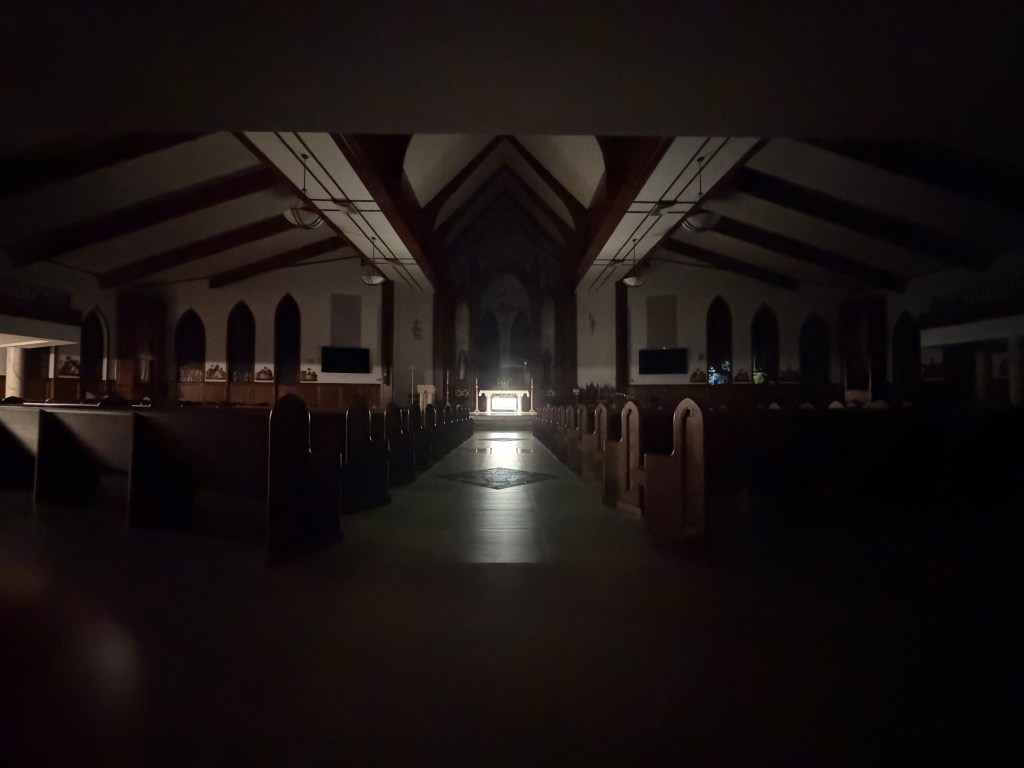
“For Jesus, it was more important to conquer death than to cure disease.”
Martha, Mary, Jesus’ disciples, and anyone else who experienced the sickness of Lazarus wondered why Jesus did not go to be with his friend as soon as he received word that he was dying. Jesus had healed and restored so many, why would he delay? Many of us who have experienced the death or in this moment may be accompanying a loved one in their final days and hours, may have asked or may be asking the same thing. Why is Jesus allowing this to happen? Why do so many have to suffer? Why the delay?
Jesus responded to the disciples’ inquiry by saying, “This illness is not to end in death, but is for the glory of God, that the Son of God may be glorified through it” (Jn 11:4). Not sure if Jesus’ response would have helped me if I was among the crowd. Many of us have experienced the death of our family and friends, as did Martha and Mary. What is Jesus up to?
Does Jesus care? Does this Gospel speak to us today? Yes. At the height of the Covid pandemic back in March of 2020, I remember being quarantined at home still on oxygen and watching Pope Francis come out on the steps of St. Peter at the Vatican in the dark and rain and said, Jesus, “more than anyone, cares about us.” Just as Jesus wept when he witnessed the anguish of Martha and Mary, the sisters of Lazarus, he also imagined the anguish of one of his closest friends sick and dying. So he wept and weeps with us in our present challenges, trials, and pain. Still he did not come until four days later. Why?
We may wonder in hearing or reading this account where Jesus is in the midst of our struggles at times, may wonder where he was in past challenges. There is good news here. Jesus had a plan for Lazarus and he has one for us. We need to have the same faith as Martha. Though she did not understand why Jesus had not come sooner, she trusted in him. Martha responded to Jesus when he asked he if she believed that he was the resurrection and the life and she responded: “I have come to believe that you are the Christ, the Son of God” (John 11:27). Just as Jesus was present to Martha, he is present and among us as well. But why the delay?
St. Peter Chrysologos offers a great response to that question, “for Christ, it was more important to conquer death than to cure disease. He showed his love for his friend not by healing him but by calling him back from the grave. Instead of a remedy for his illness, he offered him the glory of rising from the dead.” Jesus followed the lead of his Father to help those who were closest to him to understand that the reign of sin and death was over. Jesus came to usher in a new creation.
I believe Jesus conquered death and it has helped me with my deepest loss. Jesus did not cure my wife, JoAnn, from pancreatic cancer, and yet, it is my hope that he conquered her death, reached out to JoAnn, and led her home to the Father so that she may now be experiencing “the glory of rising from the dead.” But I am getting ahead of myself.
Jesus brought back Jairus’ daughter from the dead as well as the widow of Nain’s only son. The difference between each of them and Lazarus, was they were raised fairly soon after their death within even the same day or days. Lazarus had been dead for four days. Ancient Jews, unlike the ancient Egyptians, did not embalm the dead. By the fourth day, Lazarus’ body would have begun to decompose. In Jesus calling him back to life, and Lazarus rising, the effects of the decomposition were reversed and he walked out of the tomb on his own power, even while still wrapped in his burial cloths.
We need to resist just a complacent passing over of this incredible miracle that Jesus performed. This was beyond anything that anyone had ever experienced, and why, “many of the Jews who had come to Mary and seen what he had done began to believe in him” (John 11:45). Without diminishing the wonder of this event, it was only a forecast of the miracle of miracles to come and why the Church in her wisdom placed this account on the fifth Sunday of Lent. This is but a foreshadowing of the death and resurrection of Jesus.
Lazarus rose in a miraculous way but would die again. Jesus died, conquered death, and rose again never to die again. He was willing to do so for Martha, Mary, and Lazarus, so they could rise with him on the last day and have their souls be reunited with their bodies. The good news for us reading these words at this moment is that Jesus did the same for us today!
The key take away from the story of Lazarus is that no matter how wonderful the raising of Lazarus, a dead man four days in a tomb, was, it was just a foreshadowing of the truly incredible miracle of miracles we are about to celebrate in just a few weeks. The fact that Jesus rose from the dead himself was no mere resuscitation as with Lazarus. Jesus experienced the fullness of death and conquered it becoming the firstborn of the new creation. Jesus would later ascend into heaven and from the right hand of his Father, he would send us the Holy Spirit.
This is why we never need doubt that we are not alone ever, and especially in times of our deepest suffering. Jesus cares and accompanies us in each of our present situations as well as our unhealed traumas of the past. When we weep we can remember, “Jesus wept” also. Why? To teach us that it is ok to weep. Our tears remind us that we are human and that when we have lost a loved one, even if now we know death doesn’t have the final answer, there is a loss none the less.
We will live on, and just as if we experienced an amputation, our living without those that have died will never be the same. As we put our faith in the One who cares for us and loves us more than we can imagine, we will draw closer to him and to each other, we will see the glory of God at work in each of our lives, we will heal, and we will overcome and emerge stronger than before. Our healing happens when we too believe in Jesus the Christ the Son of God.
Our hope in this life is that we are invited to write our final chapter not here but in the new creation to come. “On the last day, Christ will call us forth from our graves as our friend, if we’ve lived in friendship with him. And he will command us as our Lord, the one who made the heavens and the earth, to come out of the tomb and to experience the resurrection of the dead, the new creation, and the life of the world to come” (Dr. Brant Pitre).
Photo: Each time we see the altar, we are reminded that Jesus died for us and conquered death so that death no longer has the final answer, Jesus the first born of the new creation does.
Pitre, Brant. Catholicproductions.com
Link for the Mass readings for Sunday, March 22, 2026
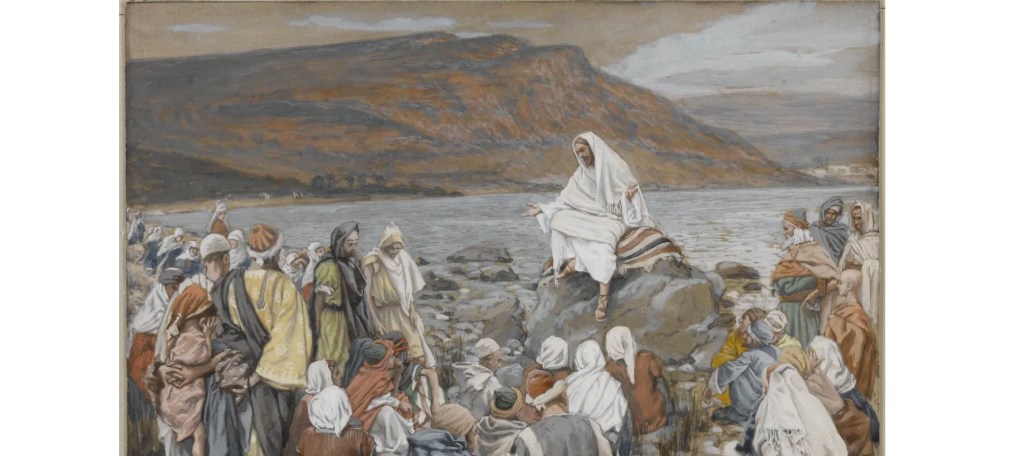
Learn, grow, and inform, not convince.
Jesus affirms who he is and whose he is in today’s Gospel of John. There were those who did not believe that he was the Messiah, but even those who were beginning to move in that direction, there was a deeper identity. Jesus continued to make his point very clear: “I did not come on my own, but the one who sent me, whom you do not know, is true. I know him, because I am from him, and he sent me” (Jn 7:28-29). Jesus is the Son of God made man and he belongs to the One who sent him, God the Father.
As Jesus was challenged in his time, he continues to be challenged today. That level of challenge has increased even to the degree that his human existence is even dismissed in some circles as a mere legend. Even as a historical figure, some speculate that Jesus did not walk the roads of Galilee and Judea as recorded in today’s Gospel. This need not be a reason for alarm. Though it is a reason to know our Tradition, the deposit of faith that has been preserved and passed on from Jesus to his Apostles and disciples, and to those early Church Fathers and Mothers named and unnamed, and passed on up to us to this day in an unbroken apostolic succession.
It is important that we also know the Bible, not in an academic sense alone, not just to quote chapter and verse, but how to read and receive the living word of God in its proper context, and as well as to meditate and pray and ponder what we hear proclaimed at Mass as well as what we read privately. Sacred Scripture is the Word of God expressed in human language, as presented in the Vatican II document, Dei Verbum, (Word of God).
Knowing Sacred Tradition and Sacred Scripture helps us to better understand what we believe, who we believe in, and whose we belong to. In this way, when we are challenged, we do not need to stoop into a defensive crouch, but instead listen to the person’s points, their critiques, and ask questions of what they believe and why they believe what they believe. We can defend our position while at the same time being open to understanding where our questioners are coming from. We can then respond with the truth, just as Jesus did, with an open mind and heart of surrender to allow the Holy Spirit to be present and speak through us.
When we are anxious, defensive, argumentative, seeking to be right, or fearing to be wrong, we limit what Jesus can do through us. God is not about numbers and quotas, he is about building relationships, one person at a time. It is more important to build relationships than to win arguments. We can learn much from St. Bernadette of Soubirous who when challenged regarding the validity of her experiences and encounters with Mary responded, “My job is to inform, not convince.”
Lent is a good time to learn, grow, pray, seek and offer forgiveness, and heal. All of which helps us to continue to grow in our intimacy with Jesus. As our journey continues, let us trust Jesus more and share our experiences of him with others. We are all on this journey of seeking the True, the Good, and the Beautiful together. It is important to respect and love those who have differing perspectives outside of and even within the Church, be open to the reality that we can learn from each other, and allow God to guide each of us through our common challenges and step by faithful step grow closer to God and one another.
————————————————————————–
Photo: James Tissot Nantes – “Jesus Teaches the People by the Sea.”
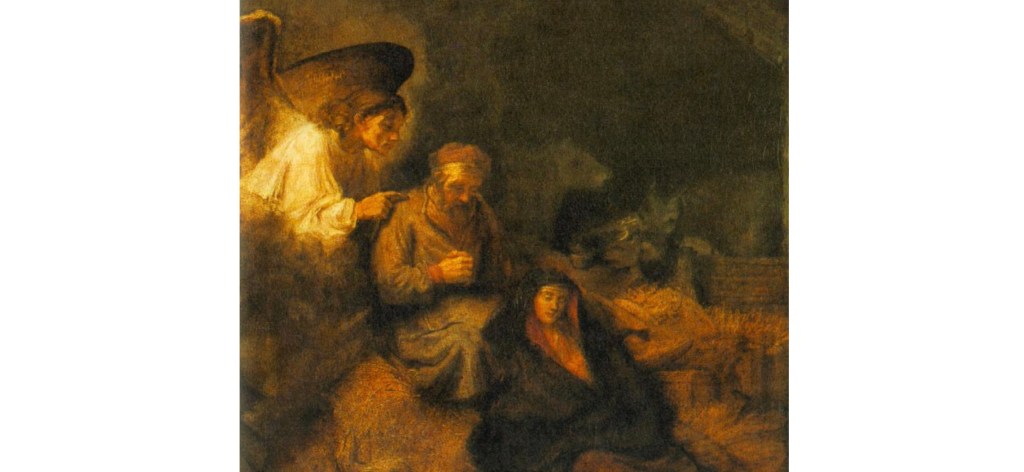
Discerning or feeling stressed about a decision, maybe time for a nap.
Who do we want to be? It is so easy to get caught up in being busy, taking care of children, the home, school assignments, work, as well as a myriad of other activities that each of us, experiencing our unique vocational state in life, can add to the list. These can all be good things, but we can lose ourselves in our business and responsibilities as well as how we define ourselves, such that we slip into a state of survival mode or merely existing. One day can move into one week, into one month, into one year, and then we wake up one morning and wonder where the last ten years have gone!
We can fall into the trap of being defined by what we do instead of who we are and who God is calling us to be. We may have heard or be told at some point in our lives, “Don’t just sit there, do something.” God has another way of presenting us this statement: “Don’t just do something, sit there, and let me do something in you.” God has a plan for each one of us with the end result being eternal communion with him in heaven. Living a life of holiness and becoming saints is who God seeks each of us to be. We need to remind ourselves of this from time to time, by assessing where we are now and if we are listening to the guidance of God.
Our Gospel account from Matthew today gives us an opportunity to see holiness in action. Joseph has become aware that Mary, his betrothed, is with child and he is not the Father. Pass the Pepto Bismol please… Joseph, “a righteous man” follows the law, but is “unwilling to expose her to shame, decided to divorce her quietly” (Mt 1:19). Joseph’s life of righteousness pulls him to follow the law, yet he shows that discernment in matters of the dignity of the person is just as important. Joseph not only was unwilling to make Mary into a public spectacle but was also unwilling to allow the possibility of her to be stoned to death.
Joseph pondered the idea of divorcing her quietly. Before he made his final decision, Joseph slept on the matter, which is often a good course of action when weighing heavy issues or dealing with stressful conflict. How many times do we rush into decisions only to regret them later? Joseph receives God’s direction through the angel of the Lord in a dream.
When Joseph awoke in the morning, he did not dig in his heels feeling that he knew best, that he knew better than Gabriel, and return to his original decision. Joseph did not let fear or anxiety about the possible scenarios that were running through his mind regarding what others may say or think sway him, nor did the possible and real difficulties he could envision deter him.
Joseph trusted God. With confidence and assurance of who he was and what God called him to do, Joseph acted on the guidance he had received without hesitation.
St. Joseph is a model for us. When faced with decisions to make, we need to remember who we are, whose we are, and who we are called to be. We are children of God, and that means we belong to God who loves and cares for us. He has a plan and each thought, decision and action we follow through on is a step in diverting from or fulfilling that plan.
There are many elements in good discernment, gathering information, ponder the reasonable options, praying and seeking God’s guidance, slowing down to breathe and think, seeking guidance from a trusted family member or friend, reading, praying, meditating with the Bible, his creation, being open to Godincidents, or a good nap or early to bed. Joseph followed some of the above and had the humility to listen to God’s messenger and he granted him not only the guidance he sought but the support to fulfill the commission he received. God will do the same as we discern his direction too.
St. Joseph, pray for us!
——————————————————————–
Painting: Closeup of Rembrandt’s “Dream of St. Joseph”
 Spiritual Stepping Stones