peace
This Advent, more anxiety and stress or more joy and peace?
“Rejoice in the Lord always, I shall say it again rejoice!” (Philippians 4:4)
There is a running theme in each of our readings and why we call today, Gaudete Sunday. Gaudete is the Latin word for rejoice. We rejoice because we are half way through Advent, and Christmas, our celebration of the incarnation, is only eleven days away. We are also called to rejoice because as St. Paul wrote to the Philippians that we can rejoice always!
Can we really?
Yes, because Paul is not inviting us to rejoice, he is commanding us to do so and he did so not only once but twice. But how can we actually rejoice always? One way is to distinguish between happiness and joy. When we are happy it is because we are reacting to a pleasurable experience that we find good. Yet, what often happens when the experience goes away… so with it goes our happiness. We then seek more of the same to fill that need to be happy and we need more and more of what stimulation we seek. Our happiness can linger on a bit or return as we call to mind the memory of the experience, but even then, the memory will fade after a bit.
Joy is not dependent on external experiences. Joy is dependent on our closeness to God and the indwelling of the Holy Spirit within us. That is why even when we experience challenges, trials, and conflicts, we can still feel joy. The key is where we put our focus. Focusing on the externals, we will sink. Keeping our eyes on Jesus, like Peter, we will walk on water! As long as we stay close to Jesus, we will experience his joy within.
Paul gives us to recipe for rejoicing always when he says, “Have no anxiety about anything”. As soon as we experience the first stirrings of anxiety, we are to turn to God in prayer and thanksgiving and let our “requests be made known to God.” I first remember experiencing this when I was in my late teens. I had been experiencing a period of desolation and anxiety about the future ahead beyond high school. I had recently purchased a Bible and one evening opened it at random to Luke 12:22: “Therefore I tell you, do not worry about your life and what you are to eat, or about your body and what you will wear.”
Then I heard God letting me know that I would never win the lottery but he would continue to provide me with the means to work. He would provide for and take care of me. Having heard these words in the quiet of my heart, I then returned to reading the whole section about placing our dependence and complete trust in God. A feeling of not only joy but peace welled up within, and the anxiety and insecurity I went into the reading of the Bible with dissipated. Light and darkness, love and hate, nor anxiety and trust, cannot exist at the same time and in the same place. We actually can choose which we want to experience.
The word anxiety comes from the Greek merimnaō. Biblical scholar, Dr. Brant Pitre describes Paul’s usage of merimnaō as, “an imperative; it’s not just a suggestion. And he’s saying not to have it about anything. Now this Greek word merimnaō is closely related to the verb for ‘to remember’. So when a person is anxious about something, it keeps coming to their mind. They remember it” (Dr. Brant Pitre).
What we place our focus on is what governs our thoughts and also has a tremendous influence on what we feel. If we are consistently attentive to what we are stressed about, like a dog drilling down, worrying on a bone, we are going to be anxious – always. The other side is just as true. The more we focus on Jesus, breathe, receive, rest, and abide in his love for us, and we consistently place our trust in him in all situations, the good as well as the bad, we will move closer to aspiring to Paul’s command to, “Rejoice in the Lord always”.
We will also rejoice more often when we are willing to make time to stop and think about what we are grateful for. It is so easy to get caught up in the busy, in our work as well as our perceived recreation, pass out at the end of the day, and start over again the next. Taking time to wind down each evening away from channel or social media surfing, we could instead choose to truly relax and let go by being still, quiet and reflecting upon the day to see where God has been blessing us, where we have said, “yes” to his invitation and where we have said, ‘no.”
Calling to mind what we are thankful for and having the humility to ask Jesus for help to correct or sins and missteps, also deepens our relationship with him and rekindles the awareness of the love of the Holy Spirit within us. What then wells up again from his eternal spring is not only joy but God’s peace, that peace that surpasses all understanding. Knowing and experiencing that God is close, that his Son is at hand, will help us to experience more regularly the love that is shared between them, the Holy Spirit.
Being filled with the joy, love, and peace of God to overflowing will then move us to share what we have received with others in very practical ways. In giving and sharing the joy, love, and peace that we have received, does not diminish in any way the what we have received. Instead, our giving only increases the joy, love, and peace God has given us. Not a bad way to spend our final days of Advent which will lead us into celebrating the miracle of Emmanuel – God with us, always. And because he is, let us rejoice always!!!
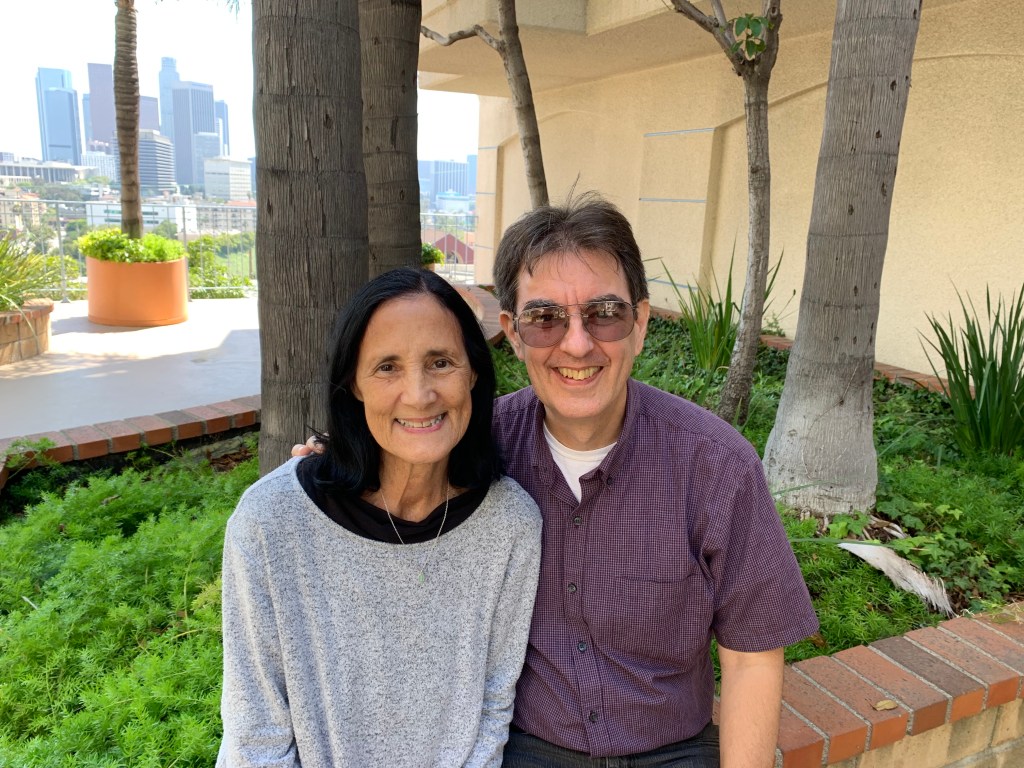
Photo: A different Advent. We were preparing for Jesus to come to bring JoAnn home to heaven. Because we had a better idea of the time and hour, we were able to appreciate each moment we had together. God blessed us with his joy, love, and peace to overflowing. I still look upon the last six months we had together as a blessing.
Dr. Brant Pitre. “Anxiety and Gratitude” from his video commentary: The Mass Readings Explained.
When we confess our sin, trust in Jesus, and are willing to serve each other, we take a closer step to peace.
“Amen, I say to you, in no one in Israel have I found such faith” (Mt 8:10).
The one to whom Jesus was referring to was the Roman centurion who approached Jesus seeking healing for his servant. I imagine that Jesus was not only amazed by the man’s humility, in recognizing his sinfulness and that he believed that Jesus could heal from a distance with simply his word, but also that he was aware of the need and suffering of his servant and willingness to do something about it. This Roman centurion, part of the occupying power in Israel, clearly embodied the teachings of Jesus! It is from the centurion’s words that we get the words that we speak before receiving Jesus in the Eucharist during each Mass: “Lord, I am not worthy that you should enter under my roof, but only say the word and I shall be healed.”
God chose the people of Israel not for themselves alone, but that they would be a light to all peoples. As Isaiah said, all nations shall stream toward mount Zion and “from Zion shall go forth instruction, and the word of the LORD from Jerusalem” (see Isaiah 2:1-5). Jesus echoes Isaiah’s prophetic words as is recorded in today’s Gospel: “Amen, I say to you, in no one in Israel have I found such faith. I say to you, many will come from the east and the west, and will recline with Abraham, Isaac, and Jacob at the banquet in the Kingdom of heaven” (Mt 8:11). The centurion’s act of faith is one of this beginning movements of faith in Jesus that, like a few drops of water, become the beginning of a majestic waterfall.
The first point we can learn from the centurion is that he was aware that his servant was in need. A slave held no dignity, and yet, he was not invisible to the centurion. Nor was the centurion indifferent to his suffering and pain. We also need to be aware of those in our midst who are in need. We need to resist the temptation to walk around, over, or by others and be willing to embrace them in their need.
Second, like the centurion, we need to embrace humility and acknowledge our own sinfulness, and when we do so, we are better able to see the needs of others. None of us are perfect. No one person is above any other. We all have gifts as well as shortcomings. We need each other because we complement one another and we are stronger together than apart.
Third, we cannot stand on our own. The centurion knew his strengths, the authority he possessed, while at the same time he recognized his limitations. He acknowledged that he needed help. He needed Jesus. As do we. We cannot accomplish our salvation on our own merit or will power. We need a savior, for apart from Jesus, who we prepare to encounter this Advent season, we can do nothing, but with Jesus all things are possible.
Jesus is the Truth that we seek. He has sent out a universal invitation of communion for all, to Israel first and then to those from east and west, north and south. The Roman centurion modeled our response to Jesus’ presence when he recognized his own sinfulness and acknowledged it before Jesus. He was also aware of and sought healing for his servant. The centurion had faith and hope that Jesus could and would provide healing with just his word.
May we follow his example this Advent as we take time to examine our conscience, have the humility to confess our sins, to acknowledge that we need help from Jesus and others. May we be willing to seek forgiveness and be willing to forgive. May we resist the temptation to embrace fear and close ourselves off from and be indifferent to the plight and needs of others.
We have so much to offer one another when we are willing to work together instead of stand apart from or against one another. May we who have received the forgiveness and grace of Jesus and felt the embrace of his love, work to beat our “swords into plowshares
and [our] spears into pruning hooks”. We can use our words to destroy or to empower and give hope. Choosing to return hate with love, and to say the good things people need to hear, we can promote a ripple of peace that can contribute to making Isaiah’s words a bit more real: “One nation shall not raise the sword against another, nor shall they train for war again” (Isaiah 2:4). Wouldn’t it be nice if we could take a few steps closer to this reality this Advent?
——————————————————————-
Painting: Sebastiano Ricci – Christ Heals the Centurion’s Servant, 1726-1729
Link for the Mass readings for Monday, December 2, 2019
Be vigilant, still, and pray this Advent, and we will be ready for Jesus’ coming.
As the earth turned again one more time on its axis last night, and the shadows began to fall, night slowly crept over each part of our planet. Our sacred text, our sacred word, is not only written in the Bible, but the finger of God has traced his word across all of the earth, the galaxy, the universe, the whole of the created order. For God continues to write his love song. The ground, foundation, and source of creation and our very being is the outpouring of the Trinitarian Love eternally and ongoingly expressed between God the Father, God the Son, and God the Holy Spirit.
As the sun appeared to set, and night gently made its way across our minuscule earth in this part of the Milky Way, the vigil began and so also the beginning of the new liturgical year and the season of Advent. We heard or will hear again today the words of Jesus to his disciples in today’s Gospel for the first Sunday of Advent: “Be vigilant at all times and pray that you have the strength to escape the tribulations that are imminent and to stand before the Son of Man” (Lk 21:36).
Advent comes from the latin, Adventus, which comes from the Greek, Parousia, and which we translate in English to mean coming. In our first reading, Jeremiah picks up on the prophecy of Isaiah in which “a shoot shall sprout from the stump of Jesse” (Isaiah 11:1) by stating that God “will raise up for David a just shoot” (Jeremiah 33:15). Both Isaiah and Jeremiah are pointing to the coming of the messiah. Faithful Jews would continue to watch and pray for the coming of the messiah to set the world aright.
Zedekiah was the king of Judah during the time of Jeremiah. He, as well as much of the leadership and chosen people of God would not listen to the guidance of the prophet and Jerusalem and the Temple fell at the hands of the Babylonians. From that time forward, from 587 BC, those exiled and even when they returned and rebuilt the Temple again, began the long, expected wait for the messiah. As Christians, we believe that Jesus, the Son of God and Son of Mary, is the promised messiah.
Our season of Advent not only is the opening of the new year, the new liturgical calendar. Advent is the season we wait, the season we prepare to remember the first coming of Jesus into the world as a baby.
The Gospel reading from Luke picks up on the momentum that we listened to during last week’s celebration of Christ the King. We also in Advent, prepare for the second coming of Jesus at the end of time. Jesus himself quotes from Daniel 7:13-14 by calling himself by a title he uses often, the “Son of Man” (Luke 21:27). This second coming will be different than his first coming. He will not come under the cover of darkness in the humble means of sleeping vulnerably in an animal’s trough in a cave wrapped in swaddling clothes. Jesus when he comes again to judge, will come “in a cloud with power and great glory” and when that time comes our “redemption” will be “at hand” (Luke 21:28).
During Advent then we are to prepare for celebrating again of the first coming of Jesus, while at the same time, we prepare for his second coming, the time or the hour only the Father knows. In the midst of these two, there is also a preparation for a third coming, which will help us to prepare better for Christmas and for our Lord’s second coming.
This Advent, this coming, is Jesus’ coming to us in the present moment. This is why the psalmist guides us to sing, “To you, O Lord, I lift my soul” (Psalm 25:1). Turning our hearts and minds, our very souls to God is one way we can watch and pray for Jesus who is already with us in each present moment, waiting for us to slow down, to breathe, to be still, so that we might hear his word and be aware of his presence at hand. In doing so, we recognize how close Jesus is to us. He reminds us who and whose we are, God’s beloved daughters and sons.
Advent is a season in which we are invited to slow down to receive, rest, and experience in the love that God wants to share with us. We are invited to resist the temptations of the stress and strain, the anxiety and angst that seek to divert and distract us. We will resist better when we allow ourselves to meditate upon the words and invitation of St. Paul: “May the Lord make you increase and abound in love” (1 Thessalonians 3:12).
As we make time to be still, to breathe and receive God’s love, his love in us will increase. Our experience of peace will replace the stress and anxiety that can arise because of our busyness and expectations. May we be vigilant and watch for the first signs of a snow ball of anxiety beginning to roll, stop, breathe, and turn to God. From a posture of watching and praying, may this season be one freer of the hustle and bustle going on all around us. Instead, may we rest with Jesus so to be the eye, the calm, in the midst of the storm.
This Advent, let us put into practice such spiritual exercises as breathing, praying, and being vigilant to root out any influences not of God and renounce them. Choosing to spend more time in God’s word, and focusing on the real meaning of why we are doing what we are doing – to grow in our relationship with Jesus, his Father, will help us to better experience the love of the Holy Spirit.
As we are vigilant at all times and pray, and increase our spiritual disciplines, we will grow in our spiritual strength, in our relationship with Jesus, and we will be better prepared to celebrate Christmas. We will more easily be able to surrender to his reign and help to support the coming of his kingdom, so to be ready when he comes again at the end of the age, or when our time on this earth comes to an end and we face our personal judgment.
We have been created by Love to love, to experience the closeness of Jesus. As gently as the night gave way to the morning rays of the sun this morning, may we live and move more gently upon this earth. May our thoughts, actions, and words be filled with kindness, compassion, understanding, thanksgiving, forgiveness, and love to overflowing in our relations with one another during this Advent.
————————————————————–
Photo: Advent sky back at St. Vincent de Paul Regional Seminary, Boynton Beach, a year ago September. If ever you feel a bit down this Advent, head outside and look up. God has something to share!
Link for the Mass readings for Sunday, December 1, 2024
When we know God and rest in his love, we can experience his peace even in times of conflict.
Jesus said to the crowd: “They will seize and persecute you, they will hand you over to the synagogues and to prisons, and they will have you led before kings and governors because of my name” (Lk 21:12).
Each of the predictions above; being seized, persecuted, handed over, and led before the rulers happened to Jesus’ disciples as was recorded by Luke in his second volume, the Acts of the Apostles. Jesus did not nor does he hide or paint a rosy picture of discipleship. He consistently shared and modeled in his own life how demanding it will be to follow his lead, the will of his Father, the demands of discipleship, as well as the reality of having to endure persecutions. This continues to be true today. In fact, the number of Christian martyrs in the twentieth century rose to a higher level than at any other time in history combined.
Since the first days of Jesus’ public ministry, there have been those who have said yes to the invitation to be his disciple and this has continued generation after generation up to an including today. Each of us has to make our own commitment to Christ. It is a personal invitation and a personal response. Though the demands, the sacrifices, and the expectations are high, Jesus is present with us through the journey. St. Paul equated discipleship with running a race: “Every athlete exercises discipline in every way. They do it to win a perishable crown, but we an imperishable one” (I Cor 9:25).
Any athlete, musician, artist, or person engaged in any serious endeavor, must discipline themselves to accomplish their goal of freedom for mastery, for excellence. A lack of concerted discipline will not lead to the fluency and the freedom for the sought after goal. The same is true with discipleship.
The discipline required that Jesus presents in today’s Gospel of Luke is to remain firm in authentically living out our faith even in the face of pushback, persecution, and hostility. This pressure may not just come from those who would seek us harm, but from family, friends, and/or peers. This is where the issue of putting God first comes to bear. We are not to be belligerent, get in someone’s face, or shut down dialogue about what we believe but meet others with love, mercy, and respect. Nor ought we back down from what we believe.
It is important to share, listen, respect and allow another the opportunity to do the same. From a place of mutual respect and honoring each other within and without of our own faith traditions, as well as those having none, we grow. People are free to decide as they wish. Sometimes people will react emotionally, rudely, crudely, or even violently. Yet that is not an excuse nor does it provide the green light for us to respond in kind. If we do, then we will often feed into and justify another person’s preconceived notions.
Archbishop Fulton Sheen said: “There are not one hundred people in the United States who hate the Catholic Church, but there are millions who hate what they wrongly perceive the Catholic Church to be.” As disciples of Jesus Christ, it is important that we know our faith, can explain what we believe, live it out authentically, clarify as needed through respectful dialogue, and above all to be icons of hope and love. We need not be afraid. The Holy Spirit will give us the words to speak as well as the ears to hear. The gift of respectful dialogue will result in the deepening of our relationship with the one who has made us for himself and one another. For where there is the truth, there is God who is Truth.
Photo: Making friends with silence, helps us to listen better to God and one another. We will also then know better when and what God wants us to speak.
Link for the Mass readings for Wednesday, November 27, 2024
“Peace…” is “a gift of God: It requires our prayer.”
As Jesus drew near Jerusalem, he saw the city and wept over it, saying, “If this day you only knew what makes for peace– but now it is hidden from your eyes” (Lk 19:42).
What Jesus foretold in these words would arrive some thirty plus years after his death. Jewish and Roman conflicts increased until it spilled over in 66 AD. A Jewish rebellion amassed such force that the Roman occupying military was pushed out of Jerusalem. This triggered a predictable and overpowering retaliation from Rome which resulted in the horrific deaths of over a million Jewish people. Jerusalem fell in August of 70 AD, the Temple was destroyed, and not a stone upon another was left. The only remnant was some of the retaining walls. The western retaining wall, still present today, is known as the Wailing Wall, where people come each year to insert their petitions into the cracks between the stones.
Jesus knew that peace would not come from violence. We can glean from his teachings that real peace is not the absence of war or conflict, but a change of mind and heart. A metanoia or conversion of the mind and heart must take place. There must be peace within before there will be peace without or as Thomas Merton wrote, “If you are yourself at peace, then there is at least some peace in the world.”
In our first reading from the book of Revelation the author himself weeps because no one in heaven or earth is found worthy to open and study the scroll which has seven seals. The one who does arise, appears to be a lamb who was slain. As St. John the Baptist called, “Behold the Lamb of God.” Jesus is the Lamb of God who takes away the sins of the world. He is our hope in times of darkness, he is the one for whom we can place our trust and find our rest.
May we be able to weep as Jesus did over Jerusalem. May we, as Pope Francis has encouraged us, never lose our capacity to weep over the injustice committed to our brothers and sisters throughout our woretorn and weary world.
Many have wept over the deluge of division, dehumanization, and horrific violence, worked to bring about change, and have been a light in the darkness. Mohandas K. Gandhi marshaled a non-violent movement that defeated the colonizing grip of the English Empire. Dr. Martin Luther King, Jr. applied both the teachings of Jesus and Gandhi by shining a light that exposed the dark night of segregation, poverty, and our military presence in Vietnam. Vietnamese Buddhist monk, Thich Nhat Hahn, dedicated his life to advocating for world peace and stated that: “If in our daily life we can smile, if we can be peaceful and happy, not only we, but everyone will profit from it. This is the most basic kind of peace work.”
Through the bold witness and preaching of the Gospel through his words, writings, and presence, Pope St. John Paul II played a significant part in inspiring the fall of the oppressive regime of the USSR. He wrote early in his pontificate that: “Peace is our work: It calls for our courageous and united action. But it is inseparably and above all a gift of God: It requires our prayer.”
As we near the end of the liturgical calendar let us be people of prayer and allow the love of Jesus to transform our hearts and minds such that each of our thoughts, words, and actions may, in collaboration with people of all faith traditions and good will, reflect that peace that Jesus gives, that peace that surpasses all understanding (cf Philippians 4:6-7).
Photo: Of Pope St.John Paul II celebrating outdoor Mass in Slovenia. National Catholic Register – Gabriel Bouys
Link for the Mass readings for Thursday, November 21, 2024
Let us turn over our anxiety to and receive from Jesus his peace.
“Martha, Martha, you are anxious and worried about many things. There is need of only one thing. Mary has chosen the better part and it will not be taken from her” (Lk 10:41-42).
My wife, JoAnn, used to have more than a few spirited discussions on this Gospel passage each time that it arose because at first reading it appears that Jesus does not show any empathy or regard for Martha’s gift of hospitality nor for all the work she is doing. All the men are sitting around listening to Jesus with Mary doing the same, and who is left to do all the work? Martha.
It is not only deacon’s wives who carry extra weight and burdens in support on the home front to allow their husbands the time to serve, (While JoAnn was still alive, the time it took me to write these daily posts was less time I spent with JoAnn or less time to devote to the needs of our home) but many wives who are full-time homemakers, run in-home businesses or carry a job outside the home, as well as caring for the children, overseeing the bills, the day to day grind, find themselves at times, rightly so, underappreciated, undervalued, and not respected for all they do.
Husbands can do a better job of being present, more patient, respectful, and attentive to their wives and be more of an equal partner on the journey. All of us, female or male, could also be better served when we follow this pattern of attention and priority: For those married as well as single put God first, then family, work, and our unique vocation.
With all the above as a prelude, I do not believe that Jesus was disregarding Martha. Especially in the Gospel of Luke, there are many instances in which Jesus empowers women so far beyond the cultural reality of his time. We read this as we do any biblical account from our twenty-first-century mindset. Contextually, the men sitting at the teacher’s feet in a different room, the women cooking, and most times eating separately were commonplace for those in the ancient near east of the first century AD. Mary was the only person out of step with the times.
Jesus said that Martha was worried about many things. Mary could have been one of those worries, and not so much that Mary wasn’t helping in the kitchen, but because she was breaking the social norm of sitting with the men. When Martha calls Jesus to redirect Mary, she probably expects him to support her plea. Yet, Jesus acknowledges that “Mary has chosen the better part” of sitting and having her primary focus be on him. I can visualize Martha being taken aback at first, but then slowly feeling the muscles in her face relax as the lightbulb went on, she chooses to let go of her anxiety, take her apron off, throw it to the side, and sit down next to Mary.
There is biblical evidence that beyond the Twelve, Martha, Mary, and Lazarus, were Jesus’ friends. When Jesus came four days after the death of Lazarus, as soon as Martha heard Jesus was outside, she, not Mary, came immediately out to Jesus, and in that exchange, it was Martha who made the claim that Jesus was the Messiah, the Son of God (cf Jn 11:27). Would she have had this insight, the same as Peter, if she was still holding a grudge?
Our modern reaction and push back to this Martha and Mary account in Luke may not so much be a reflection on Jesus but how poorly men have treated women over the generations and how poorly women continue to be treated even today. No matter their ages, young, old, and everywhere in between, women are human beings created in the image and likeness of God. No one has the right to abuse, demean, disparage, devalue, or exploit any woman. Women are to be appreciated, heard, respected, cherished, and valued.
God has given each of us gifts and ways to participate in his Father’s plan. May we seek to be still and rest in Jesus’ presence as Mary, and hopefully Martha, did. In this way, our anxiety can begin to reside as we experience feeling safe and we will come to know and experience his love. Doing so will help us to better know Jesus, his voice, and his teaching, know and follow his will, love others as he loves us, and live our lives respecting, encouraging, and supporting one another with the gifts and guidance that God has given us.
Photo: One of the ways that I sit at Jesus’ feet and experience his peace, Rosary walks on our campus here at Holy Cross, Vero Beach. Praying for the west coast of Florida and all in the path of Milton.
Jesus does demand a choice.
“Do not think that I have come to bring peace upon the earth. I have come to bring not peace but the sword” (Mt 10:34).
Words to live by from the King of Peace. The reality of this statement is the reality of his mission. Jesus entered the lives of individuals. Some said yes to following him and some said no; some saying yes and no within the same family. The image of the sword represents how sharp and stark this choice could cut. If you do not think that is true, just look at the political polarization in our country right now. The cut between democrat and republican, right and left, bleeds. And we unfortunately all witnessed the worst expression of that with Saturday’s shooting at former President Trump’s rally.
During the time of Jesus and for most within the first generation of believers, there was not a luke-warm choice. You were either for Jesus or against Jesus. Jesus was either very dangerous because he was leading people to believe he was God, he was distorting the teaching of the Jewish faithful and leading people astray, he was just crazy, or he was who he said he was. These choices would have divided families and friends. In today’s teaching, Jesus was not softening the choice. He said, “Whoever receives you receives me, and whoever receives me receives the one who sent me.”
If you believe in God, you will believe in Jesus. And the choice followed then that if one assented to that truth they followed Jesus first before anyone else. Before father, mother, brother, sister, husband or wife. Anything less is not worthy of a disciple. This stance will cause division because each person is free to reject or accept the truth of who Jesus is.
When Jesus said, “I have come to bring not peace but the sword” (Mt 10:34), he meant that we are not to settle for a false peace, a lethargic appeasement to just get along or to water down the Gospel message in the hope that others will receive it. Jesus demanded a choice from those who were to follow him then and in our time today. We are to decide whether or not we believe that Jesus is who he says he is or not. If he is, then we must follow him and put his teachings into practice which is even more of a challenge.
The good news is that Jesus, following the lead of his Father, meets us where we are and gently leads us with his tender chords of love. He is also there to pick us up when we fall, if we are willing to accept his help. We need to realize too that evangelizing does not mean we carry a mallet and bludgeon others with the true, the good, and the beautiful of our faith. We share our faith in the same way we have received it, through love, patience, and compassion. We meet people where they are and walk with them, build authentic relationships, and help them to know Jesus, develop a relationship with him, and then to slowly seek to understand and to put his teachings into practice together.
In following Jesus and putting into practice the words of the Prophet Isaiah by ceasing to do evil, learning to do good, and making justice our aim (cf. Isaiah 1:15-17), we will cause disruption and face conflict but when we trust in Jesus, respect each other as human beings, really listen to, seek to understand, and are present to one another, we will begin to see that we are beloved children of a loving God, brothers and sisters, fellow human beings, and we might just learn something from one another and maybe begin to move toward the reconciliation and healing our country so desperately needs.
Photo: E Pluribus Unum – Out of many, one – View from my Rosary walk last night at Riverside Park, Vero Beach, FL.
Link for the Mass readings for Monday, July 15, 2024
When we are willing, God will transform our hard hearts to living hearts.
“Hard of face and obstinate of heart are they to whom I am sending you” (Ezekiel 2:4).
Each of our readings present the closed and stubborn attitude, the obstinate and hard of heart turned in upon itself that closes itself off from God. The interesting point also is that for Ezekiel, those whose hearts are hardened are the people God has chosen for himself. In the Gospel, the people to reject Jesus are those who are from his own hometown of Nazareth. These are not enemies but family and kin.
It is easy to point fingers at those in these accounts who are closed to God, who harden their hearts, who are obstinate in the face of God’s truth. We need to be careful though that we don’t miss where we are obstinate, where we are closed and dig in our heals to the invitation of the Holy Spirit who is speaking in the silence of our hearts. Are we willing to listen, are we willing to slow down long enough to listen?
Saul, who is the author of today’s second reading to the Corinthians is a good example to follow. One for whom was the best and brightest of his time. He studied under the premiere rabbi, Gamaliel. He was fluent in Hebrew and Greek, he knew the Law and the teachings of the prophets inside and out, and yet when the new way of Jesus, who did not come to abolish but to fulfill the Law came, his heart was so hardened, so obstinate, that he rose up to persecute the followers of Jesus.
Then, on the road to Damascus, he encountered the risen Jesus. Jesus did not condemn him who ordered St. Stephen’s stoning, he asked him a simple question. “Saul, Saul, why are you persecuting me?” Saul was blinded, his whole life came to an abrupt halt and in that encounter with Jesus, his heart of stone was softened and he became one of the most prominent promoters of this new way that he fought so hard to crush.
We are invited by Jesus, as he did with Paul, to turn away from the temptations that led him and some of the other Israelites to rebel against God, and instead to open our hearts and minds as did Ezekiel to hear the Spirit speaking in us. That means we need to make time to be still and to listen, for as St. Mother Teresa spoke, “We need to find God, and he cannot be found in noise and restlessness. God is a friend of silence.”
We are also invited to let go of closing ourselves off from our preconceptions and limitations as those residents of Nazareth who could not see beyond the simple carpenter they knew from his youth. A good answer for what Jesus was doing in those “hidden years” before his public ministry is – nothing spectacular. He was a simple day laborer, a peasant. Those who had lived with him most, knew him the least, and even though they were astonished at his teaching, that astonishment quickly shifted to a hardening of heart such that they took offense at the one who was offering them their salvation and he was “not able to perform any mighty deed there.”
Jesus invites us in this moment to become a friend of silence. We can do so with some simple steps that will help us to soften our hearts, unclench our fists, and help our shoulders to come out of our ears. We begin first by taking some slow, deep breaths and then to rest there in those breaths. Next we begin to feel our body again and notice where the tension is, so we can feel the stress and strain, and let it work its way out. Then rest in God’s word. Choose a word or phrase from today’s reading that touched you, a word or phrase from the Our Father or Hail Mary, or from one of the psalms, like Psalm 42, “Hope in God I will praise him still, my savior and my God.” And repeat it and let it become alive in your heart.
Breathing deeply and slowly shifts the momentum of our frantic, daily pace, and God’s word helps us to shift our focus from ourselves, our challenges, and any stress or anxiety, and instead to begin to feel safe and see what is real and true. As we breathe and rest with his word, our hearts and minds can be more open to receiving God’s guidance and by remaining there, not only will our hearts begin to soften, but we will also be more willing to follow his direction. When we breathe and rest in God’s word, we begin to experience his love, and receive his guidance. This is the place that we want to abide, so that we may release any stress or strain, experience his peace, and grow closer to God and each other, and make our decisions not by reacting but acting from God’s direction. When we find ourselves slipping and tightening, we just simply return to each of the above steps.
As with any discipline, these simple steps will become more fruitful with consistent practice. When we are feeling more anxious or emotional, sitting or standing still and breathing, and feeling those parts of our body touching the chair, our feet on the floor, any points of contact, will help our body to feel grounded, safe, and begin to reset itself from the fight or flight mode we often slip into. Resting in God’s word can also help us to feel him close and again to begin to feel safe. For God is our rock and our firm foundation. Let us trust in our God and Father, his Son who he sent to guide us, and the love of the Holy Spirit, so that we can too will experience his love and presence. We will do so when we become a friend of silence.
Photo: While on my Rosary walk last night, I came upon this gift along the path. When we are willing to become friends of silence, we will experience God’s love!
Jesus offers us peace, are we willing to receive his peace and put it into practice?
Have you ever wondered why there is so much violence? How many countries, including our own, were founded on taking of lands by force and oppression of aboriginal peoples? Has there ever been a time without war? How many of our youth and citizens die from gun violence and mass murders? So many examples of road rage, domestic abuse, human trafficking, terrorism – foreign and domestic, and the myriad of random acts of violence that occur everyday?
We often hear goodwill speeches, petitions, and intercessions ringing from our pulpits and prayer groups, participate and see people march, and vote for change. There are those working in the trenches, putting their own lives at risk, matching their words and their deeds, yet do any of these efforts make a difference?
Amidst our own experiences, directly and indirectly, and with the constant temptation of cynicism and despair biting at our heels, the words of Jesus are proclaimed in today’s Gospel from John: “Peace I leave with you; my peace I give to you” (Jn 14:27).
The peace that surpasses all understanding, the peace that is not of this world, has been and continues to be offered to us as a gift. Many have indeed said, “If there is a God, well then, why doesn’t he do anything?” He has. The reality is, the peace that God shares through his Son, is one person at a time. This is why when he rose from the dead, he only appeared to those he chose and not the whole world. Even if he had, these experiences, in time, would have been attributed to mere myth and legend. Jesus must be encountered personally, and his relationship is built with each person in each generation. What we pass on as disciples are our experiences of our relationships with him. Our accounts and presence provide for others the opportunity to open their hearts and minds to receive and enter into their own encounter and relationship with Jesus, to accept the gift of his grace and peace.
This peace that Jesus offers is not some abstract formula and the command to love is not some pie in the sky universal love for all. The acts of peace and love Jesus shares throughout the Gospel are very concrete, individual, and personal. Jesus interacts with people as people, not as numbers. He interacts and directs us to do the same, by encountering, accompanying, and loving a person. The real question is not why isn’t God doing anything? The real question is why have we left the gift of his peace that he has given us unwrapped?
If we want peace, our heart and mind must be open to receive it, to embrace it, and to live it in the most minute of details. Having the room to receive it means that we must be willing to let go of our own weapons of hate, prejudice, cynicism, racism, paternalism, and the like. God created us as beings who are interconnected, which means that what one does affects all, for the sun rises and sets on the good and the bad alike.
If we want peace, we need to be more aware and mindful of our thoughts, words, actions, and even the expressions on our faces. The thoughts that we feed are the ones that bear fruit in our words and deeds. Figuratively and literally, we need to be willing to “beat our swords into plowshares and our spears into pruning hooks” (cf. Isaiah 2:4).
This verse becomes real in our lives when we disagree with someone and resist being disagreeable and respectful of the person. When we make a mistake, we resist beating ourselves up and instead look to learn from our missteps and begin again. We also need to be willing to offer the same understanding and patience to someone who speaks or acts in a way that gets under our skin.
Can we really bring about world peace? In some abstract form, for all people, for all time, no. What we can do, is make a choice to respect the dignity of each person we encounter. We can offer a smile, a random act of kindness, an encouraging ear or word, we can be patient and understanding, even with someone who we have kept at a distance. What we need to decide today, is whether or not we really want to receive the peace that Jesus offers and to put it into practice, person to person as he did.
—————————————————————
Photo: With Fr. Ed O’Brien during a moment of stillness before my ordination as a permanent deacon, September 7, 2013. Seeking to be an instrument of his peace as his priest in a few more days.
Link for the Mass reading for Tuesday, April 30, 2024