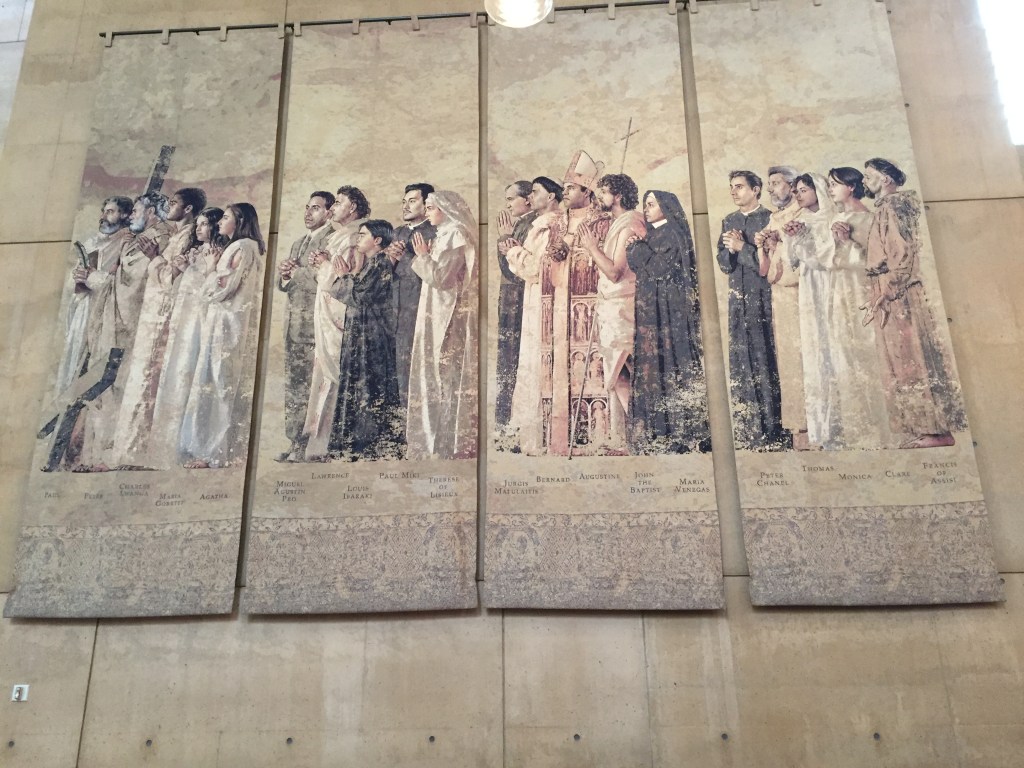
Let us choose the better part, slow down to receive, and reflect the light of Jesus.

“Martha, Martha, you are anxious and worried about many things. There is need of only one thing. Mary has chosen the better part and it will not be taken from her” (Lk 10:41-42).

My wife, JoAnn, and I used to have more than a few spirited discussions on this Gospel passage each time that it arose because, at first reading, it appears that Jesus does not show any empathy or regard for Martha’s gift of hospitality nor for all the work that she is doing. All the men are sitting around listening to Jesus, and Mary… she is doing the same, and who is left to do all the work? Martha.

Blessed to serve as a permanent deacon for ten years, I saw my own, as well as other deacon’s wives, carry extra weight and burdens in support on the home front to allow their husbands the time to serve, many of us who also still held full time jobs. Not only deacon’s wives, this reality is also true for many wives who are full-time homemakers, run in-home businesses, or carry a job outside the home, as well as care for the children, overseeing the bills, the day to day grind, and so find themselves at times, feeling under-appreciated, undervalued, and not respected for all they do.

Husbands can do a better job of being present, more patient, respectful, and attentive to their wives and be more of an equal partner on the journey. For those married as well as single, the point Jesus is making, that he makes throughout the Gospels is to put God first, then family, work, and our unique vocation. The expression of that is going to be different for each station in life. There will be more time constraints for parents of infants. No matter how little time we may have, we must pray daily, we must be still and sit at the feet of Jesus. As we do so, we will find that the time we did not think we have, through the guidance of the Holy Spirit will be properly ordered.

This prelude acknowledges the reality of how much we juggle in every age. There is much to do and much to be done. Jesus was not disregarding Martha’s hospitality. Especially in the Gospel of Luke, there are many instances in which Jesus empowers women so far beyond the cultural reality of his time. We read this as we do any biblical account from our twenty-first-century mindset. Contextually, the men sitting at the teacher’s feet in a different room, the women cooking, and most times eating separately were commonplace for those in the ancient near east of the first century AD. Mary was the only person out of step with the times.

The interpretive key to understanding this account is what Jesus said. He pointed out that Martha was “anxious and worried about many things.” Mary could have been one of those worries, and not so much that Mary wasn’t helping in the kitchen, but because she was breaking the social norm of sitting with the men. When Martha calls Jesus to redirect Mary, she probably expects him to support her plea. Yet, Jesus acknowledges that: “There is need of only one thing. Mary has chosen the better part and it will not be taken from her” (Luke 10:42).

Mary, sitting and having her primary focus on Jesus was the posture of a disciple. Jesus was not only allowing her to do so, he was commending her for doing so. I can visualize Martha being taken aback at first, but then slowly feeling the muscles in her face relax as the lightbulb went on. We don’t know, but could she in that moment have experienced that peace, that peace that surpasses all understanding, and the anxiety and worry left her? Feeling the peace, instead fear in approaching Jesus as Mary had done, did Martha then take her apron off, throw it to the side, and sit down next to her sister and also become his disciple?

There is biblical evidence that beyond the Twelve, Martha, Mary, and Lazarus, were Jesus’ friends. When Jesus came four days after the death of Lazarus, as soon as Martha heard Jesus was outside, she, not Mary, came immediately out to Jesus, and in that exchange, it was Martha who made the claim that Jesus was the Messiah, the Son of God (cf Jn 11:27). Would she have had this insight, the same as Peter, if she was still holding a grudge from this encounter?

Our modern reaction and push back to this Martha and Mary account in Luke may not so much be a reflection on Jesus but how poorly men have treated women over the generations and how poorly women continue to be treated even today. No matter their ages, young, old, and everywhere in between, women are human beings created in the image and likeness of God. No one has the right to abuse, demean, disparage, devalue, or exploit any woman. Women are to be appreciated, heard, respected, cherished, and valued.

God has given each of us gifts to participate in his Father’s plan. May we resist the temptation to fear coming close to Jesus and taking time out to sit at his feet, to engage in mental maelstroms, to be “anxious and worried about many things.” Instead, when we experience the beginning tremors of any stress or strain, instead, be still and rest in Jesus’ presence as Mary, and hopefully Martha, did.

In this way, any anxiety will begin to dissipate as we experience feeling safe in his presence and experience Jesus’ love. Doing so will help us to better know Jesus, his voice, and his teaching, know and follow his will, love others as he loves us, and live our lives respecting, encouraging, and supporting one another with the gifts and guidance that God has given us.

One woman who may have learned the Martha and Mary account well was Lydia. Luke and Paul encounter her and some other women in the city of Philippi. When Paul preached, Lydia, “listened, and the Lord opened her heart to pay attention to what Paul was saying.” She then asked to be baptized with her household, and then invited them into her home (cf Acts 16:11-15). She listened and pondered God first, then acted.

When we choose the better part of sitting at Jesus’ feet before making a decision, we can experience less chaos and more of his peace and guidance. Instead of living in a perpetual state of chronic stress and anxiety, we can instead choose to breathe, rest, receive and abide in God’s love. Then from that place of stillness, like Mary and Lydia, and I believe Martha, instead of reacting, we can make a choice based on God’s guidance.


Photo: Mary, Jesus’ mother, was the premier disciple for she “pondered” the mysteries she experienced with Jesus “in her heart” (Luke 2:19) and “heard the word of God and observed it” (Luke 11:28). She also chose the better part and so like the moon that reflects the light of the sun, Mary reflects the light of her Son. Our Lady of the Rosary, pray for us!

Link for the Mass readings for Tuesday, October 7, 2025

Want to be great? Reject self sufficiency and depend on God like a little child.

“Whoever humbles himself like this child is the greatest in the Kingdom of heaven. And whoever receives one child such as this in my name receives me” (Mt 18:4-5).

Children during the time of Jesus were seen, if there were acknowledged at all, to have little worth. They were vulnerable, had little if any status in society. They were often nothings, nobodies, and completely dependent on their parents for survival. Jesus invites a child to come to him, identifying himself with the child, as a response to the disciples’ question as to who would be considered the greatest in the Kingdom of heaven.

Jesus taught his disciples, and us today that we need to be completely dependent on God our Father, just as a small child is totally dependent on his or her parents. What leads us to greatness in the Kingdom of heaven is our turning away from the temptation to curve in upon ourselves, resisting the urge to feed our ego, place ourselves first, and as St Thomas Aquinas taught, resisting the cultural lures and substitutes for God: power, pleasure, honor, and wealth.

We are also to reject the image of the Übermensch, the super man, popularized by Friedrich Nietzsche, the 19th century German philosopher. Nietzsche wrote that God was dead and promoted the idea that humanity needed to create a world that would create new values based on the power of their will alone. Supermen and women striving for complete autonomy and self-sufficiency. Jesus teaches the exact opposite. We need to place our complete dependency and trust in and on God and rely on him for everything.

Participating in the reign of God is not one of lordship over another. Instead we are to assume the humility to accompany, walk along with, and serve each other along our journey in this life. Jesus embodied this reality. He, as the Son of God, entered into our human condition. He did not grasp at his divinity but instead surrendered it to his humanity. While remaining fully divine, he became fully human when through the power of the Holy Spirit was conceived in the womb of Mary. In such vulnerability and weakness, he developed through his period of gestation, and was born into our world. As an infant and child, he was completely dependent on Mary, Joseph, and God his Father.

As Jesus continued to grow as a young child, he experienced the fullness of the human condition. He laughed, he cried, he got sick, he was tempted, he felt pain, he experienced heartache and joy. Throughout his life, and especially during his public ministry, he experienced human suffering up close and personal. He understood the suffering of his neighbor and experienced his own human and finite limitations. He loved and wept as we saw in his encounters with Lazarus, Martha, and Mary.

Jesus invites us to relate to God as our Father often in the Gospels, in the best sense of that intimacy of dependence. St Thérèse of Lisieux, whose memorial we celebrated yesterday got this. “Jesus has chosen to show me the only way which leads to the Divine Furnace of love; it is the way of childlike self-surrender, the way of a child who sleeps, afraid of nothing, in its father’s arms.”

Accepting Thérèse’s image is an acknowledgment that we are just as dependent on God and others, that we are not self-sufficient, that we are not capable of living radically independent lives, nor are we supposed to. God created us to be loved and to love, to be in community, to care for, empower, and support one another.

Our guardian angels, whose memorial we celebrate today, are at the ready awaiting our call. When we have the humility to ask for their help, we will realize that we are not alone. When we experience some supernatural support, from God, his angels and the saints, we might just be willing to seek help from and support each other. We can offer a shoulder to lean on, a smile, a hug, a voice that speaks for the voiceless, a soul open to pray with and for others, an ear to hear, and we can embody the courage to serve and stand up for the dignity of each other.

St Mother Teresa was willing to come close and pick up that first dying man in the street. She did not ask his religion, was not concerned if he was of a different race or nationality, was not afraid to risk illness or injury by attending to him. She knelt down and was present in his time of dire need. We are at our best when we follow Jesus, St. Thérèse, St Mother Teresa, the saints, and our guardian angels, and surrender to, and place our dependency and complete trust in God and support each other by doing little things with great love.


To be loved and to love in return is why we are here at this time. Photo credit François Le Diascorn

Mass readings for Thursday, October 2, 2025

We are fit for the kingdom of God when Jesus is first before all and everyone else.

And another said, “I will follow you, Lord, but first let me say farewell to my family at home.” Jesus answered him, “No one who sets a hand to the plow and looks to what was left behind is fit for the Kingdom of God” (9:61-62).

This is one of the three challenges that Jesus offers to potential followers of his in today’s account. As Jesus is continuing on to Jerusalem, to the ultimate gift he will give to humanity, himself on the cross, Jesus invites those who are still with him to embrace the radical call of the Gospel. God is to be first before anyone and everything else. Even the security of home and family are not to hold one back from following Jesus. His listener’s would don’t have missed the biblical allusion Jesus is countering. When Elijah called Elisha to follow him, Elijah allowed Elisha to say goodbye to his family and settle his estate, so to speak, before they left together (cf 1 Kings 19:19-21).

Jesus is showing in his request, not just the demands of being a follower of his but also why. Jesus is God and if that is true, those seeking to follow him are not to do so with any naïveté nor false presumptions. They are to be willing to give all without holding anything back in following him. Demanding? Yes. But Jesus is about to do the same thing that he asks in giving all he has, his very life on the cross.

These three invitations offered by Jesus are not responded to by those he invites. This is most likely on purpose because the invitation is not only for them but for all who hear this invitation or read it today. We are invited to participate in the life of Jesus and build up the Church. The important foundational point is that we understand what Jesus means by the Church. The original Greek term that we have in the earliest manuscripts was ekklēsia. This is more than just a gathering or an assembly of like minds. Ekklēsia means to be called out from.

Jesus reveals to us anything or anyone that we have placed before God, and he calls us to a new way of living. He calls us to participate more intimately in his life and the life of the Trinity. We will do so when we let go of our grasp of the false substitutes that really don’t bring true happiness and fulfillment. Pleasure, power, honor, and wealth when properly ordered can be goods in and of themselves, but placed first and foremost in our lives, they will not fulfill, provide stability, nor will they give us control over our lives that we seek.

Jesus is revealing in today’s message that home and family also cannot be first. By accepting the invitation of Jesus to place him first and follow him, then our lives in this world will be properly ordered. Nothing else will satisfy, nothing and no one. In fact, we put unrealistic expectations on each other when God is not first because no one can live up to our deepest desires of intimacy and communion. Nothing can fully satisfy us because all is finite and we will only seek more. Only God can satisfy our deepest longing.

Once we reorient our life, put God before all else, grow in our relationship with him, then the other matters and material realities of our lives will fall into place. Our relationships with one another will be more realistic and we will be more understanding when those we are in relationships make mistakes and let us down. We will be more loving and forgiving toward one another when God is the foundation of our lives. God will provide all that we need and he loves us more than we can imagine. When we are confident in God as our refuge and our strength, we can appreciate the material things of creation more and being free of the unrealistic expectations we place on family and friends, we can love each other more.


Photo: When we make daily time to spend with God, we experience so much more wonder even in the simplest of moments.

Link for the Mass readings for Wednesday, October 1, 2025

As we commit to a deeper relationship with God our relationships with each other will improve.

Accompanying him were the Twelve and some women (Lk 8:1-2).

A simple statement but significant regarding how Jesus again is showing us how to live our lives as his followers, his disciples. Jesus is fully human and fully divine. What he has done and continues to do as the Son of God incarnate is to draw close to us in our humanity, as human beings, so that we can enter into a relationship with him and his Father through the love of the Holy Spirit, thus becoming one with him in his divinity.

From the beginning of his public ministry, throughout his time walking this earth, and continuing on after his resurrection and ascension into heaven, he  invites people to participate in his life and the kingdom of Heaven which is at hand in his very presence. Jesus does so by building relationships. This is how Luke can write the verses that Jesus was accompanied by the Twelve and Mary Magdelene, Joanna, and Susanna. These were real people with whom Jesus developed real and intimate bonds.

Christianity is not a Lone Ranger religion, it is not the survival of the fittest, and Jesus did not teach us to pull ourselves up by our own bootstraps. We are created by God to be in communion, to be in a relationship with him and each other, to experience his love and to love one another. That means we need to ask for help from God and each other when in need and to come to the aid of, accompany, empower, and support one other.

We are invited to welcome, engage with, and make time for each other by exchanging in the stories of our tragedies and our triumphs. Let us resist the temptation of withdrawing into our own bubbles and instead, risk encountering one another. Relationships are not perfect. By putting God first, making a commitment to him and his commandments, and putting them into practice, we can better commit to being there for each other.

When we are growing in our relationship with God, he feeds the deepest core of our being as no other can. Thus fulfilled by his love for us, our insecurities that seek to derail our human relationships will diminish. We can risk being ourselves even when tempted by our fears to be otherwise. As we begin to feel safe in God’s love we can better breathe, trust, keep an open heart and mind, give the benefit of the doubt, and be more understanding, kind, and forgiving, all of which are ingredients for healthier relationships.

Jesus chooses each one of us to accompany him and to forge relationships grounded in mutual respect, where no one is last and where no person is left behind. Our addictions, insecurities, and prejudices only survive when we keep people at a distance. When we allow Jesus to come close, spend time with him and one another, we will see our weaknesses, sins and shortcomings, but also our gifts, possibilities, and promise. Conflicts will arise as we heal and purify, leading to greater intimacy. We will realize that we are not alone, we can acknowledge and reject the lies we have believed, and our relationships will heal and deepen.

————————-

Photo: Quiet time with the Jesus and Mary in the sanctuary of St. Mary Catholic Church, Windsor Locks, CT.

Link for the Mass readings for Friday, September 19, 2025

“From the fullness of the heart the mouth speaks.” What are we filling our hearts with?

“A good person out of the store of goodness in his heart produces good, but an evil person out of a store of evil produces evil; for from the fullness of the heart the mouth speaks” (Lk 6:45).

We can experience hardships, trials, and suffering. We may have experienced traumas, and even come face to face with evil. Yet, we are not evil because of what happens to us, nor how we are tempted. Neither are we defined by any trauma, suffering, or abuse. We have been created good by a loving God.

Negativity, sin, hate, and evil, can be seductive, can lure us to rationalize and decide that what we may think of as good in the moment, is in reality, just an apparent good or not good at all. To encounter or experience a word or act of unkindness, negativity, or even violence, we may feel justified in retaliation, yet if we speak or act in this way, we perpetuate the negativity or evil we seek to stand up against. In The Strength to Love, a collection of Dr. Martin Luther King’s sermons he wrote:

“Returning hate for hate multiplies hate, adding deeper darkness to a night already devoid of stars. Darkness cannot drive out darkness; only light can do that. Hate cannot drive out hate; only love can do that. Hate multiplies hate, violence multiplies violence, and toughness multiplies toughness in a descending spiral of destruction.”

At the moment we have a thought in our mind, we want to be aware of it and decide where and from whom this thought is coming from. Then, what to do with that thought. Many thoughts come from ourselves, others come externally from our experiences, our observations, our concupiscence – our tendency to sin, and yes even some from demonic influences.

What we listen to, read, and/or watch on a regular basis matters. We need to discern each thought or influence that comes our way. It is important to be aware what we are feeding on, literally and figuratively, and honestly assess our thoughts before we speak and act. Thinking through and deciding on what we will say and do is different from immediately or impulsively reacting.

Consuming the things of this world will lead to a different way of life than meditating and pondering on the things from above (cf. Colossians 3:1). Spending time in prayer and following Jesus’ commands will help us to bear the fruit of the Spirit: “love, joy, peace, patience, kindness, generosity, faithfulness, gentleness, self-control”(Galatians 5:22-23). Honestly examining our conscience daily will help us to purify that which is deadening and replenish that which will nourish.

Violence and the worst of our humanity continue through multiple media outlets, also, they horrifically materialize in real time, and ad nauseam on 24/7 cable coverage. The starting place to counter evil is to resist returning evil for evil, and to learn and put into practice Jesus’ teachings which will help to expose the darkness in our own hearts. We will see more precisely how to clear out the plaque of our own fears, wounds, frustrations, disruptions, and disordered affections. Then there will be more room for the love of the Holy Spirit to flow. With our hearts flowing with love, we will react less, listen, think, and speak better, and choose to act in ways that promote healing, understanding, forgiveness, reconciliation, and love.

——————————

Photo: Would that each of our hearts were open and receptive to God’s love as these flowers.

Link for the Mass readings for Saturday, September 13, 2025

The spiritually blind will lead us to fall, Jesus will light our path to healing and freedom.

“Can a blind person guide a blind person? Will not both fall into a pit” (Lk 6:39)?

This phrase from today’s Gospel appears to be one of Jesus’ simple teachings. It seems to be straightforward, practical and makes sense. Yet, as with much of what Jesus teaches, there is a deeper level. There are many degrees of spiritual blindness that we can succumb to. We can follow others, thinking we are improving, yet allowing them to lead us to fall into a pit or off a cliff.

Succumbing to a cult of personality is very tempting. Who are our models, our heroes? Who is it that we seek to emulate? Are they people who are seeking all that is good, true, and beautiful? Are they people who are guiding us to our highest hope and good to actualize our potential, or do they constantly lead us astray?

We need people in our lives that are not afraid to tell us the truth, or who respect us enough to guide us in such a way that they do not manipulate and take advantage of our blind spots but instead, help reveal to us our shortsightedness and give us the light to see clearer to avoid the pitfalls. Any person we place on a pedestal is dangerous because they are imperfect and finite, sooner or later they will fall or not live up to our expectations. The one who we can trust is Jesus.

We can do so because Jesus is more than just a man, he is the God man, the Christ the Son of the Living God who became one with us in our humanity so that we can become one with him in his divinity. How can we follow a dead man? We can do so because he rose from the dead, he conquered death and became the first born of the new creation.

When we read the Gospel accounts prayerfully by inviting the Holy Spirit to guide us, we can enter into the biblical scenes. As we read, meditate and pray with them, we can also as St. Ignatius of Loyola taught, apply our senses. We just watch and listen, smell, taste, and feel what is happening around us. This can be done even with lines of scripture that are not narrative.

I remember at the beginning of my thirty-day retreat reading from Paul’s letter to the Ephesians. As I slowed my breath, I read this verse a few times: “To know the love of Christ that surpasses knowledge, so that you may be filled with the fullness of God” (Ephesians 3:19). I then imagined Jesus sitting next to me on the bench. I hesitated for a moment and then asked him, “How can I know your love?”

Jesus said, “Trust me.”

Trust him I did and because I did, for the remaining days of the retreat, as I walked with him through the Old and New Testaments, I experienced forgiveness, healing, joy, and transformation. We need to discern wisely who we are to follow. Jesus will light the path leading to our freedom when we are willing to trust him, follow his teachings, and put them into practice.

————

Photo: Continue to trust in and follow Jesus.

Link for the Mass readings for Friday, September 12, 2025

Real love has a cost.

Our Gospel today, may not appear to be related or confusing in the analogies that Jesus is making. Jesus first begins by stating that to be a disciple of his, there is a need to, first hate “father and mother, wife and children, brothers and sisters, and even his own life,” and then be willing to “carry his own cross” (cf Lk 14:26-27). Jesus continues to talk about the wise builder calculating the cost of materials and labor to be sure he has enough to complete his project. In the same way, a king preparing for battle, assesses whether he has enough soldiers to win, and if not, he needs to be honest and prudent enough to “ask for peace terms.”

With each point, Jesus is emphasizing the cost of his discipleship. Nowhere in the Gospels and definitely not here in today’s, does Jesus say, follow me and all will be wonderful, there will be no pain, no suffering, and you will have all the material pleasure this world can offer. There is a cost to discipleship and those who seek to follow him in his time and our’s must pause and be aware of the cost.

Is the cost really to hate our mother and father, family and friends, and ourselves? This is graphic language. It is also an important reminder that each word and phrase we read in the Bible is to be read in the context of the whole Bible, not on its own or in isolation. Dr. Brandt Pitre identifies where the same Greek work miseō translated here in Luke as hate is used in the same context in Genesis 29:31, “When the Lord saw that Leah was hated, he opened her womb…” The way miseō is used in this context in Genesis helps us to interpret Jesus’ usage which is to “prefer one person over another” (Pitre). Jesus is saying, starkly, that we are prefer God over and above anyone or anything else.

Another help to recall where Jesus himself, in Luke 7:27, is emphatic that we are to love our enemies. To say that we are to love our enemies and hate, in the sense of loathing, our family would not make sense. It does make sense in the context of we are to place God first before any other person. This interpretation also aligns with the fourth commandment which is to honor our father and mother. We honor our father and mother best by living out the first three commandments that have to do with putting God first.

Context also helps us to understand that the hyperbolic language used by Jesus is a rhetorical strategy common to rabbis to make a point by waking up their listeners to get their attention. This statement did just that and continues to do so. The Catholic author, Flannery O’Connor, can help us to understand what Jesus is doing in describing her own writing shared that: “To the hard of hearing you shout, and for the almost blind you draw large and startling figures”. 

Why? To awaken the listener’s from their spiritual stupor. But even when we step back from Jesus’ hyperbolic language, the message to a first century Israelite, as it is for us today, is still hard to fathom.  Jesus is making it clear to the multitude that is gathering around, and letting them know clearly, that if they really want to follow him, there will be a cost. God must be first in their lives before all else, even the closest of family members and most intimate of friends.

Throughout the gospels, Jesus is consistent about the demands of being a disciple of his. A relationship with God is not just knowing about him, but knowing him intimately, and that means transformation. Not only is God to be first before family and friends, God is to be first before even ourselves. Being self-reliant, self-focused, and self-centered will not do. St. Teresa of Avila puts it quite well: “We shall never learn to know ourselves except by endeavoring to know God; for, beholding his greatness, we realize our own littleness; his purity shows us our foulness; and by meditating upon his humility we find how very far we are from being humble.”

Jesus is inviting us today to be his disciple, his student, and to join him in the most wonderful experience and adventure known to humanity. The Son of God who became one with us in our humanity is inviting us to be one with him in his divinity and to share in the communion of love that he shares with the Father and the Holy Spirit. To do so, we need to be as prudent as the wise builder and king. We need to assess the cost that Jesus is demanding of us. We are in the same position in this moment as the young rich man was who asked Jesus, “What do I need to do to inherit eternal life” (see Mt 19:16-22). The man was not willing to accept the cost of discipleship and walked away sad.

We have been created by Love, to receive his love, and to love in return, God, ourselves, and one another. Love is the greatest gift that we can receive and what we all seek in the depths of our souls. Jesus is giving us the key to unlocking the treasure chest and that key is to put God first before family, friends, self, and anything else. The way we put God first is to spend time with him every day. The amount of time is not as important in the beginning. What is most important is to set up a time you can commit to, show up, and let God happen.

If you are not sure what to do when you show up, you can start simply. Make the Sign of the Cross, take three, deep breaths, one for the Father, one for the Son, and one for the Holy Spirit. Continue to breathe slowly and receive God’s love for you and you alone in this moment. Remain until your mind starts to wander, then you can pray one slow and intentional Our Father. One Our Father said with meaning is more important than a thousand rattled of with no meaning. They are just words. When we pray, we are not just speaking words, we are speaking with someone: God our Father, who created us for this very moment: to be loved.


Photo: Spending time with Jesus in prayer each day – priceless!

Dr. Brandt Pitre. “Mass readings explained.” 23rd Sunday in OT

Flannery O’Connor quote accessed from “Listening to Flannery O’Connor” National Catholic Reporter.

Link for the Mass readings for Sunday, September 7, 2025

Is the lord of the sabbath the Lord of our lives?

Then he said to them, “The Son of Man is lord of the sabbath” (Lk 6:5).

The disciples were traveling with Jesus, they gathered food where they could. In today’s Gospel, they picked heads of grain and rubbed them in their hands to make them easier to chew. The critique of those Pharisees, presumably, walking along with or close by to Jesus, was that his disciples were breaking the sabbath law by working and thus not keeping it holy.

The reason for this was that pious Jews would often practice what is called, building a hedge around the Torah, meaning that they would institute practices beyond the original law so that there would be no way of breaking it. Fr. Bill Burton, ofm, shared an example that has stuck with me since my Scripture studies in seminary.

There is a prescription in Exodus 23:19, that states that you should not cook a kid (baby goat) in its mother’s milk. So as not to even come close to breaking this law, observant Jews developed the practice, which continues from many today, to not cook any meat and dairy together; thus the idea of building a hedge around the Torah.

The hedge in today’s reading had to do with what constituted work and what did not to keep the sabbath rest intact and keep the sabbath holy. Jesus settled the debate by claiming that he was the lord of the sabbath.

The lord of the sabbath needs to be the Lord of our lives. We live in a fallen world, but even at its best, we live in a finite and fragile world. We as human beings can only do so much. The best we can do is to use our intellect and ability to reason while at the same time seek to discern God’s will and direction so that we may access the spiritual resources that God offers to us in our everyday affairs, especially when tragedy strikes.

Tragedy, pain, and suffering happen in our independent lives directly and in our world collectively, the list and variety are vast and varied. Each situation arises for different reasons, some sensible and others with no apparent rhyme or reason. The why to our own personal or broader national and international sufferings we may not ever receive an answer. Yet, in each instance, we are not abandoned, we are not alone. We need not despair because the Holy Spirit works with and through us when we turn to him and allow our hearts and minds to be open to his love working through us.

The Holy Spirit, through Mary’s yes, helped to bring our world a savior. When his time came, he healed, exorcised, preached and sought the unification of his people so to unify all of humanity. Many of the Pharisees could not accept that Jesus was the Messiah and instead saw him as a threat. In their minds, Jesus was disobeying God. If he wasn’t God incarnate, they would have been correct. That is the decision we need to make. If he is God, Jesus needs not only to be the lord of the sabbath, but the Lord of our lives, in and out of season, during our trials as well as our joys and celebrations.

—————————–

Photo: Jesus in the Wheat Field” by Hangwallz on Etsy

Link for the Mass readings for Saturday, September 6, 2025

Let us spend time with Jesus, trust, and follow where he leads.

After he had finished speaking, he said to Simon, “Put out into deep water and lower your nets for a catch.” Simon said in reply,” Master, we have worked hard all night and have caught nothing, but at your command I will lower the nets” (Lk 5:4-5).

Faith is to believe in God and that what he tells us is true. On our own initiative and will power we are limited as finite beings regarding what we can understand and do. Today’s Gospel reading provides an example of this. Simon had been fishing all night with no results. Simon Peter follows Jesus’ command to go back out and put into the deep, and Simon not only accomplishes what he originally set out to do, but he also did so beyond anything he had ever imagined!

When we follow God’s direction and initiative all things are possible for us as well.

God’s initiative and grace enter our lives daily just like Jesus entered Simon’s boat. Do we have eyes to see, ears to hear, and a willingness to listen and follow the initiative of Jesus? Remember the rich man who had followed all the commandments, but when Jesus invited him to sell all and come and follow him, he could not do it. All he was asking for was right in front of him, and yet, the man did not believe in Jesus.

Rejecting the offer is one way to miss the mark. We can also miss the mark as Simon the magician did. When he saw the works of Philip, Peter, and John, he wanted to buy the power of the Holy Spirit to heal for his own aggrandizement, but was rebuked. Turning away from Jesus’ invitation or seeking to manipulate Jesus for our own personal gain will not bring us the fulfillment that we seek. Discipleship with Jesus is about relationship with him.

A better example to follow is that of Mary, who when the archangel Gabriel shared God’s message with her that she was to bear a child, even though she did not understand how this could be, Mary entrusted herself to God. She conceived in her womb, through the overshadowing of the Holy Spirit, the God-Man, the incarnate Son of God, Jesus the Christ. Joseph also trusted. After hearing the news from Mary, he had decided to quietly divorce her. Gabriel also spoke to him in a dream and Joseph trusted.

Peter, James, and John, although less adept in their faith, are maybe even better examples for us. They followed Jesus’ request and lowered their nets, even though they did not see the point. They followed through and were amazed. Then led by Peter’s humility and contrition, they “left everything” and followed Jesus. They went on to announce the Gospel of the Lord and caught people for the Kingdom of heaven.

Where are we today in our faith journey? Are we walking away from Jesus, are we seeking to gain access to the power of Jesus on our own terms, or do we have the humility to follow Jesus, on his terms, even when we may feel or see no point in his request? God has a plan, as he did for Mary, Joseph, and the Apostles. In a quiet place in our soul, in the stillness of our hearts, Jesus is inviting us to follow him. What we may hear may seem unbelievable, or insignificant, we may even experience anxiety, fear, and/or trepidation. Yet, let us trust, risk, and follow Jesus where he leads and what he asks us to do.

I did just that a few years ago. After following JoAnn’s guidance to put everything on the table regarding my options of how to live my life without her, I whittled down eight options to two, and then asked God, “What do you want me to do?” In the silence of my heart, I heard quietly, but clearly, “priesthood.” The two years returning to seminary were not easy, and about two months in, when I told Jesus that, “I didn’t think I can this.” He said, “You can’t. But I can.” I trusted and followed his lead.

When we allow our hearts and minds to be open to where God is leading us, we will not only be happy, but we will find fulfillment and meaning in our lives, such that it overflows to others. As Pope Benedict put it during his first homily as Pope, “There is nothing more beautiful than to know him and to speak to others of our friendship with him” (Gadenz, 111). I agree.


Photo: St. Mary’s Chapel, St. Vincent de Paul Regional Seminary where I went often to listen.

The Gospel of Luke. Grand Rapids, MI: Baker Academic, 2018.

Link for the Mass readings for Thursday, September 4, 2025

Jesus continues to proclaim the Gospel today, and is inviting us to join him.

But he said to them, “To the other towns also I must proclaim the good news of the Kingdom of God, because for this purpose I have been sent” (Lk 4:43).

Jesus himself, the Son of God incarnate, fully divine and fully human, is the foretaste of heaven. His work of preaching, teaching, healing, and casting out demons, shows that the divine flow of the Father’s Love is infused into our fallen human condition. Jesus came to restore unity to that which had been divided and once he began his public ministry, he was ever on the go.

Through our Baptism, we have been conformed to and indelibly marked by Christ and for Christ. We are nourished by his Body and Blood in the Eucharist and we’re empowered through the laying on of hands by the bishop at our Confirmation. We have been divinized, grafted into the life of God through our participation in the life of Jesus the Christ. We too then are priests, prophets, and kings as we participate in his life. We also are, to preach and teach the same Gospel, to be his healing and comforting presence, to make Jesus present to those in our midst, and yes we too are called to cast out all demons, and to shine the light on negativity, dehumanization, and division in his name. As James teaches, we are to “submit [our]selves to God. Resist the devil, and he will flee” (James 4:7).

Jesus did not travel very far during his three and a half years of public ministry, yet his teachings have touched the corners of the world. That is because of those who have encountered him, said yes to his invitation, submitted to the will of his Father, and continued to spread his teachings and life in each generation. We too are called to experience “a resurrected new life”, just as the mother-in-law of Peter did. And what did she do once she was healed? Out of gratitude, she immediately rose and served him. She mirrored Jesus in her willingness to serve (cf. Gadenz, 107).

Moment by moment, in each circumstance, we are invited to surrender to the will of his Father, and follow the gentle guidance of the Holy Spirit. Each yes to the guidance of the Trinity is an embrace of the gift of the unique vocation we are called to put into practice. The time of fulfillment is now because Jesus is present in our midst, he is at hand. So let us repent and believe in the Gospel, (cf. Mk 1:15), and follow the lead of Jesus that we read about each day.

These are not just nice stories. They are invitations for transformation and participation. By reading, praying, and meditating with these scriptures, we deepen our relationship with Jesus and begin to experience the love of the Holy Spirit and we are given clearer sight about what to let go of that holds us back from a more intimate union with the Father. Each day is a new opportunity to learn from Jesus, follow his guidance, and be advocates of his love and healing in the unique expression he would have us share! Let us like, Peter’s mother-in-law, arise and serve.


Painting: The Exhortation to the Apostles by James Tissot

Gardens, Pablo T.. The Gospel of Luke. Grand Rapids, MI: Baker Academic, 2018.

Link for the Mass readings for Wednesday, September 3, 2025