Jesus calls us to attain greater heights. Choosing him and asking for his help, we will attain them.

Jesus not only tells his disciples that he has not come to abolish but to fulfill the law, he constantly teaches how this is true, models how to put his teachings into practice, and empowers them to do so. This elaboration on the law and the prophets, the entirety of Jewish scripture, is highlighted well in Jesus’ Sermon on the Mount. This is evident in his Beatitudes with one example being, “Blessed are the poor in spirit for theirs is the kingdom of heaven”, and another example from his Six Antithesis show the building on the Torah more vividly: “You have heard that it was said ‘an eye for an eye,’ but I say to you offer no resistance to one who is evil”. Jesus clearly begins with quoting the law, “You have heard that is was said”, and then offers a deeper implementation by stating with authority, “But I say to you”.

If we seriously take the time to read through Jesus’ teachings, we will see quickly how challenging they are. Jesus is not lowering the bar of discipline for his followers. Instead, he is raising it. Jesus is not putting heavy burdens on us for burden’s sake, he seeks to make us holy, to guide us to be restored to our original glory that God has intended from the beginning. He himself lives what he preaches, but Jesus is no ordinary teacher or mentor. The principles that he teaches, forgiving seventy-seven times, loving our enemy, giving up all to follow him, seemed impossible to his disciples then and to us today as well.

At face value, we may think that many of Jesus’ teachings are not possible to put into practice or very practical in our day and age. This is why many people do not follow him and walk away. Attempting to do so with our willpower alone will lead to coming up short each time, feeling more frustrated, and/or not wanting to even put in the time and effort to do so. Jesus does not expect nor desire us to accomplish living as his followers on our own efforts. Much the opposite! We are to yolk ourselves with him and be open to the transforming power and love of the Holy Spirit acting through us. This happens when we daily invite Jesus into our lives and are humble enough to follow his lead and to ask for his help in putting into practice what he requires of us.

We grow in our discipleship of Jesus when we study his life, learn and put his teachings into practice, and surrender ourselves to his will through prayer, discipline, worship, service, and participation in the sacraments. Ultimately though, it is nothing we do, other than ask for his help, open our hearts and minds to and allow Jesus to live his life in and through us. As we see and experience that with Jesus all things are possible, we are transformed by his love and conformed to his life such that we can say with Paul, it is no longer I who live but Jesus who lives in me (cf. Galatians 2:20).

The path of faith is not a sprint or a one-time event, but a marathon, a life-long journey of healing. Each one of us can be assured that Jesus is with us for the long haul, every step of the way. No matter what trials or challenges, we can meet them with Jesus. Resist the temptations, refuse to make decisions from a fearful or reactive state, and let us instead lean into Jesus and on each other. In breathing, receiving, resting, and abiding in the love of God, we will not only make healthier decisions, we will grow in our intimacy with God and one another, no matter what arises.

————————————————————————–

Photo: Blessed to lead a retreat for the administrators and principals of the Diocese of Palm Beach today. Some quiet time breathing and praying with Jesus in the chapel at Our Lady of Florida Retreat Center before the first session. Very thankful for Jesus’ help in the preparation and presentation, not possible without him.

Link for the Mass readings for Wednesday, March 11, 2026

The antidote to division and polarization? Jesus commands us to be merciful, forgiving, and giving.

Polarization, division, and finger-pointing appear to continue to be the order of the day on the national level. Unfortunately, it is taking a firmer hold at the community and familial level and has crept into the Church as well. Instead of entering into and embracing the blame game, may we instead look in the mirror and honestly assess how we may contribute to division and isolation. The good news is that we have founding motto that we can aspire to; In the United States of America – E Pluribus Unum – Out of Many One and put into practice the words of Jesus’ prayer request to his Father – “That they may all be one” (John 17:21).

It is important to take a step back, take a breath or two or three, and examine our conscience and honestly acknowledge how we are contributing to the divisiveness and polarization through our own thoughts, words, and actions. Then we will be in a better position to act instead of react. We can disagree and offer different points of view and seek different approaches to solve problems respectfully when we are willing to engage in dialogue and collaboration instead of forcing or seeking to prove our own point.

Let leads us back to the basics of Jesus’ teachings and we are given another good one today:

“Be merciful, just as your Father is merciful” (Lk 6:36)

Mercy, from the Hebrew word chesed, meaning to show tender compassion, can help us to turn the momentum away from disunity and polarization and toward respecting the gift of our diversity while at the same time embracing our unity.  Fr. James Keenan, S.J. defines mercy as the willingness to enter into the chaos of another. Instead of imposing our point of view, mercy is the willingness to draw close with a posture of seeking to understand someone. Instead of keeping someone at a distance, reducing them to a caricature, seeking to prove someone wrong, and/or prejudging or labeling, we can instead make a concerted effort to understand, to listen, to seek common ground, and to seek the best in each other.

When we aspire to be merciful we lead with listening, asking questions to seek clarification and better understanding. A merciful perspective even seeks to assess thoughtfully the underlying point of what has been said, even when the message conveyed is emotionally charged, derogatory, and/or inflammatory. There may be some truth in the maelstrom of what has been spewed.

This is why Jesus also encourages us to stop judging and condemning. We are limited by our own finite natures as it is. We are limited also by our own wounds, defensive mechanisms, and knee-jerk responses. We are not God and are not capable of fully reading the heart of another person.

In most cases, we do not know another’s struggles, anxieties, fears, traumas, and experiences. When encountering each another and we notice the anxiety, stress, or fear beginning to rise, it is important to resist slipping into a fight or flight response. We do so when we intentionally breathe, invite Jesus to filter our thoughts, breathe more, and listen more. When allowing someone to vent without taking offense, the person has a chance of feeling heard. Instead of escalating the situation, by not reacting, we can help to bring calm and peace. It is also helpful to let go the need to want to fix the problem at hand.

Jesus commands us to forgive. As God forgives us we are also to forgive others, to let go of grudges. Not to do so means allowing the poison injected to spread. The one who has wounded us has walked away and when we are not willing to forgive, we choose to continue to allow the harm that was inflicted to continue to fester. The antidote is forgiveness. When we forgive, we don’t condone the harm done, nor keep ourselves in harm’s way. When we forgive, we heal.

It is much easier to stay in our shell or bubble. We feel protected and safe so no one can hurt us, but that is not the posture Jesus would have us assume. In doing so, we remain focused on our self. Staying in our bubble suffocates us, stunts our growth, and limits our potential as human beings created in the image and likeness of God. Jesus calls us, not to constrict, to cave in upon ourselves, but to expand, to go out from ourselves, to be agents of love and mercy.

Each moment we have a choice. We can withdraw, remain indifferent, judge, and condemn. Each of these choices contributes to isolation, division, and polarization. We can also follow Jesus’ invitation to seek to be merciful, forgiving, and giving. These choices contribute to building relationships, communion, and unity. In our willingness to forgive, we will promote healing and invite others to forgive and heal. Let us choose in this moment to invite the Holy Spirit to expand our hearts and minds that we may become more understanding, forgiving, and merciful just as our heavenly continues to be with us.

——————————————————————————

Image: Pope St. John Paul II living Jesus’ teaching of forgiveness in his meeting with the man who shot him, Mehmet Ali Agca – ARTURO MARI/AFP/Getty Images

Link for the Mass readings for Monday, March 2, 2026

“A bright cloud cast a shadow over them…”

Our life can be an experience both of sadness and joy, desolation and consolation, doubt and hope. We can experience an ebb and flow where we suffer from trials and also celebrate triumphs. The key to living a life of faith is to seek God in either experiences. Jesus today provides an opportunity for Peter, James, and John, the inner circle of the Twelve, to experience an expression of his divinity for he was transfigured before them; his face shone like the sun and his clothes became white as light. (Mt 17:2). Jesus revealed his divine nature to his disciples in a powerful display to prepare them for the Passion that he was about to endure. The experience is also a foreshadowing of his Resurrection.

Jesus, in this living word proclaimed or read today, invites us to experience the Transfiguration, the Passion, and the Resurrection in our own lives. We can miss a transfigured moment when we assume a posture of pride, not acknowledging God’s leading by believing we achieved or arrived at our present station in life on our merits alone. We can experience moments of transfiguration when we acknowledge that God breaks into our lives at that moment when we need him most and recognize the assistance he has given us, and/or when he has revealed to us the path and direction we were to take. The natural response is to offer prayers of thanksgiving, recognizing that we don’t go it alone, that God and those he sends to help us are a tremendous support.

Jesus is also present in our desolations. Many of us run from our suffering, we are afraid of the Cross. But it is through the Cross that we come to experience the Resurrection. We may not be aware, but when we run away from our suffering, we are running away from Jesus who awaits us with arms wide open to embrace us; to comfort us, heal us, and transform us. To experience the embrace of Jesus, we need to be willing to face our suffering.

Jesus cares from the deep place of understanding in experiencing his own tremendous suffering. He in the Garden of Gethsemane sought another way than the Cross, he asked for the cup of his death to be taken away, but he chose his Father and his will. He obeyed and set his face firm and accepted the upcoming suffering and death. In doing so, he then was also to experience his Resurrection and Ascension. Jesus now in his glorified body can be there for all of us, to lead us through our sorrows and trials.

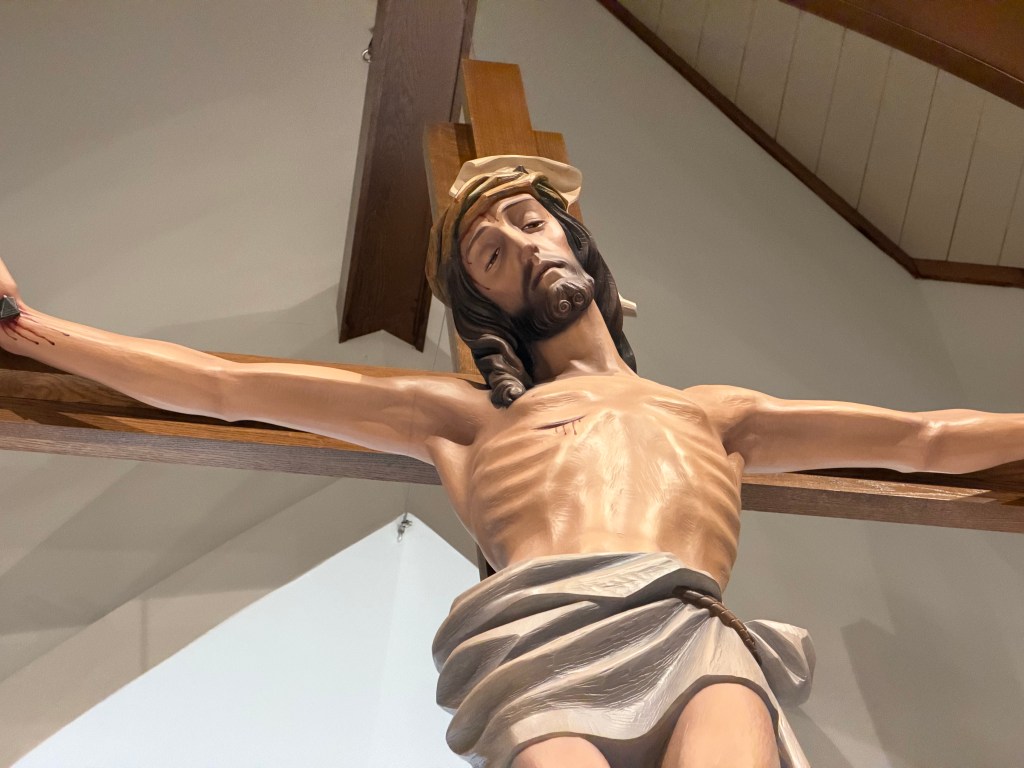
The older I get, the crucifix becomes more of a consolation. This icon of Jesus, his body broken, emptied out for us on the cross, represents how he entered the full range of our human condition. He assumed our sin, our anxiety, fear, and selfishness, and transformed the worst of our fallen nature through his love such that we are offered the opportunity to be forgiven and redeemed. The crucifix is not a sign of despair, but of hope and transfiguration, for it reminds us that no matter what we go through, what trial that we may be in the midst of at this very moment, Jesus understands and is present with us.

Looking and meditating upon Jesus on the Cross has provided me moments of transfiguration, granting me the courage that I did not have to face various conflicts, challenges, and trials, which has only increased in my first year and half as a priest. And in facing each challenge for myself as well as those I pray for, Jesus has been by my side. As he looks down from the cross he loves us despite our sins, our weaknesses, and failures and is willing to lead and accompany us through the ups and downs of life, so that we too may be renewed and transformed.

The transfiguration was for Peter, James, and John a preparation for the glory of Jesus’ crucifixion. Their experience strengthened them as they witnessed the horror of their teacher and friend’s death and the struggles they would face in their the ministry. May we spend some time mediating and praying with the words of today’s gospel, experience again the glory that Peter, James, and John did, and savor that gift. May we breathe in deep the radiant light of the Father shining through the clouds and experience the love of the Trinity so that we too may face with Jesus, what rises before us. All is grace, as long as we bring all we experience to Jesus, and follow his guidance.

________________________________________

Photo: “This is my beloved Son, with whom I am well pleased; listen to him.”

Link for the Mass readings for Sunday, March 1, 2026


“Love your enemies, and pray for those who persecute you.” Really? Yeap.

“You have heard that it was said, You shall love your neighbor and hate your enemy. But I say to you, love your enemies, and pray for those who persecute you, that you may be children of your heavenly Father” (Mt 5:43-45). With these words, Jesus continues to raise the bar of discipleship and outlines what the pursuit of love truly is.

The command to love our enemies and pray for those who persecute us is challenging today, but we may be a bit removed from the original power of those words. The inference that Jesus was making to his listener’s was that their enemies and those who were persecuting them, were the soldiers of the Roman imperial that were occupying Israel. Though we can still relate, and also be shocked by it and think that this command is impossible. And that is just the point. Apart from Jesus and our relationship and the transformation of our hearts and minds through our discipleship with Jesus, there is no way we are going to love our enemies and pray for those who persecute us.

One reason is that for us our definition of love is limited to the romantic, emotional, sensual, or mere sentimental. It can also be reduced to the mere sublime of loving ketchup or mustard on a hot dog, loving our cat or dog, or even at best getting closer to what Jesus is talking about when we love the members of our families or close friends. But all of these perspectives of love would not make sense in the context of Jesus’ command.

The bond of friendship and family goes beyond mere attraction and is built through shared interests and experiences. Through sharing our lives with others, working through conflicts, trust is built, and relationships will hopefully grow and deepen. Jesus, though, is calling us to mature in our growth of loving even beyond friendship or familial ties. If we love those who willingly love us in return, greet only our brothers and sisters (if we actually get along with them, blessed that I get along with my sister ;)), only those in our clique, group, tribe, or political party, what is the recompense or satisfaction in that? Agape, in Greek, loving without conditions, with little or no chance of mutual exchange, is what Jesus is calling us to strive for.

Many of us could not conceive of loving our enemy or someone who is persecuting us, because we have, minimally only experienced doing no overt harm to others and at best, loved our friends and family. But do we risk going outside of our group, our like-minded safety net? Life is hard enough and it is often safer, we believe, not to take the risk. We continue to operate from a concept of love as an emotion or feeling, because it feels good. We want to be happy and feel good. We avoid suffering at all costs.

Jesus challenged “his disciples to love and pray for the very people who occupy their land, tax them heavily, and treat them with violence and injustice” (Mitch and Sri, 100). How could they love the Roman occupiers? How can we love, those that we feel in some form or fashion in a similar way? St. Thomas Aquinas can be of help. He defined the love that Jesus describes as willing the good of the other as other. We make an act of the will, a free choice to accept the person as they are, to see them, not from our limited finite perspective but as God sees them, as a person with dignity. Can we pray for, seek kinder thoughts and to be more understanding, be more patient, and resist reacting in kind? Can we resist judging and labeling others?

On our own, we may not even conceive of the possibility, loving our enemies, but we can be assured that if Jesus has asked us to strive for this height and depth of love, he will provide the means. We love others unconditionally by allowing Jesus to love us. To breathe, receive, receive, and abide in his love, we experience his love. As we do so daily, we experience more of and are transformed by his love, and begin to allow God to love others through us.

We strive to reach the summit of loving our enemy only with the help of the Holy Spirit. Jesus called his disciples and he calls us to “imitate God by being perfect in love… to reflect the Father’s perfect, committed, selfless, merciful love in their own lives… to go beyond external conformity to the requirements of the law and imitate the perfect love of the heavenly Father, who is love himself” (Mitch and Sri, 101).

Even when we fall short, how much better would our families, communities, countries and world be if we sought this goal? To counter divisiveness, fear, and hatred, we need to refuse to react and instead choose to engage in an act of the will to love one another as Jesus loves us. “Jesus summons us to a heavenly way of life; the saints show that it is possible to live this way on earth.” If the saints can love their enemies and pray for those who persecute them, then by following their example, and allowing ourselves to abide in God’s love as they did, then so can we.


Photo: Jesus lived his command of loving his enemies and praying for those who persecuted them most radically when while dying on the cross he asked his Father to “forgive them for they know not what they do.”

Curtis Mitch and Edward Sri. The Gospel of Matthew. Grand Rapids, MI: Baker Academic, 2010

Link for the Mass readings for Saturday, February 28, 2026

May we guard ourselves against the leaven of the Pharisees and Herod.

Jesus convicted the Pharisees for demanding a sign and for their continued hardness of heart, their unwillingness to see and hear the work and presence of God right before them. He also saw the unsettling yeast of the Pharisees present in his own disciples. In today’s reading, Jesus seized on the opportunity of being together in the boat, Jesus seized on this teachable moment. He wanted to help the disciples of his inner circle to resist the same path of corruption when he enjoined them: “Watch out, guard against the leaven of the Pharisees and the leaven of Herod” (Mk 8:15).

As has been their pattern, the disciples missed the point as they focused on the literal reality that they only had one loaf of bread among them. Jesus was not, as they thought, taking them to task for not thinking ahead to bring enough bread. He had twice now multiplied minimal amounts of bread to feed thousands. One loaf with them would not have been an issue. He was more concerned about them falling into the danger of pride, seeking honor, power, and fame which had lead many of the Pharisees and Herod astray. To be his followers, striving to place themselves first would be not only the undoing of each of them but also undermine the authenticity of the Gospel message they were to proclaim and affect those they would be charged to care for.

Unfortunately, too many have not heeded the lesson that Jesus offered in today’s Gospel to his disciples regarding being aware of the corrupting leaven of many of the Pharisees and Herod. Just as the effects of original sin has wounded humanity, so it has also affected those in the Church. Throughout the ages, clergy and laity alike have succumbed to the temptations of placing our needs before and focusing on ourselves instead of God and who he calls us to serve. The curving in upon ourselves and the hardening of our hearts, close us off to the love of God and the reality of the truth that we can be in relationship with him, this truth that Jesus came to bring.

Yet throughout the worst corruptions and abuses, the Church remains. God continues to work through many who are faithful, like Mary his mother, and say “yes” to his invitation and follow his will in simple ways, living lives of quiet prayer, worship, and giving of themselves in acts of service daily. It is unfortunate that there are those who leave because they see hypocrisy, injustice, abuse, and corruption. For it is those with eyes to see and ears to hear that need to stay and be faithful witnesses to the call of the one true Bread from Heaven.

We must remain persistent and lean on Jesus to give us the strength and clarity on how best to seek healing for ourselves and proceed to help to heal his wounded Body. We also need to be aware of the sinful leaven that would seek to undo each of us. It is easy to point fingers. We will be on stable footing when we seek forgiveness, healing, transformation, and guidance from Jesus and choose to place God primary before any self-serving pursuits. Doing so will help us to live simple and holy lives of loving God, our neighbors, and ourselves.

——————————————————

Photo: Daily prayer and meditation, pondering the word of God, participating in the sacraments, and opening our hearts and minds to God’s guidance will help us to resist the spiritual leaven of hypocrisy, sin, and the hardening of our hearts.

Link for the Mass readings for Tuesday, February 17, 2026

When we look at the crucifix, do we see humility?

“Seek the LORD, all you humble of the earth, who have observed his law” (Zephaniah 2:3).

To be humble is not mocking or putting ourselves down, being milk toast, allowing others to walk all over us, being indecisive, insecure, lacking confidence, or denying the gifts God has given us – just read the parable of the talents (Matthew 25:14-30) and you will get that message loud and clear from Jesus. A better way to understand the definition of humility is to ponder a good quote that is attributed to CS Lewis, but according to the C.S. Lewis Foundation, he did not write.

“Humility is not thinking less of yourself, it’s thinking of yourself less.” We are to “seek the Lord” and “observe his law” because God is God and we are not. To be humble in the biblical sense is to bring each thought, word, and action to God first before following through on any and to trust him with everything and before anyone else. We are to be as dependent on God as infants and toddlers are with their parents.

Another good barometer of our humility is to assess to what extent we are attached to the things of this world at the expense of the things of heaven. If we would like to see a good example of non-attachment, ponder a crucifix for a while. Jesus, the incarnation of the second Person of the Trinity, gave up everything. He surrendered his divinity to experience the fullness of his humanity. In the Garden of Gethsemane, he felt the full weight of his impending death. Jesus did not want to die, but in these words, Jesus saved each of us and all of creation. “Father, if you are willing, take this cup away from me; still, not my will but yours be done” Luke 22:42).

That statement is humility of humilities! Jesus was willing to give all he had, all he was, holding nothing back, even his life, and he was willing to die for his bride, the Church. Would that we who have been or still are husbands as well as wives, were willing to be as humble as Jesus is for our spouse. That is not an indictment, but an invitation to assess our present level of humility in our relationships. Jesus is not the gold standard, he is the heavenly standard. If we are to grow in our humility, we must be willing to love as Jesus did and we begin by allowing ourselves to be loved by the Father and to depend on him for everything.

In doing so, we will slowly begin to become less, the ego will have less of a reign, and we will follow God’s will more freely and with less hardness of heart. To be humble is to be willing to change by allowing the light of Jesus to identify what within our lives are leading us away from growing in our relationship with God and what is helping us to improve our relationship with God. Being humble is being willing to stand in the fire of God’s truth, his love, and let it burn. What is burned away are the disordered affections, lies, sins, attachments, and what remains is the purity of who he has created us to be.

Zephaniah announced that if we are humble, we are to observe God’s law. As disciples, we realize that Jesus not only observed the law, for he did not come to abolish the law, and he not only fulfilled it, Jesus also raised the bar of observing the law. The Ten Commandments are a solid foundation to put into practice in our lives, but the Beatitudes we read about from Matthew 5:1-12, take our seeking God to the next level. The Beatitudes are worth pondering and observing in our lives, experimenting with, and putting them into practice.

I like the interpretation of the Beatitudes as presented by Dr. Brandt Pitre, which I close with and which we might meditate upon:

Those who live out each of these eight beatitudes will be happy and experience more meaning in their lives. We start off with the hinge pin of the beatitudes, which ought not to be a surprise if I haven’t put you to sleep yet. Those who are poor in spirit are those who are humble, those who are dependent on the love and support of God for everything in their lives. Mourners are those who lament sin, suffering, and death, they lament that which separates us from the love of God. The meek are those who receive insults and are not undone by them, resist reacting in kind and instead, conquer evil with good.

Those who hunger and thirst for righteousness seek a life devoted to holiness and justice. The merciful are blessed because they are willing to forgive, they live the law with compassion, willing to suffer with others to bring about change. The pure or clean in heart are those who act with integrity, those we can trust to do God’s will even when no one is looking. The peacemakers are those who have embraced the gospel, they are willing to seek reconciliation with others whoever the other may be, even enemies. And to finish off, blessed are those who are persecuted, those are accept the slander, false accusations, and being reviled for being a follower of Jesus.

Let us this Lord’s Day, in which we celebrate the resurrection of Jesus, give ourselves some time to meditate and pray about how humble we are, how willing we are to follow the law of God, and whether or not we want to be truly happy, and if so, how well are we following the Beatitudes in our day to day. Where we fall short in any of the above, may be a good invitation that Jesus is inviting us to pray with, and discern which Beatitude that we might be able to begin to practice with more intention this Lent.


Photo: Humility of humilities!

Link for the Mass readings for Sunday, February 1, 2026


God brings about the growth of his creation, us included.

Two parables are presented by Jesus today in the Gospel of Mark. Both are presenting what the kingdom of God is like. The first presents a man who sows seeds, and the second is a mustard seed that is planted. In both cases, the seeds germinate, sprout, go through the process of growth, and become mature plants. The kingdom of God is like these plants in that God works through the smallest of and many times, unnoticed beginnings. Also, God’s timing is not our timing. In our rapid-paced world of instant access, we would do well to slow down.

God not only begins small, and on his own timetable, but he often works beyond the realm of our awareness. This is evident in the first parable offered by Jesus: “This is how it is with the Kingdom of God; it is as if a man were to scatter seed on the land and would sleep and rise night and day and the seed would sprout and grow, he knows not how” (Mk 4:26-27). This is not to say that God has set everything in motion and is indifferent or despondent to his creation. Quite the opposite.

God has a plan. He has been and continues to be intimately engaged in guiding his creation and in each of our lives as well. He revealed this truth to Jeremiah: “Before I formed you in the womb I knew you, before you were born I dedicated you” (Jeremiah 1:5). God is present, invites us to be in relationship, and once we accept, seeks for our relationship to grow. Like the farmer in the first parable, “I have planted seeds but don’t see anything happening.” But slowly, a sprout emerges, a stalk rises, and a bud forms. We too may make an attempt at prayer and feel nothing is happening. If we intentionally make time to be with God, something is happening.

God has no need for us, and yet he has loved us into existence for our good. He invites us to know him and to participate in the spreading of his kingdom. Just think of someone who you have, for the longest time, wanted to meet. If the opportunity arose to spend time with that person, how excited would you be? How much more so if they also did not want to just meet but spend more time with you, with the intention of forming a relationship! We have the opportunity to do so with the Creator of all that exists, and not just today, or tomorrow, but for all of eternity.

God has created us to know, love, and to serve him. He invites us to be in communion with him, and to participate in his work of salvation history in simple and subtle ways. Are we aware of his invitation, are we willing to watch and pray? Are we willing to place ourselves in a posture to receive his word as well as his silence? Just as an acorn that is sown matures and grows over time into the mightiest of oaks, so may our relationship with our Loving God and Father also grow and mature that we become one with him in this life and into the next for eternity.


Photo: May we mature and flourish like these cabbage palms that even withstood the tornados of Milton.

Link for the Mass readings for Friday, January 30, 2025

Jesus offers us his light to shine in and through us to be shared.

“Is a lamp brought in to be placed under a bushel basket or under a bed, and not to be placed on a lampstand? (Mark 4:21).

God blesses us by giving his Son to us. He has done great things for us and he is the source of our joy! We do not earn nor is there anything that we can do to gain God’s grace. Our God and Father loves us unconditionally and always without hesitation and calls us to deeper and more intimate communion. But we can lose this gift of invitation to relationship, either by refusing what has been offered, or once accepting and receiving, not doing anything with the gift. If we are people of faith in name only, but not followed by action, we are concealing the light we have been given.

Prayer is the lifting of our hearts and minds to God, to spend time with him and in truly doing so, our lives as with any relationship, is changed. If we are not moving forward in the spiritual life, we are moving backwards. If we do not exercise our faith and allow that to happen over longer periods, we will receive signs of spiritual atrophy. To not even acknowledge the presence of God in our lives, the free gift of his invitation to be in a relationship with him, we will experience limitations and frustrations.

For whether we believe in God or not, we hunger to be in communion with him and one another, so we will be looking for other apparent avenues of happiness that will fall short of fulfilling us. If we do accept that there is a God, yet don’t participate in worship, fellowship, service, meditation and prayer, we are little but not much better off. I can believe that my truck will get me to where I want to go, but if I do not put the key in the ignition, turn on the engine, and shift it into drive, and press the gas peddle, I will remain stationary.

We are called daily to spend time reading, meditating and praying with the words of the Bible, putting into practice what we receive, and serving God as he leads. These spiritual non-negotiables happen more consistently when we schedule them first before any other activities, while being true to our station in life. A parent with an infant will have different demands than a monk or nun. What we do or do not do, does not earn God’s love. God loves us no matter what. The difference is that when we are consistently engaged in spending time with God, following his will, and putting into practice what he is guiding us to do, we experience his love and peace more because we experience him more.

We will then be more like Mary and the saints who reflected the light of Jesus. Privatizing our faith as well as getting into another’s face stifles the light of Jesus. We are called to follow the lead of the Holy Spirit, to be present, caring, understanding, supportive, convicting, and empowering, as we accompany one another in our realm of influence. The relationships we build are those that God brings into our lives.

Jesus has given his life for us, he continues to be present to and through us to others. May we be open to being conformed today and each day by his love. We are better able to do so by resisting and renouncing the temptations, diversions, and distractions that seek to lead us away from God. God sent Jesus to enter the chaos of our lives. May we allow him in to shine his light in our lives so we can identify and purge anything not of him, so that then we may begin to radiate the presence of Christ’s light in simple and concrete ways that allow God to happen through us in each encounter.


Photo: More of Jesus’ light will shine through us the more we are still enough to receive it.

Link for the Mass readings for Thursday, January 29, 2026

“Whoever does the will of God is my brother and sister and mother.”

Even a surface reading of the Gospels will offer a glimmer of Jesus making things new. We can read and imagine the scene today. Many are gathered around him. The crowd is large, we might recall a similar scene when the four friends came to get to Jesus and were also denied passage because of the enormity of the crowd packed tightly together. Those gathered were focused intently on Jesus as he taught. His family, presumably the relatives that only a few verses earlier came to seize him because some of them thought he was out of his mind (cf. Mk 3:21), had arrived, were standing outside. They send word to Jesus, thinking they would get the VIP treatment. The message passed among the people was: “Your mother and your brothers [and your sisters] are outside asking for you” (Mk 3:32).

Most would have expected him to immediately get up and welcome his family. Jesus seized on the opportunity for a teachable moment. He looked, not beyond and past the crowd that encircled him to his family, did not wave to them to come closer, but rested his gaze upon those who were nearest to him and said: “Here are my mother and my brothers. [For] whoever does the will of God is my brother and sister and mother” (Mk 3:35).

The true measure of the family in the kingdom of God is not bloodline but faith in and following the will of God. Those who have experienced or still experience the gift of a close, tight-knit, extended family can come close to the dramatic moment of silence that must have followed after this statement. For anyone living in the ancient Near East, familial, clan, and tribal relations were paramount to survival. To say that family bonds were strong is an understatement. Yet, Jesus challenged this societal norm by raising the bar even higher and expanded the bond of family beyond blood or marriage ties.

The relatives of Jesus were not present in this inner circle, they were on the outside. Imagine who might have been sitting in that circle; sinners, the unclean, tax collectors, and possibly even Gentiles – non-Jews, and Jesus said that they were his brother and sister and mother! If his relatives thought he had lost his mind before, I cannot imagine what kind of mental conniption they entered into after these words.

Jesus was not devaluing or delegitimizing family, he was restoring the family to its proper place and extending it out beyond what anyone of his time could have conceived of. As Bishop Robert Barron writes, “when we give the family a disproportionate importance, in short, it becomes dysfunctional” (Barron 2011, 17). We as the baptized are united in a deeper way into the Mystical Body of Christ, which is an even more powerful call to unity here than the blood-line of family, clan, or tribe.

The end goal is that as we draw closer in our encounter and relationship with Jesus, we also draw closer together. As we are conformed more and more to the life of Christ we begin to bear his fruit of love, joy, peace, patience, kindness, goodness, gentleness, and self-control (cf. Galatians 5:22).

In sharing the fruit of the spirit, in giving this gift away to one another, our relationships will grow and our bonds will become stronger. Our love grows as we give it away, person to person, out beyond our comfort zones, to the peripheries, where there are those who feel set apart, and/or are on the outside looking in. We are even to share with our enemies. Not possible? True, if we enclose ourselves within our own bubble and focus on protecting our egos. Possible, when we deepen our relationship with Jesus and allow him to love through us.

Too many today are choosing to encase themselves in their own protective bubble wrap. Instead of embracing diversity, we are going backward, we are regressing. By choosing to close ourselves off from other viewpoints, talking over each other and at each other, if we are talking at all, and embracing fear instead of love, we are distancing ourselves from God and each other.

Our strength as a people, as a nation, and as a world increases when we embrace the human dignity of each person, and the rich diversity bestowed upon us through the unconditional love of God. May we embrace the teaching of Jesus who in his emphasis on following God’s will “was insisting that the in-gathering of the tribes into God’s family is of paramount importance” (Barron 2011, 17).

In today’s Gospel account from Mark 3:31-35, Jesus did not define those gathered around him by race, ethnicity, gender, or any other label. He defined them then, as he still defines his family today, as those who are willing to follow the will of God his Father. Mary his mother being the primary model. Imagine what she must have wondered, when she heard Jesus’ words? Mary, “is called to undergo a certain detachment in her earthly relationship to Jesus so that her faith can be stretched to encompass her far greater role in the new family that Jesus is establishing” (Healy, 80).

Jesus, please help us to open our hearts and minds and be stretched, as did Mary, to follow his will even when we may not understand what he is asking of us. Help us to receive the Love of the Holy Spirit, savor, and share that love with others. Help us to sit at your feet, not only to learn from you but also to be empowered and transformed by you, so you may be first in every thought, word, and deed.

———————————————————————

Photo: Who better than Mary follows the will of Jesus and the will of our Father? She who followed Jesus all the way to the cross and beyond.

Barron, Robert. Catholicism: A Journey to the Heart of Faith. NY: Image, 2011.

Healy, Mary. The Gospel of Mark. Grand Rapids, MI: Baker Academic, 2008.

Link for the Mass readings for Tuesday, January 28, 2025

Jesus challenges us to follow him, will we follow?

Jesus has been on a whirlwind tour since beginning his public ministry. Daily he has been healing the sick, casting out demons, teaching with authority, and the number of people continue to gather and press in around him. The authorities have also taken notice are most of the scribes and Pharisees are not pleased with this new upstart rabbi, claiming to preach not from the authority of any rabbi he may have studied with, but on his own. Not only that he is making covert claims and practices that place him on equal ground with God. Not only has the leadership of Jerusalem taken notice, his family from Nazareth have as well.

Jesus has also just called the twelve, representatives of the new Israel. He has returned to the house of Peter and Andrew for a respite. As has been happening, people flock to the home because of their unique needs. The numbers press in with such demand that they made it impossible for Jesus and his disciples “even to eat” (Mark 3:20).

When his relatives heard of this they set out to seize him, for they said, “He is out of his mind” (Mark 3:21). What exactly causes his family to think that he is out of his mind? Is it that Jesus has called Apostles, is it that people are following him in such great numbers to come to be healed, is it that they hear of the growing threat from leadership? Now seeing for themselves the numbers gathering, they don’t get it.

There are many speculations about the “hidden years” of Jesus referring to the fact that there is no mention of Jesus in the gospels from the moment he is twelve years old when Joseph and Mary lose him, until he is about thirty and beginning his public ministry. There are wild speculations about what happened in those unrecorded years, but accounts such as this one support the idea that nothing special happened during that time. Jesus led an ordinary and very simple life and that is why nothing is written.

This could be the reason why his relatives are thinking that he is “out of his mind.” How can this simple carpenter all of a sudden be getting all of this attention? Who does he think he is? Does he think he is better than us?

It also reveals, as we have been seeing with the scribes and Pharisees, and possibly now with Jesus’ relatives, that when we get stuck in our routines, grind ourselves into a rut, and find our definition and security there, we feel safe only in our comfort zones, and that stunts our growth and maturation.

Jesus is a challenge. One of the biggest challenges that he offers is to step out of our comfort zones. We can dig in our heals or trust him and take a risk. Many of Jesus’ relatives as well as the scribes and Pharisees, unfortunately dug in their heels. They were not only unwilling to see who Jesus was, they were not willing to answer his call to follow him as the apostles did.

Jesus, as he shared when he offered the image of the new wine skins, challenges us as well, to be open to the leading of the Holy Spirit. He challenges us not to settle, and he offers to reveal to us the reality that many of us are existing in a chronic state of fight or flight and in perpetual reactive mode. We have not been created to merely survive. God created us to thrive and embrace the gift of our human existence with consolation and joy.

Jesus is inviting us in this moment to breathe, slow and deep. He is inviting us to stretch a bit and to take a risk, to take a step or two out of our comfort zones. Where might that lead? Will we follow Jesus’ call to come and follow him or dig in our heals as well? When we follow Jesus, it will get bumpy, we will be challenged, but following Jesus will lead to our freedom.


Photo: Sitting at the feet of the master USML, Mundeleine, IL.

Link for the Mass readings for Saturday, January 24, 2025