Joseph and Mary trusted, followed the will of God, and gave us our Savior.

Joseph had an interesting twenty-four hour period. First, he learned that his betrothed, Mary, was “with child”. Betrothal in ancient Judaism was not what we think of today as being engaged. Betrothal is the first step in the marriage process in which the man and wife give consent to marry before at least two witnesses. The wife remains with her family while the husband builds a home for them. Once the time for the second stage of the marriage arrives, they will celebrate for about a week and then at the end, there is a procession of the husband and wife and all present that leads to their home. The couple enters their new home and consummate the marriage.

The key point is that even in the first stage of the marriage, the betrothal period, the couple is considered to be married and have formed a covenantal bond. If on the night of marriage it was uncovered that the woman was not a virgin or that she had conceived a child with another man, the punishment could be as severe as stoning. Although, by the time of the Roman occupation, it was not allowed for the Jews to enact capital punishment. This is why the Jewish leadership brought Jesus to Pilate to get permission for his crucifixion and why the crucifixion was enacted by the Roman centurions.

Providing this context may help us better understand that when Joseph hears the news from Mary that she is pregnant, and knowing that he was not the biological father he decided, to “divorce her quietly.” This could have been because he did not believe Mary, that she conceived this child through the power of the Holy Spirit. He also could have believed Mary, recognizing this was a miracle, but did not feel himself worthy to take on this roll. Either way or if there was some other thoughts swirling in his brain, before being able to act on his decision, the angel Gabriel had a few things to say.

“Joseph, son of David, do not be afraid to take Mary your wife into your home” (Mt. 1:20). Gabriel confirmed Mary’s story and was asking Joseph to fulfill his vow to Mary and to commence with completing the second stage of their marriage. Gabriel also called Joseph, “Son of David.”

These words reveal that the royal line of David did not die out at the destruction of the Temple in 587 BC at the hands of the Babylonians. Joseph was an heir to the throne of David. Gabriel continued, “You will name him Jesus” (Mt. 1:21). In calling Joseph to name Jesus, even though he was not his biological father, meant that he was asking him to adopt him legally and that meant he was just as much his son as if by blood. Meaning that Jesus would be part of the royal lineage and an heir to the throne as Joseph was.

The end of Gabriel’s message was the most powerful. Jesus or Yeshua in Aramaic, means God or the LORD saves, and this son of Joseph and Mary was not just to be the long awaited Messiah, he is: “Emmanuel, which means ‘God with us'” (Mt. 1:23) and he be the savior of the children of God, he would save them from their sins. If Joseph did not know how to respond to Mary’s version of her account, what about now? Joseph followed Gabriel’s opening line and was not afraid. Joseph fulfilled his word, trusted in God, fulfilled the second stage of marriage, and was willing, ready and able to provide and protect his young family from the challenges that were about to unfold.

Both Joseph and Mary awaited the coming of the Messiah just as so many of their kinsmen, yet neither could believe the part they were asked to play in being the parents of the Son of God. Yet, once they were clear of the plan that God had for them they faithfully assumed their responsibility. Because of Joseph and Mary’s faith and trust in God, their ascent to follow the will of God, the second person of the Trinity, the Son of God, took on flesh and became man in the virgin womb of Mary.

As Jesus would later speak during his public ministry, “Blessed are those who hear the word of God, and observe it” (see Luke 11:28). Joseph and Mary did just that and continued to do so with each thought word and deed going forward. They are models for us and Jesus their Son is more than a model, but the one who saves us, gives us the strength, guidance, and hope when we may feel weak, lost, or experiencing sorrow.

There are so many anonymous people within and without of the Church who are just like Mary and Joseph. They quietly and diligently go about their daily lives as pencils in God’s hands. They are not only open to hearing but also following the guidance of the Word of God. They ascent to the truth and follow through with their actions. They may not have even be aware of the profound effect that their choices have had on others.

Throughout the Bible, God calls those who are not necessarily worthy, but humble and willing to play their part in salvation history. Each one of us is invited to participate as well. If our heart aches about a particular issue and we may wonder why God does not intercede and correct a certain situation, he may be convicting our conscience, moving our hearts to compassion. The injustice that tugs at our heartstrings could be an invitation from the Holy Spirit to be the hands and feet of Jesus to help to make right what has gone wrong.

Mary and Joseph waited with great expectation for the Messiah, never in their wildest dreams would they have imagined that they would play a central role in his birth. Never would they have dreamed that he would be more than the Messiah, he would be “Emmanuel, God with us.” Jesus remained fully divine while he became fully human. If it were not for the care, guidance, and support of Mary and Joseph, things would have gone badly for Jesus and for us all.

May we allow our hearts and minds to be conformed to the movement of the love of Holy Spirit as did Mary and Joseph. Jesus, Mary, Joseph, and the saints have paved the way of salvation history for us to follow. We are invited to walk on, even if with baby steps in the beginning, and play our part by daily allowing each thought, word, and action to be filtered by the Holy Spirit so that we can engage in small acts of great love with each choice we make.

—————————————-

Painting: “All is Calm” by Gabriel Heaton from havenlight.com

Link for the Mass readings for Sunday, December 21, 2025

Let us ponder Mary’s, “Yes.”

Mary said, “Behold, I am the handmaid of the Lord. May it be done to me according to your word.” Then the angel departed from her (Lk 1:38).

Whether this is the first or thousandth time we have read or heard this verse, the more important question for us is how many times have we said to God, “May it be done to me according to your word”? How would it be for us to begin each day with this prayer and then at the end of the day reflect on how well we have heard and answered yes to God’s will?

Mary’s “yes” changed the course of human history. Her willingness to bear the Son of God allowed him to come close. He entered our wounded, human condition to offer us healing, forgiveness, and to lead us home to communion with his Father and each other. Jesus is the gift that keeps giving – and we receive his gift each time we, as did Mary, say, “Yes.” When we do so, we become less, as he becomes more, and the kingdom of God continues to expand.

Along with Mary, the “yes” that we make is not a one-time, “yes,” but we are to affirm a daily, moment by moment “yes”. As St Paul wrote to the Church of Thessalonica, we are to: “Rejoice always. Pray without ceasing” (1 Thessalonians 16-17). We are able to rejoice always and pray without ceasing when we say, “yes,” to God by developing and sustaining our relationship with him such that even when we experience pain, suffering, and struggles, we are not overcome or overwhelmed. When we allow Jesus to be close, we can even feel joy in the midst of whatever arises. He does not abandon us to random fate. He is our source, our refuge, and our strength, present to us in all that we experience.

Our prayers of petition for ourselves and intercession for others are another “yes” to God’s will because they are an “admission of one’s own helplessness” (Lohfink 2014, 240). Prayer is a, “no,” to pride. We cannot get through this life on our own, nor are we meant to, for apart from God we can do nothing. We are all interconnected and interdependent and God is the foundation and source of our very being, and with God all things are possible.

Our willingness to ask for help and to help others are also practical ways of saying “yes” to God. There is no such thing as a “Lone Ranger Christian”. Even the Lone Ranger had Tonto. Two by two, just as Jesus sent his disciples. Prayer is a “yes” to our acknowledgment that we need Jesus to guide and help us, also to save us from ourselves! Service is a “yes” to the love we have received from him and a willingness to share this love with and receive it from others.

Let us rejoice as we are readying to begin this fourth week of Advent because we are drawing ever closer to celebrating the birth of Jesus who is Emmanuel, God with us. Let not the busyness of the preparations and plans impede the invitation to experience God’s love in our time of meditation, prayer and serving one another. This reality is made possible because of the handmaid of the Lord.


Painting: “The Annunciation” by Ossawa Tanner 

Lohfink, Gerhard. No Irrelevant Jesus: On Jesus and the Church Today. Collegeville, MN: Liturgical Press, 2014.

Link for the Mass readings for Saturday, December 20, 2025

May we trust the guiding light of God and follow his lead.

The Gospel of Luke and today’s first reading from the Book of Judges both continue the theme of divine intervention through angelic messengers and the message they convey is new life. The wife of Manoah, not named, and Zechariah, the husband of Elizabeth, both receive the message of an impending birth. The miraculous claim here is that both women are beyond child bearing age. These accounts also bring to mind the blessing of the conception of Isaac in the womb of Sarah, wife of Abraham.

For women of ancient Israel, being barren was a tremendous cause for shame; for many women, their worth was defined by their ability to bear children. This was in evidence in the words of Elizabeth. When she was aware she had conceived she said, “So has the Lord done for me at a time when he has seen fit to take away my disgrace before others.” (Lk 1:25). Her shame and anguish, her long period of barrenness, through the words of Gabriel were coming to an end.

Many women today feel similar anguish and shame in that they desire to have a child and are not able to. There are many reasons for infertility, but there may also be a plan that God has in place that is not readily apparent at the time. One may be God’s timing, for Mary it was too soon! For Manoah’s wife and Elizabeth it was about time! But in each case God had his plan and timing in mind. For some women there may be another way of serving other than being a birth mother.

Adoption or foster parenting of children who are in desperate need of safe, stable homes are direct options. Some more indirect ways could be assisting in caring for nieces and nephews, cousins, teaching catechesis or working with youth groups. Other ways to serve could be through more time consuming active ministries, vocations, or jobs. There can also be underlying medical conditions as well as the stress of trying too hard. I know of two occasions in which each couple adopted, shortly thereafter, both couples were blessed to conceive a child. I cannot imagine wanting to give birth to my own child and not be able to do so, nor can I imagine the inner anguish that may cause. I do believe that God has a plan for each of us and when we align ourselves with his will we will truly be happy and fulfilled.

Advent is a time of waiting and anticipation. There are periods of waiting in all of our lives and we can certainly feel impatient with God and ourselves. We have certain expectations, intentions, and plans that we would like to see fulfilled, but often are not capable of seeing far enough down the road to notice if those plans are apparent or actual goods. The light at the end of a tunnel could actually be a train!

When we remain faithful like Manoah’s wife, Elizabeth, and Mary, and resist the temptation to go off on our own, while seeking to understand God’s will, we will find fulfillment and joy better than we could ever imagine on our own. Each of us are called in our own unique way to bear Christ to a worn and weary world desperately in need of new life!

We will also enjoy the time of waiting more when we believe that God has our best intentions in mind and that following his will is the best course of action. In the remaining days of Advent, let us trust that God is preparing us for something even greater than we can ever hope for or imagine!

———————————————————————–

Photo: God will give us enough light to see a few steps ahead. When we walk those steps, he will offer some more light for the next few.

Link for the Mass readings for Thursday, December 19, 2025

Jesus, Mary, and Joseph, please help us to follow the will of God as you did.

Joseph heard the news that Mary, his betrothed, was with child. In ancient Judaism, a betrothal was the first stage of marriage in which the couple exchanged their consent before at least two witnesses. They were considered to be legally married and yet the woman would still live in her home for up to a year. The second stage happened when the bride moved into the groom’s home and they consummated the marriage.

In Matthew sharing the information that Joseph and Mary were betrothed, indicated that the child was not biologically Joseph’s. Matthew does disclose the thoughts or emotions of Joseph about what he felt when he found out this news. Whatever inner turmoil he had, he chose not to bring Mary’s case to a public hearing, he did not want expose Mary to any shame. He was not going to make a public spectacle of Mary, but instead decided to “divorce her quietly.” Before he made his final decision though, Joseph made an excellent choice regarding the discernment of serious matters. He slept on the idea before acting.

During Joseph’s sleep, the angel of the Lord delivered a message. “Joseph, son of David, do not be afraid to take Mary your wife into your home. For it is through the Holy Spirit that this child has been conceived in her. She will bear a son and you are to name him Jesus, because he will save his people from their sins” (Mt 1:20-21). When Joseph awoke, he was obedient to the angel of the Lord. Joseph was willing to change his mind and took his wife into his home (Mt 1:24).

We may hear this so many times, we may miss the power of Joseph’s choice. He could have felt anger that the child was not his own and that Mary was unfaithful, which is what most of us go to when we read this account. There is another interpretation of the “reverential fear view,” which “was held by Sts. Thomas Aquinas, Bernard, Basil, and Ephraim. In this view, Mary told Joseph about her conceiving by the Holy Spirit and he responds with religious awe over the mystery of what God is working in Mary” (Curtis and Sri, 44). Joseph, like many of the prophets when encountering the work of God concretely do not feel worthy to follow through on what is being asked of him.

We don’t know what was going through Joseph’s mind before the angel, but we do know that he as did Mary once he was clear of God’s will trusted in God’s will, and “that has made all the difference” to quote Robert Frost’s poem, “The Road Not Taken.” Because of Mary and Joseph’s, “yes”, to God and to family, the Son of God became man and opened up heaven for us in the humanity he assumed.

God often works in the same way when dealing with us. What may appear to be absurd, unimaginable, or downright impossible, is indeed possible when we align our will with God’s will. This is the week of Joy in Advent.

The source of joy does not come from external experiences but from an encounter with and acceptance of God’s invitation. Joy is an experience of communion with the love of God. This has been given to us in greater measure because Jesus became one with us, and so upon his ascension into heaven, we too can experience the loving communion he experiences with his Father. We can also experience the love of the Holy Spirit in our encounter with family and friends, this exchange of giving and receiving of ourselves in conversation, shared experiences, and in resolving challenges and conflicts together.

Mary and Joseph both received incredible news, that neither of them fully comprehended. They could have easily responded in a different way. They could have given into very real fears. Instead, they trusted in and obeyed God, they chose family, and because they did, we can rejoice not just during this week but we can rejoice always! The same God who sought out Mary and Joseph has a plan for us as well.

Mary and Joseph followed God’s lead and were willing to allow their unborn child, Jesus, to come to full term. Because they were willing to risk public ridicule and worse, Jesus entered into our human condition. There may be a difficult situation we are dealing with, we may feel like we are on our own, and that there is no way out, and/or no help on the horizon. God will make a way when there appears to be no way, and reveal it to us through his Son. We may not understand either, but like Mary and Joseph, let us trust in God, one another.

Jesus, Mary, and Joseph, please intercede on our behalf this Advent Season such that we will resist the temptation of taking each of our family members for granted, and instead give others the benefit of the doubt, appreciate and be thankful for one another. Help us to react less and breathe deeply more. Help us to be more understanding, patient, and willing to forgive, such that even though we have experienced past hurts, conflicts, disagreements, and different points of view, we may ultimately experience time and again the joy of being there for one another, through thick and thin.


Photo: Blessed to spend time with the Holy Family each evening for my holy hour.

Link for the Mass readings for Thursday, December 18, 2025

“Jesus who is called Messiah” will light our way through the homestretch of Advent.

Today in the liturgical calendar of the church we begin the nine days before Christmas as we do each year with Matthew’s account of the genealogy of Jesus. Jesus, the Son of God, is fully divine, while at the same time he is also fully human. Matthew gets us started in the home stretch with the lineage of Jesus’ human line from Abraham to his father Joseph (foster father, in that Joseph was not Jesus’ biological dad, but no one would not have made that distinction in Jesus’ time.) and his mother Mary.

Jesus was part of a people and a family, he was born at a particular time and in a particular place. If you go through this genealogy with a fine-tooth comb, there are gaps, but Matthew was more concerned with the line of faith than a strict historical account. Matthew also included women in this listing, which was not common in ancient patriarchal societies. This was also not common in ancient Jewish genealogies, “which traced lineage from father to son” (Mitch and Sri, 38). Looking at their stories in Scripture will also show that most listed were not the most morally upright, but more importantly, God was still able to work through this imperfect line of humanity and so the genealogy ends with, “Jacob the father of Joseph, the husband of Mary. Of her was born Jesus who is called Messiah” (Mt 1:16).

Though Jesus was conceived in Mary who was a virgin and immaculately conceived, he came from a line that was far from perfect. As Catholics and Christians, this is our heritage as well. We are spiritual Semites. Genealogies have become more popular in recent years as can be seen by the different advertisements for DNA test kits. There is a natural instinct to reach out for these because we want to belong and to be a part of.

To understand who we are and where we have come from, and to continue forward, it is helpful to reach behind. Jesus belonged to the people of Judah. He is a part of the succession from Abraham and his clan, to the twelve tribes of Jacob, to the unified nation of Israel under David. That did not change even as the fall from grace beginning with David, continued with his son Solomon, and most of the other kings.

Joseph was the heir to the thrown that in this imperfect line of succession went underground when Jerusalem was conquered by the Babylonians. This promise of the return of the messiah, the king in the line of David remained even while under occupation for the next five hundred years under Babylonians, Persians, Greeks, and at the time of Jesus’ birth, the Romans. When Joseph died, Jesus was next in line. Jesus’ leadership would become and continues like no other before him or that will ever come again. Jesus brought God’s movement of grace, the seeds of which were planted by some of the prophets like Isaiah, beyond the nation of Israel to fulfill the promise that they be a light to the nations, a universal invitation for all.

Another piece that a careful reading of the genealogy uncovers is that Jesus does not come from a purely Jewish lineage. As mentioned above, women were included in this list of ancestors. The common denominator of each of these four women, Tamar, Rahab, Ruth, and most likely Bathsheba was that each of them were Gentiles. “Gentile blood flowed into the royal line of David. This underscores God’s concern for Gentiles, demonstrating that he brought them into the story of Israel even in the Old Testament” (Mitch and Sri, 39).

God’s invitation of relationship with him was intended from the beginning, and step by step through salvation history God continued to thirst for his children and sought to woo them back, drawing them with his tender chord of love. This would come to fruition in the incarnation. The Son of God became one with us in our imperfect and sinful human condition to set right a world that had gone wrong.

Through our Baptism, we become part of the royal lineage and line of Jesus. No blood test needed. We are not alone, no longer estranged, no longer separate, or on the peripheries. We belong to the Body of Christ. Yet many, even those who profess their belief in Christ, are missing his greatest gift of faith, which is developing a relationship with him now. Let us not be complacent and settle for Christian in name only or walk away from our birthright.

In these final days of Advent, may we set aside a little more time to spend with Jesus. As our schedule revs up, may we bring Jesus into our busy. The Son was willing to draw close to us in the incarnation that we are about to celebrate, let us draw close to him. We all have the same amount of time in our days. Deciding to set aside some time of quiet, to take some deep and slow breaths, and accept the invitation to draw close to Jesus who is at hand will help us to engage better with the time we have and those walking with us.

Those brief moments are a powerful reset. In those moments of turning our hearts and minds to Jesus, we can receive the rest and renewal we desperately need. We can receive his love and invite him to walk with us in all that we think, say, and do. We can yoke ourselves to Jesus so that we do not travel these days alone. Jesus is more than willing to share our burdens, and he will give us the strength to carry on.

By our baptism we are part of the royal line of Jesus. More importantly, Jesus is present in each moment. We just need to remember to turn to him. Each intentional, deep breath will bring our shoulders out of our ears, help us to react less, and experience greater clarity in our choices and decisions. We will also see each other a little different than before, with more understanding, patience, and love.

As we celebrate the birth of “Jesus who is called Messiah”, even in the imperfections and messy moments, Jesus’ light will shine through. We are invited this season to be the calm in the storm of the chaos. “Peace be still.”


Photo: In times of silence we will experience how close Jesus really is.

Mitch, Curtis and Edward Sri. The Gospel of Matthew. Grand Rapids, MI: Baker Academic, 2010.

Link for the Mass readings for Wednesday, December 17, 2025

In choosing God’s will, we will experience more peace and love.

Although the chief priests and elders evaded the question about whether or not John’s baptism was “of heavenly or human origin” (see Mt 21:26) by saying, “We do not know” (Mt. 21:27), Jesus did not let them off the hook. His intent was not to call them out or prove himself right, but to call them to conversion. Jesus, as he does with all he meets, seeks to shine a light on where our hearts and minds are in need of opening and expanding.

And so, in today’s account from Matthew, Jesus offers the Parable of the Wicked Son. The first son says he will not do the will of his father and then changes his mind and does it. The second son said that he would do the work his father asked him to do but did not. “”Which of the two did his father’s will?’ They answered, ‘The first'” (Mt 21:31). Jesus went on to reveal to the priests and elders how those who sinned had indeed gone against his Father’s will, but heard John, came to him for baptism and were willing to repent. They recognized they were off course and made a correction. The priests and elders, saw no need for John’s baptism for themselves, and in also rejecting Jesus, were not only going against God’s will, but his Son.

These men who stood before Jesus and challenged him were likely received the call received by the Pharisees and Sadducees: “You brood of vipers! Who warned you to flee from the coming wrath” (Mt 3:7)? For they, like the chief priests and elders, were not interested in repenting, they thought themselves well and good, thank you very much.

Jesus not only compared them to the second son who did not follow the will of God, but he also said that the “tax collectors and prostitutes are entering the kingdom” (Mt. 21:31) before they would. If their hearts were hardened before, the grip only tightened. They did not take kindly to Jesus’ invitation to repent.

The call for repentance that John, Jesus, and the Apostles all proclaimed was, and still continues to be, an invitation to experience God’s grace and love. We are good but something has gone terribly wrong and we need to set things right. Jesus is the one to help us to do just that. We just need to be willing to admit there is a problem. We need to come to the awareness that Paul came to, when he wrote: “What I do, I do not understand. For I do not do what I want, but I do what I hate” (Romans 7:15).

If we think we are fine and not in need of any help, let alone that are we in need of a savior, then we are going to  keep coming back to Paul’s anguish as he pulled out what little hair he had left. We can’t white knuckle our way to healing, there is no three point plan that will free us from our sin, breathing deep alone will not help us to experience freedom from anxiety.

We have to place ourselves first, less, and Jesus first, more. The more we make that transition, then we can also say with Paul, and keep a little more hair while doing so, “I have been crucified with Christ; it is no longer I who live, but Christ who lives in me” (Galatians, 2:20). When we are willing to repent, to change our mind, and are willing to be transformed, then like the first son, we will follow the will of the Father. Instead of isolation and unrest, we will come to experience more of his communion and love.


Photo: We still have time this Advent to repent and experience our Father who loves and thirsts for us.

Link for the Mass readings for Tuesday, December 16, 2025

The love of Jesus can help us in our times of conflict.

The question raised by “the chief priests and the elders of the people” regarding what authority Jesus was teaching was not an uncommon question. Rabbis and teachers often began their presentations by sharing with their listeners who was their teacher. It would be comparable today to say what university we received our degree from.

There is also a bit of edginess in their question as well because Jesus has not only consistently been challenging their authority but he had also just purged the temple by driving out the sellers and money changers (see Mt. 21:12-17).

Although Jesus’ authority came directly from God, Jesus did not fall for their trap, wanting him to say just that. Then they could accuse him of blasphemy or force him to say his authority did not come from God and show him to be a fraud. Jesus did not give them the satisfaction. Instead of answering their question, Jesus asked one of his own. “Where was John’s baptism from? Was it of heavenly or of human origin” (Mt: 21:24)?

The answer given by these priests and elders showed further their unwillingness to accept who Jesus was. They were the shepherds of the people of Israel, yet they would not speak the truth. They were like reeds swaying in the wind (see Mt. 11:7). Unlike John the Baptist who stood on the truth and spoke truth to power, these chief priests and elders offered an answer that was calculated and weighed out by taking a quick opinion poll among themselves. Their answer was a lukewarm, “We do not know.” 

In answering this way, their authority as leaders was diminished. For if they were the religious guardians and guides, why could they not answer the simple question regarding the origin of John’s baptism? Jesus was not deflecting the question. He was prefacing his response. For if they recognized that John’s baptism originated from God, then why would they refuse to believe Jesus? They knew the answer, they were not willing to give it.

How about us? Are we like reeds swaying in the wind? Do we weigh our answers solely on a perceived response or do we speak the truth as the Holy Spirit leads us? We want to be liked, respected, to belong and to fit in, to be affirmed and accepted, which is healthy and natural, but at what cost? Sometimes we feel uncomfortable speaking what we believe because we fear another’s reactions. This is even more challenging these days because a simple response can affect a harsh reaction.

To live out our baptismal call as prophets, there will be times that we need to resist the perceived and real pressures we feel, resist our own insecurities, lean into conflicts, trust in God, seek his guidance, and speak the words the Holy Spirit gives.

As we do so, we need to remember to speak from a place of understanding and love. It is better to engage in a dialogue, not just mutually imposed monologues. A good reminder is to follow the lead of Jesus and ask more questions rather than offer ultimatums and pronouncements. Our goal in any encounter is not to impress or prove we are right and the other wrong, but to express what we believe and allow others to do the same. We can grow from one another when we are willing to listen and dialogue even when we disagree.

Sometimes God invites us to be silent and sometimes to speak boldly with passion. The key is to prayerfully pause, then choose to speak or to be silent. It is possible to move away from the extremes of talking past or shouting over one another and avoiding talking altogether. This happens when we listen first, breathe, pray, pause, and respect each other.

Jesus, please forgive us for giving into automatic reactions, not speaking as you have led, and disrespecting others. Help us in each encounter to breathe, to have ears to hear your guidance, to be understanding and respectful. Give us the courage and words to speak with charity and help us to know when to be silent and to listen. Above all, help us to love.

———————————-

Photo: Quiet times alone with God help us to experience peace that we can carry with us in times of conflict and disagreement.

Link for the Mass readings for Monday, December 15, 2025

Surrendering to Jesus, we will experience more of his presence, light, and love.

John the Baptist sent his disciples to Jesus to ask him whether or not he was the Messiah. Jesus answered their inquiry with the concrete expressions of what was happening. “Go and tell John what you hear and see: the blind regain their sight, the lame walk, lepers are cleansed, the deaf hear, the dead are raised, and the poor have the good news proclaimed to them. And blessed is the one who takes no offense at me” (Mt 11:4-5).

The ministry of Jesus was and continues to be today one of personal contact. Christianity is not merely a philosophical idea or even a particular theology. It is a faith tradition of an encounter with the Messiah, the Christ, the Son of the living God. We are walking through Advent to remember again that a light has shone in the darkness, and the darkness did not overcome it (cf. Jn 1:5).

Sometimes we can be weighed down by the darkness, the negativity, horror, and destruction we see all around us. The world certainly appears to be in a real mess at times. One of the most common critiques, and a valid one at that, is if there is a loving God, why does he allow such horrible things to happen, especially to the innocent?

The Scriptures are clear, all that God has created is good. Evil is a deprivation of the good. It is an absence or distortion of the good that God has made, like a cavity in a tooth. The healings and miracles of Jesus we read about, as he himself describes in today’s Gospel, are the beginning overture of the restoration of that which was lost. God comes to us in our everyday lives and circumstances with the intent to save us, to make things right again for everyone. “God, in Christ, has come to set right a world gone wrong” (Grunow, 175).

No matter what darkness we may be experiencing or witnessing this Advent, let us look for the light of Jesus shining in the midst of it. I can’t offer you a sufficient answer as to why God allows some bad things to happen or why he heals some and not others.

Some six years later, the words of the head of hospice still ring in my ears. “Except for the cancer, JoAnn was in perfect health.” I have no answer as to why she contracted cancer. I don’t ask why any more nor do I cling to the past. I remember and continue to hold JoAnn close to my heart but it has been in letting her go that I have experienced a closeness to where she is now. Especially, in some precious moments in the Mass and at prayer.

This Advent as we look for a light in the darkness, may we also be that light in the darkness for others. As we receive, rest, and abide in the love of Jesus, may we allow him to shine through us, to allow his love to be present in each encounter. We are just passing through this world and need to remember this is not all there is, but there is a life of fulfillment to come. What we see now is just but a hazy image of what is to come in the fullness of the height, depth, and breadth of God’s plan. John knew he was not the messiah, he was the forerunner, the messenger, and he became less so that Jesus could become more.

Jesus began his public ministry after John’s arrest and his healing of the blind, lame, and deaf, the lepers and the three he brought back from the dead, are but a foreshadowing of heaven he opened for us in the humanity he assumed. We live in the in-between time of the first coming of Jesus at his birth and his second coming. May we remain open to receive Jesus daily by rejecting doubt, despair, and fear, and choosing hope, faith, and love. As we encounter Jesus close at hand, may we offer our hand to one another.

—————————-

Photo: Blessed with this view walking back to the rectory after morning Mass.

Grunow, Stephen. Introduction to the Gospel of Mark in The Word on Fire Bible: The Gospels. Park Ridge, Illinois: Word on Fire, 2020.

Link for the Mass readings for Sunday, December 14, 2025

Elijah, the prophets, and John prepared the way for Jesus the Way.

The disciples who asked the question, “Why do the scribes say that Elijah must come first?” (Mt 17:10) were Peter, James, and John, who had just witnessed the transfiguration of Jesus. They were walking down from the Mount of Transfiguration, tradition identifying this mountain as Mt. Tabor, and the context of the question had to do with, Moses and Elijah, who they saw with Jesus as he revealed to them his divinity.

As the disciples were attempting to digest this Mystery of the Transfiguration just witnessed, they were drawn back to what they knew. Most likely what they were referring to were the accounts in the Books of Sirach and Malachi. In Sirach 48:10, we too can read that, “You [Elijah] are destined, it is written, in times to come to put an end to the wrath before the day of the Lord, to turn back the hearts of the fathers toward their sons, and to re-establish the tribes of Jacob.” In the last chapter of the Book of Malachi, which is incidentally the last lines of the Christian Old Testament ordering of the canon, are the words: “Remember the law of Moses my servant, which I enjoined upon him on Horeb, the Statutes and ordinances for all Israel. Lo, I will send you Elijah, the prophet, before the day of the Lord comes, the great and terrible day” (3:22-23).

Moses in this encounter represents the Torah, the Law or Teachings, and Elijah represents the line of prophets. Elijah also, as we can read in 2 Kings 2:11, was taken up by God into heaven, amid “a flaming chariot and flaming horses… and Elijah went up to heaven in a whirlwind”, and, it was believed, that he was to return again at the appointed time of the Messiah’s coming. Jesus clarified for his disciples that John was indeed the new Elijah. In the revealing of his divinity to Peter, James, and John, Jesus showed that he was the fulfillment of the salvific paths forged by Moses, Elijah, the line of prophets, and John the Baptist.

Jesus is the fulfillment of the Law and Prophets as well as our fulfillment. We are invited to prepare the Way of the Lord in our hearts and minds, to become less so that Jesus can become more, as well as to help prepare the way for others. When I began to attend church again in my late teens, I went to the Congregational Church that was about a half-mile walk from our home. At the end of that first service I attended, the interim pastor made an appeal for Sunday School teachers.

One of the things he said was that we do not know who Jesus’ Sunday School teacher was and he referenced that we could be teaching Jesus and not be aware. He was not speaking literally but his point rang true: we have the responsibility to continue to pass on the Greatest Story ever told. Also, his appeal was an avenue for the Holy Spirit to speak through him to me, and although I refused the invitation the first week, I accepted the following week. What might Jesus be inviting you to do this Advent? Trust in him and his invitation.

My trusting in the nudge of the Holy Spirit and “yes”, to teaching Sunday School, not knowing the first thing about what I was doing, thinking I was too young and way too inexperienced, both true, would eventually lead me back home to the Catholic Church, to the Franciscans, then leaving and to marriage, becoming a step-father, school teacher, permanent deacon, and now as I am typing, blessed to  be serving as a priest.

Let us all take heed of the invitation from the prophets and John the Baptist, summed up by Jesus, and carried on by the Apostles: “This is the time of fulfillment. The kingdom of God is at hand. Repent, and believe in the Gospel” (Mk 1:15). My journey has not come to an end and neither has your’s.
———————————————————
Photo: Blessed to experience an Advent day of reflection and prayer with my brother priests at Our Lady of Florida Spiritual Center. We can notice the kingdom of heaven at hand, when we are still and repent.

Link for the Mass readings for Saturday, December 13, 2025

The least of us are greater even than that John because of our baptism in Christ.

Amen, I say to you, among those born of women there has been none greater than John the Baptist; yet the least in the Kingdom of heaven is greater than he” (Mt 11:11).

Jesus shared that there has been no greater than John the Baptist. John is a bridge from the Old Covenant to the New. To say that John and Jesus played significant roles in ushering in the Kingdom of heaven is an understatement. For they both preached the same message of repentance, of the need for all to recognize how and where they had turned away from and needed to turn back to God. This is a key invitation for us as well during the preparatory seasons of Advent and Lent. May we have the ears to hear!

John lived a life of asceticism giving all to God, rejecting the material comforts of his time, choosing to live in the wilderness, and relying solely on the divine providence of God. He followed in the line of the prophets and he did so with full-throated confidence and fearlessness. Many were moved by his words and came to repent. John though ministered not to put himself on a pedestal, his role was to prepare the way for the coming of the Messiah. He was to assist in ushering in the Kingdom of heaven, as he himself was not the Kingdom. John knew well, Jesus was to increase and he was to decrease (cf. Jn 3:30). John’s words of speaking truth to power also led to his martyrdom. The death of John signaled the time for Jesus’ public ministry to begin.

Jesus recognized the contribution and place of John in his Father’s plan, yet he also shared how “the least in the Kingdom of heaven is greater than he.” The reason Jesus made this claim was that John’s baptism was one of repentance. The Baptism Jesus instituted was one of a new life of communion. Through our being baptized in the name of the Father, and of the Son, and of the Holy Spirit, we have been given a new life and are incorporated into his Mystical Body.

Through our Baptism, we, in participation with Jesus, become priests, prophets, and kings. Through the gift of the common priesthood, we are to sacrifice our time, giving of ourselves in prayer, worship, and service; our talent, embracing the unique gifts God has given us to share; and our treasure, being good stewards of the blessings God has given.

As prophets, we are to speak the word of God, speak truth to power as John and Jesus did, we are to be the voice of the voiceless and stand for up for the human dignity of all those who are vulnerable or mistreated from the moment of conception, through each stage of life, until natural death.

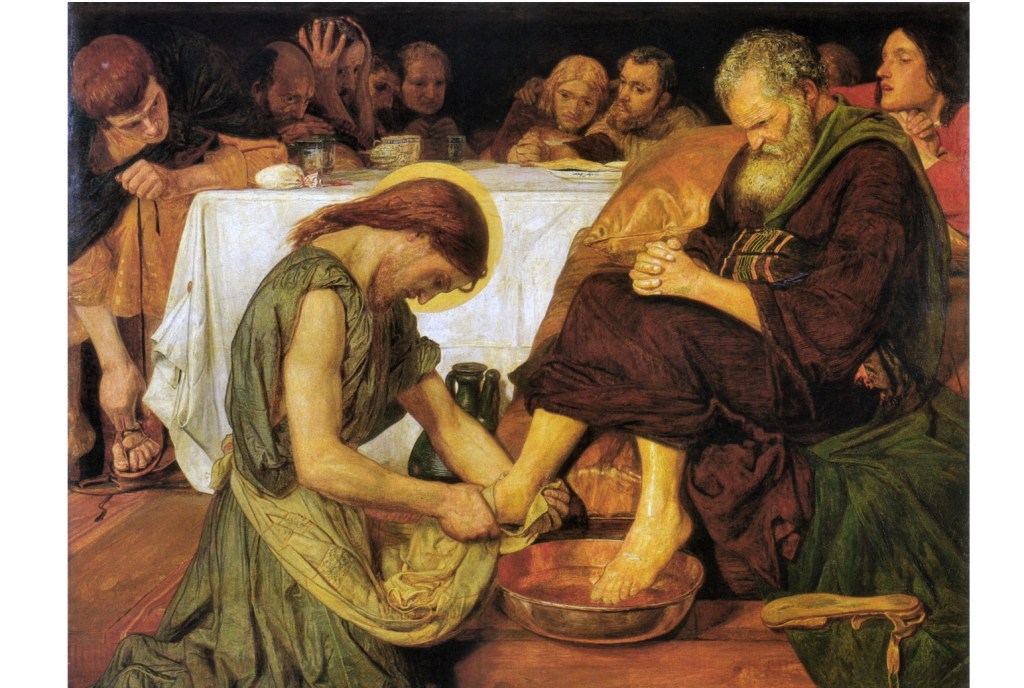
We are to be servant kings, resisting the temptation to seek our own power, glory, fame, and riches, and instead surrender ourselves to the will of our Father, and like his Son wash the feet of those in need. There is no service of our brothers or sisters that we ought to feel is beneath us in reaching out in love, which is to will the good of each other.

Advent is our time to repent, to recommit, to rediscover the wonderful relationship we are invited to embrace and are called to share: The infinite, divine love of God the Father, God the Son, and God the Holy Spirit, whose name we have been baptized in.

Advent is also an opportunity to slow down and remember why we do what we do. Each time we pass the baptismal font we bless ourselves with the Sign of the Cross. We are invited to resist the temptation of dipping in our fingers and continuing to move ahead on the fly. Instead, may we stop, dip our fingers and intentionally make the Sign of the Cross calling to mind each person of the Trinity.

This practice also provides us the opportunity to recommit ourselves to our baptismal vows, to renounce Satan and all evil, to affirm our commitment to the Trinity, Jesus Christ our Lord, and one Holy Catholic and Apostolic Church. Just as we do this when we enter, we may repeat the gesture and brief meditation when we depart. We leave as bearers of the Christ who we have received at Mass to go forth into our realm of influence to love one another as Jesus loves us, with an all-embracing, unconditional love!


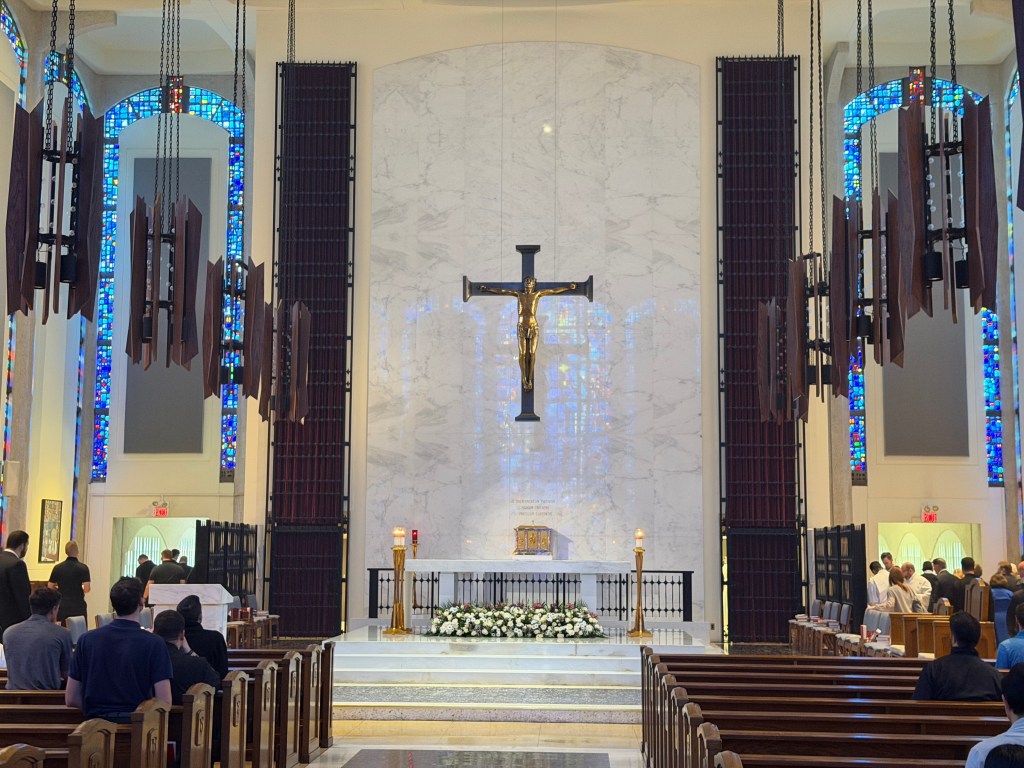
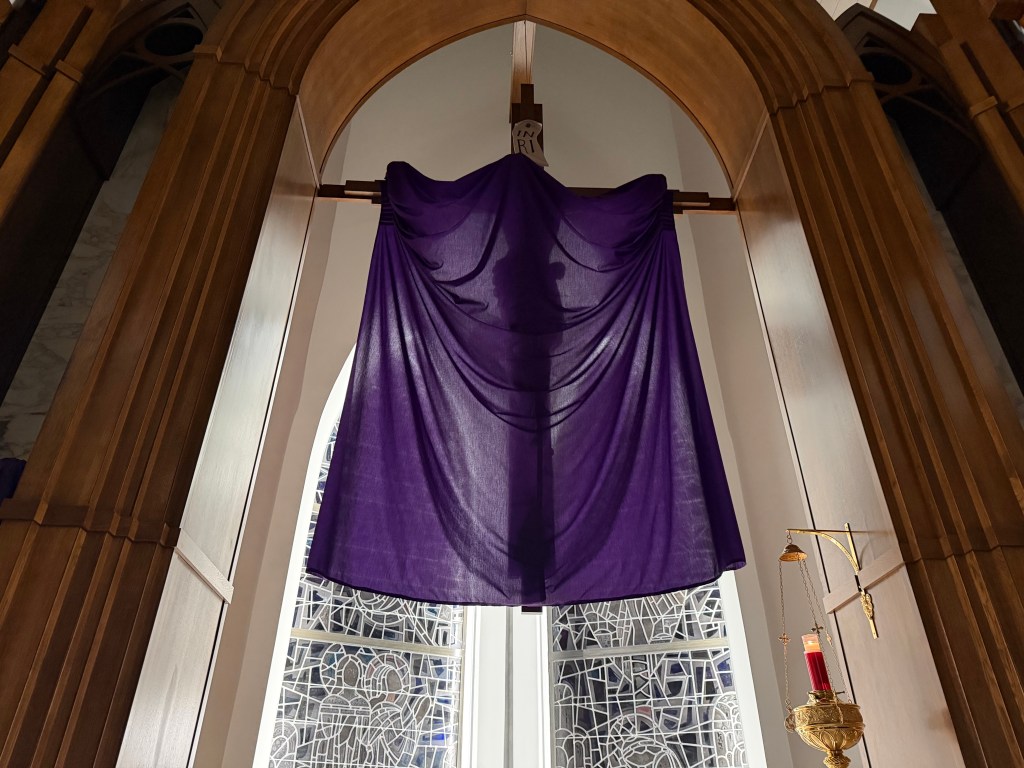
Photo: Last minute touch ups the eve before opening Holy Cross again for public Mass after completion of our renovation.

Link for the Mass readings for Thursday, December 11, 2025