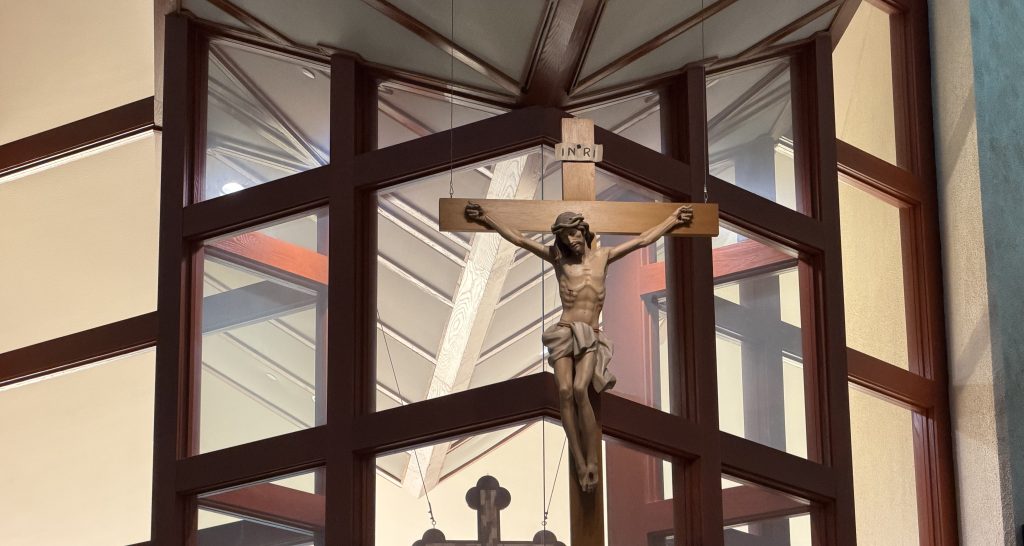
When we pray, we are loved by God, and the love of God casts out our fear.

“Then the one who had received the one talent came forward and said, ‘Master, I knew you were a demanding person, harvesting where you did not plant and gathering where you did not scatter; so out of fear I went off and buried your talent in the ground. Here it is back'” (Mt 25: 24-25).

I used to struggle with this verse of Jesus’ Parable of the Talents, not because I didn’t relate to it, but because I did. The problem was that I sided with the servant who buried his talent in the ground. What the servant did made sense to me, he kept his master’s talent safe and returned what he had been given. Historically, burying was considered a safe and acceptable practice in ancient Palestine when protecting someone else’s money. Even in reading carefully back to the beginning of the parable, I could see no reference to investing the talents. Though in the Gospel of Luke, there is an explicit demand to “trade with these until I come” (Lk 19:13). What is Jesus saying?

Actually, Jesus in this parable offers a microcosm of salvation history, the thread of which has been woven through all of Sacred Scripture from Genesis to Revelation. God, through his sovereign will, has consistently called, calls today, and will continue to call into the future a people to himself. In each age, God has bestowed upon humanity the generous gift of his grace, inviting us to receive and share in his very life, which is what we have been created for. This is a free gift, to be freely accepted or rejected. Once received though – no matter how little we choose to receive, five, two or one talent, we are directed to share what we have been given. Through a life lived of accepting, receiving, giving back to God and to one another, we are given even “greater responsibilities”.

In receiving the gift of God, himself, and sharing what he has given, ultimately his love, for God is Love, we not only mirror on earth, albeit dimly, but share in the divine communion of the love between God the Father, God the Son, and God the Holy Spirit. To reject this gift outright, or to receive some of the benefits and not to share, we cut ourselves off from the very life force and source of our being.

The message of The Parable of the Talents is as clear as it is challenging. John P. Meier summarizes that “Jesus is insistent; along with sovereign grace, serious demand, and superabundant reward comes the possibility of being condemned for refusing the demand contained in the gift. Indeed, one might argue that no aspect of Jesus’ teaching is more pervasive in the many different streams of the Gospel tradition, and no aspect is more passed over in silence today” (Meier 2016, 309).

God has created us and all of creation from the abundant outpouring of his love. Will we reject the gift of his love and invitation of communion? Will we receive, yet not actualize who we are called to be for our self and others because we would rather merely just exist, willing to be lured and entrapped by the temptations of anxiety, fear, apparent goods, and half-truths? Will we give in to the fear, too afraid to risk, to go out from ourselves to serve others? Or, will we appreciate the gift of our life and say thank you for the breath that we breathe? Are we willing to expand the love we have received by being willing to share, to multiply our talents, to embrace who God calls us to be, to love in kind, to will the good of others in the unique way God calls us to serve, whoever they may be?

I have lived the life of the wicked servant who buried his talent out of fear. I have embraced the sin of sloth by overworking and thinking I was doing good, but was it really the good God wanted me to do? As I have recognized the importance of placing prayer front and center, so that I have grown in my relationship with God, my life has become more properly ordered. I do better when I reach out and seek the hand of Jesus and accept to be led by him. I have risked and fallen, made mistakes and duffed up time and again, but have learned and persevered.

When we learn who the enemy is, are able to identify his lies, renounce and turn away from them and back to God; when we slow down instead of run from what we are afraid of and invite the Lord into these areas we will be purified, we will heal; and when we realize that the most important thing that we can do each day is pray, then we will come to know in our core, that we are not human-doings, we are human beings. God loves us as we are. As we are loved, we will then act from being loved and share the love we have received.

We are not alone. What Jesus invites, gives, and yes, demands of us, he will at the same time provide the courage, guidance, support and strength we need to carry out the task given and to bring it to fulfillment. God has a talent or two to invest. We need not fear to invest what God has given. This morning, let us breathe deep and entrust ourselves to the words of Jesus and St John Paul II who echoed them as he began his pontificate:

“Be not afraid” (Mt 14:27).

———————————————————————————-

Photo credit: dpa Picture-Alliance via AFP accessed from Aleteia

Meier, John P. A Marginal Jew: Probing the Authenticity of the Parables. Vol. 5. New Haven: Yale University Press, 2016.

Link for the Mass readings for Saturday, August 28, 2021

God only wants to love us and give us rest and peace.

“You have searched me and you know me Lord… Where can I go from your spirit? From your presence where can I flee? If I go up to the heavens, you are there; if I sink to the nether world, you are present there… You have searched me and you know me Lord” (From Responsorial Psalm 139:7-8).

God knows us through and through. He knows us better than we know ourselves. And yet, we hide from him. We seek to do things on our own, even while in the same breath we say we believe in him. For most of us, it is because deep down we are listening to the father of lies and we really don’t trust our loving God and Father. We choose not from freedom as much as from our reactions based in those lies that are fueled by the wounds we have inflicted and received by living in a fallen world.

The path out of the darkness of distraction, diversion, and doubt is lit by the light of Jesus. We are invited to trust him even when our instinct is to resist the light. We judge ourselves and project that judgment on God. We listen the liar who condemns, shames us, and accuses us, and then for a good dose adds, God will not forgive us or I will keep committing the same sins over and over again so why bother? What will God think of me if I reveal this to him?

God loves us to the very depths of our being, more than we can ever imagine. We do not need to be afraid of his reaction to even our most egregious sin, because he already knows! “You have searched me and you know me Lord.” God even loves us in the very act of our committing sin. The issue is, we don’t experience his love when we choose something else over him. We don’t experience his love when we don’t come to him for forgiveness. We don’t experience his love when he forgives us and we don’t forgive ourselves.

We experience his love when we repent. When we turn away from our sin and turn back to God. We may turn away from our sins out of guilt, but turning away or white knuckling with our will power alone is why we continue to fall for the same temptations. We need to turn away from the sin and turn to Jesus and allow ourselves to experience God’s love. Then filled with his love, we can resist the temptations awaiting us.

God has searched us to our very core, he knows the worst about us and loves us anyway. We can stop running and burying ourselves in busyness, distractions, diversions, false promises, and disordered affections, and instead allow ourselves, even if for only a few minutes today, to trust Jesus who is holding out his hand to lead us to a place of peace and rest. A peace and rest nothing in the world can give.


Photo: Moments of quiet, like a sunset walk can help us to slow down enough to experience God’s love for us. (University of St. Mary of the Lake)

Link for the Mass readings for Wednesday, August 27, 2025

“Whoever humbles himself will be exalted.”

“The greatest among you must be your servant. Whoever exalts himself will be humbled; but whoever humbles himself will be exalted” (Mt 23:11-12).

Jesus warns us to resist the sin of pride, and hubris, where we place ourselves as the focal point instead of God. This happens when we seek to be the center of the gravitational pull within our realm of influence. Through our subtle and not so subtle actions, we can embrace this temptation to live a life of, “Look at me, look at me!” Desiring to be affirmed is not a bad thing but that ought not to be our primary motivation for our actions. Ultimately, we will be better served when we seek our affirmation from God.

Choosing our own self-determination free of God’s guidance is the height of pride. God does not seek to limit us but to inspire us so that we may actualize the fullness of who he has created us to be. St Mother Teresa often guided her sisters not to seek to do great things but to do little things with great love. I came across a cassette tape of one of her talks during my freshman year of college. Her words started to plant a seed in my soul that urged me to look out beyond myself toward others.

Growing up with an introverted and shy nature, I spent much of my youth in my own world and spent more time with myself than others. The invitation to change that perspective would happen during my second semester of that same year. I took a psychology course and thought it would be interesting to work in a hospital. A close friend of mine, Steve, shared with me that his mother was a nurse in a nursing home in our hometown. That summer, when the semester ended, I applied for the job as a certified nursing assistant and was hired.

The first resident I assisted was named Margaret, age somewhere in her 90’s. She rolled passed me in her wheelchair and a particular odor followed. The aide I was training with caught my eye and I realized this would be my first solo attempt of service. I redirected and guided her to the toilet, which was in a small closet-sized area in between two adjoining bedrooms. It was a particularly hot day, and as I removed Margaret’s depends, I found quite the surprise. For the next fifteen minutes as I cleaned her up, I sweat, teared up, and repeatedly fought back the urge to gag, all the while Margaret – sang. Once finished and in a fresh nightgown, I helped her into her bed, tucked her in, and then Margaret said, “Give me a kiss lover.”

Others may have run for the door and never looked back. I stayed, and for the next four or five years, I experienced the wonderful gift of building relationships with the many residents and coworkers who drew me out of myself. What started out as a job became an extended family, and I served them with great joy.

God presents us with opportunities daily. We can choose to curve in upon ourselves or we can risk being present for and give of ourselves to others. Let us resist the urge to be led by anxiety or fear and instead pray for the courage to be open to the opportunities to extend the grace God offers us to serve in little ways with great love, one person, one encounter at a time. I pray that you may encounter your Margaret! For Margaret helped me to live what St Mother Teresa taught me: “Love only can become our light and joy in cheerful service of each other” (Teresa 2010, 355).

———————-

Photo: Let us serve one another with joy as St. Mother Teresa did.

Mother Teresa. Where There Is Love, There is God. Edited by Brian Kolodiejchuck, M.C. NY: Doubleday, 2010.

Link for the Mass readings for Saturday, August 23, 2025

When we allow ourselves to be loved by God we can love in return.

When the Pharisees heard that Jesus had silenced the Sadducees, they gathered together, and one of them, a scholar of the law, tested him by asking, “Teacher, which commandment in the law is the greatest?” He said to him, “You shall love the Lord, your God, with all your heart, with all your soul, and with all your mind. This is the greatest and the first commandment. The second is like it: You shall love your neighbor as yourself. The whole law and the prophets depend on these two commandments.” (Mt 22:34-40).

Jesus, in response, was not just throwing up a cloud of theological dust into the eyes of the Pharisees. His answer to, “which commandment in the law is the greatest?” was drawn directly from the Torah. Showing again his knowledge of the Torah. Jesus quoted from Deuteronomy 6:5 and Leviticus 19:18 and merged the two verses together as one unit. His purpose was to emphasize the point that what is to be the greatest aspiration for humanity is to love God and to love our neighbor as ourselves, not either/or. Jesus again was showing that he did not come to abolish the law and the prophets, but that he came to fulfill them (cf. Mt 5:17).

In this statement, Jesus also revealed the foundation of reality, the Trinitarian communion of love. For the immanence of God – God within himself – has always been, always is, and always will be a communion of love. God the Father loves the Son, God the Son receives the Father’s love and in return loves God the Father, and God the Holy Spirit is the love expressed and shared between God the Father and God the Son. The overflow and abundance of this perichoresis, or divine dance of trinitarian communion, has been the loving of creation into existence.

This means that we as God’s created beings, his children, have been loved into existence too! We are loved by and capable of loving God and one another in return mirroring on earth the love that is shared in Heaven. It is through our participation in the life of Jesus that we can live up to his command to love our enemies, best expressed in the parable of the Good Samaritan (Lk 10:29-37).

This is why prayer is so important. If we don’t get our relationship with God right, if we don’t spend time with and allow ourselves to rest, receive, and abide in his love, we will not be able to return the love we have received, and then how can we truly love ourselves and each other? When we do get the love of God right, we and our realm of influence changes. We can experience that peace that surpasses all understanding, and we can find the rest, that rest within the depths of our souls that we all seek. This peace, love, and rest we can then share with God and one another.

We can do so in simple but powerful ways. When we catch the eye of another smile. This small gift can make such difference in another’s life. If someone says, “How are you today?” say, “Better that you asked.” When you are with someone be there as if they were the only person in the world. Go out of your way to do some random acts of kindness, especially for that someone who ordinarily and regularly gets under your skin.

Today – Perichoresis! Let us rest, receive, and abide in God’s love, participate in the dance of God’s trinitarian Love and let his Love reign free in your life to overflowing.


Picture: When we embrace the vertical of loving God with all our heart, mind, and soul, we can share the horizontal, loving our neighbors as we love ourselves.

Link for the Mass readings for Friday, August 22, 2025

Jesus has our back in our successes as well as our failures.

Peter shows, as he did when he walked on and then sank in the water, how our faith journey can be compared to a rollercoaster ride of ups and downs, sometimes more intense than others. As expressed time and again in the Gospels, Peter provides examples of taking a step forward and two steps back.

In today’s Gospel from Matthew, Peter still called Simon at this time, exemplified this balancing act of our growth process as he first answered Jesus’ question as to who Jesus was when he stated, “You are the Christ, the Son of the living God” (Matthew 16:16). Jesus not only commended Simon for being open to sharing this revelation given to him by God the Father, but also added, “And so I say to you, you are Peter, and upon this rock I will build my Church, and the gates of the netherworld shall not prevail against it” (Matthew 16:17-18).

Name changes in the Bible were common when there was a significant change in one’s life. We can see evidence of this in the examples of Abram, changing his name to Abraham, Sarai to Sarah, and Jacob to Israel, just to name a few. Without a doubt, this event was a significant giant step forward for Simon Peter!

Yet, just as Peter reached the heights of theological insight he would just as quickly come crashing down again as he cut his teacher off. Jesus began to share with his disciples about how he would suffer, be killed, and rise again on the third day when, Peter took Jesus aside and began to rebuke him, “God forbid, Lord! No such thing shall ever happen to you.” He turned and said to Peter, “Get behind me, Satan! You are an obstacle to me. You are thinking not as God does, but as human beings do” (Matthew 16:22-23).

From being called the rock upon which Jesus would build his Church in one instant, to Satan in the next, Peter’s experiences offer some solace for us who are on our own faith journeys. Peter apprenticed with Jesus and as in any learning experience, he made mistakes. We need to realize that in our spiritual life this is going to happen to us as well.

We will have days when we feel the joy of the Holy Spirit filling our soul, and yet in the next instant, we may feel empty. We may have clear discernment and direction and then feel indecisive and confused. Some days we discern well our loving God and Father’s voice and some moments we choose to follow the Father of Lies. Some days our prayer is fruitful and we feel energized and other days we may experience dryness and that we are just going through the motions.

Jesus’ admonition of Peter to get behind him was not the end of the story. In fact, it would get worse when Peter gave into his fear and denied Jesus three times! Peter persisted and Jesus did not give up on him. After his resurrection, Jesus asked Peter three times if Peter loved him, and three times, the third a bit exasperated, Peter said yes, undoing the travesty of his denials. After the Ascension of Jesus, Peter lead the early Church and gave the ultimate witness and measure of his spiritual growth and maturity by giving his life.

We too will have fits and starts along the way, but the key is to remain faithful to God and the Way he guides us to walk. We are to continue to dust ourselves off when we have fallen down and be willing to learn from our mistakes, to repent, be forgiven, to seek the help and support of Jesus and one another, and be willing to begin again. The Good News for us today, is that Jesus does not define us by our mistakes or our worst moments. He does not give up on us. He loves us and continues to hold out his hand to us, to lead us onward!


Photo: A great compass to access as we journey is to ask, “Is our heart beating with the same rhythm as Jesus’ Sacred Heart?”

Link for the Mass readings for Thursday, August 7, 2025

Prayer helps us to restore our likeness to God.

He took Peter, John, and James, and went up the mountain to pray (Luke 9:28).

Peter, John, and James experienced Jesus’ profound teachings, his powerful signs, his wonders, and they also witnessed his healings, casting out demons, and forgiving of sins, which, alluded to the reality that he was the Son of God. Peter, James, and John, although acknowledging Jesus as the Messiah, still pretty much looked at Jesus as a human being. In the encounter of Jesus transfigured, Jesus revealed to his inner circle of Apostles not only a foretaste of what was to come in heaven but a glimpse of his actual divinity.

Jesus is not 50% God and 50% human. He is fully God and fully man. This is the Mystery of the Incarnation; the reality that the second Person of the Trinity took on flesh and became human. This is an important reality, because in this very act of Infinite Grace, the Son of God assuming humanity, Jesus, Emmanuel, God with us, as St. Irenaeus wrote, “opened up heaven for us in the humanity he assumed.” The Son of God became one with us in our fallen and sinful state so that we can become one with him. Through participation in the life of Jesus Christ, we can be restored and deepen our relationship with his Father, and we too can be transformed.

“By revealing himself God wishes to make [us] capable of responding to him, and of knowing him, and of loving him far beyond [our] own natural capacity” (Catechism of the Catholic Church 1997, 52). This reality of the invitation of communion with the Loving God and Father of all creation is for all. Authentic joy and fulfillment are achieved through developing a relationship with the God of Jesus Christ.

Many may say they are happy and living a good life without having a relationship with Jesus Christ, the do not need God or his Church, and I would not disagree with them. I would only add that if we are honest with ourselves, there is more to life than the mere material and finite reality we see and what experience with our senses. When we slow down enough, when we are actually still enough, we can experience a deeper yearning for more, and begin to see what is keeping us from the deeper reality Jesus is offering.

Even with great achievement, mastery, honor, and accumulation, there is still a lingering question, “Is this all there is?” We experience consciously or unconsciously a restlessness, we continually search to fill this unease, feeling satisfied for the moment, but eventually in short order, we are left empty, time and time again. This unease is our soul’s yearning, our transcendent nature longing for more, and that longing is for the infinite that the finite cannot provide. St Augustine of Hippo articulated this desire and yearning so well in the opening chapter of his autobiography, Confessions: “You move us to delight in praising You; for You have made us for Yourself, and our hearts are restless until they find rest in You.”

The Feast of the Transfiguration is an invitation to embrace the fullness of what it means to be human, as the Son of God did through the Mystery of his becoming one with us, all of us, all of humanity, not just a select few. We are invited to embrace the fullness and rich diversity of our humanity; the reality that we are physical, emotional, intellectual, while at the same time, spiritual beings. Our fulfillment and joy come from a balance of nurturing the reality that each and every one of us have been created in the image and likeness of God.

Peter, John, and James, as well as each of the saints, embraced the invitation of Jesus and were healed. The likeness to God that was lost in the fall of Adam and Eve was restored through their lives of prayer, service, and growing in relationship with Jesus. We can see the restoration of the likeness through such biblical imagery as Moses’ face which radiated after his intimate encounters with God and in the transfiguration of Jesus with not just his face but his whole being.

Setting time away with God daily to speak with him, listen, as well as follow the guidance of God will help us to grow in holiness and restore our likeness as well. Our hearts and minds and souls will be expanded and transformed such that we will experience the fullness of our humanity, be purified and perfected by our Father’s divinity. We will also embrace the gift of our common dignity and love others as we are loved.
———————————————————————–

Photo: “The person who prays begins to see.” From Pope Benedict XVI accessed from The Gospel of Luke by Pablo T. Gadenz.

Link for the Mass readings for Wednesday, August 6, 2025

With each small act of love, we help God to embrace one more person in need.

“The Kingdom of heaven is like a mustard seed that a person took and sowed in a field. It is the smallest of all the seeds, yet when full-grown it is the largest of plants.” (Mt 13:31-32).

God can do so much with so little. This is so because even the smallest detail is important to God. Just think of the immensity, not only of our solar system and galaxy but the whole cosmos. Despite the grandiosity and massive expanse of all creation, not even a sparrow can fall to the ground without the notice of God. Even all the hairs of our head he has counted (cf Mt 10:29-30). Our life, who we are, and who we are becoming matters to God.

Jesus is revealing through these parables of small beginnings, seed sown in a field, a mustard seed, and yeast allude to how God begins small and often hidden to fulfill his plan of salvation. What God has begun, he will bring to fruition. The gathering in of the nations is an Old Testament theme that Ezekiel especially highlights when he shares that God will break off and plant a tender cedar shoot and from this small shoot it will become a, “majestic cedar. Every small bird will nest under it, all kinds of winged birds will dwell in the shade of its branches” (Ezekiel 17:22-23). God has a plan for the unity of all of humanity and creation and Jesus is inviting us to be a part of the collaborative effort.

God builds up his kingdom one person at a time and sows his seeds of divine grace which is a movement of the outpouring of his divine love. He watches over us, his children, and shares his life with us. We can accept or reject this love which falls afresh upon us like the morning dew upon the grass. To accept and abide in the reality that God loves us is a gift. When we say yes to the outpouring of God’s love, we become more aware of the gift already bestowed. As we experience and savor this nourishing gift of God’s love we then have something to share with others.

What we will come to realize is that as we give more of God’s love away, we receive more in return. Our smallest thoughts, words, or deeds make a significant difference to those on the receiving end of God’s love flowing through us. We have an opportunity today to think, speak, and act as bearers of our loving God and Father. We can share a smile, a word of encouragement, a wave, and/or a hug, send a text, and/or just follow through on the the myriad stirrings of the Holy Spirit and offer a simple act of the will to love and truly be present with someone. No matter how small a sharing, it will mean more than we will ever know or can even imagine to the one who receives.


Photo: This colonnade at St. Mary of the Lake is fashioned after the colonnade in St. Peter Square. Both represent the welcoming arms of the Church seeking to embrace the people of the world.

Link for the Mass readings for Monday, July 28, 2025

“Can you drink the cup that I am going to drink?” Matthew 20:22

“The mother of the sons of Zebedee approached Jesus with her sons and did him homage, wishing to ask him for something. He said to her, ‘What do you wish?’ She answered him, ‘Command that these two sons of mine sit, one at your right and the other at your left, in your Kingdom’” (Mt 20:21-22).

The context of this request from the mother of the sons of Zebedee, James and John, comes from reading a few verses before the quote above. Start reading at Matthew 20:17 and you will see that Jesus and his twelve apostles are heading toward Jerusalem. Jesus stops to share with them, for the third time, that he will be condemned and crucified.

The request of James and John, through his mother, in the eyes of the world would seem a reasonable request. To them, Jesus was marching toward Jerusalem to claim his throne as king. To sit on his right and left, was an acknowledgment of their willingness to follow him, and serve as support for and witnesses of his kingship. It was also a preemptive strike before any of the other apostles could make that claim. There is a problem with their understanding though.

Jesus’ third statement of his imminent suffering and death appears to be ignored by or it goes over the heads of James and John, again, as well as their mother. The other ten are indignant, not because of the apparent lack of acknowledging Jesus’ upcoming passion, but because they entered into a free for all for position of which of them would be the greatest! It is easy to imagine how chaotic this scene quickly escalated! Saint John Chrysostom offered this insight: “See how imperfect they all are: the two who tried to get ahead of the other ten, and the ten who were jealous of the two” (Chrysostom 1975, 1552)!

This event made an impact for it was recorded in Matthew, Mark, and Luke. Mark has James and John speaking for themselves, not their mother, as in Matthew. Luke does not even record the initial request of James and John and instead comes in at the point of the apostle’s dispute. What all record, including the Gospel of John, is how Jesus made it clear that he came to serve, not to be served. To follow Jesus meant, not that James and John would be given positions of honor and power, the sitting at his right or his left, but that they were to serve as he served, to love as he loved.

The right and left that James and John asked for, Jesus shared was not his to give. That assignment would come directly from the Father. He also said, “You do not know what you are asking” (Matthew 20:22). For if James and John did, they would have thought twice about asking him. The ones who would assume the right and left were the two thieves on either side of him as Jesus was lifted up on the cross.

As disciples of Jesus, we too are called to show our love, not a sentimental love, but a love willing to serve and sacrifice for one another. Most of us are not accustomed or naturally disposed to either. A good way to begin is to be truly present to another, done most effectively when we actively listen. We learn this best in times set aside to meditate and pray with God. As we are able to quiet our minds, slow our heartbeats, and listen to God, we can begin to do so with one another.

Listening happens when we look up, put the phone, paper, or magazine down, turn away from the computer and/or turn off the tv. Then as we take a few breaths, we can open our hearts and minds to listen, and hear. When we learn to listen to God and one another, we will hear where the needs are. When we allow our hearts to be moved with compassion, we will be more willing to truly love by sacrificing and serving one another.

—————————————

Painting: “St. James the Greater” by Guido Reni. James learned the art of service and became the first to drink Jesus’ cup. St. James, pray for us!

Chrysostom, St John. Homily. The Liturgy of the Hours: According to the Roman Rite. Vol. 3. NY: Catholic Book Publishing, 1975.

Parallel Gospel passages to review:
Mark 10:35-45; Matthew 20:20-28; Luke 22:24-27 and John 13:12-17

Link for the Mass readings for Friday, July 25, 2025

“Let us build a Church founded on God’s love.”

“At that time the Lord appointed seventy-two others whom he sent ahead of him in pairs to every town and place he intended to visit” (Lk 10:1). Jesus did not stop with this action, he continued and continues to call people to himself and sends them on mission to proclaim the same words: “The kingdom of God is at hand for you” (Lk 10:9).

To be a disciple of Jesus is to be both about maintaining the Church he instituted and going out on mission. This is why at the end of each Mass the deacon or priest in the absence of a deacon will say, “Go and proclaim the Gospel of the Lord” or three other formulas of being sent to be missionaries in our communities. This is not a call for clergy and religious only but for all of the baptized.

Pope Leo XIV said emphasized this same sentiment well at the close of his homily on May 18: “With the light and the strength of the Holy Spirit, let us build a Church founded on God’s love, a sign of unity, a missionary Church that opens its arms to the world, proclaims the word, allows itself to be made “restless” by history, and becomes a leaven of harmony for humanity. Together, as one people, as brothers and sisters, let us walk towards God and love one another.”

There is much here in the Pope’s words to meditate upon and put into action. We are not just to go out and do missionary work, to evangelize and share the Gospel, we are to embody mission. We “are to be a leaven of harmony for humanity.” At the moment of our conception we existed as unique individuals already distinct from our parents. We are endowed with dignity and worth just by the fact that we exist. In embracing that gift and dignity of our lives, in allowing ourselves to slow down long enough to be loved by God, then we can begin to see each other as brothers and sisters and begin to reach out in love toward one another.

The “Church founded on God’s love” is the Church established by Jesus Christ. In Luke recording how Jesus “appointed seventy-two others”, we see the further establishment of the Church leadership that Jesus instituted. This hierarchy echoes the one established by God through Moses (See Exodus 24:1-11). When Moses ratifies the covenant, he has with him Aaron the high priest with Nadab and Abihu, along with the twelve young men offering sacrifices, each representing the twelve tribes of Israel, along with seventy elders. Jesus is following the same pattern in calling Peter as the leader of the twelve apostles, along with James and John, and the seventy-two. Jesus is calling to himself those who would first preach to Israel, the twelve, and the seventy-two, to preach to the Gentile nations, and eventually the whole world.

The deposit of faith that Jesus handed on to Peter and the twelve along with the seventy-two has continued to be shared with each successive generation up to and including our own. We are to continue in our own time to receive the message of Jesus and share it as well. Each and EVERYONE of us are a unique gift to the world that has never been nor will ever be again. Jesus has called us to himself with the purpose to send us out on mission.

I agree with Pope Leo that, “this is the hour for love! The heart of the Gospel is the love of God that makes us brothers and sisters.” This is “the hour for love”, for: “The kingdom of God is at hand” (Lk 10:9). Let us go forth as missionary people, as contemplatives in action, to promote peace and reconciliation, to glorify the Lord with our every thought, word, and deed.  Let us open our hearts and minds to God’s love, receive, rest, and abide in his love, so that we may go out to prepare the way for others to receive the love of Jesus as we have. This is the Church Jesus calls us to continue to build up.


Photo: Pope Leo arriving at his first weekly general audience on May 21, 2025 (Credit: Gregoria Borgia, AP, accessed from America Media).

Homily of Pope Leo XIV from May 18, 2025

Link for the Mass readings for Sunday, July 6, 2025

Jesus is willing to save the one.

“What man among you having a hundred sheep and losing one of them would not leave the ninety-nine in the desert and go after the lost one until he finds it” (Lk 15:4)?

At first hearing, how many of those present hearing the parable, or us today reading it, would answer yes? To most of us it would not make sense to leave the ninety-nine to go and search for the one that was lost.

What this parable represents is the love that God has for each and everyone of us. He knows us better than we know ourselves. God loves us with an everlasting love and is continually reaching out to us because he is the foundation and source of who we are. He wills our good and wants the best for us, even when we may not see the truth. This parable also represents a microcosm of the public ministry of Jesus.

Jesus met people one on one, person to person. He encountered the blind, the lame, the leper, the Syrophoenician woman, the woman at the well, the woman accused of adultery, the daughter of Jairus, the widow’s son, and Lazarus. Jesus not only healed these people and so many others who were considered to be on the outside looking in, he restored their dignity as human beings. Jesus loved each of them as a unique person.

In crafting this parable of the good shepherd seeking the lost sheep, Jesus may be echoing, Isaiah. He prophesied that because the leadership of his time was not bringing back the stray nor seeking out the lost, God would “appoint one shepherd over them, to pasture them” (See Ezekiel 34:23). Jesus sought out and continues to seek out the lost, no matter how far we have strayed, or messed up, Jesus loves comes for us.

He opens his arms and invites us into his loving embrace so that we may feel and experience the beating of his Sacred Heart. As we enter into that sacred rhythm, all our anxiety, fears, and pain begin to fade away and we begin to heal. We begin to experience our dignity as we experience being loved for who we are, not defined by our worst sins nor by what we do.

We just need to be willing to be found and allow him to lift us up on his shoulders and carry us back into the fold. As we do so and as we continue to experience his love, we will come to believe and say, as did St Paul,“Who can separate us from the love of Christ? Trial, or distress, or persecution, or hunger, or nakedness, or danger, or the sword?… Yet in all this we are more than conquerors because of him who has loved us” (cf. Romans 8:35-37).

Once we slow down enough to place our head on the chest of and experience the beating of the Sacred Heart of Jesus, renew in the rhythm of it, we will experience his peace and rest. We too are to love with the same radical love of the Shepherd who left the ninety-nine to rescue the one, who just happens to be us if we are willing to be rescued.

—————————————————–

Photo: Stain glass window at Cathedral of Our Lady of the Angels, Los Angeles, CA

Link for the Mass readings for Friday, June 27, 2025, Solemnity of the Sacred Heart of Jesus