The commandments of Jesus do not constrict but expand our freedom to be loved and to love.

“Whoever has my commandments and observes them is the one who loves me” (John 14:21).

Especially in our modern, western mind set, the idea or mere mention of following commandments may cause a bristling. Mostly this is because of the witnessing weakness of our fallen nature expressed in egregious ways through the abuse of power, abuse in relationships, and a weakening of trust in secular and religious institutions.

Jesus though is offering more of a challenge as he draws the following of commandments and love together. He is sharing with his apostles in the beginning stages of his farewell discourse, and before his crucifixion, what he feels is most important to share. His testament that he not only wants to give, but these final words he wants to impart upon them in such a way that they continue to learn and receive his teachings, put them into practice, allow themselves to be transformed by and so perpetuate them.

Just as commandments can lead one to bristle, love has many more superficial meanings than what Jesus means. One reason is that, even though the English language has a plethora of words to utilize and choose from, there is only one word for love and it is interpreted and used in many ways. In Ancient Greek, there are four words that are used to connote love. There is eros, which has to do with attraction. It is the beginning stage of love because we are drawn out of ourselves as we are attracted to another. The next word for love is philia, which aligns with friendship, a wanting to be together, to share between friends. If our love matures it moves from attraction or infatuation to friendship. The third word, storge, is the deeper love shared with family members which can be through blood or a deepening of friendship. The fourth word is agape, which is unconditional love, a sacrificial love.

When Jesus shares that we are to follow the commandments, he is not demanding that we do so as a tyrant would. He is providing boundaries, guard rail, parameters for us to grow and mature as people who love, who, in the words of St Thomas Aquinas, will the good of the other as other. As humans, we are social beings. We want to belong, to be accepted, and to be a part of. We seek meaning, purpose, and fulfillment in our lives. This is best done through cooperation and collaboration with God and with one another, striving to love unconditionally, agape. We desire to belong, to be loved, and to love in return. Yet, we need to ground our love in God first or our pursuit of love and belonging will be disordered.

As a good son of St. Augustine, Pope Leo XIV quoted Augustine in his inaugural Mass as Pope last year: “Lord, you have made us for yourself, and our heart is restless until it rests in you (Confessions, I: 1,1).” We are made by God to be loved and to love in return. Nothing we seek in this world will satisfy this deepest hunger that we all have in our soul besides the love God has for us. Unfortunately, we succumb to many disordered affections in pursuit of the love we seek. We are led astray by apparent goods that leave us hungry, thirsty, and wanting for more.

If we operate from a self-centered posture in which we are only turned in upon our self, and we only seek to manipulate and get from others, or worse, objectify others. Instead of working for consensus and sharing a common vision, we will ultimately be empty with the exchange on any level, because even in our relationships as with material things, we will be left wanting more. This is true because once the immediacy of the stimulation, whether material, emotional, or sensual, ends, so does the experience of the feeling. Some happiness may linger from the effect, but we will never be filled or satisfied with that which is finite. We will continue to seek more and more until the pursuit of instant and constant gratification ensnares us and we are entangled in a web of addiction.

God’s commandments, grounded in love, are meant to provide boundaries for us, training wheels, and to keep us free from enslavement to sin. The commandments point us to that which is not apparently but truly good for a wholesome and whole life. At the same time God’s commandments and the teachings of Jesus help us to mature as persons moving away from a posture of being self-centered to becoming disciples that love as Jesus loves.

Discipline in this way is meant to be a means of freedom for excellence such that we can become who God calls us to be and who we truly desire to be. God is not in competition with us. He is our biggest fan. As St Irenaeus wrote, the glory of God is the human being fully alive! When we can rest in the truth that God loves us as we are, even in our sin, when we can stop, breathe, receive, rest, and abide in his love, we can begin to settle and feel safe. Our restlessness can slow, the grasping can release, and we can just be, be loved, be ourselves, and experience peace.

Commandments and morality imposed indiscriminately, without reason or an end goal is a bludgeon. Love and mercy without accountability and justice can be enabling. Jesus’ invites us to receive and observe his commandments so that we may be freed from disordered affections and so properly order and discipline our desires and passions to be free to love authentically. Jesus knows what will truly fulfill and give us deeper meaning. May we trust in and learn from the deposit of faith passed on from Jesus to the Apostles, to each successive generation, as well as the ongoing guidance of the Holy Spirit, our Advocate that the Father sent in his name (John 14:26).

Pope Leo XIV, the vicar of Christ, implored us about a year ago: “Brothers and sisters, this is the hour for love! The heart of the gospel is the love of God that makes us brothers and sisters.” We are brothers and sisters, disciples of Jesus, when we receive and put into practice Jesus’s commandments, when we love him and his Father, we are given the discernment to reveal the lies of the enemy, we grow, and mature in our spiritual lives. The “heart of the gospel” Pope Leo preached in his inaugural address echoed again in his Sunday Regina Caeli address, May 3, 2026.

Having faith in God and Jesus “frees our hearts from the anxiety of possessing and acquiring, and from the illusion that we must pursue a position of prestige to have worth. Each person already has infinite worth in the mystery of God, which is the true reality. By loving one another as Jesus has loved us, we impart this awareness to one another… through love, amidst a multitude of brothers and sisters, each one discovers that they are uniquely made.”

Let us allow and continue to allow the tender chords of the Holy Spirit’s love to draw us deeper into intimacy with Jesus so that we can be transformed, forgiven, and healed by his love, and so freed from the false lures and promises that seek to divert us from being the beloved daughters and sons of God our Father that he has uniquely created us to be.


Photo: Pope Leo Regina Caeli address (Vatican Media)

Quotes above from Pope Leo XIV Inauguration Mass, May 18, 2025: Transcript of Pope Leo XIV’s Homily

Pope Leo XIV Regina Caeli, Sunday May 3

Link for the Mass readings for Monday, May 4, 2026

When we love, we reveal Jesus and his Father to others.

Philip said to him, “Master, show us the Father, and that will be enough for us.” Jesus said to him, “Have I been with you for so long a time and you still do not know me, Philip” (Jn 14:8-9)?

Again we see the Apostles struggling to understand that Jesus and the Father are one, that Jesus is the Son of God. Jesus attempts to explain again to Philip that whoever sees him sees the Father.

The challenge here is that Philip and Jesus are using the same language but talking from different points of view. When Philip is asking Jesus to show him the Father through physical eyes, he is asking to see God along the lines of what we might perceive from Michaelangelo’s Sistine Chapel painting of God. Jesus has been revealing the Father through the spiritual eyes of his works. Or: “He might be looking for a grand theophany, because his request of Jesus, Show us the Father, recalls Moses’ request of the Lord at Mount Sinai: ‘Let me see your glory!” (Exodus 33:18).” (Martin and Wright, 246).

God is not finite, he is not a being like we are. He is neither male nor female. We use the term Father because Jesus used it often to speak of him, and thus why we use the pronoun him. Jesus used analogous language to create a bridge of understanding for us who are finite, human beings to help us understand better that we can have a relationship with our God who is Infinite Act. God’s essence and his existence is one and the same. Even though God is beyond any genus of being, beyond any way for us to classify him, we can still know and experience God.

Jesus shared with Philip that “The Father who dwells in me is doing his works. Believe me that I am in the Father and the Father is in me, or else, believe because of the works themselves” (Jn 14:11).

When Jesus heals, exorcises demons, speaks on his own authority, associates with those on the peripheries, these are some of the ways he is revealing the Father. In these very acts, he is loving those in his midst, he is willing their good. When Philip and the Apostles believed in Jesus and acted in his name they revealed Jesus and so his Father to others. When we love one another as Jesus loves us, live and act from the love we have received from Jesus, we also will reveal Jesus and the Father to others!


Photo: Jesus helps us to remember that we are each beloved daughters and sons of his Father, to be loved by him, to breathe, receive, rest and abide in his love for us and to love in return.

Martin, Francis and William M. Wright IV. The Gospel of John. Grand Rapids, MI: Baker Academic, 2015.

Link for the Mass readings for Sunday, May 3, 2026


May we allow the light of Jesus to shine in our darkness.

“I came into the world as light, so that everyone who believes in me might not remain in darkness” (Jn 12:46).
What might be the darkness that Jesus refers to? It could be anything that turns us within ourselves, that turns us away from that which is True, Good, and Beautiful. Anyone or anything that turns us away from God. God has created humanity and all of creation out of the abundance of his love. Through sin, suffering and the good God has created, has been corrupted and darkened. We as well as the world has been wounded but not destroyed, nor is the damage so far gone that we are doomed. Prejudice, ignorance, cynicism, sin, violence, hatred, war, division, dehumanization, and destruction reign, but the darkness cannot stand up to the light. The darkness has not nor ever will overcome the light. Jesus invites us to make a choice to feed on the darkness or the receive the light.
Jesus has come and continues to be present in our lives to invite us to heal. Each and every one of us is important to him. Jesus knows us better than we know ourselves and he knows the darkness that is within, the places we may not want to even face. The wounds, the hurt, the grief and suffering, the pain, and our sin. Jesus invites us gently to trust him and allow his light to shine into these places, not to shame and condemn us, but to love us there and lead us to freedom.
Jesus encourages us to leave our self imposed imprisonment by loving us as we are, more than we can imagine, and more than we can ever mess up. Christianity is not just a set of moral principles, a set of doctrines, a philosophy, or a theology. Christianity is about an encounter with a person, the Son of God, Jesus the Christ, who invites us to be loved and to love in return. When we allow ourselves to feel safe with Jesus as a person who cares and has our best interest in mind, we can begin to trust him and experience his love and healing. The wonder of his gentle light is that we can see more clearly where we buy into the lies and deceptions of the enemy.
When we allow the light of Jesus into our hearts and minds, we can choose between the darkness and the light, evil and good, pride and humility. The light of Jesus leads and invites us to experience that which we have been created and are restless for – an intimate relationship with God the Father and each other. Through the light of his love, Jesus reveals to us those apparent goods, false substitutes, and idols that distract us and keep us separated from deepening our relationship with God. As we grow in our relationship with Jesus and his Father, we experience the love of the Holy Spirit and are moved to share his love with each other.
Jesus, in this moment, help us to take some slow deep breaths. Help us to be still. Help us to receive and experience your love. Help us to see where we are reactive, where triggers are engaging past wounds in need of healing, and what are the apparent goods we are attached to that are leading us away from spending time to be able to be still right now, right here with you. May we rest and abide here in your love so to experience the reality of your presence, and help us to come back to spend time with you tomorrow as well so that we come to believe that your light is greater than any darkness we may face, that you are with us, and that we know we are loved.

Photo: Breathing, receiving, resting, and abiding in God’s love.
Link for the Mass readings for Wednesday, April 29, 2026

“Jesus walks with us. Always.”

Jesus continues to present the imagery of the shepherd in today’s Gospel reading from John. He offers the assurance of security and protection that is to be found for those that are in his fold when he says, “No one can take them out of my hand. My Father, who has given them to me, is greater than all, and no one can take them out of the Father’s hand. The Father and I are one” (Jn 10:28-30). How does one enter the fold of the Good Shepherd? All who hear his voice, believe in, and follow him will be known by him, come to know him, and so be a part of his flock.

Yet, there are those who hear his voice and do not recognize the Shepherd. They do not follow him and so are not known by him, although he seeks them out. They may know about the Shepherd, have heard of him, but do not know him. Their hearts and minds are closed. They do not believe in his miracles, his exorcisms, his teachings, and the question of those opposing him in today’s reading is, “If you are the Messiah, tell us plainly” (Jn 10:24). Jesus did just that by saying that he and the Father are one. The response to the forthright comment of Jesus is that those who are closed to his answer pick up rocks to throw at him (see Jn 10:31).

Jesus offers the gift of relationship with him and his Father, to experience the love shared between them, the Holy Spirit. Jesus offers eternal life. Jesus is open about who he is, who we are, and who we can become in participation with him. Those who say no to his invitation do so for their own reasons. Just as Jesus invites us to freely come to him, he will only come so far as we are willing to receive him. He does not conform to us or to our will.  Jesus does not need us nor does he force his will upon us, yet he loves us by willing our ultimate good. He is willing to risk that we will walk away, but he continues to be close and ready for when we turn back.

Even many of us who have said yes, only go so far. We hedge our bets, dip our toes into the water, and maybe go in ankle-deep, but not too many of us are willing to relinquish control, let go, and surrender fully all at once. Jesus offers, eternal life, true, but also a life of meaning and fulfillment now. A perfect life? No, there will continue to be challenges, conflicts, mistakes, and missteps. There will be suffering, pain, and heartache. All the while, Jesus’ voice continues to call us to follow him, to trust him, and seek safety and healing from our anxieties, fears, wounds, weakness, and sins. Our safety is truly in Jesus, because he is eternal and unchanging.

Jesus empowers us to face our conflicts and resistances, and as we grow in our trust in him, we can feel safe to let go of our control and defense mechanisms, and become more disciplined in resisting temptations and apparent goods. Through all our experiences, the ups and downs, the only assurance is that we are not alone. No matter what we may face today or tomorrow, we can be assured that Jesus will never let us go and no one can take us out of his hand. Each step of the journey we take, we can be confident that Jesus, our Good Shepherd, will be there to guide and protect us as he leads us to experience deeper intimacy with him, his Father, and the Holy Spirit.

——————

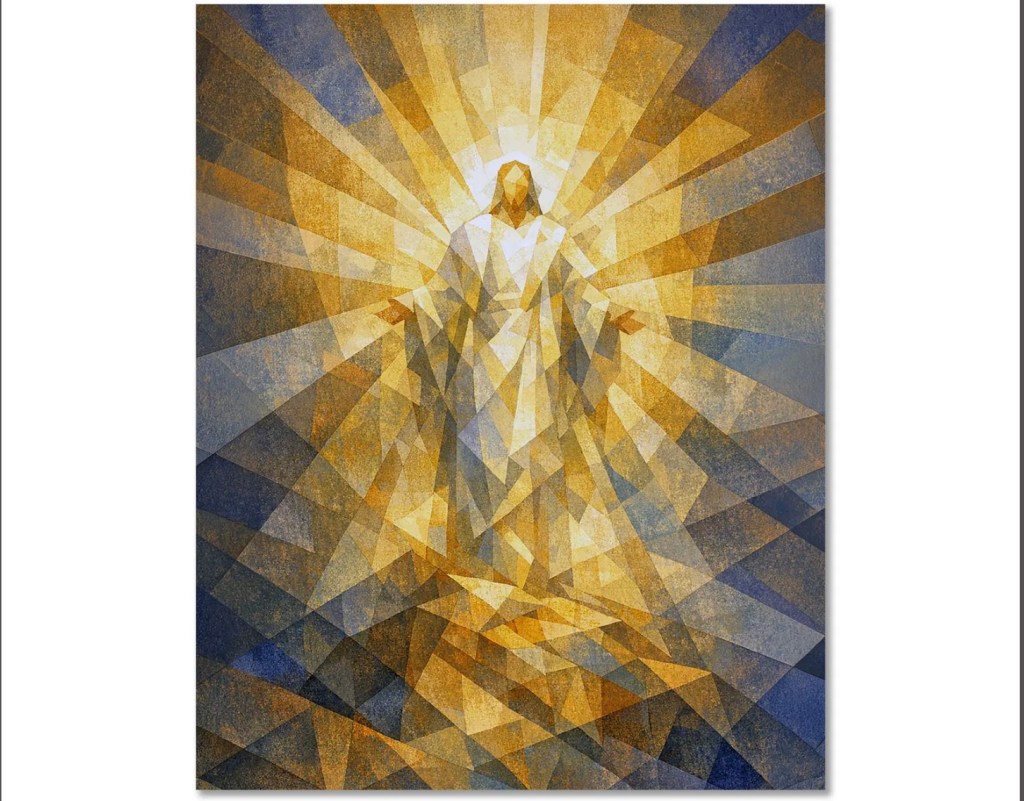
Painting: Accessed on Amazon.com wall art

Link for the Mass readings for Tuesday, April 28, 2026

May we allow ourselves to rest and be cared for by Jesus our shepherd.

I am not sure how many people reading this reflection are shepherds, live on a farm, or raise sheep. Many of us are most likely removed from the daily life and commitment of a shepherd. With such ignorance as our starting point, we can fall prey to a false romanticism of the life of a shepherd as a reaction to the fast pace and hustle and bustle of modern urban and suburban life. The commitment and demands of shepherds during Jesus’ time were demanding and all-consuming, with little acknowledgment or recognition. In fact, many shepherds were looked down upon, and groveling at the bottom of the social class of ancient Palestine. Yet Jesus compared himself to being a shepherd.
Just scratching the surface of the social context of shepherds could help to shed light on John’s Gospel today where Jesus paints an image of himself as a shepherd who when he calls his sheep they hear and recognize his voice so they follow him. the sheep hear his voice, “the shepherd calls his own sheep by name” (Jn 10:3).
Jesus is not just a shepherd, but the good shepherd. Good shepherds lived among their sheep, watched over them, cared for them, helped to birth and raise them, as well as was willing to protect them with his life from predators and thieves. Though we may not be fond of being compared to sheep, Jesus does the same for us. He watches, cares for, protects, nourishes us with his own Body and Blood, and has given his life for us. Jesus calls us by name. Imagine that. Really, ponder all the billions of human beings that have, exist now, and will ever exist, and Jesus knows each one of us by name. Are we willing to listen and come to him.
We can get in trouble when we stray from his protective care and wander away. Yet, just as a sheep baas and bleats, so the Good Shepherd is always close to hear when we call. Each one of us is precious and important to him. We just need to remember that truth and reach out to him daily and more importantly stay close to him. Yet, no matter how far we may find ourselves astray, he will come to us and will carry us back home on his shoulders.
I invite you to spend some quiet time with Jesus, the Good Shepherd, today. With the humility and simplicity of a lamb, allow yourself to rest your head on his lap, surrender to him all your cares, doubts, anxieties, and fears. Allow your self to feel the comforting weight of his hand and so be healed by confessing any sins that are weighing you down. Let him impart some healing balm on past hurts left unforgiven, and let him bind up any recent wounds. At some point in your contemplation, also let soak in the ultimate gift this shepherd gave: his life for each one of us that we might have life in him. A life not merely to exist or survive, but a life of joy, fulfillment, and wholeness.
————————————————-
Photo: Some quiet time resting with my Lord and my Shepherd.
Link for the Mass readings for Sunday, April 26, 2026

Having beheld and received Jesus, may we go forth to serve him in one another.

Jesus appeared to the Eleven and said to them: “Go into the whole world and proclaim the Gospel to every creature” (Mk 16:15). Jesus is once again claiming who he is: Kyrios – Lord. The word, gospel, comes from the Greek word, euangelion, meaning good news, but the one who proclaimed “good news” during the time of Jesus was the emperor. Caesar would send his emissaries to announce such good news as a great victory or his birthday. What Mark conveys in the very first line and here at the ending of his Gospel, is that Jesus is Lord! Not Kaiser Kyrios, Caesar is Lord, but Jesus Kyrios, Jesus is Lord!!!

We receive Jesus our Lord in an intimate way in the Eucharist. We receive his Body and Blood. We are loved and transformed by him each time we receive him by consuming him as we have been reviewing these past few days with Jesus’ Bread of Life discourse. When we are dismissed from Mass, one of the dismissal lines is, “Go and announce the Gospel of the Lord.” This is to echo the command of Jesus for all of us to proclaim the Gospel in our everyday experiences and encounters.

We proclaim the Gospel first and foremost by believing that Jesus is the Christ, the Son of God, our Savior and Lord. He has risen! He has risen indeed! He is the firstborn of the new creation. This is something to get excited about, something to fill us with joy. We are not to be a Grumpy Gus People, but an Alleluia People!!! Once we remind ourselves what we believe, who we believe in, who we are, and whose we belong to, then we are better prepared to engage with others.

The most powerful witness we can offer is when we seek opportunities to act, speak about and engage others with respect, caring, and joy. When we catch the eye of another offer a smile. We can also say hello, a nod of our head, or offer a wave, fist bump, high five, or a hug. We also need to be aware of other’s boundaries and respect their space at the same time. If someone is not open, we need to respect their posture, and meet them where they are.

Reaching out to others to acknowledge their dignity and value is the simplest, yet most profound way to spread the Gospel, which really means to share the love of Jesus by willing their good. We are to accept and accompany others as Jesus does with the purpose of building relationships. We are more inviting when we are willing to be patient, gracious, and willing to listen and hear in our interactions with each person we meet and in doing so we may begin to understand each other a little better.

Remember God gave us two ears and one mouth for a reason because it is better to listen first and speak second. As we encounter others, we are to also remember the common courtesy of saying please, thank you, and I forgive you, whether in a store, restaurant, bank, convenience store, on the sidewalk, in traffic, or online. It is just as important to engage in a similar fashion with those of our family, friends, and those closest to us.

Especially now, with our country and the world on edge and more anxious than ever, believing in Jesus, embracing his love, and putting into practice small actions with great love we can make a difference. As Pope Leo said in his homily on Holy Thursday: “Christ offers us the example of self-giving, service and love. We need his example to learn how to love, not because we are incapable of it, but precisely to teach ourselves and one another what true love is. Learning to act like Jesus — the living sign that God has placed within the history of the world — is the work of a lifetime.”


Photo: Pope Leo XIV celebrating Mass Holy Thursday Evening (@Vatican Media)

Link for the Mass readings for Saturday, April 25, 2026

Even in our darkest moments, Jesus cares, and is here for us.

“Everything that the Father gives me will come to me, and I will not reject anyone who comes to me, because I came down from heaven not to do my own will but the will of the one who sent me” (Jn 6:37-38).
Jesus does not reject us when we seek him out and when we come to him. He accepts us because he knows that we come because we have on some level listened to his Father and allowed our hearts and minds to be moved by his love. Jesus has come to do his Father’s will which is to lead us all to salvation, to redeem and restore us to the proper order of freedom from our enslavement to sin. Even when we turn away, are diverted by distractions, misled by our sin, or misunderstandings, Jesus is with us. We don’t experience him or his love though when we have turned away from him. In the depths of our souls thought, we all seek the love of God that we have been created for.
This is why Jesus met Cleopas and the other disciple on the road to Emmaus. Even though they were walking the wrong way, Jesus did not point that out. He came upon them, walked among them, and opened up the Scriptures to them. In doing so, the fire that had been dimmed by the despair of Jesus’ death, was rekindled in Jesus’ breaking open the word for them, in sharing salvation history, such that when Jesus moved to continue on, they invited him to stay with them. Then, in the breaking of the bread, they recognized Jesus, who they thought they lost. They experienced in their presence and were nourished by “the bread of life” (John 6:35).
It was through sharing a meal with them that they recognized him. How many meals had they shared together before his death? A close reading of Sacred Scripture shows how important table fellowship is for Jesus and his followers before his death and after his Resurrection. True, Jesus eating with his disciples after his Resurrection shows that he is no ghost, he is human, but also he is reestablishing the cornerstone of his ministry, table fellowship.
Not only are the basic needs of sustenance met, but also in sharing his time and conversation with anyone willing to eat with him, no matter their level of ritual purity, they were touched at the deepest hunger within their hearts, which is to belong, to be accepted, and loved. The majority of the crowd that Jesus spoke to has continued to come to him because he fed them with only a few loaves and some fish. In the miraculous multiplication, Jesus provided for their bodily nourishment, but also was also inviting them to experience the deeper spiritual nourishment of the soul which can only be nourished by his Body and Blood.
Jesus loves us, he wills the best for us. Many resist this truth for different reasons. It could be the callouses, scars, and growing cynicism as a result of wounds inflicted by others, those who did not fulfill expectations, and/or betrayal. Each of us could have experienced the same and have also been let down by those we have looked up to and trusted. If we are involved in a relationship long enough, we will experience disappointment or worse. This is because sooner or later, when we draw close, the masks will come down and who we truly are, the fullness of our wounds and our gifts will come to the fore. Conflicts will arise because we are finite and imperfect, human beings. We are still a work in progress.
None of us are perfect. We are all on a journey. On our own, we will consistently fall short of our goal. That is why we need a savior. We need someone that we can trust that will be there for us when we are let down and when we fall down face-first into the mud. Someone who, when that happens, will lay down in the mud with us, look us in the eye, and smile.
Even if we are not able to look past the predicament, or smile in return, we might just be able to catch his eyes looking at us and then we will see him offer us his hand. We can then rise together, and stand again. That is how Jesus shows his mercy and love for us. He enters into our chaos and meets us in the midst of the muck and mire of our mistakes, wounds, and sins. He loves us there, and when we are ready to accept his offer of love, he invites us to get up, and begin to walk again.
As our relationship with Jesus grows, as our trust deepens, we will begin to feel safe, to believe that we belong and have dignity. We will begin to heal and realize that we are a part of something greater than ourselves. Then with wobbly steps, begin to offer attempts of the same mercy, forgiveness, and unconditional love to others that we have received. This is the path of discipleship. This is the road we are on, together.
When we allow ourselves to be loved in those places we have kept everyone at a distance, when we trust Jesus to come into those places and receive his love even there. We begin to heal. We are not problems to be solved or machines to be fixed. We are children to be loved by Our Father.
This is not a hundred-yard dash but a long and winding road. Let us be willing to: persist, be loved and led, be there for, and accompany one another as we take the hand of Jesus and allow him to lead us on the Way. Jesus will not reject any of us who are willing to take his hand and walk with him. May we help others, as Jesus helps us, when we fall, to rise up, and begin again.
———————————————————————————
Photo: When we are willing to go into the dark places in need of healing, we will see the light of Jesus there guiding us to healing.
Link for Mass readings for Wednesday, April 22, 2026

Jesus does not ration his gift of the Spirit.

The question that arises and is foremost regarding Christianity above all else is, “Who is Jesus?” How this is answered has a lot to do with what we believe. Biblical scholars debate whether today’s passage, John 3:31-36 is a continuation of John the Baptist talking with his disciples or these are an insertion by John the author. No matter who is the source of these points of concern, the goal is coming to understand and to believe that Jesus is the one who “comes from above” and the one who “comes from heaven is above all”; he “testifies to what he has seen and heard” and he is sent by God to speak “the words of God”; he is also generous in that he “does not ration the gift of the Spirit”; and the Son is loved by the Father and God “has given everything over to him”.
Each of these phrases are revealing the truth that Jesus is the Son of God who has come from above to reveal the truth about his Father and that he is able to do so because he has seen and has an infinite relationship with his Father. Jesus preaches the Gospel, the Good News, that God loves us, that he seeks and has always sought, to be in communion with us, his created beings. Jesus has come to reveal the love of the Father and that his love is unlimited.
The proclamation that Jesus is the Messiah, is not just revealed in the Gospel of John, but each of the three other Gospels, Matthew, Mark, and Luke, as well as the other epistles of the New Testament. Jesus, as the Son of God, is also the key to unlocking the Hebrew Scriptures, and we can see how the Torah, the Prophets, and the Writings all point to Jesus as well. Jesus shared this outline of salvation history with Cleopas and the other disciple on the road to Emmaus, such that their hearts were burning within them while Jesus opened the scriptures to them (cf. Lk 24:32).
John the Baptist got it and the Apostle John and the other apostles eventually got it. They came to understand that Jesus is the Son of the Living God and that he offers a model for us to follow, but more than that, Jesus empowers us with his very life. This was a key point of surrender for John the Baptist when he shared with his disciples, the truth that, he, they and we are all called to ascribe to if we are to grow in our faith: “He must increase; I must decrease” (Jn 3:30). May we spend some time in quiet reflection today by pondering the phrases offered to us regarding who Jesus is. Which one, two, or do all of them call to you?
“The one who comes from above is above all.”
“The one who comes from heaven is above all.”
“He testifies to what he has seen and heard.”
“For the one whom God sent speaks the words of God.”
“He does not ration his gift of the Spirit.”
“The Father loves the Son and has given everything over to him.”
When we have finished, what is our response? Do we disobey or discount that Jesus is who he says he is or do we “accept his testimony” and “certify that God is trustworthy”? If we “accept his testimony”, are we willing to decrease, such that he will increase his influence in our lives? Do we believe that Jesus is the Christ, the Son of the Living God?
Reading, meditating, praying with and listening to the Gospel readings, helps us to encounter, sit at the feet of, and be in the presence of Jesus who teaches us in our time as he did with each generation of believers from the time of the apostles to our present age. Are we willing to be still, listen, and come to him daily? If yes, then in the words of Pope Benedict XVI, we will meet the Risen Christ and “know him intimately by the power of the Holy Spirit…” and have “actually touched him” so that we “can witness to him” (Martin and Wright, 79).
Let us not follow the lead of the rich man who walked away sad from his encounter with Jesus. May we instead follow the lead of the Apostles, Mary Magdalene, the woman at the well, Cleopas and his companion, surrender our lives to him, and so be loved, forgiven, healed, transformed, that we may be witnesses of Jesus’ joy.

Photo: Jesus did not ration his love, he gave all of himself, holding nothing back, not even his life, so that we may know him and his Father intimately and so experience the outpouring of their love shared between them, the Holy Spirit.
Pope Benedict XVI, “Homily,” May 7, 2005 found in: Martin, Francis and Wright IV, William M. The Gospel of John. Grand Rapids, MI: Baker Academic, 2015.
Link for the Mass readings for Thursday, April 16, 2026

Our path to eternal life begins when we accept the invitation of, then receive and share God’s love.

Jesus continues his conversation with Nicodemus in today’s Gospel from John. In the opening verse, Jesus outlines why he came into the world: “God so loved the world that he gave his only-begotten Son, so that everyone who believes in him might not perish but might have eternal life” (Jn 3:16). God has created us out of love and shepherds us out of love. God loves what he has created, and in his order and timing, he sent his Son to enter humanity to become one with us, to heal us and invite us to come out of the shadows and dark recesses of turning in upon ourselves, from living in fear and sin and sometimes at best survival and to experience peace, forgiveness, healing, and wholeness.
Loving means to risk being rejected. Jesus entered humanity as we all did, in the utter vulnerability of the womb. His very life was at risk from the moment of his conception. Mary, a young woman,  betrothed to Joseph, in a time and culture in which a woman found to be with child and not from her husband, could be stoned to death. Mary could have made a different choice, Joseph could have made a different choice, but both chose to follow the will of God. They resisted the temptation to close in upon themselves and make an isolated decision based on their own needs, anxieties, and fears. While all of creation held its collective breath, Mary and Joseph trusted God, they chose the light, they chose to protect life.
“Whoever believes in him will not be condemned, but whoever does not believe has already been condemned, because he has not believed in the name of the only-begotten Son of God” (Jn 3:18). Jesus did not come to condemn, he came to redeem, to save, to love us into eternity. For love to be real, it must be truly free. Free to the full extent that it can be rejected. To love is to risk rejection. Otherwise, what is experienced by the other is coercion, conditional, manipulation, pressure, but not love.
The Son of God entered the womb of Mary risking rejection by her, Joseph, and/or their extended family. The only difference between Jesus in the womb and Jesus who ministered to those on the margins was that he was smaller and more vulnerable. Those who, like Mary and Joseph, believe will come to have eternal life, and those who do not have already been condemned, not by God but by themselves who reject or turn away from the invitation. For they choose to curve in upon themselves and remain in their sin, choose to remain separated from God, choose the darkness instead of embracing the light.
Those rejecting God have been invited to receive his love also, but for reasons they may or may not be aware of say no. They may not even be aware that by some of their choices that they are choosing something other than God. We who choose Jesus are to receive and be his presence of love among those we encounter, even those who shy away or reject him. We may be the only Bible someone ever reads.
We are to protect the the unborn as well as those who have been born. We are not just pro-birth, but we are also pro-life. That means that each of us has a charism of who we are called to reach out to, speak up for, and touch with the love of Jesus, to be present to those who God brings into our lives. We can think, speak, and act by respecting the dignity of each person we encounter, in-person and online, supporting a consistent ethic of life from the moment of conception until natural death and at every stage in between.
“God so loved the world that he gave his only-begotten Son, so that everyone who believes in him might not perish but might have eternal life” (Jn 3:16). We, even in our wounds, imperfections, and sin, are loved by Jesus. We can reject or accept his love. As Pope Francis wrote: “We are called to be holy by living our lives with love and by bearing witness in everything we do, wherever we find ourselves.” As we receive and experience the love of Jesus, may we seek to love every person we encounter as he has loved us. If there are those that we might not necessarily include in every person, may we be willing to allow Jesus to love them through us until we can.

Photo: Quiet time with Jesus is a good way to breathe, receive, rest, and abide in his love.
Link for article on Gaudete et Exultate (“Rejoice and Be Glad”)
Link for the Mass readings for Wednesday, April 15, 2026

When we encounter Jesus for ourselves, we too will have some good news to share!

Today’s reading from the Gospel of Mark, 16:9-16, is commonly called, “The Longer Ending.” Most ancient manuscripts of Mark end at 16:8. Whether this Gospel ended there or the original ending was lost is not definitively known. Many biblical scholars also recognize in these verses a different writing style, so attribute this longer ending to a different author. This ending recounts that Mary Magdalene and two disciples, presumably the same on the road to Emmaus as recorded in Luke, met the risen Jesus. When both Mary and the this pair share their experiences with the eleven, they are not believed, and then, “later, as the eleven were at table, he [Jesus] appeared to them and rebuked them for their unbelief and hardness of heart”

How many times had Jesus rebuked the Pharisees for being hard of heart? Now he is saying the same to the eleven for not believing the accounts of Mary and the two disciples. We do not have a reason for their unbelief and maybe that is well and good because that gives us the opportunity to ponder for ourselves when has someone brought us a message from Jesus and we responded to them with hard hearts and were unbelieving? Are there certain people we would not believe no matter what good news they had to share with us? Have we brought the good news of our encounter with Jesus and it was met with coldness or even disdain?

Mary a woman and a woman that has had seven demons exorcized from her would not have been considered a credible witness in the ancient near East. And yet, Jesus chose her to appear to first and to bring the message of his resurrection to the Apostles. And that such an “unreliable” source, Mary’s witness, has been retained in all four gospels has something to also say – Mary encountered Jesus, believed, and shared what she saw and experienced and although initially not believe, her testimony was preserved.

Jesus does not belabor the point. His conviction helped them to see that as his followers their hearts needed to be open to him working through others, as he told John when someone was casting out demons in Jesus’ name, “whoever is not against us is for us” (cf. Mk 9:40). He was also preparing them for those who would believe their testimonies.

Christianity is not a secret sect, it is a universal call and proclamation to be shared with all. We are celebrating in this Easter Octave, as we continue to do so each year, the fullness of the Paschal Mystery. Not only did the Son of God became incarnate and live the fullness of a human existence, he suffered, died, conquered death, and rose again, for all of humanity and creation.

This was no mere resuscitation like Lazarus who would die again. Jesus conquered death and became the firstborn of the new creation and he invites us to participate in his reign. He invites us to share in his divinity. The resurrection is the Good News he wanted his eleven to proclaim when he said to them, “Go into the whole world and proclaim the gospel to every creature” (Mk 16:15).

Do we believe the apostolic claim that was first shared by Mary Magdalene, the Apostle to the Apostles, and has been passed on generation after generation? Will we, like those who have gone before us, receive, abide in, and share the love of God? Jesus is calling us to do so not for a select few in our pew, but for all in our realm of influence. We are to build relationships by bringing the light, joy, and love of Jesus to each individual that we meet, person to person. Let us also be open to God working through others and receive his message from them as well! Alleluia!!!Alleluia!!!

———————————————————————

Photo: Elizabeth Tabish, playing Mary Magdalene in the series The Chosen.

Link for the Mass readings for April 11, 2025