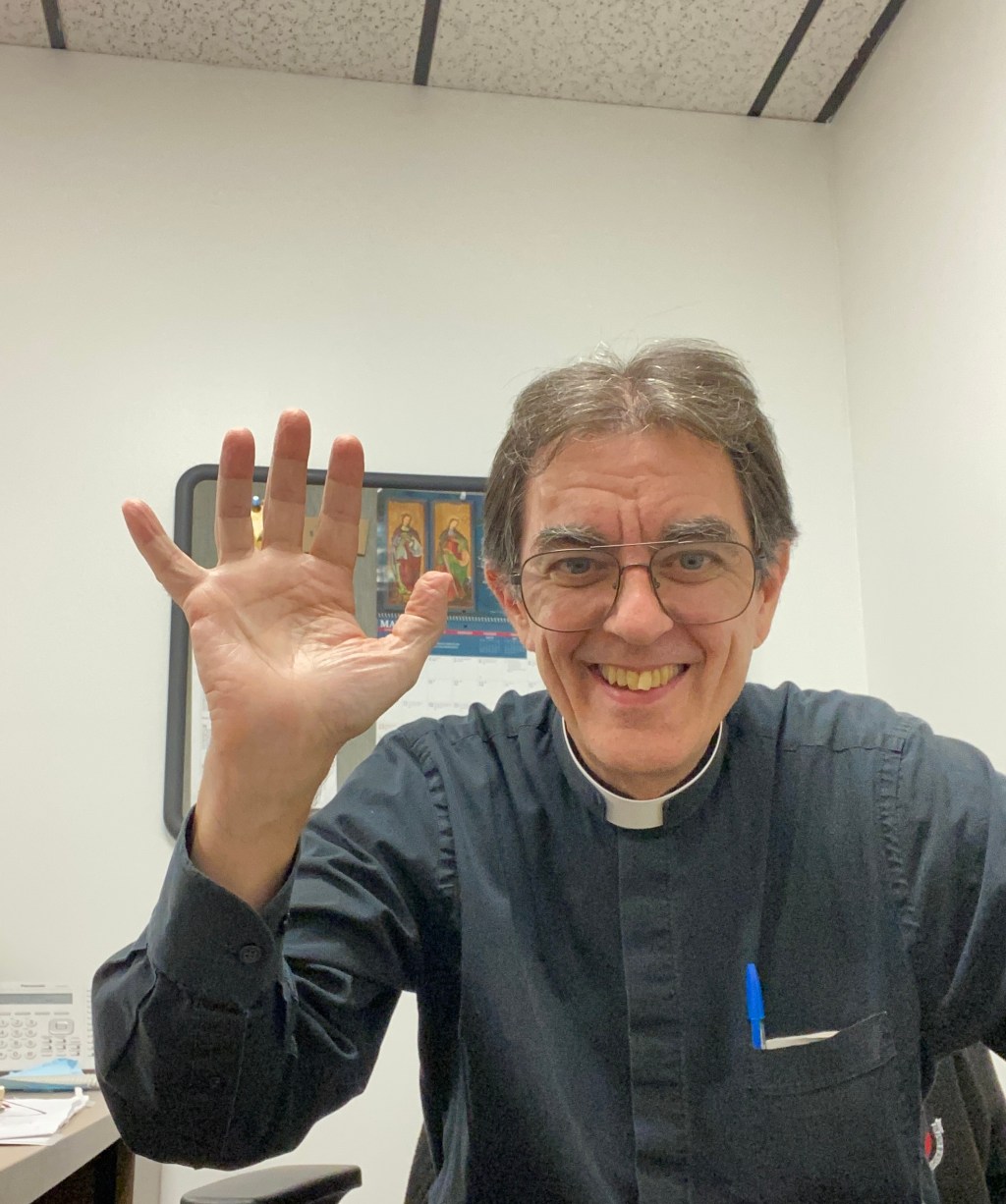
Resist the temptation to compare, trust and follow Jesus instead.

How many times have we looked to others instead of staying focused on what we need to do or be doing? How many times do we compare ourselves to others, assessing what we or others have or don’t have, how others are more or less confident, more or less better looking, more or less intelligent, and even, how our faith life is worse or better?

We get a taste of these questions and what our response ought to be from Jesus in today’s Gospel. The background of today’s reading is a continuation from yesterday’s, in which the author described how Jesus forgave Peter for denying him by asking him not only if Peter loved him, but how he was to put that love into action by feeding his lambs, taking care of and feeding his sheep. Jesus also had just let Peter know that Peter was going to die in his service to him.

Today, we read that upon hearing the news of his eventual death, that Peter shifts the direction away from himself.  When Peter saw him, he said to Jesus, “Lord, what about him?” Jesus said to him, “What if I want him to remain until I come? What concern is it of yours? You follow me” (Jn 21:21-22). Jesus does not definitively say what is or is not going to happen to the beloved disciple. Jesus is clear with Peter that his focus is not to be on what is going to happen to the beloved or any other disciple, but to direct his attention to following him and his will.

Our orientation as disciples of Jesus is to follow Jesus, to focus on his will for our lives and to expend our energy in such a way that promotes his will. We are to spend less time comparing ourselves to others. This is very good advice because the temptation to compare is a very slippery slope that can easily lead us to the devastating sins of gossip, pride, and envy. If we are to compare ourselves to anyone, let it be to Jesus.

Jesus calls us to be perfect as his heavenly Father is perfect, which is an impossible task if we seek to go it alone. Yet, we can become perfected through our participation in the life of Jesus the Christ. We begin when we decide to ask for Jesus to help us make a commitment to resist the temptation to compare ourselves to others. Then when the first instant of a comparative thought arises, we can replace it with a prayer of blessing directed toward another.

Moment by moment, we just need to remember that we are not alone, that we walk with Jesus. One thought, one action, one interaction at a time, we are called to surrender our will to the love of God. By taking these steps to counter the influences of a focus on self first as well as resist the comparative and/or seeking to follow a cult of personality, we can begin to shift the momentum away from increasing divisiveness, polarity and mistrust, and instead strive toward supporting, encouraging, and uplifting one another.

As we place our trust in and follow Jesus, our thoughts, prayers, and actions will change. We will become more understanding, patient, willing to engage in conflict resolution, and dialogue. To love as Jesus loves us will help us to begin to lessen the intensity of fear, prejudice, biases, and chronic stress. As we are able to then experience his peace, let our shoulders come out of our ears, then we might be willing to see each other as human beings and through God’s eyes, as beloved daughters and sons with whom he is well pleased.

————————————————————

Photo: Follow Jesus where he leads and all will be well. Back home for a quiet walk a few weeks ago.

Link for the Mass reading for Saturday, June 7, 2025

We can experience Jesus’ peace even in our greatest challenges.

“Peace I leave with you; my peace I give to you. Not as the world gives do I give it to you” (Jn 14:27). The peace that Jesus is talking about, the peace that he gives us is a peace the surpasses all understanding, because it does not come from this world but from the love of the Trinity. This peace Jesus can give because he has received this peace from the relationship that he has with his Father. “It is a supernatural peace that arises from a total love for the Father” (Martin and Wright, 252).

God is an infinite communion of Love. There are three Persons, yet one God, because of their infinite nature. There is a complete, perfect, and infinite giving and receiving between the Father and the Son and the love that is shared between them who is the Holy Spirit. We experience this peace because of Jesus, in his becoming one with us in our humanity, we become one with him in his divinity. Because of our union with Jesus, we too then share in the love of the Holy Spirit and experience also the peace of the Holy Spirit. This peace is not just an absence of stress, anxiety, violence, and war, but a receiving, resting, abiding, and sharing in his trinitarian communion of love. Jesus seeks to share the love and peace he has received from his Father with each of us.

Jesus does not promise with the bestowal of his peace a life of perfection and peace. We still live in a wounded, dark, and fallen world and there will be challenges, trials, tribulations, and tragedy, yet through all matter of what we encounter, we can tap into the infinite well spring of the love of the Holy Spirit. He is present and accompanies us in the midst of any and every situation we invite him into. There may be chaos all around, but as we turn to Jesus and trust in him, we will experience his peace.

Today, would have been JoAnn and my 29th anniversary. I can still remember the day we received the news of JoAnn’s diagnosis of pancreatic cancer during the Wednesday of Holy Week. From that moment, our life entered a non-stop whirlwind and flurry of activity. There was so much we had to prepare and plan for even beyond dealing with the diagnosis. Despite everything, there was a peace that was consistently present for both of us. Jesus sustained us through every step leading up to her death, the time of grieving and mourning that followed, and learning how to live again without her.

Nothing this side of heaven is permanent. At best, all God has created is good, but finite. The one constant we can place our hope and trust in is Jesus’ love and support for each one of us. This is why we are an alleluia people because even death does not have the final say, Jesus does. The veil between heaven and earth is so thin at Mass because Jesus is present with us in his word proclaimed, in his Body and Blood, in each of us who gather on earth as the angels and saints gather in heaven. Jesus seeks to enter our lives and to share with us his love and peace in every situation, are we willing to open the door and let him in?


Photo: Thanks for 23 blessed years and for your help and intercession these past five and a half years. Happy 29th my heart and my love!

Martin, Francis and Wright IV, William M. The Gospel of John. Grand Rapids, MI: Baker Academic, 2015.

Link for the Mass readings for Sunday, May 25, 2025

“Peace be with you all!”

Why so much violence? So many countries are and have been consistently embroiled by the ravages of war. Many countries, including our own, were founded on the taking of lands by force and oppression of aboriginal peoples. Too many of our youth and citizens die from gun violence and mass murders. So many examples of road rage, domestic abuse, human trafficking, terrorism – foreign and domestic, and the myriad of random acts of violence that continue daily.

We may hear goodwill speeches shared after each atrocity, participate in the petitions and intercessions ringing from our ambos and pulpits in our places of worship, and pray personally and in prayer groups, participate and/or witness demonstrations, marches, and votes for change. All the while, there are those working in the trenches of communities throughout the world, putting their own lives at risk, matching their words and prayers with their deeds. And yet, do any of these efforts make a difference?

There is a constant temptation of cynicism and despair biting at our heels, but let us never give in. There is a light the shines in the darkness of our fallen world, and there is hope that we can pray with and rest in from  Jesus’ Gospel from John: “Peace I leave with you; my peace I give to you” (Jn 14:27).

This peace that Jesus promises to leave with his apostles is a peace that is not of this world, a peace that surpasses all understanding (cf. Philippians 4:7), and this peace has been and continues to be offered to us as a gift. Many have indeed said, “If there is a God, well then, why doesn’t he do anything?” He did and he has. God sent his Son the King of kings and the Prince of Peace. The peace that God shares through his Son and the love of the Holy Spirit is offered to one person at a time. This is why when Jesus resurrected he only appeared to those he chose and not the whole world.

Jesus is to be encountered and his relationship is built one person at a time in each generation. Each of us have the invitation to accept or reject his invitation to believe in him, but so much more. Jesus invites us to be his disciples. Learning from and putting into practice his teachings, as did the original apostles and saints who in each generation have done just that, is the way we are to follow. We do this best when we surrender our minds and hearts and the very depths of our souls to the love and peace that Jesus offers and teaches.

Pope Leo XIV chose to do continue to offer our war worn and weary world Jesus’ peace with his first words as Pope: “Peace be with you all!” This “is the peace of the risen Christ. A peace that is unarmed and disarming, humble and persevering. A peace that comes from God, the God who loves us all, unconditionally.”

This peace of God that the risen Jesus offers is not some abstract formula and the command to love is not some pie in the sky universal love for all. The teachings and acts of peace and love that Jesus shares throughout the Gospels are very concrete, individual, and personal. Jesus interacts with people as people, not as numbers. He engages and directs us to do the same, by encountering, accompanying, and loving a person. The real question is not why isn’t God doing anything? The real question is why have we left the gift of God’s peace offered to us unwrapped?

If we want peace in our world or even our corner of the world, our hearts and minds must be open to receive God’s love. We must be still and receive, savor, and embrace the love he wants for give and then share with others what we have received and as he directs us to give. To receive and embrace the peace of Jesus, we must be willing to let go of our own weapons of hate, prejudice, cynicism, racism, division, selfishness, and the like. God created us as beings who are interconnected, which means that what one does affects all, for the sun rises and sets on the good and the bad alike.

If we want peace, as I believe all of us really do, we need to be more aware of and choose more intentionally our thoughts, words, actions, and even the expressions of our faces. The thoughts that we feed are the ones that bear fruit in our words and deeds. Figuratively and literally, we need to be willing to “beat our swords into plowshares and our spears into pruning hooks” (cf. Isaiah 2:4).

This verse becomes real in our lives when we choose to resist the temptation to react and choose instead to seek the guidance of the Holy Spirit. In the concrete, we can choose to disagree with someone without being  disagreeable or disrespectful. When we make a mistake and resist beating ourselves up over the process and instead learn from our misstep, and begin again. We also do so when we are willing to seek and offer forgiveness, acknowledge we need to be healed, are willing to be more patient and understanding and we can do none of these alone. We need a Savior, to heal us, save us, and lead us from our own darkness into his light.

Can we really bring about world peace? In some abstract form, for all people, for all time, no. What we can do is make a daily commitment to spending time with Jesus to receive his love, study, pray, meditate with and learn from him. Then we can begin to put into practice what we have learned and received. We can share the love and peace of Jesus with each other one person at a time.

—————————————————————

Photo: Pope Leo XVI’s first appearance praying for the Church and the world that we may receive and share the peace of the risen Christ. Credit: Dylan Martinez from Reuters 

Quotes of Pope Leo from full Urbi et Orbi message.

Link for the Mass readings for Tuesday, May 20, 2025

Accepting Jesus’ invitation to slow down can help us to grow in our relationship with him and experience more peace.

Our days are so full of activities, conflicts, health issues, technological stimulation, 24/7 news cycles, social media interaction, challenges, polarization, as well as good and healthy activities, pursuits, interaction, and engagements which can all contribute to our emotional, physical, psychological, and spiritual weariness. If we do not have the proper foundation and orientation, we can feel stretched, hollow, and/or fatigued at best. One day can seem to blend into another, and another, and another. The image of being on a hamster wheel or an unending treadmill can fall afresh in our mind’s eye when we actually do take a minute to breathe. Anxiety, worry, stress, fear, prescriptions, and addictions all appear to be on the rise and swirling out of control.

Is there an answer to this hyper pace or are we doomed to just keep going until the wheels fall off? The opening verse in today’s reading provides an antidote when we are feeling any or all of the above.

Jesus said to his disciples: “Do not let your hearts be troubled. You have faith in God; have faith also in me” (Jn 14:1).

Jesus was speaking specifically to his disciples after he had talked to him about leaving them. He was going back to the Father through the way of the cross. No matter the challenges that we face, even death, our own or a loved ones, we are invited to place our trust in God through his Son, Jesus. By putting God first does not mean that the externals to our life will immediately take an abrupt turn for the better. What establishing a foundational relationship with Jesus does mean is that we will have support and divine assistance. We are not alone in our struggles. The disciples found this out when in the midst of a sudden sea squall. Their boat was taking on water as the waves grew higher such that they were terrified and so, called to a sleeping Jesus. Jesus awoke and with a word, he calmed the sea (cf. Mk 4:35-41).

Jesus may or may not calm the sea of our trials and tribulations, but what he will do is be present with us through our storms in life and we can trust in him that he will guide us through. As we grow more confident in our trust in Jesus, we will be assured that no matter who or what comes at us, he will be there to assist us. We will experience a peace that surpasses all understanding and calm within ourselves. The ultimate assurance that Jesus provides is that when we surrender our life to him, we belong to him, we are not alone or orphaned. He gave his life for us, to redeem and save us so that we can be assured of our home for eternity. “I will come back again and take you to myself, so that where I am you also may be” (John 14:3).

Jesus promised he will come back for us at the hour of our death. He is preparing a place for us in the heavenly kingdom. We do not have to just wait for him to come back though. By growing in our relationship with him now, we enter into and participate in the loving relationship Jesus shares with his Father and experience the love of the Holy Spirit.

If we are struggling at any level and are seeking to build our trust and faith in Jesus, it is important to proceed patiently. God works slowly and this goes against our seeking of instant gratification. God is building a foundation in us which is meant to last not only in this life but in the next. When we make time to sit at the feet of  Jesus, slow down and breathe, ask for his help, seek his discernment about where we can make changes in our life, he will lead us. We just need to trust him and be willing to follow his lead.

This time does not need to be lengthy, three to five minutes a day to start can do wonders. On the surface level, by stopping for five minutes to pray and breathe more deeply and consciously, we get off the wheel, we step out of survival and reaction mode, so that we can then make more intentional and insightful decisions, and we can come to see that we truly have options, but more importantly, we begin to develop a relationship and intimacy with Jesus so to begin to recognize his voice in our stillness and in our activity. When we show up, God will happen.

The Liturgy of the Hours, and the daily readings of the Mass, meditating, praying, and contemplating the word of God have been foundational for me and my transformation, healing, and growth. Over my two years at the seminary, I was also introduced to practicing a holy hour of prayer, often before the Blessed Sacrament daily. Each of these practices have become foundational and non-negotiable anchors in my day. Setting the time aside with my busy daily schedule has been a challenge over my first year of priesthood, but doing so has helped me to better prioritize my time and seek the guidance of Jesus to guide me.

Having set times to stop to meditate and pray throughout the day has been helpful, especially on those days when my schedule is full to overflowing. Author Wanda E. Brunstetter, wrote, “If you are too busy to pray, you are busier than God wants you to be.” There is a lot of truth in her statement. I have had busy days, weeks and months, where I have wondered if taking the time to pray and meditate was really the most sensible choice. Time and again doing so has made an incredible difference and has now been helping me better reevaluate what I schedule into each day. 

The Rosary is another great way to get into God’s word by meditating on the mysteries of the life of Jesus and Mary. If you are not able to pray the whole Rosary in one sitting, start with one decade a day. Read for a few minutes from the Bible once in the morning and then return to meditate on the same verse or verses that touch or challenge you throughout the day. You can also read the daily Mass readings and place your self in the scene and allow the account to open up before you as if were actually there.

Each of these practices offer us a few of the many ways to stop the madness, to slow down, simplify, and connect with the power, the love, and the grace that Jesus yearns to share with us such that no matter the external or internal upheaval, we may experience his peace, that peace that surpasses all understanding (cf. Philippians 4:7).

—————————————————–

Photo: Jesus is “the way, the truth, and the life” (John 14:6) . Let us trust him, take his hand, and follow his lead.

Link for the Mass readings for Friday, May 16, 2025

How we treat one another with our thoughts, words, and actions matters.

Jesus calls us to be holy, each and every one of us. Our life is to be lived with the end goal being our ascent to heaven, to be in union with our Loving God and Father for all eternity, and to assist others to do the same. Jesus provides for us a concrete example of the heights to which we are called to reach: “You have heard that it was said to your ancestors, You shall not kill; and whoever kills will be liable to judgment. But I say to you, whoever is angry with his brother will be liable to judgment, and whoever says to his brother, Raqa, will be answerable to the Sanhedrin, and whoever says, ‘You fool,’ will be liable to fiery Gehenna” (5:21-22). Jesus is building on the Torah, the Law or the Teachings, by helping us to realize that we cannot only kill with weapons but also inflict dehumanizing damage with our words.

To resist this temptation of inflicting mortal wounds, we need to start participating in a deeper examination of conscience which gets to the roots of our own thoughts, words, and actions. If we are not able to discipline our thoughts, what will follow is undisciplined words, and then undisciplined actions, which can lead to entertaining and embracing the deadly sin of wrath. Wrath is unbridled anger that leads someone away from the capacity to think or behave in a rational manner, such that this individual would no longer acknowledge the dignity of the person they would inflict their wrath upon.

Jesus never settled for a minimalist approach to our faith. He is helping us to see that we can be free of the temptation of wrath if we recognize the danger and destruction of unleashing words as weapons. He offers us the examples of calling someone, Raqa, meaning something along the lines of an air-head or an idiot, and calling someone a fool. These words directed at another have no other cause than to demean, degrade, belittle, and harm. This language, and worse, has no business coming out of the mouths of a disciple of Christ. If we are serious about being one of his followers, we need to make a decision regarding how we think, speak, and act.

I remember a moment in sixth or seventh grade unleashing a derogatory word or two toward a classmate. Even though they were loosed in jest, I felt a sinking feeling in my gut after hearing myself say them. God convicted my heart in that graced moment and I felt contrition, actual sorrow for the negativity and poison I had unleashed. I remember making a commitment to myself not to speak that way toward another person going forward.

We need to be aware that words have the power to wound or to heal. If we are serious about following Jesus, fasting from gossip and from words that belittle, divide, diminish, or dehumanize is a good practice to engage with this Lent. Jesus wants us to remove any and all obstacles that would prevent us from growing in sharing his unconditional love with one another. Instead of an unkind word we can share words that empower, uplift, and comfort or at least listen more and speak less. Even when we disagree with another’s point of view, we can do so by still respecting the person and fostering dialogue.

Our words are not enough. Our words will be more kind when we are willing to go deeper and resist entertaining negative or dehumanizing thoughts. Even when we have defensive musings resulting from another’s disparaging tone, words, or actions, we need to resist entertaining them. Instead of reacting, we can breathe, pray for the strength from the Holy Spirit for understanding, hold each other accountable when necessary with respect, and ultimately seek to love, to will the good of each other in all circumstances. We begin this by praying for one another and seeing each other as brothers and sisters.

—————————————————————

Photo: May God bless you with a peaceful mind and heart this day that you can share with others!

Link for the Mass readings for Friday, March 14, 2025

With a breath and a prayer, we can choose what we think, speak, and how we are to act.

“[W]hat comes out of the man, that is what defiles him” (Mk 7:20).

Jesus offers a list in today’s gospel of what can be unleashed from within and then directed out toward another. These are examples of what defiles us because, at some level, we make the decision to think about, speak, and put into action those thoughts, words, and actions.

To resist the temptation to defile ourselves and others, we can follow the lead of the writer from the letter to the Hebrews who offered a wonderful verse, which I pray each morning in my recitation of the Office: “Encourage each other daily while it is still today” (Hebrews 3:13). There are many that we will encounter or hear about each day that will do the exact opposite.

Our goal each moment is to resist spending any time or energy in supporting any thoughts, words, or actions that demean, belittle, or dehumanize. We can call those out who do so, stand up for those impoverished from these attacks who do not have a voice but we must not succumb, engage, or in any way be lowered to the negativity unleashed. Otherwise, we become an agent in perpetuating the same vileness and poison already unleashed.

Our thoughts, words, and actions matter because we are all interconnected, and even what we ruminate upon can be projected onto our faces and directed out toward another without saying one word. Thoughts entertained can lead to words and actions that wound. We are better when we approach each moment accessing more intentional choices. Instead reacting on automatic pilot, we can take a slow breath, think, and pray about our response.

Let us choose this day to align our thoughts, words, and actions with those of Jesus. We can follow St Mother Teresa of Calcutta’s five-finger gospel as a reminder: “You did it to me.” What we say and do to the least of our brothers and sisters, we say and do to Jesus (cf. Mt 25:35-45). This begins when we resist defiling ourselves by never letting evil talk pass our lips and instead think, speak, and act in ways that empower, convict, and build up others. Our effort is strengthened when we choose to forgive any negativity hurled at us, and meet it with a posture of compassion that seeks to understand the perspective of the hurler. In our efforts, we are not alone when we call upon the help and strength of Jesus as we strive to become ambassadors of his transforming love.

————————————————————————————————-

Photo: Making time to be still and quiet when all is well helps us to more easily choose to do so when stressful opportunities arise.

Link for the Mass readings for Wednesday, February 12, 2025

“Quiet! Be still.”

On display in Mark’s recounting of the calming of the storm at sea is the humanity of Jesus. He had finally succumbed to the exhaustion from being pulled and touched, challenged and accused, the constant interaction through his service of teaching, healing, forgiving, and exorcising, such that he not only fell asleep on the boat but was in such a deep state that he was as if dead, even during the height of the storm.

What is also on display is his deep and abiding faith in his Father. For those aboard with Jesus were seasoned fishermen and had experienced sudden storms arise before. This must have been some storm to raise such panic. And yet, Jesus is sound asleep. He only arises because of his disciples insistence: “Teacher, do you not care that we are perishing” (Mark 4:38)? They unconsciously echo their ancestors in the desert with Moses when they moaned that it would have been better if the Lord had killed them in Egypt instead of their perceived starvation in the wilderness (see Exodus 16:1-3). Even though God had freed them from their slavery, they did not trust he would provide for them in the desert.

Despite the grumbling of the disciples and the fatigue of Jesus, he also reveals a glimpse of his divinity. Jesus arises. He does not invoke God’s aid but commands: “Quiet! Be Still” (Mk 4:39)! Just as Mark recorded that Jesus exorcised demons earlier in his Gospel, Jesus hear rebukes the wind and the waves and all is calm and peaceful.  This does not escape the disciples who are filled with awe.

The disciples have grasped his uniqueness, have accepted him as their rabbi, their teacher, but they are still grappling with the reality that Jesus is at the same time the Son of God. They will continue to experience his miracles, exorcisms, and teachings, but their faith is still small like a mustard seed. Though germinating, the stalks will not break through to maturity until after his resurrection and ascension. It is then that their faith will begin to bear fruit as they participate in the fullness of the ministry that Jesus is about to begin to train them for.

Similar to the disciples, storms arise in our lives, sometimes just as unannounced and as quickly as the squall from today’s Gospel. A health issue, an injury, an economic shift, a conflict, the effects of a mistake in judgment, or a sinful choice, all can arise at a moment’s notice. The most recent and devastating plane crash in DC shows how fragile our lives are and how quick life can change.

We, like the disciples, can sometimes only hold on so as not to be tossed into the sea, or bail out water so we don’t sink. Sooner or later, we need to turn to Jesus to seek his aid. A helpful point to keep in mind that I have learned from one of our past retreat directors, Fr. RB, was: “Sometimes the Lord calms the storm, and sometimes the Lord lets the storm rage on and calms his child.”

No matter the severity of the storm, let us place our trust in Jesus. Let us hold firm to the truth that Jesus remains present, accompanies, and cares for us and what we are going through. In every challenge he remains our anchor. We are never alone. Whether we brought the storms upon ourselves or they arose from another source, Jesus does not leave us to fend for ourselves.

When we remember to call on his name, he will either calm the storm or bring us a sense of peace as he guides us through, and empowers us to ride it out to the other side. With each storm that has arisen over the years, I have felt less fear and insecurity and more peace as I trust in Jesus. My faith has grown because time and again when I have turned to Jesus he has been there. The outcome has not always been the one I sought, but that he has been with me through each storm, I have no doubt.

As we experience Jesus and his love, we come to understand Jesus’ teachings as well as our lives better. The maturity of our faith begins to bear fruit when we are willing to allow Jesus to work through us so to be there for others in their storms. We can be a conduit of calm assurance for those who need Jesus even and especially when they do not know him or are focusing on the anxiety and fear of the storm instead of him. May God grant us the presence of heart and mind to be his peace and stillness for those who invite us into their boats as we ride out their storms with them.


Photo: Thankful all is calm and peaceful this night.

Fr RB Williams home page and link to his homily – http://www.rbwords.com/wttw/date/2018-01-27

Link for the Mass readings for Saturday, February 1, 2025

May we receive God’s light and love, so to dispel any darkness, and walk in his peace.

“In the tender compassion of our God, the dawn from on high shall break upon us, to shine on those who dwell in darkness and the shadow of death, and to guide our feet into the way of peace” (cf Luke 1:78-79).

This promise of the Holy Spirit is spoken by the father of John the Baptist, Zechariah, as his ability to speak has returned to him after he confirmed that his son, as Elizabeth stated was to be called John. This evening at the Christmas Vigil we will begin to celebrate whaat we have been preparing all Advent to celebrate – the fulfillment of those beautiful words. The fulfillment of the promise made to Abraham, Isaac, Jacob, the Judges, David, and the Prophets. We will celebrate that the Son of God is Emmanuel, God with us. He is the fulfillment of the promises preserved in the Old Testament and he is to be a light to the nations.

The words of Luke were as relevant to those he wrote to in his day as they are to us as well in our day. God’s tender compassion has surrounded us and has been a part of us since before our conception. He knows the number of hairs on our head and he knows each one of us by name. Totally transcendent, infinite beyond our beyond our wildest imagination, comprehension, beyond all space and time, while at the same time, God knows each one of us more intimately than we know ourselves. He cares for us, guides us, and invites us to experience his joy and the fulfillment of who he has created us to be.

The ultimate love that God expresses is that he invites us to be in relationship with him and we are given the choice to say “no” or “yes”. He gives us the freedom to choose anything but him. Some would say, he should just make us follow him. That would not be love, but oppression and tyranny. The invitation to receive the light of God is a gentle one, and when we say “yes”, he enters our life and begins to heal and transform us from within to the level and pace we are willing to accept. The choice remains, we can recede back into the darkness or continue to walk into his brilliant light.

When we accept the invitation of relationship and follow God’s guidance we will better be able to identify the darkness and the lies of the enemy that cloud our discernment and keep us from experiencing the fullness of his grace. Choosing to allow the light to dawn in every aspect of our being, our wounds, our prejudices, our defense mechanisms, our false comforts, all those areas where we deny the truth or where we are supporting false realities or apparent goods, will help us to let go of unhealthy attachments so that we will be free to receive his light and love.

May we continue to repent and prepare our hearts and minds as we celebrate the gift of the incarnation one more time. Let us, “who dwell in darkness and the shadow of death,” not hide or withdraw from God’s invitation, and instead walk into the “dawn from on high,” so that God may “guide our feet into the way of peace.” The closer we are to God, the more we experience his love and his peace, that peace that surpasses all understanding, and having received, then we are better able to share his love, light, and peace with others each day of the Christmas season and into the new year.


Photo: Morning Rosary walk experiencing the dawn from on high at the end of a winter retreat back in January, 2023.

Link for the Mass readings for Tuesday, December 24, 2024

“John is his name.”

Zechariah had not spoken since the time he encountered the angel Gabriel. Gabriel shared with Zechariah that his wife Elizabeth, though barren and past childbearing age, would give birth to a son and his name would be called John. The time for the fulfillment of Gabriel’s prediction had now come to pass, Elizabeth gave birth, and with friends and relatives gathered around on the eighth day for his circumcision and naming. Elizabeth announced that her son will be named John. Those with her balked, “There is no one among your relatives who has this name” (Lk 1:61).

There may also be some hesitancy because John, or יוֹחָנָן, Yôḥanan in Hebrew, means one who is graced by God. Who did Elizabeth think she was naming her son by this sacred name? They then appealed to Zechariah. He would support his wife by writing on a tablet that “John is his name.” Zechariah confirmed Elizabeth’s words and: “Immediately his mouth was opened, his tongue freed, and he spoke blessing God” (Lk 1:63-64).

Filled with the Holy Spirit, Zechariah spoke what we call today the Benedictus or Canticle of Zechariah, the beginning lines of which read: “Blessed be the Lord, the God of Israel; for he has come to his people and set them free. He has raised up for us a mighty Savior, born of the house of his servant David” (Lk 1:68-69).

Zechariah did not proclaim that John was the Messiah. As Christians, we believe that Micah prophesied that John was to be the herald of the Messiah. He prepared the way for the coming of the Lord. The Benedictus, like the Magnificat, is a song of great promise. This is why the Church proclaims that they are to be prayed every day in the recitation of the Book of Christian Prayer or the Liturgy of the Hours. We are living in the time of its fulfillment.

The year 2024 A.D. does not stand for after the death of Jesus, it stands for anno domini, in the year of our Lord. We live in the in between times of Jesus’ first coming as we prepare for his next coming. We live in great joy because we can prepare to receive Jesus everyday. This is why St. Paul wrote to the Philippians, we are “to rejoice always.” No matter the external circumstances or internal angst, our Lord Jesus the Christ, the Son of the living God is at hand, to forgive and heal us, accompany and deliver us, give us guidance and strength!

In the midst of continuing violence, war, polarization, endless forms and acts of dehumanization, fear, and growing anxiety, we will celebrate again this Wednesday. We will celebrate Christmas, the reality that the Son of God agreed to be sent close to us, to become human, to die, and conquer death so that he can be with us and lead us into eternity. John helped to prepare the way to receive Jesus by calling people to repentance. May we seek his intercession as we remember his birth today to prepare well in these final days of Advent so to better remember and celebrate again the reason for the season. Our Savior has come. Sin, suffering, and death do not have the final answer. Jesus does.

May we heed the call of John and Jesus to repent so that we may receive God’s forgiveness and grace and be freed from our entanglements with sin. May we let go of anything that separates us from our relationship with God and resist the temptation to curve in upon ourselves which leads us to death. Let us turn away from our pride and the false promise of self sufficiency and instead depend upon and place our trust in Jesus who offers us life. Each and every day, with the courage of John, let us prepare the way of the Lord and “give people knowledge of salvation” that Jesus is at hand so that God may “guide our feet into the way of peace.”


Photo: St. Elizabeth and John the Baptist by Krysten Brown, The Saints Project

Link for the Mass readings for Monday, December 23, 2024 A.D.

A few moments of stillness can transform our days and lives.

Today’s Gospel account is from Matthew’s record of the genealogy of Jesus. Jesus, the Son of God, is fully divine, while at the same time he is also fully human. Here Matthew presents the lineage of Jesus’ human line from Abraham to his father Joseph (foster father, in that Joseph was not Jesus’ biological dad, but no one would not have made that distinction in Jesus’ time.) and his mother Mary.

Jesus was part of a people and a family, he was born at a particular time and in a particular place. If you go through this genealogy with a fine-tooth comb, there are gaps, but Matthew was more concerned with the line of faith than a strict historical account. Matthew also included women in this listing, which was not common in ancient patriarchal societies. Looking at their stories in Scripture will also show that they were not at all the most morally upright, but more importantly, each played a significant part in God’s plan of salvation.

As Catholics and Christians, this is our heritage as well. We are spiritual Semites. Genealogies have become more popular in recent years as can be seen by the different advertisements for DNA test kits. There is a natural instinct to reach out for these because we want to belong and to be a part of. To understand who we are, we seek to understand where we have come from. To be able to go forward, we need to reach behind. Jesus was to the people of Judah, and is a part of the succession from Abraham and his clan, to the twelve tribes of Jacob, to the unified nation of Israel under David.

Joseph is heir to the thrown in this line of succession that was thought to have been lost when Jerusalem was conquered by the Babylonians. When Joseph died, Jesus was next in line. Jesus will lead like no other before him or that will ever come again. Jesus brought God’s movement of grace beyond the nation of Israel to fulfill the promise that they be a light to the nations, a universal invitation for all.

Through our Baptism, we become part of that lineage of Jesus. No blood test needed. We are not alone, no longer estranged, no longer separate, or on the peripheries. We belong to the Body of Christ. Yet many, even those who profess their belief in Christ, are missing his greatest gift of faith, which is developing a relationship with him now. Let us not be complacent and settle for Christian in name only or walk away from our birthright.

In these final days of Advent, as we draw closer to the celebration of Christmas, may we also set aside a little more time to spend with Jesus. If our schedule is revving up, may we bring Jesus into our busy. The second Person of the Trinity was willing to draw close to us in the incarnation that we are about to celebrate. Even if there is not a lot of time in our days, let us periodically take a few conscious, deep and slow breaths at some key moments so that we may draw close to Jesus who is at hand. This can be as simple as taking three slow, deep breaths – one for each person of the Trinity.

Just those short moments can be a powerful reset because even in that little turning of our hearts and minds to God, we can rest in the loving gaze that Jesus wants to share with us. We can receive his love and invite him to walk with us in all that we do. We can yoke ourselves to Jesus so that we do not travel these days alone, because he is more than willing to share our burdens, and he will give us to strength to carry on.

We are never alone if we remember Jesus is present in our everyday experiences. We just need to remember to turn to him. In so doing, each breath will bring our shoulders out of our ears, we will react less, and experience greater clarity in the choices and decisions we make. Practicing in this way, we will have more joy in our being loved by God, so that we can have more joy in our doing.


Photo: Brief stop during Rosary walk outside our church here at Holy Cross. Praying we will be able to return by Easter!

Link for the Mass readings for Tuesday, December 17, 2024