We are to “turn and become like children.”

“Amen, I say to you, unless you turn and become like children, you will not enter the Kingdom of heaven. Whoever becomes humble like this child is the greatest in the Kingdom of heaven. And whoever receives one child such as this in my name receives me (Mt 18:3-5).

The above response Jesus gave was to the disciple’s question regarding, “Who is the greatest in the Kingdom of heaven.” Jesus offered an unexpected response, as children had no esteem, honor, let alone greatness in the cultural realm of his time. Jesus was also not pointing out so much the innocence of children, but emphasizing that children were completely dependent on others for their very survival.

If we are to embark or stay on the journey that will lead us to the Kingdom of heaven, we need to do the same. Jesus is inviting us to give up our control, our apparent, self-sufficiency, and surrender all we are to God and place our dependence on him alone. We are to depend on God as would an infant or young child depends on his or her parents.

Very young children also have not developed a defensive filter and they say what is on their mind, often with precise insights! How often do we do the opposite by automatically responding in a defensive manner, thinking about how we will be received or fearing an ulterior motive from the question? Jesus has taught us that our yes is to be yes, and our no is to be no, and anything more is from the evil one (cf. Mt 5:37). As his disciples, Jesus calls us to be humble, to admit to our sins, our mistakes, to confess, correct, learn from them, and so mature in the spiritual life.

We grow in humility when we depend on God and place our trust in him. Doing so, we will experience the truth and see through our own rationalizations for accepting apparent goods instead of that which is truly good. Having turned away from the false promises and turned toward the truth, we will mature and begin to discern between what St. Ignatius of Loyola calls the competition of goods – choosing between those things that are indeed good, but accepting only those that align with God’s will for our unique station in life.

Trusting in God for everything and depending completely on him will also make our lives much simpler because we will no longer be chasing after that which is really not helpful or healthy. We will also come to accept that what we have, is a gift from God. From this place of gratitude, we will experience more peace and more rest, or as St. Jane de Chantal’s offers: “How blessed is the person who, in tranquility of heart, lovingly maintains the sacred sense of God’s presence! For this person’s union with divine Goodness will continue growing perpetually, though imperceptibly, and will fill her whole spirit with its infinite sweetness…”


Photo: When we allow ourselves to be childlike we can also embrace wonder again!

Link for the readings of the Mass for Tuesday, August 12, 2025

Jesus leads us through death into life.

Jesus said to them, “The Son of Man is to be handed over to men, and they will kill him, and he will be raised on the third day.” And they were overwhelmed with grief (Mt 17:22-23).

This is the second time in the Gospel of Matthew that Jesus shares with his disciples that he will die soon. They are overwhelmed with grief because their focus is on the first part of Jesus’ statement that he will be handed over to death. They do not understand or yet comprehend the second part about how he will be raised on the third day. How could they? There was no point of reference for them. Jesus did bring three people back to life during his ministry, but Jesus would not be merely resuscitated as they were and just die again. Jesus would resurrect and conquer death.

For us, we can read today’s Gospel about the impending death of Jesus and gloss over it a bit too easily. Because we celebrate Easter each year, we celebrate that Jesus has risen. Yet, do we really take in what this means? Does the fact of the Resurrection, the reality that Jesus has conquered death and become the firstborn of the new creation really have relevance in our lives?

The life, death, and Resurrection of Jesus matters! The missing piece for those for whom this statement doesn’t register any relevance may be that they do not want to think about death all that much. To be honest, none of us really want to come face to face with our own mortality, and most of us don’t until we or a loved one is forced to.

Beginning the summer after my freshman year of college, I began working the second shift in a nursing home as a CNA. It was the first time that I experienced death up close through the care of the residents I worked with. They were not merely patients but became family. What happened when I was present when some of them died was surprising. I was blessed with an experience of peace.

I learned from these moments of grace, revisited with my own wife, JoAnn’s death, and in this past year as a priest walking with about forty families from anointing to funeral masses, is to not take life for granted. Life is fragile and when we are able to contemplate and face the impending reality of our own deaths as well as those we love, we have an opportunity to live our lives more fully as well as appreciate a bit more those still with us! And when we experience this practice with the One who conquered death, life and our purpose takes on an even deeper meaning.

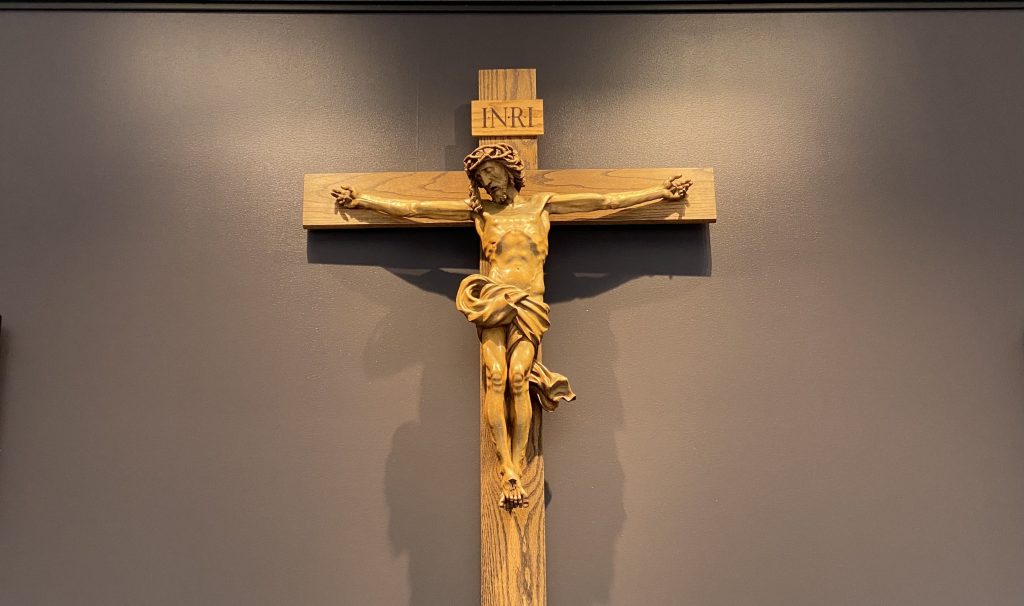
Jesus understands each of our struggles and tribulations, our sins and our failings, as well as our deepest hopes and dreams. Jesus also knows about our deepest fear of death, for he, as a human being, experienced it too in the Garden of Gethsemane. The gift of the crucifix, the sacramental object of Jesus on the Cross, is a reminder of the reality of death while at the same time that death does not have the final answer, Jesus, fully human and fully divine, does.


Photo: Crucifix outside the dining hall at University of St. Mary of the Lake.

Link for the Mass readings for Monday, August 11, 2025

Our Father is pleased to give us the kingdom.

We live in a fallen world where suffering, violence, hatred, anxiety, and fear abound and this reality does not appear to be getting better any time soon. Yet, there is still cause for hope. Jesus says in the opening of today’s Gospel: “Do not be afraid any longer, little flock, for your Father is pleased to give you the kingdom” (Luke 12:32).

Unfortunately, far too many do not find comfort in these words. A common complaint is “Well, Jesus said these words some two thousand years ago, I do not see any kingdom, and not only has this world not gotten any better, but it also seems to be getting worse!” To say or buy into this perspective is to miss what God’s kingdom is.

The first words that we have recorded from the beginning of the ministry of Jesus were, “This is the time of fulfillment. The kingdom of God is at hand. Repent, and believe in the Gospel” (Mk 1:15). What Jesus said then and is saying to us now is that the kingdom of God is about a relationship and a relationship happens person to person and builds slowly over time.

Jesus came to restore the relationship that has been lost with his Father. We live in a fallen world because most of us have forgotten who we are – children of God. Instead of our primary focus being the building and strengthening our relationship with God, we are distracted, diverted, tempted, and led astray by so many other material pursuits and voices. We put ourselves first. We are the priority instead of God and each other. There is suffering, pain, and deep hunger in the world because too many are selfish and self-centered.

The “little flock” that Jesus is offering the kingdom of God to is the disciples who are willing not only to hear his word but those who are willing to receive and put God’s will into action and practice. Because the Apostles did just that, we can do the same today, but each of us have to make our choice about who we are going to follow and which voice we are going to listen to. Our Father is pleased to offer us the kingdom, relationship with him. Will we receive this gift and seek that which is above, or choose to be diverted and entranced by the things here below that only wither and fade?


Photo: God was willing to come close to us through his Son. Are we willing to come close to Jesus to know his Father and be a part of his kingdom?

Link for the Mass readings for Sunday, August 10, 2025

Be still, and allow the Holy Spirit to burn!

Then the disciples approached Jesus in private and said, “Why could we not drive it out?” He said to them, “Because of your little faith.” (Mt 17:19-20).

How do the disciples get from this recurring theme of having little faith in the Gospel accounts to Peter healing a crippled beggar by saying with boldness, “I have neither silver nor gold, but what I do have I give you: in the name of Jesus Christ the Nazorean, [rise and] walk” (Acts 3:6)? And the man did just that!

A helpful definition “is to say that faith always entails a relationship between persons which stands or falls with the credibility of the person who is believed” (Rahner and Vorgrimler 1965, 164). Faith is not just an intellectual exercise, it is a lived experience. Christian faith is the conviction, belief, and relationship experienced with Jesus the Christ. The disciples learned from Jesus but more importantly developed an intimate relationship with him, such that the love they received and shared became so strong that there was no more room for doubt, distraction and/or fear, such that they would align themselves with the will of God and do what Jesus did.

The disciples did have some moments of doing as Jesus had done, but it was not until Jesus ascended and the Holy Spirit descended upon them at Pentecost that everything changed. Jesus had tilled the soil, he helped to unearth the rocks of the hardness of their hearts, he forgave them, and healed them. But it was not until they let him go after his Ascension that they were able to receive the Holy Spirit and by his power working through them they would do even greater deeds than he (cf. Jn 14:12-14)!

We are invited to do the same. If we only read the Gospels or hear them read we may know something about Jesus, but our life will for the most part remain unchanged. When we read, meditate, and pray with the Gospels and put into practice what we read, we will encounter Jesus as did his disciples. We too will come to know and develop a relationship with Jesus and our hearts and minds will be transformed by him. In this way, we are not just reading a dead letter but encountering the living Word, the Son of God, who invites us to share in the infinite dance of Love that he participates in with God the Father and God the Holy Spirit.

The enemy will do everything in his power to distract, divert, and tempt us from setting aside time to pray with God each day. And when we actually begin to discipline ourselves, enter into quiet time daily, we are invited not to stay there but to go deeper, to move beyond only reading, meditating, and praying. There will be times Jesus invites us to set aside our Bible, notes, journal, prayer cards, and/or vocal prayers of petition, and to just be still, to listen, and receive the love that Jesus and the Father experience, the Holy Spirit.

The same Holy Spirit who empowered the Apostles to fulfill what Jesus had begun with them is quietly nudging us on each day. Please listen! He is inviting us to see more clearly those subtle ways we are being distracted, tempted, and diverted from his guidance and what has been inhibiting the growth of our relationship with God. The love and light of the Holy Spirit will reveal, when we are willing to remain still, where and how, in minute and massive ways, we are refusing to follow the will of God.

One of the reasons that we have “little faith” is that we rely too much on ourselves. We are invited to stand in the presence of the Holy Spirit and let his fire burn, to purify us from our own misguided thoughts of self sufficiency. As gold and silver is placed in a crucible and heated, the dross is purified. We are purified in the crucible of our meditation, prayer, and contemplation by the love of the Holy Spirit. Through this purifying light we will see that we cannot save ourselves, that we need a savior, Jesus, with his arms wide open ready, willing, and able to forgive us and love us unconditionally and continually.

———————————————————————–

Photo:  A moment of stillness and purification back in December.

Rahner, Karl and Vorgrimler, Herbert. Theological Dictionary. New York: Herder and Herder, 1965.

Link for the Mass readings for Saturday, August 9, 2025

Denying ourselves, taking up his cross and following Jesus, leads us to greater intimacy and freedom.

Jesus said to his disciples, “Whoever wishes to come after me must deny himself, take up his cross, and follow me” (Mt 16:24).

Jesus invites us to deny our self-centered default position which places I, me, and mine (As George Harrison sang) at the center of each of our decisions. We can deny ourselves when we resist making excuses for our sins and come to a genuine place of sorrow for the pain we have caused God, ourselves, and others. By acknowledging our sins and confessing them, we die to our selfish ways, and then we rise again through the power of Christ. Empowered by our humility and the strength of Jesus we are better equipped to resist those temptations in the future.

We are also in a better position to then take up our cross, which is to follow the will of God. Jesus showed us the proper orientation of surrender when he said at Gethsemane: “Father, if you are willing, take this cup away from me; still, not my will but yours be done” (Lk 22:42). Jesus followed his Father’s will to the cross and endured horrific suffering, excruciating pain, humiliation, and abandonment, unto death… while doing so, gave him the opportunity to conquer death and become the first born of the new creation!

Many a mother I have talked with has shared the struggles of labor, but also expressed the joy of giving birth; many students who I taught were exasperated by the time and effort expended for an examination, a sporting event, art show, musical or theatrical performance and yet experienced the joy from the feat they accomplished; and how many times have we faced a challenge, trial, or cleared some obstacle and felt the exhilaration of overcoming the hurdle?

Taking up our cross and following the will of God means accepting a disciplined approach to our lives. When we follow God’s will, as opposed to our own apart from God, the difference is that we are not alone in our persistent effort. Seeking God’s will in the midst of our discernment and trials for our everyday physical as well as spiritual pursuits is the key.

In my mid-twenties, I entered the Franciscan Friars of Holy Name Province to study for the priesthood. In the year and a half of discernment, from time to time I would imagine my ordination day. To my surprise, I did not feel any joy. I enjoyed every aspect of my experience with the friars and the ministries but there was something or someone missing. I took a leave of absence and about a year and a half later, I realized what was missing was a family.

About two years later I met JoAnn, and her three children, Mia, Jack, and Christy. Six months after that we were married and seventeen years later, I was ordained to the permanent diaconate. This is the short version of the story. There were bumpy moments as we learned to grow together by being willing to see each other’s point of view, some perspectives took a little longer than others, and we were at our best when we were willing to sacrifice for and serve one another.

Our greatest challenge came almost six years ago when we experienced JoAnn’s final weeks this side of heaven. From the beginning of JoAnn’s diagnosis of pancreatic cancer. This cross was the heaviest to bear, yet Jesus shouldered it with us and blessed us richly in our surrender. I am truly grateful for those final months that we had together.

When the realization that JoAnn wasn’t coming back finally sank in about a year and a half later, I decided I needed to learn to live again without her. I followed JoAnn’s advice to put all options on the table and over some months whittled eight choices down to two. Standing in our bedroom, I pondered whether to leave teaching for a year and collapse or pursue the priesthood.  I then asked God, “What do you want me to do?” A quiet voice within confirmed, priesthood. My body sank but my spirit soared.

I would be accepted into the seminary to study for the priesthood and with the support of some great people and the strength of the Holy Spirit guiding and carrying me, I made it through to my ordination day. This time I anticipated ordination with joy, but there was a lingering feeling that I was betraying JoAnn by going ahead and living my life without her. We need to be careful what voices we listen to! The Father of lies seeks to wreak havoc but the Holy Spirit invites us to experience freedom, healing, and wholeness.

Some of the doubt lingered into my ordination Mass, until the moment when each priest walked by, placed their hands on our heads while each remained silent. About half way through the progress, one priest leaned close and whispered, “Your wife has the best seat in the house.” The tears began to flow and purify the lies. During the Eucharistic Rite, for a moment, I felt JoAnn with me, helping to realize that I was actually celebrating my first Mass as a priest, concelebrating with our bishop.

A few months later, I realized that I could be happy again. I was not happy JoAnn had died (which enemy fed me), I was happy because I was following the will of God. JoAnn told me that I would be sad but not to stay there and that she would be closest to me when I was doing that which made me happy. I have also come to realize that during the Mass, because of the presence with Jesus, the veil between heaven and earth is so thin.

When Jesus calls us to “deny ourselves”, he is talking about denying those attachments and disordered affections that we have to things and people, which is anything and anyone we place before God. When we are willing to surrender all and follow Jesus, allow the purifying fire of the love of Holy Spirit to burn the dross of our sin, attachments, and apparent goods away, we will experience the love and intimacy with God we have been created for, and experience a freedom we never thought possible.


Photo: Blessed and filled with joy to be serving in the priesthood of Jesus Christ.

Link for the Mass readings for Friday, August, 8, 2025

Jesus has our back in our successes as well as our failures.

Peter shows, as he did when he walked on and then sank in the water, how our faith journey can be compared to a rollercoaster ride of ups and downs, sometimes more intense than others. As expressed time and again in the Gospels, Peter provides examples of taking a step forward and two steps back.

In today’s Gospel from Matthew, Peter still called Simon at this time, exemplified this balancing act of our growth process as he first answered Jesus’ question as to who Jesus was when he stated, “You are the Christ, the Son of the living God” (Matthew 16:16). Jesus not only commended Simon for being open to sharing this revelation given to him by God the Father, but also added, “And so I say to you, you are Peter, and upon this rock I will build my Church, and the gates of the netherworld shall not prevail against it” (Matthew 16:17-18).

Name changes in the Bible were common when there was a significant change in one’s life. We can see evidence of this in the examples of Abram, changing his name to Abraham, Sarai to Sarah, and Jacob to Israel, just to name a few. Without a doubt, this event was a significant giant step forward for Simon Peter!

Yet, just as Peter reached the heights of theological insight he would just as quickly come crashing down again as he cut his teacher off. Jesus began to share with his disciples about how he would suffer, be killed, and rise again on the third day when, Peter took Jesus aside and began to rebuke him, “God forbid, Lord! No such thing shall ever happen to you.” He turned and said to Peter, “Get behind me, Satan! You are an obstacle to me. You are thinking not as God does, but as human beings do” (Matthew 16:22-23).

From being called the rock upon which Jesus would build his Church in one instant, to Satan in the next, Peter’s experiences offer some solace for us who are on our own faith journeys. Peter apprenticed with Jesus and as in any learning experience, he made mistakes. We need to realize that in our spiritual life this is going to happen to us as well.

We will have days when we feel the joy of the Holy Spirit filling our soul, and yet in the next instant, we may feel empty. We may have clear discernment and direction and then feel indecisive and confused. Some days we discern well our loving God and Father’s voice and some moments we choose to follow the Father of Lies. Some days our prayer is fruitful and we feel energized and other days we may experience dryness and that we are just going through the motions.

Jesus’ admonition of Peter to get behind him was not the end of the story. In fact, it would get worse when Peter gave into his fear and denied Jesus three times! Peter persisted and Jesus did not give up on him. After his resurrection, Jesus asked Peter three times if Peter loved him, and three times, the third a bit exasperated, Peter said yes, undoing the travesty of his denials. After the Ascension of Jesus, Peter lead the early Church and gave the ultimate witness and measure of his spiritual growth and maturity by giving his life.

We too will have fits and starts along the way, but the key is to remain faithful to God and the Way he guides us to walk. We are to continue to dust ourselves off when we have fallen down and be willing to learn from our mistakes, to repent, be forgiven, to seek the help and support of Jesus and one another, and be willing to begin again. The Good News for us today, is that Jesus does not define us by our mistakes or our worst moments. He does not give up on us. He loves us and continues to hold out his hand to us, to lead us onward!


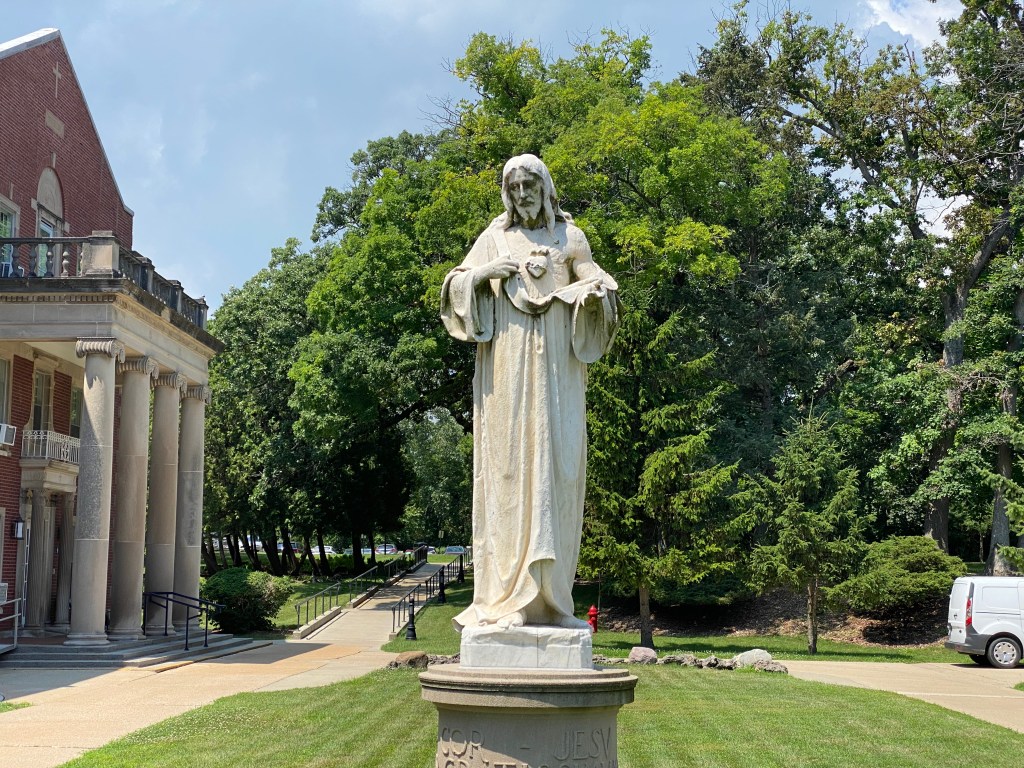
Photo: A great compass to access as we journey is to ask, “Is our heart beating with the same rhythm as Jesus’ Sacred Heart?”

Link for the Mass readings for Thursday, August 7, 2025

Prayer helps us to restore our likeness to God.

He took Peter, John, and James, and went up the mountain to pray (Luke 9:28).

Peter, John, and James experienced Jesus’ profound teachings, his powerful signs, his wonders, and they also witnessed his healings, casting out demons, and forgiving of sins, which, alluded to the reality that he was the Son of God. Peter, James, and John, although acknowledging Jesus as the Messiah, still pretty much looked at Jesus as a human being. In the encounter of Jesus transfigured, Jesus revealed to his inner circle of Apostles not only a foretaste of what was to come in heaven but a glimpse of his actual divinity.

Jesus is not 50% God and 50% human. He is fully God and fully man. This is the Mystery of the Incarnation; the reality that the second Person of the Trinity took on flesh and became human. This is an important reality, because in this very act of Infinite Grace, the Son of God assuming humanity, Jesus, Emmanuel, God with us, as St. Irenaeus wrote, “opened up heaven for us in the humanity he assumed.” The Son of God became one with us in our fallen and sinful state so that we can become one with him. Through participation in the life of Jesus Christ, we can be restored and deepen our relationship with his Father, and we too can be transformed.

“By revealing himself God wishes to make [us] capable of responding to him, and of knowing him, and of loving him far beyond [our] own natural capacity” (Catechism of the Catholic Church 1997, 52). This reality of the invitation of communion with the Loving God and Father of all creation is for all. Authentic joy and fulfillment are achieved through developing a relationship with the God of Jesus Christ.

Many may say they are happy and living a good life without having a relationship with Jesus Christ, the do not need God or his Church, and I would not disagree with them. I would only add that if we are honest with ourselves, there is more to life than the mere material and finite reality we see and what experience with our senses. When we slow down enough, when we are actually still enough, we can experience a deeper yearning for more, and begin to see what is keeping us from the deeper reality Jesus is offering.

Even with great achievement, mastery, honor, and accumulation, there is still a lingering question, “Is this all there is?” We experience consciously or unconsciously a restlessness, we continually search to fill this unease, feeling satisfied for the moment, but eventually in short order, we are left empty, time and time again. This unease is our soul’s yearning, our transcendent nature longing for more, and that longing is for the infinite that the finite cannot provide. St Augustine of Hippo articulated this desire and yearning so well in the opening chapter of his autobiography, Confessions: “You move us to delight in praising You; for You have made us for Yourself, and our hearts are restless until they find rest in You.”

The Feast of the Transfiguration is an invitation to embrace the fullness of what it means to be human, as the Son of God did through the Mystery of his becoming one with us, all of us, all of humanity, not just a select few. We are invited to embrace the fullness and rich diversity of our humanity; the reality that we are physical, emotional, intellectual, while at the same time, spiritual beings. Our fulfillment and joy come from a balance of nurturing the reality that each and every one of us have been created in the image and likeness of God.

Peter, John, and James, as well as each of the saints, embraced the invitation of Jesus and were healed. The likeness to God that was lost in the fall of Adam and Eve was restored through their lives of prayer, service, and growing in relationship with Jesus. We can see the restoration of the likeness through such biblical imagery as Moses’ face which radiated after his intimate encounters with God and in the transfiguration of Jesus with not just his face but his whole being.

Setting time away with God daily to speak with him, listen, as well as follow the guidance of God will help us to grow in holiness and restore our likeness as well. Our hearts and minds and souls will be expanded and transformed such that we will experience the fullness of our humanity, be purified and perfected by our Father’s divinity. We will also embrace the gift of our common dignity and love others as we are loved.
———————————————————————–

Photo: “The person who prays begins to see.” From Pope Benedict XVI accessed from The Gospel of Luke by Pablo T. Gadenz.

Link for the Mass readings for Wednesday, August 6, 2025

“Take courage, it is I; do not be afraid… Come.”

“It is a ghost,” they said, and they cried out in fear. At once Jesus spoke to them, “Take courage, it is I; do not be afraid.” Peter said to him in reply, “Lord, if it is you, command me to come to you on the water.” He said, “Come.” Peter got out of the boat and began to walk on the water toward Jesus. (Mt 14:26-29).

This is one of my favorite Gospel stories. I never tire of reading, praying and meditating with it. And for those times of contemplation, I am blessed with consolations from the Lord. Yes, Peter quickly started to sink, but for that brief moment… he “began to walk on the water toward Jesus.”

Life is a struggle. Challenges, fears, trials, and conflicts pound at us like turbulent waves kicked up by strong winds. We may be tempted to be paralyzed by indecisiveness and begin to sink because of the weight of the pounding. Yet, when we trust in and keep our eyes on Jesus, who is present in the midst of our storms, we will overcome.

In many a top ten list of fears, I would guarantee that speaking in public consistently makes the top three. This is an area I have struggled with on and off again over the years. One incident happened about thirteen years ago as I had the opportunity to share my first reflection during my acolyte year of formation for the permanent diaconate. I must have prepared for three to five hours, writing and rewriting well into the wee hours of the morning the night before. Just before the morning liturgy, our director of formation informed me that there had been a last-minute change of plans and we were going to have different readings than I had prepared for. He offered to give the reflection in my place, as well as gave me the option to continue and incorporate what I had planned into the new readings.

I chose to remain on course and offer the reflection. As we processed in, I immediately regretted my choice. The winds and waves of anxiety started to batter me and continued their assault as I came up to read the Gospel. As I came to the end of the reading, a quiet peace settled over me. I then began to preach extemporaneously, ignoring my notes. There was an unexplainable feeling of joy that welled up within me, and like Peter, for that brief moment, it was as if, I too was walking on water. Halfway through the reflection though, my mind directed me back to my prepared notes, and I lost the connection that I had just experienced. I sputtered a bit to the end but finished free of any major catastrophe.

After the service ended, I remained in my seat quietly for a second to catch my breath. My classmates Dennis, Hank, and Pete, who all knew how nervous I was going into this, swarmed around me like I had just touched home plate after a walk-off home run. I can still feel Pete’s bear hug.

JoAnn had appendicitis during her first-grade year of school. She missed a lot of her reading lessons but worse became very self-conscious from that time forward about reading aloud. During our husband/wife retreats each year, wives were given the opportunity to read during the Liturgy of the Hours and Mass. JoAnn did not feel comfortable nor did she want to do so but accepted the invitation. We prepared, she practiced ahead of time, and then she prayed to the Holy Spirit just as she approached the ambo. JoAnn felt very nervous but as she began to read, she felt this deep sense of peace fill her whole body. She was no longer fighting back nerves but tears of joy at God’s presence.

There will be times when Jesus invites us to come out of our boat and step onto the water, he will call us to move out of our comfort zone. May we trust him and step out as Peter did. This will be a risk, and yes, there will be times that we will sink, just as Peter had done. But even though he sank, he immediately remembered to call out and Jesus immediately reached out and pulled him up. Jesus was there for Peter, he has been there for JoAnn and me, and he will be there for you.

“Times of testing and adversity can show us where we are in our spiritual development and where we need to improve if we are to grow in Christian maturity” (Mitch and Sri). Whether we fail or succeed is not the end goal. It is that we grow in our faith and trust in Jesus, so we can learn from our mistakes, turn away from the distractions, diversions, anxieties, and fears that we may experience and keep our eyes on Jesus!

There may be something that you have been feeling led or encouraged to attempt, to start, to do, yet mental winds and waves have been rocking the stability of your boat.  “Be not afraid! Come.” Step out of your boat, take the risk, keep your eyes on Jesus, and walk on the water!
———————————————————————–

Painting: Walking on Water by Ivan Aivazovsky

Mitch, Curtis and Edward Sri. The Gospel of Matthew. Grand Rapids, MI: Baker Academic, 2010.

Link for the Mass readings for Tuesday, August 5, 2025

Withdraw with Jesus for a while.

When Jesus heard of the death of John the Baptist, he withdrew in a boat to a deserted place by himself (Mt 14:13).

This is not the first time nor the last time that Jesus withdrew to a deserted place. Unfortunately, his effort for some alone time ended abruptly, for when he got off the boat he was immediately met by many seeking him. Jesus was not put off nor did he roll his eyes at this interruption for time to rest.

Making time for quiet may seem like a waste of time, just a simple act, but it is one that is imperative. As busy a Jesus was, Jesus made time to pray. Though the “deserted place” was full of people by the time his boat reached the shore, he did have some quiet, alone time on the boat before he disembarked. Sometimes in busy moments, even just a few minutes of intentional rest can make a difference. Jesus showed no frustration for having his plans interrupted, instead, his “heart was moved with pity for them” (Mt 13:14).

Often we lose our patience when we are interrupted. When we are cut off or cut short by someone else we may react in a negative way internally and/or externally. Most of the time our hearts are not moved with pity nor do we show compassion for those who may consciously or unconsciously come to us in need.

If we find that we are constantly impatient, short with others, one reason could be that we do not give ourselves time to stop and be still, we do not make time to pray, meditate, or contemplate. We do not sit for a few moments and just breathe. Sometimes when we need to wind down and renew, we choose activities that actually do the opposite. Instead of resting and renewing our minds, bodies, and souls, surfing channels on television, going down rabbit holes on the internet, or watching reels and scrolling through social media for a few minutes will not only turn into a few hours, but we feel more worn out than when we began.

This happens because the video stimulation is not relaxing but actually hyper stimulating our central nervous systems. Especially with social media, once we enter those clips, algorithms go in place and hook into similar viewing sites which activates dopamine hits that get us hooked to engage in more viewing, much more than intended. Again, instead of experience the rest we desperately sought, we feel more wired.

And we then wonder why sleep takes a while and why we get stuck in repeating the same pattern. We just keep moving ahead, on the phone, on our apps, on the computer, working, studying, interacting with others, completing this activity believing that once we finish we will be all caught up. Hyped up on caffeine to keep up the pace we have set, and then needing wine or a drink or two to wind down, we then wonder why we are consistently anxious or on edge, if we are even aware that we are actually in a state of chronic stress, and that may even be when things are going well!

Jesus needed some downtime, and in today’s Gospel, we read that he did not get the amount of time he set out to have, yet he did get a brief respite on the boat before he reached the shore. When he saw the people he did not whisper to himself, “Oh no, here they come again.” He instead was moved in depth of his gut with compassion to serve their needs and he went on to perform an incredible miracle of feeding thousands with only a five loaves of bread and a few fish.

When we turn to Jesus for our rest, renewal, and nourishment, he provides to overflowing. Turning away from the modern temptations of perpetual motion and breathing to be still and sit at Jesus’ feet allows us to enter into his rest. We can trust Jesus and seek his guidance, and allow him to do in us his Father’s will so that we can stop doing, and even if only for a few minutes, just be.

From this place of rest, we can think more clearly, make healthier decisions, and resist the impulsive, reactive, and immediate gratification choices. We can realize what we truly need in the moment. Instead of another handful of chips – a glass of water, because we are actually not hungry but thirsty. Instead of checking emails, we can take a twenty minute nap and reset our mind. Instead of scrolling, surfing, and reeling, we can pull our Bible off the shelf, take a few deep breaths, and read this Gospel account, imagine getting into the boat with Jesus, withdraw to a deserted place for a while, and truly wind down. Giving ourselves at least an hour away from technology before going to sleep, we may find we not only fall asleep quicker but sleep more soundly.


Photo: Evening Rosary walk at University of Saint Mary of the Lake.

Link for the Mass readings for Monday, August 4, 2025

Where, in what, or with whom do we place our trust?

Jesus said to the crowds, “Take care to guard against all greed, for though one may be rich, one’s life does not consist of possessions” (Lk 12:15). Jesus is responding to the man in the crowd who asked him to be an arbitrator between him and his brother. The brother was concerned that he would not get his fair share, or any share, from the inheritance.

Jesus is offering the man a healthier orientation and perspective, which is to help him to see what is most important in life. Jesus knows the scriptural stories of conflicts between brothers, such as Cain and Abel, Esau and Jacob, Joseph and his eleven brothers. Jesus knew his own culture and interactions of the people of his time. He knew that conflicts over inheritance could quickly escalate into blood feuds and even death.

Jesus is helping the man in today’s Gospel, his disciples, as well as those listening to him then and us today to see that what is primary and important is relationships, not wealth. First and foremost, our relationship with God is the most important. One’s life does not consist in possessions, and this ought not to be our pursuit and primary focus in life. Wealth and material goods are fleeting, they do not last. We will always seek the newest, updated model of this or that, we will become bored quickly and want more and more. Ultimately, we will not be fulfilled, because we have been created for so much more.

We have been created to be in relationship with God and each other. We have been made to worship, and if we do not worship God, we will worship something or someone else. If it has been awhile, return to reading the Book of Exodus and see what happened when Moses was away from the Israelites for only forty days (see Exodus 32). Too many of us idolize wealth or seek it as security. Dr. Matt Nelson, author, apologist, and assistant director of the Word on Fire Institute has written that: “Sanity begins with the realization that God does not need us to worship him, we need to worship God. Worship cultivates peace in the soul of the deepest and most lasting kind. When we worship we rest. It is thus the essential human activity, the first of all first things and the secret to real and lasting happiness.”

The parable that Jesus shared about the rich man with his bountiful harvest brings the point home that God and the things of heaven are more important than the things of this world which will not last. The man in the parable constantly thinks of only himself, not what does God want me to do with this bountiful harvest. He is wrapped up in – I, me, and mine. Jesus’ listeners would have recognized in Jesus’ telling another person who stored up vast amounts of grain, Joseph who “collected grain like the sands of the sea, so much at last he stopped measuring it, for it was beyond measure” (Genesis 41:49).

The difference between the man in the parable and Joseph was that the man was storing up grain for himself alone, and not thinking of anyone else in need. Joseph stored up grain beyond this man’s wildest dreams and was doing so because God let him know that the seven years of prosperity would end and would be followed seven years of dire poverty. Joseph was saving the grain to save the nation and those in need. The man was following his own self interest, Joseph was following the will of God.

Let us meditate on the words that Jesus offers us today, “Take care to guard against all greed, for though one may be rich, one’s life does not consist of possessions.” What is more important to us, our things or God and the people in our lives? Do we place our security in wealth or God? Do we want apparent, temporary happiness or real, lasting meaning and fulfillment? All that we have is a gift from God. What prevents us from sharing with others in need from that which we have received? How we ponder and answer these questions will have an impact on the peace and happiness in our lives now and in the life to come.


Painting: I have found more peace and rest in following the guidance of Jesus. Photo of the painting of Jesus I took in the chapel at The University of St. Mary of the Lake.

Nelson, Matt. Just Whatever: How To Help the Spiritually Indifferent Find Beliefs That Really Matter. El Cajon, CA: Catholic Answers, 2018.

Link for the Mass readings for Sunday, August 3, 2025