“O woman, great is your faith.”

[A] Canaanite woman of that district came and called out, “Have pity on me, Lord, Son of David! My daughter is tormented by a demon” (Mt 15:22).

In Jesus’ encounter with the Canaanite woman, Jesus revealed through three responses, some of the darker sides of our fallen, human nature. In his fourth response, he also identified the way to resist these three sinful tendencies.

When the Canaanite woman called out to the Son of David to have pity on her, Jesus first responded with silence. His silence can represent the indifference we feel toward those not like us. We ignore their very presence as if they don’t exist. In the early nineties, while I was in the novitiate with the Franciscans of Holy Name Province, we toured an impoverished inner-city area in Philadelphia. One of the local friars pointed up to the elevated tracks as the commuter train headed past us toward the heart of the city. He shared how the majority of those commuting had no idea of the need, pain, and struggles of those down here below, like the homeless mother and her three young children that I had met that day. Are we aware of those in need around us, or do we ride our own Elevated Train of Indifference?

We can look upon or past people with indifference, but we can also look upon them with disdain or fear. This woman was in dire need and seeking healing for her daughter. She was also a Canaanite. To the ancient Jews she was not only one of the people they considered an enemy in war, but in cultural practices. Canaanites were believed to be immersed in idolatry, immorality, and even committing egregious acts of sacrificing their children.

The disciples approached Jesus and asked that he send the woman away. Was it because they considered her a pest, unclean, a pagan, not one of them… Yet, Jesus did not dismiss her. He replied: “I was sent only to the lost sheep of the house of Israel” (Mt 15:24). Jesus’ response can represent the dangers of tribalism and nationalism, and how it can taint our perception regarding how we perceive those that are outside of our group. Those we consider as not one of us. The danger is that this perspective can grow such that we see others as less than human.

A Lakota elder, Fire Hawk, who became family to me in my early twenties shared how in his youth, he thought about being a priest. He voiced his interest and was told that it was not possible because he was Indian, and after receiving one too many baths in which he was scrubbed down in bleach and water, to wash the red out, he gave up on the idea. Do we dismiss those in need around us, do we not help, or worse crush their dreams because someone has a different national, religious, political, racial, ethnic, or gender identity?

The woman was not deterred, increased her boldness, and walked directly up to Jesus and did him homage. She may have at that point knelt or prostrated herself before and asked him directly for help. Jesus still not only appeared unmoved, but appeared to ratchet up his own uncharacteristic response: “It is not right to take the food of the children and throw it to the dogs” (Mt 15:26). This derogatory statement has been hurled at people who have been different for eons. Jesus’ third response can reveal the power of our words and symbols that we use to belittle, demean, and dehumanize. When we place labels on others and begin to believe them, when we think we are superior, we begin to see others as caricatures, as less than human.

Not only do we refuse to help but we also make people, fellow human beings, into an enemy that must be put in their place. On April 18, 2015, I was living in Palm Beach Gardens, Florida. In the next town north of us in Jupiter, three white teens were out “Guat-hunting”, their phrase, looking for Guatemalans to rob. That night they found a Guatemalan young man, 18-year-old Onesimo Marcelino Lopez-Ramos, a son and brother. After their encounter, Onesimo was bludgeoned to death with a rock. Onesimo was heading home from working extra hours. When we allow our thoughts to be poisoned, our words will then be laced with venom, and then our actions can become deadly. Are we aware that our attitudes, our words, and our actions matter?

The Canaanite woman retorted, “Please, Lord, for even the dogs eat the scraps that fall from the table of their masters.” Jesus’ responded: “O Woman, great is your faith” (Mt 15:28)! This final statement can reveal to us that there is an antidote to indifference, fear, disdain, tribalism, and dehumanization and that is the love expressed by the Canaanite woman for her daughter. She crossed social boundaries, side-stepped indifference, refused to be sent away, risked ridicule, and possible abuse and death because she would not be denied until her daughter was healed. She did not get defensive, did not fight back, because she did not think of herself. She thought only of the welfare of her daughter.

Jesus in his interaction with the Canaanite woman was teaching his disciples and us today a profound lesson by allowing himself to be a mirror. His first response was silence. Those around him were given the opportunity to experience their thoughts about who this woman was to them. When the disciples asked Jesus to send her away, they were revealing something of what they were thinking.

His second response that he was sent “to the lost sheep of Israel” was true. Jesus truly was sent to unite the lost tribes of Israel and unite his people, which was one of the roles of the Messiah. He also knew about the first reading for today about how foreigners who became faithful to God and were willing to follow him would be received in love and welcomed to stay in God’s “house of prayer for all peoples” (Isaiah 56:7). Jesus provides the foretaste of that universal fulfillment in this and other encounters with those outside the house of Israel.

His third and most derogatory statement toward this woman who was now honoring him as her Lord, even when Jesus called her a dog, revealed the worst of our fallen natures. Could the disciples, who he had hand picked, who he had been modeling ways of love and compassion, the same ones who were asking to send her away, now be turning into a hurtful mob at these words? If so, they would receive an incredible whip lash. She was not deterred by the degrading, she remained resolute, and replied not in kind, but with one of the greatest one liners of the Bible. “Please, Lord, for even the dogs eat the scraps that fall from the table of their masters.”

Were the disciples ready to pick up rocks or were their hearts finally moved to compassion? Jesus responded: “O Woman, great is your faith” (Mt 15:28). This Canaanite woman full of courage from the love of her daughter stood toe to toe with Jesus and represented the height of the faith that Isaiah was prophesying. Jesus mirrored the fallen and dark side of our human nature. Who modeled love in the face of silence, determent, and degradation? The Canaanite woman.

What does this encounter between this woman and Jesus say to us today? We are to see each other as interconnected, as human beings. What befalls one of us befalls us all. We are sacred beings created in God’s image and likeness, we are all created by the same loving God and Father. Jesus demands that we meet darkness with light, hate with love, and that in everyone we encounter, we engage them with that same love and mercy he bestows upon us. We are to will the good of the other as other, no matter who they are. We are to choose faith, hope, and the greatest of these, love, as the light that guides how we experience one another, especially those who are hurting in our midst.

It is not enough to believe in and receive Jesus, truly present in the Eucharist. If we truly believe we receive him then we need to allow him into the darkest, most wounded areas of our souls where our biases and prejudices dwell.  We also must have eyes that are willing to see him present in others. May we allow our thoughts, words, and actions go through the filter of the love of the Holy Spirit. Before we think, speak, or act, let us breathe, receive, rest, and abide in God’s love and then choose to dismiss or continue that thought, word, or action. From this posture, our places of worship, gathering, and homes, in the words of Isaiah, will “be called a house of prayer for all peoples.”


Painting: “Christ and the Canaanite Woman” by Jean-Germaine Drouais

Link for the Mass readings for Sunday, August, 16, 2026

Mary was “preserved immune from the corruption of the tomb” – Pope Pius XII

There was no one on this earth closer to Jesus than Mary. He was conceived in her womb, she bore him, nursed him, raised him, initiated his public ministry, held him in her arms as he was taken down from the cross, and she was with the Apostles in the upper room when the Holy Spirit descended upon them. Mary from her own beginning, received an incredible grace from God and thus was given the title Immaculate Conception. Even with all that what allowed Mary to experience more intimacy with Jesus was that she “heard the word of God and put it into practice” (Luke 11:28). When her time came to leave this life, who better than Mary to have experienced the “singular participation in her Son’s resurrection and an anticipation of the resurrection of other Christians” (Catechism of the Catholic Church 1997, 966)?

Today we celebrate the official dogmatic constitution issued by Pope Pius XII in 1950, the Assumption of Mary, acknowledging what the Church has recognized from the beginning, the special grace she received from her Son. Jesus is the promise and Mary is the hope that we will live eternally with our heavenly Father. Mary is now where we all hope to one day be, body and soul.

Jesus and Mary have undone the sin of Adam and Eve. They, in their continual faithful life of saying yes to the will of God, opened up heaven for us. In our darkest trials, when the storm clouds of injustice, racism, violence, division, and polarization gather, when a situation or conflict does not appear to be getting any better, when death may be imminent, and/or when a loved one has died, even then, death does not have the last word because we are not alone.

St. Paul wrote to the Church in Corinth, “Christ has been raised from the dead” (1 Corinthians 15:20). Jesus is the first born of the new creation. We are invited to join Jesus in participating in his new Kingdom on earth as it is in heaven, preparing ourselves in this life for eternity in the next. How? By doing what Jesus and Mary did. We are to open our hearts and minds to God, hear and observe his word, and put into practice what we receive.

Mary was not blessed so much because she gave birth to the Son of God, not because he nursed at her breasts, but because she heard the word of God, pondered it in her heart, obeyed, and put it into practice. This is why the Church calls Mary the model of discipleship. Just as the moon does not radiate because of its own light but reflects the light from the Sun, so Mary reflects the light of her Son.

Mary radiates the light of Jesus in her thoughts, words, and deeds and we are to do the same such that when people look at us they no longer see us but the love of Jesus radiating from us. How do we radiate Christ to others? We become deified, our likeness to God is being restored through our participation in the life of Jesus. This happens when we make a daily commitment to meditate, pray, and contemplate the words that God has given to us in Sacred Scripture, so as to allow the Holy Spirit to transform us by the holy fire of his love.

A simple way to begin is to commit to a time and place every day to ponder the mysteries of Jesus as Mary did. One beautiful way is to practice the Rosary which embodies all three of the traditional forms of Catholic prayer, vocal, meditative, and contemplative. You may feel that praying a Rosary in one setting is too much of a task to undertake, then start with one mystery. Make the Sign of the Cross, take in three, deep breathes for each Person of the Trinity, announce the mystery and begin to ponder the mystery you have chosen, slowly.

Ponder the beautiful mystery of the Assumption. The Lord’s Prayer helps to quiet our minds and rest. Each Hail Mary, like background noise in a movie, helps our minds to resist distraction. Even if thoughts come, bring them to Mary and Jesus and share with them. If we remain focused with them, we are still praying. As our mind stills, we can stop the vocal part of the prayer and just imagine Mary’s final hours, maybe with the Apostle John by her side. We can imagine ourselves experiencing the peace of not only her passing but of her Assumption into heaven, body and soul. We can contemplatively rest in God’s peace that we have received from our time with Mary and the promise that she is where we hope to one day. We can remember who we are, beloved daughters and sons of our loving God and Father.


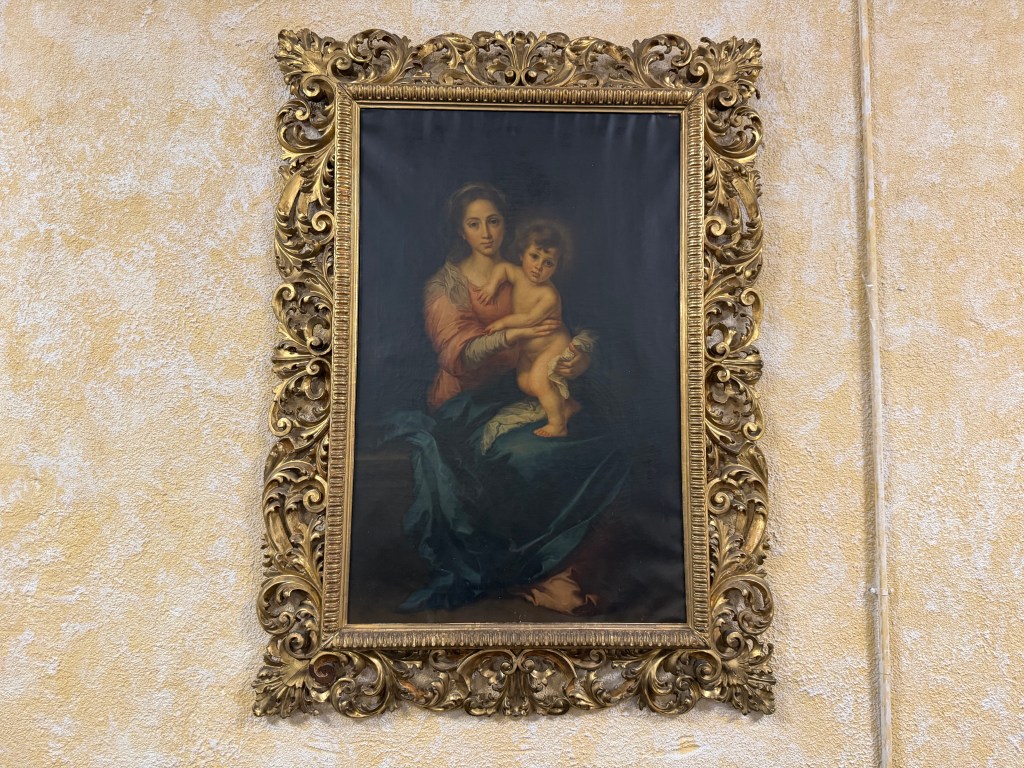
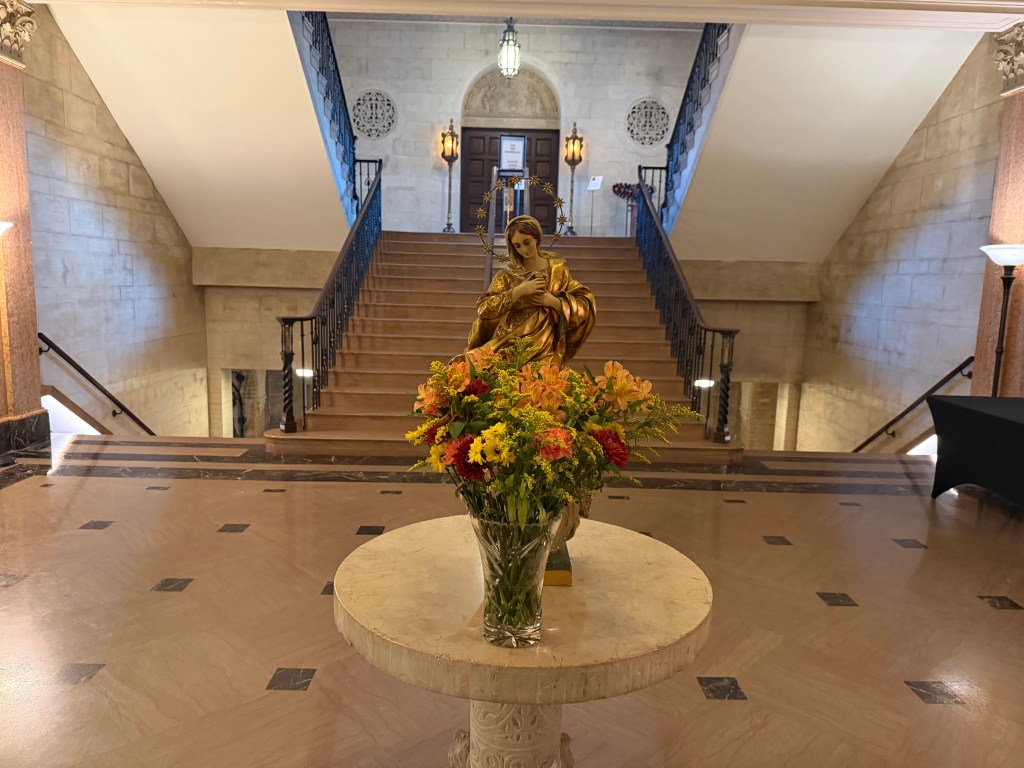
Photo: “… by her Assumption, she goes ahead like her son to prepare a way for us.” – From The World’s First Love, by Fulton J. Sheen.

Link for the Mass readings for Saturday, August 15, 2026

“And the two shall become one flesh.” United by God in covenant.

Some Pharisees approached Jesus, and tested him, saying, “Is it lawful for a man to divorce his wife for any cause whatever” (Mt 19:3)?

The question about divorce came from an already existing debate within Jewish circles of interpretation and schools of thought. Testing Jesus arose from time to time to better understand who he would side with. Regarding the issue of divorce, there was a range of interpretations. On one end of the spectrum, there was the School of Shammai, which permitted divorce only in the event of some sexual misconduct. At the other end, was the School of Hillel, which would allow a man to divorce his wife if she cooked a bad meal (cf. Harrington 2007, 275).

The Pharisees may have sought to understand the perspective of Jesus in this debate or they may have had a more “hostile intent” (Mitch and Sri, 239). Jesus would not be trapped and seized the opportunity to clarify: “Have you not read that from the beginning the Creator made them male and female and said, ‘For this reason a man shall leave his father and mother and be joined to his wife, and the two shall become one flesh'” (Mt 19:4-5)? The implication here from Jesus is that divorce was never intended by God. Jesus also rejected the precept that Moses set for allowing divorce, explaining that, “from the beginning it was not so” (Mt 19:8). Jesus’ defense went back to God’s original intent recorded in the Book of Genesis, which allowed no provision for divorce.

“The definitive teacher on the Torah has just revoked the legal allowance for divorce altogether. Because the one flesh union between husband and wife is an unbreakable union in the eyes of God, it follows that divorce and remarriage are equivalent to adultery (Exodus 20:14). With these words, Jesus makes himself history’s greatest defender of the sanctity and permanence of marriage” (Mitch and Sri, 240).

In God’s plan, marriage is a covenantal relationship, as is the relationship between God and his people as was vividly outlined in the first reading from the prophet Ezekiel, and Jesus and his bride the Church. A covenant is a sacred bond that is not to be broken. “Therefore, what God has joined together, man must not separate.” In the Sacrament of Matrimony, a man and a woman who give themselves freely, for life, to one another and are open to children as the fruit of their union, mirror the Trinitarian communion of the Father and the Son and the eternal love between them, the Holy Spirit.

Yet we live in a fallen world, and we do not often live up to what God has planned. Many marriages do not persist for many reasons, one big reason is that many marry for the wrong reasons and not because God has called them to be together. What they thought was love, may not have been the mature expression of sacrificial love.

There may have been attraction and genuine care, but instead mostly a mixture of ignorance, false premises, and impediments underneath that bore fruit only later. When a relationship breaks down, we need to be present to and walk with those who suffer through the pain of such a rupture. We are not to abandon one another, for Jesus does not abandon us. He instead loves and bestows his mercy upon us, which is his willingness to enter into the chaos of our lives.

Declarations of nullity are not Catholic divorces. An investigation reveals that there was a flaw or flaws from the beginning and thus not a valid, sacramental marriage, although a valid civil marriage. “Couples united in an invalid marriage are not guilty of adultery when they separate and subsequently pursue a lawful marriage” (Mitch and Sri, 242).

We are not to give up on marriage as Jesus’ disciples moaned when saying, “it is better not to marry.” Relationships are not easy, and they take commitment, hard work, and a willingness to sacrifice for one another through everything. When we seek first to establish our foundation with God, then our relationships will be properly ordered. Marriage has a chance when discerned properly, as each person trusts in Jesus and each other.

We need to learn how to pray, to worship, communicate, listen, forgive, be patient and understanding with one another. As we ground our relationships in Jesus, we will heal from the wounds from within, we will grow stronger in our relationships, and be in a better position to help those not only preparing for marriage but also to continue to mentor and guide them during their marriage.

—————————————-

Photo: JoAnn and my hand on my breviary, taken seven years and two days ago. Loving God and each other helped us to respect, heal, mature, and become better together.

Harrington, S.J., Daniel J. The Gospel of Matthew in Sacra Pagina, vol. 1. Edited by Daniel J. Harrington, S.J. Collegeville, MN: Liturgical Press, 2007.

Mitch, Curtis and Edward Sri. The Gospel of Matthew in Catholic Commentary on Sacred Scripture. Edited by Peter S. Williamson and Mary Healy. Grand Rapids, MI: Baker Academic, 2010.

Link for the Mass readings for Friday, August 14, 2026

May we resist reaction and gossip and instead seek understanding and reconciliation.

Gossip is a seductive and enticing poison. Many of us fall for its lure and its intoxication to greater or lesser degrees. There are many different reasons we engage. We may think we feel better about ourselves by pointing out and pontificating about other’s faults true or imagined, we may be jealous, envious because we wish someone ill, maybe someone just rubs us the wrong way, or there is a sense of intimacy with another in the commonality of talking about someone else. We may even feel justified to do so when someone has hurt, offended, or wronged us, or someone close to us, in some way. Even in that instance, Jesus offered a different approach in today’s Gospel.

Jesus said to his disciples: “If your brother sins against you, go and tell him his fault between you and him alone” (Mt 18:15). Jesus is drawing on his Jewish heritage. Leviticus 19:17 warns against holding hate in your heart and instead encourages seeking to reason with your brother. Jesus is redirecting us from disparaging, gossipping, adding fuel to the fire by seeking revenge or stewing in our own hurt, which will build resentment and hate. Instead, he is inviting us to seek reconciliation.

The wisdom of approaching someone with an issue sooner rather than later, also helps to get the issue out of our minds and hopefully provide and opportunity for resolution and reconciliation. By churning the negative over in our minds and talking about it with others exacerbates the issue, distorts it out of proportion, and fuels a greater emotional angst. Doing so also keeps another other, keeps them at a distance, and less human.

Pope Francis, in his September 9, 2016, General Audience was very clear: “[G]ossip is a ‘terrorist’ who throws a grenade – chatter – in order to destroy,” he added. “Please, fight against division, because it is one of the weapons that the devil uses to destroy the local Church and the universal Church.” Let us refuse to be a weapon of the devil in his plot to divide us with our thoughts or our words. Instead, let us seek to be a disciple of Jesus by advocating for forgiveness and reconciliation.

St. Paul guides us to let no evil talk pass our lips and to say only the good things people need to hear (see Ephesians 4:29). May we meditate upon and pray with this verse as well as put it into practice. With our words, we can cut, wound, and destroy, or we can convict, reconcile, and heal. We can commit to being more discerning with our thoughts and tongue, and choose to lift up and empower one another.

Pope Leo XIV encouraged the youth at Rate Field in Chicago last year on June 14: “To share that message of hope with one another – in outreach, in service, in looking for ways to make our world a better place – gives true life to all of us, and is a sign of hope for the whole world.” We can share messages of hope and make our world a better place when we take time for a prayerful pause and discern well what we are going to say before letting the words fly.

Yes, it is easier to grumble about someone than to approach them in love and work for reconciliation. But this only perpetuates division. It is worth the time and energy to be more intentional with our thoughts, words, and actions. When needing to hold another accountable, it is important to do so directly and with respect. It is also helpful to step out of reactive mode, by taking some breaths, seeking the help of the Holy Spirit, and thinking before we speak. If we just aren’t there yet, maybe we can start with a slow breath and a simple smile. We will all be better for the effort.


Photo: For guidance in conflict, let us, “seek what is above where Christ is seated at the right hand of God” (Colossians 3:1).

Link for the Mass readings for Wednesday, August 12, 2026

When we are willing to become like children, we take a few steps closer to the Kingdom of heaven.

“Amen, I say to you, unless you turn and become like children, you will not enter the Kingdom of heaven. Whoever becomes humble like this child is the greatest in the Kingdom of heaven. And whoever receives one child such as this in my name receives me (Mt 18:3-5).

The above response Jesus gave was to the disciple’s question regarding, “Who is the greatest in the Kingdom of heaven.” Jesus offered an unexpected response, as children had no esteem, honor, let alone greatness in the cultural realm of his time. Jesus was also not pointing out so much the innocence of children, but emphasizing that children were completely dependent on others for their very survival.

If we are to embark or stay on the journey that will lead us to the Kingdom of heaven, we need to do the same. Jesus is inviting us to give up our control, our apparent self-sufficiency, and surrender all we are to God and place our dependence on him alone. We are to depend on God as would an infant or young child depends on his or her parents.

Very young children also have not developed a defensive filter and they say what is on their mind, often with precise insights! They also provide good insights about what we say and do in their presence when they mirror us!!! How often do we access our default defense mechanisms by reading and automatically responding, or if we do pause, thinking about how we will be received or fearing an ulterior motive from the question? Jesus taught us that our yes is to be yes, and our no is to be no, and anything more is from the evil one (cf. Mt 5:37). We grow as his disciples when we accept this simplicity.

We grow in humility when we depend on God and place our trust in him. Doing so, we will experience more of the truth and see through our own rationalizations for accepting apparent goods instead of that which is truly good. Having turned away from the false promises and turned toward the truth, we will begin to discern between what St. Ignatius of Loyola calls the competition of goods – choosing between those things that are indeed good and those that align with God’s will for our unique station in life.

Trusting in God and depending completely on him for everything will also make our lives much simpler because we will no longer be chasing after that which is really not helpful or healthy. We will also come to accept that what we have, is a gift from God. Getting in touch daily with what we are grateful for, we will experience more peace and more rest, and as St. Jane de Chantal’s shared: “How blessed is the person who, in tranquility of heart, lovingly maintains the sacred sense of God’s presence! For this person’s union with divine Goodness will continue growing perpetually, though imperceptibly, and will fill her whole spirit with its infinite sweetness…”


Photo: Catching the sunset out of the corner of my eye, followed God’s invitation to sit outside and share my dinner with my Father!

Link for the Mass readings for Tuesday, August 11, 2026

“Take heart, I am.”

“Take courage, it is I, do not be afraid” (Matthew 14:27).

Jesus speaks these words at the fourth watch, sometime between three and six a.m. The disciples are in the middle of the Sea of Galilee, some four miles from shore. He is walking to them in the midst of a storm at sea, on the water. Because of the ferocity of the storm, there most likely is no moon, no stars. It is dark, the wind is howling, the waves are rising and falling, and it is dark – can barely see hand in front of face dark. In the midst of this tumultuous scene, being pelted by rain and waves, deafened by the wind, somehow the disciples see a figure approaching.

That they could see anything implies that some light was emanating from ghostly image. Jesus is assuring them that he is no ghost. He is providing comfort to his band of followers in the midst of their fear. The intensity of the storm may have waned a bit for them to hear Jesus speak. Emboldened by Jesus’ words, Peter then addressed him, “Lord, if it is you, command me to come to the water.” He said, “Come” (Matthew 14:28).

The storm roared again. Peter was undeterred and fixed his gaze on Jesus. He got out of the boat, and walked toward the light that was overcoming the darkness. As he walked on and got closer to Jesus he realized how far away he was from the boat, maybe realized what he was doing, then the strength of the wind led him to turn his gaze away from Jesus, and sank. “Lord, save me!” Jesus immediately grasped him and pulled him up. Peter may not have realized how close he was to reaching Jesus. Together they then walked back and “got into the boat and the wind died down. Those who were in the boat did him homage, saying, ‘Truly you are the Son of God.” (Matthew 14:32-33).

Just the day before, Jesus had multiplied five loaves and a two fish and fed thousands. They all rose up to make them their king. He removed himself from their sight and told his disciples to go ahead of him. Jesus was not the messiah the people sought. A military king or great prophet from their frame of reference. Jesus was and is so much more. He is the Son of God incarnate come to love us and help us to build a foundation of security and safety so that we can move beyond our defensive postures, heal from our wounds, and confess our sins. Jesus is the light that shines in our darkness and the darkness will not overcome it.

When Jesus said, “Take courage, it is I, do not be afraid”, he was not only encouraging the disciples in the boat, he was revealing to them his divinity. A clearer translation of the Greek is egō eimi, meaning “I am.” A more literal translation of Jesus’ statement is, “Take heart, I am.” This could have been the source of Peter’s courage to step out of the boat. More than his impetuousness, he would have remembered “I am” as how God spoke to Moses, God said, “I am who am.”

Peter recognized Jesus as God and so boldly stepped into the turbulent sea and walked toward Jesus. He was able to do so through the power of Jesus as long as he was connected to him. Once he turned his eyes away and focused on the wind, then he sank. The good news is that he immediately called out to Jesus and Jesus saved him.

Once, they returned to the boat, Jesus calmed the sea and all “did him homage”. The Greek word proskyneō is better akin to each of them fully prostrating themselves before Jesus. An act only offered for God. The disciples recognized the Son of God, I am who am, was in their midst. This account is just as powerful an account as the transfiguration moment we read a few days ago.

This truth is not just for Peter and the disciples. The reality that Jesus is both fully God and fully man is just as relevant for us today. For we too experience our own storms and Jesus comes to us as he came to his disciples being tossed about at sea. The challenge is, do we have the eyes to see him and the ears to hear his voice when he calls out to us, “Take heart, I am.” Will we have the courage of Peter to take the risk and come to Jesus and even when we fall, to call out for Jesus’ help?

We are able to develop the ears to hear when we do as Jesus at the beginning of this account. When we too make time to go off by ourself alone to pray. When we come to a place of stillness and quiet, God speaks in the silence of our hearts. When he speaks, he speaks words of encouragement. God’s words throughout scripture has always been one of – be calm, do not be afraid, trust in me, and let me fight for you. Let us come to a place of quiet today, trust in Jesus, brings our trials and challenges to him, walk on the water with him by rising above our posture of fight or flight and instead experience God’s peace.


Photo: May Jesus also be our light in the darkness that calms or guides us through any storm.

Link for the Mass readings for Sunday, August 9, 2026

Even with a little faith, when we trust in Jesus and allow him to love us our faith will grow.

Then the disciples approached Jesus in private and said, “Why could we not drive it out?” He said to them, “Because of your little faith.” (Mt 17:19-20).

How do the disciples get from this recurring theme of having little faith in the Gospel accounts to Peter healing a crippled beggar by saying with boldness, “I have neither silver nor gold, but what I do have I give you: in the name of Jesus Christ the Nazorean, [rise and] walk” (Acts 3:6)? And the man did just that!

A helpful definition “is to say that faith always entails a relationship between persons which stands or falls with the credibility of the person who is believed” (Rahner and Vorgrimler 1965, 164). Faith is not just an intellectual exercise, it is a lived experience. Christian faith is not an impressive idea or ideology, philosophy, or theology. Christian faith is the conviction, belief, and relationship experienced with Jesus the Christ.

The disciples learned from Jesus but more importantly developed an intimate relationship with him, such that the love they received and shared became so strong that there was no more room for doubt, distraction and/or fear, such that they would align themselves with the will of God and do what Jesus did. Jesus referred to the disciples as having “little faith” which is different than them having no faith at all. This faith would grow as the disciples continued to be faithful to Jesus and continued to follow him, even when others walked away.

The disciples did have some moments of doing as Jesus had done, but it was not until Jesus ascended and the Holy Spirit descended upon them at Pentecost that everything changed. Jesus had tilled the soil, he helped to unearth the rocks of the hardness of their hearts, he forgave them, and healed them. But it was not until they let him go after his Ascension that they were able to receive the Holy Spirit and by his power working through them they would do even greater deeds than he (cf. Jn 14:12-14)!

We are invited to do the same. If we only read the Gospels or hear them read we may know something about Jesus, but our life will for the most part remain unchanged. When we read, meditate, and pray with the Gospels and put into practice what we read, we will encounter Jesus as did his disciples. We too will come to know and develop a relationship with Jesus, we will experience his love, and our hearts and minds will be transformed. In this way, we are not just reading a dead letter but encountering the living Word, the Son of God, who invites us to share in the infinite dance of Love that he participates in with God the Father and God the Holy Spirit.

The enemy will do everything in his power to distract, divert, and tempt us from setting aside time to pray with God each day. And when we actually begin to discipline ourselves, enter into quiet time daily, we are invited not to stay there but to go deeper, to move beyond only reading, meditating, and praying. There will be times Jesus invites us to set aside our Bible, notes, journal, prayer cards, and/or vocal prayers of petition, and to just be still, to listen, and receive the love that Jesus and the Father experience, the Holy Spirit.

The same Holy Spirit who empowered the Apostles to fulfill what Jesus had begun with them is quietly nudging us on each day. Please listen! He is inviting us to see more clearly those subtle ways we are being distracted, tempted, and diverted from his guidance and what has been inhibiting the growth of our relationship with God. The love and light of the Holy Spirit will reveal, when we are willing to remain still, where and how, in minute and massive ways, we are refusing to follow the will of God.

One of the reasons that we have also “little faith” is that we rely too much on ourselves. We are invited to stand in the presence of the Holy Spirit and let his fire burn, to purify us from our own misguided thoughts of self-sufficiency. As gold and silver are placed in a crucible and heated, the dross is purified. We are purified in the crucible of our meditation, prayer, and contemplation by the love of the Holy Spirit. Through the purifying love of the Holy Spirit we will see that we cannot save ourselves, that we need a savior, Jesus, with his arms wide open ready, willing, and able to embrace, forgive, and love us unconditionally and continually.

———————————————————————–

Photo:  A reminder from a mama sandhill crane and her young one to slow down and breathe.

Rahner, Karl and Vorgrimler, Herbert. Theological Dictionary. New York: Herder and Herder, 1965.

Link for the Mass readings for Saturday, August 8, 2026

Jesus took up his cross for us, are we willing to take up ours for him?

Jesus said to his disciples, “Whoever wishes to come after me must deny himself, take up his cross, and follow me” (Mt 16:24).

Jesus invites us to deny our self-centered default position which places I, me, mine (As George Harrison sang) at the center of each of our decisions. We can deny ourselves when we resist making excuses for our sins and come to a genuine place of sorrow for the pain we have caused God, ourselves, and others. By acknowledging our sins and confessing them, we die to our selfish ways, and then we rise again through the power of Christ. Empowered by our humility and the strength of Jesus we are better equipped to resist those temptations in the future.

The key in following Jesus is that as we identify and confess our sins, we are also given the opportunity to slow down and see what is at the root of our sins. In most cases, there are unhealed wounds that are activated when we are triggered or tempted. Jesus leads us with his tender chords of love to experience the wounds, pains, and traumas of the past and when we allow ourselves to be loved in those places that maybe for years and decades we have felt unlovable, then healing and transformation can begin.

Experiencing our Father’s love, mercy, and forgiveness, his healing, we are then in a better position to take up our cross daily, which is to follow the will of God. Jesus showed us the proper orientation of surrender when he said at Gethsemane: “Father, if you are willing, take this cup away from me; still, not my will but yours be done” (Lk 22:42). Jesus followed his Father’s will to the cross and endured horrific suffering, excruciating pain, humiliation, and abandonment, unto death… and in doing so, gave him the opportunity through the love of the Holy Spirit to conquer death and become the first born of the new creation!

Many a mother I have talked with has shared the struggles of labor, but also expressed the joy of giving birth; many students who I taught were exasperated by the time and effort expended for an examination, a sporting event, art show, musical or theatrical performance and yet experienced the joy from the feat they accomplished; and how many times have we faced a challenge, trial, or cleared some obstacle and felt the exhilaration of overcoming the hurdle?

Taking up our cross and following the will of God means accepting a disciplined approach to our lives. When we are more intentional about spending time with God each day, we will know him, love him, will better know and will be better able to follow God’s will. The enemy seeks to isolate us and tempt us to be more constricted. From there we feel more isolated and alone and are more vulnerable to seek out disordered affections and apparent goods. Resisting self-sufficiency and curving in upon ourselves and in trusting Jesus with everything that comes, we will experience instead communion and expansion and grow in his love for us.

When I was twenty-four, I entered the Franciscan Friars of Holy Name Province to study for the priesthood. In the year and a half of discernment, from time to time I would imagine my ordination day. To my surprise, I did not feel any joy. I enjoyed every aspect of my experience with the friars and the ministries but there was something or someone missing. I took a leave of absence and about a year and a half later, I realized what was missing was a family.

Three years since I discerned out of the Friars, I met JoAnn, and her three children, Melissa, Jack, and Christy. Six months after that we were married and seventeen years later, I was ordained to the permanent diaconate. This is the short version of the story. There were bumpy moments as we learned to grow together by being willing to see each other’s point of view, some perspectives took a little longer than others, and we were at our best when we were willing to sacrifice for and serve one another.

A greater challenge came almost seven years ago when we experienced JoAnn’s final weeks this side of heaven. JoAnn’s diagnosis of pancreatic cancer became the cross that was the heaviest to bear, yet Jesus shouldered it with us and blessed us richly in our surrender. I am truly grateful for those final months that we had together.

When the realization that JoAnn wasn’t coming back finally sank in about a year and a half after her death, I decided I needed to learn how to live again without her. I followed JoAnn’s advice to put all options on the table and over some months whittled eight choices down to two. Standing in our bedroom, I pondered whether to leave teaching for a year and collapse or pursue the priesthood.  I then asked God, “What do you want me to do?” A quiet voice within confirmed, priesthood. My body sank but my spirit soared.

I would be accepted into the seminary to study for the priesthood and with the support of some great people and the strength of the Holy Spirit guiding and carrying me, I made it through to my ordination day. This time I anticipated ordination with joy, but there was a lingering feeling that I was betraying JoAnn by going ahead and living my life without her. We need to be careful what voices we listen to! The Father of lies seeks to wreak havoc but the Holy Spirit invites us to experience freedom, healing, and wholeness.

Some of the doubt lingered into my ordination Mass, until the moment when each priest walked by, placed their hands on our heads while each remained silent. About half way through the progress, one priest leaned close and whispered, “Your wife has the best seat in the house.” The tears began to flow and purify the lies. During the Eucharistic Rite, for a moment, I felt JoAnn with me, helping to realize that I was actually celebrating my first Mass as a priest, concelebrating with our bishop.

A few months later, I realized that I could be happy again. I was not happy JoAnn had died (which the enemy fed me), I was happy because I was following the will of God. JoAnn told me that I would be sad but not to stay there and that she would be closest to me when I was doing that which made me happy. I have also come to realize that during the Mass, because of the presence with Jesus in the Eucharist, the veil between heaven and earth is so thin.

When Jesus calls us to “deny ourselves”, he is talking about denying those attachments and disordered affections, anything and anyone that we place before God. When we are willing to surrender all and follow Jesus, allow the purifying fire of the love of Holy Spirit to burn the dross of our sin, attachments, apparent goods, and disordered affections away, we will experience a deeper love and intimacy with God that we have been created for, as well as a freedom and consolation we never thought possible.

Jesus never calls us to do anything that he is not willing to do. He also calls us to, take up our cross. To take up our cross and follow him is possible because Jesus did just that. He was willing to give all out of love for us. He was willing to suffer, carry his cross beam, fall and get up three times, to be crucified and die that we might have a way to break free of anything attempting to keep us from growing in our communion with God. Jesus, speaking to his first apostles, was even asking them to be willing to give their lives as he did.

Jesus “demands a commitment of faith that is ready to embrace the will of God wherever it leads, even unto death” (Mitch and Sri, 212). He meets us where we are. Maybe before answering the question of whether or not we are willing to give our lives to Jesus as he gave his life for us, we might start with, are we willing to slow down enough to let him love us in our wounds, sins, and failures. As we do so, we will come to know and love Jesus in return and then have a better idea of how to serve him “wherever it leads.”


Photo: Prayerful pause with Jesus who loved us this much!

Mitch, Curtis. The Gospel of Matthew. Grand Rapids, MI: Baker Academic, 2010.

Link for the Mass readings for Friday, August 7, 2026

“Prayer helps us to see.”

He took Peter, John, and James, and went up the mountain to pray (Luke 9:28).

Peter, John, and James experienced Jesus’ profound teachings, his powerful signs, his wonders, and they also witnessed his healings, casting out demons, and forgiving of sins, which, alluded to the reality that he was the Son of God. Peter, James, and John, although acknowledging Jesus as the Messiah, still pretty much looked at Jesus as a human being. In the encounter of Jesus transfigured, Jesus revealed to his inner circle of Apostles not only a foretaste of what was to come in heaven but a glimpse of his actual divinity, and the miracle of miracles, the Resurrection.

Jesus is not 50% God and 50% human. He is fully God and fully man. This is the Mystery of the Incarnation; the reality that the second Person of the Trinity took on flesh and became human. This is an important reality, because in this very act of Infinite Grace, the Son of God assuming humanity, Jesus, Emmanuel, God with us, as St. Irenaeus wrote, “opened up heaven for us in the humanity he assumed.” The Son of God became one with us in our fallen and sinful state so that we can become one with him.

Through participation in the life of Jesus Christ, we can be restored and deepen our relationship with his Father, and we too can be transformed. We can do more in this life than to survive and just get by. We can live beyond just recovery from healing from our wounds, beyond merely functioning and keeping our head above water. Jesus came to reveal to us that we are to live in the consolation and joy of being in relationship with his Father and so we can with St. Paul, “rejoice always!” With Jesus not only is recovery from wounds, addictions, sin, disordered affections possible; forgiveness, healing, reconciliation, wholeness, and a peace that surpasses all understanding possible.

“By revealing himself God wishes to make [us] capable of responding to him, and of knowing him, and of loving him far beyond [our] own natural capacity” (Catechism of the Catholic Church 1997, 52). This reality of the invitation of communion with the Loving God and Father of all creation is for all. Authentic joy and fulfillment are achieved through developing a relationship with the God of Jesus Christ.

Many may say they are happy and living a good life without having a relationship with Jesus Christ, they do not need God or his Church, and I would not disagree with them. I would only add that if we are honest with ourselves, there is more to life than the mere material and finite reality we see and what we experience with our senses. When we slow down enough, when we are actually still enough, we can experience a deeper yearning for more, and begin to see what is keeping us from the deeper reality Jesus is offering.

Even with great achievement, mastery, honor, and accumulation, there is still a lingering question, “Is this all there is?” We experience consciously or unconsciously a restlessness, we continually search to fill this unease, feeling satisfied for the moment, but eventually in short order, we are left empty, time and time again. This unease is our soul’s yearning, our transcendent nature longing for more, and that longing is for the infinite that the finite cannot provide or satisfy. St Augustine of Hippo articulated this desire and yearning so well in the opening chapter of his autobiography, Confessions: “You move us to delight in praising You; for You have made us for Yourself, and our hearts are restless until they find rest in You.”

The Feast of the Transfiguration is an invitation to embrace the fullness of what it means to be human, as the Son of God did through the Mystery of his becoming one with us, all of us, all of humanity, not just a select few. We are invited to embrace the fullness and rich diversity of our humanity; the reality that we are physical, emotional, intellectual, while at the same time, spiritual beings. Our fulfillment and joy come from a balance of nurturing the reality that each and every one of us have been created in the image and likeness of God and are to identify ourselves foundational as his beloved daughters and sons.

Peter, John, and James, as well as each of the saints, embraced the invitation of Jesus and were healed, experienced wholeness, and communion. The likeness to God that was lost in the fall of Adam and Eve was restored as they dedicated themselves to lives of prayer, repentance, service, allowing themselves to be loved by Jesus and to love in return. We can see the restoration of the likeness through such biblical imagery of Moses’ face that radiated after his intimate encounters with God and in the transfiguration of Jesus with not just his face but his whole being.

“The person who prays begins to see” (Pope Benedict). Setting time to be alone with God daily to speak with him, listen, simply rest and be still, as well as receive, hear, and follow the guidance of God will, and above all to receive his love, help us to see and experience reality, grow in holiness, and restore the glory he made us for. We embrace the gift of our common dignity when we love God, ourselves, and our neighbors as ourselves.
———————————————————————–

Photo: Jesus transfigured reveals the fullness of our humanity as physical and spiritual.

Link for the Mass readings for Wednesday, August 6, 2025

Faith check – no, little, or the great faith of the Canaanite woman?

He said in reply, “I was sent only to the lost sheep of the house of Israel.” But the woman came and did him homage, saying, “Lord, help me.” He said in reply, “It is not right to take the food of the children and throw it to the dogs.” (Mt 15:23-24).

Reading Matthew 15:21-28 to get the full feel of this Gospel account is helpful before proceeding (If needed, see the link below).

Jesus’ reaction in this scene does not appear to be consistent with how he has acted toward others who have approached him in the past. Is he just having a bad day and taking it out on this woman? Is his reaction because she is a woman and a Gentile at that? I don’t believe either case to be true.

Jesus has seen his disciples time and again attempting to turn people away, just as recently when the five thousand were hungry and they were ready to send them to the nearby villages, knowing the hour was late to get their food. Jesus was also tired that day too, all but spent, yet, even so, I am sure that he did not check to see who were the card-carrying Jews among those who had gathered, but instead fed all.

I wonder if Jesus was not so much testing the woman’s faith, as much as he was testing the faith and the response of his disciples. The woman was calling for help. Would the disciples offer to provide her support, following the lead of Jesus who they had observed so many times before? Jesus remained silent to her initial plea for help. What did the disciples do? They asked Jesus to send her away. Jesus appeared to support their indifference when he justified his non-response by stating that he was sent to the lost sheep of Israel, clearly, she was of another fold.

The disciples did not step up to defend the woman. Maybe they even egged Jesus on and yet the woman persisted. She came forward and knelt before Jesus imploring him to help her and Jesus met her with a degrading slur, referring to the woman as a dog. The disciples would now certainly appeal to Jesus for mercy, right? Nothing. Nada. His apostles stayed silent, or worse they may have even started to have a good laugh at her expense.

The woman did not back down. She remained resilient in her effort because her daughter needed her help and she would not be turned away. She did not react nor get defensive, but returned with her own retort, “Please, Lord, for even the dogs eat the scraps that fall from the table of their masters” (Mt 15:27). Jesus then upended the whole scene by stating that the woman was the one who had great faith! A woman, a Gentile, and not his disciples, who consistently exhibited little faith.

This is a good Gospel to ponder and to help us to assess our faith. Are we preventing people from encountering Jesus or are we opening opportunities for people to experience the healing and love of Jesus? This is not to be an exercise in shame but one of awareness. The disciples fell short in this case, but they did not walk away with their tails between their legs. They remained with Jesus, they learned, they too would serve others in need, and would eventually give their lives for him.

Are we as persistent as this woman was when faced with our challenges and trials? She remained firm and resolute. First, she came to Jesus because she believed he could heal her daughter. Do we believe that Jesus can help us in our situations, and do we go to him? And she wasn’t leaving until he did so. Do we have the same conviction in Jesus that he can provide for our need, are we willing to reach out to him, and persist when he appears to be silent? The Canaanite woman is a model of clear intent and persistence that we can emulate.

Again, our examination is not to lead us to beat ourselves up if we lack this clear intentionality and persistence in our faith. If we fall short, we admit that truth and strive to be more intentional in our times of prayer. We set a time each day to pray, and for whatever time we choose, we resist any distractions that would attempt to derail us. We are clear and resolute in our intention that it is just Jesus and us that matter in that moment. And even when we feel nothing is happening or that Jesus is silent, we continue to come back. For each time we show up, God will happen.

———————————————————————–

Painting: Christ and the Canaanite Woman by Annibale Carracci

Link for the Mass readings for Wednesday, August 5, 2026