Instead of pointing out the sins of another, let us confess our own.

Logistically, to our modern minds, the setting of this verse may appear confusing. How could this “sinful” woman be standing behind Jesus such that her tears would fall on his feet? When we think of someone sitting and eating, we imagine them doing so by sitting in a chair. Thus, the feet would be under the chair or toward the front of the person.

During the time period and cultural setting in which Jesus lived, the customary practice when eating was not to sit at all but to recline for the tables were lower. From this position of reclining then it would make sense that she, “stood behind him at his feet weeping and began to bathe his feet with her tears” (Luke 7:38). She then knelt down, dried his feet with her hair, and then anointed Jesus’ feet with the ointment she brought for him.

She did not rationalize, deny, ignore, or come grudgingly nor wait for Jesus to call her out, she came not asking for healing but with true contrition for her sins. Hopefully, we can be like this woman, and come to Jesus with the same open heart to his love so that we too will experience his compassion and have our hearts pierced with our own sorrow for the hurt we have caused others through our sinful actions.

Those quick to point the finger at other’s sins, like Simon, who judged this woman, are less apt to be aware of the depth of their own sin and thus “the one to whom little is forgiven, loves little” (Lk 7:47). We are not forgiven less because God is not willing to forgive but because God will not go against our free will. Hiding, being in denial of, rationalizing, or justifying our sins, curving in upon ourselves or listening to the father of lies keeps us at a distance. If we are unaware or unwilling to bring our sins forward in a contrite manner, we are cutting ourselves off from the healing forgiveness God wants so much to share.

When we are instead like the woman in today’s Gospel account by expressing the same trust and faith, are willing to bear our soul with humility and sorrow, with our deepest and darkest sins, we will not only be forgiven but experience a deeper outpouring of God’s love. The one who confesses truthfully, fully, and contritely is forgiven more, be loved more, and thus will love more.

We may not want to face our sins and as we open our hearts and minds to the purifying fire of the Holy Spirit we will experience the pain of seeing our sins. We will not physically heal without experiencing the pain of broken bones mending or skin growing back together to make a scar. Jesus experienced the excruciating pain of dying on the Cross. There could be no Resurrection until he experienced his death. When we are contrite, confess, and atone for our sins, the truth will set us free, and we will experience God’s freedom more fully and his love and peace more deeply.


Photo: Just as running water keeps a pool clean and fresh, so a daily examination of conscience helps us to remain open to the purifying flow of the Holy Spirit.

Link for the Mass readings for Thursday, September 18, 2025


Standing in our sorrows with Jesus and Mary will help us to experience healing and joy.

When Jesus saw his mother and the disciple there whom he loved he said to his mother, “Woman, behold, your son.” Then he said to the disciple, “Behold, your mother.” And from that hour the disciple took her into his home (Jn 19:26-27).

During the summer of 1991, I joined the Franciscans of Holy Name Province as a pre-novitiate and was stationed at Holy Cross Friary in the Bronx. My ministry for that year was working in the friary and the adjoining parish of Holy Cross. Shortly after entering, one of the friars, Br. Paul Goldie, died. He had been serving at the friary since 1953 and had been a friar for 54 years. A practice among the friars was to pass on personal items to those in the community when one of their own passed away. I was honored to have been given a picture of St. Francis, that hangs in my room in the rectory of Holy Cross and Br. Paul’s rosary.

I noticed that the rosary was different from others but didn’t ask any of the friars, most likely because I already felt self conscious about how little I knew about Catholicism. Instead of a crucifix it had a Miraculous Medal, instead of five beads there were three beads leading to the decades of beads, and instead of five decades of beads, there were seven groupings of seven beads. In between each of the series of seven beads there was a small medal. On one side was a picture of Mary pierced in the heart seven times, and on the back of each medal was a different scene.

I would find out some time later that this was a Rosary of Our Lady of Sorrows. The depictions on the back of the seven medals represented Mary’s seven sorrows: Simeon announces the suffering destiny of Jesus, Mary escapes into Egypt with Jesus and Joseph, Mary seeks Jesus lost in Jerusalem, Mary meets Jesus as He carries his Cross to Calvary, Mary stands near the Cross of her Son Jesus, Mary receives into her arms the body of Jesus taken down from the Cross, and Mary helps place the body of Jesus in the tomb.

The fifth mystery, Mary stands near the Cross of her Son Jesus, is from our Gospel reading today. For Mary to witness her son dying such an agonizing death, it must have been the most sorrowful of the seven. Yet, Mary did not run from the pain, she embraced his and her own pain, the piercing of the lance, pierced her own heart, into the depths of her own soul. Mary, though free of sin, was not free of the pain of a fallen world. In fact, Mary, like Jesus, felt it more deeply.

By being willing to love, we risk experiencing and entering into the pain of those we love. So many times we run from love, because we do not want to experience the pain relationships entail. We are finite and fragile beings, and so we will let each other down, we will make mistakes, say the wrong things, do hurtful things, we will get sick or deal with chronic illness and need care, we will lose patience, we will sin, and those we care about will die. Jesus though calls us, like Mary and John present at the Cross, to remain present to one another, to love, to will the good of the other, and so to experience the fruit of an authentic relationship which is grounded in the unimaginable love that God the Father has for us.

Love is the bond of communion that gives us the strength to move through the crossroads and upheavals of life. Love is the bond of commitment that draws us out from our selfishness so to learn from one another, to grow stronger together, and to be present to one another. Where there is an authentic relationship, there is love at its foundation. When we love one another, we participate in the communion of the Holy Trinity, we participate in the very same divine communion of the Father, and the Son, and the Holy Spirit.

Is there risk of rejection in loving another? Yes. Is there pain in love? Yes. Is there conflict in relationship? Yes. Yet to be fulfilled, to be fully alive, for love to be real, we must be willing to take the risk to love and be rejected, just as God does with us. As we enter relationships or strive for better authenticity in our present relationships, we must be willing to love, to commit, be present, to sacrifice and share our pain and experience another’s pain. We must be willing to stand by each other in our imperfections as well as be humble and willing to offer and seek forgiveness and reconciliation.

We cannot come close to imagining what Mary and John experienced with Jesus at the climax of his crucifixion. Each of them embraced horrific pain and sorrow at the foot of the cross, yet they remained, and so they were able to mourn, heal, and experience the full joy of the Resurrection. At the coming of the Holy Spirit at Pentecost, they also experienced the divine communion of love between the Father and the Son and shared that same love and commitment with the community of Jesus’ followers and those who had never met him.

Br. Paul’s Rosary of the Seven Sorrows, is a reminder for me of the brotherhood I shared with the friars for the year and a half that I was with them. It is also a reminder that there will be pain and struggles in this life but that I am not alone. Mourning JoAnn’s death from 2019 and recovering from Covid and double pneumonia in 2021 are realities that I am continuing to heal and learn from. Not running away from but standing alongside Mary and John have helped me to face these and other challenges and experience Jesus waiting with his arms wide open to embrace and walk with me time and again.

We can trust Jesus and Mary, as well as John and the apostles, and turn to them when we are faced with challenges and suffering. Praying with the mysteries of the Rosary or the Seven Sorrows can be of great help. When we resist merely reciting but instead slowly pray and ponder the mysteries, we can experience with Jesus and Mary how they were able to face their suffering. They in turn will gently guide us to experience and face our own pain and challenges, and provide comfort and healing.


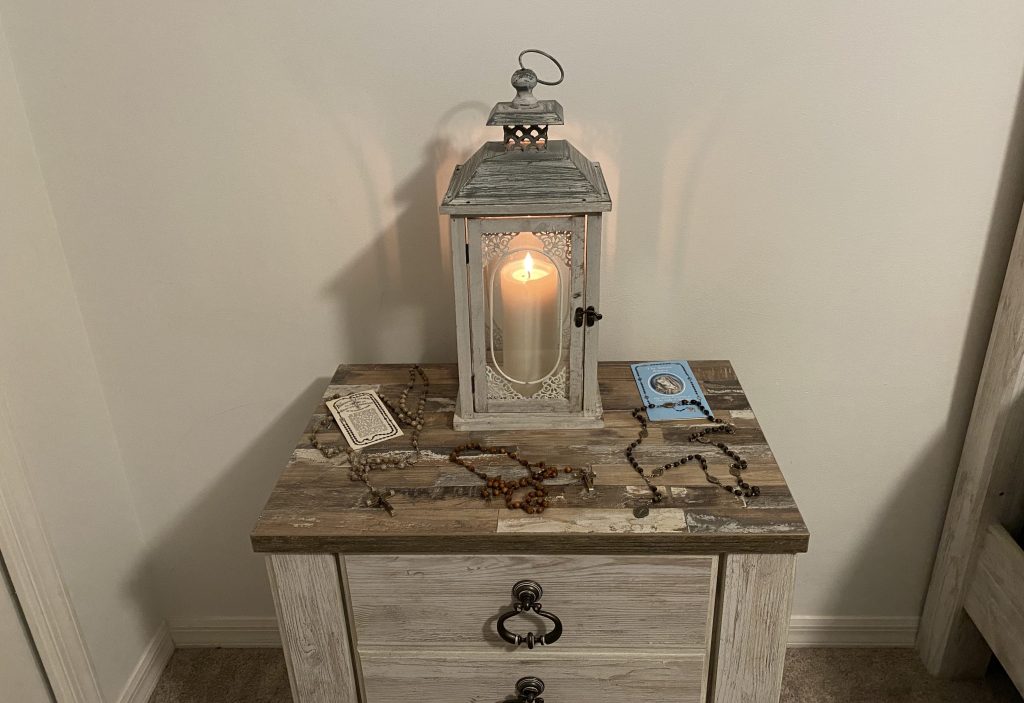
Photo: Br. Paul’s Seven Sorrows Rosary on the right, Franciscan Crown (Seven Joys of the Blessed Virgin) Rosary on the left, and standard five decade Rosary in the center. We can walk with Jesus and Mary in any and every season!

Link for the Mass readings for Monday, September 15, 2025

“From the fullness of the heart the mouth speaks.” What are we filling our hearts with?

“A good person out of the store of goodness in his heart produces good, but an evil person out of a store of evil produces evil; for from the fullness of the heart the mouth speaks” (Lk 6:45).

We can experience hardships, trials, and suffering. We may have experienced traumas, and even come face to face with evil. Yet, we are not evil because of what happens to us, nor how we are tempted. Neither are we defined by any trauma, suffering, or abuse. We have been created good by a loving God.

Negativity, sin, hate, and evil, can be seductive, can lure us to rationalize and decide that what we may think of as good in the moment, is in reality, just an apparent good or not good at all. To encounter or experience a word or act of unkindness, negativity, or even violence, we may feel justified in retaliation, yet if we speak or act in this way, we perpetuate the negativity or evil we seek to stand up against. In The Strength to Love, a collection of Dr. Martin Luther King’s sermons he wrote:

“Returning hate for hate multiplies hate, adding deeper darkness to a night already devoid of stars. Darkness cannot drive out darkness; only light can do that. Hate cannot drive out hate; only love can do that. Hate multiplies hate, violence multiplies violence, and toughness multiplies toughness in a descending spiral of destruction.”

At the moment we have a thought in our mind, we want to be aware of it and decide where and from whom this thought is coming from. Then, what to do with that thought. Many thoughts come from ourselves, others come externally from our experiences, our observations, our concupiscence – our tendency to sin, and yes even some from demonic influences.

What we listen to, read, and/or watch on a regular basis matters. We need to discern each thought or influence that comes our way. It is important to be aware what we are feeding on, literally and figuratively, and honestly assess our thoughts before we speak and act. Thinking through and deciding on what we will say and do is different from immediately or impulsively reacting.

Consuming the things of this world will lead to a different way of life than meditating and pondering on the things from above (cf. Colossians 3:1). Spending time in prayer and following Jesus’ commands will help us to bear the fruit of the Spirit: “love, joy, peace, patience, kindness, generosity, faithfulness, gentleness, self-control”(Galatians 5:22-23). Honestly examining our conscience daily will help us to purify that which is deadening and replenish that which will nourish.

Violence and the worst of our humanity continue through multiple media outlets, also, they horrifically materialize in real time, and ad nauseam on 24/7 cable coverage. The starting place to counter evil is to resist returning evil for evil, and to learn and put into practice Jesus’ teachings which will help to expose the darkness in our own hearts. We will see more precisely how to clear out the plaque of our own fears, wounds, frustrations, disruptions, and disordered affections. Then there will be more room for the love of the Holy Spirit to flow. With our hearts flowing with love, we will react less, listen, think, and speak better, and choose to act in ways that promote healing, understanding, forgiveness, reconciliation, and love.

——————————

Photo: Would that each of our hearts were open and receptive to God’s love as these flowers.

Link for the Mass readings for Saturday, September 13, 2025

Jesus continues to proclaim the Gospel today, and is inviting us to join him.

But he said to them, “To the other towns also I must proclaim the good news of the Kingdom of God, because for this purpose I have been sent” (Lk 4:43).

Jesus himself, the Son of God incarnate, fully divine and fully human, is the foretaste of heaven. His work of preaching, teaching, healing, and casting out demons, shows that the divine flow of the Father’s Love is infused into our fallen human condition. Jesus came to restore unity to that which had been divided and once he began his public ministry, he was ever on the go.

Through our Baptism, we have been conformed to and indelibly marked by Christ and for Christ. We are nourished by his Body and Blood in the Eucharist and we’re empowered through the laying on of hands by the bishop at our Confirmation. We have been divinized, grafted into the life of God through our participation in the life of Jesus the Christ. We too then are priests, prophets, and kings as we participate in his life. We also are, to preach and teach the same Gospel, to be his healing and comforting presence, to make Jesus present to those in our midst, and yes we too are called to cast out all demons, and to shine the light on negativity, dehumanization, and division in his name. As James teaches, we are to “submit [our]selves to God. Resist the devil, and he will flee” (James 4:7).

Jesus did not travel very far during his three and a half years of public ministry, yet his teachings have touched the corners of the world. That is because of those who have encountered him, said yes to his invitation, submitted to the will of his Father, and continued to spread his teachings and life in each generation. We too are called to experience “a resurrected new life”, just as the mother-in-law of Peter did. And what did she do once she was healed? Out of gratitude, she immediately rose and served him. She mirrored Jesus in her willingness to serve (cf. Gadenz, 107).

Moment by moment, in each circumstance, we are invited to surrender to the will of his Father, and follow the gentle guidance of the Holy Spirit. Each yes to the guidance of the Trinity is an embrace of the gift of the unique vocation we are called to put into practice. The time of fulfillment is now because Jesus is present in our midst, he is at hand. So let us repent and believe in the Gospel, (cf. Mk 1:15), and follow the lead of Jesus that we read about each day.

These are not just nice stories. They are invitations for transformation and participation. By reading, praying, and meditating with these scriptures, we deepen our relationship with Jesus and begin to experience the love of the Holy Spirit and we are given clearer sight about what to let go of that holds us back from a more intimate union with the Father. Each day is a new opportunity to learn from Jesus, follow his guidance, and be advocates of his love and healing in the unique expression he would have us share! Let us like, Peter’s mother-in-law, arise and serve.


Painting: The Exhortation to the Apostles by James Tissot

Gardens, Pablo T.. The Gospel of Luke. Grand Rapids, MI: Baker Academic, 2018.

Link for the Mass readings for Wednesday, September 3, 2025

Let us believe in and entrust ourselves to Jesus.

In yesterday’s reading, Jesus’ message in his hometown of Nazareth did not end so well, with his fellow Nazoreans running him out of town (Lk 4:29). In today’s account, Jesus continues on and teaches in the synagogue at Capernaum. The initial reaction to Jesus’ teaching was similar in both accounts; the people were “amazed” and “astonished” with his teaching. But no one in either group makes the bold statement that arises today: “I know who you are – the Holy One of God” (Lk 4:34)! This phrase was professed by a demon who taunted Jesus.

From the very beginning of Jesus’ ministry opposition was present. In Nazareth, the fallen nature of our humanity reared its head. The people he grew up with were unwilling to see beyond the ordinary Jesus they always knew. Wasn’t he just the son of Joseph, just the carpenter? Jesus was safe when he merely worked a quiet life, participated in the life of the synagogue, even when he returned from surrounding territories amidst words of praise, and even stepping up to read in the synagogue from the words of Elijah: he was the hometown boy making good. But once Jesus began to equate himself in the line of the prophets and share how God was working beyond the people of Israel, with his accounts of Elijah going to the Gentile widow, and Naaman, another Gentile, going to Elisha, highlighting that God worked beyond the people of Israel, even his own had enough. Jesus had to go (Lk 4:29).

In today’s account, another source of opposition is the taunting demon. Jesus rebuked the demon immediately and called him out of the man. Jesus faced time and again the fallen nature of humanity, disbelief, lack of faith, as well as the opposition of demons, and the temptations of Satan himself in the desert. He was also opposed by most of the religious establishment of the Sadducees, Pharisees, and scribes.

Where do we find our self in the scenes of Jesus’ ministry and teaching, in our own time today? Following Jesus is a day to day commitment and we must be willing to face the same challenges that his disciples did. We are faced with the challenges of living up to his teachings as well as facing our weaknesses, wounds, and  shortcomings as we seek to resist the lies of the enemy and conform our lives to the will of Jesus. By doing so, we will be confronted with the darkness and sin within ourselves. With true humility, we will be better able to resist defending and rationalizing where we fall short of the glory of God and instead repent, turn away from our sin, turn back to God, and receive forgiveness and be healed.

We also need to resist dismissing Jesus’ encounter with the demon in today’s Gospel too quickly. Demons do exist and play a role in the principalities and powers that influence us and our world. We ignore this reality to our own peril, for they will tempt and subtly attack us at our weakest and most vulnerable points. This is not a cause for anxiety and fear. The weakest Christian is stronger than the devil himself but we must be aware and vigilant. When faced with temptation by Satan or his demons, we just call on the name of Jesus and those of the dark will flee from the radiant light of Christ. This is why it is so important to regularly examine our conscience, to be aware of, and to confess our sin. In doing so, we will be free, otherwise, they can and will be used against us.

The closer we draw to Jesus, the more we experience his light and the more of our sin will be revealed. This is not a cause to run and hide but to humbly embrace the truth so that forgiveness and healing will happen. This also means that we will see more clearly the dark influences that plague our own thoughts and our world which we are blinded to when we turn in upon ourselves and feed our own selfishness, embrace our own pride, and allow ourselves to get caught up in the stream of the world.

Choosing to believe in and entrust our lives to Jesus with our first waking breaths and thoughts is an important way to begin each day. Doing so helps us to get ahead of the thoughts that will arise to distract, divert, and dissuade us from hearing the word and guidance of God. Beginning our day in quiet with Jesus is so important to do before we get up and running and return to the daily busy. When we resist moving on automatic pilot, we can realize that we can live our lives more intentionally. Moving more thoughtfully and seeking God’s guidance we can react less so to choose his will more. 

When we fall short, are distracted, fail, as did the apostles, we need to follow, not Judas, but Peter: repent, confess our love for Jesus, and begin again to hold one another accountable, support, and lift one another up in love, for Jesus is at our right hand. Even when we find ourselves in our darkest moments, we can turn to Jesus and stand firm for he is our refuge and our strength.


Photo: Following the light.

Link for the Mass readings for Tuesday, September 2, 2025


Will we reject or hear Jesus’ message?

He said to them, “Today this Scripture passage is fulfilled in your hearing” (Lk 4:21).

Jesus sat down after speaking these words to his hometown congregation in Nazareth who had just heard him read the passage from the prophet Isaiah. Jesus proclaimed that he was the one to whom Isaiah was talking about. Luke chose to place this event as the starting point of Jesus’ public ministry, of bringing glad tidings to the poor, proclaiming liberty to the captives, recovering sight to the blind, letting the oppressed go free, and proclaiming a year acceptable to the Lord (cf. Lk 4:18-19).

This is a message of universal healing for all of humanity. Restoration and reconciliation would come and Jesus would be the vehicle to bring all the nations, all people, back into communion and relationship with his Father. The poor mentioned were not just in reference to those experiencing material poverty but to those finding themselves on the margins of society, the outcasts, those on the peripheries. The captives were not only those imprisoned for debts or crimes but those bound in the chains of their own sin and addiction. The blind were not only those who could not physically see but those who experienced the spiritual blindness of pride and arrogance. The oppressed were not just those under the iron fist of totalitarian and dictatorial regimes but those pressed down through their own self imposed anxieties and fears.

In what ways are we in need of Jesus’ healing and restorative power? What is keeping us on the peripheries, apart from communion and fellowship? What sins and addictions keep us bound, what fears and anxieties keep us oppressed? Jesus invites us in today’s Gospel to be healed and to align ourselves with his will and ministry of loving service to others. The same words he spoke to his own hometown he is speaking to each one of us today.

Even though initially moved by the words of Jesus, they could not see past the boy and humble man of Nazareth they had or thought they had known. How could he be the Messiah? They also rejected his universal message that God was inviting Gentiles into the party. Jesus held up as models of faith, the widow of Zarephath who trusted Isaiah with her last bit of flour and oil and Naaman who trusted the advice of a slave girl and the prophet Elisha. Both, Gentiles, and both blessed by God through their trust in him. His own people chose to hold tighter to their biases and prejudices instead of let go and receive the freedom and healing Jesus offered.

How will we respond to Jesus? Will we follow the hometown crowd or ponder his words? Life is too short to allow our pride to get in the way. Examining our conscience and coming to Jesus with a contrite, sorrowful heart for what we have done and what we have failed to do helps us to be more open. Instead of rejecting, let us welcome Jesus and experience his healing hands on our bowed heads and the warmth of his love pouring through and purging us of our sin and pride so that we may participate with him in bringing the invitation of healing, reconciliation, and love to others and help to bring about an “acceptable year of the Lord” (Lk 4:19).

—————————————————-

Photo from freebibleimages.org

Link for the Mass readings for Monday, September 1, 2025

When we pray, we are loved by God, and the love of God casts out our fear.

“Then the one who had received the one talent came forward and said, ‘Master, I knew you were a demanding person, harvesting where you did not plant and gathering where you did not scatter; so out of fear I went off and buried your talent in the ground. Here it is back'” (Mt 25: 24-25).

I used to struggle with this verse of Jesus’ Parable of the Talents, not because I didn’t relate to it, but because I did. The problem was that I sided with the servant who buried his talent in the ground. What the servant did made sense to me, he kept his master’s talent safe and returned what he had been given. Historically, burying was considered a safe and acceptable practice in ancient Palestine when protecting someone else’s money. Even in reading carefully back to the beginning of the parable, I could see no reference to investing the talents. Though in the Gospel of Luke, there is an explicit demand to “trade with these until I come” (Lk 19:13). What is Jesus saying?

Actually, Jesus in this parable offers a microcosm of salvation history, the thread of which has been woven through all of Sacred Scripture from Genesis to Revelation. God, through his sovereign will, has consistently called, calls today, and will continue to call into the future a people to himself. In each age, God has bestowed upon humanity the generous gift of his grace, inviting us to receive and share in his very life, which is what we have been created for. This is a free gift, to be freely accepted or rejected. Once received though – no matter how little we choose to receive, five, two or one talent, we are directed to share what we have been given. Through a life lived of accepting, receiving, giving back to God and to one another, we are given even “greater responsibilities”.

In receiving the gift of God, himself, and sharing what he has given, ultimately his love, for God is Love, we not only mirror on earth, albeit dimly, but share in the divine communion of the love between God the Father, God the Son, and God the Holy Spirit. To reject this gift outright, or to receive some of the benefits and not to share, we cut ourselves off from the very life force and source of our being.

The message of The Parable of the Talents is as clear as it is challenging. John P. Meier summarizes that “Jesus is insistent; along with sovereign grace, serious demand, and superabundant reward comes the possibility of being condemned for refusing the demand contained in the gift. Indeed, one might argue that no aspect of Jesus’ teaching is more pervasive in the many different streams of the Gospel tradition, and no aspect is more passed over in silence today” (Meier 2016, 309).

God has created us and all of creation from the abundant outpouring of his love. Will we reject the gift of his love and invitation of communion? Will we receive, yet not actualize who we are called to be for our self and others because we would rather merely just exist, willing to be lured and entrapped by the temptations of anxiety, fear, apparent goods, and half-truths? Will we give in to the fear, too afraid to risk, to go out from ourselves to serve others? Or, will we appreciate the gift of our life and say thank you for the breath that we breathe? Are we willing to expand the love we have received by being willing to share, to multiply our talents, to embrace who God calls us to be, to love in kind, to will the good of others in the unique way God calls us to serve, whoever they may be?

I have lived the life of the wicked servant who buried his talent out of fear. I have embraced the sin of sloth by overworking and thinking I was doing good, but was it really the good God wanted me to do? As I have recognized the importance of placing prayer front and center, so that I have grown in my relationship with God, my life has become more properly ordered. I do better when I reach out and seek the hand of Jesus and accept to be led by him. I have risked and fallen, made mistakes and duffed up time and again, but have learned and persevered.

When we learn who the enemy is, are able to identify his lies, renounce and turn away from them and back to God; when we slow down instead of run from what we are afraid of and invite the Lord into these areas we will be purified, we will heal; and when we realize that the most important thing that we can do each day is pray, then we will come to know in our core, that we are not human-doings, we are human beings. God loves us as we are. As we are loved, we will then act from being loved and share the love we have received.

We are not alone. What Jesus invites, gives, and yes, demands of us, he will at the same time provide the courage, guidance, support and strength we need to carry out the task given and to bring it to fulfillment. God has a talent or two to invest. We need not fear to invest what God has given. This morning, let us breathe deep and entrust ourselves to the words of Jesus and St John Paul II who echoed them as he began his pontificate:

“Be not afraid” (Mt 14:27).

———————————————————————————-

Photo credit: dpa Picture-Alliance via AFP accessed from Aleteia

Meier, John P. A Marginal Jew: Probing the Authenticity of the Parables. Vol. 5. New Haven: Yale University Press, 2016.

Link for the Mass readings for Saturday, August 28, 2021

Prayer will help us to heal and grow closer to God and each other.

“Lord, will only a few people be saved?” He answered them, “Strive to enter through the narrow gate, for many, I tell you, will attempt to enter but will not be strong enough (Lk 13:23-24).

This can be a challenging verse to understand and to put into practice. Our salvation is assured in Christ, for he died for all of us and not just for a select few. It is also true that there is no way we can buy or nothing we can do to earn our way into heaven. That said, with the free gift of the grace we have been given by Jesus in the giving of his life for us, we have a responsibility to work out our salvation in this life, “with fear and trembling” (see Philippians 2:12).

Christianity is not a pie in the sky or walk in the park religion, we do not seek a utopia, because Christianity is about a relationship. God loves us and gives us the choice to reject or accept his love. If we say yes, then we collaborate in building a relationship with him and one another. Our fear and trembling is not in a cowering observance, but through humble obedience. We recognize that God is God and we are not. When our relationship with God is properly understood, when he is first, then our relationships with each other as well as what we do and what we seek will stand a better chance of being properly ordered.

Authentic relationships take an investment of time and hard work if those relationships are to move beyond the masks and pretenses we project, pretending to be something we are not or trying to be who others want us to be. This is the same for God. We can pray falsely and for false purposes, and in so doing, grow no closer in our relationship with God. Jesus loves us as his Father loves him, and he invites us to experience the same. This is more than an emotional experience, but a willing of each other’s good. Love is accepting the other as other, in their brokenness and pain, their failings and shortcomings, their sin. It means being willing to take off our masks, being vulnerable, revealing our fears, and resist being defensive or reactive when we are hurt or offended by those who are close to us.

Our prayer becomes real, not when we say the right prayers or words, but when we are honest with God. Our relationship with him grows when we let go of our false understanding that we are self-reliant and we admit that we need the help of the Holy Spirit. When we trust in God, are humble and honest with him, allow ourselves to see our weakness and sin, we can begin to be loved and begin to heal, we can be forgiven and transformed.

When we approach our human relationships, love does not mean that we endure physical and emotional manipulation and abuse, for then we are enabling someone’s destructive behavior. The goal of healthy relationships is to mutually respect each other’s boundaries, be willing to support and empower one another and grow together. We accept each other as we are, while at the same time, we are willing to accompany one another as we seek to hold each other accountable, grow in our relationship with God and who God calls us to be.

Every relationship, if it is to grow and develop, will at some point, come to a cross-road, a narrow gate, in which each person needs to make a decision. We can remain stubborn, hold our ground, and build up a wall, or  we can instead work through the conflict, be honest, risk sharing what we truly believe, allow another to see our best and our worst, admit when we have been wrong or made a mistake, and then mutually support one another, as well as get the help from counseling or spiritual direction as needed.

Healing and growing together happens when we are willing to enter into and seek the root of the conflicts, to each own the parts we have played, and have the humility to say, I am sorry or I forgive you. We heal when we are willing to uncover the underlying issues below the surface, that is most likely veiled by our insecurities, anxieties, and fears. What can help us to feel safe and move toward healing and transformation is the willingness to invite God into our relationship through personal and mutual prayer.

Prayer is the most important thing we can do each day. The light of the Holy Spirit will help us to identify and let go of the baggage we carry and identify the voices we are listening to. Is it the father of lies or the Father who loves us more than we can imagine? Spending time with God and allowing the fire of his love to burn freely anything that is not of him, will help us to discern between the enemy’s voice and God’s. Jesus is the way, the truth and the life who seeks to lead us each step of the way to more intimate relationships. We get to decide whether we want to go our own way or follow Jesus through the narrow gate.


Photo: Praying together helped us to grow through conflicts, and closer to God and each other. Picture taken after we finished evening prayer with only 18 days before JoAnn would transition from this life to the next.

Link for the Mass readings for Sunday, August 23, 2025

Be still, and allow the Holy Spirit to burn!

Then the disciples approached Jesus in private and said, “Why could we not drive it out?” He said to them, “Because of your little faith.” (Mt 17:19-20).

How do the disciples get from this recurring theme of having little faith in the Gospel accounts to Peter healing a crippled beggar by saying with boldness, “I have neither silver nor gold, but what I do have I give you: in the name of Jesus Christ the Nazorean, [rise and] walk” (Acts 3:6)? And the man did just that!

A helpful definition “is to say that faith always entails a relationship between persons which stands or falls with the credibility of the person who is believed” (Rahner and Vorgrimler 1965, 164). Faith is not just an intellectual exercise, it is a lived experience. Christian faith is the conviction, belief, and relationship experienced with Jesus the Christ. The disciples learned from Jesus but more importantly developed an intimate relationship with him, such that the love they received and shared became so strong that there was no more room for doubt, distraction and/or fear, such that they would align themselves with the will of God and do what Jesus did.

The disciples did have some moments of doing as Jesus had done, but it was not until Jesus ascended and the Holy Spirit descended upon them at Pentecost that everything changed. Jesus had tilled the soil, he helped to unearth the rocks of the hardness of their hearts, he forgave them, and healed them. But it was not until they let him go after his Ascension that they were able to receive the Holy Spirit and by his power working through them they would do even greater deeds than he (cf. Jn 14:12-14)!

We are invited to do the same. If we only read the Gospels or hear them read we may know something about Jesus, but our life will for the most part remain unchanged. When we read, meditate, and pray with the Gospels and put into practice what we read, we will encounter Jesus as did his disciples. We too will come to know and develop a relationship with Jesus and our hearts and minds will be transformed by him. In this way, we are not just reading a dead letter but encountering the living Word, the Son of God, who invites us to share in the infinite dance of Love that he participates in with God the Father and God the Holy Spirit.

The enemy will do everything in his power to distract, divert, and tempt us from setting aside time to pray with God each day. And when we actually begin to discipline ourselves, enter into quiet time daily, we are invited not to stay there but to go deeper, to move beyond only reading, meditating, and praying. There will be times Jesus invites us to set aside our Bible, notes, journal, prayer cards, and/or vocal prayers of petition, and to just be still, to listen, and receive the love that Jesus and the Father experience, the Holy Spirit.

The same Holy Spirit who empowered the Apostles to fulfill what Jesus had begun with them is quietly nudging us on each day. Please listen! He is inviting us to see more clearly those subtle ways we are being distracted, tempted, and diverted from his guidance and what has been inhibiting the growth of our relationship with God. The love and light of the Holy Spirit will reveal, when we are willing to remain still, where and how, in minute and massive ways, we are refusing to follow the will of God.

One of the reasons that we have “little faith” is that we rely too much on ourselves. We are invited to stand in the presence of the Holy Spirit and let his fire burn, to purify us from our own misguided thoughts of self sufficiency. As gold and silver is placed in a crucible and heated, the dross is purified. We are purified in the crucible of our meditation, prayer, and contemplation by the love of the Holy Spirit. Through this purifying light we will see that we cannot save ourselves, that we need a savior, Jesus, with his arms wide open ready, willing, and able to forgive us and love us unconditionally and continually.

———————————————————————–

Photo:  A moment of stillness and purification back in December.

Rahner, Karl and Vorgrimler, Herbert. Theological Dictionary. New York: Herder and Herder, 1965.

Link for the Mass readings for Saturday, August 9, 2025

Denying ourselves, taking up his cross and following Jesus, leads us to greater intimacy and freedom.

Jesus said to his disciples, “Whoever wishes to come after me must deny himself, take up his cross, and follow me” (Mt 16:24).

Jesus invites us to deny our self-centered default position which places I, me, and mine (As George Harrison sang) at the center of each of our decisions. We can deny ourselves when we resist making excuses for our sins and come to a genuine place of sorrow for the pain we have caused God, ourselves, and others. By acknowledging our sins and confessing them, we die to our selfish ways, and then we rise again through the power of Christ. Empowered by our humility and the strength of Jesus we are better equipped to resist those temptations in the future.

We are also in a better position to then take up our cross, which is to follow the will of God. Jesus showed us the proper orientation of surrender when he said at Gethsemane: “Father, if you are willing, take this cup away from me; still, not my will but yours be done” (Lk 22:42). Jesus followed his Father’s will to the cross and endured horrific suffering, excruciating pain, humiliation, and abandonment, unto death… while doing so, gave him the opportunity to conquer death and become the first born of the new creation!

Many a mother I have talked with has shared the struggles of labor, but also expressed the joy of giving birth; many students who I taught were exasperated by the time and effort expended for an examination, a sporting event, art show, musical or theatrical performance and yet experienced the joy from the feat they accomplished; and how many times have we faced a challenge, trial, or cleared some obstacle and felt the exhilaration of overcoming the hurdle?

Taking up our cross and following the will of God means accepting a disciplined approach to our lives. When we follow God’s will, as opposed to our own apart from God, the difference is that we are not alone in our persistent effort. Seeking God’s will in the midst of our discernment and trials for our everyday physical as well as spiritual pursuits is the key.

In my mid-twenties, I entered the Franciscan Friars of Holy Name Province to study for the priesthood. In the year and a half of discernment, from time to time I would imagine my ordination day. To my surprise, I did not feel any joy. I enjoyed every aspect of my experience with the friars and the ministries but there was something or someone missing. I took a leave of absence and about a year and a half later, I realized what was missing was a family.

About two years later I met JoAnn, and her three children, Mia, Jack, and Christy. Six months after that we were married and seventeen years later, I was ordained to the permanent diaconate. This is the short version of the story. There were bumpy moments as we learned to grow together by being willing to see each other’s point of view, some perspectives took a little longer than others, and we were at our best when we were willing to sacrifice for and serve one another.

Our greatest challenge came almost six years ago when we experienced JoAnn’s final weeks this side of heaven. From the beginning of JoAnn’s diagnosis of pancreatic cancer. This cross was the heaviest to bear, yet Jesus shouldered it with us and blessed us richly in our surrender. I am truly grateful for those final months that we had together.

When the realization that JoAnn wasn’t coming back finally sank in about a year and a half later, I decided I needed to learn to live again without her. I followed JoAnn’s advice to put all options on the table and over some months whittled eight choices down to two. Standing in our bedroom, I pondered whether to leave teaching for a year and collapse or pursue the priesthood.  I then asked God, “What do you want me to do?” A quiet voice within confirmed, priesthood. My body sank but my spirit soared.

I would be accepted into the seminary to study for the priesthood and with the support of some great people and the strength of the Holy Spirit guiding and carrying me, I made it through to my ordination day. This time I anticipated ordination with joy, but there was a lingering feeling that I was betraying JoAnn by going ahead and living my life without her. We need to be careful what voices we listen to! The Father of lies seeks to wreak havoc but the Holy Spirit invites us to experience freedom, healing, and wholeness.

Some of the doubt lingered into my ordination Mass, until the moment when each priest walked by, placed their hands on our heads while each remained silent. About half way through the progress, one priest leaned close and whispered, “Your wife has the best seat in the house.” The tears began to flow and purify the lies. During the Eucharistic Rite, for a moment, I felt JoAnn with me, helping to realize that I was actually celebrating my first Mass as a priest, concelebrating with our bishop.

A few months later, I realized that I could be happy again. I was not happy JoAnn had died (which enemy fed me), I was happy because I was following the will of God. JoAnn told me that I would be sad but not to stay there and that she would be closest to me when I was doing that which made me happy. I have also come to realize that during the Mass, because of the presence with Jesus, the veil between heaven and earth is so thin.

When Jesus calls us to “deny ourselves”, he is talking about denying those attachments and disordered affections that we have to things and people, which is anything and anyone we place before God. When we are willing to surrender all and follow Jesus, allow the purifying fire of the love of Holy Spirit to burn the dross of our sin, attachments, and apparent goods away, we will experience the love and intimacy with God we have been created for, and experience a freedom we never thought possible.


Photo: Blessed and filled with joy to be serving in the priesthood of Jesus Christ.

Link for the Mass readings for Friday, August, 8, 2025