Almsgiving helps us to tap into the source of God’s love and service.

The Parable of the Rich Man and Lazarus (Luke 16:19-31) is well worth the read. Jesus challenges us through parables such as these. For the people of his time, those who had wealth and status in society did so, it was believed for the most part, because they were blessed by God. And likewise, those who were poor, were so because of God’s punishment. When the rich man and the beggar, Lazarus, die, I am sure Jesus paused to allow his listeners to imagine what would happen to these two men and to give their presumptions some time to ferment. Many would not have predicted what happened next.

Lazarus was taken up “by angels to the bosom of Abraham” (Lk 16:22). The rich man found himself suffering from the torment of flames, such that he was parched, begging just for a drop of water from Lazarus (cf. Lk 16:23-24). Abraham, the model of faith and father of Judaism, was not sitting with the rich man, who must have always been seated at the highest places in his day. Now that seat, at the bosom of Abraham, was offered to Lazarus. There was no hope at this moment for the rich man to cross over because of the wide chasm that separated them. An ironic subtlety was afoot as well in Jesus’ telling of the parable to the Pharisees. Lazarus the poor beggar is named, whereas, the rich man is not. Some biblical scholars, based on the context of this exchange with Jesus and the Pharisees, believe that Jesus was alluding to the rich man to be Herod Antipas and indirectly calling out the Pharisees for their close association with Herod, especially regarding the death of John the Baptist.

This state of suffering and separation for this rich man because of the uncrossable chasm, is a revelation of the life he lived prior to his death. He walked over or by Lazarus day after day not giving him even a second look. Lazarus would have been grateful even for the mere scraps that fell from the rich man’s table, just as the rich man now sought just a drop of water from the finger of Lazarus. The rich man committed the root offense from which sprouts much of our sin; he failed to bother, to care, to love his brother, to will his good. He failed to come close to Lazarus who was in need.

Jesus’ parable of the Rich Man and Lazarus, echoes very closely Matthew 25:40, “whatever you did for one of the least brothers of mine, you did for me.” How we treat each other matters. Failing to care, to reach out to those in need around us is sinful. We, probably like those who first heard this parable, experience time and again, a wicked mind storm that swirls with reasons, rationalizations, and justifications as to why we do not reach out to help. The majority, if any, are not valid. We are invited to give and to love joyfully from a natural, not a hesitant disposition, to provide aid and support.

Almsgiving is one of the three pillars of Lent and the practice helps us to heal our relationship with others. The first step is to be aware of those who are in need. This can be in our own home! Second, when we see someone in need and we feel the wind and the waves of our mind surging with reasons of why not to help, it is important to take a breath and call on Jesus. In that moment of pause, may we allow our eyes to adjust so that we can see the person before us as a human being, as a brother or sister with dignity, value, and worth.

What we are to seek in each moment of encounter is the guidance of Jesus and our willingness to allow him to work through us. May we be willing to be present and allow the Holy Spirit to happen in whatever form or act of kindness we are directed. We can do this best when we are daily entering into God’s word and allowing the Old and New Testament readings, especially these Lenten readings, to shape and transform us. When we trust “in the Lord”, we will be “like a tree planted beside the waters” (Jeremiah 17:7-8).

Almsgiving is the sharing of this spring flowing from the love of Jesus and helps us to grow in compassion and generosity. This flow will never run dry as long as we seek to be nourished by God’s word and his laws that teach us how to love one another. If not sure where to begin, we can pause and listen to Mary and do the same as she directed the servants at the wedding feast to: “Do whatever he tells you” (John 2:5).

——————————————————————-

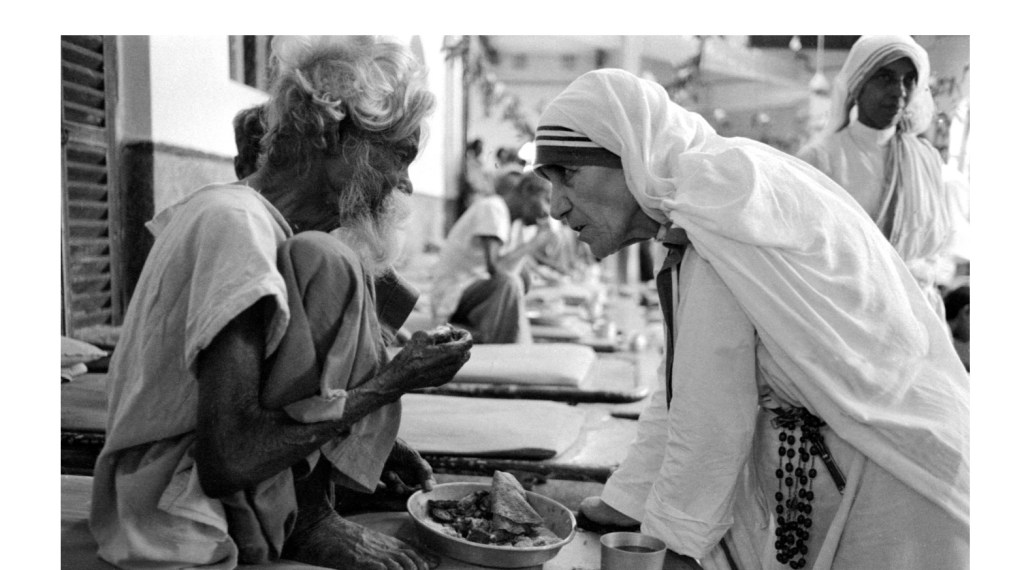
Photo credit: When St. Mother Teresa picked up the first man dying in the street she began to put into action her call within a call to serve the poorest of the poor. How and who is God calling us to serve?

Link for the Mass readings for Thursday, March 5, 2026

“Love your enemies, and pray for those who persecute you.” Really? Yeap.

“You have heard that it was said, You shall love your neighbor and hate your enemy. But I say to you, love your enemies, and pray for those who persecute you, that you may be children of your heavenly Father” (Mt 5:43-45). With these words, Jesus continues to raise the bar of discipleship and outlines what the pursuit of love truly is.

The command to love our enemies and pray for those who persecute us is challenging today, but we may be a bit removed from the original power of those words. The inference that Jesus was making to his listener’s was that their enemies and those who were persecuting them, were the soldiers of the Roman imperial that were occupying Israel. Though we can still relate, and also be shocked by it and think that this command is impossible. And that is just the point. Apart from Jesus and our relationship and the transformation of our hearts and minds through our discipleship with Jesus, there is no way we are going to love our enemies and pray for those who persecute us.

One reason is that for us our definition of love is limited to the romantic, emotional, sensual, or mere sentimental. It can also be reduced to the mere sublime of loving ketchup or mustard on a hot dog, loving our cat or dog, or even at best getting closer to what Jesus is talking about when we love the members of our families or close friends. But all of these perspectives of love would not make sense in the context of Jesus’ command.

The bond of friendship and family goes beyond mere attraction and is built through shared interests and experiences. Through sharing our lives with others, working through conflicts, trust is built, and relationships will hopefully grow and deepen. Jesus, though, is calling us to mature in our growth of loving even beyond friendship or familial ties. If we love those who willingly love us in return, greet only our brothers and sisters (if we actually get along with them, blessed that I get along with my sister ;)), only those in our clique, group, tribe, or political party, what is the recompense or satisfaction in that? Agape, in Greek, loving without conditions, with little or no chance of mutual exchange, is what Jesus is calling us to strive for.

Many of us could not conceive of loving our enemy or someone who is persecuting us, because we have, minimally only experienced doing no overt harm to others and at best, loved our friends and family. But do we risk going outside of our group, our like-minded safety net? Life is hard enough and it is often safer, we believe, not to take the risk. We continue to operate from a concept of love as an emotion or feeling, because it feels good. We want to be happy and feel good. We avoid suffering at all costs.

Jesus challenged “his disciples to love and pray for the very people who occupy their land, tax them heavily, and treat them with violence and injustice” (Mitch and Sri, 100). How could they love the Roman occupiers? How can we love, those that we feel in some form or fashion in a similar way? St. Thomas Aquinas can be of help. He defined the love that Jesus describes as willing the good of the other as other. We make an act of the will, a free choice to accept the person as they are, to see them, not from our limited finite perspective but as God sees them, as a person with dignity. Can we pray for, seek kinder thoughts and to be more understanding, be more patient, and resist reacting in kind? Can we resist judging and labeling others?

On our own, we may not even conceive of the possibility, loving our enemies, but we can be assured that if Jesus has asked us to strive for this height and depth of love, he will provide the means. We love others unconditionally by allowing Jesus to love us. To breathe, receive, receive, and abide in his love, we experience his love. As we do so daily, we experience more of and are transformed by his love, and begin to allow God to love others through us.

We strive to reach the summit of loving our enemy only with the help of the Holy Spirit. Jesus called his disciples and he calls us to “imitate God by being perfect in love… to reflect the Father’s perfect, committed, selfless, merciful love in their own lives… to go beyond external conformity to the requirements of the law and imitate the perfect love of the heavenly Father, who is love himself” (Mitch and Sri, 101).

Even when we fall short, how much better would our families, communities, countries and world be if we sought this goal? To counter divisiveness, fear, and hatred, we need to refuse to react and instead choose to engage in an act of the will to love one another as Jesus loves us. “Jesus summons us to a heavenly way of life; the saints show that it is possible to live this way on earth.” If the saints can love their enemies and pray for those who persecute them, then by following their example, and allowing ourselves to abide in God’s love as they did, then so can we.


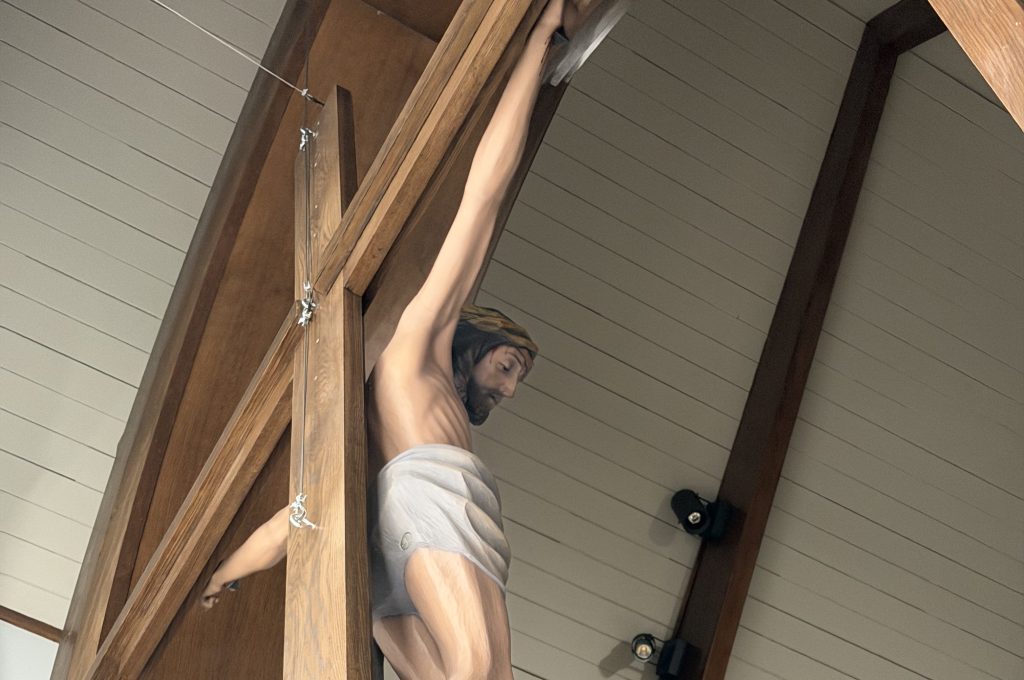
Photo: Jesus lived his command of loving his enemies and praying for those who persecuted them most radically when while dying on the cross he asked his Father to “forgive them for they know not what they do.”

Curtis Mitch and Edward Sri. The Gospel of Matthew. Grand Rapids, MI: Baker Academic, 2010

Link for the Mass readings for Saturday, February 28, 2026

When we can hear God, we can experience healing at a deeper level.

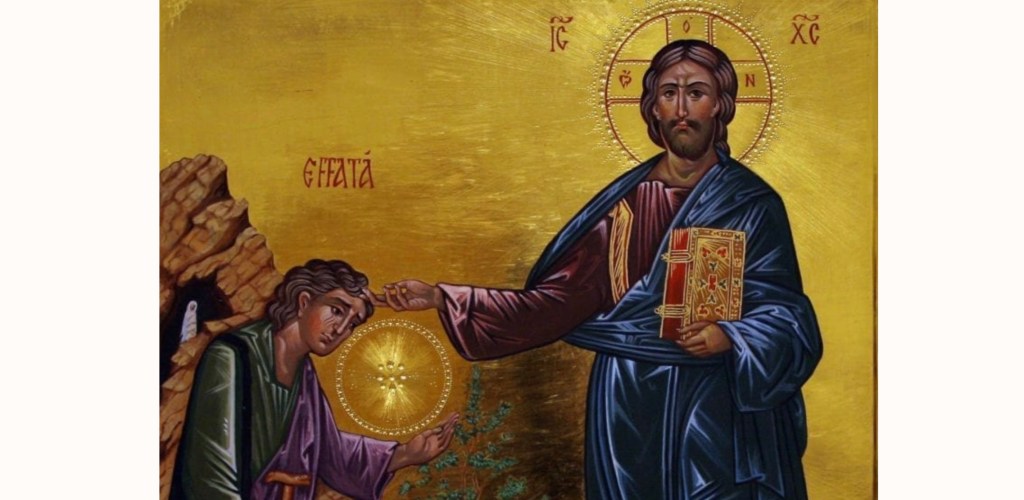
Those who witnessed Jesus healing the man who was deaf with a speech impediment grasped something more than just the healing when they stated: “He has done all things well. He makes the deaf hear and the mute speak” (Mk 7:37). With these words, they were acknowledging the deliverance of Israel by the Lord, promised by the prophet Isaiah, when he mentioned how, “the eyes of the blind will be opened, the ears of the deaf will be cleared” (Isaiah 35:5).

The beauty of this healing may be missed by us in the modern age because of the graphic nature of the details used by Mark. Jesus places his fingers in the man’s ears, spits into his own hands, and then touches the man’s tongue. Jesus is mixing his own saliva with this man in need of healing. We don’t even share drinks from the same bottle anymore as we used to do when we were kids! Still in the shadow of Covid and a new flu strain, this imagery can seem incomprehensible!

Yet, what Jesus is showing is the intimacy of communion that he offers us. He gave the very essence of his own being, his own saliva and mingled it with this man’s saliva. This physical teaching is an image or icon, of how the Son of God, in no way diminishing the fullness of his divinity, entered into the very real corporality of our humanity. He became one with us so that we can become one with him. This was true then and it is still true for us today, less the saliva!

This is also especially true because as with Jesus healing of the Syrophoenician woman’s daughter yesterday, this man too is not a Jew but a Gentile. In each of the healings, the good news is that the good news is still being proclaimed to the Jewish people but also Jesus is moving beyond, and all people are given access to God through Jesus. The eyes and ears of all will be opened to the glory of God’s message and invitation to relationship.

We all suffer at some point from physical, emotional, psychological, and/or spiritual trials. What is worse is when we close ourselves of from or have not learned to hear God’s word, and become deaf and mute. Jesus, even if he does not provide a healing or an immediate solution, is present. We are invited to resist avoiding or denying our suffering, pain, and/or challenges and instead embrace them with Jesus. In doing so, we align our suffering with his on the Cross. When we choose to offer up our pain and suffering on behalf of another, we participate in redemptive suffering. Others can experience relief and healing from our sacrifice in participation with Jesus.

This act of the will sometimes brings healing for ourselves, comfort, and even when the suffering continues, gives meaning. We do not endure what we are going through in vain. Better to face, head-on, that which challenges us open to the guidance of Jesus. Along with the advances in medicine, science, and psychology, engaging both our faith and reason, our discernment will be more balanced. Just masking struggles without dealing with the root cause(s) can prolong and possibly worsen the condition.

Jesus seeks to heal us at the core root of our wounds as well by saying to us: “Ephphatha!” so that we too can hear and speak his word, experience a closer walk with Jesus, and be more present to and love one another. Jesus wants to heal others through us. With ears open to the voice of God, we will become more aware of those in need. One of the best gifts of healing we can offer is to be present, listen to and hear those speaking with us. We know the peace and joy that we experience when he have been heard and loved. As we have received, so let us give!

——————————————————————————————-

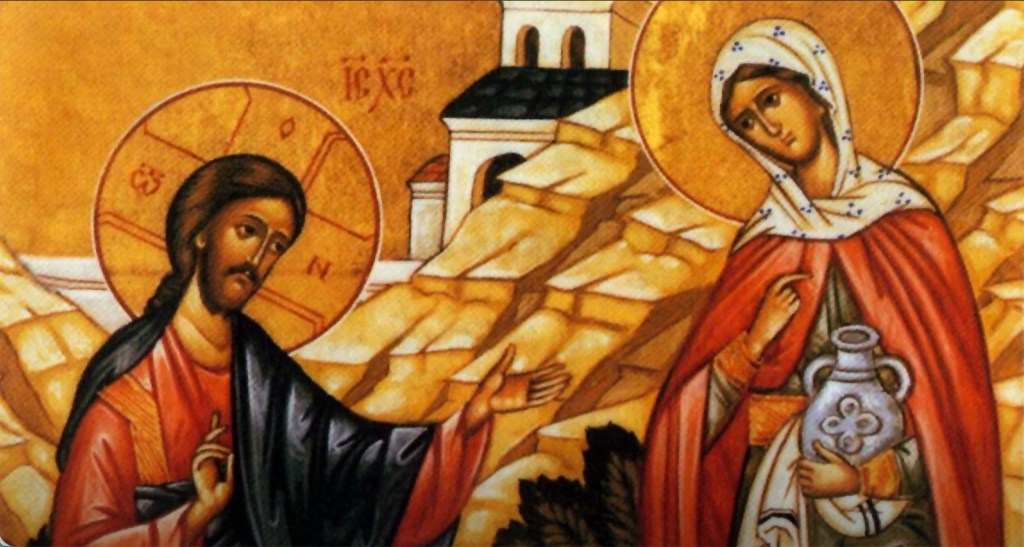
Picture: Icon of Jesus healing the man deaf and mute – Artist unknown.

Link for the Mass readings for Friday, February 13, 2026

May we think, speak, and act as if Jesus was before us, because he is.

“[W]hat comes out of the man, that is what defiles him” (Mk 7:20).

Jesus offers a list in today’s gospel of what can be unleashed from within and then directed out toward another. These are examples of what defiles us because, at some level, we make the decision to think about, speak, and put into action those thoughts, words, and actions. Jesus is making a clear distinction that external things don’t defile or make a person unclean, “rather uncleanness comes from within, from the deep inner wellspring of a person’s words and actions” (Healy, 141).

To resist the temptation to defile ourselves and others, we can follow the lead of the writer from the letter to the Hebrews who offered a wonderful verse, which I pray each morning in my recitation of the Office: “Encourage each other daily while it is still today” (Hebrews 3:13). There are many that we will encounter or hear about each day that will do the exact opposite.

A valuable goal is to resist spending any time or energy supporting any thoughts, words, or actions that demean, belittle, or dehumanize. We can call those out who do so, stand up for those impoverished from these attacks who do not have a voice, but we must not succumb, engage, or in any way be lowered to the negativity unleashed. Otherwise, we become agents in perpetuating the same vileness and poison already unleashed.

Our thoughts, words, and actions matter because we are all interconnected, and even what we ruminate upon can be projected through our faces and directed out toward another without saying one word. Thoughts entertained can then lead to words and actions that deeply wound. Our thoughts can wound as well. We are better when we approach each moment accessing more intentional choices. Instead of reacting on automatic pilot, we can take a few, slow deep breaths, think, and pray about our response. If God is not calling us to think in some way, we renounce and resist speaking or acting upon it.

Let us choose to align our thoughts, words, and actions with those of Jesus. We can follow St Mother Teresa of Calcutta’s five-finger gospel as a reminder: “You-did-it-to-me.” What we say and do to the least of our brothers and sisters, we say and do to Jesus (cf. Mt 25:35-45). This begins when we resist defiling ourselves by never letting evil talk pass our lips and instead think, speak, and act in ways that empower, convict, and build up others. Our effort is strengthened when we choose to forgive any negativity hurled at us, and meet it with a posture of compassion that seeks to understand the perspective of the hurler. In our efforts, we are not alone when we call upon the help and strength of Jesus and strive to become ambassadors of his transforming love.

————————————————————————————————-

Photo: We become disciples of Jesus when we are willing to be transformed by his love and to live as he did and put into practice his teachings.

Link for the Mass readings for Wednesday, February 11, 2026

Our faith and practices are healthy when they lead us to Jesus and “a deep transformation of the heart.”

Jesus reacted to the criticism of not observing ritual washing prior to eating that was leveled at him from the Pharisees and scribes by recalling the tradition of the Prophets through the words of Isaiah: “This people honors me with their lips, but their hearts are far from me” (Mk 7:6). Jesus recognizes the context of these words as he uses them. Many of the Israelites of Isaiah’s time “lost an intimate contact with God, and serve him with an empty formalism devoid of authentic love… inherited rituals that are not rooted in interior conversion of heart” (Healy, 137).

Jesus is convicting the Pharisees and scribes of doing the same, following the law for the law’s sake which is an empty act. What is more important is encountering the living God, experiencing his love and forgiveness, developing a relationship, being transformed by him, and restoring what has been lost.

Isaiah, the prophet, the mouthpiece of God also invoked a promise. For when his children see the work of my hands in his midst, they shall sanctify my name; they shall sanctify the Holy One of Jacob, be in awe of the God of Israel” (Isaiah 29:23). When the people again are willing to see God among them and recognize his presence, change their minds and hearts, they will again be invited to turn away from their idolatrous and selfish ways and again worship God.

In quoting this verse, those with eyes to see and ears to hear will reflect on the life, teachings, exorcisms, and healings, they will ascent to the truth, that Jesus is his Father’s hands in their midst.

Are we willing to see this truth as well? Each of us as human beings were created in God’s image and likeness, but through sin, lost that likeness. Jesus us come to reveal where we have turned away and lead us back, heal where we have been wounded, forgive us of our sins, and show us where, in our religious practices, we may be going through the motions, offering empty lip service, rather than growing in our relationship with him as a person.

We must be careful and vigilant that we resist substituting “religiosity for genuine obedience to God and his word. What is needed is a personal encounter with Jesus leading to a deep transformation of heart. When that occurs, religious practices come to life and serve their true practice” (Healy, 138). Jesus challenged the hyper scrupulosity and exactitude of the rules that had nothing to do with being humble servants of and growing in relationship with God.

Just laws and practices are enacted to help us to build up and empower through discipline and clear boundaries so that we can identify the false promises and lies of the enemy, the apparent goods the distract us. Their aim is to help keep us from being enslaved to our passions and sins and instead lead us to freedom for excellence, for fulfillment, and to experience a heart on fire with an ever-growing love that yearns for a relationship with God and each other, like a deer that longs for running streams.

As with any game we play, there are rules and regulations, there are referees and officials to keep order. When the rules enforced encroach on the flow of the game, such that they inhibit the freedom of play, the game is stunted. When there is no enforcement, the game quickly devolves into chaos. When the rules are consistent, they provide the structure and boundaries that limit abuse, allow for the game to flourish, and the players to experience the freedom to actualize their potential, and as such, the play becomes something beautiful for God.

The first time I saw people skate, at around seven years, I was enraptured. My father was working on a project at our local, ice rink. We had not gone there to skate, and yet, I refused to leave until he took me on the ice. It didn’t matter that the only skates that fit my feet were figure skates or that my first attempt was a dismal failure. What mattered was that I made it to the ice and the joy of that experience inspired me as I learned the rules of balance, how to stop, and what a toe kick was and was not for. Soon I had the freedom not only to skate but to join a hockey team. The freedom and joy I felt any time I skated or played hockey, I still carry with me.

We as the Church, are not to lead with the rules and moralizing, but instead, share our time, presence, the joy of our faith, and build opportunities of encounter and relationship. We empower and support one another as we enter into the play between our finite freedom and God’s infinite freedom. We have been created for and to seek a deep and intimate relationship with him that will lead us to a deeper transformation of our hearts and minds. With both open to God’s guidance, we can better identify and discern between the voice of the enemy and God. There is a unique balance between the rules and the freedom of play in ice skating as well as our relationship with God.

Loving someone does not mean allowing them to do whatever. Loving means willing their good, offering invitations, options, establishing boundaries, corrections, opportunities for growth, maturity, and authentic freedom. This is how God guides us with his love. We are going to make mistakes, I have made plenty. The key is learning from those mistakes, recognizing that we are on a journey together, and we are to learn from God and one another. The boundaries, practices, and rules that God teaches us through the Church provides a foundation to identify and renounce that which seeks to divide and isolate us. They allow us to grow in relationship with God, who invites us to be; joyful, human beings that are fully alive!

———————————————————————————

Photo: Be aware what brings you closer to experiencing God and his love for you and do that! Holy Hour at St. Gerard Majella Catholic Church this morning.

Healy, Mary. The Gospel of Mark. Grand Rapids, MI: Baker Academic, 2008.

Link for the Mass readings for Tuesday, February 10, 2026

“I yearn to see you again… that I may be filled with joy.”

“I yearn to see you again, recalling your tears, so that I may be filled with joy, as I recall your sincere faith that first lived in your grandmother Lois and in your mother Eunice and I am confident lives also in you” (2 Timothy 1:3-5).

What is wonderful about the words that St. Paul wrote to Timothy was not only the affection he had for Timothy, his recalling of Timothy’s tears, which was most likely from their last parting, but also that he knew Timothy’s mother and grandmother. He also remembered their names and the depth of the faith of each. What will bring him great joy is seeing them again. Who would we write a letter like this to?

We are at our best when we resist slipping into a deist understanding or misunderstanding that God is just something or someone out there, the big guy in the sky. God is a person, three persons, a divine community of love. God thirsts and hungers to be in relationship with each one of us. He is so far beyond our imagination and conception while at the same time he is closer to us than we are to ourselves. The Father sent his Son to us so that we can share in the divine love of the community of the Trinity. We are invited to build a relationship with God and that is to be our top priority.

As God is not just an idea, Christianity is not just a philosophy or even a theology. Christianity is an invitation to be in a relationship with a person, the God made man, Jesus the Christ. This faith in and willingness to enter into a relationship with God was lived by Lois, passed on to Eunice, and they both modeled and shared their relationship with God to Timothy.

They knew and loved God and one another, they cared for and supported each other, and they welcomed Paul into their family such that he knew them well enough to refer to them by name. Do we know Jesus or as St. Mother Teresa would ask her sisters: “Do you really know the living Jesus, not through books, but by being with him in your hearts?” (Sattler, 20). As we get to know Jesus and experience his love, allow his heart to touch our hearts, we begin to trust him. As we trust him, we spend more time with him and grow in intimacy. As we know Jesus, we come to know his Father and the Holy Spirit, and will begin to know each other better as well.

Dr. Leo Buscaglia, a professor at USC shared a story about how he noticed that one of his students had missed class for a few days. When she did not return the following week, he asked her classmates about her whereabouts, and no one knew where she was. He then reached out to the dean of students, and she broke the tragic news to Dr. Buscaglia that she had taken her life.

He was horrified not only by her death but even more by the fact that no one in the class knew anything about her. He then began to teach a course simply titled, “Love Class 101” in which his students came together to learn about building relationships with one another. He was doing what Lois, Eunice, Timothy, and Paul were doing, what faith communities and families are called to do, what we as human beings are called to do: to be loved by God and to love one another.

We can help to shift the tide of growing anxiety, confusion, isolation, loneliness, and division when we make a commitment to spending quiet time with Jesus. As we receive his love, we have something to share. We will care, be more present, communicate and listen, be more understanding and patient, support, and empower one another. In other words, when we are willing to be still long enough to experience God’s love, we will love God in return with our whole heart, mind, soul, and strength, and then we will be better at loving our neighbor as ourselves.


Photo: Blast from past, my teaching days at Cardinal Newman HS. Many fond memories of my teaching years come to mind that still bring me joy.

Sattler, Fr. Wayne. Remain in Me and I in You: Relating to God as a Person, not an Idea. Manchester, NH: Sophia Institute, 2025.

Link for the Mass days for Monday, January 26, 2025

Let us seek Jesus not for what he can do for us, but to grow in relationship with him.

After the most recent clash with those Pharisees bent now on killing Jesus, he “withdrew toward the sea”, the Sea of Galilee. After his entanglements with the Pharisees, he may have sought refuge or a quieter setting away from the crowds. As with other times, going off to a private place to pray. He also acknowledged the seriousness of the leader’s threat and was aware of their plot to kill him. Since his hour was not yet, he was being more careful to stay out of the limelight.

Yet, the people followed. Mark details in his account that many from all over the region came to Jesus to be healed. Among the crowd, unclean spirits threw those they possessed down before Jesus. This did not slow the gathering of people who pressed in on Jesus, just to touch him. The mass of people grew to a point that it was getting out of control so Jesus, “told his disciples to have a boat ready for him because of the crowd, so that they would not crush him” (Mk 3:9).

People wanted to be healed, to be cured, to be exorcised, and brought others to experience the same. Yet they were missing the deeper point of who Jesus is. He was not just a miracle worker, not just someone that brought about physical healing. Healing accounts were heard and known about in the ancient world.  The unclean spirits got it, they recognized Jesus before the people did, “for, whenever unclean spirits saw him they would fall down before him and shout, ‘You are the Son of God'” (Mk 3:11).

They were bound by the authority of Jesus to be renounced. They had to obey him and in calling out who he was they were attempting to control him with no effect. Throughout the Gospel of Mark, we will read about how the crowds, disciples, and even the apostles, all struggle to understand who Jesus is. The people closed in on Jesus seeking to be healed, but missed the deeper hunger within their souls that St Augustine, the fourth-century bishop of Hippo, so eloquently described on the first page of his autobiography: “[Y]ou have made us for yourself, and our hearts are restless until they can find peace in you” (Augustine 1963, 17). Jesus is the Son of God, not just a miracle worker, teacher, or healer, but God Incarnate.

The only way we will be fully satisfied, inspired, fully alive, and be at peace within our own skin, is by developing an ongoing, deepening relationship, and communion with our Father. God is infinite and cannot be exhausted. We as finite beings are left wanting even when we have the best of family, friends, and material things. We always hunger and want for more, because in the depths of our very being, whether we recognize it or not, we want God. The many who came to Jesus for healing, were not aware of the deeper hunger and healing they sought.

The deeper healing that Jesus offers is to restore us to the fullness of who his Father created us to be. To do that, we must be willing to embrace the truth, the way, and the life that he offers us. Which means that we will need to let go of anything that does not align with his will for our lives. At the first, we may be taken aback, even with an attachment to Jesus. We are not to seek what Jesus can give or do for us, that is what the crowds were doing. We are to seek relationship with him. We need not be afraid. Jesus works slowly. His light shines gently.

Jesus satisfies our deepest hunger as he invites us to be drawn into his grace-filled embrace so as to be forgiven, healed, renewed, shaped, and conformed to his heart, mind, and will. When we come to this place of encounter, reconciliation, and intimate relationship, we will know our mission and in serving through that mission we come to know who and whose we truly are. In that place, is our greatest joy and it only gets better the more we receive and share his love!

————————————————————————

Photo: “God speaks in the silence of the heart.” – St. Mother Teresa

St Augustine. The Confessions of St Augustine. Translated by Rex Warner. New York: New American Library, 1963.

Link for the Mass readings for Thursday, January 22, 2025

It is lawful to do good rather than evil, to save life rather than destroy it.

In today’s Gospel scene, Jesus enters the synagogue and sees a man with a withered hand. The eyes of the Pharisees are on him to see if, yet again, Jesus will heal on the Sabbath. Jesus is clear in his mind what he is going to do. Before doing so, he calls the man up and asks the Pharisees, “Is it lawful to do good on the sabbath rather than to do evil, to save life rather than to destroy it” (Mk 3:4)?

Jesus here is giving them a no-brainer of a question. Of course, one is to do good rather than evil on the Sabbath, to save life rather than destroy it! Yet, the Pharisees remain silent!!! Jesus expresses anger and grief. Jesus is meeting the Pharisees on the ground of Scripture that they are using against him and giving them an opportunity to soften their hearts. 1 Maccabees 2:41 records the account of the Maccabeans deciding to take up arms on the Sabbath to defend themselves against attack. With this in mind, Jesus may be appealing to those Pharisees that were challenging him to choose to see the healing of this man as a greater good. Unfortunately, “their hardness of heart” shows they were not appreciative of the scriptural assistance.

At the peak of this fifth conflict in Mark, before we continue, may we stop and imagine ourselves present in the synagogue. Witness Jesus looking at the Pharisees and the Pharisees looking back at him. Have you ever been present when tensions were very high and there was dead silence? Imagine what was going through the mind of the guy standing in between them with the withered hand?!!!

The anger rising in Jesus may have had to do with the unwillingness of the Pharisees to show any compassion at all for this man. That they would hold so tightly to their self-righteous stance and refuse to even have a discussion about the matter. Not even to say in effect, “Yes, Jesus of course, it is lawful to do good, to save a life but what you are doing is unorthodox.” No. They refuse to dialogue. Their faces are set like flint, they dig in their heels. Even though Jesus is inviting them to take just a step to consider another alternative, they instead harden their hearts. In their silence, they are choosing evil over good, choosing to destroy life rather than save it. Pride has reared its grotesque head.

Jesus breaks the silence as he says to the man, “Stretch out your hand.”

The man is healed, but instead of rejoicing, and sharing the good news as Andrew did with his brother Simon, the Pharisees leave immediately to find the Herodians and begin to plot to not only undo Jesus but “to put him to death.” Think about the massive irony! They who would refuse to see a man healed on the Sabbath, did not hesitate to plan someone’s death on the Sabbath.

We have witnessed in today’s Gospel the poison of pride. We have witnessed the mercy of God presented and rejected. As is stated in the Catechism of the Catholic Church: “There are no limits to the mercy of God, but anyone who deliberately refuses to accept his mercy by repenting, rejects the forgiveness of his sins and the salvation offered by the Holy Spirit” (1864). That is what Jesus is angry about. Not only do the Pharisees resist any move in the slightest direction toward compassion, or their own repentance, they further separate themselves from the love of God. They start with a principle of defending the law, and walk out seething with a premeditated intent to kill Jesus, and on the Sabbath!

With each choice of putting self over another, pride grows. Its appetite is insatiable. Pride is known as the mother of all sins because of its disordered focus on self at the expense of all others and all else. The deadliest component of which is in direct opposition to God and separation from the very life force of our existence. Choosing to be prideful, we foster attitudes of vanity, arrogance, and a disordered self-reliance. We can think the center of universe revolves around us, and that is not only untrue, it is unhealthy.

If there are places where we see any tendrils of pride, amen! Slash them, repent, and ask Jesus to give us the antidotes to pride, humility and obedience to God. Choosing these virtues frees us from the isolating grip of pride so we may experience the healing communion of Jesus. May we reject evil and choose the good, reject pride and choose love, reject death and choose life, resist the temptation to withdraw or scowl and instead offer a smile, a hand of welcome, and/or a listening ear.

———————————————————————-

Photo: Jesus, thank you for your light and love that reveals our sin, so we can repent, confess, heal, and be forgiven and free and who you created us to be.

Catholic Church. “Article 8: Sin,” in the Catechism of the Catholic Church, 2nd ed. Vatican: Libreria Editrice Vaticana, 2012.

Link for the Mass readings for Wednesday, January 21, 2025

Let us be instruments of light and love to dispel hate.

“The sabbath was made for man, not man for the sabbath. That is why the Son of Man is lord even of the sabbath” (Mk 2:27-28).

In making the above statement, Jesus was not discrediting or devaluing the observance of the Sabbath. He was weighing in on one of the common debates that Jewish people engaged in about what was considered work, and thus what could and could not be done on the Sabbath. Jesus went deeper to address the origin of the Sabbath observance in that it, “commemorates God’s creative and saving action for humanity, and alleviating hunger might be an example” (Donahue and Harrington, 112).

Although, the Pharisees who confront Jesus are most likely looking at a strict interpretation of Exodus 34:21 in which even during the time of harvest, one “must rest” on the Sabbath. The rubbing off of the husks in their hands to access the kernels of wheat within constituted such work. Jesus offers David and his followers doing the same thing in their time of hunger when they were fleeing from the soldiers of King Saul. In claiming this account, Jesus is aligning himself and his disciples with King David and his men. The Pharisees in this comparison would then be aligned with the followers of King Saul.

“The whole purpose of the sabbath was to raise human beings above the routine of earthly labors each week, to fulfill their unique privilege of living in covenant relationship with God” (Healy, 65). God created us, formed us, and breathed life into us. God seeks intimacy and closeness between himself and us his created beings, his children. God is our source and we are interconnected in our relationship with him and with one another. God continues to deal with us in a personal way. The Torah, the Law or the Teachings, is meant to enhance the intimacy and closeness of that relationship with God and one another, to provide boundaries and definition so that we can resist going astray.

Jesus came not to abolish but to fulfill the Law, to restore it from distortion, while at the same time bring it to a higher level. When asked what commandment is the greatest, Jesus announced that we are to Love God with all our heart, soul, mind, and strength and we are to love our neighbor as ourselves (cf. Mk:12:30-31). To live out this commandment then, we need to foster our relationship with God if we are to experience his love, mercy, and forgiveness, to fill up to overflowing, so to share with others what we have received, otherwise, we have nothing to give.

With or without a relationship with God we can experience emptiness, anxiety, fear, and loneliness. Without a relationship with God, and the community of the Church, we are more vulnerable to the temptations to satiate our hunger with the material, finite, and false goods, that are readily available, hungering more, and falling deeper into the lures of power, pride, prestige, ego, and addiction. We then seek to protect that false sense of self at all costs, and react defensively, as we feed our fear and pride. We buffer ourselves off from the very one we have been created for. In following this path, we isolate ourselves from God and one another and this provides fertile ground in which fear, prejudice, sexism, and racism can grow along with the manifestation of the dehumanization and objectifying of human beings.

As a part of the Body of Christ, we are constantly reminded that we are not alone and that all of us and creation are interconnected. As Pope Francis shared in his homily in 2018: “Having doubts and fears is not a sin. The sin is to allow these fears to determine our responses, to limit our choices, to compromise respect and generosity, to feed hostility and rejection. The sin is to refuse to encounter the other, the different, the neighbor when this is, in fact, a privileged opportunity to encounter the Lord.”

The Pharisees felt threatened by Jesus and rejected him. They refused to see who he was. We know there were other Pharisees that came to trust in and follow Jesus, Nicodemus and most famously, Saul, who became Paul. They were able to resist curving in upon themselves, were willing to encounter Jesus, expand, and come to believe that Jesus is the Son of Man, the Son of God. We are offered a choice to see Jesus either as a legend, liar, lunatic, and/or blasphemer, or as our Lord.

We are at our best when we align ourselves with the Lord of the Sabbath, who walked with his disciples among a field of wheat one day, and who is now our Bread of Life this day. Empowered by the Eucharist we are filled with the healing power and love of Jesus and we will then better be able to let no evil talk to pass our lips and to say only the good things that people need to hear (cf. Ephesians 4:29). Receiving God’s love, we are transformed to love others, even those who profess hate. Dr. Martin Luther King, Jr., who we remembered yesterday, invites us to be instruments of the light to dispel the darkness and conduits of love to transform hate. Let us do just that with each thought, word, and deed.

———————————————————

Photo: Receiving the warmth of the sun during my morning walk to celebrate Mass, to receive and share the light and love of Christ.

Donahue, S.J., John R., and Daniel J. Harrington, S.J. The Gospel of Mark in Sacra in Sacra Pagina Series, vol. 2. Collegeville, MN: Liturgical Press, 2002.

Healy, Mary. The Gospel of Mark. Grand Rapids, MI: Baker Academic, 2008.

Pope Francis full text of homily at Mass on World Day of Migrants and Refugees, Sunday, January 14, 2018: http://saltandlighttv.org/blogfeed/getpost.php?id=79091

Link for the Mass readings for Tuesday, January 20, 2025

Giving ourselves the time to pray, to breathe, and be still, helps us to be loved so to love.

There is a danger when we read a comment from Scripture such as when Jesus, “cured many who were sick with various diseases, and he drove out many demons” (Mk 1:34). The danger is that we may not believe we are capable of healing as Jesus did, so we don’t do anything active with our faith. We also might think that Jesus is divine, so of course, there is no way we can measure up to what he has done. An even less helpful line of thought would be to disbelieve that the healings of Jesus happened at all, they were all made up, and that they never really happened.

Another challenge can be pride. We may want to heal like Jesus, for the purpose of our own aggrandizement, so people look at us, not God. That was the sin of Simon the magician, who saw the Apostles healing, just as Jesus had, and offered payment for the power to accomplish the same (cf. Acts 8:9-25). Along the same line is wanting to do something grandiose, something beyond our own unique gift and charism, again so the focus is placed on us.

A more helpful perspective is ponder about the truth that Jesus had a specific mission to accomplish, and yes he is divine, but, as I have shared often and the Church maintains, Jesus is also fully human. He had a specific mission from his Father, he gave a specific mission to his Apostles, and his Father has a specific mission for each and every one of us as well. Jesus himself proclaimed: “Amen, amen, I say to you, whoever believes in me will do the works that I do, and will do greater ones than these, because I am going to the Father” (Jn 14:12). Not only works as Jesus did, but even greater ones! Jesus knows the plan God has for our life, the part we are to play, and he will share it with us and empower us with that which we need to accomplish it.

We all have the capacity to provide God’s healing presence to others. God works through us when we embrace the love of the Holy Spirit and are conformed by it such that we come to know how God wants us to love and be present. There is some way for all of us to contribute. Throughout the Bible there are accounts of how God invites others to service, each in very small and humble ways – Jesus himself began his days on this earth wrapped in swaddling clothes, in a feeding trough, as vulnerable and humble a beginning as there can be. He then lived the next thirty years in obscurity until his public ministry began.

We need to resist the temptation to limit and define Jesus, but instead embrace the gift of a “sitting theology” in which we allow ourselves to look at Jesus, take him in, for he is “infinite Love incarnate” (Barron). Then to place ourselves before Jesus and allow him to expand us so that we can receive his revelation and guidance and come to know the mission God has planned for us. We also need to be willing to allow his Spirit to work through us.

Then as we go about our lives each day, we become contemplatives in action. We take time away to pray as Jesus did, listen for his guidance, and be open to the experiences that arise. Facing opportunities and interruptions in which we can be present to another with a smile, an active listening ear, and a helping hand, leads to more joy. In each small act, we say yes to God’s invitation, are present and accompany others by our willingness to love as he has loved us. Small acts of presence and willing each other’s good, leads to healing.

—————————————————————————–

Photo: Jesus often went off to a deserted place to pray, who better to teach us how to do the same. Some quiet time with Jesus to end the day back at USML.

The thought of a sitting theology comes from Bishop Robert Barron Lesson 5 lecture that he gave on Hans Urs von Balthasar from his Word on Fire Institute. To learn more about the WOFI and what it offers, type the following link into your web browser: https://wordonfire.institute

Link to the Mass readings for Wednesday, January 14, 2025