“Whoever does the will of God is my brother and sister and mother.”

Even a surface reading of the Gospels will offer a glimmer of Jesus making things new. We can read and imagine the scene today. Many are gathered around him. The crowd is large, we might recall a similar scene when the four friends came to get to Jesus and were also denied passage because of the enormity of the crowd packed tightly together. Those gathered were focused intently on Jesus as he taught. His family, presumably the relatives that only a few verses earlier came to seize him because some of them thought he was out of his mind (cf. Mk 3:21), had arrived, were standing outside. They send word to Jesus, thinking they would get the VIP treatment. The message passed among the people was: “Your mother and your brothers [and your sisters] are outside asking for you” (Mk 3:32).

Most would have expected him to immediately get up and welcome his family. Jesus seized on the opportunity for a teachable moment. He looked, not beyond and past the crowd that encircled him to his family, did not wave to them to come closer, but rested his gaze upon those who were nearest to him and said: “Here are my mother and my brothers. [For] whoever does the will of God is my brother and sister and mother” (Mk 3:35).

The true measure of the family in the kingdom of God is not bloodline but faith in and following the will of God. Those who have experienced or still experience the gift of a close, tight-knit, extended family can come close to the dramatic moment of silence that must have followed after this statement. For anyone living in the ancient Near East, familial, clan, and tribal relations were paramount to survival. To say that family bonds were strong is an understatement. Yet, Jesus challenged this societal norm by raising the bar even higher and expanded the bond of family beyond blood or marriage ties.

The relatives of Jesus were not present in this inner circle, they were on the outside. Imagine who might have been sitting in that circle; sinners, the unclean, tax collectors, and possibly even Gentiles – non-Jews, and Jesus said that they were his brother and sister and mother! If his relatives thought he had lost his mind before, I cannot imagine what kind of mental conniption they entered into after these words.

Jesus was not devaluing or delegitimizing family, he was restoring the family to its proper place and extending it out beyond what anyone of his time could have conceived of. As Bishop Robert Barron writes, “when we give the family a disproportionate importance, in short, it becomes dysfunctional” (Barron 2011, 17). We as the baptized are united in a deeper way into the Mystical Body of Christ, which is an even more powerful call to unity here than the blood-line of family, clan, or tribe.

The end goal is that as we draw closer in our encounter and relationship with Jesus, we also draw closer together. As we are conformed more and more to the life of Christ we begin to bear his fruit of love, joy, peace, patience, kindness, goodness, gentleness, and self-control (cf. Galatians 5:22).

In sharing the fruit of the spirit, in giving this gift away to one another, our relationships will grow and our bonds will become stronger. Our love grows as we give it away, person to person, out beyond our comfort zones, to the peripheries, where there are those who feel set apart, and/or are on the outside looking in. We are even to share with our enemies. Not possible? True, if we enclose ourselves within our own bubble and focus on protecting our egos. Possible, when we deepen our relationship with Jesus and allow him to love through us.

Too many today are choosing to encase themselves in their own protective bubble wrap. Instead of embracing diversity, we are going backward, we are regressing. By choosing to close ourselves off from other viewpoints, talking over each other and at each other, if we are talking at all, and embracing fear instead of love, we are distancing ourselves from God and each other.

Our strength as a people, as a nation, and as a world increases when we embrace the human dignity of each person, and the rich diversity bestowed upon us through the unconditional love of God. May we embrace the teaching of Jesus who in his emphasis on following God’s will “was insisting that the in-gathering of the tribes into God’s family is of paramount importance” (Barron 2011, 17).

In today’s Gospel account from Mark 3:31-35, Jesus did not define those gathered around him by race, ethnicity, gender, or any other label. He defined them then, as he still defines his family today, as those who are willing to follow the will of God his Father. Mary his mother being the primary model. Imagine what she must have wondered, when she heard Jesus’ words? Mary, “is called to undergo a certain detachment in her earthly relationship to Jesus so that her faith can be stretched to encompass her far greater role in the new family that Jesus is establishing” (Healy, 80).

Jesus, please help us to open our hearts and minds and be stretched, as did Mary, to follow his will even when we may not understand what he is asking of us. Help us to receive the Love of the Holy Spirit, savor, and share that love with others. Help us to sit at your feet, not only to learn from you but also to be empowered and transformed by you, so you may be first in every thought, word, and deed.

———————————————————————

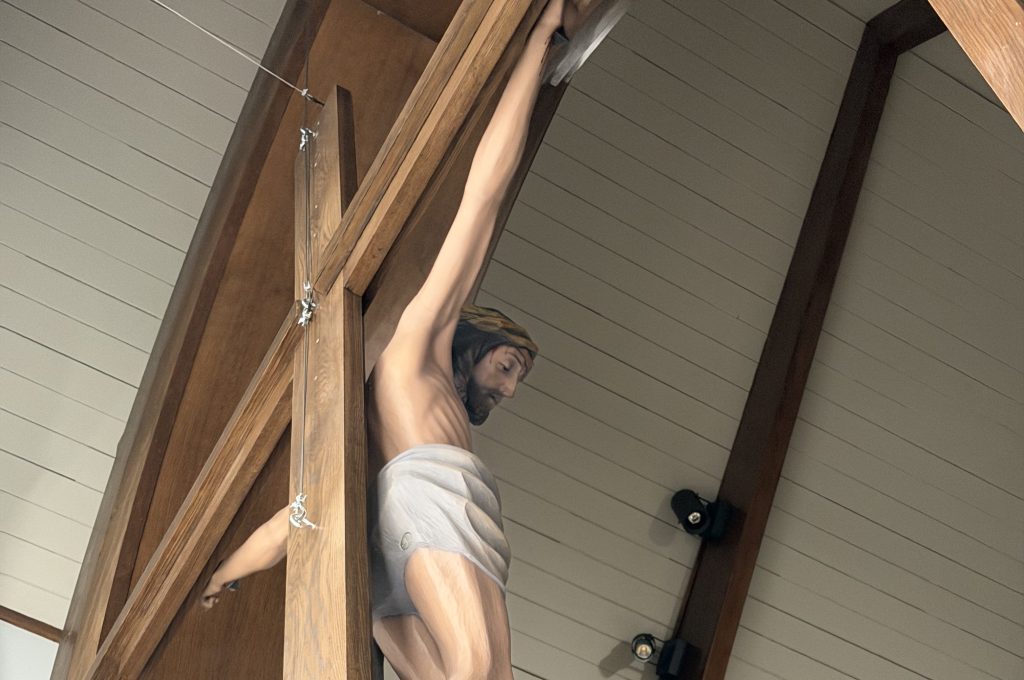
Photo: Who better than Mary follows the will of Jesus and the will of our Father? She who followed Jesus all the way to the cross and beyond.

Barron, Robert. Catholicism: A Journey to the Heart of Faith. NY: Image, 2011.

Healy, Mary. The Gospel of Mark. Grand Rapids, MI: Baker Academic, 2008.

Link for the Mass readings for Tuesday, January 28, 2025

“I yearn to see you again… that I may be filled with joy.”

“I yearn to see you again, recalling your tears, so that I may be filled with joy, as I recall your sincere faith that first lived in your grandmother Lois and in your mother Eunice and I am confident lives also in you” (2 Timothy 1:3-5).

What is wonderful about the words that St. Paul wrote to Timothy was not only the affection he had for Timothy, his recalling of Timothy’s tears, which was most likely from their last parting, but also that he knew Timothy’s mother and grandmother. He also remembered their names and the depth of the faith of each. What will bring him great joy is seeing them again. Who would we write a letter like this to?

We are at our best when we resist slipping into a deist understanding or misunderstanding that God is just something or someone out there, the big guy in the sky. God is a person, three persons, a divine community of love. God thirsts and hungers to be in relationship with each one of us. He is so far beyond our imagination and conception while at the same time he is closer to us than we are to ourselves. The Father sent his Son to us so that we can share in the divine love of the community of the Trinity. We are invited to build a relationship with God and that is to be our top priority.

As God is not just an idea, Christianity is not just a philosophy or even a theology. Christianity is an invitation to be in a relationship with a person, the God made man, Jesus the Christ. This faith in and willingness to enter into a relationship with God was lived by Lois, passed on to Eunice, and they both modeled and shared their relationship with God to Timothy.

They knew and loved God and one another, they cared for and supported each other, and they welcomed Paul into their family such that he knew them well enough to refer to them by name. Do we know Jesus or as St. Mother Teresa would ask her sisters: “Do you really know the living Jesus, not through books, but by being with him in your hearts?” (Sattler, 20). As we get to know Jesus and experience his love, allow his heart to touch our hearts, we begin to trust him. As we trust him, we spend more time with him and grow in intimacy. As we know Jesus, we come to know his Father and the Holy Spirit, and will begin to know each other better as well.

Dr. Leo Buscaglia, a professor at USC shared a story about how he noticed that one of his students had missed class for a few days. When she did not return the following week, he asked her classmates about her whereabouts, and no one knew where she was. He then reached out to the dean of students, and she broke the tragic news to Dr. Buscaglia that she had taken her life.

He was horrified not only by her death but even more by the fact that no one in the class knew anything about her. He then began to teach a course simply titled, “Love Class 101” in which his students came together to learn about building relationships with one another. He was doing what Lois, Eunice, Timothy, and Paul were doing, what faith communities and families are called to do, what we as human beings are called to do: to be loved by God and to love one another.

We can help to shift the tide of growing anxiety, confusion, isolation, loneliness, and division when we make a commitment to spending quiet time with Jesus. As we receive his love, we have something to share. We will care, be more present, communicate and listen, be more understanding and patient, support, and empower one another. In other words, when we are willing to be still long enough to experience God’s love, we will love God in return with our whole heart, mind, soul, and strength, and then we will be better at loving our neighbor as ourselves.


Photo: Blast from past, my teaching days at Cardinal Newman HS. Many fond memories of my teaching years come to mind that still bring me joy.

Sattler, Fr. Wayne. Remain in Me and I in You: Relating to God as a Person, not an Idea. Manchester, NH: Sophia Institute, 2025.

Link for the Mass days for Monday, January 26, 2025

Let us repent, rise from the darkness and walk into the light of Jesus.

“The people who sit in darkness have see a great light” (Matthew 4:16).

Matthew is quoting the prophet Isaiah and the darkness he is referring to was the fall of Zebulun and Naphtali, the first two of the ten tribes of Israel that were conquered by the Assyrians in around 722 BC. The other eight tribes of Israel would also fall. The two tribes of Judah remained for a time, but then in 587 BC, Jerusalem, the capital city, along with the Temple, were also destroyed. The last two of the original twelve tribes of Israel were also conquered. The promise of an everlasting kingdom from David’s line appeared to be lost.

Not so. A great light would come, the Messiah, one greater than Moses would be sent by God to unite again the twelve tribes of Israel. The Kingdom of David would be re-established, this time – forever. A glimmer of hope arose in 538 BC when Cyrus the Great conquered Babylon and freed Judah and sent them back to rebuild Jerusalem and the Temple. Cyrus was a liberator, but not the promised Messiah.

What Matthew did not share in this part of his Gospel was the next promise that Isaiah made: “For a child is born to us, a son is given to us; upon his shoulder dominion rests. They name him Wonder-Counselor, God-Hero, Father-Forever, Prince of Peace” (Isaiah 9:5).

As Christians we believe this child promised to become the Prince of Peace, is Jesus the Christ, the Son of the living God. In the gospel today, Matthew records the beginning of his public ministry which began with the arrest of John the Baptist. Jesus has come from the northern region, Galilee to be baptized by John. Now with his arrest, the political climate in Jerusalem seems a bit too hot. Jesus “withdrew to Galilee… in the region of Zebulun and Naphtali” (Mt. 4:12-15).

Wait a minute – Zebulun and Naphtali? Yep. Jesus is going back to the beginning where the fall of the ten tribes of Israel first began. Makes sense since he came to restore and re-establish and re-unify the twelve tribes of Israel. He did not only come to restore but to establish the new Israel. That is what we see in the next verses in which Jesus calls Simon, Andrew, James and John, the first of the, wait for it – twelve apostles.

Just as the twelve tribes of Israel began with the twelve sons of Jacob/Israel, the new Jerusalem will begin with the twelve apostles. By our baptism, we are heirs and members of the new Israel, the Body of Christ. Yet, we don’t have to look far to see the seeds of disunity and division still festers like a plague. Just as David unified the twelve tribes, for them only to be divided after one generation, we too suffer division and polarization in our nation, church, families, and friends.

Paul experience this in one the church’s he founded in Corinth. In our second reading, he appeals to them: “I urge you, brothers and sisters, in the name of our Lord Jesus Christ, that all of you agree in what you say, and that there be no divisions among you, but that you be united in the same mind and in the same purpose” (I Corinthians 1:10). We are to be united in the love of Christ. Jesus is the light that shines in our darkness of division.

We can easily fall into despair with the disunity and polarization, we can feel like people sitting in darkness and overshadowed by death on every side. Yet, we are not overcome. Jesus is the fulfillment of Isaiah’s prophecy. And his antidote to the darkness? “Repent, for the kingdom of heaven is at hand” (Mt 4:17).

Jesus’ message is as simple as it is clear. Jesus is the kingdom of heaven that is at hand and he is continuing to establish the new Israel that will be fulfilled in the heavenly kingdom. He is present among us revealing with his gentle light another way, one of harmony and peace. When we allow ourselves to breathe, receive, rest, and abide in the love of Jesus, when we become less so Jesus can become more, we experience his love, consolation, and joy. If we are not, there may be something we need to repent from, reject, something to heal from, and/or something to let go of.

The light of Jesus will guide us through our darkness and when we follow, will lead to our healing, forgiveness, and freedom. We can retreat further into the shadows and feed anxiety, doubt, or fear. We can also choose to repent, leave the darkness, and come into the light. Each thought, word, and action contributes to fostering the present darkness or to the light that will overcome it. Hopefully, with each choice, we trust more in Jesus.

——————————————-

Photo: When we are willing to see, Jesus shines in our darkness.

Link for the Mass readings for Sunday, January 25, 2026


Jesus challenges us to follow him, will we follow?

Jesus has been on a whirlwind tour since beginning his public ministry. Daily he has been healing the sick, casting out demons, teaching with authority, and the number of people continue to gather and press in around him. The authorities have also taken notice are most of the scribes and Pharisees are not pleased with this new upstart rabbi, claiming to preach not from the authority of any rabbi he may have studied with, but on his own. Not only that he is making covert claims and practices that place him on equal ground with God. Not only has the leadership of Jerusalem taken notice, his family from Nazareth have as well.

Jesus has also just called the twelve, representatives of the new Israel. He has returned to the house of Peter and Andrew for a respite. As has been happening, people flock to the home because of their unique needs. The numbers press in with such demand that they made it impossible for Jesus and his disciples “even to eat” (Mark 3:20).

When his relatives heard of this they set out to seize him, for they said, “He is out of his mind” (Mark 3:21). What exactly causes his family to think that he is out of his mind? Is it that Jesus has called Apostles, is it that people are following him in such great numbers to come to be healed, is it that they hear of the growing threat from leadership? Now seeing for themselves the numbers gathering, they don’t get it.

There are many speculations about the “hidden years” of Jesus referring to the fact that there is no mention of Jesus in the gospels from the moment he is twelve years old when Joseph and Mary lose him, until he is about thirty and beginning his public ministry. There are wild speculations about what happened in those unrecorded years, but accounts such as this one support the idea that nothing special happened during that time. Jesus led an ordinary and very simple life and that is why nothing is written.

This could be the reason why his relatives are thinking that he is “out of his mind.” How can this simple carpenter all of a sudden be getting all of this attention? Who does he think he is? Does he think he is better than us?

It also reveals, as we have been seeing with the scribes and Pharisees, and possibly now with Jesus’ relatives, that when we get stuck in our routines, grind ourselves into a rut, and find our definition and security there, we feel safe only in our comfort zones, and that stunts our growth and maturation.

Jesus is a challenge. One of the biggest challenges that he offers is to step out of our comfort zones. We can dig in our heals or trust him and take a risk. Many of Jesus’ relatives as well as the scribes and Pharisees, unfortunately dug in their heels. They were not only unwilling to see who Jesus was, they were not willing to answer his call to follow him as the apostles did.

Jesus, as he shared when he offered the image of the new wine skins, challenges us as well, to be open to the leading of the Holy Spirit. He challenges us not to settle, and he offers to reveal to us the reality that many of us are existing in a chronic state of fight or flight and in perpetual reactive mode. We have not been created to merely survive. God created us to thrive and embrace the gift of our human existence with consolation and joy.

Jesus is inviting us in this moment to breathe, slow and deep. He is inviting us to stretch a bit and to take a risk, to take a step or two out of our comfort zones. Where might that lead? Will we follow Jesus’ call to come and follow him or dig in our heals as well? When we follow Jesus, it will get bumpy, we will be challenged, but following Jesus will lead to our freedom.


Photo: Sitting at the feet of the master USML, Mundeleine, IL.

Link for the Mass readings for Saturday, January 24, 2025

Jesus summons, are we willing to follow?

Jesus went up the mountain and summoned those whom he wanted and they came to him (Mk 3:13).

Through the centuries mountains have been sites where people have gone to rise above their daily experiences, to rise above the clouds, where the air is crisper, cleaner. It is a means of gaining a new perspective, insight, transcending the human to touch the spiritual, and with the hope hearing the voice of God. When one of the Gospel writers inserts the detail that Jesus is present on a mountain, we can be prepared that something significant is going to happen.

In today’s Gospel of Mark, the good news revealed to us is that Jesus calls to himself the Twelve, the Apostles, to preach and cast out demons. They are to continue the ministry of Jesus. These are not perfect men, but each will have a part to play in salvation history. Jesus will entrust them with the deposit of faith that they are to protect, yes, but more so to proclaim by word and deed. Apostle means one who is sent.

Jesus will continue to call the Twelve to himself, to teach, mentor, model, and empower them so that they will continue his mission to call people to repent and believe in the Gospel. Even though, especially through the Gospel of Mark, it often looks as if Jesus may have made a mistake in his choice. The Twelve do not ever grasp who Jesus really is, and when Jesus needs them most, Judas will turn him over to the Temple guards, the others flee at his arrest, and Peter will publicly deny him three times. It will not be until after the Resurrection and Ascension that the seeds that Jesus had sown in them would begin to germinate, sprout, and bear fruit.

Just as Jesus called the Twelve. Bishops are the successors to the apostles and continue the apostolic succession we can see beginning is such lines of succession as with Jesus, John, Polycarp, and Irenaeus. The ordering of the names of Apostles that Mark shows this early hierarchy. Peter is first, James and John to follow. These three become the inner circle and participate in each of the significant events of Jesus’ public ministry. Andrew with his brother Peter were the first to be called. The other we can see in the reading round out the number of twelve. Jesus is showing that he is preparing the leadership for a new Israel.

We are called in our own unique way as well to be his disciples in union with the Bishop of Rome and our local ordinary. Each generation must experience and embrace the deposit of faith that has been given to us and pass it on to the next. Are we perfect, no. Do we have doubts, fears, weaknesses, yes. Does God call us and love us anyway? Yes. Like each Apostle, we are to go out and proclaim the good news that Jesus is our Lord! We do this daily with our words, faces, and actions. We are to think, look, speak, and act in ways that are kind, empowering, uplifting, and convicting while at the same time resisting the temptation to fix others. We are to strive to bear witness, be present, accompany and guide one another.

We all have much on our plate, some of us to overflowing. We may be thinking I cannot possibly do one more thing. Start small by bringing God into whatever we are already doing. He will give us the tools and accompany us as we seek to fulfill his will. As did the Apostles, we will make mistakes, make false starts, trip, fall, sin, and deny opportunities to reach out to be a witness. When we commit any or all of the above, resist beating ourselves up, learn from the experience, lean into Jesus, and prepare better for the next apostolic opportunity.

Jesus went up the mountain to pray. We are to make time each day to do the same. Let us begin our day today with a few moments of intentional stillness, to breathe, and ask Jesus what does he want us to do today. Are we worthy of his call? No, for all of us fall short of the glory of God. More important, are we willing? That is a question for each of us to answer today and take one step with Jesus on the way.


Photo: Jesus summoned me when I was about 17, I have been following him along the way step by wobbly step ever since. Each step with him gets better and better!

Link for the Mass readings for Friday, January 23, 2025

Let us seek Jesus not for what he can do for us, but to grow in relationship with him.

After the most recent clash with those Pharisees bent now on killing Jesus, he “withdrew toward the sea”, the Sea of Galilee. After his entanglements with the Pharisees, he may have sought refuge or a quieter setting away from the crowds. As with other times, going off to a private place to pray. He also acknowledged the seriousness of the leader’s threat and was aware of their plot to kill him. Since his hour was not yet, he was being more careful to stay out of the limelight.

Yet, the people followed. Mark details in his account that many from all over the region came to Jesus to be healed. Among the crowd, unclean spirits threw those they possessed down before Jesus. This did not slow the gathering of people who pressed in on Jesus, just to touch him. The mass of people grew to a point that it was getting out of control so Jesus, “told his disciples to have a boat ready for him because of the crowd, so that they would not crush him” (Mk 3:9).

People wanted to be healed, to be cured, to be exorcised, and brought others to experience the same. Yet they were missing the deeper point of who Jesus is. He was not just a miracle worker, not just someone that brought about physical healing. Healing accounts were heard and known about in the ancient world.  The unclean spirits got it, they recognized Jesus before the people did, “for, whenever unclean spirits saw him they would fall down before him and shout, ‘You are the Son of God'” (Mk 3:11).

They were bound by the authority of Jesus to be renounced. They had to obey him and in calling out who he was they were attempting to control him with no effect. Throughout the Gospel of Mark, we will read about how the crowds, disciples, and even the apostles, all struggle to understand who Jesus is. The people closed in on Jesus seeking to be healed, but missed the deeper hunger within their souls that St Augustine, the fourth-century bishop of Hippo, so eloquently described on the first page of his autobiography: “[Y]ou have made us for yourself, and our hearts are restless until they can find peace in you” (Augustine 1963, 17). Jesus is the Son of God, not just a miracle worker, teacher, or healer, but God Incarnate.

The only way we will be fully satisfied, inspired, fully alive, and be at peace within our own skin, is by developing an ongoing, deepening relationship, and communion with our Father. God is infinite and cannot be exhausted. We as finite beings are left wanting even when we have the best of family, friends, and material things. We always hunger and want for more, because in the depths of our very being, whether we recognize it or not, we want God. The many who came to Jesus for healing, were not aware of the deeper hunger and healing they sought.

The deeper healing that Jesus offers is to restore us to the fullness of who his Father created us to be. To do that, we must be willing to embrace the truth, the way, and the life that he offers us. Which means that we will need to let go of anything that does not align with his will for our lives. At the first, we may be taken aback, even with an attachment to Jesus. We are not to seek what Jesus can give or do for us, that is what the crowds were doing. We are to seek relationship with him. We need not be afraid. Jesus works slowly. His light shines gently.

Jesus satisfies our deepest hunger as he invites us to be drawn into his grace-filled embrace so as to be forgiven, healed, renewed, shaped, and conformed to his heart, mind, and will. When we come to this place of encounter, reconciliation, and intimate relationship, we will know our mission and in serving through that mission we come to know who and whose we truly are. In that place, is our greatest joy and it only gets better the more we receive and share his love!

————————————————————————

Photo: “God speaks in the silence of the heart.” – St. Mother Teresa

St Augustine. The Confessions of St Augustine. Translated by Rex Warner. New York: New American Library, 1963.

Link for the Mass readings for Thursday, January 22, 2025

It is lawful to do good rather than evil, to save life rather than destroy it.

In today’s Gospel scene, Jesus enters the synagogue and sees a man with a withered hand. The eyes of the Pharisees are on him to see if, yet again, Jesus will heal on the Sabbath. Jesus is clear in his mind what he is going to do. Before doing so, he calls the man up and asks the Pharisees, “Is it lawful to do good on the sabbath rather than to do evil, to save life rather than to destroy it” (Mk 3:4)?

Jesus here is giving them a no-brainer of a question. Of course, one is to do good rather than evil on the Sabbath, to save life rather than destroy it! Yet, the Pharisees remain silent!!! Jesus expresses anger and grief. Jesus is meeting the Pharisees on the ground of Scripture that they are using against him and giving them an opportunity to soften their hearts. 1 Maccabees 2:41 records the account of the Maccabeans deciding to take up arms on the Sabbath to defend themselves against attack. With this in mind, Jesus may be appealing to those Pharisees that were challenging him to choose to see the healing of this man as a greater good. Unfortunately, “their hardness of heart” shows they were not appreciative of the scriptural assistance.

At the peak of this fifth conflict in Mark, before we continue, may we stop and imagine ourselves present in the synagogue. Witness Jesus looking at the Pharisees and the Pharisees looking back at him. Have you ever been present when tensions were very high and there was dead silence? Imagine what was going through the mind of the guy standing in between them with the withered hand?!!!

The anger rising in Jesus may have had to do with the unwillingness of the Pharisees to show any compassion at all for this man. That they would hold so tightly to their self-righteous stance and refuse to even have a discussion about the matter. Not even to say in effect, “Yes, Jesus of course, it is lawful to do good, to save a life but what you are doing is unorthodox.” No. They refuse to dialogue. Their faces are set like flint, they dig in their heels. Even though Jesus is inviting them to take just a step to consider another alternative, they instead harden their hearts. In their silence, they are choosing evil over good, choosing to destroy life rather than save it. Pride has reared its grotesque head.

Jesus breaks the silence as he says to the man, “Stretch out your hand.”

The man is healed, but instead of rejoicing, and sharing the good news as Andrew did with his brother Simon, the Pharisees leave immediately to find the Herodians and begin to plot to not only undo Jesus but “to put him to death.” Think about the massive irony! They who would refuse to see a man healed on the Sabbath, did not hesitate to plan someone’s death on the Sabbath.

We have witnessed in today’s Gospel the poison of pride. We have witnessed the mercy of God presented and rejected. As is stated in the Catechism of the Catholic Church: “There are no limits to the mercy of God, but anyone who deliberately refuses to accept his mercy by repenting, rejects the forgiveness of his sins and the salvation offered by the Holy Spirit” (1864). That is what Jesus is angry about. Not only do the Pharisees resist any move in the slightest direction toward compassion, or their own repentance, they further separate themselves from the love of God. They start with a principle of defending the law, and walk out seething with a premeditated intent to kill Jesus, and on the Sabbath!

With each choice of putting self over another, pride grows. Its appetite is insatiable. Pride is known as the mother of all sins because of its disordered focus on self at the expense of all others and all else. The deadliest component of which is in direct opposition to God and separation from the very life force of our existence. Choosing to be prideful, we foster attitudes of vanity, arrogance, and a disordered self-reliance. We can think the center of universe revolves around us, and that is not only untrue, it is unhealthy.

If there are places where we see any tendrils of pride, amen! Slash them, repent, and ask Jesus to give us the antidotes to pride, humility and obedience to God. Choosing these virtues frees us from the isolating grip of pride so we may experience the healing communion of Jesus. May we reject evil and choose the good, reject pride and choose love, reject death and choose life, resist the temptation to withdraw or scowl and instead offer a smile, a hand of welcome, and/or a listening ear.

———————————————————————-

Photo: Jesus, thank you for your light and love that reveals our sin, so we can repent, confess, heal, and be forgiven and free and who you created us to be.

Catholic Church. “Article 8: Sin,” in the Catechism of the Catholic Church, 2nd ed. Vatican: Libreria Editrice Vaticana, 2012.

Link for the Mass readings for Wednesday, January 21, 2025

Let us be instruments of light and love to dispel hate.

“The sabbath was made for man, not man for the sabbath. That is why the Son of Man is lord even of the sabbath” (Mk 2:27-28).

In making the above statement, Jesus was not discrediting or devaluing the observance of the Sabbath. He was weighing in on one of the common debates that Jewish people engaged in about what was considered work, and thus what could and could not be done on the Sabbath. Jesus went deeper to address the origin of the Sabbath observance in that it, “commemorates God’s creative and saving action for humanity, and alleviating hunger might be an example” (Donahue and Harrington, 112).

Although, the Pharisees who confront Jesus are most likely looking at a strict interpretation of Exodus 34:21 in which even during the time of harvest, one “must rest” on the Sabbath. The rubbing off of the husks in their hands to access the kernels of wheat within constituted such work. Jesus offers David and his followers doing the same thing in their time of hunger when they were fleeing from the soldiers of King Saul. In claiming this account, Jesus is aligning himself and his disciples with King David and his men. The Pharisees in this comparison would then be aligned with the followers of King Saul.

“The whole purpose of the sabbath was to raise human beings above the routine of earthly labors each week, to fulfill their unique privilege of living in covenant relationship with God” (Healy, 65). God created us, formed us, and breathed life into us. God seeks intimacy and closeness between himself and us his created beings, his children. God is our source and we are interconnected in our relationship with him and with one another. God continues to deal with us in a personal way. The Torah, the Law or the Teachings, is meant to enhance the intimacy and closeness of that relationship with God and one another, to provide boundaries and definition so that we can resist going astray.

Jesus came not to abolish but to fulfill the Law, to restore it from distortion, while at the same time bring it to a higher level. When asked what commandment is the greatest, Jesus announced that we are to Love God with all our heart, soul, mind, and strength and we are to love our neighbor as ourselves (cf. Mk:12:30-31). To live out this commandment then, we need to foster our relationship with God if we are to experience his love, mercy, and forgiveness, to fill up to overflowing, so to share with others what we have received, otherwise, we have nothing to give.

With or without a relationship with God we can experience emptiness, anxiety, fear, and loneliness. Without a relationship with God, and the community of the Church, we are more vulnerable to the temptations to satiate our hunger with the material, finite, and false goods, that are readily available, hungering more, and falling deeper into the lures of power, pride, prestige, ego, and addiction. We then seek to protect that false sense of self at all costs, and react defensively, as we feed our fear and pride. We buffer ourselves off from the very one we have been created for. In following this path, we isolate ourselves from God and one another and this provides fertile ground in which fear, prejudice, sexism, and racism can grow along with the manifestation of the dehumanization and objectifying of human beings.

As a part of the Body of Christ, we are constantly reminded that we are not alone and that all of us and creation are interconnected. As Pope Francis shared in his homily in 2018: “Having doubts and fears is not a sin. The sin is to allow these fears to determine our responses, to limit our choices, to compromise respect and generosity, to feed hostility and rejection. The sin is to refuse to encounter the other, the different, the neighbor when this is, in fact, a privileged opportunity to encounter the Lord.”

The Pharisees felt threatened by Jesus and rejected him. They refused to see who he was. We know there were other Pharisees that came to trust in and follow Jesus, Nicodemus and most famously, Saul, who became Paul. They were able to resist curving in upon themselves, were willing to encounter Jesus, expand, and come to believe that Jesus is the Son of Man, the Son of God. We are offered a choice to see Jesus either as a legend, liar, lunatic, and/or blasphemer, or as our Lord.

We are at our best when we align ourselves with the Lord of the Sabbath, who walked with his disciples among a field of wheat one day, and who is now our Bread of Life this day. Empowered by the Eucharist we are filled with the healing power and love of Jesus and we will then better be able to let no evil talk to pass our lips and to say only the good things that people need to hear (cf. Ephesians 4:29). Receiving God’s love, we are transformed to love others, even those who profess hate. Dr. Martin Luther King, Jr., who we remembered yesterday, invites us to be instruments of the light to dispel the darkness and conduits of love to transform hate. Let us do just that with each thought, word, and deed.

———————————————————

Photo: Receiving the warmth of the sun during my morning walk to celebrate Mass, to receive and share the light and love of Christ.

Donahue, S.J., John R., and Daniel J. Harrington, S.J. The Gospel of Mark in Sacra in Sacra Pagina Series, vol. 2. Collegeville, MN: Liturgical Press, 2002.

Healy, Mary. The Gospel of Mark. Grand Rapids, MI: Baker Academic, 2008.

Pope Francis full text of homily at Mass on World Day of Migrants and Refugees, Sunday, January 14, 2018: http://saltandlighttv.org/blogfeed/getpost.php?id=79091

Link for the Mass readings for Tuesday, January 20, 2025

Let us take care of the body and soul well in the new year.

“Can the wedding guests fast while the bridegroom is with them? As long as they have the bridegroom with them they cannot fast. But the days will come when the bridegroom is taken away from them, and then they will fast on that day” (Mk 2:19-20).

The conflict, the third one in this gospel, that Jesus is responding to was that he is witnessed eating and drinking, practicing table fellowship with his disciples, as well as tax collectors and sinners. There is no evidence that he and his disciples practice fasting. Jesus’ response utilizes the image of a wedding banquet, which for the people of his time would often last at least a week.

Devout Jews, following the pharisaic tradition, would often fast one to two days per week, many Jews, once a year during Yom Kippur, but during a wedding feast, there was an exemption from fasting. Now that Jesus has begun his public ministry, it is a time of celebration, because Jesus has been proclaiming the good news that the kingdom of God is at hand, the bridegroom has come to renew his covenant with his unfaithful bride. “People are summoned to hear the good news of the victory of God over evil, illness, and sin. Even those thought to be habitually outside the pale of God’s forgiveness are welcomed to the banquet” (Donahue 2002, 108). This is indeed a time to rejoice for heaven and earth have been wedded in Jesus, fully human and fully divine. Even more, his promise is that humanity can participate in this divine union!

People are being healed of chronic conditions, having demons exorcised from them, are able to see, to hear, and be restored to the community that they had been separated from. These are causes of celebration, why wouldn’t those receiving the gift of new life not celebrate? We have and will continue to see Jesus preaching, healing, and inviting those in his midst to participate in God’s kingdom played out in our daily readings. That is one of the gifts of reading the Gospels daily.

Jesus also references his death, when he will be taken away, and then on that day people will fast. We, like the community of Mark, live in between the time after Jesus walked the earth and proclaimed his message of the good news, after his Crucifixion, Resurrection, and Ascension, until the time when he will return. We are living in a time of both/and. If we look at the course of a week as a model, we may contemplate the opportunity to fast on Fridays in remembrance of the day he gave his life for us, and to feast on Sundays, the Lord’s Day, when we celebrate his Resurrection.

The course of our lives follow an ebb and flow of sorrow and joy, sickness and healing, conflict and resolution, sin and reconciliation. In the midst of our everyday experiences, Jesus, the one who is fully human and fully divine, invites us to yoke our lives to his. Let us resist the temptations of overindulgence and gluttony while at the same time resist the polar opposite of a hyper asceticism. We are a unity of soul and body, so we need to attend to and take care of both our spiritual and physical needs.

Make a list of three things this week to take care of yourself spiritually and physically. This can be to go to Mass or gather in the community of your faith practice, spend five to ten minutes a day in quiet prayer, read from the Gospel of Mark, or a spiritual book, meditate in silence, and/or listen to some music. Three things to take care of the physical, such as plan your meals so they are a little healthier, fast with smaller meals on Fridays as well as even an occasional Tuesday or Wednesday, invite family and friends to gather this Sunday for a meal and fellowship together, get enough sleep, hydrate, add some exercises that include a combination of stretching, cardio, and weight-bearing, take a walk outside, and/or breath in some fresh clean air.

Life goes too fast, let us not take the gift of our life for granted, and commit this week to take better care of ourselves and each other, spiritually and physically, to celebrate the victory we have received in Christ, the wedding of heaven and earth, the human and divine.


Photo: Reciting and meditating with the Rosary while walking is a good way to take care of both our bodies and souls in one activity.

Link for the Mass readings for Monday, January 19, 2025

” A sacrifice of love for the salvation of the world.”

On a significant day in the history of the world, those who gathered around John the Baptist to be baptized in the Jordan heard John speak, “Behold, the Lamb of God, who takes away the sin of the world” (Jn 1:29). The phrase would have brought back the imagery of the blood of the lamb that was placed on the doorposts to save their ancestors from death and also remember the beginning of the Exodus and freedom from slavery. We who attend Mass hear the priest invoke this same phrase as he holds up the consecrated host. Jesus, of whom John said, “Now I have seen and testified that he is the Son of God” (Jn 1:24), was present to testify that the Son of God was in their midst and at Mass the priest does the same, now to free each of us from our slavery to sin.

Jesus is truly present to us in the Eucharist. This is no mere remembrance nor just a symbol. Jesus came to us, to become one with us in our humanity. He continues to do so in the Eucharist so that we can be nourished by his very Body and Blood and so become one with him in his divinity. This gives new meaning to the words we are what we eat!  In receiving Jesus in this way, we are transformed and conformed to him so that when we return to our everyday experiences we can see Jesus present in each other. This intimate encounter with Jesus is a gift that we are invited to receive and partake of often, even daily if at all possible.

Many times we struggle in our lives because we may not feel heard or misunderstood, we may not feel accepted for who we are, and/or we feel alone, we may not experience being seen or we make allowances, self ourselves short to attempt to fit in. Jesus comes to us in our places of doubt and confusion, disfunction and disorder, to remind us who we are: beloved daughters and sons of his Father. Through his physical manifestation and presence in the Eucharist, we are reminded that God loved us so much that he sent his Son, not just at one historical point in history, but again and again at each Mass.

Jesus understands our trials and tribulations because he experienced them first hand. He was rejected by the people of his own hometown, many walked away from him when he was offering the bread of life discourse, and even his closest friends betrayed him in his most dire hour. Yet, he experienced joy even in these moments because he followed his Father’s will. He teaches us how to experience that same trust and love in the Father as he experienced then and continues to experience.

As we gather around the table of fellowship to experience the sacrifice of Jesus that is re-presented in his real presence, we experience again that Jesus has died for us and rose again conquering death, that we might have life; not just mere existence but instead a life of consolation and fulfillment. He died for us so he could be present to us in the very simple elements of bread and wine anywhere and everywhere in the world, to remind us that we are never alone and that our lives, as well as those we care for, can be better.

When we come to Mass we do not come for ourselves alone. We come to participate in the heavenly banquet feast that happens on earth as it is in heaven. We come to pray for the salvation of the world. We come to be transformed by the Son of God and as we consume him in such an intimate way, we become more and more conformed to his Body. “The Lord receives, sanctifies, and blesses the bread and wine that we place on the Altar, together with the offering of our lives, and transforms them into the Body and Blood of Christ, a sacrifice of love for the salvation of the world” (Pope Leo XIV, Angelus June 22, 2025).

Come to the feast and invite others to join you so that together we may, “Behold, the Lamb of God, who takes away the sin of the world” (Jn 1:29). Together, we may be saved, healed, and know that we are not alone but loved more than we can ever imagine and given the mission to go forth to heal and love others as we have been.


Photo: Pope Leo XIV celebrating Mass at the Shrine of Santa Maria della Rotonda in Albano Laziale, Italy, Aug. 17, 2025 (CNS photo/Lola Gomez).

Link for the Mass readings for Sunday, January 18, 2025